I very much enjoyed the latest episode of the Pex Lives Podcast, which looks at 'Paradise Towers'. During it, Kevin and James' guest Jane (of achairforjane and many fascinating comments - and an amazing guest post on Lost - at Phil Sandifer's blog) suggests a Marxist reading of the story in which the Rezzies are the consumerist bourgeois who ascend a few levels via the system which later consumes them. Totally valid and satisfying reading. (And I'm grateful for the lovely shout-out, as always.)
I think, however, that it illuminates a certain interesting ambiguity about what constitutes a 'Marxist reading' or a 'Marxist analysis'. I know Jane and the Pex Lives boys already know this, so this isn't in any way meant as a criticism of any of them, but I think a 'Marxist analysis' would really have to constitute more than finding some way in which aspects of the narrative function as an allegory of some aspect of the class struggle. I hold my hands up: that's often what I do here, and it doesn't really cut the mustard.
To do that is to bring Marxist categories to a text, but still to treat a text as something that exists somehow outside its own origins and function within the forces of production. A more proper sense of the term 'Marxist analysis' would be to critically evaluate the story in the light of the circumstances of its production - in individual terms, in terms of material/technical circumstances, in terms of the overall system of capitalist cultural production, and then also in terms of broader Marxist categories like 'the culture industries' or 'ideology' or 'hegemony' (with different Marxists probably stressing this or that aspect over another). I personally would want to argue that a proper Marxist analysis of a text, or any artifact of cultural production, would also focus at least as much upon the social circumstances of its consumption, circulation, distribution, exchange, commodification and financialisation. For my money, too many Marxist critics (of lots of things including - but also beyond - texts) have overstressed the node of production, which is only one node in the circuit of capital.
I'm often said (by people who kindly link to me on social media, for instance) to have written a 'Marxist reading' or 'Marxist analysis' of this or that. This makes me more than a little uneasy, to be honest, because I'm not usually anything like as rigorous and scholarly as I would need to be to meet even my own standards for such a thing. Generally I just react to texts in a very individual way, with my Marxist views inevitably forming the backbone of my response.
I worry that people with, perhaps, no other exposure to Marxism than me, might take me as a meaningful representative. Ye gods, I hope not. I am an amateur and, despite having gone to University, I consider myself effectively an autodidact. One of my purposes here (beyond simply amusing myself and indulging my vanity) has been, via the conduit of a popular TV show, to maybe bring a bit of Marxism (or just critical leftiness generally) into the thinking and reading of people who might otherwise not encounter it in our barren age. I worry that someone out there might read me and then think they know what 'Marxist criticism' is. I may be vain, but I know my limitations, and I hate the idea of doing my own beliefs a disservice, even in a very small way.
I've reacted to 'Paradise Towers' in a way that is actually a bit more properly Marxist than I usually manage. In this post, I at least gesture towards a proper Marxist contextualising of the story (i.e. I mention the dawning neoliberalism of 1987 as a context for the production of the story, for the way it references modernism, which I also historicise very briefly.) Even so, I'd hesitate to claim the status of a 'Marxist analysis' for that post.
And I wouldn't want to claim that I always even do as well as I do in that piece. My 'essay' about Dawn of the Planet of the Apes, for instance, has been called a 'Marxist reading' or 'Marxist analysis'. I'm really not sure it qualifies. It gestures in that direction towards the end, but I think of it as a personal reaction which has a background in my Marxist convictions - something quite distinct.
Going back to 'Paradise Towers', and addressing some of the things said in the podcast... Jane doesn't actually say that the Rezzies represent capitalists or capitalism, but she nevertheless uses the word 'bourgeois' to describe them. Now, that's right - I agree. They clearly (through their aesthetic representation - something Jane is very hot on) signify a certain stereotypical middle-class, middle-brow social position which is deeply associated - and not inaccurately - with a strata of people in bourgeois society who combine the passive, the complacent, the ressentimental, the reactionary and the aspiring. But we should remember to separate the 'bourgeois' from the 'bourgeoisie'. The Rezzies are not capitalists. (To be clear: Jane doesn't say they are.)
Similarly, neither are the Caretakers. Here I have a more serious quibble with Jane, because she says they are the proletarians in Paradise Towers. I don't think that's right... or rather, I think it needs nuancing. Jane mentions elsewhere in the podcast that the Caretakers are costumed in military style... but they are explicitly not the military, because the military took all the rest of the males away to war. The Caretakers are the police. And the police are not proletarians. In capitalism, the police are ultimately aligned with the class interests of the capitalist class. They are, essentially, defenders of private property (and of the peace of the system which normalises and legitimises private property) against people who don't own anything. (This is one big reason why the end of 'Paradise Towers' clangs for me, at least politically. If you wait for the police to align themselves with anybody other than their masters, you will wait forever.)
Jane goes on to say interesting things about how, if viewed as proletarians who have achieved positions of authority, the Caretakers can be seen as an illustration of how power corrupts any class. And that's true too (as long as we expand a bit on what we mean by 'power'). Jane takes this observation on to see a polemic against Stalinism lurking within the story, with the Caretakers as being a kind of nomenklatura, and the Chief Caretaker as a General Secretary. I think it'd be dangerous to generalise that into any kind of ahistorically-detached model, but it isn't inaccurate as a description of what happened in the Soviet Union. A segment of the working class achieved political power and then, detached from the rest of the class (owing to historical circumstances that 'Paradise Towers' almost acknowledges via the business of the male population disappearing into a war), they become a bureaucratic tyranny. (Jane also stresses - in an almost neo-Trot way - that the Stalinists are merely posturing as being in charge while capitalism still runs the show in a hidden form below the surface. All lovely stuff, and music to the ears of someone like me who accepts the argument that Stalinism is the political expression of authoritarian, bureaucratic state capitalism.) But I don't think you need to go as far as post-Civil War Soviet Russia to see what the Caretakers represent. In capitalist society, the police are just what Jane describes: a layer of the working class that is detached from the class position (and therefore the class interests) of the rest of the workers. Even in openly capitalist society, the Caretakers are there.
Kroagnon, by the way, doesn't really convince me as a manifestation of capitalism... though, as a representation of the authoritarian inner-core of some variants of modernism, he obviously reflects capitalism because modernism is part of the cultural logic of early-C20th Euro-American capitalist culture.
For me, 'Paradise Towers' is not really a picture of a capitalist dystopia so much as a picture of a post-industrial one. The theory of the post-industrial is about to be massively in vogue in Britain as 'Paradise Towers' appears. It's an idea that is aloft on the postmodernist wind. It ties in with certain non-Marxist or pseudo-Marxist Left impulses to declare that capitalism is changing beyond the ken of classical Marxism. And it also ties in with impulses within the burgeoning neoliberal Right to claim that capitalism is changing beyond the ken of even old-style social democracy. The response of the anti-Thatcher Left is to point to post-industrialism as a kind of social dysfunction. An understandable (if ultimately unsatisfactory) position which, I think, we see mirrored in 'Paradise Towers'. None of this makes 'Paradise Towers' any less angry and wonderful (I adore it, by the way), but it marks the circumstances of its production as being within the cultural context of early-neoliberal Left thinking. It also allows us to loop back a tad and join this ramble up in a notional loop of logic... because it illustrates the distance between finding a Marx-friendly allegory within a narrative, and actually analysing said narrative using a material-dialectic method (not that I'm claiming to have done more than gesture vaguely towards that here.)
Oh, one more thing. During the podcast, Jane asks James if he thinks Mel has changed at all during the course of the story. James says she's learned a Moral of the Week. I agree, and I've been trying to think how to formulate the Moral of the Week that she learns. I've decided that it would be best expressed as: 'a monomaniacal obsession with swimming pools can be fatal under certain extremely specific circumstances'.

ideas are icepickproof
Showing posts with label 80s. Show all posts
Showing posts with label 80s. Show all posts
Saturday, 7 February 2015


Monday, 17 February 2014
Catching Them at Their Best
The Pex Lives boys have done a supplemental podcast about the Star Trek movies. Got me thinking about why I like Star Trek IV so much. I decided to try writing something about it, since anything that even vaguely twitches my interest is worth grabbing hold of at the moment, what with my blogging mojo being critically ill and lying, sobbing and wailing, in a deep dark pit.
I don't like the movie because it's 'tongue-in-cheek' or because I have any sort of ideological attachment to the idea that SF in general (or Trek in particular) should be 'self-aware' or anything like that. I like it because it is, essentially, a movie about a bunch of old relics from the 60s wandering around Regan's America and disapproving of it heartily.
This is not a deep movie. It isn't hard to parse. No great leaps of interpretation are needed. Just look at what happens.
In order to survive in 80s San Franciso, Kirk must sell his beloved spectacles, a gift from Bones. He, a man who - as we learn from this film - comes from a culture without money, must commodify something precious to him.
In order to achieve their aims, Bones and Scotty must - essentially - bribe a sexist business manager with promises of the untold wealth which will come from a new commodity. Commodification again.
In the course of acquiring some radiation (or something) Chekhov gets arrested by the US Navy, gets interrogated, called a "retard" and a "Russkie" by paranoid officers, and is chased to the point where he sustains a life-threatening injury.
In the course of rescuing him, Bones encounters an elderly woman, in need of dialysis, waiting unattended and forgotten on a gurney in a hospital corridor.
Kirk and Spock encounter a representative of a moribund counter-culture where the best the 'rebellious youth' can offer is loud anti-social music which screeches that "we're all bloody worthless". (This is, admittedly, rather unfair on Punk. The depiction is, at best, a clueless and curmudgeonly parody... but then, by this point in the 80s, the real remnants of Punk were, at best, commercialised and decontextualised parodies of the Punk movement.)
Kirk and Spock must team up with a right-on scientist who seems to be the only person who gives a shit about the whales. Just as the animals are likely to be slaughtered for commercial reasons once they are sent back into the wild, so the reasons for their being so sent are implicitly commercial: they're not enough of a draw to make them economically viable for the cash-strapped institute.
As if all this weren't enough, how does Kirk justify Spock's eccentric behaviour? He places him in the context of the 60s.
Diegetically, Kirk et al are from 'the future'... but, in this film, the future = America's past. Specifically, the crew are played as displaced representatives of the culture from which they extra-diegetically come: the 60s. They are remnants of utopian Kennedyish 60s liberalism. Now, however much wrong there may have been with utopian Kennedyish 60s liberalism (and there was a fuck-ton wrong with it), it was mostly preferable to Reaganism, and - more importantly - certainly entailed popular ideas that were far in advance not only of Reaganism but also of its own actual practice. Similarly, however much old Trek may have frequently failed to live up to the best principles and promises of utopian Kennedyish 60s liberalism (Josh Marsfelder is especially good on this), it also entailed popular ideas far in advance of its own actual practice. One way or another, the widespread popular idea of Trek that emerges from the mixed-truth of its original 60s run is a progressive and idealistic one.
So these ageing progressives from another time come to Reagan's America. They encounter resuscitated Cold War paranoia, decaying hospitals, underfunded science, omnipresent commodification, etc.
In this context, they stick out like sore thumbs. And, as mentioned, Kirk passes off the noticeably hippyish behaviour of Spock (he wears robes and swims with whales) as echoes of his past in the 60s counter-culture. He speaks of the "free speech movement" on US campuses, associating them with the Civil Rights movement - implying that he sees the entire rebellion as all of a piece and part of a struggle for democracy. Even the druggie counter-culture is referenced as being bound up with this "free speech movement".
The 60s meets 'Save the Whales' and builds a bridge between the past and the future (the film archly reverses them and pretends that the past is actually the future).
Don't get me wrong. I'm not about to plonk down my DVD copy of this and call it my manifesto. There are lots of problems with it... not least the grumpy emphasis on anti-social people in the streets, and the pessimism that means that Dr Gillian Taylor (the right-on cetacean biologist) has to escape back into the past/future because there's nothing left for her in the 80s. But it's a thing of melancholy beauty nonetheless.
"You're not exactly catching us at our best," says Kirk.
I beg to differ.
I don't like the movie because it's 'tongue-in-cheek' or because I have any sort of ideological attachment to the idea that SF in general (or Trek in particular) should be 'self-aware' or anything like that. I like it because it is, essentially, a movie about a bunch of old relics from the 60s wandering around Regan's America and disapproving of it heartily.
This is not a deep movie. It isn't hard to parse. No great leaps of interpretation are needed. Just look at what happens.
In order to survive in 80s San Franciso, Kirk must sell his beloved spectacles, a gift from Bones. He, a man who - as we learn from this film - comes from a culture without money, must commodify something precious to him.
In order to achieve their aims, Bones and Scotty must - essentially - bribe a sexist business manager with promises of the untold wealth which will come from a new commodity. Commodification again.
In the course of acquiring some radiation (or something) Chekhov gets arrested by the US Navy, gets interrogated, called a "retard" and a "Russkie" by paranoid officers, and is chased to the point where he sustains a life-threatening injury.
In the course of rescuing him, Bones encounters an elderly woman, in need of dialysis, waiting unattended and forgotten on a gurney in a hospital corridor.
Kirk and Spock encounter a representative of a moribund counter-culture where the best the 'rebellious youth' can offer is loud anti-social music which screeches that "we're all bloody worthless". (This is, admittedly, rather unfair on Punk. The depiction is, at best, a clueless and curmudgeonly parody... but then, by this point in the 80s, the real remnants of Punk were, at best, commercialised and decontextualised parodies of the Punk movement.)
Kirk and Spock must team up with a right-on scientist who seems to be the only person who gives a shit about the whales. Just as the animals are likely to be slaughtered for commercial reasons once they are sent back into the wild, so the reasons for their being so sent are implicitly commercial: they're not enough of a draw to make them economically viable for the cash-strapped institute.
As if all this weren't enough, how does Kirk justify Spock's eccentric behaviour? He places him in the context of the 60s.
Diegetically, Kirk et al are from 'the future'... but, in this film, the future = America's past. Specifically, the crew are played as displaced representatives of the culture from which they extra-diegetically come: the 60s. They are remnants of utopian Kennedyish 60s liberalism. Now, however much wrong there may have been with utopian Kennedyish 60s liberalism (and there was a fuck-ton wrong with it), it was mostly preferable to Reaganism, and - more importantly - certainly entailed popular ideas that were far in advance not only of Reaganism but also of its own actual practice. Similarly, however much old Trek may have frequently failed to live up to the best principles and promises of utopian Kennedyish 60s liberalism (Josh Marsfelder is especially good on this), it also entailed popular ideas far in advance of its own actual practice. One way or another, the widespread popular idea of Trek that emerges from the mixed-truth of its original 60s run is a progressive and idealistic one.
So these ageing progressives from another time come to Reagan's America. They encounter resuscitated Cold War paranoia, decaying hospitals, underfunded science, omnipresent commodification, etc.
In this context, they stick out like sore thumbs. And, as mentioned, Kirk passes off the noticeably hippyish behaviour of Spock (he wears robes and swims with whales) as echoes of his past in the 60s counter-culture. He speaks of the "free speech movement" on US campuses, associating them with the Civil Rights movement - implying that he sees the entire rebellion as all of a piece and part of a struggle for democracy. Even the druggie counter-culture is referenced as being bound up with this "free speech movement".
The 60s meets 'Save the Whales' and builds a bridge between the past and the future (the film archly reverses them and pretends that the past is actually the future).
Don't get me wrong. I'm not about to plonk down my DVD copy of this and call it my manifesto. There are lots of problems with it... not least the grumpy emphasis on anti-social people in the streets, and the pessimism that means that Dr Gillian Taylor (the right-on cetacean biologist) has to escape back into the past/future because there's nothing left for her in the 80s. But it's a thing of melancholy beauty nonetheless.
 |
| Another repudiation of popular 80s ideology there. (Image stolen from http://trekkiefeminist.tumblr.com/post/56691910508/dr-gillian-taylor-star-trek-iv-the-voyage ) |
"You're not exactly catching us at our best," says Kirk.
I beg to differ.
Thursday, 21 November 2013
7
The Doctor has refused Enlightenment. Turlough is nonchalantly (rather too nonchalantly) picking at his fingernails when the White Guardian offers him a share.
"It's a diamond," he says, staring at the massive, glowing crystal, "The size! It could buy a galaxy. I can have that?"
The White Guardian tells him he can.
"I would point out," interjects the Black Guardian, "that under the terms of our agreement, it is mine... unless, of course, you wish to surrender something else in its place. The Doctor is in your debt for his life. Give me the Doctor, and you can have this," he indicates the crystal, "the TARDIS, whatever you wish."
Turlough is evidently extremely tempted. He has to struggle with himself. When he shoves it towards the Black Guardian, it couldn't be more obvious that he is angry and disappointed with the choice he feels have has to make.
"Here," he shouts petulantly, burying his face, "take it!"
Even so, he does make that choice.
The Black Guardian bursts into flames and vanishes, gurgling and screaming.
"Light destroys the dark," comments the White Guardian. "I think you will find your contract terminated," he tells Turlough.
Turlough takes a smaller crystal from his trouser pocket. It's the one the Black Guardian gave him to seal their bargain. It has turned back, charred by the same flames that consumed the Black Guardian. Turlough drops it.
"I never wanted the agreement in the first place," he mutters.
Tegan is sceptical.
"You believe him because he gave up Enlightenment for your sake," she tells the Doctor.
"You're missing the point," the Doctor says, "Enlightenment was not the diamond. Enlightenment was the choice."
Well, isn't that twee.
Except that it's a bit more grounded that it sounds.
Listen to the words everyone's been using. Diamond. Buy. Terms. Agreement. Contract. Mine. Debt. This is the language of trade, of commerce, of business, of employment, of property, of value and wealth and commodification. Turlough has been desperately trying to wriggle out of a contract, a job. He was basically coerced into it and given a misleading description of what it entailed. He responded by slacking off, dragging his feet, working to rule, fobbing off the boss with endless excuses. The boss got sick of this and tried to sack him. Then, Turlough was presented with an opportunity to take up an altogether more alluring contract. This time, it was a straightforward deal: a dirty great jewel of immense value (Turlough immediately conceives of it in monetary terms) in exchange for a crude hit. No illusions. No lies. Just kill this guy you know to be pretty decent in return for a big pay-off.
He started the story leaning over a chessboard, moving pieces around, deciding which pawn to sacrifice in the cause of winning the game. He ends the story leaning over a table, staring at a prize, given the option to pick it up in exchange for sacrificing one piece. And he can't do it.
This refers to more than just Good vs. Evil. In the cultural landscape of Thatcher's Britain, this is obviously about the morality of being a 'rational actor', a self-interested utility-maximiser, an unsentimental go-getter, etc., etc., ad infinitum, ad nauseum.
But it's also about much older iterations of similar ideas. It's about hierarchy and class and the nightmare of history. The whole story has been a race to the finish, a ruthless competition for a prize. The contestants were bored, amoral exploiters; users of those they call 'Ephemerals', i.e. the short-lived and tiny-brained little people who are only good for labouring to make ships work. The Eternals are always there, fixed and unchangeable, always maximising the utility of the humans that they obtain to work for them (in contracts as coercive and dishonest as the one the Black Guardian foisted on Turlough). They "feed on" them, as the Doctor says. They are hollow and utterly self-involved things, empty without the value they extract from the thoughts and muscles and culture of the 'Ephemerals'. They think of them as worthless, yet obtain everything they have from them. They look like Edwardian officers, ancient Greek warlords, Spanish imperialists... or buccaneering pirates who have entirely embraced the ethic of ruthless, no-holds-barred competition. These are all iterations of the same thing: the top layer, the rulers... to use a more current phrase, the 1%.
They are the 'masters of sail'. Ruling classes from all the way through history, clubbed together and amusing themselves, a band of warring brothers (and sisters), keeping the 'Ephemerals' fooled with doctored grog.
The 'choice' the Doctor mentions is the choice to opt out, at least on a personal level, of that version of history. It's the choice to break that very, very old contract.
"It's a diamond," he says, staring at the massive, glowing crystal, "The size! It could buy a galaxy. I can have that?"
The White Guardian tells him he can.
"I would point out," interjects the Black Guardian, "that under the terms of our agreement, it is mine... unless, of course, you wish to surrender something else in its place. The Doctor is in your debt for his life. Give me the Doctor, and you can have this," he indicates the crystal, "the TARDIS, whatever you wish."
Turlough is evidently extremely tempted. He has to struggle with himself. When he shoves it towards the Black Guardian, it couldn't be more obvious that he is angry and disappointed with the choice he feels have has to make.
"Here," he shouts petulantly, burying his face, "take it!"
Even so, he does make that choice.
The Black Guardian bursts into flames and vanishes, gurgling and screaming.
"Light destroys the dark," comments the White Guardian. "I think you will find your contract terminated," he tells Turlough.
Turlough takes a smaller crystal from his trouser pocket. It's the one the Black Guardian gave him to seal their bargain. It has turned back, charred by the same flames that consumed the Black Guardian. Turlough drops it.
"I never wanted the agreement in the first place," he mutters.
Tegan is sceptical.
"You believe him because he gave up Enlightenment for your sake," she tells the Doctor.
"You're missing the point," the Doctor says, "Enlightenment was not the diamond. Enlightenment was the choice."
Well, isn't that twee.
Except that it's a bit more grounded that it sounds.
Listen to the words everyone's been using. Diamond. Buy. Terms. Agreement. Contract. Mine. Debt. This is the language of trade, of commerce, of business, of employment, of property, of value and wealth and commodification. Turlough has been desperately trying to wriggle out of a contract, a job. He was basically coerced into it and given a misleading description of what it entailed. He responded by slacking off, dragging his feet, working to rule, fobbing off the boss with endless excuses. The boss got sick of this and tried to sack him. Then, Turlough was presented with an opportunity to take up an altogether more alluring contract. This time, it was a straightforward deal: a dirty great jewel of immense value (Turlough immediately conceives of it in monetary terms) in exchange for a crude hit. No illusions. No lies. Just kill this guy you know to be pretty decent in return for a big pay-off.
He started the story leaning over a chessboard, moving pieces around, deciding which pawn to sacrifice in the cause of winning the game. He ends the story leaning over a table, staring at a prize, given the option to pick it up in exchange for sacrificing one piece. And he can't do it.
This refers to more than just Good vs. Evil. In the cultural landscape of Thatcher's Britain, this is obviously about the morality of being a 'rational actor', a self-interested utility-maximiser, an unsentimental go-getter, etc., etc., ad infinitum, ad nauseum.
But it's also about much older iterations of similar ideas. It's about hierarchy and class and the nightmare of history. The whole story has been a race to the finish, a ruthless competition for a prize. The contestants were bored, amoral exploiters; users of those they call 'Ephemerals', i.e. the short-lived and tiny-brained little people who are only good for labouring to make ships work. The Eternals are always there, fixed and unchangeable, always maximising the utility of the humans that they obtain to work for them (in contracts as coercive and dishonest as the one the Black Guardian foisted on Turlough). They "feed on" them, as the Doctor says. They are hollow and utterly self-involved things, empty without the value they extract from the thoughts and muscles and culture of the 'Ephemerals'. They think of them as worthless, yet obtain everything they have from them. They look like Edwardian officers, ancient Greek warlords, Spanish imperialists... or buccaneering pirates who have entirely embraced the ethic of ruthless, no-holds-barred competition. These are all iterations of the same thing: the top layer, the rulers... to use a more current phrase, the 1%.
They are the 'masters of sail'. Ruling classes from all the way through history, clubbed together and amusing themselves, a band of warring brothers (and sisters), keeping the 'Ephemerals' fooled with doctored grog.
The 'choice' the Doctor mentions is the choice to opt out, at least on a personal level, of that version of history. It's the choice to break that very, very old contract.
Saturday, 16 November 2013
21
Earl plays a C on his harmonica. It starts a sympathetic resonance in the pipes that stretch under and through the regime on Terra Alpha, like the arteries in a body. What flows in these arteries is sugarly gloop, the outpourings of the Kandy Kitchen. It fills the regime with the glucose it needs to survive. And the regime uses it to kill dissidents or refuseniks or men wearing pink triangles, drowning them in sweetness. Earl's note causes the encrusted, crystallised, fossilised sugar coating the insides of the pipes to crack and fall. Tonnes of the stuff falls on top of Fifi, Helen A's savage attack dog and beloved pet. She sent it into the pipes to kill the Doctor and the Pipe People, the surviving aboriginals on her colony.
"Happiness will prevail," says the artificially fruity voice on the colony tannoy system, "Factory guards are joining forces with the drones to destroy the Nevani sugar beet plant here in sector six. We will keep broadcasting."
This is a revolution. The killjoys are marching and demonstrating, and having their own melancholy parties in subversion of the rules. The factories are falling to strikers. Even the aboriginals are getting in on the act. And, as in 'The Sun Makers', you know the revolution is really happening when it even gets on the news.
"It's only one factory, Daisy K," says Helen A, dictator of Terra Alpha and obvious Thatcher analogue, "I've built over a thousand." (Not that much like Thatcher then. She didn't build up manufacturing industry; she calculatedly decimated it.)
"What about the reports of riots?," asks Daisy K, "And public unhappiness?"
Oh for the days when things like the Poll Tax (which, like so many things, now looks like gnat's piss by comparison) used to cause good, healthy, necessary riots.
Helen A wants to use her best, most fanatical enforcer... but it turns out that she's already been detained in her own Waiting Zone (they don't have 'prisons' on Terra Alpha, there being no need for unhappy places in the best of all possible worlds). So instead, Helen A asks Daisy K to...
"Get me the Kandyman."
"You're not unhappy about something?" asks Daisy K, noticing the cracks in Helen A's ideological purity when her own self-interest is threatened... just as Thatcher cried for herself when someone subjected her to the strictures of the marketplace of ideas.
"GET ME THE KANDYMAN!"
The Kandyman answers his telephone.
"Kandyman," he says. (This bit makes me gurgle with pleasure every time. It's so arch.)
He's an evil Bertie Basset. Bassett himself is a PR image, an advert, an avatar of a company, a promotor of consumption, the friendly face of capitalism who cheerily encourages kids to shovel sugary shite into their mouths so his puppetmasters can make a profit. The Kandyman is all this and an accretion of various manifestations of authority. He's the state torturer of a dictator, a killer brand, a manifestation of the confected malnutritious psuedo-delights of consumer capitalism reconfigured as a psychopathic sadist... and he's a tool, a machine, a commodity fetishised into life, alienated labour (he is the product of the labour of Gilbert M) that confronts his creator as hostile and alien power. And he's a bureaucrat. He might even be Gilbert M's mother, or his 'nagging' wife. (I wouldn't put it past a story like this, which harnesses the Planet-of-Women trope to rather dunderheaded effect, sometimes looking like a reactionary whinge about 'reverse sexism'.)
Helen A tells the Kandyman to get the Doctor - at any price.
"That won't be necessary," simpers the Kandyman viciously, "he's just dropped in."
The Doctor and Ace harry the Kandyman into his own pipes, where he is consumed by his own torrents of monosodium glutamate, flavouring and preservative.
Terra Alpha is a Stalinist 'paradise', i.e. everyone pretending to be deliriously happy... or pretending that they're pretending... and pretending that everyone else is pretending... while surrounded by corruption, decay and authoritarian brutality. As in 'The Macra Terror' and 'The Sun Makers', 'Happiness Patrol' combines open anxiety about capitalism with a doggerel-Orwellian story about totalitarianism. It may be because of the influence of Kneale/Cartier's TV version of Nineteen Eighty-Four, and the appeal of the Orwellian aesthetics, that this mode got embedded in the show. But the anxiety about capitalism is already built-in to Orwell's satire. He knew that 'really existing socialism' (i.e. Stalinism) was a kind of state capitalism (though his grasp of this was intermittent, and instinctive rather than theoretical). But he knew that Big Brother's Oceania was just a shabbier, nastier, more intense version of capitalist, imperialist, class-ridden Britain.
This same elision allows Doctor Who to notice the fundamental synergy and compatibility of Stalinism and 'market Stalinism', of authoritarianism and neoliberalism. Helen A likes Silas P's "enterprise and initiative" as a murderer of dissidents. He's aiming for the top in this meritocracy. All he has to do is stamp on people on every rung of the ladder. Thatcher admires 'law and order' while sponsoring covert warfare and police attacks against striking miners. And don't forget about the "moaning minnies", the whingeing lefties always complaining. The "enemy within". Killjoys, in other words.
That's why the smiley face of 80s Acidhouse was such subversion when it started: it was libertarian Thatcherism taken at its smiling face value.
"Happiness will prevail," says the artificially fruity voice on the colony tannoy system, "Factory guards are joining forces with the drones to destroy the Nevani sugar beet plant here in sector six. We will keep broadcasting."
This is a revolution. The killjoys are marching and demonstrating, and having their own melancholy parties in subversion of the rules. The factories are falling to strikers. Even the aboriginals are getting in on the act. And, as in 'The Sun Makers', you know the revolution is really happening when it even gets on the news.
"It's only one factory, Daisy K," says Helen A, dictator of Terra Alpha and obvious Thatcher analogue, "I've built over a thousand." (Not that much like Thatcher then. She didn't build up manufacturing industry; she calculatedly decimated it.)
"What about the reports of riots?," asks Daisy K, "And public unhappiness?"
Oh for the days when things like the Poll Tax (which, like so many things, now looks like gnat's piss by comparison) used to cause good, healthy, necessary riots.
Helen A wants to use her best, most fanatical enforcer... but it turns out that she's already been detained in her own Waiting Zone (they don't have 'prisons' on Terra Alpha, there being no need for unhappy places in the best of all possible worlds). So instead, Helen A asks Daisy K to...
"Get me the Kandyman."
"You're not unhappy about something?" asks Daisy K, noticing the cracks in Helen A's ideological purity when her own self-interest is threatened... just as Thatcher cried for herself when someone subjected her to the strictures of the marketplace of ideas.
"GET ME THE KANDYMAN!"
The Kandyman answers his telephone.
"Kandyman," he says. (This bit makes me gurgle with pleasure every time. It's so arch.)
He's an evil Bertie Basset. Bassett himself is a PR image, an advert, an avatar of a company, a promotor of consumption, the friendly face of capitalism who cheerily encourages kids to shovel sugary shite into their mouths so his puppetmasters can make a profit. The Kandyman is all this and an accretion of various manifestations of authority. He's the state torturer of a dictator, a killer brand, a manifestation of the confected malnutritious psuedo-delights of consumer capitalism reconfigured as a psychopathic sadist... and he's a tool, a machine, a commodity fetishised into life, alienated labour (he is the product of the labour of Gilbert M) that confronts his creator as hostile and alien power. And he's a bureaucrat. He might even be Gilbert M's mother, or his 'nagging' wife. (I wouldn't put it past a story like this, which harnesses the Planet-of-Women trope to rather dunderheaded effect, sometimes looking like a reactionary whinge about 'reverse sexism'.)
Helen A tells the Kandyman to get the Doctor - at any price.
"That won't be necessary," simpers the Kandyman viciously, "he's just dropped in."
The Doctor and Ace harry the Kandyman into his own pipes, where he is consumed by his own torrents of monosodium glutamate, flavouring and preservative.
Terra Alpha is a Stalinist 'paradise', i.e. everyone pretending to be deliriously happy... or pretending that they're pretending... and pretending that everyone else is pretending... while surrounded by corruption, decay and authoritarian brutality. As in 'The Macra Terror' and 'The Sun Makers', 'Happiness Patrol' combines open anxiety about capitalism with a doggerel-Orwellian story about totalitarianism. It may be because of the influence of Kneale/Cartier's TV version of Nineteen Eighty-Four, and the appeal of the Orwellian aesthetics, that this mode got embedded in the show. But the anxiety about capitalism is already built-in to Orwell's satire. He knew that 'really existing socialism' (i.e. Stalinism) was a kind of state capitalism (though his grasp of this was intermittent, and instinctive rather than theoretical). But he knew that Big Brother's Oceania was just a shabbier, nastier, more intense version of capitalist, imperialist, class-ridden Britain.
This same elision allows Doctor Who to notice the fundamental synergy and compatibility of Stalinism and 'market Stalinism', of authoritarianism and neoliberalism. Helen A likes Silas P's "enterprise and initiative" as a murderer of dissidents. He's aiming for the top in this meritocracy. All he has to do is stamp on people on every rung of the ladder. Thatcher admires 'law and order' while sponsoring covert warfare and police attacks against striking miners. And don't forget about the "moaning minnies", the whingeing lefties always complaining. The "enemy within". Killjoys, in other words.
That's why the smiley face of 80s Acidhouse was such subversion when it started: it was libertarian Thatcherism taken at its smiling face value.
Tuesday, 12 November 2013
29
Midge walks into the Gym. You get the sense that it's not the sort of place the old Midge would've visited. The old Midge would've been scared of the self-defence crowd.
The new Midge is all swagger, in his shades and his shiny jacket.
"Waiting on the Sarge?" he asks the room full of silent, watching, bemused, singlet-and-sweatpants-wearing blokes. "He's been held up. He asked me to have a little chat with you."
This is a lie.
"I learned a secret today. The secret of success. Thought I'd share it with you."
Midge has been learning all sorts of things. He's been quarry in a quarry, hunted through a rocky wilderness on another world, stalked by carnivorous beasts. He chose to survive at all costs. He killed... not just to survive but for fun, for revenge, for a feeling of power that - one senses - is entirely new to him, a new experience in a stunted and powerless dead-end life. Of course, in the process, he adopted the viewpoint of the beasts. The logic of tooth and claw. The logic of 'fuck you, I'm all right'. The logic that makes you escape the lions by feeding them your friends.
"It's common sense, right? It's just the way of the world, right? Survival of the fittest."
And he's right, in a way. It is the way of the world. Everyone in his sleepy little home town, his pokey little corner of Thatcher's Britain, is obsessed with the survival of the fittest. It has seeped all the way through society, into every nook and cranny. It's in the shops, where Hale and Pace are scared of being driven out of business. It's in the suburbs where the net curtains twitch. It's in the Territorial Army training sessions where the Sarge says young men have to be taught to fight. It's in the housing estate where Midge comes from.
It doesn't matter that it's one logic among many in nature, or that sometimes we see it in nature where it isn't because we often mistake mirrors for windows, or that it may be fitting for the beasts but applying it to people is vacuous and specious and destructive. Truth is: for the purposes of the people who benefit from it, the more vacuous and specious and destructive it is, the better.
"Get rid of the deadwood, let the wasters go to the wall, and the strong will inherit the earth. You and me."
Why do I suspect that some of the lads in this room used to bully Midge when they were at school with him?
"Do you hear what I'm saying?" he demands, furiously, enraged by their failure to respond to his glib soundbites, "Do you know what I'm talking about?"
He takes off his shades. Beneath them, his eyes are the yellow, mindless eyes of an animal. But that's what he chose.
The Master is there. A stalking, diseased old man, seething with resentment and malice. Through Midge, his slavering pet, he casts his hypnotic spell over the young men in the room. They'll do as they're told.
When the Sarge gets back, he'll find plenty of fighters, as ruthless as he always said they should be, none of them unwilling to send the weak to the wall. He should be proud.
The new Midge is all swagger, in his shades and his shiny jacket.
"Waiting on the Sarge?" he asks the room full of silent, watching, bemused, singlet-and-sweatpants-wearing blokes. "He's been held up. He asked me to have a little chat with you."
This is a lie.
"I learned a secret today. The secret of success. Thought I'd share it with you."
Midge has been learning all sorts of things. He's been quarry in a quarry, hunted through a rocky wilderness on another world, stalked by carnivorous beasts. He chose to survive at all costs. He killed... not just to survive but for fun, for revenge, for a feeling of power that - one senses - is entirely new to him, a new experience in a stunted and powerless dead-end life. Of course, in the process, he adopted the viewpoint of the beasts. The logic of tooth and claw. The logic of 'fuck you, I'm all right'. The logic that makes you escape the lions by feeding them your friends.
"It's common sense, right? It's just the way of the world, right? Survival of the fittest."
And he's right, in a way. It is the way of the world. Everyone in his sleepy little home town, his pokey little corner of Thatcher's Britain, is obsessed with the survival of the fittest. It has seeped all the way through society, into every nook and cranny. It's in the shops, where Hale and Pace are scared of being driven out of business. It's in the suburbs where the net curtains twitch. It's in the Territorial Army training sessions where the Sarge says young men have to be taught to fight. It's in the housing estate where Midge comes from.
It doesn't matter that it's one logic among many in nature, or that sometimes we see it in nature where it isn't because we often mistake mirrors for windows, or that it may be fitting for the beasts but applying it to people is vacuous and specious and destructive. Truth is: for the purposes of the people who benefit from it, the more vacuous and specious and destructive it is, the better.
"Get rid of the deadwood, let the wasters go to the wall, and the strong will inherit the earth. You and me."
Why do I suspect that some of the lads in this room used to bully Midge when they were at school with him?
"Do you hear what I'm saying?" he demands, furiously, enraged by their failure to respond to his glib soundbites, "Do you know what I'm talking about?"
He takes off his shades. Beneath them, his eyes are the yellow, mindless eyes of an animal. But that's what he chose.
The Master is there. A stalking, diseased old man, seething with resentment and malice. Through Midge, his slavering pet, he casts his hypnotic spell over the young men in the room. They'll do as they're told.
When the Sarge gets back, he'll find plenty of fighters, as ruthless as he always said they should be, none of them unwilling to send the weak to the wall. He should be proud.
Thursday, 31 January 2013
Apocalypse Below (or The Tractate Face-Off)
From Panic Moon, July 2011. Edited, and with new material in a seprate coda.
This is the end
Beautiful friend
This is the end
My only friend, the end
Of our elaborate plans, the end
Of everything that stands, the end
At first, 'Frontios' seems like the odd one out amongst Christopher H. Bidmead’s Doctor Who scripts. Unlike 'Logopolis' and 'Castrovalva', it’s overtly political and doesn’t seem to be powered by any underlying scientific concept. Also, it has monsters in it.
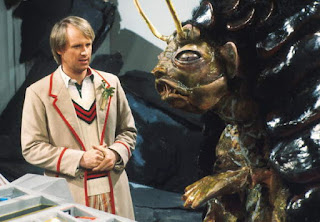 Bidmead included monsters – reluctantly – at the insistence of John Nathan-Turner. On reflection, this seems a dodgy call. Monsters from Bidmead were always going to be too concept-heavy to realise properly on screen. Sure enough, he comes up with giant woodlice that can disguise themselves as rocks until they unexpectedly uncurl… which was never gonna look good on the day.
Apparently finding the macabre more fascinating than he expected, Bidmead also included alien machines made with bits of corpses. This was very tuned in to the then-current turn towards biomechanics and ‘body horror’ in the fantasy genre, but it proved too horrific for Doctor Who to attempt on screen (though it livens up the novelisation).
The politics is also a departure. Aside from Tegan’s worries about sweatshops in 'Logopolis' and the hilarious sexism of the Castrovalvans, previous Bidmead scripts seem politically detached. He’s a world-builder, but not in the utopian or dystopian manner. So 'Frontios' comes a little out of leftfield... though that’s the only leftish thing about it. I’ve no idea what Bidmead’s own politics may be, but 'Frontios' seems to say that the ordinary people require stern discipline, that they want and need confident rulers. The story frowns on the ‘every man for himself’ ethic, yet implies that only hierarchy and obedience stand between society and what Hobbes described as the “war of all against all”.
In the absence of Plantagenet, there is “anarchy”, with the colonists turning to looting with a rapidity that is almost funny. Thrown “outside the system”, Cockerill is quickly attacked by ravening ‘Retrogrades’. However, when he apparently defeats the hungry earth, Cockerill is eagerly adopted as a replacement leader by the mob. Meanwhile, Plantagenet’s bravery proves he is genetically fit to rule (he is, after all, named after a line of kings). Brazen – the personification of authority – ultimately proves himself admirable, his noble final words being “that’s an order!”.
Actually, I think 'Frontios' has more in common with 'Logopolis' than it appears. Bidmead never takes the series into the past – he’s too aware of entropy as ‘time’s arrow’ to believe that you can go backwards – and his view of the far future is one of maximum entropy. The “failure proof technology” that failed, the dwindling population, the wrecked ship, the malfunctioning generator, the “doomed planet Earth”, etc. Mine shafts collapse. Lights stop working. The TARDIS falls apart. Even “eaten by the earth” sounds like a metaphor for putrefaction.
The politics reflects this state of decay. Order becomes disorder as Orderlies become disorderly. The structure of society crumbles, undermined from below, as people die unaccountably and the ‘Rets’ desert the sinking ship. Bidmead is always treating entropy as corrupted information; in 'Frontios', Range’s secret file is information uselessly pooled, like waste heat in a machine.
Even the monsters are “an infection”, like all Bidmead baddies. The Master is like a computer virus in both 'Logopolis' and 'Castrovalva', infecting the hard drive of reality and corrupting the information. Interestingly, however, the Tractators also fight entropy in their own nasty way. The gravity drive and excavating machine represent structure, after all. That’s why it’s such a shame that we never get to see the Tractators’ corpse engines, because what could better express their parasitic method of fighting entropy than machines patched up with bits of people?
Additional: Peter Davison as Rambo
The Tractators burrow away. Like all burrowing creatures, they carry connotations of the busy and the unseen. Like the 'mole of history', they are always working beneath our feet. This must carry valences in a story so obviously predicated upon the human race having reached an endpoint. Despite the ostensibly hopeful ending of the story, I think it's clear that the humans on Frontios are quite likely doomed. This is the end. This is what it was all leading up to. The history that burrows beneath them has lead them to the point of maximum entropy (as noted), to isolation in a cosmos where everything has drifted so far away from everything else that space itself isolates you.
The Tractators are, from one angle, manifestations of History as busy industry leading to decay anyway, of the entropy inherent in time. They lead the human race to an echoing, muddy telos... moreover, it's a telos of authoritarianism, necessary to counter our original sins as they are exacerbated by siege and starvation. Yet Plantagenet is no Leviathan, however much the world he tries to rule conforms to Hobbesian pessimism. He won't be able to save them. In a way, the Tractators were their last hope. Not to live, but to fight. The Gravis could've been Leviathan for them... and his busy, selfish, greedy, industrious grotesques (they are, of course, echoes of the subterrenean Semitic dwarves of Wagner and Tolkien) were the humans' last hope to cheat the cosmic/social 'running down' endemic at the endpoint of space/time and History. The Tractators could've used them. They could've used the humans as raw material in their fearsome engines, their gravity drive, their anti-entropy machine, their anti-History contraption.
There is a strange, unsettling ambiguity here that chimes with the political implications of the face-off between the two races. The humans are colonists and, as ever, it is assumed that colonists that look like whitey have every right to be there... and yet the Tractators don't convince as natives. They don't come from this final F/frontier. They are as much colonists as are the humans. They are as much anti-entropists as the humans (though they're better at it). They are as much Hobbesian authoritarians as the humans, with their one Absolute Leader whose brain is the key to their collective will (though again, as noted, they are more effective in this respect than their two-legged rivals). Woodlice are actually crustaceans (which may even give the Tractators a touch of the Weird...) but they look and act enough like bugs to fool most of us into instinctively linking them with insects, and insects (with their hives and castes and hierarchies and group will) are always symbols of human society as an antheap, as a pyramid of the mindlessly obedient.
In short, there's little to choose between the Tractators and the humans in 'Frontios'. The Tractators are the aggressors... but would the humans, so eager to stamp on each other when needed, forebear to do unto the Tractators as the Tractators have done unto them? Again, the only difference is in efficiency. So, at the end of History, it all comes down to ruthless Darwinian effectiveness... and/or how entropy-proof our machines are. The Tractators machines, as noted, sidewind around entropy by roping in life itself, the only force that ever temporarily stalls entropy (this is not, by the way, necessarily my metaphysics). We humans look doomed because, for all our best efforts to be as ruthless as we need to be, we can't cut it. We go squishy when it counts. Brazen gets himself killed by compromising (he lets himself be interrogated by an inquiry! he makes peace with Range the whining liberal backstabber!) and then having a bash at altruism. We are outstripped by the utter mercilessness of the animals. It's the sociobiologist's wet dream. And, again, it's deeply Hobbesian.
Plantagenet's tottering camp is the old regime. Decadent. Gone soft. Insufficiently strong and brutal to defend itself against the onrushing Puritans/Jacobins/Bolsheviks/Jews, etc., unable to make the grade in the bellum omnium contra omnes. I've been reading Corey Robin on this just recently. This contempt for the old regime as weak, this anger at the softness of the very regime for which it takes up the cudgels, is a staple of conservatism... right up to, to pick an instance entirely at random (honest guv), John Milius's script for Apocalypse Now. 'Charlie' (i.e. the Viet Cong) will win because "his idea of R&R is a little rat meat". If Kurtz had a division of men strong enough to hack off the arms of babies, he could win the war. Much as I love that film, one of its most prominent inner logics (to its credit it has several conflicting inner logics) is the same inner logic as Rambo II, which is itself a self-induced orgasm of the dreary ultra-conservative attitude to America's wars. Kurtz/Rambo is the Leviathan the inferior liberal Americans need to carry them past cowardice, decadence or scruple. At least Coppola's film has the decent queasiness to see that Kurtz has to go mad first.
Similarly, in 'Frontios', the only reason the humans ultimately win is because of the Doctor's intervention. He becomes their (sane and reasonable) Leviathan. He terminates the termites with extreme prejudice. He saves the human antheap against the crustacean one. He saves the ancient regime from the barbarians at the gate, and from its own softness.
Even so, it's hard to quite read 'Frontios' straightforwardly as a celebration of the Leviathan, of the rule of law and hierarchy, of the victory of the strongest, of the defeat of the Niebelung by Wotan. In the end - and we are definitely at the end, beautiful friend - entropy still lies in wait. There's always something stronger than you. Time and History (that burrowing little thing) will kill even Rambo one day. Doctor Kurtz... he dead.
31/01/13
(Lyrics by The Doors... as if you didn't know.)
This is the end
Beautiful friend
This is the end
My only friend, the end
Of our elaborate plans, the end
Of everything that stands, the end
At first, 'Frontios' seems like the odd one out amongst Christopher H. Bidmead’s Doctor Who scripts. Unlike 'Logopolis' and 'Castrovalva', it’s overtly political and doesn’t seem to be powered by any underlying scientific concept. Also, it has monsters in it.

Apparently finding the macabre more fascinating than he expected, Bidmead also included alien machines made with bits of corpses. This was very tuned in to the then-current turn towards biomechanics and ‘body horror’ in the fantasy genre, but it proved too horrific for Doctor Who to attempt on screen (though it livens up the novelisation).
The politics is also a departure. Aside from Tegan’s worries about sweatshops in 'Logopolis' and the hilarious sexism of the Castrovalvans, previous Bidmead scripts seem politically detached. He’s a world-builder, but not in the utopian or dystopian manner. So 'Frontios' comes a little out of leftfield... though that’s the only leftish thing about it. I’ve no idea what Bidmead’s own politics may be, but 'Frontios' seems to say that the ordinary people require stern discipline, that they want and need confident rulers. The story frowns on the ‘every man for himself’ ethic, yet implies that only hierarchy and obedience stand between society and what Hobbes described as the “war of all against all”.
In the absence of Plantagenet, there is “anarchy”, with the colonists turning to looting with a rapidity that is almost funny. Thrown “outside the system”, Cockerill is quickly attacked by ravening ‘Retrogrades’. However, when he apparently defeats the hungry earth, Cockerill is eagerly adopted as a replacement leader by the mob. Meanwhile, Plantagenet’s bravery proves he is genetically fit to rule (he is, after all, named after a line of kings). Brazen – the personification of authority – ultimately proves himself admirable, his noble final words being “that’s an order!”.
Actually, I think 'Frontios' has more in common with 'Logopolis' than it appears. Bidmead never takes the series into the past – he’s too aware of entropy as ‘time’s arrow’ to believe that you can go backwards – and his view of the far future is one of maximum entropy. The “failure proof technology” that failed, the dwindling population, the wrecked ship, the malfunctioning generator, the “doomed planet Earth”, etc. Mine shafts collapse. Lights stop working. The TARDIS falls apart. Even “eaten by the earth” sounds like a metaphor for putrefaction.
The politics reflects this state of decay. Order becomes disorder as Orderlies become disorderly. The structure of society crumbles, undermined from below, as people die unaccountably and the ‘Rets’ desert the sinking ship. Bidmead is always treating entropy as corrupted information; in 'Frontios', Range’s secret file is information uselessly pooled, like waste heat in a machine.
Even the monsters are “an infection”, like all Bidmead baddies. The Master is like a computer virus in both 'Logopolis' and 'Castrovalva', infecting the hard drive of reality and corrupting the information. Interestingly, however, the Tractators also fight entropy in their own nasty way. The gravity drive and excavating machine represent structure, after all. That’s why it’s such a shame that we never get to see the Tractators’ corpse engines, because what could better express their parasitic method of fighting entropy than machines patched up with bits of people?
Additional: Peter Davison as Rambo
Desperately in need of some stranger's hand
In a desperate land
In a desperate land
The Tractators burrow away. Like all burrowing creatures, they carry connotations of the busy and the unseen. Like the 'mole of history', they are always working beneath our feet. This must carry valences in a story so obviously predicated upon the human race having reached an endpoint. Despite the ostensibly hopeful ending of the story, I think it's clear that the humans on Frontios are quite likely doomed. This is the end. This is what it was all leading up to. The history that burrows beneath them has lead them to the point of maximum entropy (as noted), to isolation in a cosmos where everything has drifted so far away from everything else that space itself isolates you.
The Tractators are, from one angle, manifestations of History as busy industry leading to decay anyway, of the entropy inherent in time. They lead the human race to an echoing, muddy telos... moreover, it's a telos of authoritarianism, necessary to counter our original sins as they are exacerbated by siege and starvation. Yet Plantagenet is no Leviathan, however much the world he tries to rule conforms to Hobbesian pessimism. He won't be able to save them. In a way, the Tractators were their last hope. Not to live, but to fight. The Gravis could've been Leviathan for them... and his busy, selfish, greedy, industrious grotesques (they are, of course, echoes of the subterrenean Semitic dwarves of Wagner and Tolkien) were the humans' last hope to cheat the cosmic/social 'running down' endemic at the endpoint of space/time and History. The Tractators could've used them. They could've used the humans as raw material in their fearsome engines, their gravity drive, their anti-entropy machine, their anti-History contraption.
There is a strange, unsettling ambiguity here that chimes with the political implications of the face-off between the two races. The humans are colonists and, as ever, it is assumed that colonists that look like whitey have every right to be there... and yet the Tractators don't convince as natives. They don't come from this final F/frontier. They are as much colonists as are the humans. They are as much anti-entropists as the humans (though they're better at it). They are as much Hobbesian authoritarians as the humans, with their one Absolute Leader whose brain is the key to their collective will (though again, as noted, they are more effective in this respect than their two-legged rivals). Woodlice are actually crustaceans (which may even give the Tractators a touch of the Weird...) but they look and act enough like bugs to fool most of us into instinctively linking them with insects, and insects (with their hives and castes and hierarchies and group will) are always symbols of human society as an antheap, as a pyramid of the mindlessly obedient.
In short, there's little to choose between the Tractators and the humans in 'Frontios'. The Tractators are the aggressors... but would the humans, so eager to stamp on each other when needed, forebear to do unto the Tractators as the Tractators have done unto them? Again, the only difference is in efficiency. So, at the end of History, it all comes down to ruthless Darwinian effectiveness... and/or how entropy-proof our machines are. The Tractators machines, as noted, sidewind around entropy by roping in life itself, the only force that ever temporarily stalls entropy (this is not, by the way, necessarily my metaphysics). We humans look doomed because, for all our best efforts to be as ruthless as we need to be, we can't cut it. We go squishy when it counts. Brazen gets himself killed by compromising (he lets himself be interrogated by an inquiry! he makes peace with Range the whining liberal backstabber!) and then having a bash at altruism. We are outstripped by the utter mercilessness of the animals. It's the sociobiologist's wet dream. And, again, it's deeply Hobbesian.
Plantagenet's tottering camp is the old regime. Decadent. Gone soft. Insufficiently strong and brutal to defend itself against the onrushing Puritans/Jacobins/Bolsheviks/Jews, etc., unable to make the grade in the bellum omnium contra omnes. I've been reading Corey Robin on this just recently. This contempt for the old regime as weak, this anger at the softness of the very regime for which it takes up the cudgels, is a staple of conservatism... right up to, to pick an instance entirely at random (honest guv), John Milius's script for Apocalypse Now. 'Charlie' (i.e. the Viet Cong) will win because "his idea of R&R is a little rat meat". If Kurtz had a division of men strong enough to hack off the arms of babies, he could win the war. Much as I love that film, one of its most prominent inner logics (to its credit it has several conflicting inner logics) is the same inner logic as Rambo II, which is itself a self-induced orgasm of the dreary ultra-conservative attitude to America's wars. Kurtz/Rambo is the Leviathan the inferior liberal Americans need to carry them past cowardice, decadence or scruple. At least Coppola's film has the decent queasiness to see that Kurtz has to go mad first.
Similarly, in 'Frontios', the only reason the humans ultimately win is because of the Doctor's intervention. He becomes their (sane and reasonable) Leviathan. He terminates the termites with extreme prejudice. He saves the human antheap against the crustacean one. He saves the ancient regime from the barbarians at the gate, and from its own softness.
Even so, it's hard to quite read 'Frontios' straightforwardly as a celebration of the Leviathan, of the rule of law and hierarchy, of the victory of the strongest, of the defeat of the Niebelung by Wotan. In the end - and we are definitely at the end, beautiful friend - entropy still lies in wait. There's always something stronger than you. Time and History (that burrowing little thing) will kill even Rambo one day. Doctor Kurtz... he dead.
31/01/13
(Lyrics by The Doors... as if you didn't know.)
Tuesday, 28 August 2012
Private Ownership of the Means of Inhumation
or
Sex, Death and Rock 'n' Roll - Part 2
(Part 1 can be found here.)
Some disjointed observations about 'Revelation of the Daleks'; fragments of a larger and uncompleted essay that's been in the draft drawer for ages... just so that I can say I've served up more this month than an off-the-cuff whinge about how much I hated P.E. lessons.
Hang the D.J.
 He skulks in his private studio. He almost prefigures RTD’s quasi-fan characters. He’s a geek, a dweeby enthusiast. He sits alone, watches TV, greets a visitor very shyly and comes alive when given a chance to enthuse about his pet obsession: the old style D.J.s and music of America. When he learns that Peri is really American, he reacts like… well, like a Who fan meeting Nicola Bryant. You get the feeling that he might ask for her autograph. He’s almost a parody of the nerdacious loner. He has little or no direct contact with any of the other characters. Apart from Peri, he’s only ever seen with Jobel – and they don’t speak to each other. One gets the sense of someone asocial and detached, always watching the goings on around him but never getting personally involved. In a way, he’s like an anti-Davros. Both are holed up in their personal hideaways, watching everything via cameras, commenting on the action like choruses… but from different perspectives. Where Davros schemes and snarls and giggles at the suffering of others, the D.J. takes the piss out of his place of employment and plays around with words, songs and personas.
(There are a lot of these chorus/voyeur characters in 80s Who, from Arak and Etta in ‘Varos’ up to the culmination of the trend in ‘The Trial of a Time Lord’, which sees the Doctor himself become a member of the audience watching his own adventures on television!)
The other thing the D.J. does is play. He plays records, plays at disguise, plays at dressing up, plays at accents and attitudes and styles. This seems to be partly for his audience and partly for his own amusement. He comes over as a childman, an innocent. He’s not unaware of “the humanoid female form” but mentions it to “those of you who appreciate” it. He’s not personally interested, or his desire is submerged, or he’s too shy. His reaction to Peri is appreciative, but the oily, wandering-handed, heavy-breathing, harassing lust of Jobel is a counterpoint that throws the D.J.’s childish reaction into sharp relief.
Mind you, he’s not so innocent that he doesn’t know what’s going on and he clearly has no vociferous loyalty to his employers. He finds the notion of bodysnatchers making away with a cadaver rather funny and makes no effort to report them to his superiors. His off-mic comments to himself about George’s wife show that he’s savvy about the kinds of people his workplace caters for. To him, Tranquil Repose is a job. Okay, it’s a job that he has somehow managed to warp around his own personality and in which he plainly finds some pleasure, but essentially this guy is a working stiff.
In fact, this story is full of working stiffs (who work with stiffs). Almost all the relationships are economic. They are relationships between business partners, between boss and secretary, knight and squire, hitman and client, owner and manager, manager and staff. Even the relationships that are not blatantly exploitative are still tainted by their economic nature. Vogel plainly performs more than secretarial duties for his Sunset Boulevardy dominatrix boss, but her reaction to his death is to complain – albeit sounding shocked - about the difficulty in finding such good help. Apart from Peri and the Doctor, and the friendship that Peri strikes up with the D.J., the only entirely non-economic relationships are between Natasha and Gregory (they talk like dissidents or rebels) and between Natasha and her father.
The Capitalist Way of Death
All these economic relationships (with the exception of Orcini and Bostock, who seem like relics of a feudal order) look like they’re based on wages. Wages are never specifically mentioned (unless you count Orcini’s fees... which I don't because they're payment for services) but it is implicit that Takis, Lilt, Vogel, etc., are all being paid for turning up in the morning. Even Jobel is clearly a senior employee rather than the proprietor. These employment relations, along with the fact that Kara and Davros are both clearly in private business, place the story in a highly capitalist world.
Doctor Who doesn’t always depict the future as capitalistic. Many Who stories set in the future (or on other planets) seem to show a post-economic world in which people just exist in societies which lack forces of production, distribution and exchange (Marinus, Atrios, Karfel); or which achieve such things by a kind of tacit, quasi-magical, hyper-technological advancement (Gallifrey... unless, as I suspect, the unseen Shabogans do all the actual work); or through some dastardly trick which becomes the focus of the plot (Zanak, the Elders); or through the providence of some hidden exploiters (the Krotons, the Macra); or the dirty work is done by a slave class (Inter-Minor, Thoros-Beta, Kaldor City). Of course, this is because the writers are less interested in intricate worldbuilding than in creating drama or developing their big concepts. Who comes from myth, children’s fiction and B-movies: nobody is interested in who manufactures the stirrups for the horses in Narnia, or how much they get paid for doing it. In historicals and present-day stories we occasionally get some sense of economic relationships. We are, at least, more likely to meet characters with jobs (like Anne Chaplet) or with executive positions (Hibbert of Auton Plastics for example).
But sometimes, Doctor Who takes us to future societies with recognisable forms of economic organisation. Sometimes it is feudalism, as on Tara and the planet in E-Space where the Three Who Rule lord it over their peasants. But occasionally we encounter some of the recognisable hallmarks of capitalism: wage labour, industrialised or technological capital in private hands, large scale financial transactions, mass media and conspicuous consumption. Every one of these markers is to be found in 'Revelation of the Daleks'.
Necros is obviously part of a wider interplanetary economy which is based on the capitalist mode. Davros appears to have somehow bought-out the old management of Tranquil Repose. He owns (or at least controls) the means of inhumation. He presumably pays the wages of the people that work and train there, including the D.J. who represents the media, supposedly relays news and current events to his 'listeners' and appears as a selling point in the advert that is played for the Doctor and Peri. Davros is involved in a direct financial partnership with another firm, Kara's food producing company. He funds his work (R&D, one might call it) with investments from Kara alongside the profits that TR presumably makes from selling funerary services. The death business is big money for him, just as it is in our society. Anyone who has read Jessica Mitford's classic The American Way of Death will know that the funeral industry was (and is) rife with abuses and swindling; moreover, it is a mass service industry (no pun intended). It is an emblem of the capitalistic way in which our basic needs and feelings are appropriated by business, reconstituted and then sold back to us. It is thoroughly consumerist. Your average grieving consumer gets stung, in their most desperate and vulnerable hour, for spurious extras like airtight coffins (which often explode owing to a build up of gas within) or velvet pillows upon which the oblivious dead can eternally lay their unfeeling heads. Meanwhile, the financially overloaded - remembering, perhaps, the old dictum "if I can't take it with me, I don't want to go" - can (theoretically) stump up for any bizarre posthumous luxury that their hearts desire. You can have your ashes shot into orbit. You can pay of a private mausoleum. Wanna be frozen in the hope of one day being defrosted, cured and welcomed back to the head of the boardroom table? There are companies that claim to be able to provide this service... well, they can freeze you after you're dead anyway. The rest of it... well, you're gambling on future technology that can both thaw you out and then cure death... and on anybody in the future thinking it would be a good idea to bring back someone stupid and narcissistic enough to have themselves frozen in the first place. And then there's the concern raised in 'Revelation': would the living want their dead/frozen rivals to be resurrected? There's an urban legend that Walt Disney was frozen and stored under Disney World. Imagine how the current President and CEO of the Walt Disney Company would feel if told that Uncle Walt was ready to be defrosted and resume his old position. I imagine he or she'd be quite keen to keep the old man on ice.
Consumer Resistance is Useless
One of the wider points here is to do with the consumerist cycle of representation, which latches on to human needs, commodifies them, rebrands them, turns them into images and ideology, and then feeds them back to the consumer via the media. The strange thing is that, in the process, the needs themselves are lost in all sorts of ways. The human need to take in liquids, the human desire to take in pleasant-tasting liquids... this is the basis of soft drink adverts, but what are soft drink adverts really selling? Anyone who has read Naomi Klein's No Logo - and the literature that followed in its wake - will be familiar with the fact that many corporations do little actual production. The dirty task of actually producing the commodities is farmed out to other companies, often based in Third World countries with no pesky labour regulations, where they can work the local paupers longer and for less money, often at the sharp end of vicious bullying, sometimes corralled in virtual concentration camps. The corporations then buy the products that are produced under conditions of virtual slavery and flog them on the Western market for inflated prices. The process has many advantages for capitalists. The less they personally spend on production, the more surplus value they pocket when their products are sold... the more domestic jobs they destroy (or threaten to destroy) the more they can blackmail their remaining domestic workers to accept lower pay, longer hours, harder work and lower job security... and they can carry on selling their primary product: brand images. That's what corporations tend to produce and market now: brand images and identities. They market the idea that certain brands (and their products) embody and thus confer certain values and philosophies. This is why adverts try to associate their products with desires, aspirations, trends and ideas that are seen as popular. One of the ironies here is that, while the images in adverts are often designed to appeal to our basest urges or our prejudices, they can also reflect values diametrically opposed to the values actually practiced and pursued by the corporations that produce them. Clothes manufactured under ghastly conditions by bullied, repressed, half-starved, overworked, brown-skinned unpeople are marketed to the Western consumer with inspirational images that reflect public concerns like anti-racism, egalitarianism and rebellion against authority. Gorgeous models throw molotov cocktails at menacing riot police while backed by 60s tunes about revolution; hunks rescue innocent Asian children from oncoming fascist tanks... be like these inspiring (sexy) heroes, the ads imply, by wearing the same mass-produced, overpriced jeans.
Okay, I've galloped off on a hobby horse... but there is a point here. In the age of the mass media and branding, consumerism is cannibalistic. It makes us consumers not only of products, but of our own images. It feeds us images of ourselves, altered and doctored to fit a certain agenda, but recognisable as us, or as the kind of people we want to be, or as the kind of people that they want us to think of as normal. They sell us images of beauty and we consume them, internalise them and they become irrational yardsticks by which we measure each other. They sell us ourselves to consume. Even our anti-corporate sentiments are sold back to us. Our green sentiments are sold back to us by BP. And all too often, we gobble them up with relish. It should not be hard to see where 'Revelation of the Daleks' hooks into this.

Sex, Death and Rock 'n' Roll - Part 2
(Part 1 can be found here.)
Some disjointed observations about 'Revelation of the Daleks'; fragments of a larger and uncompleted essay that's been in the draft drawer for ages... just so that I can say I've served up more this month than an off-the-cuff whinge about how much I hated P.E. lessons.
Hang the D.J.
 He skulks in his private studio. He almost prefigures RTD’s quasi-fan characters. He’s a geek, a dweeby enthusiast. He sits alone, watches TV, greets a visitor very shyly and comes alive when given a chance to enthuse about his pet obsession: the old style D.J.s and music of America. When he learns that Peri is really American, he reacts like… well, like a Who fan meeting Nicola Bryant. You get the feeling that he might ask for her autograph. He’s almost a parody of the nerdacious loner. He has little or no direct contact with any of the other characters. Apart from Peri, he’s only ever seen with Jobel – and they don’t speak to each other. One gets the sense of someone asocial and detached, always watching the goings on around him but never getting personally involved. In a way, he’s like an anti-Davros. Both are holed up in their personal hideaways, watching everything via cameras, commenting on the action like choruses… but from different perspectives. Where Davros schemes and snarls and giggles at the suffering of others, the D.J. takes the piss out of his place of employment and plays around with words, songs and personas.
(There are a lot of these chorus/voyeur characters in 80s Who, from Arak and Etta in ‘Varos’ up to the culmination of the trend in ‘The Trial of a Time Lord’, which sees the Doctor himself become a member of the audience watching his own adventures on television!)
The other thing the D.J. does is play. He plays records, plays at disguise, plays at dressing up, plays at accents and attitudes and styles. This seems to be partly for his audience and partly for his own amusement. He comes over as a childman, an innocent. He’s not unaware of “the humanoid female form” but mentions it to “those of you who appreciate” it. He’s not personally interested, or his desire is submerged, or he’s too shy. His reaction to Peri is appreciative, but the oily, wandering-handed, heavy-breathing, harassing lust of Jobel is a counterpoint that throws the D.J.’s childish reaction into sharp relief.
Mind you, he’s not so innocent that he doesn’t know what’s going on and he clearly has no vociferous loyalty to his employers. He finds the notion of bodysnatchers making away with a cadaver rather funny and makes no effort to report them to his superiors. His off-mic comments to himself about George’s wife show that he’s savvy about the kinds of people his workplace caters for. To him, Tranquil Repose is a job. Okay, it’s a job that he has somehow managed to warp around his own personality and in which he plainly finds some pleasure, but essentially this guy is a working stiff.
In fact, this story is full of working stiffs (who work with stiffs). Almost all the relationships are economic. They are relationships between business partners, between boss and secretary, knight and squire, hitman and client, owner and manager, manager and staff. Even the relationships that are not blatantly exploitative are still tainted by their economic nature. Vogel plainly performs more than secretarial duties for his Sunset Boulevardy dominatrix boss, but her reaction to his death is to complain – albeit sounding shocked - about the difficulty in finding such good help. Apart from Peri and the Doctor, and the friendship that Peri strikes up with the D.J., the only entirely non-economic relationships are between Natasha and Gregory (they talk like dissidents or rebels) and between Natasha and her father.
The Capitalist Way of Death
All these economic relationships (with the exception of Orcini and Bostock, who seem like relics of a feudal order) look like they’re based on wages. Wages are never specifically mentioned (unless you count Orcini’s fees... which I don't because they're payment for services) but it is implicit that Takis, Lilt, Vogel, etc., are all being paid for turning up in the morning. Even Jobel is clearly a senior employee rather than the proprietor. These employment relations, along with the fact that Kara and Davros are both clearly in private business, place the story in a highly capitalist world.
Doctor Who doesn’t always depict the future as capitalistic. Many Who stories set in the future (or on other planets) seem to show a post-economic world in which people just exist in societies which lack forces of production, distribution and exchange (Marinus, Atrios, Karfel); or which achieve such things by a kind of tacit, quasi-magical, hyper-technological advancement (Gallifrey... unless, as I suspect, the unseen Shabogans do all the actual work); or through some dastardly trick which becomes the focus of the plot (Zanak, the Elders); or through the providence of some hidden exploiters (the Krotons, the Macra); or the dirty work is done by a slave class (Inter-Minor, Thoros-Beta, Kaldor City). Of course, this is because the writers are less interested in intricate worldbuilding than in creating drama or developing their big concepts. Who comes from myth, children’s fiction and B-movies: nobody is interested in who manufactures the stirrups for the horses in Narnia, or how much they get paid for doing it. In historicals and present-day stories we occasionally get some sense of economic relationships. We are, at least, more likely to meet characters with jobs (like Anne Chaplet) or with executive positions (Hibbert of Auton Plastics for example).
But sometimes, Doctor Who takes us to future societies with recognisable forms of economic organisation. Sometimes it is feudalism, as on Tara and the planet in E-Space where the Three Who Rule lord it over their peasants. But occasionally we encounter some of the recognisable hallmarks of capitalism: wage labour, industrialised or technological capital in private hands, large scale financial transactions, mass media and conspicuous consumption. Every one of these markers is to be found in 'Revelation of the Daleks'.
Necros is obviously part of a wider interplanetary economy which is based on the capitalist mode. Davros appears to have somehow bought-out the old management of Tranquil Repose. He owns (or at least controls) the means of inhumation. He presumably pays the wages of the people that work and train there, including the D.J. who represents the media, supposedly relays news and current events to his 'listeners' and appears as a selling point in the advert that is played for the Doctor and Peri. Davros is involved in a direct financial partnership with another firm, Kara's food producing company. He funds his work (R&D, one might call it) with investments from Kara alongside the profits that TR presumably makes from selling funerary services. The death business is big money for him, just as it is in our society. Anyone who has read Jessica Mitford's classic The American Way of Death will know that the funeral industry was (and is) rife with abuses and swindling; moreover, it is a mass service industry (no pun intended). It is an emblem of the capitalistic way in which our basic needs and feelings are appropriated by business, reconstituted and then sold back to us. It is thoroughly consumerist. Your average grieving consumer gets stung, in their most desperate and vulnerable hour, for spurious extras like airtight coffins (which often explode owing to a build up of gas within) or velvet pillows upon which the oblivious dead can eternally lay their unfeeling heads. Meanwhile, the financially overloaded - remembering, perhaps, the old dictum "if I can't take it with me, I don't want to go" - can (theoretically) stump up for any bizarre posthumous luxury that their hearts desire. You can have your ashes shot into orbit. You can pay of a private mausoleum. Wanna be frozen in the hope of one day being defrosted, cured and welcomed back to the head of the boardroom table? There are companies that claim to be able to provide this service... well, they can freeze you after you're dead anyway. The rest of it... well, you're gambling on future technology that can both thaw you out and then cure death... and on anybody in the future thinking it would be a good idea to bring back someone stupid and narcissistic enough to have themselves frozen in the first place. And then there's the concern raised in 'Revelation': would the living want their dead/frozen rivals to be resurrected? There's an urban legend that Walt Disney was frozen and stored under Disney World. Imagine how the current President and CEO of the Walt Disney Company would feel if told that Uncle Walt was ready to be defrosted and resume his old position. I imagine he or she'd be quite keen to keep the old man on ice.
Consumer Resistance is Useless
One of the wider points here is to do with the consumerist cycle of representation, which latches on to human needs, commodifies them, rebrands them, turns them into images and ideology, and then feeds them back to the consumer via the media. The strange thing is that, in the process, the needs themselves are lost in all sorts of ways. The human need to take in liquids, the human desire to take in pleasant-tasting liquids... this is the basis of soft drink adverts, but what are soft drink adverts really selling? Anyone who has read Naomi Klein's No Logo - and the literature that followed in its wake - will be familiar with the fact that many corporations do little actual production. The dirty task of actually producing the commodities is farmed out to other companies, often based in Third World countries with no pesky labour regulations, where they can work the local paupers longer and for less money, often at the sharp end of vicious bullying, sometimes corralled in virtual concentration camps. The corporations then buy the products that are produced under conditions of virtual slavery and flog them on the Western market for inflated prices. The process has many advantages for capitalists. The less they personally spend on production, the more surplus value they pocket when their products are sold... the more domestic jobs they destroy (or threaten to destroy) the more they can blackmail their remaining domestic workers to accept lower pay, longer hours, harder work and lower job security... and they can carry on selling their primary product: brand images. That's what corporations tend to produce and market now: brand images and identities. They market the idea that certain brands (and their products) embody and thus confer certain values and philosophies. This is why adverts try to associate their products with desires, aspirations, trends and ideas that are seen as popular. One of the ironies here is that, while the images in adverts are often designed to appeal to our basest urges or our prejudices, they can also reflect values diametrically opposed to the values actually practiced and pursued by the corporations that produce them. Clothes manufactured under ghastly conditions by bullied, repressed, half-starved, overworked, brown-skinned unpeople are marketed to the Western consumer with inspirational images that reflect public concerns like anti-racism, egalitarianism and rebellion against authority. Gorgeous models throw molotov cocktails at menacing riot police while backed by 60s tunes about revolution; hunks rescue innocent Asian children from oncoming fascist tanks... be like these inspiring (sexy) heroes, the ads imply, by wearing the same mass-produced, overpriced jeans.
Okay, I've galloped off on a hobby horse... but there is a point here. In the age of the mass media and branding, consumerism is cannibalistic. It makes us consumers not only of products, but of our own images. It feeds us images of ourselves, altered and doctored to fit a certain agenda, but recognisable as us, or as the kind of people we want to be, or as the kind of people that they want us to think of as normal. They sell us images of beauty and we consume them, internalise them and they become irrational yardsticks by which we measure each other. They sell us ourselves to consume. Even our anti-corporate sentiments are sold back to us. Our green sentiments are sold back to us by BP. And all too often, we gobble them up with relish. It should not be hard to see where 'Revelation of the Daleks' hooks into this.
Sunday, 20 May 2012
Beyond Redemption
I think there is something inherently dodgy about the notion of 'redemptive readings'. It seems to imply a determination to look at a text in a positive way that is at odds with what could be called 'proper scepticism'. This objection is itself open to the objection that it's silly to approach a piece of entertainment product with 'scepticism', especially when it is part of a series of which one is supposedly a fan. But, this loses sight of context and agency. There are various ways of choosing to watch the same thing. When you sit down to enjoy an episode of a show you like, for fun, you're a bit odd if you're not expecting, hoping and trying to like it. When you're watching it with the express intention of analysing it and then writing about what it means, proper scepticism becomes appropriate. Trying to like what you're watching becomes a somewhat iffy strategy in that context. Besides, doesn't the necessity of trying to find ways of praising what you're analysing tell us something in itself? This muddle also loses sight of the distinctions that are always to be found within the concept of enjoyment, distinctions that are all too often spuriously aggregated. You don't have to think something is politically or morally correct in order to like it (though, in practice...). No more do you need to think that something is aesthetically sophisticated or beautiful in order to relish its aesthetic. Conversely, you may dislike a beautifully made piece of art which offers praiseworthy political or moral analyses. Or you may take enjoyment from the act of hostile reading itself. I, for instance, very much enjoy hating and criticising certain things, and I don't see anything wrong with this.
This is by way of a preamble to talking about 'The Two Doctors', which has been subject to an attempted rehabilitation from the charge of being reactionary on the issue of race. The re-evaluation of the story has been pioneered and best expressed by Robert Shearman in About Time 6. The essence of his argument is that the Androgums are a comment on the concept of the monster as employed by Doctor Who. They are characterised as generic monsters but it is disarming when people treat them as such because they do not look like monsters. They are treated the same way as the Sontarans - all of them racially evil and hateful - but, because they do not have potato-heads or eye-stalks, this poses a problem. We notice the inappropriateness, even tastelessness, of generalising about the evil of an entire race when they look like us. We don't blink when the Doctor describes the entire Jagaroth race as vicious and callous but it bothers us when the same racial villainy is implied about aliens who look human. Philip Sandifer recently summarized and expanded the case admirably, here.
I'm enormously tempted by this reading... and, maybe, if I'd approached 'The Two Doctors' with the express intention of finding a 'redemptive reading', I would've happily seized upon it. Apart from allowing me to enjoy 'The Two Doctors' (a story that, in many respects, I rather like) with a lighter heart, it would also address an issue that I have criticised in Who in the past. The issue is best demonstrated in 'Resurrection of the Daleks', in which the Doctor appears blithe about slaughtering Daleks using biological weapons but cannot make himself gun down Davros because he's a humanoid (just about).
However, with all due respect to Shearman (which is a lot of respect), I think the 'redemptive' argument for 'Two Doctors' misses something very important: the Androgums are - in a way - made-up and costumed as monsters.
They are the jumbled ethnic 'other' as monster.
They are clothed in garb that is inflected with the 'ethnic' and/or 'exotic' and are given physical characteristics - red hair, heavy features, florid complexion, warts, etc - that directly connect with very old stereotypes that have been used against several groups to indicate lowness from birth (in very much the same way that David Lynch's movie version of Dune had recently used similiar characteristics to represent the Harkonnen kinship group as biologically evil).

To be sure, the Androgums are not consistently reminiscent of any particular group of stereotypes. To a certain extent they chime with stereotypes about Scottish people (think, for instance, of the roughly contemporaneous MacAdder from Blackadder the Third... a violent, lecherous, orange-faced, ginger-haired lunatic).

Similar stereotypes - red hair, violence, dissoluteness, primitiveness - have long been used in the representation of the Irish and Irish culture. There is also something reminiscent of the Arab in the Shockeye mix. He seems to be wearing a hat that is somewhere between a turban and a 'Tam O'Shanter'. He wears harem pants under a decoration hanging from his belt that is halfway between a plaid (it's hard not to see an echo in Jamie's tartans) and a rug. He has a curved, scimitar-like blade.

It will be noticed that all these stereotypes suggested by Shockeye represent groups - the Scots, the Irish, Arabs, etc - who have historically been victims of English/British imperialism. As usual, the imperial culture derides, demonizes, vilifies and appropriates the culture of its victims.
Above all, however, if the Androgums recall any set of stereotypes, it is stereotypes about Jews... very, very old ones at that.
It's hard for us to imagine now but, when depicted on the Renaissance stage, Jewish villains like Shylock and Barabas would probably have worn ginger fright-wigs and huge comedy noses (which is disconcerting in the light of so much effort by more modern actors and producers to emphasize the complex and sympathetic aspects of Shylock). Here is some background, courtesy of Peter Ackroyd in his book Shakespeare - The Biography:
Shakespeare refers somewhere to Judas as red-headed, something often found in Italian and Spanish art. Judas was always painted as 'more Jewish' than the other apostles, for obvious reasons. As Michaelangelo asks the Pope in that Monty Python sketch: "Are they too Jewish? I made Judas the most Jewish."
Even hundreds of years after Shylock, Dickens was obsessing over "red-headed and red-whiskered Jews" in Sketches by Boz and The Pickwick Papers. Here he is in Oliver Twist, likening Fagin to the Devil by emphasizing his red beard and toasting fork:
Interesting that Fagin is cooking meat the first time we see him. Also interesting that Shockeye too has a fondness for silk.

Shockeye - which, I can't help notice, doesn't exactly sound unlike Shylock - is greedy, gluttonous and cannibalistic, recalling many anti-Semitic stereotypes including the ancient blood libel, which asserted that Jews would use the blood of murdered Christian children to make their unleavened bread. (It might be objected that since Shockeye and his victims are supposedly of different races, he cannot be called a cannibal, but this concentrates too much on the sci-fi rationales of the text and ignores the visual impact of a person preparing another person for butchery and consumption.) Shockeye menaces Peri in a way that is half cannibalistic and half lecherous, hardly a million miles away from endless anti-Semitic tropes about Jewish men preying upon young gentile girls.
It's also worth noting that, in the story, the Androgums are shown to be playing both the Sontarans and the Third Zoners off against each other in an attempt to seize power themselves... exactly the kind of triangulating conspiratorial machiavellianism imagined by the forger of the Protocols of the Learned Elders of Zion, or by the Nazis, who fantasized that 'the Jews' were behind both capitalism and communism.
In light of all this, it is deeply unfortunate - to say the least! - that the Doctor should end up killing Shockeye with, of all things, cyanide gas.
I'm not saying that Bob Holmes, or the make-up designer, or anybody involved was being deliberately anti-Semitic (or, for that matter, anti-Scots, anti-Irish, anti-Arab, etc). I don't believe that. But the visual references got in there anyway. These stereotypes - the red hair, the coarse features, the 'ethnic' trappings, the scimitar, the libels of blood lust and cannibalism, etc. - are so well established as signifiers for primitivism and inferiority in the cultural discourse of Western imperialist societies that they get rehearsed unconsciously, unthinkingly, naturally, as a matter of course.
Mind you, I do sometimes wonder if Holmes was deliberately drawing on the Jewish villains of the Renaissance stage. Shockeye seems to have been meant to work rather like Shylock or Barabas, i.e. in the way Shakespeare and Marlowe were starting to re-use the old theatrical character known as the Vice. They both recoded the Vice - the stage embodiment of a vice or vices - in the figure of a villainous Jew... who nonetheless acted as a kind of dramatic highlighter, showing up the often less than pure moral condition of the gentiles around him. Shylock conforms to stereotypes, but his plight also shows up the materialism, hypocrisy and prejudice of the Venetians. Barabas is less complex, but even his outrageous villainy can be read as a satire of the emergent capitalist culture of the Christians around him. Something similar is at work in Shockeye and, to this extent, I think Shearman and others have a point when they identify the Androgums as an attempt to interrogate some of the implicit values of Doctor Who. Shockeye's behaviour seems - at least, at first - to show up the hypocrisy of the Third Zoners, the Sontarans, the Time Lords... not to mention the prejudice of the Doctor. Holmes really does seem to be doing this deliberately. Otherwise why go to all the trouble of having a scene where the Doctor is upbraided for not being progressive in his attitudes, right after he makes an odious remark comparing a minority to monkeys!
The Androgums seem to have been deliberately crafted as an exaggerated reflection of those they satirise. They are considered primitive yet consider humans primitives. They are power-hungry, as are the Sontarans. They assume the right to travel in time, as do the Time Lords. They are very much like Shylock and Barabas. They satirise a culture that despises them by sharing its values and turning them against those who have oppressed them.
Thing is... the production fumbles it. And fumbles it badly. The scene where Chessene can't help lapping up the gore shows that she's inherently, biologically, inescapably low and savage... thus justifying all the prejudice shown against the Androgums, removing any chance that they might represent a condemnation of slavery as lowering and degrading the slaves, announcing (in the, so to speak, authorial voice) that they deserve to be enslaved and/or killed, and so disspating any satire of the Third Zoners, Sontarans, Time Lords, etc. So the Androgums end up working very much like Barabas (we're never meant to be in any doubt that he's worse than the Christians) and less like Shylock (who remains, until the end, irresolvably ambiguous). After all, in 'The Two Doctors' even those 'generic' Sontarans are shown to be concerned with honour and to seethe at accusations of cowardice... noble attributes entirely lacking in the crude, philistine Androgums.
The story even compromises its own deliberate aim to poke at the meat industry. If the Androgums are meant to represent that aspect of humanity that is callous about farming and killing animals for food (which they clearly are - just look at the scene where Shockeye is 'tenderising' Jamie and saying that "primitive creatures don't feel pain the way we do") then this also is compromised by Dastari's specific comparison, when he says "and he calls humans primitives!" So even we heartless, meat-munching, human carnivores are better than Shockeye.
Moreover, the idea that, as generic monsters in human shape, the Androgums represent a rebuke to the assumptions of the programme is simply untenable. The more one compares them to such generic monsters, the less of a fit they appear. They are not generic monsters in their behaviour or outlook any more than they are in appearance.
Okay, since Grendel (no, the other one) many monsters have wanted to eat people... but this has hardly been a major preoccupation of monsters in Doctor Who, which has largely drawn its quintessential ideas of the monstrous from the nightmares of modernity (fascism, biological racism, industrial genocide, technological warfare, nukes, the autonomous product, etc). And the Androgums are not just carnivores that prey on humans like, say, sirens or werewolves or zombies. They are gourmands (their very species name is an anagram of this word), obsessed with food generally. Since when has an obsession with culinary pleasure been a trait of the 'generic' monster?
Moreover, the Androgums are more even than just amoral gourmands. They are ideologically devoted to the maxim that "the gratification of pleasure is the sole motive of action". They are remorseless nihilists; parodic hedonists. They cleave to the definition of the ethics of Satanism offered by Aleister Crowley: "do as thou wilt shall be the whole of the law". They are, in a sense, Satanists.
Added to this is their status as slaves. Since when has the 'generic' Who monster been a slave? Since when has the 'generic' Who monster been generally considered, by all other characters, to be inherently inferior and in need of genetic enhancement? On the contrary, the more usual strategy in Who is for the villainous monsters to be the ones that think that way about everybody else... which, as noted above, would mean that 'Two Doctors' pulls off a nice bit of satire by ultimately painting the Third Zoners and the Doctor as akin to Daleks, were it not for the fact that the text backs them in their assumptions about the Androgums! It'd be like if the Thals turned out to be evil at the end of 'The Daleks', or all Silurians were shown to conform to Miss Dawson's prejudices, or the Mutts in 'The Mutants' really were mindless and infectious brutes.
Jews, on the other hand, were a bullied, subjected, exploited and constrained people for centuries in Christian Europe. And, at the same time, centuries of official Christian church-sanctioned anti-Semitism in Europe equated the Jews, either directly or as allies, with the Devil - as did Dickens (see above). The Androgums are far from a perfect fit with anti-Semitic stereotypes... but they fit them much better than they fit the behaviour patterns of the standard Doctor Who monster.
In order to interpret the Androgums as a satire on the concept of the monstrous in Who, one must also - for instance - see the Celestial Toymaker the same way. One must be able to see him simply as a humanoid who displays the villainy of a monster, thus satirising the usual assumption that a monster looks monstrous. However, as has been irrefutably argued by Philip Sandifer (here), the Celestial Toymaker carries unavoidable connotations of China and the Chinese. I don't think you can argue that he is the racial 'other' construed as monstrous without also having to concede the same about the Androgums (with the caveat that they are far less straightforwardly about one specific group).
Most damaging to the Shearman/Sandifer reading is the scene where, upon her death, Chessene reverts back to her 'true' form, the original self from which she was unable to escape even with those genetic upgrades. Her racial biology trapped her into villainy. This is not only the crudest kind of biological determinism, it also destroys the idea that the Androgum's human appearance makes their status and treatment into a mordant comment on Doctor Who's usual way of demarcating the evil by way of alien ugliness. Chessene's 'true' and underlying alien ugliness reasserts itself at the end. Her evil inner core is thus represented by the red eyebrows, the heavy features, the warts... just as it was earlier represented by her inability to resist tasting the sacrificial blood of someone outside her own race. Even if you don't buy the connections I've drawn between these features and anti-Semitic stereotypes, it remains impossible to argue that the Androgums are not visually represented as monstrous. If anything, their monstrousness is more clearly and deliberately visually represented than that of the 'generic' monsters they fail to resemble. Chessene is the test case. When she looks more or less exactly the same as Dastari, she is treated more or less exactly the same. Her false 'human' appearance (apparently good) is explicitly contrasted with her 'true' Androgum appearance (bad). The moment of her reversion from the former to the latter is also the moment when her irredeemable monstrosity is finally revealed.
In this moment, her racial 'otherness' is her evil.
This is by way of a preamble to talking about 'The Two Doctors', which has been subject to an attempted rehabilitation from the charge of being reactionary on the issue of race. The re-evaluation of the story has been pioneered and best expressed by Robert Shearman in About Time 6. The essence of his argument is that the Androgums are a comment on the concept of the monster as employed by Doctor Who. They are characterised as generic monsters but it is disarming when people treat them as such because they do not look like monsters. They are treated the same way as the Sontarans - all of them racially evil and hateful - but, because they do not have potato-heads or eye-stalks, this poses a problem. We notice the inappropriateness, even tastelessness, of generalising about the evil of an entire race when they look like us. We don't blink when the Doctor describes the entire Jagaroth race as vicious and callous but it bothers us when the same racial villainy is implied about aliens who look human. Philip Sandifer recently summarized and expanded the case admirably, here.
I'm enormously tempted by this reading... and, maybe, if I'd approached 'The Two Doctors' with the express intention of finding a 'redemptive reading', I would've happily seized upon it. Apart from allowing me to enjoy 'The Two Doctors' (a story that, in many respects, I rather like) with a lighter heart, it would also address an issue that I have criticised in Who in the past. The issue is best demonstrated in 'Resurrection of the Daleks', in which the Doctor appears blithe about slaughtering Daleks using biological weapons but cannot make himself gun down Davros because he's a humanoid (just about).
However, with all due respect to Shearman (which is a lot of respect), I think the 'redemptive' argument for 'Two Doctors' misses something very important: the Androgums are - in a way - made-up and costumed as monsters.
They are the jumbled ethnic 'other' as monster.
They are clothed in garb that is inflected with the 'ethnic' and/or 'exotic' and are given physical characteristics - red hair, heavy features, florid complexion, warts, etc - that directly connect with very old stereotypes that have been used against several groups to indicate lowness from birth (in very much the same way that David Lynch's movie version of Dune had recently used similiar characteristics to represent the Harkonnen kinship group as biologically evil).

To be sure, the Androgums are not consistently reminiscent of any particular group of stereotypes. To a certain extent they chime with stereotypes about Scottish people (think, for instance, of the roughly contemporaneous MacAdder from Blackadder the Third... a violent, lecherous, orange-faced, ginger-haired lunatic).

Similar stereotypes - red hair, violence, dissoluteness, primitiveness - have long been used in the representation of the Irish and Irish culture. There is also something reminiscent of the Arab in the Shockeye mix. He seems to be wearing a hat that is somewhere between a turban and a 'Tam O'Shanter'. He wears harem pants under a decoration hanging from his belt that is halfway between a plaid (it's hard not to see an echo in Jamie's tartans) and a rug. He has a curved, scimitar-like blade.

It will be noticed that all these stereotypes suggested by Shockeye represent groups - the Scots, the Irish, Arabs, etc - who have historically been victims of English/British imperialism. As usual, the imperial culture derides, demonizes, vilifies and appropriates the culture of its victims.
Above all, however, if the Androgums recall any set of stereotypes, it is stereotypes about Jews... very, very old ones at that.
It's hard for us to imagine now but, when depicted on the Renaissance stage, Jewish villains like Shylock and Barabas would probably have worn ginger fright-wigs and huge comedy noses (which is disconcerting in the light of so much effort by more modern actors and producers to emphasize the complex and sympathetic aspects of Shylock). Here is some background, courtesy of Peter Ackroyd in his book Shakespeare - The Biography:
...we must never forget the stridency of the Elizabethan theatre. Shylock would have been played with a red wig and bottle nose. The play is, after all, entitled the 'comicall History'.
...
...the stage image of Jews essentially came from the mystery plays, where they were pilloried as the tormentors of Jesus. In the dramatic cycle Herod was played in a red wig, for example; it represents the origin of the clown in pantomime. It was the costume of Barabas in Marlowe's The Jew of Malta. It is, in effect, the image with which Shakespeare was obliged to work.
Shakespeare refers somewhere to Judas as red-headed, something often found in Italian and Spanish art. Judas was always painted as 'more Jewish' than the other apostles, for obvious reasons. As Michaelangelo asks the Pope in that Monty Python sketch: "Are they too Jewish? I made Judas the most Jewish."
Even hundreds of years after Shylock, Dickens was obsessing over "red-headed and red-whiskered Jews" in Sketches by Boz and The Pickwick Papers. Here he is in Oliver Twist, likening Fagin to the Devil by emphasizing his red beard and toasting fork:
In a frying-pan, which was on the fire, and which was secured to the mantel-shelf by a string, some sausages were cooking; and standing over them, with a toasting-fork in his hand, was a very old shrivelled Jew, whose villanous-looking and repulsive face was obscured by a quantity of matted red hair. He was dressed in a greasy flannel gown, with his throat bare; and seemed to be dividing his attention between the frying-pan and a clothes-horse, over which a great number of silk handkerchiefs were hanging.
Interesting that Fagin is cooking meat the first time we see him. Also interesting that Shockeye too has a fondness for silk.

Shockeye - which, I can't help notice, doesn't exactly sound unlike Shylock - is greedy, gluttonous and cannibalistic, recalling many anti-Semitic stereotypes including the ancient blood libel, which asserted that Jews would use the blood of murdered Christian children to make their unleavened bread. (It might be objected that since Shockeye and his victims are supposedly of different races, he cannot be called a cannibal, but this concentrates too much on the sci-fi rationales of the text and ignores the visual impact of a person preparing another person for butchery and consumption.) Shockeye menaces Peri in a way that is half cannibalistic and half lecherous, hardly a million miles away from endless anti-Semitic tropes about Jewish men preying upon young gentile girls.
It's also worth noting that, in the story, the Androgums are shown to be playing both the Sontarans and the Third Zoners off against each other in an attempt to seize power themselves... exactly the kind of triangulating conspiratorial machiavellianism imagined by the forger of the Protocols of the Learned Elders of Zion, or by the Nazis, who fantasized that 'the Jews' were behind both capitalism and communism.
In light of all this, it is deeply unfortunate - to say the least! - that the Doctor should end up killing Shockeye with, of all things, cyanide gas.
I'm not saying that Bob Holmes, or the make-up designer, or anybody involved was being deliberately anti-Semitic (or, for that matter, anti-Scots, anti-Irish, anti-Arab, etc). I don't believe that. But the visual references got in there anyway. These stereotypes - the red hair, the coarse features, the 'ethnic' trappings, the scimitar, the libels of blood lust and cannibalism, etc. - are so well established as signifiers for primitivism and inferiority in the cultural discourse of Western imperialist societies that they get rehearsed unconsciously, unthinkingly, naturally, as a matter of course.
Mind you, I do sometimes wonder if Holmes was deliberately drawing on the Jewish villains of the Renaissance stage. Shockeye seems to have been meant to work rather like Shylock or Barabas, i.e. in the way Shakespeare and Marlowe were starting to re-use the old theatrical character known as the Vice. They both recoded the Vice - the stage embodiment of a vice or vices - in the figure of a villainous Jew... who nonetheless acted as a kind of dramatic highlighter, showing up the often less than pure moral condition of the gentiles around him. Shylock conforms to stereotypes, but his plight also shows up the materialism, hypocrisy and prejudice of the Venetians. Barabas is less complex, but even his outrageous villainy can be read as a satire of the emergent capitalist culture of the Christians around him. Something similar is at work in Shockeye and, to this extent, I think Shearman and others have a point when they identify the Androgums as an attempt to interrogate some of the implicit values of Doctor Who. Shockeye's behaviour seems - at least, at first - to show up the hypocrisy of the Third Zoners, the Sontarans, the Time Lords... not to mention the prejudice of the Doctor. Holmes really does seem to be doing this deliberately. Otherwise why go to all the trouble of having a scene where the Doctor is upbraided for not being progressive in his attitudes, right after he makes an odious remark comparing a minority to monkeys!
The Androgums seem to have been deliberately crafted as an exaggerated reflection of those they satirise. They are considered primitive yet consider humans primitives. They are power-hungry, as are the Sontarans. They assume the right to travel in time, as do the Time Lords. They are very much like Shylock and Barabas. They satirise a culture that despises them by sharing its values and turning them against those who have oppressed them.
Thing is... the production fumbles it. And fumbles it badly. The scene where Chessene can't help lapping up the gore shows that she's inherently, biologically, inescapably low and savage... thus justifying all the prejudice shown against the Androgums, removing any chance that they might represent a condemnation of slavery as lowering and degrading the slaves, announcing (in the, so to speak, authorial voice) that they deserve to be enslaved and/or killed, and so disspating any satire of the Third Zoners, Sontarans, Time Lords, etc. So the Androgums end up working very much like Barabas (we're never meant to be in any doubt that he's worse than the Christians) and less like Shylock (who remains, until the end, irresolvably ambiguous). After all, in 'The Two Doctors' even those 'generic' Sontarans are shown to be concerned with honour and to seethe at accusations of cowardice... noble attributes entirely lacking in the crude, philistine Androgums.
The story even compromises its own deliberate aim to poke at the meat industry. If the Androgums are meant to represent that aspect of humanity that is callous about farming and killing animals for food (which they clearly are - just look at the scene where Shockeye is 'tenderising' Jamie and saying that "primitive creatures don't feel pain the way we do") then this also is compromised by Dastari's specific comparison, when he says "and he calls humans primitives!" So even we heartless, meat-munching, human carnivores are better than Shockeye.
Moreover, the idea that, as generic monsters in human shape, the Androgums represent a rebuke to the assumptions of the programme is simply untenable. The more one compares them to such generic monsters, the less of a fit they appear. They are not generic monsters in their behaviour or outlook any more than they are in appearance.
Okay, since Grendel (no, the other one) many monsters have wanted to eat people... but this has hardly been a major preoccupation of monsters in Doctor Who, which has largely drawn its quintessential ideas of the monstrous from the nightmares of modernity (fascism, biological racism, industrial genocide, technological warfare, nukes, the autonomous product, etc). And the Androgums are not just carnivores that prey on humans like, say, sirens or werewolves or zombies. They are gourmands (their very species name is an anagram of this word), obsessed with food generally. Since when has an obsession with culinary pleasure been a trait of the 'generic' monster?
Moreover, the Androgums are more even than just amoral gourmands. They are ideologically devoted to the maxim that "the gratification of pleasure is the sole motive of action". They are remorseless nihilists; parodic hedonists. They cleave to the definition of the ethics of Satanism offered by Aleister Crowley: "do as thou wilt shall be the whole of the law". They are, in a sense, Satanists.
Added to this is their status as slaves. Since when has the 'generic' Who monster been a slave? Since when has the 'generic' Who monster been generally considered, by all other characters, to be inherently inferior and in need of genetic enhancement? On the contrary, the more usual strategy in Who is for the villainous monsters to be the ones that think that way about everybody else... which, as noted above, would mean that 'Two Doctors' pulls off a nice bit of satire by ultimately painting the Third Zoners and the Doctor as akin to Daleks, were it not for the fact that the text backs them in their assumptions about the Androgums! It'd be like if the Thals turned out to be evil at the end of 'The Daleks', or all Silurians were shown to conform to Miss Dawson's prejudices, or the Mutts in 'The Mutants' really were mindless and infectious brutes.
Jews, on the other hand, were a bullied, subjected, exploited and constrained people for centuries in Christian Europe. And, at the same time, centuries of official Christian church-sanctioned anti-Semitism in Europe equated the Jews, either directly or as allies, with the Devil - as did Dickens (see above). The Androgums are far from a perfect fit with anti-Semitic stereotypes... but they fit them much better than they fit the behaviour patterns of the standard Doctor Who monster.
In order to interpret the Androgums as a satire on the concept of the monstrous in Who, one must also - for instance - see the Celestial Toymaker the same way. One must be able to see him simply as a humanoid who displays the villainy of a monster, thus satirising the usual assumption that a monster looks monstrous. However, as has been irrefutably argued by Philip Sandifer (here), the Celestial Toymaker carries unavoidable connotations of China and the Chinese. I don't think you can argue that he is the racial 'other' construed as monstrous without also having to concede the same about the Androgums (with the caveat that they are far less straightforwardly about one specific group).
Most damaging to the Shearman/Sandifer reading is the scene where, upon her death, Chessene reverts back to her 'true' form, the original self from which she was unable to escape even with those genetic upgrades. Her racial biology trapped her into villainy. This is not only the crudest kind of biological determinism, it also destroys the idea that the Androgum's human appearance makes their status and treatment into a mordant comment on Doctor Who's usual way of demarcating the evil by way of alien ugliness. Chessene's 'true' and underlying alien ugliness reasserts itself at the end. Her evil inner core is thus represented by the red eyebrows, the heavy features, the warts... just as it was earlier represented by her inability to resist tasting the sacrificial blood of someone outside her own race. Even if you don't buy the connections I've drawn between these features and anti-Semitic stereotypes, it remains impossible to argue that the Androgums are not visually represented as monstrous. If anything, their monstrousness is more clearly and deliberately visually represented than that of the 'generic' monsters they fail to resemble. Chessene is the test case. When she looks more or less exactly the same as Dastari, she is treated more or less exactly the same. Her false 'human' appearance (apparently good) is explicitly contrasted with her 'true' Androgum appearance (bad). The moment of her reversion from the former to the latter is also the moment when her irredeemable monstrosity is finally revealed.
In this moment, her racial 'otherness' is her evil.
Monday, 23 May 2011
Rolling the Boulder
It's JN-T Day! In honour of the late and much-maligned Mr Nathan-Turner - who rescued Who from the stylistic doldrums, produced a slew of stone classics and stuck around longer than he wanted to because he knew his departure would mean the end of the show - here is my Timelash II stuff on the stories usually called the 'Black Guardian Trilogy'. Much undervalued, all three of them.
For John Nathan-Turner.
'Mawdryn Undead'
Once you get past the Billy Bunter bibble of the opening (and even that is pleasingly unexpected) this develops into a highly satisfactory bit of concept-driven sci-fi, cleverly using time travel (never a major concern of the old-style show) as part of a complex but admirably clear plot, aware of itself as myth-reiteration (immortality as curse, the Flying Dutchman, etc.) and with a submerged political sense in its depiction of crime, power, unscrupulousness and luxury.
It engages with the Who mythos without being enslaved to it, using concepts from the show's backstory to create a genuinely dramatic conflict situation in the characters' here and now.
You can see everyone's point of view here, even if you don't like the way they're behaving. There are no clear goodies or baddies except for the jarringly satanic Black Guardian, but even he works as a figure on the sidelines trying to manipulate and influence events through his conflicted avatar Turlough, who constitutes a bravura bit of experimentation: the companion who is unsure whether he's bad or not!
The production design is superlative... with the mutants' ship, the obelisk, the transmat capsule, the crystal, the stolen gallifreyan machine, the hall of portraits, etc., all impressing and lingering in the memory.
The acting is very good, with David Collings giving it the full RSC and Nick Courtney very carefully and skillfully delineating the differences between the alternate versions of the Brig. Davison is never better than when called upon to play the Doctor as thinking through events and figuring out his situation... and this story plays to that strength... also allowing him to bring an almost suave air of intelligence, particularly when he tosses the crystal back to Turlough with a look of sardonic calculation.
And you have to admire the sheer off-the-wall combinations. A public school comedy that develops into a story about time travelling mutants on a luxury cruise liner, featuring an alien teenager (though obviously played by a grown man) and one of his teachers being split into two personas... well, we've come a long way from stomping monsters invading Southern England every week.
It may not be as spectacular as some of the other stories from this era, but if this is the 80s show chugging along as normal then they're obviously doing something very right.
I make no apologies; I love ‘Terminus’.
It’s almost relentlessly cold, austere, alienating, unsympathetic, brutal and nihilistic, set in an explicitly godless universe which is depicted as teeming with sickness, decay, cowardice, failure, pettiness, selfishness and great crashing waves of existential boredom.
There’s hardly anyone or anything to cheer for. This is no morality tale. There is no clear Good or Bad anywhere (even the Doctor is being a survivor rather than a moral force). There are just loads of people trying to make do and survive in a hostile world not of their own making; people subject to all the frailties of the flesh and of the intellect and of the spirit.
In this way, it's a very realistic story.
Like so much Who it’s obsessed with entropy, everything is decaying, from Terminus’ engines to Kari’s power pack to Nyssa’s body. Like so much of this season, it’s obsessed with the crushing tedium of immortality, with how eternity becomes nullity.
If ‘Warrior’s Gate’ was about bursting out of the nightmarish continuum of history, Steve Gallagher’s second story is about how sometimes history just seems to judder to a halt, leaving people stranded in a seemingly eternal Now.
The Garm is stranded by the control box, unable to leave or stay and do what he wants to do. The Vanir are stranded by their ignorance and their sickly addiction (hydromel is clearly a drug rather than a medicine), unable to leave or stay and be humane. The raiders are stranded, unable to raid or escape. Moreover, these people are stranded by their own ideas and assigned roles… that’s why the story makes such a fuss over people (from Olvir to Valguard to the Garm) renegotiating their roles and changing their ideas. The lazars are stranded, apparently dependant upon a crudest form of make-or-break treatment before they get shipped who-knows-where by the company. Even Terminus Inc. is stranded in its crazy vicious circle of shipping slaves and lepers about the universe. It isn’t just an ‘evil corporation’ like the Usurians; it’s an expression of the futility of moving in circles without getting anywhere.
Terminus itself is stranded at the centre of the universe (which must be a metaphysical position since it obviously can’t mean anything spatially) and at a nonsensical everywhen. It must be eternal (even its construction can’t really be said to be its beginning, if you think about it) and that’s why it seems so still and silent; it is bereft of history, of the passing of time. Everybody there gets stuck in the stillness and the silence… and the boredom of eternally rolling the boulder up the hill.
This is why the reworking of the Norse myth works so well, because those myths are obsessed with people guarding things forever… and endings are always just smotherings and silencings rather than real conclusions.
It’s quite wrong of the writers of About Time vol. 5 to say that this should’ve been done as Wagnerian opera… it’s not about heroism or villainy or anything grand. It’s about the alienation of working for a cause that you don't control, for masters you don't see, in ways you don't choose. It's about the drabness and tedium and smothering silence of stopped time, of neverending routine and mindless circularity… which is mirrored by the mindless circularity of the paradox at the heart of the story. The universe itself is the endlessly circulating trap in which people get stuck.
Of course, you can break out of loops, as the raiders do, as Valguard does, as the Garm does… but, in this story, it’s hard. What Biroc does heroically and comparatively easily in ‘Warrior’s Gate’, the people in ‘Terminus’ have to do slowly and painfully and reluctantly. It’s a gruelling learning process for them, and for Nyssa, who volunteers to be stranded at the end… but only so she can break out of her own loop and help others break out of theirs.
Does it make for friendly, accessible, thrilling, inclusive family viewing? Nope, I couldn’t claim that it does. Did it alienate viewers? Dunno; maybe.
Do I care? In a pig’s arse.
'Enlightenment'
Gorgeous, unexpected, sophisticated, ambiguous, textured, flowing, poetic, witty....
Easily one of my all-time favourites. It's a quality production, with some great guest actors (who really *get* it), lovely music, lovely production design, lovely model work, lovely costumes, lovely dialogue... it's almost too lovely, actually. The tone is opulent, louche and semi-comic... at times, almost farcical. It’s a panto [oh no it isn’t], but a very rich and strange one...
‘Enlightenment’ is an entirely fitting finale to the ‘Black Guardian Trilogy’ because it brings the running themes of existential tedium, immortality-as-curse and stopped-time to a head with its depiction of the Eternals as semi-tragic, atemporal, bored sociopaths… but it also seems like another of those occasional, thematically-linked stories about the nightmare of history as we know it… the history in question being the history of hierarchy and exploitation.
The Eternals almost seem to embody the various ruling classes that have plagued humanity. All through the history of class society, the priests and administrators and warlords and kings have controlled the means and technology of production, and have hoarded the surplus wealth that people produced through those means… a bit like the captain of a ship who keeps the prize when the ship was powered by the labour of the crew!
Such rulers have always felt more real than the little people (when the exact opposite was usually the case) and more entitled to be amused and pampered and served. They’ve always built temples to themselves, greedily hoarded knowledge (enlightenment) and always convinced themselves that they were immortal, little gods on Earth… and sometimes their immense power made that effectively true, but it also left them contemptible (though our own equally class-ridden culture tends to fawn over their memory).
All through the history of class society, Power has always used and abused the little people. The Eternals masquerade as a selection of ruling class and/or criminal bullies, employers and slavedrivers from Earth history. The very bosses who used the people as commodities to be owned and used. The party, with its congregation of the various overlords from every era (“the masters of sail”) always reminds me of the opening of Chapter One of The Communist Manifesto, with its litany of struggling classes. I suppose it's questionable how Wrack's pirate vibe fits in with this picture... but what were pirates (indeed, what is all organised crime) but the mirror image of all 'legitimate' mercantile capitalist enterprise? The pirates that Wrack copies were the outlawed cousins-under-the-skin of the imperialist navies that hunted them... though they were ultimately responsible for much less violence and theft than the official fleets of empire, or the seagoing mercantile thugs of international trade.
The Eternals quite clearly depend upon us, on the little people... though they get unusually animated when fiercely denying this. Their exploitation of the ephemerals for their imaginative abilities is analogous to the way ruling classes have exploited the labour (physical and mental) of ordinary people for the surplus it creates… always brandishing their stolen power as proof of their putative superiority, always angrily claiming that they are the ‘wealth creators’, not the helots or serfs or working classes who actually make and do everything real.
None of this is a moral question about villains and their dastardly deeds. It’s about history and the forces of production… well, I’d love to get deeper into historical materialism, but we’d be here all day. Suffice it to say that it works beautifully that the Eternals are just cogs in an impersonal machinery of usage rather than villains, with even Wrack being best described as a cat toying with mice. Even the Guardians seem more like the balancing counterweights in a system, despite Dyall’s “nyah ha ha!” moments.
This story presents itself as a straightforward morality tale, of a fairytale of Good vs. Evil. The chess board at the start points the way... but chess is also about something else. It's about social classes. Kings, priests, knights (i.e. titled thugs and enforcers) and pawns. And its about usage. It's about the powerful gameplayers who use the pawns as... well, as pawns in their game. Just like the Guardians. Just like the Eternals. This isn't really a fable about Good and Evil so much as a meditation on history and class and exploitation and usage... about how there is a system that runs on these things, almost impersonally, and which can lead to great Enlightenment if the game is played out... but what’s Enlightenment? It’s the end of the game... and the opt-out clause from the system. It’s the choice to not buy power with someone else’s life, to not be a king sacrificing a pawn, to not buy "whatever you wish" by trading in another's life, to not treat another living person as a commodity.
The style is postmodern (which is simply to say pop-modernist), concealing some very sophisticated thematic machinery under an outer shell of pastiche, eclecticism and pseudo-cod moral philosophy. Even the inner cogs and wheels don’t really add up to any kind of complete or conscious Marxist parable (which would have to involve the ephemerals shaking off their chains and collectively freeing themselves). But all the same….
Sadly, it marks the end of another of those great little runs of consistently excellent/interesting stories. 'Snakedance' to 'Enlightenment' is a kind of mini-return to the great form of 'Full Circle' to 'Kinda'. It's over now though. But what a way to close!
All in all, it's astonishing how well these three stories form a thematically consistent whole, each of them meditating on immortality as a curse, on time as a trap, on the boredom of alienated existence, on stranded people, on the nightmares of history and on people used as commodities... themes that resound through all the better stories of this era, and even some of the worse ones. Stuff this thoughtful doesn't come along too often. If we (i.e. fans) had more sense, we'd be prouder of it.
For John Nathan-Turner.
'Mawdryn Undead'
Once you get past the Billy Bunter bibble of the opening (and even that is pleasingly unexpected) this develops into a highly satisfactory bit of concept-driven sci-fi, cleverly using time travel (never a major concern of the old-style show) as part of a complex but admirably clear plot, aware of itself as myth-reiteration (immortality as curse, the Flying Dutchman, etc.) and with a submerged political sense in its depiction of crime, power, unscrupulousness and luxury.
It engages with the Who mythos without being enslaved to it, using concepts from the show's backstory to create a genuinely dramatic conflict situation in the characters' here and now.
You can see everyone's point of view here, even if you don't like the way they're behaving. There are no clear goodies or baddies except for the jarringly satanic Black Guardian, but even he works as a figure on the sidelines trying to manipulate and influence events through his conflicted avatar Turlough, who constitutes a bravura bit of experimentation: the companion who is unsure whether he's bad or not!
The production design is superlative... with the mutants' ship, the obelisk, the transmat capsule, the crystal, the stolen gallifreyan machine, the hall of portraits, etc., all impressing and lingering in the memory.
The acting is very good, with David Collings giving it the full RSC and Nick Courtney very carefully and skillfully delineating the differences between the alternate versions of the Brig. Davison is never better than when called upon to play the Doctor as thinking through events and figuring out his situation... and this story plays to that strength... also allowing him to bring an almost suave air of intelligence, particularly when he tosses the crystal back to Turlough with a look of sardonic calculation.
And you have to admire the sheer off-the-wall combinations. A public school comedy that develops into a story about time travelling mutants on a luxury cruise liner, featuring an alien teenager (though obviously played by a grown man) and one of his teachers being split into two personas... well, we've come a long way from stomping monsters invading Southern England every week.
It may not be as spectacular as some of the other stories from this era, but if this is the 80s show chugging along as normal then they're obviously doing something very right.
I make no apologies; I love ‘Terminus’.
It’s almost relentlessly cold, austere, alienating, unsympathetic, brutal and nihilistic, set in an explicitly godless universe which is depicted as teeming with sickness, decay, cowardice, failure, pettiness, selfishness and great crashing waves of existential boredom.
There’s hardly anyone or anything to cheer for. This is no morality tale. There is no clear Good or Bad anywhere (even the Doctor is being a survivor rather than a moral force). There are just loads of people trying to make do and survive in a hostile world not of their own making; people subject to all the frailties of the flesh and of the intellect and of the spirit.
In this way, it's a very realistic story.
Like so much Who it’s obsessed with entropy, everything is decaying, from Terminus’ engines to Kari’s power pack to Nyssa’s body. Like so much of this season, it’s obsessed with the crushing tedium of immortality, with how eternity becomes nullity.
If ‘Warrior’s Gate’ was about bursting out of the nightmarish continuum of history, Steve Gallagher’s second story is about how sometimes history just seems to judder to a halt, leaving people stranded in a seemingly eternal Now.
The Garm is stranded by the control box, unable to leave or stay and do what he wants to do. The Vanir are stranded by their ignorance and their sickly addiction (hydromel is clearly a drug rather than a medicine), unable to leave or stay and be humane. The raiders are stranded, unable to raid or escape. Moreover, these people are stranded by their own ideas and assigned roles… that’s why the story makes such a fuss over people (from Olvir to Valguard to the Garm) renegotiating their roles and changing their ideas. The lazars are stranded, apparently dependant upon a crudest form of make-or-break treatment before they get shipped who-knows-where by the company. Even Terminus Inc. is stranded in its crazy vicious circle of shipping slaves and lepers about the universe. It isn’t just an ‘evil corporation’ like the Usurians; it’s an expression of the futility of moving in circles without getting anywhere.
Terminus itself is stranded at the centre of the universe (which must be a metaphysical position since it obviously can’t mean anything spatially) and at a nonsensical everywhen. It must be eternal (even its construction can’t really be said to be its beginning, if you think about it) and that’s why it seems so still and silent; it is bereft of history, of the passing of time. Everybody there gets stuck in the stillness and the silence… and the boredom of eternally rolling the boulder up the hill.
This is why the reworking of the Norse myth works so well, because those myths are obsessed with people guarding things forever… and endings are always just smotherings and silencings rather than real conclusions.
It’s quite wrong of the writers of About Time vol. 5 to say that this should’ve been done as Wagnerian opera… it’s not about heroism or villainy or anything grand. It’s about the alienation of working for a cause that you don't control, for masters you don't see, in ways you don't choose. It's about the drabness and tedium and smothering silence of stopped time, of neverending routine and mindless circularity… which is mirrored by the mindless circularity of the paradox at the heart of the story. The universe itself is the endlessly circulating trap in which people get stuck.
Of course, you can break out of loops, as the raiders do, as Valguard does, as the Garm does… but, in this story, it’s hard. What Biroc does heroically and comparatively easily in ‘Warrior’s Gate’, the people in ‘Terminus’ have to do slowly and painfully and reluctantly. It’s a gruelling learning process for them, and for Nyssa, who volunteers to be stranded at the end… but only so she can break out of her own loop and help others break out of theirs.
Does it make for friendly, accessible, thrilling, inclusive family viewing? Nope, I couldn’t claim that it does. Did it alienate viewers? Dunno; maybe.
Do I care? In a pig’s arse.
'Enlightenment'
Gorgeous, unexpected, sophisticated, ambiguous, textured, flowing, poetic, witty....
Easily one of my all-time favourites. It's a quality production, with some great guest actors (who really *get* it), lovely music, lovely production design, lovely model work, lovely costumes, lovely dialogue... it's almost too lovely, actually. The tone is opulent, louche and semi-comic... at times, almost farcical. It’s a panto [oh no it isn’t], but a very rich and strange one...
‘Enlightenment’ is an entirely fitting finale to the ‘Black Guardian Trilogy’ because it brings the running themes of existential tedium, immortality-as-curse and stopped-time to a head with its depiction of the Eternals as semi-tragic, atemporal, bored sociopaths… but it also seems like another of those occasional, thematically-linked stories about the nightmare of history as we know it… the history in question being the history of hierarchy and exploitation.
The Eternals almost seem to embody the various ruling classes that have plagued humanity. All through the history of class society, the priests and administrators and warlords and kings have controlled the means and technology of production, and have hoarded the surplus wealth that people produced through those means… a bit like the captain of a ship who keeps the prize when the ship was powered by the labour of the crew!
Such rulers have always felt more real than the little people (when the exact opposite was usually the case) and more entitled to be amused and pampered and served. They’ve always built temples to themselves, greedily hoarded knowledge (enlightenment) and always convinced themselves that they were immortal, little gods on Earth… and sometimes their immense power made that effectively true, but it also left them contemptible (though our own equally class-ridden culture tends to fawn over their memory).
All through the history of class society, Power has always used and abused the little people. The Eternals masquerade as a selection of ruling class and/or criminal bullies, employers and slavedrivers from Earth history. The very bosses who used the people as commodities to be owned and used. The party, with its congregation of the various overlords from every era (“the masters of sail”) always reminds me of the opening of Chapter One of The Communist Manifesto, with its litany of struggling classes. I suppose it's questionable how Wrack's pirate vibe fits in with this picture... but what were pirates (indeed, what is all organised crime) but the mirror image of all 'legitimate' mercantile capitalist enterprise? The pirates that Wrack copies were the outlawed cousins-under-the-skin of the imperialist navies that hunted them... though they were ultimately responsible for much less violence and theft than the official fleets of empire, or the seagoing mercantile thugs of international trade.
The Eternals quite clearly depend upon us, on the little people... though they get unusually animated when fiercely denying this. Their exploitation of the ephemerals for their imaginative abilities is analogous to the way ruling classes have exploited the labour (physical and mental) of ordinary people for the surplus it creates… always brandishing their stolen power as proof of their putative superiority, always angrily claiming that they are the ‘wealth creators’, not the helots or serfs or working classes who actually make and do everything real.
None of this is a moral question about villains and their dastardly deeds. It’s about history and the forces of production… well, I’d love to get deeper into historical materialism, but we’d be here all day. Suffice it to say that it works beautifully that the Eternals are just cogs in an impersonal machinery of usage rather than villains, with even Wrack being best described as a cat toying with mice. Even the Guardians seem more like the balancing counterweights in a system, despite Dyall’s “nyah ha ha!” moments.
This story presents itself as a straightforward morality tale, of a fairytale of Good vs. Evil. The chess board at the start points the way... but chess is also about something else. It's about social classes. Kings, priests, knights (i.e. titled thugs and enforcers) and pawns. And its about usage. It's about the powerful gameplayers who use the pawns as... well, as pawns in their game. Just like the Guardians. Just like the Eternals. This isn't really a fable about Good and Evil so much as a meditation on history and class and exploitation and usage... about how there is a system that runs on these things, almost impersonally, and which can lead to great Enlightenment if the game is played out... but what’s Enlightenment? It’s the end of the game... and the opt-out clause from the system. It’s the choice to not buy power with someone else’s life, to not be a king sacrificing a pawn, to not buy "whatever you wish" by trading in another's life, to not treat another living person as a commodity.
The style is postmodern (which is simply to say pop-modernist), concealing some very sophisticated thematic machinery under an outer shell of pastiche, eclecticism and pseudo-cod moral philosophy. Even the inner cogs and wheels don’t really add up to any kind of complete or conscious Marxist parable (which would have to involve the ephemerals shaking off their chains and collectively freeing themselves). But all the same….
Sadly, it marks the end of another of those great little runs of consistently excellent/interesting stories. 'Snakedance' to 'Enlightenment' is a kind of mini-return to the great form of 'Full Circle' to 'Kinda'. It's over now though. But what a way to close!
All in all, it's astonishing how well these three stories form a thematically consistent whole, each of them meditating on immortality as a curse, on time as a trap, on the boredom of alienated existence, on stranded people, on the nightmares of history and on people used as commodities... themes that resound through all the better stories of this era, and even some of the worse ones. Stuff this thoughtful doesn't come along too often. If we (i.e. fans) had more sense, we'd be prouder of it.
Subscribe to:
Posts (Atom)