
ideas are icepickproof
Showing posts with label history. Show all posts
Showing posts with label history. Show all posts
Friday, 29 August 2014
Random Thing #3
And one more. Please bear in mind, this is a fragment.
Marx saw creativity as essential to human nature. He famously once said that “Milton produced Paradise Lost in the way that a silkworm produces silk, as the expression of his own nature”. The difference is that Marx saw such creativity as a potential in all people, and believed that class society stunted such potentials in the majority by forcing them to do work that was alien to their natures.
Yet there is some truth to the idea of progress in the history of class society. Marx is quite comfortable – sometimes a little too comfortable – with the idea that the accumulation of capital can also be the accumulation of progress, that even the imperialistic development of class society can push people ‘forwards’. It’s just that he also sees horror in the process, eventually calling the ‘progress’ that British imperialism and capitalism brought to India as resembling a “hideous, pagan idol, who would not drink the nectar but from the skulls of the slain.” This is far from an unproblematic way of putting it, but the point stands.
It is a point later taken up by Walter Benjamin in On the Concept of History, in which he describes history as both a triumphal procession and a great piling up of wreckage and horror.
Moral progress is only found when the increase of power and knowledge is used to make life fairer or better for common people (i.e. the majority), and this is the exception rather than the rule. And when it does happen, it isn’t a trickle-down effect. It is the result of struggle from below. And even the accumulation of power and knowledge in the hands of the rulers can only come from the unrequited labour of the masses. Even when a genius makes an individual discovery, he usually sits on top of a great pyramid of unacknowledged workers. Charles Darwin was only able to spend years in his study working and thinking and writing because he had servants, inherited wealth, and a wife who was related to the Wedgewoods. And that’s the history of class society at its prettiest. At other times it looks like Alexander, invading and slaughtering. Alexander was one of those potentates who poured the fruits of human labour into makewaste vanity projects like wars and great opulent buildings for the top people. Contrary to the assertions of classicists (who tend to assume that they would be reincarnated in the past as fellow aristocrats) Alexander achieved little to better mankind, even if he was taught by Aristotle, one of the undoubted ‘great men’ of history. But then Aristotle himself defended slavery in his Politics, as he had to, given that his leisure to sit around all day thinking depended on it.
Terry Eagleton has frequently pointed out that the Marxist view of history as simultaneously progressive and barbaric is a Tragic one, as Tragic (with a capital T) as Othello. He asks (rhetorically) if even communism (as Marx envisaged it) would justify the necessary slog through class society. Would it all have been worth it, to get us there?


Saturday, 23 November 2013
1
What can I do but cheat?
Three moments, not in chronological order.
1
Barbara Wright is in a junkyard. She walks into a Police Box. She's in a large, brightly lit control room.
This can happen on screen because of the cut. The material conditions of TV production, manifested as a splicing together of two recorded moments into the appearance of one fluid event, makes this possible. We have "discovered television". We can put huge buildings inside small boxes. We can put Narnia inside the wardrobe; Wonderland inside the rabbit hole. The quintessential trait of British fantastic literature for kids - the eccentric relationship of impossible spaces - can be made visual.
Doctor Who's very nature as storytelling is utterly bound up with the limits of the material conditions of television production. So much so that living on that limit became its raison d'etre. Its development has always been inextricably connected with what can materially be done, and how it is done. And what it has done has always developed what it wants to be able to do next. As I've said elsewhere, 'The Space Museum' pushes the show onto a new track, politically speaking... and it does this partly because the aesthetics of the show - which stem from the limits and capabilities of material TV production - crunch up against an allegory about empire. This sort of thing happens several times, but the first time it happens is that cut from the junkyard to the control room. The kind of story that is told is fundamentally shaped by its material production. Later, the kinds of stories that are being told demand new developments in how stories can be told. The dialectic starts here.
This is analogous (I'll go no further than that) to one aspect of how history itself works. The productive forces determine (in the soft sense) the ideas and relations built upon them; then they come into conflict and new ideas arise that demand new developments in the productive forces. It's fitting to find this analogy in the clockwork of a show that puts so much stress on history. It does stress history, by the way, even when it moves away from 'historicals' and into SF. Its mode of SF is essentially allegorical and utopian. And that too is fitting, because of those eccentric and impossible spaces of British fantastic children's literature upon which the show is so reliant. In the post-war era, those spaces became gateways to newly-imagined social pasts, presents and futures. Under the rubble, rabbit holes might lead to a New Jerusalem.
2
The Doctor picks up a sharp rock. Ian evidently suspects that the Doctor intends to do something brutally pragmatic and brain Za with it. The Doctor claims he wanted to ask Za to draw a map back to the ship.
Either way, the Doctor saw a rock and decided to use it as a tool. Given that this story is about 'cavemen' who are dying out because they've forgotten how to use their own technology, I think this is pretty big.
The use of tools played a crucial role in the evolution of humanity, making us the creature with a 'species-being' bound up with conscious labour. Fear played a crucial role too. 'An Unearthly Child' is obsessed with fear, both as a poison and as a source of solidarity. "Fear makes companions of us all," says the Doctor when he comes to Barbara's aid. Fear melds society together.
In a talk I linked to here, China Mieville spoke about octopuses that have been observed picking up weapons just in case they need to use them later. That looks like the beginnings of conscious foresight. Maybe something like that happened to our ancient ancestors. Maybe the avoidable 'dreaded outcome' sparked the dialectic that began the transformation of the hand and brain. This is a vital part of a Marxist defence of the value of scaring kids. (That's irony on the square, by the way.)
This is particularly ironic in terms of 'An Unearthly Child' if you suspect, as I do, that the bickering and jockeying cavemen are not our ancestors, but the descendants of the survivors of the nuclear holocaust that people in 1963 expected at any time.
The tool helped bring us into being... but it was always both map and club. Its progress was always towards television and nukes. It isn't a popular insight, but that tragic doubleness is just what progress is.
3
Susan looks through a book about the French Revoution.
This revolution was probably the event most foundational to the modern world. It was a process which drastically marked the beginning of the end for feudalism in Europe. It was a popular revolt which heralded the beginning of the great dialectic of class struggle that would mark all bourgeois society and history.
She looks through a schoolbook account, doubtless a safe and sanitised version, the way such books usually are. She, one of those unpredictable and scary 'teenager' things that they have nowadays, one of those people who is puzzlingly neither child nor adult, one of those unearthly children, one of those youngsters listening to the Common Men, a member of a generation who would soon lead a worldwide political and cultural revolt... she reads a book about revolution that her teachers have given her, and she says to herself, in a whisper of surprised outrage...
"That's not right!"
Fifty years later, it still isn't right. But, for better or worse, the show goes on.
*
Finally, an invitation to speculate. Given that Doctor Who was so much better under social democracy than under neoliberalism, imagine how wonderful Doctor Who would be under socialism.
Admittedly, it would have to find new things to talk about...
Three moments, not in chronological order.
1
Barbara Wright is in a junkyard. She walks into a Police Box. She's in a large, brightly lit control room.
This can happen on screen because of the cut. The material conditions of TV production, manifested as a splicing together of two recorded moments into the appearance of one fluid event, makes this possible. We have "discovered television". We can put huge buildings inside small boxes. We can put Narnia inside the wardrobe; Wonderland inside the rabbit hole. The quintessential trait of British fantastic literature for kids - the eccentric relationship of impossible spaces - can be made visual.
Doctor Who's very nature as storytelling is utterly bound up with the limits of the material conditions of television production. So much so that living on that limit became its raison d'etre. Its development has always been inextricably connected with what can materially be done, and how it is done. And what it has done has always developed what it wants to be able to do next. As I've said elsewhere, 'The Space Museum' pushes the show onto a new track, politically speaking... and it does this partly because the aesthetics of the show - which stem from the limits and capabilities of material TV production - crunch up against an allegory about empire. This sort of thing happens several times, but the first time it happens is that cut from the junkyard to the control room. The kind of story that is told is fundamentally shaped by its material production. Later, the kinds of stories that are being told demand new developments in how stories can be told. The dialectic starts here.
This is analogous (I'll go no further than that) to one aspect of how history itself works. The productive forces determine (in the soft sense) the ideas and relations built upon them; then they come into conflict and new ideas arise that demand new developments in the productive forces. It's fitting to find this analogy in the clockwork of a show that puts so much stress on history. It does stress history, by the way, even when it moves away from 'historicals' and into SF. Its mode of SF is essentially allegorical and utopian. And that too is fitting, because of those eccentric and impossible spaces of British fantastic children's literature upon which the show is so reliant. In the post-war era, those spaces became gateways to newly-imagined social pasts, presents and futures. Under the rubble, rabbit holes might lead to a New Jerusalem.
2
The Doctor picks up a sharp rock. Ian evidently suspects that the Doctor intends to do something brutally pragmatic and brain Za with it. The Doctor claims he wanted to ask Za to draw a map back to the ship.
Either way, the Doctor saw a rock and decided to use it as a tool. Given that this story is about 'cavemen' who are dying out because they've forgotten how to use their own technology, I think this is pretty big.
The use of tools played a crucial role in the evolution of humanity, making us the creature with a 'species-being' bound up with conscious labour. Fear played a crucial role too. 'An Unearthly Child' is obsessed with fear, both as a poison and as a source of solidarity. "Fear makes companions of us all," says the Doctor when he comes to Barbara's aid. Fear melds society together.
In a talk I linked to here, China Mieville spoke about octopuses that have been observed picking up weapons just in case they need to use them later. That looks like the beginnings of conscious foresight. Maybe something like that happened to our ancient ancestors. Maybe the avoidable 'dreaded outcome' sparked the dialectic that began the transformation of the hand and brain. This is a vital part of a Marxist defence of the value of scaring kids. (That's irony on the square, by the way.)
This is particularly ironic in terms of 'An Unearthly Child' if you suspect, as I do, that the bickering and jockeying cavemen are not our ancestors, but the descendants of the survivors of the nuclear holocaust that people in 1963 expected at any time.
The tool helped bring us into being... but it was always both map and club. Its progress was always towards television and nukes. It isn't a popular insight, but that tragic doubleness is just what progress is.
3
Susan looks through a book about the French Revoution.
This revolution was probably the event most foundational to the modern world. It was a process which drastically marked the beginning of the end for feudalism in Europe. It was a popular revolt which heralded the beginning of the great dialectic of class struggle that would mark all bourgeois society and history.
She looks through a schoolbook account, doubtless a safe and sanitised version, the way such books usually are. She, one of those unpredictable and scary 'teenager' things that they have nowadays, one of those people who is puzzlingly neither child nor adult, one of those unearthly children, one of those youngsters listening to the Common Men, a member of a generation who would soon lead a worldwide political and cultural revolt... she reads a book about revolution that her teachers have given her, and she says to herself, in a whisper of surprised outrage...
"That's not right!"
Fifty years later, it still isn't right. But, for better or worse, the show goes on.
*
Finally, an invitation to speculate. Given that Doctor Who was so much better under social democracy than under neoliberalism, imagine how wonderful Doctor Who would be under socialism.
Admittedly, it would have to find new things to talk about...
Thursday, 21 November 2013
7
The Doctor has refused Enlightenment. Turlough is nonchalantly (rather too nonchalantly) picking at his fingernails when the White Guardian offers him a share.
"It's a diamond," he says, staring at the massive, glowing crystal, "The size! It could buy a galaxy. I can have that?"
The White Guardian tells him he can.
"I would point out," interjects the Black Guardian, "that under the terms of our agreement, it is mine... unless, of course, you wish to surrender something else in its place. The Doctor is in your debt for his life. Give me the Doctor, and you can have this," he indicates the crystal, "the TARDIS, whatever you wish."
Turlough is evidently extremely tempted. He has to struggle with himself. When he shoves it towards the Black Guardian, it couldn't be more obvious that he is angry and disappointed with the choice he feels have has to make.
"Here," he shouts petulantly, burying his face, "take it!"
Even so, he does make that choice.
The Black Guardian bursts into flames and vanishes, gurgling and screaming.
"Light destroys the dark," comments the White Guardian. "I think you will find your contract terminated," he tells Turlough.
Turlough takes a smaller crystal from his trouser pocket. It's the one the Black Guardian gave him to seal their bargain. It has turned back, charred by the same flames that consumed the Black Guardian. Turlough drops it.
"I never wanted the agreement in the first place," he mutters.
Tegan is sceptical.
"You believe him because he gave up Enlightenment for your sake," she tells the Doctor.
"You're missing the point," the Doctor says, "Enlightenment was not the diamond. Enlightenment was the choice."
Well, isn't that twee.
Except that it's a bit more grounded that it sounds.
Listen to the words everyone's been using. Diamond. Buy. Terms. Agreement. Contract. Mine. Debt. This is the language of trade, of commerce, of business, of employment, of property, of value and wealth and commodification. Turlough has been desperately trying to wriggle out of a contract, a job. He was basically coerced into it and given a misleading description of what it entailed. He responded by slacking off, dragging his feet, working to rule, fobbing off the boss with endless excuses. The boss got sick of this and tried to sack him. Then, Turlough was presented with an opportunity to take up an altogether more alluring contract. This time, it was a straightforward deal: a dirty great jewel of immense value (Turlough immediately conceives of it in monetary terms) in exchange for a crude hit. No illusions. No lies. Just kill this guy you know to be pretty decent in return for a big pay-off.
He started the story leaning over a chessboard, moving pieces around, deciding which pawn to sacrifice in the cause of winning the game. He ends the story leaning over a table, staring at a prize, given the option to pick it up in exchange for sacrificing one piece. And he can't do it.
This refers to more than just Good vs. Evil. In the cultural landscape of Thatcher's Britain, this is obviously about the morality of being a 'rational actor', a self-interested utility-maximiser, an unsentimental go-getter, etc., etc., ad infinitum, ad nauseum.
But it's also about much older iterations of similar ideas. It's about hierarchy and class and the nightmare of history. The whole story has been a race to the finish, a ruthless competition for a prize. The contestants were bored, amoral exploiters; users of those they call 'Ephemerals', i.e. the short-lived and tiny-brained little people who are only good for labouring to make ships work. The Eternals are always there, fixed and unchangeable, always maximising the utility of the humans that they obtain to work for them (in contracts as coercive and dishonest as the one the Black Guardian foisted on Turlough). They "feed on" them, as the Doctor says. They are hollow and utterly self-involved things, empty without the value they extract from the thoughts and muscles and culture of the 'Ephemerals'. They think of them as worthless, yet obtain everything they have from them. They look like Edwardian officers, ancient Greek warlords, Spanish imperialists... or buccaneering pirates who have entirely embraced the ethic of ruthless, no-holds-barred competition. These are all iterations of the same thing: the top layer, the rulers... to use a more current phrase, the 1%.
They are the 'masters of sail'. Ruling classes from all the way through history, clubbed together and amusing themselves, a band of warring brothers (and sisters), keeping the 'Ephemerals' fooled with doctored grog.
The 'choice' the Doctor mentions is the choice to opt out, at least on a personal level, of that version of history. It's the choice to break that very, very old contract.
"It's a diamond," he says, staring at the massive, glowing crystal, "The size! It could buy a galaxy. I can have that?"
The White Guardian tells him he can.
"I would point out," interjects the Black Guardian, "that under the terms of our agreement, it is mine... unless, of course, you wish to surrender something else in its place. The Doctor is in your debt for his life. Give me the Doctor, and you can have this," he indicates the crystal, "the TARDIS, whatever you wish."
Turlough is evidently extremely tempted. He has to struggle with himself. When he shoves it towards the Black Guardian, it couldn't be more obvious that he is angry and disappointed with the choice he feels have has to make.
"Here," he shouts petulantly, burying his face, "take it!"
Even so, he does make that choice.
The Black Guardian bursts into flames and vanishes, gurgling and screaming.
"Light destroys the dark," comments the White Guardian. "I think you will find your contract terminated," he tells Turlough.
Turlough takes a smaller crystal from his trouser pocket. It's the one the Black Guardian gave him to seal their bargain. It has turned back, charred by the same flames that consumed the Black Guardian. Turlough drops it.
"I never wanted the agreement in the first place," he mutters.
Tegan is sceptical.
"You believe him because he gave up Enlightenment for your sake," she tells the Doctor.
"You're missing the point," the Doctor says, "Enlightenment was not the diamond. Enlightenment was the choice."
Well, isn't that twee.
Except that it's a bit more grounded that it sounds.
Listen to the words everyone's been using. Diamond. Buy. Terms. Agreement. Contract. Mine. Debt. This is the language of trade, of commerce, of business, of employment, of property, of value and wealth and commodification. Turlough has been desperately trying to wriggle out of a contract, a job. He was basically coerced into it and given a misleading description of what it entailed. He responded by slacking off, dragging his feet, working to rule, fobbing off the boss with endless excuses. The boss got sick of this and tried to sack him. Then, Turlough was presented with an opportunity to take up an altogether more alluring contract. This time, it was a straightforward deal: a dirty great jewel of immense value (Turlough immediately conceives of it in monetary terms) in exchange for a crude hit. No illusions. No lies. Just kill this guy you know to be pretty decent in return for a big pay-off.
He started the story leaning over a chessboard, moving pieces around, deciding which pawn to sacrifice in the cause of winning the game. He ends the story leaning over a table, staring at a prize, given the option to pick it up in exchange for sacrificing one piece. And he can't do it.
This refers to more than just Good vs. Evil. In the cultural landscape of Thatcher's Britain, this is obviously about the morality of being a 'rational actor', a self-interested utility-maximiser, an unsentimental go-getter, etc., etc., ad infinitum, ad nauseum.
But it's also about much older iterations of similar ideas. It's about hierarchy and class and the nightmare of history. The whole story has been a race to the finish, a ruthless competition for a prize. The contestants were bored, amoral exploiters; users of those they call 'Ephemerals', i.e. the short-lived and tiny-brained little people who are only good for labouring to make ships work. The Eternals are always there, fixed and unchangeable, always maximising the utility of the humans that they obtain to work for them (in contracts as coercive and dishonest as the one the Black Guardian foisted on Turlough). They "feed on" them, as the Doctor says. They are hollow and utterly self-involved things, empty without the value they extract from the thoughts and muscles and culture of the 'Ephemerals'. They think of them as worthless, yet obtain everything they have from them. They look like Edwardian officers, ancient Greek warlords, Spanish imperialists... or buccaneering pirates who have entirely embraced the ethic of ruthless, no-holds-barred competition. These are all iterations of the same thing: the top layer, the rulers... to use a more current phrase, the 1%.
They are the 'masters of sail'. Ruling classes from all the way through history, clubbed together and amusing themselves, a band of warring brothers (and sisters), keeping the 'Ephemerals' fooled with doctored grog.
The 'choice' the Doctor mentions is the choice to opt out, at least on a personal level, of that version of history. It's the choice to break that very, very old contract.
Tuesday, 12 November 2013
30
"My goodness..." says the Doctor as yet more fine fare is brought to the Tharils already-laden table, "You live like kings."
"We are kings," says Biroc impassively. He merely states it as a fact. He is both part of this feast and an observer of it. He was at it, and now he returns later in his personal timeline. He can travel along his own trajectory. He sits at a table he once sat at long ago, in the same seat. He acknowledges this past life and does not disown it, yet he does not embrace it either. His tone is neutral. Truthful.
Meanwhile, at the same table many years later, after history has revolved, men - who make their living capturing, chaining and shipping creatures like Biroc for sale and industrial use - are sitting down for their lunch break. They pass round sandwiches, pickles, thermos flasks.
Their boss, Rorvik, regards them with the wary contempt that only a truly stupid person can feel for those slightly more stupid than he is. He has so little success trying to make them listen to his inanities that he has to wave his blaster pistol at them.
Back in the 'past', back at the other meal, the Doctor asks where all the Tharils' luxury and variety comes from.
"The universe is our garden," says Biroc simply. Again, the abrupt tone of factual statement.
"Ah. So this is what it was all like."
"At the height of our empire, before the Tharils became the slaves of men."
The mention of slaves turns the Doctor's mind instantly to the servants moving around the table. He responds to Biroc's barely-implied complaint by calling him out on his apparent hypocrisy.
"I notice you don't do too badly for staff," says the Doctor. "This garden of yours, the universe... how do you manage it"
"We use our power. For those who travel on the time winds, the vastness of space is no obstacle." The Tharils have the power to travel where they will - the basic requirement of any imperial project. "Everything is ours."
The serving girl by the Doctor makes a mistake, spilling the wine that she is pouring into a goblet. The Tharil whose goblet it is knocks her to the floor, as one swipes irritably at a fly. The Doctor glares at him and gets up to help the young woman.
"Including her?" he asks.
"They're only people." Again, Biroc's tone is flat. He does not endorse or condemn... except in so far that simply saying such things is its own condemnation. He simply recites the truth of how this system operated. To the Tharils, their slaves were only people... just as, to Rorvik, his slaves are only Tharils. But there is no self-justification from Biroc. He makes no pleas, and gives no excuses. Rorvik is losing control of his present. Biroc owns his past.
"So you're the masters the Gundan spoke of, hmm? The enslavers?"
"The weak enslave themselves, Doctor. You and I know that." It would be a callous statement if it were intended straightforwardly... but how can it be intended that way by a former slaver who is now himself a slave?
All the same, the Doctor is disgusted by the aspect of the statement which reflects the ideas of a slaveocracy, the aspect that blames the slaves for their weakness.
"Yes," he says, his voice dripping with sarcasm, "yes..."
And then he picks up the servant girl's pitcher and fills the Tharil's goblet to the brim and beyond until the red wine flows across the table like blood. Surfeit. Surplus. Gluttony. Greed. Waste. The fruit of the garden, guzzled by the masters. Haemoglobin spilt in torrents.
"This is no way to run an empire."
Sadly, this implies that there is a good way to run an empire... but we know what he means.
But, as Rorvik says later: "Everything breaks eventually." Biroc hasn't brought the Doctor to the feast to gloat or boast. He's showing him the moment when the Tharil Empire broke. The Gundan robots storm into the feasting hall. The Only People built them to face the time winds that they couldn't traverse. They are History itself, coming for the Tharils.
The Tharils are feudal things. They are King's Beasts. They dwell in castles, eat in feasting halls and are served by serfs. They are of the old world.
Rorvik is a thoroughly modern man. He's a privateer in a "bulk freighter". A pirate, but a businessman too. His world is a mercantile, technological world. The slavery he practices is one of shipping and trade. His ship carries a bulk cargo of living beings, wracked and stacked in storage bays in the hold.
The analogy isn't perfect. In reality, the old kings didn't become tomorrow's chained commodities. But the trajectory of European history is right. The feudal world fell to revolution and crisis and the rise of new machines, and out of it arose the capitalist world with promises of freedom while building itself on different kinds of slavery. The warriors' gate (which was bad enough) became the trader's waystation, with the new system built on the ruins and wreckage of the old. And the new system, like all 'progress', creates only more and greater horror, more and worse wreckage.
"We are kings," says Biroc impassively. He merely states it as a fact. He is both part of this feast and an observer of it. He was at it, and now he returns later in his personal timeline. He can travel along his own trajectory. He sits at a table he once sat at long ago, in the same seat. He acknowledges this past life and does not disown it, yet he does not embrace it either. His tone is neutral. Truthful.
Meanwhile, at the same table many years later, after history has revolved, men - who make their living capturing, chaining and shipping creatures like Biroc for sale and industrial use - are sitting down for their lunch break. They pass round sandwiches, pickles, thermos flasks.
Their boss, Rorvik, regards them with the wary contempt that only a truly stupid person can feel for those slightly more stupid than he is. He has so little success trying to make them listen to his inanities that he has to wave his blaster pistol at them.
Back in the 'past', back at the other meal, the Doctor asks where all the Tharils' luxury and variety comes from.
"The universe is our garden," says Biroc simply. Again, the abrupt tone of factual statement.
"Ah. So this is what it was all like."
"At the height of our empire, before the Tharils became the slaves of men."
The mention of slaves turns the Doctor's mind instantly to the servants moving around the table. He responds to Biroc's barely-implied complaint by calling him out on his apparent hypocrisy.
"I notice you don't do too badly for staff," says the Doctor. "This garden of yours, the universe... how do you manage it"
"We use our power. For those who travel on the time winds, the vastness of space is no obstacle." The Tharils have the power to travel where they will - the basic requirement of any imperial project. "Everything is ours."
The serving girl by the Doctor makes a mistake, spilling the wine that she is pouring into a goblet. The Tharil whose goblet it is knocks her to the floor, as one swipes irritably at a fly. The Doctor glares at him and gets up to help the young woman.
"Including her?" he asks.
"They're only people." Again, Biroc's tone is flat. He does not endorse or condemn... except in so far that simply saying such things is its own condemnation. He simply recites the truth of how this system operated. To the Tharils, their slaves were only people... just as, to Rorvik, his slaves are only Tharils. But there is no self-justification from Biroc. He makes no pleas, and gives no excuses. Rorvik is losing control of his present. Biroc owns his past.
"So you're the masters the Gundan spoke of, hmm? The enslavers?"
"The weak enslave themselves, Doctor. You and I know that." It would be a callous statement if it were intended straightforwardly... but how can it be intended that way by a former slaver who is now himself a slave?
All the same, the Doctor is disgusted by the aspect of the statement which reflects the ideas of a slaveocracy, the aspect that blames the slaves for their weakness.
"Yes," he says, his voice dripping with sarcasm, "yes..."
And then he picks up the servant girl's pitcher and fills the Tharil's goblet to the brim and beyond until the red wine flows across the table like blood. Surfeit. Surplus. Gluttony. Greed. Waste. The fruit of the garden, guzzled by the masters. Haemoglobin spilt in torrents.
"This is no way to run an empire."
Sadly, this implies that there is a good way to run an empire... but we know what he means.
But, as Rorvik says later: "Everything breaks eventually." Biroc hasn't brought the Doctor to the feast to gloat or boast. He's showing him the moment when the Tharil Empire broke. The Gundan robots storm into the feasting hall. The Only People built them to face the time winds that they couldn't traverse. They are History itself, coming for the Tharils.
The Tharils are feudal things. They are King's Beasts. They dwell in castles, eat in feasting halls and are served by serfs. They are of the old world.
Rorvik is a thoroughly modern man. He's a privateer in a "bulk freighter". A pirate, but a businessman too. His world is a mercantile, technological world. The slavery he practices is one of shipping and trade. His ship carries a bulk cargo of living beings, wracked and stacked in storage bays in the hold.
The analogy isn't perfect. In reality, the old kings didn't become tomorrow's chained commodities. But the trajectory of European history is right. The feudal world fell to revolution and crisis and the rise of new machines, and out of it arose the capitalist world with promises of freedom while building itself on different kinds of slavery. The warriors' gate (which was bad enough) became the trader's waystation, with the new system built on the ruins and wreckage of the old. And the new system, like all 'progress', creates only more and greater horror, more and worse wreckage.
Wednesday, 6 November 2013
43
In an opulent throne room, the Doctor and Romana are being entertained by Zargo and Camilla, two of the Three Who Rule. Plates are loaded with meat. Glasses are filled with dark red wine. The Lords are draped in fine fabrics and smeared in make-up to mask their strangely pallid faces.
"Well, you certainly do very well for yourselves here," observes the Doctor.
"We struggle to retain some remnants of civilisation," says Zargo, who evidently considers himself civilised.
"Well, you do better than the peasants," remarks the Doctor. He and Romana have recently been in a peasant hovel, where the half-starved, over-worked, rag-clad people reacted in terror at their aristocratic confidence.
"The peasants are simple folk," observes Camilla drily, "Richer fare would only distress them."
"Quite right," says the Doctor. (His pronunciation makes it sound more like 'Quite trite.') "Probably give them indigestion," he continues, "There's nothing worse than a peasant with indigestion. Makes them quite rebellious. I hear you've been having trouble that way."
"There are always a few ungrateful ones who do not appreciate all that we do for them," agrees Camilla, without a trace of irony.
"And what do you do for them, apart from saving them from gluttony?" asks Romana, with more than a trace of irony.
The Lords claim to "protect" their people; they are unspecific about how, or from what. It turns out that they protect their people from "the Wasting". But the Lords - a gang of literal vampires - are the Wasting. They are what sucks all opportunity for progress out of the system, making their world (in Romana's phrase) "a society that evolves backwards". All wealth, all that is farmed and harvested, is appropriated by them from the people who farm and harvest it. The lifeblood of society flows upwards to them where they consume it, wear it, sit comfortably upon it. They store the literal blood of the peasants in their giant fuel tanks, like the stolen surplus that it is.
There was nothing progressive about Roman aquaducts (the water went to the fountains of the rich) or pyramids (they were the tombs of kings, stuffed with the wealth they wanted to take with them), or any of the other monuments that ruling classes throughout history have built to themselves. Such rulers have always claimed to be protecting the people they leech off. But every last ruling class in history has been a great vampire, feeding upon a wasting disease of which they are themselves the primary symptom.
"Well, you certainly do very well for yourselves here," observes the Doctor.
"We struggle to retain some remnants of civilisation," says Zargo, who evidently considers himself civilised.
"Well, you do better than the peasants," remarks the Doctor. He and Romana have recently been in a peasant hovel, where the half-starved, over-worked, rag-clad people reacted in terror at their aristocratic confidence.
"The peasants are simple folk," observes Camilla drily, "Richer fare would only distress them."
"Quite right," says the Doctor. (His pronunciation makes it sound more like 'Quite trite.') "Probably give them indigestion," he continues, "There's nothing worse than a peasant with indigestion. Makes them quite rebellious. I hear you've been having trouble that way."
"There are always a few ungrateful ones who do not appreciate all that we do for them," agrees Camilla, without a trace of irony.
"And what do you do for them, apart from saving them from gluttony?" asks Romana, with more than a trace of irony.
The Lords claim to "protect" their people; they are unspecific about how, or from what. It turns out that they protect their people from "the Wasting". But the Lords - a gang of literal vampires - are the Wasting. They are what sucks all opportunity for progress out of the system, making their world (in Romana's phrase) "a society that evolves backwards". All wealth, all that is farmed and harvested, is appropriated by them from the people who farm and harvest it. The lifeblood of society flows upwards to them where they consume it, wear it, sit comfortably upon it. They store the literal blood of the peasants in their giant fuel tanks, like the stolen surplus that it is.
There was nothing progressive about Roman aquaducts (the water went to the fountains of the rich) or pyramids (they were the tombs of kings, stuffed with the wealth they wanted to take with them), or any of the other monuments that ruling classes throughout history have built to themselves. Such rulers have always claimed to be protecting the people they leech off. But every last ruling class in history has been a great vampire, feeding upon a wasting disease of which they are themselves the primary symptom.
Wednesday, 9 October 2013
The Cut
On 'The Space Museum'

Recently, while tracking some hits this blog received, I discovered a new Doctor Who podcast called Pex Lives. It's great stuff, well worth listening to... and I'm not just saying that because the guys who make it - Kevin Burns and James Murphy - kindly linked to me and mentioned me in one of the episodes. Their third and latest podcast is just out, and centres upon 'The Krotons'. Their second podcast is about 'The Space Museum' and they delve into the piece with lots of wit (in both senses of the word) alongside anarchism, Tolstoy, progress and political change. Not many Who podcasts touch on stuff like this. My favourite quote: "we're both ambivalent about violent revolution". (For the record, so am I.) It also helps that they both have likeable voices. Kevin sounds like Terry Gilliam (i.e. he has one of those American voices that sounds as though it is filtered through a permanent grin of enthusiasm) and James sounds like a gigantic, sentient, wryly raised eyebrow that has somehow gained the ability to talk with the voice of a hip-hop DJ. Even so, I kept on wanting to interrupt them... which I mean as a compliment. So I made some notes instead, and they turned into this:
1. Freeze Frame
The Doctor, Vicki, Barbara and Ian spend episode one wandering around the museum unseen and unheard, unable to interact with events and apparently seeing glimpses of their own future, culminating in their encountering themselves as exhibits. The explanation for this is that they’ve “jumped a time track” and arrived before their arrival, so to speak. Vicki ponders what this means in a speech that, as the Pexcasters remark, is as poetic as it is scientifically meaningless:
However, I think that “time”, as used here, really refers to narrative, particularly TV narrative. One of those inner dimensions of narrative is, of course, metaphor. So when Vicki uses the word “time” metaphorically to refer to TV narrative (hereafter TVN), and thus says that narrative has dimensions of its own, she identifies one of those dimensions by using it.
But let’s look at the moment when the ‘time track’ is ‘jumped’. This happens at the very beginning of part one, which is also a reprise of the cliffhanger at the end of ‘The Crusade’. This cliffhanger was a sudden and uncanny 'freezing' of the characters. The Doctor & Co. are still frozen in their medieval duds at the beginning of 'Space Museum'. They then unfreeze in their regular clothes (Ian in suave catalogue menswear, Vicki in teenybopper pop-socks, Barbara in her oh-so-practical cardigan, and the Doctor in his usual quasi-Edwardian proto-Adam Adamant gear). The Doctor, upon being questioned about this by the baffled Ian, says that the answer is “time and relativity, dear boy”.
This 'jump' occurs at the junction of two stories, one ending and the other starting. At the start of the new TVN, the characters are still, so to speak, stuck at the end of the last TVN. They're frozen, despite the fact that a new TVN has begun without them. This is, of course, just a literalization of what always happens: the characters freeze for a week. But this time we actually see the freezing at the end of one story, continuing into the start of the next. Indeed, as noted, the freezing was the cliffhanger. The extra-diegetic business of the freezing of the characters has become a diegetic occurence. It is an in-narrative effect of which the characters are conscious.
But boil it down: what have we actually seen?
We’ve seen a cut.
(Pause to recall the momentous, primal importance of the cut in Doctor Who up to this point… the fact that a cut makes it possible for ‘An Unearthly Child’ - in a moment of pure television amidst what would otherwise look very much like televised theatre - to put the TARDIS console room inside a police box, to move Barbara and us instantly from the junkyard to the alien ship via an apparently instantaneous physical movement through impossible space, to put the latter inside the former, to do something that is possible now that we’ve “discovered television”, i.e. to put the massive building inside a small box.)
The jumping of the time track in ‘Space Museum’ is a cut. Moreover, it is the kind of cut that indicates a temporal gap, the skipping over of a movement through time. It is the moment when the narrative jumps forward, using the grammar of television; snipping out the boring and non-dramatic bits that are not relevant to the audience, slicing away the mundane ‘dead time’ of the characters which we don’t need to see and can happily take on trust. It is the kind of cut (between the reprise of a cliffhanger at the end of one story and the first scene proper of the new story) that represents a movement not only through time but also from one unit of TVN to another. It’s the kind of cut that signifies a dramatic/televisual moment, thus unifying dramatic time and TVN. The break in time is, in this kind of case, also simultaneously a break between stories. Just as the break in time sews together two discrete but separate dramatic moments, so it sews together two narratives. (In so doing it also undermines the rather dodgy premise that there really is such discreteness in the separation of narratives - a premise that fails to hold up when you delve into the actual behind-the-scenes business of writing and script-editing.) Thus it is, strangely, both a moment of progress and of stasis.
The cut signifies not only an implied/annihilated fictional half-hour of cleaning-up, wardrobe diving and changing, but also a handover - at least in broad terms - from one story/writer to a new one. The difference here is that the characters notice it. Or rather, they notice the absence/break that it signifies. They notice the stitching along the join. They notice that this hypothetical half-hour never existed for them. They have moved and not moved. They notice that strange unity of progress and stasis. They have not inherited the obliviousness to this that should come with a cut. They notice that their clothes changed in an instant. That isn’t supposed to happen… at least, not in drama. Such moments of meta-awareness are a staple of comedy (and have been long before the 60s when they started to become the vogue in TV comedy) which may be why the moment of awareness in ‘The Space Museum’ is marked by a comedic moment (the “Doctor we’ve got our clothes on!” bit).
In noticing the cut, the characters have noticed the syntax and grammar of TVN which ought to just underly their actions as structure. Just as sentences become nonsensical when you concentrate on their arrangement, or on the brute fact of the arrangement of letters, so a fissure opens up in the story by the characters’ awareness of narrative structure. This single glitch is enough to put them out of proper contact with the story into which they have just hurtled. It is enough to leave them stranded, skewiff in relation to the narrative. Out of phase, out of synch, out of time. The Doctor’s casual dismissal of the moment may be persiflage, but it also gets right to the root of the problem. His words make sense, as long as we take “time” to mean TVN (and, if you think about it, how could “time” possibly mean anything else within a story on TV?).
The Doctor and his friends have been propelled into one of the other interior dimensions of narrative: the relative distance between the characters and the narrative. Their freak moment of awareness of the functioning of the TVN (in which they are trapped like ball-bearings inside a mechanism) has allowed a distance to open up between them and the symbolic order that makes narrative function... and so, because narrative essentially is this symbolic order, the distance is between them and the narrative itself. This is how they can arrive and not arrive… and, really, this is just an extrapolation of what Doctor Who always does by its very nature: it unglues characters within TVN from the conventional causal rules of TVN, allowing them to see the future and the past, allowing them to move freely (more or less) within the interior, relative dimensions of narrative.
2. Empire Hears the Sound of Doctors Toppling
 So, thus freed, they see a possible future, a possible - as yet unsettled - narrative conclusion, to which they would not otherwise have advance access... and what they see is their own possible, nay probable, defeat. I don't buy that they've arrived before themselves. That doesn't work. They have arrived on Xeros after themselves, after their probable defeat. They find the TARDIS and their own frozen selves in the Museum. They have already arrived, wandered in, been captured and frozen and exhibited. What they see is the aftermath of this, of the whole trajectory of a Doctor Who story going wrong and being aborted. And it's not just this story that goes wrong... it's a whole new kind of trajectory for Doctor Who (the Doctor/show with an anti-imperialist and revolutionary energy) being truncated before it can get going.
The skewiff time travellers, detached from their own assigned dimension within the TVN and stuck in a subsidiary one, walk around in the remains of a story after it has ended, in the aftermath of an alternate story, a story that is literally impossible within Doctor Who but which nevertheless seems to have tried to transpire. The version of the museum they wander through in episode one is itself an exhibit of a long-settled past. Like museum exhibits, it is a mute testament to a deactivated, finished, concluded story. In the case of the desynchronised world of episode one, it is a frozen exhibit of the concluded story of the Doctor and his friends being defeated. This story is already over. In that story, Our Heroes were captured and frozen and turned into exhibits, never to travel again, never again to jump from one narrative to a new one.
The great consequence of the Doctor's capture and pickling is that the Xeron revolution never happened. Vicki never got the chance to bully the Xerons into it. So, in the version of the last episode that the TARDIS crew get to spectate at during episode one, the Xerons are still slaves and the Moroks are still masters. The museum endures. And Doctor Who is over.
 You want proof? There is a Dalek, dead and hollow, displayed as a harmless exhibit, a thing of the past. Already, by this point, the Dalek was the other part of the dyad that made Doctor Who into itself. If its dead, so is the show. (The final proof that the Doctor has won comes at the very end, when a new cliffhanger brings a new TVN... and it features reactivated, reanimated, resurgent Daleks.)
What the travellers see as they wander around the museum in their disconnected state is nothing less than post-Doctor Who. It is the Doctor Who universe continuing after the character and his show have been destroyed. It is the universe without the Doctor. And it manifests not only as a universe of eternally preserved blandness and futurelessness, a universe of frozen entropy (and thus of frozen time and frozen narrative), but also as a universe of eternal empire. Tyranny will last forever now that the Doctor is just an exhibit in a museum. The Doctor's failure to foment revolution (by proxy... because we're still feeling our way cautiously into this new energy) is what destroys him and his show. Empire gets him before he can escape it or topple it. This is not a connection that the show would ever have made before.
This is new.
3. Strange Matter
All this can happen only because of the material practices of TV production, because of their recursive re-entry into the narrative as a creatively distorting force. Just as the console room can only be within the Police Box because of the material reality of the cut influencing what is physically possible for the characters within the story, so the time track can only be jumped through use of the same technique. When they walk out onto the surface of Xeros, the time travellers leave no footprints and, when they don’t speak, there is nothing but silence. In being detached from the plot (and TVN and diegetic time) they have become materially detached... or, to look at it from the other side, re-attached to the material reality of production. They have become diegetically aware of another inner dimension of TVN: the material dimension, i.e. the setness of the set, the studioness of the studio... all this as a follow-on from their awareness of the cuttedness of a cut. I’m surprised they don’t notice their own shadows cast upon the supposedly distant mountains. This is an astonishing intrusion of the material reality of TV production into the diegesis, into the ‘consciousness’ of characters within a television story. Without actually breaking the fourth wall (which is always rather glib and obvious and bathetic whenever it actually happens) there’s very little more that can be done to make material production intrude deliberately into the narrative it produces.
In the time period / narrative dimension that Our Heroes get temporarily stuck in, their feet make no impression on the sand… because it’s a studio floor. The diegetic rationale is opaque. What matters is that the in-narrative consciousness of the material reality of TV production allows the proliferation of TVN’s interior dimensions. That’s also how Vicki’s glass can break and reform: the material reality of film (wind forward, wind backwards) can increase and decrease entropy for the characters (remember, entropy cannot decrease in our universe, which is why we can’t really travel backwards in time… but in the interior dimensions of TVN, it can… hence the possibility of time travel within TVN). The material reality of TV production is how the characters can inhabit the strange zone of skewiffness in which they spend episode one, even when inside the museum. This is how Vicki can wave her hand through the exhibits. It's how the TARDIS can be transparent and insubstantial.
4. No Future
Entropy is, of course, a perennial obsession of SF, and decidedly of Doctor Who. Who has an ambivalent relationship with the concept. The ethical value attached to order and disorder swings back and forth, and this oscillation is inherently political in its implications. There is an enormous difference between the imposition of order and stability at the end of ‘The Web Planet’ and the gleeful abandon with which disorder and instability reign at the end of ‘Power of the Daleks’. On Vortis, the Animus (a communist cancer) is defeated, the proper lords of the planet return to rule again and the formerly “militant” beasts of burden resume their due subservience. On Vulcan, various competing forms of political domination are allowed to annihilate each other while the Doctor chuckles. Arguably, the Hartnell era up to this point (’Space Museum’) has the Doctor largely playing the role of a force for entropy-minimisation. He either escapes historical narratives in which disorder is depicted as political ferment (’The Reign of Terror’) or ‘primitivism’ (too numerous to need adumbration, but...), or re-establishes order by catalysing some bourgeois political settlement (’The Sensorites’). Despite his debut as a force of anarchic interruption of bland, post-war, liberal normality in ‘An Unearthly Child’, he soon settles into the role of Guardian of Order in past and future. You can’t rewrite History: not one line. Etc.
However, in ‘The Space Museum’ something changes. Not totally, not for all time and in all instances. But the balance shifts, or begins to. The centre of gravity of the series/character starts to change. At the very least, the potentialities become wider, more open, more radical. (James and Kevin note that, in this story, Hartnell's character becomes, for the first time, something like the Doctor as we know him.) The threat which catalyses this shift is the threat of the utter foreclosure of potentialities, the loss of future, the doom of becoming an exhibit in a museum.
A museum is, of course, a place built to house objects with no future, objects upon which all potentialities have foreclosed, objects for which all possible destinies (apart from eternal static preservation and display) have collapsed. The threat of the Morok museum is of freezing, of the complete minimisation of entropy, and hence of future time… and hence, as we’ve seen, of the future dimension of TVN. The threat is of No More Stories. To Doctor Who, an anthology series to end all anthology series, this is an existential threat in both senses, i.e. a threat to its meaning and to its continuance. (See section 2, above.) Such a thing has already been hinted at in the previous story, ‘The Crusade’, in which Saladin interprets Barbara as a member of a troupe of travelling players, casts her in the role of Scheherezade, and tells her that if she runs out of stories to tell, she dies. In ‘The Space Museum’, this threat stems directly from the political project of a declining empire. It goes beyond narrative collapse. It looks more like narrative annihilation. It is a directly political threat.
5. When the Sky Falls / When it Crumbles / We Will Stand Tall / Face it All Together*
In ‘The Space Museum’, the threat to the Morok’s declining empire is directly the threat of entropy. They fight entropy with stasis. That the emblem of their empire is a museum is telling. A museum is, as noted, the place where the future is frozen and stasis eternally preserved. In order to preserve the exhibits, the Moroks have to literally freeze them, which seems to also freeze them in time, thus arresting entropy (which is, of course, both waste heat and time's arrow). On Xeros, their colony which they have overwritten with their own history in the form of their museum, all is silence and stillness. Morok anti-entropy has leaked out and freeze-dried the planet. The Xerons themselves have been reduced to a race of children. Nobody seems bothered by the idea that they might grow up. If they prove to be capable of it, they can always be exterminated - that's Lobos' stated plan. Meanwhile, frozen at the point of adolescence (a curiously bland and placid adolescence, but with all the essential impotence of that part of life), they hang around doing nothing. The Moroks hang around doing nothing too. The exhibits hang around doing nothing. Nobody visits the museum. The Moroks can’t wait to get home. Boredom reigns. It prefigures Doctor Who’s great fixation upon eternal, existential boredom in the 80s. And for the same reason. Like those 80s episodes, which came during Thatcher's great quest to freeze social progress while dressing her project up as a resurgence of national/imperial status, 'Space Museum' dramatises the calculated and cynical freezing of imperial decay. As in the 80s stories, in 'Space Museum' it leads to the stunting of progress, the dawn of a bland circularity, a smothering silence and stiltedness, the feeling in everyone that they're rolling a boulder eternally up a hill without ever getting nearer the top. Just think of Vicki's irritation at the way the Xerons just sit around indulging in melancholy dreaming. (Vicki, of course - as Kevin and James recognize - is the emblem of a hopeful, Moddish, 60s optimism about the future and about youngsters.)
 As the Pexcasters also point out, the Morok empire is, of
course, the British empire in decline. But the metaphor actually does
the Morok/Brits some favours, depicting them as pitiably bored and
mostly-passive, all assuming that their glories are in the past, doing
little that is proactive to defend their standing and influence, sitting
around bemoaning the way their own people seem uninterested in past
glories. They have, the odd bit of half-hearted repression aside,
apparently accepted that their empire is over. This at a time when the
British (under Harold Wilson) were still fighting a rearguard action to
shore up their influence by getting militarily involved in Malaysia (a
country pretty much created to serve British tactical interests in that
region), and assisting General Suharto’s bloody coup in Indonesia, which
entailed displacing the neutralist Sukarno and massacring leftists, and
paving the way for Suharto’s genocidal invasion of East Timor. The
Moroks are part-and-parcel of the widespread idea that Britain
dismantled her empire largely peaceably… forgetting about the bloody
rampages against the Mau Mau, and plenty of other sanguinary attempts at
holding back the tide of anti-colonial resistance. If Britain
sometimes yielded to the the inevitable a bit more easily than other
European colonial powers, the underlying reasons were economic rather
than moral.
As the Pexcasters also point out, the Morok empire is, of
course, the British empire in decline. But the metaphor actually does
the Morok/Brits some favours, depicting them as pitiably bored and
mostly-passive, all assuming that their glories are in the past, doing
little that is proactive to defend their standing and influence, sitting
around bemoaning the way their own people seem uninterested in past
glories. They have, the odd bit of half-hearted repression aside,
apparently accepted that their empire is over. This at a time when the
British (under Harold Wilson) were still fighting a rearguard action to
shore up their influence by getting militarily involved in Malaysia (a
country pretty much created to serve British tactical interests in that
region), and assisting General Suharto’s bloody coup in Indonesia, which
entailed displacing the neutralist Sukarno and massacring leftists, and
paving the way for Suharto’s genocidal invasion of East Timor. The
Moroks are part-and-parcel of the widespread idea that Britain
dismantled her empire largely peaceably… forgetting about the bloody
rampages against the Mau Mau, and plenty of other sanguinary attempts at
holding back the tide of anti-colonial resistance. If Britain
sometimes yielded to the the inevitable a bit more easily than other
European colonial powers, the underlying reasons were economic rather
than moral.
Glyn Jones was, of course, an exile from South Africa, and ‘The Space Museum’ clearly swipes at colonialism… but you have to wonder if he was thinking of British colonialism against the Boers, forgetting that the South African state was built on the bloody, racist colonialist repression of native Africans by the Dutch settlers. The Xerons are often observed to be “kids” but they are also definitely “white kids” (as Ace might put it). In some ways, this is preferable to the attempts at implying ethnic and/or racial difference in the ‘oppressed natives’ in other stories. The Swampies are bad enough (though their portrayal as characters could have been a lot worse, as Avatar proved) but even the Kinda - characters in a much more complex and politically sophisticated story - are problematic, being an example of Whitey taking it upon himself to represent a version of conquered peoples. Even so, the Xerons are white kids displacing, in true settler style, the real victims of Western imperialism and colonialism. They are an echo of very old imperialist stereotypes of ‘natives’ (who were, according to Kipling, “half child”) as helpless, clueless, passive and foolish, while also being a negation of the whole existence of people of colour as victims of colonialism. It might be observed here that programme makers can’t win. They either leave people of colour out completely, thus negating their existence, or put them in and thus practice the inherently imperialistic project of appropriating their experience and representing their stories for them. And it’s true: they can’t win. The necessary response to this isn’t to look harder for ways to square the various vicious circles of liberal media in imperialist, white-dominated societies… the necessary response is to stop society being imperialist and white-dominated. (If pointing out the impossibility of squaring such circles on a little-read blog contributes towards this aim, then I’m doing my part. /irony/)
Of course, the 60s had Vicki as a possibility because, even as it was the era of British imperial decline (often resisted with great savagery) it was also the era of burgeoning social and political struggle, resistance and cultural insurrection. The link was there between the liberation struggles of the colonised peoples and the struggles of Western students and workers (which is, of course, why the Xerons are both colonised 'natives' and dissatisfied youngsters). Even outside or before the realms of radicalism, there was a widespread feeling that progress was, if not inevitable, certainly hard to resist. In the 80s, what radicalism there was was reactive and defensive... and 80s Doctor Who (the odd bit of mordant satire notwithstanding) doesn't really start engaging with this until Cartmel comes along. Hence the fixation of the pre-Cartmel 80s upon entropy and decline and tedium.
'The Space Museum' is when the show really begins any attempt to engage with these syndromes. When you start looking for it, the whole of 'The Space Museum' is about entropy stalled and/or reversed, with this minimisation being the central threat and the imperial project. The intersection between the narrative manifestations of this (the jumped time track, the empty museum) and the thematic/political manifestations (The Decline and Fall of the Morok Empire, artificially paused) is what makes this story tick… or rather, not tick.
This is key. The big threat to our heroes, to their and our presumed values, to the show itself, is not entropy (or its effect/appearance: time). The threat is no entropy. The threat is the restriction of entropy, the stopping of the clocks, the freezing of decay. We want the Morok empire to decay. The Xerons and the TARDIS crew need entropy in order to liberate themselves via the continued crumbling of Morok power. The effect of the Morok effort to preserve their tyranny in amber is the creation of a massive system of freezing, of stalling, of pickling, of preserving, of exhibiting. Their museum is more than just a standard way of imposing imperial power and knowledge over the conquered, using their world as a palimpsest. Their museum is the ultimate symbol of their attempt to arrest entropy - and thus time, and thus progress (as an anti-imperialist would define it) - itself.
Now, given that we've already established entropy as synonymous with time, and time in a TVN as essentially synonymous with narrative, and narrative as essentially synonymous with the symbolic order that makes it work, so we can now see how and why that time track got jumped. When the TARDIS - the device that unglues characters from the conventional rules of narrative and allows them to travel within its interior relative dimensions - got too near to Xeros, a world overwritten by the Morok museum - and thus soaked in the toxic by-product of the Moroks' cold, anti-entropy juice - it juddered, stuttered, stammered, faltered and froze along a vulnerable fault-line of TVN - that cut we were talking about earlier, that unity of stasis and progress - thus throwing the characters off at an angle.
The material reality of TV production is the machine, the dimensions of TVN are the product, and the anti-entropic politics becomes a spanner in the works. The machine lurches and the ball-bearings inside get to see a glimpse of its destruction.
The end of Doctor Who nearly comes about because the machine nearly chokes on the way post-imperial decline and resistance to progress effects it. Why is it so effected? Because it's a series so open to radical possibilities. And why is it so open? By virtue of all those interior narrative dimensions which proliferate because of the unique way the show harnesses the material methods of TV production!
To stop his entropy being minimised - and thus his future ended - the Doctor must become different… or rather, his show must. Hence Vicki’s revolution and the story's frank embrace of the idea of revolt, insurrection, violent overthrow, etc. The show has reached the moment when it must move forward or freeze. 1965. The crux of the 60s. In many ways, Doctor Who instinctively wants to sit on the fence (it is, after all, the product of a patriarchal, authoritarian, elitest corporation), and this causes it to judder to a halt, to stumble. It is hardly the first or last institution to trip over such social contradictions. It falls over the tricky, trippy moment when the narrative dimensions generated by the material conditions of its production bump up against the figure of an entropic empire. The moment itself demands that the show make a decision. It's clear - so clear that I might even be tempted to invoke some kind of dialectical law of history - that the show’s survival depends upon the anti-imperial, progressive choice. Otherwise there is nothing but the freezing, the minimisation of entropy, the defeated embrace of changlessness. No more history. No more story. That's why, for all its faults and failures and compromises, this is the first revolutionary Doctor Who story. To go forward, the show must embrace revolution. This choice unfreezes time, history, progress, narrative, etc. Like us - then and now - the show must accept the necessity of pulling the communication cord of revolution (as Walter Benjamin put it) to avoid the train crash of history.
The cut that makes the TARDIS jump a time track is, ultimately, a cut between the show's past and its future. This is, in a way, a conflict that the show - especially the 60s show - goes over again and again and again. Entropy must be released. Time restarted. Progress made possible. Future stories depend upon it. The battle needs to be constantly repeated. The superb Vicki becomes the wretched Victoria just a few years later... but then Zoe arrives. It is partial and imperfect and imprecise and compromised. It repeatedly fails. But the process, the dialectic, starts here. And it opens up the future of the show. In their podcast, Kevin and James call it "the beating heart of Doctor Who". This is just a tad romantic and exculpatory for a cynical, Frankfurt School-influenced grump like me... but I know what they mean. We all do. And if we don't, we should.
The moral of this story?
Feel free to touch the exhibits.
Come on.
You know you want to.
ADDITION #1:
It can't be insignificant that the Doctor's souvenir of this adventure is a massive television that interprets the entire universe and all of history as TV programming.
ADDITION #2:
In London we have a Science Museum and a War Museum. As though they're separate things. Walk around the Imperial War Museum. It's a museum of science and technology.
10/10/13
*I fucking hate this song. It is an anthem of British imperial/capitalist values in the face of crisis. Just like the wretched film it accompanies, it is the heroization of the fallen hero Capital/Empire/Country climbing and clawing its way back to potency and moral authority after a near-fatal collapse/fall/wound/recession. We're all in this together, etc. Yeah. Fuck off.

Recently, while tracking some hits this blog received, I discovered a new Doctor Who podcast called Pex Lives. It's great stuff, well worth listening to... and I'm not just saying that because the guys who make it - Kevin Burns and James Murphy - kindly linked to me and mentioned me in one of the episodes. Their third and latest podcast is just out, and centres upon 'The Krotons'. Their second podcast is about 'The Space Museum' and they delve into the piece with lots of wit (in both senses of the word) alongside anarchism, Tolstoy, progress and political change. Not many Who podcasts touch on stuff like this. My favourite quote: "we're both ambivalent about violent revolution". (For the record, so am I.) It also helps that they both have likeable voices. Kevin sounds like Terry Gilliam (i.e. he has one of those American voices that sounds as though it is filtered through a permanent grin of enthusiasm) and James sounds like a gigantic, sentient, wryly raised eyebrow that has somehow gained the ability to talk with the voice of a hip-hop DJ. Even so, I kept on wanting to interrupt them... which I mean as a compliment. So I made some notes instead, and they turned into this:
1. Freeze Frame
The Doctor, Vicki, Barbara and Ian spend episode one wandering around the museum unseen and unheard, unable to interact with events and apparently seeing glimpses of their own future, culminating in their encountering themselves as exhibits. The explanation for this is that they’ve “jumped a time track” and arrived before their arrival, so to speak. Vicki ponders what this means in a speech that, as the Pexcasters remark, is as poetic as it is scientifically meaningless:
Time, like space, although a dimension in itself, also has dimensions of its own.
However, I think that “time”, as used here, really refers to narrative, particularly TV narrative. One of those inner dimensions of narrative is, of course, metaphor. So when Vicki uses the word “time” metaphorically to refer to TV narrative (hereafter TVN), and thus says that narrative has dimensions of its own, she identifies one of those dimensions by using it.
But let’s look at the moment when the ‘time track’ is ‘jumped’. This happens at the very beginning of part one, which is also a reprise of the cliffhanger at the end of ‘The Crusade’. This cliffhanger was a sudden and uncanny 'freezing' of the characters. The Doctor & Co. are still frozen in their medieval duds at the beginning of 'Space Museum'. They then unfreeze in their regular clothes (Ian in suave catalogue menswear, Vicki in teenybopper pop-socks, Barbara in her oh-so-practical cardigan, and the Doctor in his usual quasi-Edwardian proto-Adam Adamant gear). The Doctor, upon being questioned about this by the baffled Ian, says that the answer is “time and relativity, dear boy”.
This 'jump' occurs at the junction of two stories, one ending and the other starting. At the start of the new TVN, the characters are still, so to speak, stuck at the end of the last TVN. They're frozen, despite the fact that a new TVN has begun without them. This is, of course, just a literalization of what always happens: the characters freeze for a week. But this time we actually see the freezing at the end of one story, continuing into the start of the next. Indeed, as noted, the freezing was the cliffhanger. The extra-diegetic business of the freezing of the characters has become a diegetic occurence. It is an in-narrative effect of which the characters are conscious.
But boil it down: what have we actually seen?
We’ve seen a cut.
(Pause to recall the momentous, primal importance of the cut in Doctor Who up to this point… the fact that a cut makes it possible for ‘An Unearthly Child’ - in a moment of pure television amidst what would otherwise look very much like televised theatre - to put the TARDIS console room inside a police box, to move Barbara and us instantly from the junkyard to the alien ship via an apparently instantaneous physical movement through impossible space, to put the latter inside the former, to do something that is possible now that we’ve “discovered television”, i.e. to put the massive building inside a small box.)
The jumping of the time track in ‘Space Museum’ is a cut. Moreover, it is the kind of cut that indicates a temporal gap, the skipping over of a movement through time. It is the moment when the narrative jumps forward, using the grammar of television; snipping out the boring and non-dramatic bits that are not relevant to the audience, slicing away the mundane ‘dead time’ of the characters which we don’t need to see and can happily take on trust. It is the kind of cut (between the reprise of a cliffhanger at the end of one story and the first scene proper of the new story) that represents a movement not only through time but also from one unit of TVN to another. It’s the kind of cut that signifies a dramatic/televisual moment, thus unifying dramatic time and TVN. The break in time is, in this kind of case, also simultaneously a break between stories. Just as the break in time sews together two discrete but separate dramatic moments, so it sews together two narratives. (In so doing it also undermines the rather dodgy premise that there really is such discreteness in the separation of narratives - a premise that fails to hold up when you delve into the actual behind-the-scenes business of writing and script-editing.) Thus it is, strangely, both a moment of progress and of stasis.
The cut signifies not only an implied/annihilated fictional half-hour of cleaning-up, wardrobe diving and changing, but also a handover - at least in broad terms - from one story/writer to a new one. The difference here is that the characters notice it. Or rather, they notice the absence/break that it signifies. They notice the stitching along the join. They notice that this hypothetical half-hour never existed for them. They have moved and not moved. They notice that strange unity of progress and stasis. They have not inherited the obliviousness to this that should come with a cut. They notice that their clothes changed in an instant. That isn’t supposed to happen… at least, not in drama. Such moments of meta-awareness are a staple of comedy (and have been long before the 60s when they started to become the vogue in TV comedy) which may be why the moment of awareness in ‘The Space Museum’ is marked by a comedic moment (the “Doctor we’ve got our clothes on!” bit).
In noticing the cut, the characters have noticed the syntax and grammar of TVN which ought to just underly their actions as structure. Just as sentences become nonsensical when you concentrate on their arrangement, or on the brute fact of the arrangement of letters, so a fissure opens up in the story by the characters’ awareness of narrative structure. This single glitch is enough to put them out of proper contact with the story into which they have just hurtled. It is enough to leave them stranded, skewiff in relation to the narrative. Out of phase, out of synch, out of time. The Doctor’s casual dismissal of the moment may be persiflage, but it also gets right to the root of the problem. His words make sense, as long as we take “time” to mean TVN (and, if you think about it, how could “time” possibly mean anything else within a story on TV?).
The Doctor and his friends have been propelled into one of the other interior dimensions of narrative: the relative distance between the characters and the narrative. Their freak moment of awareness of the functioning of the TVN (in which they are trapped like ball-bearings inside a mechanism) has allowed a distance to open up between them and the symbolic order that makes narrative function... and so, because narrative essentially is this symbolic order, the distance is between them and the narrative itself. This is how they can arrive and not arrive… and, really, this is just an extrapolation of what Doctor Who always does by its very nature: it unglues characters within TVN from the conventional causal rules of TVN, allowing them to see the future and the past, allowing them to move freely (more or less) within the interior, relative dimensions of narrative.
2. Empire Hears the Sound of Doctors Toppling

The skewiff time travellers, detached from their own assigned dimension within the TVN and stuck in a subsidiary one, walk around in the remains of a story after it has ended, in the aftermath of an alternate story, a story that is literally impossible within Doctor Who but which nevertheless seems to have tried to transpire. The version of the museum they wander through in episode one is itself an exhibit of a long-settled past. Like museum exhibits, it is a mute testament to a deactivated, finished, concluded story. In the case of the desynchronised world of episode one, it is a frozen exhibit of the concluded story of the Doctor and his friends being defeated. This story is already over. In that story, Our Heroes were captured and frozen and turned into exhibits, never to travel again, never again to jump from one narrative to a new one.
The great consequence of the Doctor's capture and pickling is that the Xeron revolution never happened. Vicki never got the chance to bully the Xerons into it. So, in the version of the last episode that the TARDIS crew get to spectate at during episode one, the Xerons are still slaves and the Moroks are still masters. The museum endures. And Doctor Who is over.

What the travellers see as they wander around the museum in their disconnected state is nothing less than post-Doctor Who. It is the Doctor Who universe continuing after the character and his show have been destroyed. It is the universe without the Doctor. And it manifests not only as a universe of eternally preserved blandness and futurelessness, a universe of frozen entropy (and thus of frozen time and frozen narrative), but also as a universe of eternal empire. Tyranny will last forever now that the Doctor is just an exhibit in a museum. The Doctor's failure to foment revolution (by proxy... because we're still feeling our way cautiously into this new energy) is what destroys him and his show. Empire gets him before he can escape it or topple it. This is not a connection that the show would ever have made before.
This is new.
3. Strange Matter
All this can happen only because of the material practices of TV production, because of their recursive re-entry into the narrative as a creatively distorting force. Just as the console room can only be within the Police Box because of the material reality of the cut influencing what is physically possible for the characters within the story, so the time track can only be jumped through use of the same technique. When they walk out onto the surface of Xeros, the time travellers leave no footprints and, when they don’t speak, there is nothing but silence. In being detached from the plot (and TVN and diegetic time) they have become materially detached... or, to look at it from the other side, re-attached to the material reality of production. They have become diegetically aware of another inner dimension of TVN: the material dimension, i.e. the setness of the set, the studioness of the studio... all this as a follow-on from their awareness of the cuttedness of a cut. I’m surprised they don’t notice their own shadows cast upon the supposedly distant mountains. This is an astonishing intrusion of the material reality of TV production into the diegesis, into the ‘consciousness’ of characters within a television story. Without actually breaking the fourth wall (which is always rather glib and obvious and bathetic whenever it actually happens) there’s very little more that can be done to make material production intrude deliberately into the narrative it produces.
In the time period / narrative dimension that Our Heroes get temporarily stuck in, their feet make no impression on the sand… because it’s a studio floor. The diegetic rationale is opaque. What matters is that the in-narrative consciousness of the material reality of TV production allows the proliferation of TVN’s interior dimensions. That’s also how Vicki’s glass can break and reform: the material reality of film (wind forward, wind backwards) can increase and decrease entropy for the characters (remember, entropy cannot decrease in our universe, which is why we can’t really travel backwards in time… but in the interior dimensions of TVN, it can… hence the possibility of time travel within TVN). The material reality of TV production is how the characters can inhabit the strange zone of skewiffness in which they spend episode one, even when inside the museum. This is how Vicki can wave her hand through the exhibits. It's how the TARDIS can be transparent and insubstantial.
4. No Future
Entropy is, of course, a perennial obsession of SF, and decidedly of Doctor Who. Who has an ambivalent relationship with the concept. The ethical value attached to order and disorder swings back and forth, and this oscillation is inherently political in its implications. There is an enormous difference between the imposition of order and stability at the end of ‘The Web Planet’ and the gleeful abandon with which disorder and instability reign at the end of ‘Power of the Daleks’. On Vortis, the Animus (a communist cancer) is defeated, the proper lords of the planet return to rule again and the formerly “militant” beasts of burden resume their due subservience. On Vulcan, various competing forms of political domination are allowed to annihilate each other while the Doctor chuckles. Arguably, the Hartnell era up to this point (’Space Museum’) has the Doctor largely playing the role of a force for entropy-minimisation. He either escapes historical narratives in which disorder is depicted as political ferment (’The Reign of Terror’) or ‘primitivism’ (too numerous to need adumbration, but...), or re-establishes order by catalysing some bourgeois political settlement (’The Sensorites’). Despite his debut as a force of anarchic interruption of bland, post-war, liberal normality in ‘An Unearthly Child’, he soon settles into the role of Guardian of Order in past and future. You can’t rewrite History: not one line. Etc.
However, in ‘The Space Museum’ something changes. Not totally, not for all time and in all instances. But the balance shifts, or begins to. The centre of gravity of the series/character starts to change. At the very least, the potentialities become wider, more open, more radical. (James and Kevin note that, in this story, Hartnell's character becomes, for the first time, something like the Doctor as we know him.) The threat which catalyses this shift is the threat of the utter foreclosure of potentialities, the loss of future, the doom of becoming an exhibit in a museum.
A museum is, of course, a place built to house objects with no future, objects upon which all potentialities have foreclosed, objects for which all possible destinies (apart from eternal static preservation and display) have collapsed. The threat of the Morok museum is of freezing, of the complete minimisation of entropy, and hence of future time… and hence, as we’ve seen, of the future dimension of TVN. The threat is of No More Stories. To Doctor Who, an anthology series to end all anthology series, this is an existential threat in both senses, i.e. a threat to its meaning and to its continuance. (See section 2, above.) Such a thing has already been hinted at in the previous story, ‘The Crusade’, in which Saladin interprets Barbara as a member of a troupe of travelling players, casts her in the role of Scheherezade, and tells her that if she runs out of stories to tell, she dies. In ‘The Space Museum’, this threat stems directly from the political project of a declining empire. It goes beyond narrative collapse. It looks more like narrative annihilation. It is a directly political threat.
5. When the Sky Falls / When it Crumbles / We Will Stand Tall / Face it All Together*
In ‘The Space Museum’, the threat to the Morok’s declining empire is directly the threat of entropy. They fight entropy with stasis. That the emblem of their empire is a museum is telling. A museum is, as noted, the place where the future is frozen and stasis eternally preserved. In order to preserve the exhibits, the Moroks have to literally freeze them, which seems to also freeze them in time, thus arresting entropy (which is, of course, both waste heat and time's arrow). On Xeros, their colony which they have overwritten with their own history in the form of their museum, all is silence and stillness. Morok anti-entropy has leaked out and freeze-dried the planet. The Xerons themselves have been reduced to a race of children. Nobody seems bothered by the idea that they might grow up. If they prove to be capable of it, they can always be exterminated - that's Lobos' stated plan. Meanwhile, frozen at the point of adolescence (a curiously bland and placid adolescence, but with all the essential impotence of that part of life), they hang around doing nothing. The Moroks hang around doing nothing too. The exhibits hang around doing nothing. Nobody visits the museum. The Moroks can’t wait to get home. Boredom reigns. It prefigures Doctor Who’s great fixation upon eternal, existential boredom in the 80s. And for the same reason. Like those 80s episodes, which came during Thatcher's great quest to freeze social progress while dressing her project up as a resurgence of national/imperial status, 'Space Museum' dramatises the calculated and cynical freezing of imperial decay. As in the 80s stories, in 'Space Museum' it leads to the stunting of progress, the dawn of a bland circularity, a smothering silence and stiltedness, the feeling in everyone that they're rolling a boulder eternally up a hill without ever getting nearer the top. Just think of Vicki's irritation at the way the Xerons just sit around indulging in melancholy dreaming. (Vicki, of course - as Kevin and James recognize - is the emblem of a hopeful, Moddish, 60s optimism about the future and about youngsters.)
 As the Pexcasters also point out, the Morok empire is, of
course, the British empire in decline. But the metaphor actually does
the Morok/Brits some favours, depicting them as pitiably bored and
mostly-passive, all assuming that their glories are in the past, doing
little that is proactive to defend their standing and influence, sitting
around bemoaning the way their own people seem uninterested in past
glories. They have, the odd bit of half-hearted repression aside,
apparently accepted that their empire is over. This at a time when the
British (under Harold Wilson) were still fighting a rearguard action to
shore up their influence by getting militarily involved in Malaysia (a
country pretty much created to serve British tactical interests in that
region), and assisting General Suharto’s bloody coup in Indonesia, which
entailed displacing the neutralist Sukarno and massacring leftists, and
paving the way for Suharto’s genocidal invasion of East Timor. The
Moroks are part-and-parcel of the widespread idea that Britain
dismantled her empire largely peaceably… forgetting about the bloody
rampages against the Mau Mau, and plenty of other sanguinary attempts at
holding back the tide of anti-colonial resistance. If Britain
sometimes yielded to the the inevitable a bit more easily than other
European colonial powers, the underlying reasons were economic rather
than moral.
As the Pexcasters also point out, the Morok empire is, of
course, the British empire in decline. But the metaphor actually does
the Morok/Brits some favours, depicting them as pitiably bored and
mostly-passive, all assuming that their glories are in the past, doing
little that is proactive to defend their standing and influence, sitting
around bemoaning the way their own people seem uninterested in past
glories. They have, the odd bit of half-hearted repression aside,
apparently accepted that their empire is over. This at a time when the
British (under Harold Wilson) were still fighting a rearguard action to
shore up their influence by getting militarily involved in Malaysia (a
country pretty much created to serve British tactical interests in that
region), and assisting General Suharto’s bloody coup in Indonesia, which
entailed displacing the neutralist Sukarno and massacring leftists, and
paving the way for Suharto’s genocidal invasion of East Timor. The
Moroks are part-and-parcel of the widespread idea that Britain
dismantled her empire largely peaceably… forgetting about the bloody
rampages against the Mau Mau, and plenty of other sanguinary attempts at
holding back the tide of anti-colonial resistance. If Britain
sometimes yielded to the the inevitable a bit more easily than other
European colonial powers, the underlying reasons were economic rather
than moral.Glyn Jones was, of course, an exile from South Africa, and ‘The Space Museum’ clearly swipes at colonialism… but you have to wonder if he was thinking of British colonialism against the Boers, forgetting that the South African state was built on the bloody, racist colonialist repression of native Africans by the Dutch settlers. The Xerons are often observed to be “kids” but they are also definitely “white kids” (as Ace might put it). In some ways, this is preferable to the attempts at implying ethnic and/or racial difference in the ‘oppressed natives’ in other stories. The Swampies are bad enough (though their portrayal as characters could have been a lot worse, as Avatar proved) but even the Kinda - characters in a much more complex and politically sophisticated story - are problematic, being an example of Whitey taking it upon himself to represent a version of conquered peoples. Even so, the Xerons are white kids displacing, in true settler style, the real victims of Western imperialism and colonialism. They are an echo of very old imperialist stereotypes of ‘natives’ (who were, according to Kipling, “half child”) as helpless, clueless, passive and foolish, while also being a negation of the whole existence of people of colour as victims of colonialism. It might be observed here that programme makers can’t win. They either leave people of colour out completely, thus negating their existence, or put them in and thus practice the inherently imperialistic project of appropriating their experience and representing their stories for them. And it’s true: they can’t win. The necessary response to this isn’t to look harder for ways to square the various vicious circles of liberal media in imperialist, white-dominated societies… the necessary response is to stop society being imperialist and white-dominated. (If pointing out the impossibility of squaring such circles on a little-read blog contributes towards this aim, then I’m doing my part. /irony/)
Of course, the 60s had Vicki as a possibility because, even as it was the era of British imperial decline (often resisted with great savagery) it was also the era of burgeoning social and political struggle, resistance and cultural insurrection. The link was there between the liberation struggles of the colonised peoples and the struggles of Western students and workers (which is, of course, why the Xerons are both colonised 'natives' and dissatisfied youngsters). Even outside or before the realms of radicalism, there was a widespread feeling that progress was, if not inevitable, certainly hard to resist. In the 80s, what radicalism there was was reactive and defensive... and 80s Doctor Who (the odd bit of mordant satire notwithstanding) doesn't really start engaging with this until Cartmel comes along. Hence the fixation of the pre-Cartmel 80s upon entropy and decline and tedium.
'The Space Museum' is when the show really begins any attempt to engage with these syndromes. When you start looking for it, the whole of 'The Space Museum' is about entropy stalled and/or reversed, with this minimisation being the central threat and the imperial project. The intersection between the narrative manifestations of this (the jumped time track, the empty museum) and the thematic/political manifestations (The Decline and Fall of the Morok Empire, artificially paused) is what makes this story tick… or rather, not tick.
This is key. The big threat to our heroes, to their and our presumed values, to the show itself, is not entropy (or its effect/appearance: time). The threat is no entropy. The threat is the restriction of entropy, the stopping of the clocks, the freezing of decay. We want the Morok empire to decay. The Xerons and the TARDIS crew need entropy in order to liberate themselves via the continued crumbling of Morok power. The effect of the Morok effort to preserve their tyranny in amber is the creation of a massive system of freezing, of stalling, of pickling, of preserving, of exhibiting. Their museum is more than just a standard way of imposing imperial power and knowledge over the conquered, using their world as a palimpsest. Their museum is the ultimate symbol of their attempt to arrest entropy - and thus time, and thus progress (as an anti-imperialist would define it) - itself.
Now, given that we've already established entropy as synonymous with time, and time in a TVN as essentially synonymous with narrative, and narrative as essentially synonymous with the symbolic order that makes it work, so we can now see how and why that time track got jumped. When the TARDIS - the device that unglues characters from the conventional rules of narrative and allows them to travel within its interior relative dimensions - got too near to Xeros, a world overwritten by the Morok museum - and thus soaked in the toxic by-product of the Moroks' cold, anti-entropy juice - it juddered, stuttered, stammered, faltered and froze along a vulnerable fault-line of TVN - that cut we were talking about earlier, that unity of stasis and progress - thus throwing the characters off at an angle.
The material reality of TV production is the machine, the dimensions of TVN are the product, and the anti-entropic politics becomes a spanner in the works. The machine lurches and the ball-bearings inside get to see a glimpse of its destruction.
The end of Doctor Who nearly comes about because the machine nearly chokes on the way post-imperial decline and resistance to progress effects it. Why is it so effected? Because it's a series so open to radical possibilities. And why is it so open? By virtue of all those interior narrative dimensions which proliferate because of the unique way the show harnesses the material methods of TV production!
To stop his entropy being minimised - and thus his future ended - the Doctor must become different… or rather, his show must. Hence Vicki’s revolution and the story's frank embrace of the idea of revolt, insurrection, violent overthrow, etc. The show has reached the moment when it must move forward or freeze. 1965. The crux of the 60s. In many ways, Doctor Who instinctively wants to sit on the fence (it is, after all, the product of a patriarchal, authoritarian, elitest corporation), and this causes it to judder to a halt, to stumble. It is hardly the first or last institution to trip over such social contradictions. It falls over the tricky, trippy moment when the narrative dimensions generated by the material conditions of its production bump up against the figure of an entropic empire. The moment itself demands that the show make a decision. It's clear - so clear that I might even be tempted to invoke some kind of dialectical law of history - that the show’s survival depends upon the anti-imperial, progressive choice. Otherwise there is nothing but the freezing, the minimisation of entropy, the defeated embrace of changlessness. No more history. No more story. That's why, for all its faults and failures and compromises, this is the first revolutionary Doctor Who story. To go forward, the show must embrace revolution. This choice unfreezes time, history, progress, narrative, etc. Like us - then and now - the show must accept the necessity of pulling the communication cord of revolution (as Walter Benjamin put it) to avoid the train crash of history.
The cut that makes the TARDIS jump a time track is, ultimately, a cut between the show's past and its future. This is, in a way, a conflict that the show - especially the 60s show - goes over again and again and again. Entropy must be released. Time restarted. Progress made possible. Future stories depend upon it. The battle needs to be constantly repeated. The superb Vicki becomes the wretched Victoria just a few years later... but then Zoe arrives. It is partial and imperfect and imprecise and compromised. It repeatedly fails. But the process, the dialectic, starts here. And it opens up the future of the show. In their podcast, Kevin and James call it "the beating heart of Doctor Who". This is just a tad romantic and exculpatory for a cynical, Frankfurt School-influenced grump like me... but I know what they mean. We all do. And if we don't, we should.
The moral of this story?
Feel free to touch the exhibits.
Come on.
You know you want to.
ADDITION #1:
It can't be insignificant that the Doctor's souvenir of this adventure is a massive television that interprets the entire universe and all of history as TV programming.
ADDITION #2:
In London we have a Science Museum and a War Museum. As though they're separate things. Walk around the Imperial War Museum. It's a museum of science and technology.
10/10/13
*I fucking hate this song. It is an anthem of British imperial/capitalist values in the face of crisis. Just like the wretched film it accompanies, it is the heroization of the fallen hero Capital/Empire/Country climbing and clawing its way back to potency and moral authority after a near-fatal collapse/fall/wound/recession. We're all in this together, etc. Yeah. Fuck off.
Thursday, 4 April 2013
That Isn't Right
It occurs to me that this post (in which I had a go at 'The Reign of Terror' for giving us a thoroughly reactionary and misleading picture of the French Revolution) should've been called 'That Isn't Right'. So I've given that title to this post instead, which is also about all manner of wrongness in the representation of history.
I wasn't going out on much a limb dissing 'The Reign of Terror' (the acronym of which is TROT, amusingly enough); nobody is terribly attached to it. 'The Aztecs', by contrast, is one of those stories that fan opinion tends to think of as irreducibly Good. It isn't that everybody likes it, but anyone trying to say that it's Bad definitely has the burden of proof upon them.
I'm not actually going to say that it's bad, as such. On the whole, it's very well made. But....
Black and White and Red All Over
Firstly, the Aztecs are played by white people. It's not easy to tell for sure, but it looks like at least some of the actors are 'darked-up' (what would you call it... bronzeface?). It seems probable, from looking at colour photos of the actors on set, that they've been reddened. But even if they weren't actually made-up, they were still representing Aztecs one way or another. Costume, ostensibly 'native' mannerisms and speech patterns, etc. It amounts to the same thing, or at least something very similar. Remember, not all blackface involves actual 'darking-up'. These days,
many understand the word and its variants to connote any situation in which the dominant
culture reveals its inbuilt privilges (i.e. racism, ableism) by having
someone not in an oppressed group representing that oppressed group,
whether in overtly parodic form or not. As China Miéville has observed,
the Armstrong & Miller RAF sketches (while funny, at least once
upon a time) employ a deeply reactionary verbal "modern blackface" by putting
speech idioms associated with young, urban kids (who, if they're not
black, have supposedly absorbed aspects of black culture and speech)
into the mouths of 'the Few', thus implicitly comparing today's
supposedly self-obsessed, aimless, pampered, 'entitled' youngsters with
the generation of the "finest hour". Miéville points out that such
juxtapositions (old, white, middle/upper class guys 'putting on' verbal
fancy dress such as "innit") are the standard obsession of Radio
4 comedy panel shows. The more overtly sinister version of these same
assumptions was expressed with typically boorish reactionary truculence
by Dr David Starkey on Newsnight after the riots in 2011.
While blackface and its variants were on the wane in America from the 50s onwards (even before the rise of the Civil Rights Movement, which of course sharpened such unease), the use of 'darking-up' was less likely to be seen as problematic in Europe when 'The Aztecs' (and other similar historical stories of the same era) got made. Even so, it's far too glib to say that there was no way anyone at the BBC could have questioned the practice. It was common practice, but that isn't an excuse. Lots of things are common practice. Excluding young women from important jobs was common practice when Sydney Newman hired Verity Lambert. Admittedly, when early Doctor Who puts actors in dark make-up, it's usually as part of an attempt to represent other cultures with a degree of integrity rather than to outright parody them. The educational remit was (at least to start with) a kind of guaranteur that other cultures were to be represented more-or-less 'factually' rather than in parodic terms. Lucarotti is clearly trying to 'play it straight' in both 'Marco Polo' and 'The Aztecs', as is David Whitaker in 'The Crusade'. It's fair to say that people at the time may have genuinely perceived a gulf between 'appropriate' make-up conventions in drama about 'foreign' cultures and what went on in The Black & White Minstrel Show. They were fundamentally different projects. Still, the implicit assumption of 'The Aztecs' is that Aztec culture is 'ours' (i.e. white Europe's) to represent as we will. This is the implicit assumption underlying all variants of blackface. It is an inherently imperialistic assumption.
It has recently been suggested to me that criticising old episodes on this basis is like criticising them for not having CGI effects: it is anachronistic. This is, of course, partly true, in that the idea of this being a criticism would not have occured to many people at the time... but it obscures more than it reveals. Firstly, it's actually just a restatement of the problem. Secondly, the analogy fails because the concept of CGI was not only impossible but actually inconceivable in 1963. There were no similarly ontological reasons why the idea of casting Mexican actors to play Mexicans was impossible and inconcievable. CGI hadn't been invented then; Mexicans had. (We must, I suppose, add the rider that modern Mexicans - Mestizos - are, unlike the Aztecs, of mixed indigenous and European ancestry.) The fact that the idea probably didn't occur to anybody isn't an alibi for the series; it is, in and of itself, an indictment of the society of which the series was a product. In short, it doesn't neutralise the criticism but rather widens it. It takes us beyond aesthetic nitpicking, moralistic fingerpointing or identity politics, into the realms of broad social critique.
But am I really having a go at such a treasured old episode on these grounds? Is that okay, even with the alibi that it serves as a 'way in' to wider social issues? Well, yeah, I think so. As I say, I'm not moralising (that doesn't interest me) but I am putting forward the 'bronzeface' issue - and its wider implications of appropriation - as a reason to criticise the story. I think it's altogether too easy and casual the way we tend to toss off phrases like "oh, well, it was of it's time" as though that answers everything and makes it all unproblematic. I'm sorry, but we're talking about a culture that was genocidally destroyed by Europeans. Should we really be so sanguine about such sanguinary history? Isn't there room for a qualm or two about the fact that Europeans are still merrily dressing up as people that Europeans annihilated? (Yes, yes, I know the Aztecs were themselves conquerors, and Cortés had help from other indigenous Mexicans... that's not the point. Every imperialist army finds local support and many conquered cultures had their own crimes to answer for... none of that effaces the issue of imperialism itself. There is a fundamental, quantitative, qualitative difference between, say, the forms of slavery once practiced within Africa and the genocide stemming from the modern European slave trade. To not see this is to be morally blind.)
There might be a case for saying 'let it go' if we weren't still plagued by blackface and its variants, as well as the social causes which make it seem entirely unproblematic for the dominant (white) culture to represent certain groups as it pleases, without their views being taken into account. But. Johnny Depp is soon to appear in redface as Tonto in the new Lone Ranger movie. Ben Affleck played a hispanic-American character in Argo (which also assumed the right to use Iran as a foil for American moral superiority). Look up how they celebrate Christmas in Holland, and have a look at Sinterklaas and his little helper Zwarte Piet, a comedy golliwog (played by white Dutch people in black make-up and wigs) who follows Sinterklaas around on a lead, performing menial chores, begging for scraps and generally being comedically stupid. Even the Telegraph doesn't think it's acceptable. Relatedly, anybody who wants to know about 'cripping up' in theatre, films and TV (i.e. 'able bodied' or 'full size' people playing the wheelchair bound or dwarves, thus taking work away from disabled and/or dwarf actors) only needs to mention it to Nabil Shaban on Facebook.
The Aztecs may be gone, but there are still millions of oppressed people in the world who have to watch as dominant media culture appropriates their appearance and culture as it pleases, representing them in ways which range from the excluding to the patronising to the dehumanising. Does it help anybody if I snipe at an old episode of Doctor Who? No. But nor does it help to allow oneself to become innured to the cultural evidence of oppression, to the point where one doesn't notice it enough to be uncomfortable. Discomfort is sometimes a duty. It's just far too easy to be comfortable with the representation of others, especially for someone like me whose own group is never going to be patronisingly represented by someone else. There's an argument you hear about, say, the casting of John Bennett as Chang in 'Talons of Weng Chiang'. It goes something like 'well, they just cast him because he was a good actor who suited the role'. Well, that way of doing things might arguably be fair enough in a post-racist society. But we don't live in a post-racist society. Not by a loooooooooong chalk. Not by white-cliffs-of-Dover-levels of chalkiness. At the moment, the privilege of behaving and thinking as if we do belongs to the people unaffected by racism.
A Clash of Civilisations
Even if the actors in 'The Aztecs' weren't darkened with make-up (on the whole, I think they were but, as I said, it's hard to be entirely sure from the visual evidence) they were still part of a production which goes out of its way to excuse Europeans of responsibility for the genocide of the Aztecs. Barbara, supposedly an expert, makes it very clear, though she doesn't say it explicitly: Cortés destroys the Aztecs because he is horrified by their practice of human sacrifice. If she can talk the Aztecs out of their barbarism, she can save them. This is couched in terms or salvaging everything good about their culture... yet we see very little of this. There is little in the story to support the (in itself patronising) idea that the Aztecs, as a whole, were as good as they were bad. Even their splendid artefacts are only really shown in Yetaxa's tomb... with the emphasis firmly on a sinister, gothic, skull-like face.
The story does not even gesture towards the idea that Cortés and his men may have set about the violent subjugation of the Aztecs - leading to their effective extermination - for imperialistic reasons; for gold, conquest, power and the imperatives of religious bigotry. Instead the story aligns itself with an excuse seized upon by the conquerors: that the Aztecs essentially doomed their own culture by dint of their backwardness. The Spanish demanded conversion and obedience. In this way, the Aztecs would be 'saved'. Similarly, Barbara's project is to socially re-engineer Aztec society (from the top down, naturally) so that it loses those aspects supposedly most repellent to the Europeans, i.e. the civilised people. That is how the Aztecs can be delivered. The Spanish told themselves they were fighting the Devil. Barbara is fighting History. But the logic is the same.
Barbara's struggle is underwritten by the implicit assumption that European civilisation doesn't practice barbarism like human sacrifice. With reference to the Conquistadors, this is so wrong it's almost funny. Spain, and other European powers, slaughtered and tortured and enslaved their way through the 'New World' with unrelenting ferocity. Even if we take this to be some kind of aberration, we need only look at what was going on in Europe itself at the time. When Cortés arrived in Mexico, it was barely thirty years since the Alhambra Decree, by which Castille and Aragon had formally expelled all Jews unwilling to convert on pain of death. (A clue that this didn't stem from barbaric practices, that Barbara might have tried to make the Jews renounce, lies in the fact that the expelled Jews weren't permitted to take any of their gold or silver with them. Go figure.) This genocidal cleansing was part of the Spanish Inquisition. It was well underway when Cortés found himself shocked by the Aztecs. The Spanish Inquisition, contrary to myth, was actually far more careful, sparing and legalistic with torture than most European courts of the time... they only used torture rarely, unlike just about every other legal system in Europe. Also, the Spanish Church itself never executed anybody. With Christian piety, they'd hand you over to the state for public burning (or garotting then burning, if you confessed and repented).
Let's imagine a Doctor Who story that never really happened. 'The Spaniards' by Johnvid Whitcarotti (broadcast 32nd Octember 1963½). Hartnell, Hill, Ford and Russell arrive in 16th century Spain. Torquemada is played by Dickie Henderson (thus doing Torquemada a disservice, to be honest). Would the story have been about Barbara trying to convince the Spaniards to change their ways so that Napoleon wouldn't be so shocked by their backwardness and feel the need to invade and spread the Enlightenment by force? Or would the story have been about the need for the heretics to change their evil ways and thus not incur the righteous wrath of the inquisitors? I somehow doubt the fuck out of it. It's usually fairly predictable which victims will be blamed and which will not.
Going back to the supposed binary character of Aztec culture, the dichotomy between their noble side and their savage side remarked upon by all the white, 20th century European characters and the aliens that look and act like white, 20th century Europeans... Look, I'm sorry, but what culture in human history since the rise of settled civilisation hasn't been capable of both immense goodness and immense cruelty? It reminds of 'The Visitation', in which the Doctor claims to be baffled that the Terileptils love both art and war... as though this is something unusual. The unspoken assumption there is that there are cultures which, in distinction to the culture of England in 1666, get their moral priorities mixed up to the point where they can't tell the difference between civilisation and savagery. To his immense credit, Saward subverts this rather crass implicit assumption by having the debate then swing back and forth, with the Terileptil pointing out that the humans also consider war honourable, whereupon the Doctor retorts that they (unlike Terileptils) have the excuse of not being from a technologically advanced culture. It turns out that the Doctor's puzzlement stemmed from seeing a highly advanced civilisation still fixated on the 'honour' of war. Now, the characterisation of any group as "primitive" is troubling, but at least Saward is talking about Europeans, not a culture decimated by Europeans. Lucarotti, on the other hand, is dragging imperialist baggage along in his brain... and even in a text that bears hallmarks of being a 'labour of love', it shows.
Terror of the Autlocs
Even with some gestures towards Aztec spirituality, history, teaching and law, human sacrifice is still depicted as the central fact of their culture, the keystone to it. It's hard to see how this stems from anything other than the European obsession with it. It was undoubtedly a very important aspect of the Aztec worldview... and the story deserves a lot of credit for trying to show their cultural priorities. However, sacrifice seems as unintegrated as it is dominant. Its social hegemony doesn't seem to apply to everyone. Meanwhile, we are given clear guidance as to with whom our sympathies should and shouldn't lie. Autloc and Cameca are the Nice-But-Then characters (see here) in implied sympathy with the detached, modern observer in front of the TV. They supposedly stand for us in their moral qualms. Autloc in particular, in that he tells Tlotoxl that "the rains will come even without sacrifice". He is something of a proto-sceptic and empiricist. He accepts Barbara's assertion that people shouldn't be punished for breaking laws with which they're unfamiliar (a doctrine that even today we will not implement). He regrets the violent punishments faced by Susan and Ian. He is Barbara's champion and friend precisely because he is humane and rational, unlike his fellow Aztecs. As Ian says "Autloc is the extraordinary man here", the civilised man, the man who can be saved. The others are write-offs, utterly resistant to the reasonable words and moral teachings of European conscience. Barbara's project of humanitarian intervention fails because she meets only one Autloc.
By the way... am I the only person uncomfortable with how much lying Our Heroes do to Autloc and Cameca in this story? The Doctor manipulates Cameca's love for him and only her own perspicacity brings her to realise that he's going to jilt her. Autloc, meanwhile, faced with the prospect of making himself a pariah by standing alongside Barbara when she forbids sacrifice, movingly pleads that she not prove false... and she lets him go on believing that she's the reincarnation of Yetaxa so that she can count on his support. In the end, the Doctor asserts that Barbara has "saved one man" and helped him find "a better" faith. Well, Barbara's own bad faith is itself a minor illustration of the hypocrisy and self-righteousness of this. Her absolution of the Conquistadors and her victim-blaming of the Aztecs are the major illustration... with their impending extermination always lurking in the background, undermining any valid way in which superior European morality can possibly stand up as a notion. Autloc, meanwhile, has lost his friends, his wealth, his position, his house and his religion, and ends up wandering alone, a social outcast. I hope Barbara never helps me, that's all I can say.
This leads me to consider what is, I think, the biggest aesthetic flaw in 'The Aztecs', the flaw that either spoils it or comes pretty close (I fluctuate on this point). Tlotoxl. Everything else I've been moaning about in this post can be put aside, at least for a while, for the pleasure of watching the story. I do that sort of thing all the time. Indeed, the vast majority of capitalist cultural production is so multifariously offensive and repellent that, if I weren't capable of just pushing political qualms aside in order to simply enjoy things, I'd probably never be able to switch on the TV, log on to the internet, open a book or go outside. No, no. The thing I have most trouble with in 'The Aztecs' is the portrayal of Tlotoxl.
Tlotoxl is the High Priest of Sacrifice and is supposed to be the representative of Aztec barbarism, opposed to Autloc who is the High Priest of Knowledge. Well, okay, there's a problematic notion right there: that Aztec 'knowledge' was in some way distinct from, and contradictory to, Aztec religious practices. I think part of the point is that they weren't antithetical. But, we'll let that pass. The point here isn't to critique the episode's inbuilt assumptions (that's what the rest of this post is for) but to track its internal, dramatic consistency... what makes it or breaks it as a coherent and enjoyable story. So, Autloc and Tlotoxl are set up as antithetical. Well... that's a problem dramatically. Isn't part of the whole point of the story that sacrifice cannot be easily detached from the rest of Aztec culture, the 'good bits' so to speak? If the place of sacrifice in Aztec culture were so separate, so totally bound up with one individual and his prejudices and power base, then wouldn't it be much easier for Barbara to combat? Just as Tlotoxl tries to discredit her isolated ideas by impugning her and her friends, so she could attack his dogma by isolating him. She cannot do this. She doesn't even try. The episode seems to be trying to have its cake and eat it. Sacrifice is at once an integral and indivisible aspect of Aztec culture and the pathological ideology of one man and a few loyalists. (Part of the problem, as ever, is that we're getting history from above, as something that occurs within the minds and maneuvers of the ruling class, without 'the people' being involved, or even much represented.)
There's a rather pleasant irony in the way Tlotoxl becomes a sceptic towards an apparent manifestation of the gods. Autloc, the man of knowledge, the proto-empiricist, credulously assumes Yetaxa's reincarnation, while Tlotoxl, the man of faith, becomes a sceptic about it. The man who charges others with heresy becomes a heretic. The man who questions divine intervention becomes a villain in a story which revolves around the idea that people should be sceptical of apparent divine influence in the natural world. We are meant to boo him for being a religious zealot and an opponent of Barbara's truth... yet he spends the entire story trying to prove her a liar (which she is) for pretending to be a god when she isn't! These ironies, by themselves, aren't the problem. The problem lies in the way Tlotoxl is depicted. Tlotoxl is machiavellian.
John Ringham plays Tlotoxl in full Richard III-mode. Tlotoxl is hunched, insinuating, greasy, snide, etc. He even adopts a clipped, sneering manner of speech that seems reminiscent of Olivier's movie performance as Richard. This is something we're all so familiar with that the randomness of it seldom gets remarked upon. Why? What possible need is there for a Richard III-esque villain in a story about the Aztecs? Of course, it isn't really Ringham's fault. He takes his cues from his costume (he gets that sinister line of make-up across his mouth, messy dark hair, darkened eyes, etc) and from the rest of the production, including the script. When first seen, Tlotoxl is loping around in a corner like a crookback. He is made visibly different from the other Aztecs, to the point where Ian and the Doctor can immediately tell - just by looking at him - that he's "the local butcher" (that one-man pathology again). This, in itself, isn't much like Richard III (most people in Shakespeare's plays tend to initially find Richard quite plausible) but Tlotoxl as scripted recalls Richard in other ways, especially in his villainy, his manipulativeness, his plotting, his promises of advancement to allies, and his theatricality. He distorts others around him with his showish puppeteering. Tonila and Ixta both get drawn in and set on sneaky courses that otherwise they'd probably have avoided. (It should be added that, though drawn from Richard, Tlotoxl is considerably different in that Richard is a kind of just punishment upon a set of people who have devoutly deserved him... something often not realised by people unfamiliar with the earlier plays in the tetralogy.)
Let's be clear: this is rubbish. It does great damage to the whole narrative thrust of the story, which is supposed to be about a people inextricably both noble and cruel. Whatever we might think of that characterisation, or the project of characterising an annihilated culture that way, that's still what the story is supposed to be about. Instead, we get a culture that looks like it would probably be pretty much okay if only it could be rid of the evil, sneaky, oily, crafty, religious fundamentalist limping around the margins. Just think how much more powerful 'The Aztecs' would have been if Tlotoxl had been a character of integrity, of dignity, of honest faith. The tragedy here is that, dramatically, Autloc and Tlotoxl should be different aspects of one man. At the very least they should be close friends who like and respect each other, more similar than different. That would not only resolved a deeply jarring dramatic problem, it would also have resolved some of the thematic problems with the story, taking away the idea that Aztec 'knowledge' was antithetical to Aztec belief, taking away the easy Nice-But-Then character, etc.
On the whole, however, even a 'good' High Priest of Sacrifice would still leave us with the problem of Autloc as the one "extraordinary man". Indeed, it might even exacerbate it. At least Tlotoxl of Gloucester, the emblem of sacrifice as a lone villain, might be seen as undermining the idea that Autloc is unusual. Tlotoxl looks like the extraordinary man instead... extraordinarily evil. But, in that case, why did Barbara fail?
You see, much as I'm not in favour of human sacrifice (no more than anybody else anyway), I'm kind-of on Tlotoxl's side. Who precisely is this person claiming to be a goddess, lying, cheating, undermining the law, foisting her alien values upon his society, endangering (as Tlotoxl and most others would see it) the continued favour of the gods and, thereby, the survival of the people? Why does she know better than him and the rest of his society? Of course, Barbara doesn't articulate why she assumes her greater wisdom. But the story has its implicit assumptions about this (see above) and I don't like that the one guy who stands against them is depicted as a villain. (Of course, from another angle, Tlotoxl is a member of the Aztec ruling class and, as such, I'm against him. Historical materialism... which is one way of describing my outlook... requires this kind of flexibility all the time.)
Resistance was Futile
In the end, it's History that dooms the Aztecs. All historicals are inherently conservative because they all have the immutable writtenness of History lurking in the background. Even when the story doesn't tilt on the axis of changing or preserving history, there is always a shape to events that cannot be changed. Owing to its educational remit and supposedly rationalist stance, the show cannot (Inglourious Basterds-style) change the pre-written plot and go against what Teacher Says at School. In historicals, The Way It Happened (or at least The Way We Think It Happened) is always a limiting factor. It patrols the boundaries. It limits the perimeter of the possible, must as capitalist realism limits the range of the thinkable within the mainstream media. This may be the reason why the psuedo-historical was invented. Dennis Spooner chose the classic example of school history (1066 and all that) and stuck a time meddler into it, threatening to erase all the books. But 'The Time Meddler' is the story that proves the rule. No matter how cheeky or satirical it is about the whole concept of representing History (knowingly showing us the TV strategy of cliche, employed even in the 'straight' mode) it cannot escape the overriding imperative to stick to the established arc. There is literally no escape from this innately conservative impulse within the bounds of the historical... and the inevitability of aligning with the history books creates a dramatic effect whereby those doomed by History come over as inevitably doomed, inescapably trapped. They were always doomed. Coupled with the implication of progress (to which all those Nice-But-Then characters implicitly attest) and the imperialistic appropriation involved in representing non-European cultures, you get an effect whereby There Is No Alternative but for the conquered to be conquered, the exterminated to be exterminated. You can't have the Saxons beat back the Normans. You can't have the French Revolution succeed against reaction and counter-revolution, thus becoming able to fulfill its promises. You can't have the Aztecs escape the swords of the Conquistadors. As the exhausted cliche goes: history is written by the victors... so you end up with an acceptance that you can't rewrite the judgements of the powerful, of the conquerors, of the imperial culture.
Not one line.
I know I complain a lot... but I don't think I've ever gotten over just how much wasted promise there is in the fact that one of the very first things the series did was have a young person reading a school textbook about the French Revolution and declaring "That isn't right!".
I wasn't going out on much a limb dissing 'The Reign of Terror' (the acronym of which is TROT, amusingly enough); nobody is terribly attached to it. 'The Aztecs', by contrast, is one of those stories that fan opinion tends to think of as irreducibly Good. It isn't that everybody likes it, but anyone trying to say that it's Bad definitely has the burden of proof upon them.
I'm not actually going to say that it's bad, as such. On the whole, it's very well made. But....
Black and White and Red All Over
 | |
| "Tell me, Aged Servant of Yetaxa... do you approve of interracial marriage?" |
While blackface and its variants were on the wane in America from the 50s onwards (even before the rise of the Civil Rights Movement, which of course sharpened such unease), the use of 'darking-up' was less likely to be seen as problematic in Europe when 'The Aztecs' (and other similar historical stories of the same era) got made. Even so, it's far too glib to say that there was no way anyone at the BBC could have questioned the practice. It was common practice, but that isn't an excuse. Lots of things are common practice. Excluding young women from important jobs was common practice when Sydney Newman hired Verity Lambert. Admittedly, when early Doctor Who puts actors in dark make-up, it's usually as part of an attempt to represent other cultures with a degree of integrity rather than to outright parody them. The educational remit was (at least to start with) a kind of guaranteur that other cultures were to be represented more-or-less 'factually' rather than in parodic terms. Lucarotti is clearly trying to 'play it straight' in both 'Marco Polo' and 'The Aztecs', as is David Whitaker in 'The Crusade'. It's fair to say that people at the time may have genuinely perceived a gulf between 'appropriate' make-up conventions in drama about 'foreign' cultures and what went on in The Black & White Minstrel Show. They were fundamentally different projects. Still, the implicit assumption of 'The Aztecs' is that Aztec culture is 'ours' (i.e. white Europe's) to represent as we will. This is the implicit assumption underlying all variants of blackface. It is an inherently imperialistic assumption.
It has recently been suggested to me that criticising old episodes on this basis is like criticising them for not having CGI effects: it is anachronistic. This is, of course, partly true, in that the idea of this being a criticism would not have occured to many people at the time... but it obscures more than it reveals. Firstly, it's actually just a restatement of the problem. Secondly, the analogy fails because the concept of CGI was not only impossible but actually inconceivable in 1963. There were no similarly ontological reasons why the idea of casting Mexican actors to play Mexicans was impossible and inconcievable. CGI hadn't been invented then; Mexicans had. (We must, I suppose, add the rider that modern Mexicans - Mestizos - are, unlike the Aztecs, of mixed indigenous and European ancestry.) The fact that the idea probably didn't occur to anybody isn't an alibi for the series; it is, in and of itself, an indictment of the society of which the series was a product. In short, it doesn't neutralise the criticism but rather widens it. It takes us beyond aesthetic nitpicking, moralistic fingerpointing or identity politics, into the realms of broad social critique.
But am I really having a go at such a treasured old episode on these grounds? Is that okay, even with the alibi that it serves as a 'way in' to wider social issues? Well, yeah, I think so. As I say, I'm not moralising (that doesn't interest me) but I am putting forward the 'bronzeface' issue - and its wider implications of appropriation - as a reason to criticise the story. I think it's altogether too easy and casual the way we tend to toss off phrases like "oh, well, it was of it's time" as though that answers everything and makes it all unproblematic. I'm sorry, but we're talking about a culture that was genocidally destroyed by Europeans. Should we really be so sanguine about such sanguinary history? Isn't there room for a qualm or two about the fact that Europeans are still merrily dressing up as people that Europeans annihilated? (Yes, yes, I know the Aztecs were themselves conquerors, and Cortés had help from other indigenous Mexicans... that's not the point. Every imperialist army finds local support and many conquered cultures had their own crimes to answer for... none of that effaces the issue of imperialism itself. There is a fundamental, quantitative, qualitative difference between, say, the forms of slavery once practiced within Africa and the genocide stemming from the modern European slave trade. To not see this is to be morally blind.)
There might be a case for saying 'let it go' if we weren't still plagued by blackface and its variants, as well as the social causes which make it seem entirely unproblematic for the dominant (white) culture to represent certain groups as it pleases, without their views being taken into account. But. Johnny Depp is soon to appear in redface as Tonto in the new Lone Ranger movie. Ben Affleck played a hispanic-American character in Argo (which also assumed the right to use Iran as a foil for American moral superiority). Look up how they celebrate Christmas in Holland, and have a look at Sinterklaas and his little helper Zwarte Piet, a comedy golliwog (played by white Dutch people in black make-up and wigs) who follows Sinterklaas around on a lead, performing menial chores, begging for scraps and generally being comedically stupid. Even the Telegraph doesn't think it's acceptable. Relatedly, anybody who wants to know about 'cripping up' in theatre, films and TV (i.e. 'able bodied' or 'full size' people playing the wheelchair bound or dwarves, thus taking work away from disabled and/or dwarf actors) only needs to mention it to Nabil Shaban on Facebook.
The Aztecs may be gone, but there are still millions of oppressed people in the world who have to watch as dominant media culture appropriates their appearance and culture as it pleases, representing them in ways which range from the excluding to the patronising to the dehumanising. Does it help anybody if I snipe at an old episode of Doctor Who? No. But nor does it help to allow oneself to become innured to the cultural evidence of oppression, to the point where one doesn't notice it enough to be uncomfortable. Discomfort is sometimes a duty. It's just far too easy to be comfortable with the representation of others, especially for someone like me whose own group is never going to be patronisingly represented by someone else. There's an argument you hear about, say, the casting of John Bennett as Chang in 'Talons of Weng Chiang'. It goes something like 'well, they just cast him because he was a good actor who suited the role'. Well, that way of doing things might arguably be fair enough in a post-racist society. But we don't live in a post-racist society. Not by a loooooooooong chalk. Not by white-cliffs-of-Dover-levels of chalkiness. At the moment, the privilege of behaving and thinking as if we do belongs to the people unaffected by racism.
A Clash of Civilisations
Even if the actors in 'The Aztecs' weren't darkened with make-up (on the whole, I think they were but, as I said, it's hard to be entirely sure from the visual evidence) they were still part of a production which goes out of its way to excuse Europeans of responsibility for the genocide of the Aztecs. Barbara, supposedly an expert, makes it very clear, though she doesn't say it explicitly: Cortés destroys the Aztecs because he is horrified by their practice of human sacrifice. If she can talk the Aztecs out of their barbarism, she can save them. This is couched in terms or salvaging everything good about their culture... yet we see very little of this. There is little in the story to support the (in itself patronising) idea that the Aztecs, as a whole, were as good as they were bad. Even their splendid artefacts are only really shown in Yetaxa's tomb... with the emphasis firmly on a sinister, gothic, skull-like face.
 |
| So... a fairly clear stance being elaborated there, I'd say. |
The story does not even gesture towards the idea that Cortés and his men may have set about the violent subjugation of the Aztecs - leading to their effective extermination - for imperialistic reasons; for gold, conquest, power and the imperatives of religious bigotry. Instead the story aligns itself with an excuse seized upon by the conquerors: that the Aztecs essentially doomed their own culture by dint of their backwardness. The Spanish demanded conversion and obedience. In this way, the Aztecs would be 'saved'. Similarly, Barbara's project is to socially re-engineer Aztec society (from the top down, naturally) so that it loses those aspects supposedly most repellent to the Europeans, i.e. the civilised people. That is how the Aztecs can be delivered. The Spanish told themselves they were fighting the Devil. Barbara is fighting History. But the logic is the same.
Barbara's struggle is underwritten by the implicit assumption that European civilisation doesn't practice barbarism like human sacrifice. With reference to the Conquistadors, this is so wrong it's almost funny. Spain, and other European powers, slaughtered and tortured and enslaved their way through the 'New World' with unrelenting ferocity. Even if we take this to be some kind of aberration, we need only look at what was going on in Europe itself at the time. When Cortés arrived in Mexico, it was barely thirty years since the Alhambra Decree, by which Castille and Aragon had formally expelled all Jews unwilling to convert on pain of death. (A clue that this didn't stem from barbaric practices, that Barbara might have tried to make the Jews renounce, lies in the fact that the expelled Jews weren't permitted to take any of their gold or silver with them. Go figure.) This genocidal cleansing was part of the Spanish Inquisition. It was well underway when Cortés found himself shocked by the Aztecs. The Spanish Inquisition, contrary to myth, was actually far more careful, sparing and legalistic with torture than most European courts of the time... they only used torture rarely, unlike just about every other legal system in Europe. Also, the Spanish Church itself never executed anybody. With Christian piety, they'd hand you over to the state for public burning (or garotting then burning, if you confessed and repented).
Let's imagine a Doctor Who story that never really happened. 'The Spaniards' by Johnvid Whitcarotti (broadcast 32nd Octember 1963½). Hartnell, Hill, Ford and Russell arrive in 16th century Spain. Torquemada is played by Dickie Henderson (thus doing Torquemada a disservice, to be honest). Would the story have been about Barbara trying to convince the Spaniards to change their ways so that Napoleon wouldn't be so shocked by their backwardness and feel the need to invade and spread the Enlightenment by force? Or would the story have been about the need for the heretics to change their evil ways and thus not incur the righteous wrath of the inquisitors? I somehow doubt the fuck out of it. It's usually fairly predictable which victims will be blamed and which will not.
Going back to the supposed binary character of Aztec culture, the dichotomy between their noble side and their savage side remarked upon by all the white, 20th century European characters and the aliens that look and act like white, 20th century Europeans... Look, I'm sorry, but what culture in human history since the rise of settled civilisation hasn't been capable of both immense goodness and immense cruelty? It reminds of 'The Visitation', in which the Doctor claims to be baffled that the Terileptils love both art and war... as though this is something unusual. The unspoken assumption there is that there are cultures which, in distinction to the culture of England in 1666, get their moral priorities mixed up to the point where they can't tell the difference between civilisation and savagery. To his immense credit, Saward subverts this rather crass implicit assumption by having the debate then swing back and forth, with the Terileptil pointing out that the humans also consider war honourable, whereupon the Doctor retorts that they (unlike Terileptils) have the excuse of not being from a technologically advanced culture. It turns out that the Doctor's puzzlement stemmed from seeing a highly advanced civilisation still fixated on the 'honour' of war. Now, the characterisation of any group as "primitive" is troubling, but at least Saward is talking about Europeans, not a culture decimated by Europeans. Lucarotti, on the other hand, is dragging imperialist baggage along in his brain... and even in a text that bears hallmarks of being a 'labour of love', it shows.
Terror of the Autlocs
By the way... am I the only person uncomfortable with how much lying Our Heroes do to Autloc and Cameca in this story? The Doctor manipulates Cameca's love for him and only her own perspicacity brings her to realise that he's going to jilt her. Autloc, meanwhile, faced with the prospect of making himself a pariah by standing alongside Barbara when she forbids sacrifice, movingly pleads that she not prove false... and she lets him go on believing that she's the reincarnation of Yetaxa so that she can count on his support. In the end, the Doctor asserts that Barbara has "saved one man" and helped him find "a better" faith. Well, Barbara's own bad faith is itself a minor illustration of the hypocrisy and self-righteousness of this. Her absolution of the Conquistadors and her victim-blaming of the Aztecs are the major illustration... with their impending extermination always lurking in the background, undermining any valid way in which superior European morality can possibly stand up as a notion. Autloc, meanwhile, has lost his friends, his wealth, his position, his house and his religion, and ends up wandering alone, a social outcast. I hope Barbara never helps me, that's all I can say.
This leads me to consider what is, I think, the biggest aesthetic flaw in 'The Aztecs', the flaw that either spoils it or comes pretty close (I fluctuate on this point). Tlotoxl. Everything else I've been moaning about in this post can be put aside, at least for a while, for the pleasure of watching the story. I do that sort of thing all the time. Indeed, the vast majority of capitalist cultural production is so multifariously offensive and repellent that, if I weren't capable of just pushing political qualms aside in order to simply enjoy things, I'd probably never be able to switch on the TV, log on to the internet, open a book or go outside. No, no. The thing I have most trouble with in 'The Aztecs' is the portrayal of Tlotoxl.
Tlotoxl is the High Priest of Sacrifice and is supposed to be the representative of Aztec barbarism, opposed to Autloc who is the High Priest of Knowledge. Well, okay, there's a problematic notion right there: that Aztec 'knowledge' was in some way distinct from, and contradictory to, Aztec religious practices. I think part of the point is that they weren't antithetical. But, we'll let that pass. The point here isn't to critique the episode's inbuilt assumptions (that's what the rest of this post is for) but to track its internal, dramatic consistency... what makes it or breaks it as a coherent and enjoyable story. So, Autloc and Tlotoxl are set up as antithetical. Well... that's a problem dramatically. Isn't part of the whole point of the story that sacrifice cannot be easily detached from the rest of Aztec culture, the 'good bits' so to speak? If the place of sacrifice in Aztec culture were so separate, so totally bound up with one individual and his prejudices and power base, then wouldn't it be much easier for Barbara to combat? Just as Tlotoxl tries to discredit her isolated ideas by impugning her and her friends, so she could attack his dogma by isolating him. She cannot do this. She doesn't even try. The episode seems to be trying to have its cake and eat it. Sacrifice is at once an integral and indivisible aspect of Aztec culture and the pathological ideology of one man and a few loyalists. (Part of the problem, as ever, is that we're getting history from above, as something that occurs within the minds and maneuvers of the ruling class, without 'the people' being involved, or even much represented.)
There's a rather pleasant irony in the way Tlotoxl becomes a sceptic towards an apparent manifestation of the gods. Autloc, the man of knowledge, the proto-empiricist, credulously assumes Yetaxa's reincarnation, while Tlotoxl, the man of faith, becomes a sceptic about it. The man who charges others with heresy becomes a heretic. The man who questions divine intervention becomes a villain in a story which revolves around the idea that people should be sceptical of apparent divine influence in the natural world. We are meant to boo him for being a religious zealot and an opponent of Barbara's truth... yet he spends the entire story trying to prove her a liar (which she is) for pretending to be a god when she isn't! These ironies, by themselves, aren't the problem. The problem lies in the way Tlotoxl is depicted. Tlotoxl is machiavellian.
 |
| "I've got a hunch you're not really a god." |
John Ringham plays Tlotoxl in full Richard III-mode. Tlotoxl is hunched, insinuating, greasy, snide, etc. He even adopts a clipped, sneering manner of speech that seems reminiscent of Olivier's movie performance as Richard. This is something we're all so familiar with that the randomness of it seldom gets remarked upon. Why? What possible need is there for a Richard III-esque villain in a story about the Aztecs? Of course, it isn't really Ringham's fault. He takes his cues from his costume (he gets that sinister line of make-up across his mouth, messy dark hair, darkened eyes, etc) and from the rest of the production, including the script. When first seen, Tlotoxl is loping around in a corner like a crookback. He is made visibly different from the other Aztecs, to the point where Ian and the Doctor can immediately tell - just by looking at him - that he's "the local butcher" (that one-man pathology again). This, in itself, isn't much like Richard III (most people in Shakespeare's plays tend to initially find Richard quite plausible) but Tlotoxl as scripted recalls Richard in other ways, especially in his villainy, his manipulativeness, his plotting, his promises of advancement to allies, and his theatricality. He distorts others around him with his showish puppeteering. Tonila and Ixta both get drawn in and set on sneaky courses that otherwise they'd probably have avoided. (It should be added that, though drawn from Richard, Tlotoxl is considerably different in that Richard is a kind of just punishment upon a set of people who have devoutly deserved him... something often not realised by people unfamiliar with the earlier plays in the tetralogy.)
Let's be clear: this is rubbish. It does great damage to the whole narrative thrust of the story, which is supposed to be about a people inextricably both noble and cruel. Whatever we might think of that characterisation, or the project of characterising an annihilated culture that way, that's still what the story is supposed to be about. Instead, we get a culture that looks like it would probably be pretty much okay if only it could be rid of the evil, sneaky, oily, crafty, religious fundamentalist limping around the margins. Just think how much more powerful 'The Aztecs' would have been if Tlotoxl had been a character of integrity, of dignity, of honest faith. The tragedy here is that, dramatically, Autloc and Tlotoxl should be different aspects of one man. At the very least they should be close friends who like and respect each other, more similar than different. That would not only resolved a deeply jarring dramatic problem, it would also have resolved some of the thematic problems with the story, taking away the idea that Aztec 'knowledge' was antithetical to Aztec belief, taking away the easy Nice-But-Then character, etc.
On the whole, however, even a 'good' High Priest of Sacrifice would still leave us with the problem of Autloc as the one "extraordinary man". Indeed, it might even exacerbate it. At least Tlotoxl of Gloucester, the emblem of sacrifice as a lone villain, might be seen as undermining the idea that Autloc is unusual. Tlotoxl looks like the extraordinary man instead... extraordinarily evil. But, in that case, why did Barbara fail?
You see, much as I'm not in favour of human sacrifice (no more than anybody else anyway), I'm kind-of on Tlotoxl's side. Who precisely is this person claiming to be a goddess, lying, cheating, undermining the law, foisting her alien values upon his society, endangering (as Tlotoxl and most others would see it) the continued favour of the gods and, thereby, the survival of the people? Why does she know better than him and the rest of his society? Of course, Barbara doesn't articulate why she assumes her greater wisdom. But the story has its implicit assumptions about this (see above) and I don't like that the one guy who stands against them is depicted as a villain. (Of course, from another angle, Tlotoxl is a member of the Aztec ruling class and, as such, I'm against him. Historical materialism... which is one way of describing my outlook... requires this kind of flexibility all the time.)
Resistance was Futile
In the end, it's History that dooms the Aztecs. All historicals are inherently conservative because they all have the immutable writtenness of History lurking in the background. Even when the story doesn't tilt on the axis of changing or preserving history, there is always a shape to events that cannot be changed. Owing to its educational remit and supposedly rationalist stance, the show cannot (Inglourious Basterds-style) change the pre-written plot and go against what Teacher Says at School. In historicals, The Way It Happened (or at least The Way We Think It Happened) is always a limiting factor. It patrols the boundaries. It limits the perimeter of the possible, must as capitalist realism limits the range of the thinkable within the mainstream media. This may be the reason why the psuedo-historical was invented. Dennis Spooner chose the classic example of school history (1066 and all that) and stuck a time meddler into it, threatening to erase all the books. But 'The Time Meddler' is the story that proves the rule. No matter how cheeky or satirical it is about the whole concept of representing History (knowingly showing us the TV strategy of cliche, employed even in the 'straight' mode) it cannot escape the overriding imperative to stick to the established arc. There is literally no escape from this innately conservative impulse within the bounds of the historical... and the inevitability of aligning with the history books creates a dramatic effect whereby those doomed by History come over as inevitably doomed, inescapably trapped. They were always doomed. Coupled with the implication of progress (to which all those Nice-But-Then characters implicitly attest) and the imperialistic appropriation involved in representing non-European cultures, you get an effect whereby There Is No Alternative but for the conquered to be conquered, the exterminated to be exterminated. You can't have the Saxons beat back the Normans. You can't have the French Revolution succeed against reaction and counter-revolution, thus becoming able to fulfill its promises. You can't have the Aztecs escape the swords of the Conquistadors. As the exhausted cliche goes: history is written by the victors... so you end up with an acceptance that you can't rewrite the judgements of the powerful, of the conquerors, of the imperial culture.
Not one line.
 |
| Apparently they were also noble and artistic. |
I know I complain a lot... but I don't think I've ever gotten over just how much wasted promise there is in the fact that one of the very first things the series did was have a young person reading a school textbook about the French Revolution and declaring "That isn't right!".
Those who currently rule are however the heirs of all those who have ever been victorious. Empathy with the victors thus comes to benefit the current rulers every time. This says quite enough to the historical materialist. Whoever until this day emerges victorious, marches in the triumphal procession in which today’s rulers tread over those who are sprawled underfoot. The spoils are, as was ever the case, carried along in the triumphal procession. They are known as the cultural heritage. In the historical materialist they have to reckon with a distanced observer. For what he surveys as the cultural heritage is part and parcel of a lineage which he cannot contemplate without horror. It owes its existence not only to the toil of the great geniuses, who created it, but also to the nameless drudgery of its contemporaries. There has never been a document of culture, which is not simultaneously one of barbarism. And just as it is itself not free from barbarism, neither is it free from the process of transmission, in which it falls from one set of hands into another. The historical materialist thus moves as far away from this as measurably possible. He regards it as his task to brush history against the grain.
- Walter Benjamin, On the Concept of History.
Thursday, 31 January 2013
Apocalypse Below (or The Tractate Face-Off)
From Panic Moon, July 2011. Edited, and with new material in a seprate coda.
This is the end
Beautiful friend
This is the end
My only friend, the end
Of our elaborate plans, the end
Of everything that stands, the end
At first, 'Frontios' seems like the odd one out amongst Christopher H. Bidmead’s Doctor Who scripts. Unlike 'Logopolis' and 'Castrovalva', it’s overtly political and doesn’t seem to be powered by any underlying scientific concept. Also, it has monsters in it.
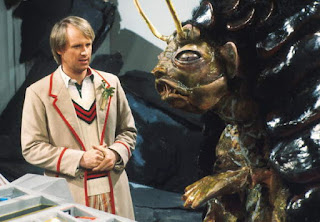 Bidmead included monsters – reluctantly – at the insistence of John Nathan-Turner. On reflection, this seems a dodgy call. Monsters from Bidmead were always going to be too concept-heavy to realise properly on screen. Sure enough, he comes up with giant woodlice that can disguise themselves as rocks until they unexpectedly uncurl… which was never gonna look good on the day.
Apparently finding the macabre more fascinating than he expected, Bidmead also included alien machines made with bits of corpses. This was very tuned in to the then-current turn towards biomechanics and ‘body horror’ in the fantasy genre, but it proved too horrific for Doctor Who to attempt on screen (though it livens up the novelisation).
The politics is also a departure. Aside from Tegan’s worries about sweatshops in 'Logopolis' and the hilarious sexism of the Castrovalvans, previous Bidmead scripts seem politically detached. He’s a world-builder, but not in the utopian or dystopian manner. So 'Frontios' comes a little out of leftfield... though that’s the only leftish thing about it. I’ve no idea what Bidmead’s own politics may be, but 'Frontios' seems to say that the ordinary people require stern discipline, that they want and need confident rulers. The story frowns on the ‘every man for himself’ ethic, yet implies that only hierarchy and obedience stand between society and what Hobbes described as the “war of all against all”.
In the absence of Plantagenet, there is “anarchy”, with the colonists turning to looting with a rapidity that is almost funny. Thrown “outside the system”, Cockerill is quickly attacked by ravening ‘Retrogrades’. However, when he apparently defeats the hungry earth, Cockerill is eagerly adopted as a replacement leader by the mob. Meanwhile, Plantagenet’s bravery proves he is genetically fit to rule (he is, after all, named after a line of kings). Brazen – the personification of authority – ultimately proves himself admirable, his noble final words being “that’s an order!”.
Actually, I think 'Frontios' has more in common with 'Logopolis' than it appears. Bidmead never takes the series into the past – he’s too aware of entropy as ‘time’s arrow’ to believe that you can go backwards – and his view of the far future is one of maximum entropy. The “failure proof technology” that failed, the dwindling population, the wrecked ship, the malfunctioning generator, the “doomed planet Earth”, etc. Mine shafts collapse. Lights stop working. The TARDIS falls apart. Even “eaten by the earth” sounds like a metaphor for putrefaction.
The politics reflects this state of decay. Order becomes disorder as Orderlies become disorderly. The structure of society crumbles, undermined from below, as people die unaccountably and the ‘Rets’ desert the sinking ship. Bidmead is always treating entropy as corrupted information; in 'Frontios', Range’s secret file is information uselessly pooled, like waste heat in a machine.
Even the monsters are “an infection”, like all Bidmead baddies. The Master is like a computer virus in both 'Logopolis' and 'Castrovalva', infecting the hard drive of reality and corrupting the information. Interestingly, however, the Tractators also fight entropy in their own nasty way. The gravity drive and excavating machine represent structure, after all. That’s why it’s such a shame that we never get to see the Tractators’ corpse engines, because what could better express their parasitic method of fighting entropy than machines patched up with bits of people?
Additional: Peter Davison as Rambo
The Tractators burrow away. Like all burrowing creatures, they carry connotations of the busy and the unseen. Like the 'mole of history', they are always working beneath our feet. This must carry valences in a story so obviously predicated upon the human race having reached an endpoint. Despite the ostensibly hopeful ending of the story, I think it's clear that the humans on Frontios are quite likely doomed. This is the end. This is what it was all leading up to. The history that burrows beneath them has lead them to the point of maximum entropy (as noted), to isolation in a cosmos where everything has drifted so far away from everything else that space itself isolates you.
The Tractators are, from one angle, manifestations of History as busy industry leading to decay anyway, of the entropy inherent in time. They lead the human race to an echoing, muddy telos... moreover, it's a telos of authoritarianism, necessary to counter our original sins as they are exacerbated by siege and starvation. Yet Plantagenet is no Leviathan, however much the world he tries to rule conforms to Hobbesian pessimism. He won't be able to save them. In a way, the Tractators were their last hope. Not to live, but to fight. The Gravis could've been Leviathan for them... and his busy, selfish, greedy, industrious grotesques (they are, of course, echoes of the subterrenean Semitic dwarves of Wagner and Tolkien) were the humans' last hope to cheat the cosmic/social 'running down' endemic at the endpoint of space/time and History. The Tractators could've used them. They could've used the humans as raw material in their fearsome engines, their gravity drive, their anti-entropy machine, their anti-History contraption.
There is a strange, unsettling ambiguity here that chimes with the political implications of the face-off between the two races. The humans are colonists and, as ever, it is assumed that colonists that look like whitey have every right to be there... and yet the Tractators don't convince as natives. They don't come from this final F/frontier. They are as much colonists as are the humans. They are as much anti-entropists as the humans (though they're better at it). They are as much Hobbesian authoritarians as the humans, with their one Absolute Leader whose brain is the key to their collective will (though again, as noted, they are more effective in this respect than their two-legged rivals). Woodlice are actually crustaceans (which may even give the Tractators a touch of the Weird...) but they look and act enough like bugs to fool most of us into instinctively linking them with insects, and insects (with their hives and castes and hierarchies and group will) are always symbols of human society as an antheap, as a pyramid of the mindlessly obedient.
In short, there's little to choose between the Tractators and the humans in 'Frontios'. The Tractators are the aggressors... but would the humans, so eager to stamp on each other when needed, forebear to do unto the Tractators as the Tractators have done unto them? Again, the only difference is in efficiency. So, at the end of History, it all comes down to ruthless Darwinian effectiveness... and/or how entropy-proof our machines are. The Tractators machines, as noted, sidewind around entropy by roping in life itself, the only force that ever temporarily stalls entropy (this is not, by the way, necessarily my metaphysics). We humans look doomed because, for all our best efforts to be as ruthless as we need to be, we can't cut it. We go squishy when it counts. Brazen gets himself killed by compromising (he lets himself be interrogated by an inquiry! he makes peace with Range the whining liberal backstabber!) and then having a bash at altruism. We are outstripped by the utter mercilessness of the animals. It's the sociobiologist's wet dream. And, again, it's deeply Hobbesian.
Plantagenet's tottering camp is the old regime. Decadent. Gone soft. Insufficiently strong and brutal to defend itself against the onrushing Puritans/Jacobins/Bolsheviks/Jews, etc., unable to make the grade in the bellum omnium contra omnes. I've been reading Corey Robin on this just recently. This contempt for the old regime as weak, this anger at the softness of the very regime for which it takes up the cudgels, is a staple of conservatism... right up to, to pick an instance entirely at random (honest guv), John Milius's script for Apocalypse Now. 'Charlie' (i.e. the Viet Cong) will win because "his idea of R&R is a little rat meat". If Kurtz had a division of men strong enough to hack off the arms of babies, he could win the war. Much as I love that film, one of its most prominent inner logics (to its credit it has several conflicting inner logics) is the same inner logic as Rambo II, which is itself a self-induced orgasm of the dreary ultra-conservative attitude to America's wars. Kurtz/Rambo is the Leviathan the inferior liberal Americans need to carry them past cowardice, decadence or scruple. At least Coppola's film has the decent queasiness to see that Kurtz has to go mad first.
Similarly, in 'Frontios', the only reason the humans ultimately win is because of the Doctor's intervention. He becomes their (sane and reasonable) Leviathan. He terminates the termites with extreme prejudice. He saves the human antheap against the crustacean one. He saves the ancient regime from the barbarians at the gate, and from its own softness.
Even so, it's hard to quite read 'Frontios' straightforwardly as a celebration of the Leviathan, of the rule of law and hierarchy, of the victory of the strongest, of the defeat of the Niebelung by Wotan. In the end - and we are definitely at the end, beautiful friend - entropy still lies in wait. There's always something stronger than you. Time and History (that burrowing little thing) will kill even Rambo one day. Doctor Kurtz... he dead.
31/01/13
(Lyrics by The Doors... as if you didn't know.)
This is the end
Beautiful friend
This is the end
My only friend, the end
Of our elaborate plans, the end
Of everything that stands, the end
At first, 'Frontios' seems like the odd one out amongst Christopher H. Bidmead’s Doctor Who scripts. Unlike 'Logopolis' and 'Castrovalva', it’s overtly political and doesn’t seem to be powered by any underlying scientific concept. Also, it has monsters in it.

Apparently finding the macabre more fascinating than he expected, Bidmead also included alien machines made with bits of corpses. This was very tuned in to the then-current turn towards biomechanics and ‘body horror’ in the fantasy genre, but it proved too horrific for Doctor Who to attempt on screen (though it livens up the novelisation).
The politics is also a departure. Aside from Tegan’s worries about sweatshops in 'Logopolis' and the hilarious sexism of the Castrovalvans, previous Bidmead scripts seem politically detached. He’s a world-builder, but not in the utopian or dystopian manner. So 'Frontios' comes a little out of leftfield... though that’s the only leftish thing about it. I’ve no idea what Bidmead’s own politics may be, but 'Frontios' seems to say that the ordinary people require stern discipline, that they want and need confident rulers. The story frowns on the ‘every man for himself’ ethic, yet implies that only hierarchy and obedience stand between society and what Hobbes described as the “war of all against all”.
In the absence of Plantagenet, there is “anarchy”, with the colonists turning to looting with a rapidity that is almost funny. Thrown “outside the system”, Cockerill is quickly attacked by ravening ‘Retrogrades’. However, when he apparently defeats the hungry earth, Cockerill is eagerly adopted as a replacement leader by the mob. Meanwhile, Plantagenet’s bravery proves he is genetically fit to rule (he is, after all, named after a line of kings). Brazen – the personification of authority – ultimately proves himself admirable, his noble final words being “that’s an order!”.
Actually, I think 'Frontios' has more in common with 'Logopolis' than it appears. Bidmead never takes the series into the past – he’s too aware of entropy as ‘time’s arrow’ to believe that you can go backwards – and his view of the far future is one of maximum entropy. The “failure proof technology” that failed, the dwindling population, the wrecked ship, the malfunctioning generator, the “doomed planet Earth”, etc. Mine shafts collapse. Lights stop working. The TARDIS falls apart. Even “eaten by the earth” sounds like a metaphor for putrefaction.
The politics reflects this state of decay. Order becomes disorder as Orderlies become disorderly. The structure of society crumbles, undermined from below, as people die unaccountably and the ‘Rets’ desert the sinking ship. Bidmead is always treating entropy as corrupted information; in 'Frontios', Range’s secret file is information uselessly pooled, like waste heat in a machine.
Even the monsters are “an infection”, like all Bidmead baddies. The Master is like a computer virus in both 'Logopolis' and 'Castrovalva', infecting the hard drive of reality and corrupting the information. Interestingly, however, the Tractators also fight entropy in their own nasty way. The gravity drive and excavating machine represent structure, after all. That’s why it’s such a shame that we never get to see the Tractators’ corpse engines, because what could better express their parasitic method of fighting entropy than machines patched up with bits of people?
Additional: Peter Davison as Rambo
Desperately in need of some stranger's hand
In a desperate land
In a desperate land
The Tractators burrow away. Like all burrowing creatures, they carry connotations of the busy and the unseen. Like the 'mole of history', they are always working beneath our feet. This must carry valences in a story so obviously predicated upon the human race having reached an endpoint. Despite the ostensibly hopeful ending of the story, I think it's clear that the humans on Frontios are quite likely doomed. This is the end. This is what it was all leading up to. The history that burrows beneath them has lead them to the point of maximum entropy (as noted), to isolation in a cosmos where everything has drifted so far away from everything else that space itself isolates you.
The Tractators are, from one angle, manifestations of History as busy industry leading to decay anyway, of the entropy inherent in time. They lead the human race to an echoing, muddy telos... moreover, it's a telos of authoritarianism, necessary to counter our original sins as they are exacerbated by siege and starvation. Yet Plantagenet is no Leviathan, however much the world he tries to rule conforms to Hobbesian pessimism. He won't be able to save them. In a way, the Tractators were their last hope. Not to live, but to fight. The Gravis could've been Leviathan for them... and his busy, selfish, greedy, industrious grotesques (they are, of course, echoes of the subterrenean Semitic dwarves of Wagner and Tolkien) were the humans' last hope to cheat the cosmic/social 'running down' endemic at the endpoint of space/time and History. The Tractators could've used them. They could've used the humans as raw material in their fearsome engines, their gravity drive, their anti-entropy machine, their anti-History contraption.
There is a strange, unsettling ambiguity here that chimes with the political implications of the face-off between the two races. The humans are colonists and, as ever, it is assumed that colonists that look like whitey have every right to be there... and yet the Tractators don't convince as natives. They don't come from this final F/frontier. They are as much colonists as are the humans. They are as much anti-entropists as the humans (though they're better at it). They are as much Hobbesian authoritarians as the humans, with their one Absolute Leader whose brain is the key to their collective will (though again, as noted, they are more effective in this respect than their two-legged rivals). Woodlice are actually crustaceans (which may even give the Tractators a touch of the Weird...) but they look and act enough like bugs to fool most of us into instinctively linking them with insects, and insects (with their hives and castes and hierarchies and group will) are always symbols of human society as an antheap, as a pyramid of the mindlessly obedient.
In short, there's little to choose between the Tractators and the humans in 'Frontios'. The Tractators are the aggressors... but would the humans, so eager to stamp on each other when needed, forebear to do unto the Tractators as the Tractators have done unto them? Again, the only difference is in efficiency. So, at the end of History, it all comes down to ruthless Darwinian effectiveness... and/or how entropy-proof our machines are. The Tractators machines, as noted, sidewind around entropy by roping in life itself, the only force that ever temporarily stalls entropy (this is not, by the way, necessarily my metaphysics). We humans look doomed because, for all our best efforts to be as ruthless as we need to be, we can't cut it. We go squishy when it counts. Brazen gets himself killed by compromising (he lets himself be interrogated by an inquiry! he makes peace with Range the whining liberal backstabber!) and then having a bash at altruism. We are outstripped by the utter mercilessness of the animals. It's the sociobiologist's wet dream. And, again, it's deeply Hobbesian.
Plantagenet's tottering camp is the old regime. Decadent. Gone soft. Insufficiently strong and brutal to defend itself against the onrushing Puritans/Jacobins/Bolsheviks/Jews, etc., unable to make the grade in the bellum omnium contra omnes. I've been reading Corey Robin on this just recently. This contempt for the old regime as weak, this anger at the softness of the very regime for which it takes up the cudgels, is a staple of conservatism... right up to, to pick an instance entirely at random (honest guv), John Milius's script for Apocalypse Now. 'Charlie' (i.e. the Viet Cong) will win because "his idea of R&R is a little rat meat". If Kurtz had a division of men strong enough to hack off the arms of babies, he could win the war. Much as I love that film, one of its most prominent inner logics (to its credit it has several conflicting inner logics) is the same inner logic as Rambo II, which is itself a self-induced orgasm of the dreary ultra-conservative attitude to America's wars. Kurtz/Rambo is the Leviathan the inferior liberal Americans need to carry them past cowardice, decadence or scruple. At least Coppola's film has the decent queasiness to see that Kurtz has to go mad first.
Similarly, in 'Frontios', the only reason the humans ultimately win is because of the Doctor's intervention. He becomes their (sane and reasonable) Leviathan. He terminates the termites with extreme prejudice. He saves the human antheap against the crustacean one. He saves the ancient regime from the barbarians at the gate, and from its own softness.
Even so, it's hard to quite read 'Frontios' straightforwardly as a celebration of the Leviathan, of the rule of law and hierarchy, of the victory of the strongest, of the defeat of the Niebelung by Wotan. In the end - and we are definitely at the end, beautiful friend - entropy still lies in wait. There's always something stronger than you. Time and History (that burrowing little thing) will kill even Rambo one day. Doctor Kurtz... he dead.
31/01/13
(Lyrics by The Doors... as if you didn't know.)
Subscribe to:
Posts (Atom)