“A commodity appears at first sight an extremely obvious, trivial
thing. But its analysis brings out that it is a very strange thing,
abounding in metaphysical subtleties and theological niceties. So far as
it is a use-value, there is nothing mysterious about it, whether we
consider it from the point of view that by its properties it satisfies
human needs, or that it first takes on these properties as the product
of human labour. It is absolutely clear that, by his activity, man
changes the forms of the materials of nature in such a way as to make
them useful to him. The form of wood, for instance, is altered if a
table is made out of it. Nevertheless the table continues to be wood, an
ordinary sensuous thing. But as soon as it emerges as a commodity, it
changes into a thing which transcends sensuousness. It not only stands
with its feet on the ground, but, in relation to all other commodities,
it stands on its head, and evolves out of its wooden brain grotesque
ideas, far more wonderful than if it were to begin dancing of its own
free will.”
- Karl Marx, Capital vol.1
Consciously or not, a
lion’s share of SF/Fantasy is concerned with just this. Almost to the
point of running with Marx’s ‘great idea for a story!’.
It’s
also a great illustration that the best Marxism is Gothic Marxism. A
Marxism which recognises the uncanny, the weird, the surreal, the
fantastic, as both truthful expression and invaluable heuristic. The
real world is made so strange, so bass-ackwards, so haunted and haunting, so alien by capitalism, that only historical materialism informed by the uncanny and the dreamlike can truly capture it.

ideas are icepickproof
Showing posts with label alienation. Show all posts
Showing posts with label alienation. Show all posts
Thursday, 20 August 2015


Saturday, 16 November 2013
21
Earl plays a C on his harmonica. It starts a sympathetic resonance in the pipes that stretch under and through the regime on Terra Alpha, like the arteries in a body. What flows in these arteries is sugarly gloop, the outpourings of the Kandy Kitchen. It fills the regime with the glucose it needs to survive. And the regime uses it to kill dissidents or refuseniks or men wearing pink triangles, drowning them in sweetness. Earl's note causes the encrusted, crystallised, fossilised sugar coating the insides of the pipes to crack and fall. Tonnes of the stuff falls on top of Fifi, Helen A's savage attack dog and beloved pet. She sent it into the pipes to kill the Doctor and the Pipe People, the surviving aboriginals on her colony.
"Happiness will prevail," says the artificially fruity voice on the colony tannoy system, "Factory guards are joining forces with the drones to destroy the Nevani sugar beet plant here in sector six. We will keep broadcasting."
This is a revolution. The killjoys are marching and demonstrating, and having their own melancholy parties in subversion of the rules. The factories are falling to strikers. Even the aboriginals are getting in on the act. And, as in 'The Sun Makers', you know the revolution is really happening when it even gets on the news.
"It's only one factory, Daisy K," says Helen A, dictator of Terra Alpha and obvious Thatcher analogue, "I've built over a thousand." (Not that much like Thatcher then. She didn't build up manufacturing industry; she calculatedly decimated it.)
"What about the reports of riots?," asks Daisy K, "And public unhappiness?"
Oh for the days when things like the Poll Tax (which, like so many things, now looks like gnat's piss by comparison) used to cause good, healthy, necessary riots.
Helen A wants to use her best, most fanatical enforcer... but it turns out that she's already been detained in her own Waiting Zone (they don't have 'prisons' on Terra Alpha, there being no need for unhappy places in the best of all possible worlds). So instead, Helen A asks Daisy K to...
"Get me the Kandyman."
"You're not unhappy about something?" asks Daisy K, noticing the cracks in Helen A's ideological purity when her own self-interest is threatened... just as Thatcher cried for herself when someone subjected her to the strictures of the marketplace of ideas.
"GET ME THE KANDYMAN!"
The Kandyman answers his telephone.
"Kandyman," he says. (This bit makes me gurgle with pleasure every time. It's so arch.)
He's an evil Bertie Basset. Bassett himself is a PR image, an advert, an avatar of a company, a promotor of consumption, the friendly face of capitalism who cheerily encourages kids to shovel sugary shite into their mouths so his puppetmasters can make a profit. The Kandyman is all this and an accretion of various manifestations of authority. He's the state torturer of a dictator, a killer brand, a manifestation of the confected malnutritious psuedo-delights of consumer capitalism reconfigured as a psychopathic sadist... and he's a tool, a machine, a commodity fetishised into life, alienated labour (he is the product of the labour of Gilbert M) that confronts his creator as hostile and alien power. And he's a bureaucrat. He might even be Gilbert M's mother, or his 'nagging' wife. (I wouldn't put it past a story like this, which harnesses the Planet-of-Women trope to rather dunderheaded effect, sometimes looking like a reactionary whinge about 'reverse sexism'.)
Helen A tells the Kandyman to get the Doctor - at any price.
"That won't be necessary," simpers the Kandyman viciously, "he's just dropped in."
The Doctor and Ace harry the Kandyman into his own pipes, where he is consumed by his own torrents of monosodium glutamate, flavouring and preservative.
Terra Alpha is a Stalinist 'paradise', i.e. everyone pretending to be deliriously happy... or pretending that they're pretending... and pretending that everyone else is pretending... while surrounded by corruption, decay and authoritarian brutality. As in 'The Macra Terror' and 'The Sun Makers', 'Happiness Patrol' combines open anxiety about capitalism with a doggerel-Orwellian story about totalitarianism. It may be because of the influence of Kneale/Cartier's TV version of Nineteen Eighty-Four, and the appeal of the Orwellian aesthetics, that this mode got embedded in the show. But the anxiety about capitalism is already built-in to Orwell's satire. He knew that 'really existing socialism' (i.e. Stalinism) was a kind of state capitalism (though his grasp of this was intermittent, and instinctive rather than theoretical). But he knew that Big Brother's Oceania was just a shabbier, nastier, more intense version of capitalist, imperialist, class-ridden Britain.
This same elision allows Doctor Who to notice the fundamental synergy and compatibility of Stalinism and 'market Stalinism', of authoritarianism and neoliberalism. Helen A likes Silas P's "enterprise and initiative" as a murderer of dissidents. He's aiming for the top in this meritocracy. All he has to do is stamp on people on every rung of the ladder. Thatcher admires 'law and order' while sponsoring covert warfare and police attacks against striking miners. And don't forget about the "moaning minnies", the whingeing lefties always complaining. The "enemy within". Killjoys, in other words.
That's why the smiley face of 80s Acidhouse was such subversion when it started: it was libertarian Thatcherism taken at its smiling face value.
"Happiness will prevail," says the artificially fruity voice on the colony tannoy system, "Factory guards are joining forces with the drones to destroy the Nevani sugar beet plant here in sector six. We will keep broadcasting."
This is a revolution. The killjoys are marching and demonstrating, and having their own melancholy parties in subversion of the rules. The factories are falling to strikers. Even the aboriginals are getting in on the act. And, as in 'The Sun Makers', you know the revolution is really happening when it even gets on the news.
"It's only one factory, Daisy K," says Helen A, dictator of Terra Alpha and obvious Thatcher analogue, "I've built over a thousand." (Not that much like Thatcher then. She didn't build up manufacturing industry; she calculatedly decimated it.)
"What about the reports of riots?," asks Daisy K, "And public unhappiness?"
Oh for the days when things like the Poll Tax (which, like so many things, now looks like gnat's piss by comparison) used to cause good, healthy, necessary riots.
Helen A wants to use her best, most fanatical enforcer... but it turns out that she's already been detained in her own Waiting Zone (they don't have 'prisons' on Terra Alpha, there being no need for unhappy places in the best of all possible worlds). So instead, Helen A asks Daisy K to...
"Get me the Kandyman."
"You're not unhappy about something?" asks Daisy K, noticing the cracks in Helen A's ideological purity when her own self-interest is threatened... just as Thatcher cried for herself when someone subjected her to the strictures of the marketplace of ideas.
"GET ME THE KANDYMAN!"
The Kandyman answers his telephone.
"Kandyman," he says. (This bit makes me gurgle with pleasure every time. It's so arch.)
He's an evil Bertie Basset. Bassett himself is a PR image, an advert, an avatar of a company, a promotor of consumption, the friendly face of capitalism who cheerily encourages kids to shovel sugary shite into their mouths so his puppetmasters can make a profit. The Kandyman is all this and an accretion of various manifestations of authority. He's the state torturer of a dictator, a killer brand, a manifestation of the confected malnutritious psuedo-delights of consumer capitalism reconfigured as a psychopathic sadist... and he's a tool, a machine, a commodity fetishised into life, alienated labour (he is the product of the labour of Gilbert M) that confronts his creator as hostile and alien power. And he's a bureaucrat. He might even be Gilbert M's mother, or his 'nagging' wife. (I wouldn't put it past a story like this, which harnesses the Planet-of-Women trope to rather dunderheaded effect, sometimes looking like a reactionary whinge about 'reverse sexism'.)
Helen A tells the Kandyman to get the Doctor - at any price.
"That won't be necessary," simpers the Kandyman viciously, "he's just dropped in."
The Doctor and Ace harry the Kandyman into his own pipes, where he is consumed by his own torrents of monosodium glutamate, flavouring and preservative.
Terra Alpha is a Stalinist 'paradise', i.e. everyone pretending to be deliriously happy... or pretending that they're pretending... and pretending that everyone else is pretending... while surrounded by corruption, decay and authoritarian brutality. As in 'The Macra Terror' and 'The Sun Makers', 'Happiness Patrol' combines open anxiety about capitalism with a doggerel-Orwellian story about totalitarianism. It may be because of the influence of Kneale/Cartier's TV version of Nineteen Eighty-Four, and the appeal of the Orwellian aesthetics, that this mode got embedded in the show. But the anxiety about capitalism is already built-in to Orwell's satire. He knew that 'really existing socialism' (i.e. Stalinism) was a kind of state capitalism (though his grasp of this was intermittent, and instinctive rather than theoretical). But he knew that Big Brother's Oceania was just a shabbier, nastier, more intense version of capitalist, imperialist, class-ridden Britain.
This same elision allows Doctor Who to notice the fundamental synergy and compatibility of Stalinism and 'market Stalinism', of authoritarianism and neoliberalism. Helen A likes Silas P's "enterprise and initiative" as a murderer of dissidents. He's aiming for the top in this meritocracy. All he has to do is stamp on people on every rung of the ladder. Thatcher admires 'law and order' while sponsoring covert warfare and police attacks against striking miners. And don't forget about the "moaning minnies", the whingeing lefties always complaining. The "enemy within". Killjoys, in other words.
That's why the smiley face of 80s Acidhouse was such subversion when it started: it was libertarian Thatcherism taken at its smiling face value.
Monday, 11 November 2013
35
Lytton and Griffiths are wandering across a quarry. It actually is a quarry. Something is being dug up or mined there, by slaves watched over by Cybermen.
Lytton has a device that detects Cybermen.
"There are two very close," he says.
"That's right!" shouts a very human voice from behind him.
Bates and Stratton - two escapees from the Cybermen's labour gangs - disarm and frisk Lytton and Griffiths.
Lytton has been looking for them, and they've been looking for him.
"Are they Cybermen?" asks the perplexed Griffiths.
"Almost," says Lytton, amused.
"This is what the Cybermen do to you..." sneers Bates, removing his glove and sleeve to reveal a cybernetic arm, a chilly construct of steel and pulleys. His metal hand closes on Griffiths' fleshy one and squeezes. Bates watched Griffiths' pain with dead eyes.
"How much of you?"
"Arms and legs."
Bates and Stratton are rejects from the Cyber-conversion process. The Cybermen turn their rejects - the ones that cannot be entirely consumed - into labourers in their quarry.
So... the Cybermen start with the arms and legs. The legs that give locomotion. The arms and hands that lift and move and dig and manipulate. The organs of physical work.
When the Cybermen catch Lytton and subject him to conversion, they start with his arms.
The original Cybermen had human hands.
The severed hand is a recurring motif of the gothic.
The gothic is about dead labour, the living death of alienated work, the physical invasion and evisceration wrought by capital upon the working body, and the occult process whereby wealth is created from labour.
The Cybermen - with their skull-faces - are gothic things. Zombies, in the old fashioned sense. People reduced to pure labour power.
Lytton has a device that detects Cybermen.
"There are two very close," he says.
"That's right!" shouts a very human voice from behind him.
Bates and Stratton - two escapees from the Cybermen's labour gangs - disarm and frisk Lytton and Griffiths.
Lytton has been looking for them, and they've been looking for him.
"Are they Cybermen?" asks the perplexed Griffiths.
"Almost," says Lytton, amused.
"This is what the Cybermen do to you..." sneers Bates, removing his glove and sleeve to reveal a cybernetic arm, a chilly construct of steel and pulleys. His metal hand closes on Griffiths' fleshy one and squeezes. Bates watched Griffiths' pain with dead eyes.
"How much of you?"
"Arms and legs."
Bates and Stratton are rejects from the Cyber-conversion process. The Cybermen turn their rejects - the ones that cannot be entirely consumed - into labourers in their quarry.
So... the Cybermen start with the arms and legs. The legs that give locomotion. The arms and hands that lift and move and dig and manipulate. The organs of physical work.
When the Cybermen catch Lytton and subject him to conversion, they start with his arms.
The original Cybermen had human hands.
The severed hand is a recurring motif of the gothic.
The gothic is about dead labour, the living death of alienated work, the physical invasion and evisceration wrought by capital upon the working body, and the occult process whereby wealth is created from labour.
The Cybermen - with their skull-faces - are gothic things. Zombies, in the old fashioned sense. People reduced to pure labour power.
36
The Doctor, Zoe and Jamie are brought in to see the Master of the Land of Fiction. He has dossiers on them. He is, as Zoe says, very well organised.
"We have to be," he says, "The running of this place requires enormous attention to detail. It's a responsible position, but very rewarding"
A 'responsible position'. So it's a job.
"Responsible to who?" asks the Doctor.
Not to a person, says the Master, to "another power. Higher than you could begin to imagine."
A system, an inhuman hegemon.
He congratulates them on the way they handled their tests. They have passed the job interview.
It transpires that the Master is a writer.
"Did you ever hear of the Adventures of Captain Jack Harkaway?" he asks.
"No, I can't say that I... wait a minute, a serial in a boys' magazine?"
"The Ensign! For twenty-five years, I delivered five thousand words every week!"
"Twenty-five years, five thousand words a week..." Zoe adds it up... "that's well over half a million words!"
"That's why I was selected to work here," says the Master. He got headhunted.
He spent his life working to create copy for a publisher, who took his words and turned them into commodities. The commodities were copies of his own ideas, his own characters, taken from him and transformed. They piled up around him. They took on a life of their own, apart from him. Now he lives in a world of characters who were created by human labour, taken and turned into commodities. They too have lives of their own. In Marxism, this is called reification: the objectification of the social relations of production as things. And it's also commodity fetishism: the treatment of commodities (in this case, fictions) as though they people... and the treatment of people as though they were commodities. One form of this is wage labour, and on that subject...
"And you're the one that's in charge of all of this?" asks Jamie.
The 'Master' hedges.
"Or is all this in charge of you?" asks the Doctor.
"My brain is the source of the creative power which keeps this operation going."
So he doesn't control it, but it won't run without him, without his work. Just like the magazines wouldn't get made without the intellectual, creative labour of people like him... just like the printing presses wouldn't print them without the manual labour of printers... just like the printed magazines wouldn't get sold if it weren't for the manual labour of distributors...
He's now in a world literally run by an alien power that robs minds, just as his mind was robbed to make magazines. And it wants to turn humanity into a string of sausages, all the same.
He denies that he's a prisoner, but then the globe behind him glows and a siren sounds and the machinery demands his attention. Soon it speaks through him, its stentorian commands coming from his mouth. He tries to negotiate with it. He wants to finally retire... but first he must recruit his successor.
Back to work, Master. Back to work.
"We have to be," he says, "The running of this place requires enormous attention to detail. It's a responsible position, but very rewarding"
A 'responsible position'. So it's a job.
"Responsible to who?" asks the Doctor.
Not to a person, says the Master, to "another power. Higher than you could begin to imagine."
A system, an inhuman hegemon.
He congratulates them on the way they handled their tests. They have passed the job interview.
It transpires that the Master is a writer.
"Did you ever hear of the Adventures of Captain Jack Harkaway?" he asks.
"No, I can't say that I... wait a minute, a serial in a boys' magazine?"
"The Ensign! For twenty-five years, I delivered five thousand words every week!"
"Twenty-five years, five thousand words a week..." Zoe adds it up... "that's well over half a million words!"
"That's why I was selected to work here," says the Master. He got headhunted.
He spent his life working to create copy for a publisher, who took his words and turned them into commodities. The commodities were copies of his own ideas, his own characters, taken from him and transformed. They piled up around him. They took on a life of their own, apart from him. Now he lives in a world of characters who were created by human labour, taken and turned into commodities. They too have lives of their own. In Marxism, this is called reification: the objectification of the social relations of production as things. And it's also commodity fetishism: the treatment of commodities (in this case, fictions) as though they people... and the treatment of people as though they were commodities. One form of this is wage labour, and on that subject...
"And you're the one that's in charge of all of this?" asks Jamie.
The 'Master' hedges.
"Or is all this in charge of you?" asks the Doctor.
"My brain is the source of the creative power which keeps this operation going."
So he doesn't control it, but it won't run without him, without his work. Just like the magazines wouldn't get made without the intellectual, creative labour of people like him... just like the printing presses wouldn't print them without the manual labour of printers... just like the printed magazines wouldn't get sold if it weren't for the manual labour of distributors...
He's now in a world literally run by an alien power that robs minds, just as his mind was robbed to make magazines. And it wants to turn humanity into a string of sausages, all the same.
He denies that he's a prisoner, but then the globe behind him glows and a siren sounds and the machinery demands his attention. Soon it speaks through him, its stentorian commands coming from his mouth. He tries to negotiate with it. He wants to finally retire... but first he must recruit his successor.
Back to work, Master. Back to work.
Friday, 8 November 2013
41
Early morning in Britain.
Shop-window dummies twitch, stand up and smash their way out into the high street. They stalk past the shop logos and brand names and adverts. Price tags dangle from their fashionable clothes.
Their hands are not like human hands. They're not organs of manipulation, to be used for work. They flip open to reveal weapons.
The dummies encounter shoppers, or people waiting for the bus to work. They gun them down. People fall and die next to the shop fronts.
The dummies are plastic effigies of people. Products, manufactured things, fashioned in the human image. They alienate the human image from humans. They were made in a factory, on a production line, by workers. Sold to shops. They are hostile commodities, made for a capitalist concern; made by people working for a wage, yet out of human control, invested with a life of their own, confronting people as an external, dominating, fierce, blank, gothic, inhuman power.
By the way Karl, the people who made these dummies were women. The dummies, by contrast, are all male. The dummies are all white too, because that's what the default, 'vanilla' human is to capitalist culture: male and white. Several of the women we see working in Auto Plastics are not white.
Talk about alienation.
Shop-window dummies twitch, stand up and smash their way out into the high street. They stalk past the shop logos and brand names and adverts. Price tags dangle from their fashionable clothes.
Their hands are not like human hands. They're not organs of manipulation, to be used for work. They flip open to reveal weapons.
The dummies encounter shoppers, or people waiting for the bus to work. They gun them down. People fall and die next to the shop fronts.
The dummies are plastic effigies of people. Products, manufactured things, fashioned in the human image. They alienate the human image from humans. They were made in a factory, on a production line, by workers. Sold to shops. They are hostile commodities, made for a capitalist concern; made by people working for a wage, yet out of human control, invested with a life of their own, confronting people as an external, dominating, fierce, blank, gothic, inhuman power.
The alienation of the worker in his product means not only that his labour becomes an object, an external existence, but that it exists outside him, independently, as something alien to him, and that it becomes a power on its own confronting him. It means that the life which he has conferred on the object confronts him as something hostile and alien.
- Karl Marx, Economic and Philosophical Manuscripts of 1844
By the way Karl, the people who made these dummies were women. The dummies, by contrast, are all male. The dummies are all white too, because that's what the default, 'vanilla' human is to capitalist culture: male and white. Several of the women we see working in Auto Plastics are not white.
Talk about alienation.
Tuesday, 5 November 2013
44
In a prison cell on Skaro, the Doctor and Jamie watch as Maxtible is paid by the Daleks for services rendered.
"The secret you promised me!" he demands.
Maxtible is a wealthy, propertied, Victorian gentleman who thinks of everything in terms of business transactions. His charity to Waterfield and his daughter has given him - Maxtible - proprietory rights to use them as he wishes, as servant and collateral. His pact with the Daleks is a "partnership". He is providing a service in return for payment. His payment is to be a secret that he has been pursuing fanatically, at the expense of anyone who gets in his way.
"The secret of transmuted metal," confirms the Black Dalek.
A series of formulae flash up on a screen. For all the talk of "atomic weight" and "specific gravity", the details are occult. But the transmutation is achieved.
"Gold!" cries Maxtible, "Iron into gold! I told you it was possible! They've kept their promise! It's true, it's true! They have!"
He thinks he has completed the alchemist's project... but that project was about harnessing purity and immutability in the hope of returning humanity to its nature before the fall. In aiding the Daleks, Maxtible has done the reverse of this: he has helped harness 'the human factor' in the service of utterly fallen things.
In any case, his lust for gold is nothing to do with purity. It is the general obsession of any Victorian gentleman. It's the basis of Victorian society. The secret he obsesses over is the secret of capital. The seemingly magical ability of capitalist production to create wealth from nowhere, from commodities that come out worth more than the raw materials that went into them. From dross comes gold - straight into the gentleman's pockets.
This is the basis of all Victorian gothic: the occult and occluded nature of profit, of capital accumulation.
The real secret, the thing occluded, is 'the human factor'. Human work, or 'species-being', alienated from humans and appearing to Maxtible in the form of Daleks, in the form of alien machines that drain humanity and substitute their own essence... which is what happens to him immediately after he is paid for his services.
His real payment is to be given 'the Dalek factor'. To be made into an occult, gothic thing. A Victorian zombie.
"The secret you promised me!" he demands.
Maxtible is a wealthy, propertied, Victorian gentleman who thinks of everything in terms of business transactions. His charity to Waterfield and his daughter has given him - Maxtible - proprietory rights to use them as he wishes, as servant and collateral. His pact with the Daleks is a "partnership". He is providing a service in return for payment. His payment is to be a secret that he has been pursuing fanatically, at the expense of anyone who gets in his way.
"The secret of transmuted metal," confirms the Black Dalek.
A series of formulae flash up on a screen. For all the talk of "atomic weight" and "specific gravity", the details are occult. But the transmutation is achieved.
"Gold!" cries Maxtible, "Iron into gold! I told you it was possible! They've kept their promise! It's true, it's true! They have!"
He thinks he has completed the alchemist's project... but that project was about harnessing purity and immutability in the hope of returning humanity to its nature before the fall. In aiding the Daleks, Maxtible has done the reverse of this: he has helped harness 'the human factor' in the service of utterly fallen things.
In any case, his lust for gold is nothing to do with purity. It is the general obsession of any Victorian gentleman. It's the basis of Victorian society. The secret he obsesses over is the secret of capital. The seemingly magical ability of capitalist production to create wealth from nowhere, from commodities that come out worth more than the raw materials that went into them. From dross comes gold - straight into the gentleman's pockets.
This is the basis of all Victorian gothic: the occult and occluded nature of profit, of capital accumulation.
The real secret, the thing occluded, is 'the human factor'. Human work, or 'species-being', alienated from humans and appearing to Maxtible in the form of Daleks, in the form of alien machines that drain humanity and substitute their own essence... which is what happens to him immediately after he is paid for his services.
His real payment is to be given 'the Dalek factor'. To be made into an occult, gothic thing. A Victorian zombie.
Wednesday, 12 June 2013
Dreams About Unicorns
On 'The Mind Robber'. A regurgitation of something originally buried in the middle of an old post.
1. The Review
Just one of the best things ever, this story is a gloriously trippy metafictional journey into Doctor Who's own status as a text.
'Robber' picks up the Troughton era handbook for writers, stamps on it, scrawls insulting and anarchistic slogans upon its pages, rips it up and sets fire to the pieces. There is no isolated base, no croaky computer, no catalgue of disposable characters who are laser-beamed to death, no unstable authority figure, no creeping infiltration, no standard fight sequence for Jamie, no scene where someone goes into a bonkers tirade and storms out of a control centre... instead we have a deeply trippy ride through sheer weirdness; a totally unpredictable variation of content, style and pace from episode to episode; an intelligently created elllision of symbolism and literalism; a classic surreal quest narrative drawing on Wizard of Oz and Alice in Wonderland yet beholden to neither.
The Doctor and his friends leave their universe and enter a non-spatial, non-temporal buffer zone... and this buffer zone is a world of fiction. An empty nothingness until imagination works upon it, it soon fills with robots and unicorns and princesses and forests of words.
They've landed in a metaphysical space instead of a physical one, and the threats they encounter are metaphysical too - they run the risk of being translated into other identities, of losing their faces, of being turned into bit players in other people's stories, of being made into fiction themselves (which, as this story constantly reminds us by constantly saying the opposite, they already are).
They are stalked by the ultimate variety of faceless, functional, baddie goons: toy soldiers. As if to swipe at the mechanical nature of so much scriptwriting, these goons have got dirty great wind-up keys sticking out of their backs. In this story, the ultimate threat is to become the functional plaything of the desperate hack writer. The soldiers not only hunt our heroes, they also represent what our heroes are threatened with (both literally and figuratively): being clockwork cyphers who just 'go' when the lazy writer winds them up and sets them off.
And this is the central threat, even of the somewhat contrived Earth-invasion plot that surfaces towards the end. Mankind would become fiction. Ironically enough, via the creative imagination, we'd all be stripped of our free will. We'd be crushed inside the pages of a book by a domineering Master Brain that controls even the writer with a stentorian bark that is channelled through his own mouth. That's what it would be like to be a character in someone else's book, or a fact pushed around by someone else's editor, or a mortal pushed around by a god (which is exactly what a writer looks like from the point-of-view of a character).
This is Doctor Who investigating its own nature as part imagineering stream-of-consciousness fantasy, part lumbering and mechanical genre hack-work. This is Doctor Who investigating its own origins in myth and legend, in children's fiction and historical romance, in satire and allegory. The Doctor wanders around in a pseudo-Narnia. The Doctor solves the kinds of puzzles to be found in kid's annuals. The Doctor becomes Perseus. The Doctor co-writes a face-off between a succession of heroes and villains who are part historical reality and part fictional confabulation (Blackbeard, Cyrano, etc). And the Doctor meets Gulliver.
It cannot be an accident that Gulliver is one of the Doctor's own antecedents in fiction: a restless traveller who finds himself banked on foreign shores where he encounters strange people and uncanny creatures representing human foibles and political follies. Swift's story is often mistaken for pure escapism for kids, but is packed with the bitterest and darkest satirical comments on human politics and behaviour... very much like Doctor Who, though ironically enough not for most of the Troughton era up until this point.
Perhaps, above all, the thing to admire most about 'Robber' is that it triumphantly makes the best of its behind-the-scenes problems. An extra episode needed at the last minute? Just get Derrick to write a new Episode 1 featuring only the regular cast! Result? One of the most unusual and sinister openings of the show's history. Frazer's got the lurgy? No trouble, just write a temporary change of actor into the script! Result? One of the most amusing, memorable and strangely unsettling events ever depicted by the series.
Now that, we must surely all agree, is the sheerest of sheer class.
2. The Attempt at Marxist Analysis
It occurs to me that 'The Mind Robber' can also be read as being about aliention and reification in the Marxist senses of those words.
The Master of the Land of Fiction is clearly offering the Doctor a job when he asks him to take his place. He even refers to it as a "responsible position". He (the Master) is clearly the servant or employee of the Master Brain. He was also a paid employee of Ensign magazine, churning out thousands and thousands of words for them to print and sell. In other words, he was (and still is) a worker. He toiled to produce a product, was paid a wage and (presumably) watched as others pocketed the profits. Whatever the Master Brain (and the power it represents) gets out of running the Land of Fiction, the Master clearly doesn't see any of the coin.
You can argue about whether writing stories constitutes "socially necessary labour" (I'd say that it does, personally... human culture is in many ways based on stories and it's pretty clear that we need them in order to be fully human... they're part of what the young Marx called our "species-being"... which is something that the Land of Fiction implies by its very existence) but clearly the Master spends much more time than he really needs to churning out all those words. His labour creates a surplus which is pocketed by the publishers... or a profit of some kind that is taken by the Master Brain.
Moreover, the necessities of the market demanded that he write a certain type of story, commercial adventure stories which may not really express his full creativity. (Certainly, the story as a whole strongly hints at a feeling that trite adventures involving handy swords and with-one-bound-he-was-free endings are highly unsatisfactory. It hints at this in an ironic and self-aware way, as it must.) Similarly, in the Land, the Master tries to construct a story about the Doctor and his friends that pleases the power he serves... a story that the Doctor resists being a part of, partly by rejecting handy swords.
On Earth, his stories would have risen up to confront him as a vast block of printed type, as piles of magazines, as things outside of himself or his control... that's what happens when workers make things under capitalism. They are not expressions of his creativity exercised for its own sake; they are not the produce of an unexploited person and a free producer... unless the person happens to be lucky enough to be a financially independent artist or something like that. Similarly, the work he does in the Land is not an expression of his unalienated self-expression. He works for the Master Brain and works to produce the effects it desires. (You could almost see the Master Brain as a personification - thus a reification, in the Marxist sense - of the market itself, which is so often treated or spoken of as a kind of infallible god which should be allowed to rule society for our own good.)
In short, the Master fits (broadly) the Marxist picture of the worker who is alienated from his species-being and from the products of his labour.
He is clearly a slave to the Master Brain. As such, he's really as menaced by the Land of Fiction as the Doctor. He is confronted by products of human intellectual labour in the form of books, characters from books, characters from folklore (the telling and retelling of legends is a human production as much as anything else), wind-up soldiers, etc. In the Land, words (themselves human productions) confront humans as things outside of human control, as trees and forests. Books - commodities produced by labour - attack and threaten to swallow you. If that isn't a way of depicting alienation, of humans estranged and menaced by the products of their own labour, then I don't know what is.
Capitalism materialises the labour of humans into commodities with use-values and exchange values (i.e. books and magazines), thus reifying human labour time. The Land of Fiction takes it further, continuing the process of reification until the characters (themselves commodities and products of labour) are fully materialised, to the point where they walk about and speak for themselves. Again, alienation is depicted when the product of human labour materialised in the form of the Karkus attacks the Doctor and Zoe.
Alienation appears in another way when Zoe and Jamie are "turned into fiction" and appear before the Doctor as blank, empty cyphers who get stuck in the grooves of their dialogue. They've been alienated from their human nature by being made into a commodity (fiction being a commodity, remember). They start behaving like stuck records, like people on an assembly line suffering from line hypnosis.
All this might seem like a helluva stretch... but you have to bear in mind that all the books alluded to, all the legends invoked, all the proverbs cited, all the characters who appear in the story... they're all products of human labour of one form or another.
1. The Review
Just one of the best things ever, this story is a gloriously trippy metafictional journey into Doctor Who's own status as a text.
'Robber' picks up the Troughton era handbook for writers, stamps on it, scrawls insulting and anarchistic slogans upon its pages, rips it up and sets fire to the pieces. There is no isolated base, no croaky computer, no catalgue of disposable characters who are laser-beamed to death, no unstable authority figure, no creeping infiltration, no standard fight sequence for Jamie, no scene where someone goes into a bonkers tirade and storms out of a control centre... instead we have a deeply trippy ride through sheer weirdness; a totally unpredictable variation of content, style and pace from episode to episode; an intelligently created elllision of symbolism and literalism; a classic surreal quest narrative drawing on Wizard of Oz and Alice in Wonderland yet beholden to neither.
The Doctor and his friends leave their universe and enter a non-spatial, non-temporal buffer zone... and this buffer zone is a world of fiction. An empty nothingness until imagination works upon it, it soon fills with robots and unicorns and princesses and forests of words.
They've landed in a metaphysical space instead of a physical one, and the threats they encounter are metaphysical too - they run the risk of being translated into other identities, of losing their faces, of being turned into bit players in other people's stories, of being made into fiction themselves (which, as this story constantly reminds us by constantly saying the opposite, they already are).
They are stalked by the ultimate variety of faceless, functional, baddie goons: toy soldiers. As if to swipe at the mechanical nature of so much scriptwriting, these goons have got dirty great wind-up keys sticking out of their backs. In this story, the ultimate threat is to become the functional plaything of the desperate hack writer. The soldiers not only hunt our heroes, they also represent what our heroes are threatened with (both literally and figuratively): being clockwork cyphers who just 'go' when the lazy writer winds them up and sets them off.
And this is the central threat, even of the somewhat contrived Earth-invasion plot that surfaces towards the end. Mankind would become fiction. Ironically enough, via the creative imagination, we'd all be stripped of our free will. We'd be crushed inside the pages of a book by a domineering Master Brain that controls even the writer with a stentorian bark that is channelled through his own mouth. That's what it would be like to be a character in someone else's book, or a fact pushed around by someone else's editor, or a mortal pushed around by a god (which is exactly what a writer looks like from the point-of-view of a character).
This is Doctor Who investigating its own nature as part imagineering stream-of-consciousness fantasy, part lumbering and mechanical genre hack-work. This is Doctor Who investigating its own origins in myth and legend, in children's fiction and historical romance, in satire and allegory. The Doctor wanders around in a pseudo-Narnia. The Doctor solves the kinds of puzzles to be found in kid's annuals. The Doctor becomes Perseus. The Doctor co-writes a face-off between a succession of heroes and villains who are part historical reality and part fictional confabulation (Blackbeard, Cyrano, etc). And the Doctor meets Gulliver.
It cannot be an accident that Gulliver is one of the Doctor's own antecedents in fiction: a restless traveller who finds himself banked on foreign shores where he encounters strange people and uncanny creatures representing human foibles and political follies. Swift's story is often mistaken for pure escapism for kids, but is packed with the bitterest and darkest satirical comments on human politics and behaviour... very much like Doctor Who, though ironically enough not for most of the Troughton era up until this point.
Perhaps, above all, the thing to admire most about 'Robber' is that it triumphantly makes the best of its behind-the-scenes problems. An extra episode needed at the last minute? Just get Derrick to write a new Episode 1 featuring only the regular cast! Result? One of the most unusual and sinister openings of the show's history. Frazer's got the lurgy? No trouble, just write a temporary change of actor into the script! Result? One of the most amusing, memorable and strangely unsettling events ever depicted by the series.
Now that, we must surely all agree, is the sheerest of sheer class.
2. The Attempt at Marxist Analysis
It occurs to me that 'The Mind Robber' can also be read as being about aliention and reification in the Marxist senses of those words.
The Master of the Land of Fiction is clearly offering the Doctor a job when he asks him to take his place. He even refers to it as a "responsible position". He (the Master) is clearly the servant or employee of the Master Brain. He was also a paid employee of Ensign magazine, churning out thousands and thousands of words for them to print and sell. In other words, he was (and still is) a worker. He toiled to produce a product, was paid a wage and (presumably) watched as others pocketed the profits. Whatever the Master Brain (and the power it represents) gets out of running the Land of Fiction, the Master clearly doesn't see any of the coin.
You can argue about whether writing stories constitutes "socially necessary labour" (I'd say that it does, personally... human culture is in many ways based on stories and it's pretty clear that we need them in order to be fully human... they're part of what the young Marx called our "species-being"... which is something that the Land of Fiction implies by its very existence) but clearly the Master spends much more time than he really needs to churning out all those words. His labour creates a surplus which is pocketed by the publishers... or a profit of some kind that is taken by the Master Brain.
Moreover, the necessities of the market demanded that he write a certain type of story, commercial adventure stories which may not really express his full creativity. (Certainly, the story as a whole strongly hints at a feeling that trite adventures involving handy swords and with-one-bound-he-was-free endings are highly unsatisfactory. It hints at this in an ironic and self-aware way, as it must.) Similarly, in the Land, the Master tries to construct a story about the Doctor and his friends that pleases the power he serves... a story that the Doctor resists being a part of, partly by rejecting handy swords.
On Earth, his stories would have risen up to confront him as a vast block of printed type, as piles of magazines, as things outside of himself or his control... that's what happens when workers make things under capitalism. They are not expressions of his creativity exercised for its own sake; they are not the produce of an unexploited person and a free producer... unless the person happens to be lucky enough to be a financially independent artist or something like that. Similarly, the work he does in the Land is not an expression of his unalienated self-expression. He works for the Master Brain and works to produce the effects it desires. (You could almost see the Master Brain as a personification - thus a reification, in the Marxist sense - of the market itself, which is so often treated or spoken of as a kind of infallible god which should be allowed to rule society for our own good.)
In short, the Master fits (broadly) the Marxist picture of the worker who is alienated from his species-being and from the products of his labour.
He is clearly a slave to the Master Brain. As such, he's really as menaced by the Land of Fiction as the Doctor. He is confronted by products of human intellectual labour in the form of books, characters from books, characters from folklore (the telling and retelling of legends is a human production as much as anything else), wind-up soldiers, etc. In the Land, words (themselves human productions) confront humans as things outside of human control, as trees and forests. Books - commodities produced by labour - attack and threaten to swallow you. If that isn't a way of depicting alienation, of humans estranged and menaced by the products of their own labour, then I don't know what is.
Capitalism materialises the labour of humans into commodities with use-values and exchange values (i.e. books and magazines), thus reifying human labour time. The Land of Fiction takes it further, continuing the process of reification until the characters (themselves commodities and products of labour) are fully materialised, to the point where they walk about and speak for themselves. Again, alienation is depicted when the product of human labour materialised in the form of the Karkus attacks the Doctor and Zoe.
Alienation appears in another way when Zoe and Jamie are "turned into fiction" and appear before the Doctor as blank, empty cyphers who get stuck in the grooves of their dialogue. They've been alienated from their human nature by being made into a commodity (fiction being a commodity, remember). They start behaving like stuck records, like people on an assembly line suffering from line hypnosis.
All this might seem like a helluva stretch... but you have to bear in mind that all the books alluded to, all the legends invoked, all the proverbs cited, all the characters who appear in the story... they're all products of human labour of one form or another.
Wednesday, 4 July 2012
Prometheus Underground
Warning: Triggers and Spoilers. And waffle.
Sex & Monsters
In Prometheus, the Engineers are ancient Titans who created humanity... and, it is implied, seeded the galaxy with their DNA. There is something very noticeable about them: they are all men. Meanwhile, there is a definite vaginal look to a great many of the alien bio-weapons they created and which then subsumed them. However, I don't think its really possible to read the battle between Engineers and their bio-weapons as a battle of the sexes. The weapon creatures are also phallic and penetrative, as in previous iterations of the Alien universe. All the same, it's true that presenting the creators of life (in their own image) as exclusively dudes does imply that generative power resides in the male alone. It is enough for one Engineer to dissolve his DNA into the waters of a planet to kickstart the process that will lead to animal life (if that's how the opening scene is meant to be read). The Engineers are male but apparently sexless, capable of asexual reproduction. The deadly runaway bio-weapons, which seem hermaphroditic, look like the intrusion of sex into a male but sexless world. Sex is thus a terrifying eruption that destabilises a male utopia. The sexual nature of the weapons suggests that the Engineers - we might even be tempted to facetiously re-christen them the 'Mengineers' - find sexual reproduction to be inherently threatening. They set about devising weapons of mass destruction and what do they come up with? Biological goo that sets off a chain reaction of tentacle rape, fanged vaginas and violent monster pregnancy.
Foz Meadows at her blog Shattersnipe (which I heard about from Jon Blum) has made some apt observations about the film's dubious concentration upon highly impractical female underwear, grueling 'ladypain' and forced impregnation. She goes on to say:
And so it is.
One of the interesting things about the original Alien is that it is a man - Kane (John Hurt) - who is the victim of the facehugger rape and the violent birth of the phallic infant Alien. So, although the alien pregnancy also suggests infection, cancer, parasitism and other horrors attendant on life, there is clearly a way in which the original Alien is a personification of sexual violence. This violence is directed at both sexes and emerges through the violation of a man and a subsequent male pregnancy... however, the creature itself is also intensely male. It has that famously phallic head and yet another phallic symbol springs out of its mouth, this one complete with a snapping set of teeth. Even its tail is like a barbed cock which gropes Lambert (Veronica Cartwright) before killing her. Later on, when Ripley (Sigourney Weaver) is menaced by the creature in the escape shuttle, she has stripped to her underwear. This scene is the film at its most sexploitative. In many ways, it's a textbook example of lingering over needlessly-exposed female flesh. But even in this scene it seems that a trap is being set: encouraging those who are so inclined to leer... before showing them their own reflection in the creature when it reappears, languid, slowly playing with its phallic inner jaw, dripping drool/jizz, forcing Ripley to run and hide like someone stalked by a rapist.
As a man, I want to be very careful about declaring that Alien is or is not dodgy in its depiction of sexualised violence against women. If it is, then I also think there is a distinct ambiguity about it. The sexualised, phallic vileness of the Alien itself seems to have been the intention all along. If the film wallows in the sight of a half-naked woman threatened by a monster that is, essentially, an evil penis with teeth, then it also seems aware of the queasiness of what it is doing. The very obscenity of the Alien suggests an awareness of the obscenity of sexual violence... beyond what is arguably the film's more general concern about the horror of physicality itself, with all its attendant violation, infection, pain and predation.
There is something of the same horror of sex in Prometheus. Fertility seems to be the terrible mistake that the Mengineers made, the mistake they wish to erase. They made the infertile fertile (their weapon specifically does this to Shaw) and set in motion the end of their outpost world. But note how the 'fertility nuke' the Mengineers developed actually works. With men, it gets in through the mouth. The Generic Asshole Biologist with Glasses gets done in by a kind of phallic worm with a cobra hood which penetrates his suit and then dives into his mouth. Holloway inadvertently drinks some of the goo and begins to turn into a kind of rampaging mutant (we see the final stage later when Fifield turns up again). Shaw, however, is impregnated in the regular way. She is impregnated via sex - with her husband, no less! That this is a kind of rape-by-proxy committed by David (who spikes Holloway's drink with some of the black goo) doesn't change the point. The creature inside Shaw gestates in what looks like a placental sac, complete with a umbilical cord. I'm not sure if we're meant to think the squid thing was going to exit Shaw violently via the belly... but, the undulations of the entity beneath her skin notwithstanding, there's actually no reason to think it wasn't going to be born via the vagina. So, the Mengineers' weaponized sex gets into the man via an orifice that does not play a specific biological role in sexual reproduction and turns him into a beast. It enters the woman via sex itself, gestates like a baby in the uterus and may even be born vaginally rather than bursting out. I'm almost fearful to think how this system is supposed to work. Once the infected male has become a mad monster, does he go on a rape rampage? If so, I'm glad it's left undepicted and undescribed. In any case, it looks uncomfortably as though the Mengineers specifically decided to use the female as a vector in the progress of their bio-weapons. They chose to use female fertility as a part of their attack. Sex is the weapon; the female is the delivery system.
Race & Monsters
The other thing about the intense un-sexual maleness of the Engineers is that it seems to suggest a monastic warrior brotherhood with fascist overtones.
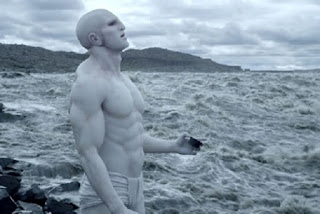
The Engineers look like the camp, macho, pseudo-expressionistic and/or
neoclassical fascist statues which decorated Hitler's Germany and
Mussolini's Italy. They are utterly white, with blank eyes, as though
made of marble. They represent a kind of aggressively male, body
fascist ideal, with all their bulging muscles and rippling pectorals.
Neoclassicism, as it was co-opted by fascism, reproduced the physiques
of Michaelangelo's David and Adam as an actual physical ideal rather
than as an emblem of human beauty, uniqueness and capability. Humanism
became the worship of the allegedly biologically 'perfect', embodied
in fascist ideology by the white, male, sexless warrior.
The Engineers tie into this in another way. They are like the giants of Norse myth as it was recycled by Wagner and then by later anti-Semites. There is something of Nazi mysticism about the story of the Engineers. They are the perfect giants from before history who supposedly founded all the life and culture of the human age, their chosen people being, of course, the Aryans. Vickers is a blonde ice maiden, which either implies the Aryan credentials of the Weyland family (if she is Weyland's biological daughter) or his fetish for the Aryan type as representing perfection (if she is an android of his design). David (interesting choice of name there) is also an image of superhuman white European 'perfection'. He dyes his hair blonde to seem even more Aryan and models himself on Peter O'Toole's portrayal of T.E. Lawrence in Lawrence of Arabia, a chiseled white European hero who is presented as overcoming pain and taking upon himself leadership of the Arabs. (Incidentally, this paradigm - whitey becomes the leader of the natives - recurs in popular SF. Think Paul Atreides in Dune, or Jake Sully in Avatar.)
There is yet another element of the film that ties in with this. The concentration on language. David studies ancient human languages, explicitly including 'Indo-European'. His fez-wearing, English-accented holographic teacher says "...whilst this manner of articulation is attested in the Indo-European descendants as a purely paralinguistic form, it is phonemic in the ancestral form dating back 5 millenia or more....". I'm not knowledgeable enough to know if this means anything, but it still specifically mentions Indo-European. It is also possible that Sanskrit is explicitly mentioned or alluded to in the film. There is some disagreement (here, for instance) most of which is well above my head. But, in any case, David is studying Indo-European languages in an attempt to find some kind of 'root' language which will enable him to communicate with the Engineers, if they do indeed prove to be the progenitors of humanity. The implication is that the Engineers - our ancient creators or ancestors - will have bestowed language upon us. Our languages will be descended from them, just as we are... therefore, the further back into language David can go, the better his chance of finding some way of comprehending the language of the Engineers. And it works.
This is a reiteration of as aspect of the imperial ideology of Aryanism. To quote Richard Seymour in The Liberal Defence of Murder:
(Seymour's notes refer to a book called Orientalism and Race by Tony Ballantyne, which looks both illuminating and dauntingly scholarly.) Note, by the way, how Seymour refers to the East India Company as "the Company".
The concept of Aryanism later found its way into German Romantic occultism and, from thence, into Nazism. The whole idea of an Aryan 'master race' responsible for the primordial foundation of Western civilization - and just about all subsequent Western cultural achievement - is bound up with the theory that the European languages can be traced back, via commonalities with Sanskrit, etc., to a root language: Proto-Indo-European. The subsequent supposed 'degeneration' of the East as the West thrived was put down to several possible influences. In the 18th and 19th centuries, especially after upsurges of rebellion, the intellectuals of the British imperium (including the liberals, by the way) put it down to the malign influence of Islam, and this notion is a direct ancestor of modern liberal Islamophobia. In the even more delusional line of descent which culminated in Nazism, biological notions of Teutonic superiority came to the fore. The biological and culturalist variants of racism have never been as separate as some claim. And both are aspects of imperialist ideology.
Tropes & Implications
Now, this is really as old as the hills. In many respects, it is a slightly more elaborate version of the von Danikenism that has infected so much SF. There is a kind of Eurocentric paternal condescension built into von Danikenism. Ancient peoples, particularly in the Middle East, Africa and South America, are assumed to have been incapable of creating their own cultures and languages. This trope has been widely used in SF. In Doctor Who alone, it has appeared in 'Death to the Daleks', 'Pyramids of Mars', etc.
But it goes further. In Prometheus, the Engineers created all humanity and all human language from their own selves. This 'strong version' too has been utilised before, though possibly never quite so explicitly. In Quatermass and the Pit, we humans have race wars because we are the genetically engineered creatures of Martian insects who went in for ethnic cleansing.... but we don't speak a language descended from theirs, at least not explicitly.
In Prometheus it is not just ancient cultures that owe their technology, design sense, religion and language to aliens, it is all humanity - possibly all life in the galaxy. Taken literally, this obviates humanity's claim to have made its own history. The various revolutions of history - argicultural, urban, industrial - are simply developments towards greater and greater convergence with the culture of the creators. High technology becomes a telos, preset in our chromosomes. The impetus is the pattern within humanity that matches the Engineers. Human biological origins lead to human historical development from cave dwelling to space ships. Our Engineer DNA leads us to develop their language and their technology. The information in our genes makes us create the corresponding information in our culture. This is a kind of biological determinism (rampant in SF) that, through the issues mentioned above, ties the film to a view of human history which stems from the primal influence of godly progenitors who seem associated with patriarchy, imperialism and Aryanism. (By the way, it also explains the film's obsession with information. The star charts; the DNA sequences; the concentration on language and hieroglyphs; the way the two ships both project massive holographic displays that map out space, geography, cartography and architecture. The film depicts a stream of information flowing from the Engineers' genes all the way up to the humans' maps.)
To an extent then, Prometheus adapts an ideologically imperialist, patriarchal, sexist and racialist view of of human history and presents this as a truth. The truth underlying human biology and also, in a deterministic way, the history of human civilisation, is that all our information stems from a kind of Aryan master race who also speak Proto-Indo-European, represent camply fascistic ideas of physical perfection, seem like a monkish warrior brotherhood and look like an all-male group mortally threatened by any other gender but prepared to use rape as a weapon delivery system.
Yet it's hard to say that this makes the import of the text reactionary in a straightforward way. After all, the character of the Engineers seems to be genocidal, ruthless, cruel, sterile, entropic, capricious.... and they are also defeated by their own creations. Moreover, their ship is brought down by a black man and their last survivor (at least on their weapons planet) is outwitted by a woman. It doesn't look as though the film is asking us to worship them or admire them. And the film definitely expects us to be pleased when their plans are thwarted by those more sexually and racially diverse. (On a basic level, it's just nice to see a genre action movie where the black supporting character doesn't die in the second act.)
The Engineers are like the Eurocentric, patriarchal, white, imperial 'origin story' made flesh. They are the idea of the herrenvolk, literalised so that it may be rejected. Weyland's dying words imply that, as gods, they fall short. They have no answers, no meaning. Indeed, they seem to seek the eradication of meaning. They conceive of information - whether it be sexual reproduction or the mechanics of travel - as ways of erasure. They are an idea that seems inimical to other meanings. This inimical idea is then negated by the return of the meaning it tried to revoke and erase. This happens to them, so to speak, twice. They wish to eradicate the first meanings they created - life/civilisation on Earth and perhaps elsewhere - by creating new, deadly meaning in the form of weaponized sex... but this new meaning again turns upon them. (They are, by the way, quite reminiscent of Light - the white, male, authoritarian scientist/angel that wishes to eradicate meaning when it cannot be controlled and classified - in the Doctor Who story 'Ghost Light'.)
If the Engineers are white, male, imperial gods - and redolent of fascism, which is the ultimate syncresis of all these reactionary power principles - then it must be said that they hardly reflect well upon these principles. They are exterminators, stockpilers of biological weapons, purgers of meaning and information when it fails to meet their inscrutable and vindictive standards, etc.
Gardeners & Engineers
In Prometheus, just as in Christian mythology, we are banished by our creators to wander alone, even as everything that we are comes from them/Him. But Prometheus not only reiterates this mythology, it also does that other quintessential job of SF: it ponders the autonomous (alienated and fetishized) product.
It's no shock that SF continually tells stories which reiterate Genesis while also thinking about the alienation of humanity from the produce of their labour. Genesis is about the alienation of humanity from nature brought by the rise of agriculture, surplus and class. SF reiterates Genesis because it is the modern cultural genre that most directly addresses the unprecedented alienation brought by capitalism, modernity, industry and technology. Genesis is about the relationship between humanity and nature, altered by tools. SF is about the constantly changing and decaying and threatening relationship between humanity and the tools themselves as they careen out of our control.
Genesis is, as noted, hardly the first myth to tread this path. Prometheus brought fire to humanity. Fire is knowledge. Science. Technology. It is the first discovery, the first tool, the first weapon, the first product. In so doing, Prometheus dared to suggest not only that humanity should have knowledge, but also that humanity should have the ability to create. More than it destroys, fire transforms. It is the basis of chemistry. It reveals that matter may change its state, be split in various different states, when altered deliberately by humanity.
Prometheus is far from the first SF story to reiterate these matters. It treads directly in the footsteps of Frankenstein. Victor Frankenstein was the 'modern Prometheus' because he revealed the next stage of what may be done with matter by human hands. Frankenstein fails because he does not take social responsibility for his creation. His 'son' is the first product-monster, the first great monster in the history of European culture that is manufactured. But it is only dangerous because it is abandoned, left without care or justice. Frankenstein's monster is the foundation of SF, which is obsessed with the autonomous product that threatens its creator, the manufactured monster. It is terrifying because it is, ultimately, our responsibility and our punishment.
We humans auto-generate. God is our attempt to infer a 'first cause' in this chain of auto-generation and to spiritually imbue it. Modernity is the rising of the productive forces to an unprecedented level, in which we may produce things of unprecedented power at unprecedented speed and in unprecedented numbers. Frankenstein the book appears at the interface of
i) our awareness of ourselves as biologically generated entities,
ii) our idea of ourselves as the creations of God, and
iii) our dawning realisation that modernity - industry, science, technology - allows us to create things more powerful than us, i.e. things more powerful than our bodies or even our gods (which are themselves our creations, after all).
Personally, we all encounter the book at this interface. This is because the book was written at the moment when European civilisation reached such an interface in history.
Humanity has always been quintessentially productive. The ability of our front two feet to leave the ground and become organs of manipulation is what drove the rise of the human brain. Humans are, above all else, the animal that makes tools. Capitalist modernity thus deeply effects our view of ourselves because it revolutionizes the way we produce. The products of modernity are - simply by virtue of their greater numbers, power and speed, if nothing else - more fetishized, more alive, more able to dominate us and run out of our control. They are more able, at least potentially, to mesh with our biology. Mary Shelley saw this potential meshing in the electrode that made the dead convict twitch and clench his fist. It is also implicit in the machine that steals labour, or which sucks the labourer into its embrace, needing to be set in motion by the workers and expressing this by encircling and towering over them. Today, the intrusion into biology becomes ever more clear. We now have cameras that can relay images directly to the brain, cloned creatures, and other wetware. And there are now more ways than ever in which the worker is towered-over and encircled by the hardware and the software.
Since Frankenstein, SF has harped on these issues. SF is a litany of robots, androids, gynoids, computer sentiences, of thinking weapons, of tools that rebel, or scientific experiments that lash back upon the experimenter. Within the settings of 'space' or 'the future' - which represent the dizzying possibilities of modernity, technology and science - the human as a producer of marvels is also a producer of nightmares than cannot be controlled. The line between the producer and the artifact is always being attacked, if only by some new technical innovation. This is the real reason why the robots attack us. This is why so many of the artifacts claim parity with humanity and demand this parity be accepted... and we're lucky if parity is all they want. Also, in SF humans seem to seek unity and merging with the machine, with its uncontrollable power. The machine seems alive; the living thing tends towards the mechanical. The boundry line between the territories is heavily disputed. Like any such border, there are wars over it.
Beyond its Freudian dimensions, Alien ponders these issues covertly. Its ancient spacefaring aliens (the ones that created the derelict ship) seem inextricably both biology and technology, their pilot looking like an extrusion of beast and engine that has grown within a ship of bones and bulges and arterial corridors and vast hot stomachs in which parasites have laid their eggs. The thing that is born from Kane's chest is a thing of tendons and pulleys, veins and cables, phallic symbols and skin criss-crossed with what look like the outlines of circuits. What people often forget is that the 'Xenomorphs' live up to their assigned name. Their shape morphs to resemble the 'other' in which they grow. The Alien in the first film has taken on the bio-mechanical nature of the pilot on the crashed ship, and it has also taken on the humanoid size and shape of Kane. The machine has penetrated the DNA and is now biologically heritable as a trait. The 'Xenomorph' is the terrifying vehicle/product of this penetration. And don't forget Ash, with his android-madness apparently triggered by resentment and frustrated sexual hatred, his injuries dripping hydraulic fluid that looks like milk or semen, his synthetic innards looking like white and blue plastic intestines.
Prometheus ponders the same issues overtly. Just as Frankenstein displaced God by doing what God does, so the Engineers displace God by being what He is supposed to be. But they also displace Darwinism, at least in the opinion of the biologist. And they displace Frankenstein again because, by having created us artificially, they trivialize the achievement of Weyland in having made David. They even displace Tyrell in Blade Runner and the crisis of simulation that his simulacra have triggered. The simulacrum becomes nothing of the kind when the creator of the simulacra proves to be as engineered a thing as his simulation. Deckard may have had ambiguous dreams about unicorns but Weyland knows, unambiguously, that he is as much a manufactured entity as David. This state of having been manufactured is his new normality. In this state of affairs, who cares that the simulacrum is indistinguishable? The internal distinction that makes this collapse of distinctions significant has been neutralised. Just as Natural Selection is overthrown by the revelation that all life is a product of technological engineering, so is Artificial Creation. You can engineer life at all levels. Creation dissipates. The Engineers have manufactured micro-organisms and macro-organisms. Microbes in the goo, all the way up to giant squids. They have manufactured not only life but life-cycles.
Of course, these biological manufactoids get 'out of control'. Creations always do in these tales. That story goes back to Genesis and before. Long before. As noted, SF has continually retold these ancient stories as a way of grappling with the modern era of technological mass-production. In Frankenstein, the process turns runaway because it is abandoned. In The Island of Dr Moreau, the process turns runaway even though, possibly even because, it has not been abandoned. As China Mieville puts it, Frankenstein says that we are failing the Enlightenment and Moreau says that the Enlightenment has failed.
The project of modernity is unstable, uncontrollable, dangerous because even the best efforts to control it founder on the autonomy of the product. What we might, in political terms, characterise as Mary Shelley's 'reformist' project - drawn from her situation amidst Wollstonecraft (her dead mother, present in her life as stories and texts), Godwin (her father) and Percy Shelley (her husband) - is to nuture and care for the product so that it becomes socially responsible, an agent of justice rather than one of horror. Frankenstein is her prescient caution of what will ensue if this is not done. The product will annihilate us. Mieville says that Frankenstein and Moreau mark opposite ends of the trajectory of Fabianism, mapped out in advance. Moreau is the despairing terminus of Fabianism, written before Wells joined the Fabians. Wells says (without knowing it) that, contra Shelley, the 'reformist' project to nurture and care for modernity is doomed to failure because the product will not be controlled, even with the best efforts. The autonomous product - which is what industry and capital and the fetishized commodity look like in SF - is too much for us to control.
David in Prometheus is, yet again, the autonomous product. At first, he seems tame because of his position. He's been subject to a stringent attempt to integrate him into Weyland's Western, capitalist, patriarchal hierarchy. Like Ash and Bishop, David is a white male. Unlike those untrustworthy agents, he has been fashioned as an heir. Weyland shows him preference over his daughter (if she is a biological daughter). David is "the closest thing" Weyland has "to a son". The daughter doesn't count. It's like Dombey, forgetting Florence and putting "only child" on Paul's tombstone. But still David moves beyond control. On the contrary, he is in control of everyone else, all the way through the film. The story happens because of David's agency and actions. He is evidently not working for Weyland. Little he does directly serves Weyland's interests. When he finally does serve Weyland, he gets the old man killed. How are we - or anyone - to know what David says to the Engineer before the Engineer kills Weyland with David's severed head? David is unsurprised by Weyland's dying declaration. David knew better than to expect answers from a manufacturer-god who has been attacked by his own autonomous product.
Prometheus makes the gods themselves into Engineers. Their name itself appropriates the tool, manufacture, industry, technology. It makes production into our master. We become the object of production not the subject. It expresses alienation. We do not make the engines. We are the engines. The engines we do make (David) are therefore the products of products, made because we were made to make them. Our evolution, our social and agricultural history, become products of alien engineering, made by us because we are machines designed to make them.
When we become the autonomous product (as we do in Prometheus), we become as alienated from our manufacturers as any commodity. But that isn't necessarily bad. Why should we care that something is 'out of control'? Whose control? And, as noted, in Prometheus our alien/ated manufacturers are Eurocentric gods. They are Aryan gods. Fascist myths come alive. Patriarchs and warrior elites. It is as though the problems identified in Frankenstein and Dr Moreau have finally been blamed on somebody. Should they be in control?
Is it conceivable - I ask this tentatively - that, in Prometheus, Hollywood has accidentally created a parable about the need for the alienated to revolt against the alien/ating gods of the era of technology? To reject a power that is conceptualised as the ultimate in white, male, imperialist, theocracy? To reject a power that is, furthermore, a personification of the alienation of humans from their ability to freely produce themselves, their lives, their sexuality, their language and their culture?
These are not profundities that were deliberately crafted into the script of this massively expensive bit of commercial entertainment. They are complexities, intimations and ironies that may be teased out of the text and willfully construed because the text stands as a garbled synthesis of many of the tropes of SF, a genre that has been pondering the issues of modernity for so long.
The best way of looking at it is to say that the film Prometheus itself is an autonomous product that seems to have partially and furtively escaped the control of its reactionary manufacturers.
But then, don't they all?
EDIT: In the original version of this article, I wrongly used the term 'Caucasian' as a synonym for 'white' and/or 'European'. I have amended this. JG, 4/4/14
Sex & Monsters
In Prometheus, the Engineers are ancient Titans who created humanity... and, it is implied, seeded the galaxy with their DNA. There is something very noticeable about them: they are all men. Meanwhile, there is a definite vaginal look to a great many of the alien bio-weapons they created and which then subsumed them. However, I don't think its really possible to read the battle between Engineers and their bio-weapons as a battle of the sexes. The weapon creatures are also phallic and penetrative, as in previous iterations of the Alien universe. All the same, it's true that presenting the creators of life (in their own image) as exclusively dudes does imply that generative power resides in the male alone. It is enough for one Engineer to dissolve his DNA into the waters of a planet to kickstart the process that will lead to animal life (if that's how the opening scene is meant to be read). The Engineers are male but apparently sexless, capable of asexual reproduction. The deadly runaway bio-weapons, which seem hermaphroditic, look like the intrusion of sex into a male but sexless world. Sex is thus a terrifying eruption that destabilises a male utopia. The sexual nature of the weapons suggests that the Engineers - we might even be tempted to facetiously re-christen them the 'Mengineers' - find sexual reproduction to be inherently threatening. They set about devising weapons of mass destruction and what do they come up with? Biological goo that sets off a chain reaction of tentacle rape, fanged vaginas and violent monster pregnancy.
Foz Meadows at her blog Shattersnipe (which I heard about from Jon Blum) has made some apt observations about the film's dubious concentration upon highly impractical female underwear, grueling 'ladypain' and forced impregnation. She goes on to say:
Insofar as the alien attacks go, I’ll give Scott some credit for trope subversion: twice in the course of the film, male characters are violently orally penetrated – and, in the process, killed – by phallic alien tentacles. This is visually disturbing on a number of levels, but given the near universal establishment of tentacle rape as a thing that happens to women, I’m going to give him a big thumbs up for bucking the trend. That being said, what happens to Shaw is awful on just about every level imaginable.
And so it is.
One of the interesting things about the original Alien is that it is a man - Kane (John Hurt) - who is the victim of the facehugger rape and the violent birth of the phallic infant Alien. So, although the alien pregnancy also suggests infection, cancer, parasitism and other horrors attendant on life, there is clearly a way in which the original Alien is a personification of sexual violence. This violence is directed at both sexes and emerges through the violation of a man and a subsequent male pregnancy... however, the creature itself is also intensely male. It has that famously phallic head and yet another phallic symbol springs out of its mouth, this one complete with a snapping set of teeth. Even its tail is like a barbed cock which gropes Lambert (Veronica Cartwright) before killing her. Later on, when Ripley (Sigourney Weaver) is menaced by the creature in the escape shuttle, she has stripped to her underwear. This scene is the film at its most sexploitative. In many ways, it's a textbook example of lingering over needlessly-exposed female flesh. But even in this scene it seems that a trap is being set: encouraging those who are so inclined to leer... before showing them their own reflection in the creature when it reappears, languid, slowly playing with its phallic inner jaw, dripping drool/jizz, forcing Ripley to run and hide like someone stalked by a rapist.
As a man, I want to be very careful about declaring that Alien is or is not dodgy in its depiction of sexualised violence against women. If it is, then I also think there is a distinct ambiguity about it. The sexualised, phallic vileness of the Alien itself seems to have been the intention all along. If the film wallows in the sight of a half-naked woman threatened by a monster that is, essentially, an evil penis with teeth, then it also seems aware of the queasiness of what it is doing. The very obscenity of the Alien suggests an awareness of the obscenity of sexual violence... beyond what is arguably the film's more general concern about the horror of physicality itself, with all its attendant violation, infection, pain and predation.
There is something of the same horror of sex in Prometheus. Fertility seems to be the terrible mistake that the Mengineers made, the mistake they wish to erase. They made the infertile fertile (their weapon specifically does this to Shaw) and set in motion the end of their outpost world. But note how the 'fertility nuke' the Mengineers developed actually works. With men, it gets in through the mouth. The Generic Asshole Biologist with Glasses gets done in by a kind of phallic worm with a cobra hood which penetrates his suit and then dives into his mouth. Holloway inadvertently drinks some of the goo and begins to turn into a kind of rampaging mutant (we see the final stage later when Fifield turns up again). Shaw, however, is impregnated in the regular way. She is impregnated via sex - with her husband, no less! That this is a kind of rape-by-proxy committed by David (who spikes Holloway's drink with some of the black goo) doesn't change the point. The creature inside Shaw gestates in what looks like a placental sac, complete with a umbilical cord. I'm not sure if we're meant to think the squid thing was going to exit Shaw violently via the belly... but, the undulations of the entity beneath her skin notwithstanding, there's actually no reason to think it wasn't going to be born via the vagina. So, the Mengineers' weaponized sex gets into the man via an orifice that does not play a specific biological role in sexual reproduction and turns him into a beast. It enters the woman via sex itself, gestates like a baby in the uterus and may even be born vaginally rather than bursting out. I'm almost fearful to think how this system is supposed to work. Once the infected male has become a mad monster, does he go on a rape rampage? If so, I'm glad it's left undepicted and undescribed. In any case, it looks uncomfortably as though the Mengineers specifically decided to use the female as a vector in the progress of their bio-weapons. They chose to use female fertility as a part of their attack. Sex is the weapon; the female is the delivery system.
Race & Monsters
The other thing about the intense un-sexual maleness of the Engineers is that it seems to suggest a monastic warrior brotherhood with fascist overtones.
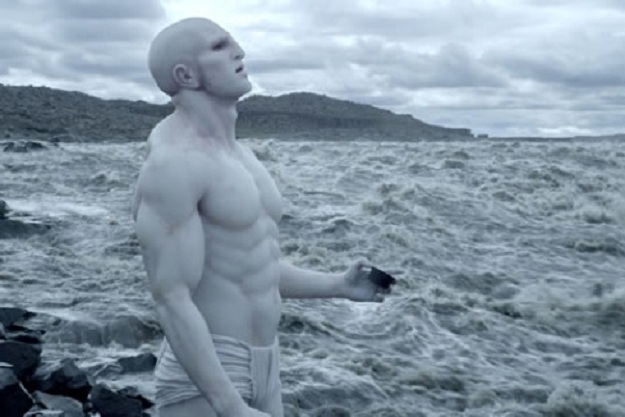
 |
| Image / Reality. |
The Engineers tie into this in another way. They are like the giants of Norse myth as it was recycled by Wagner and then by later anti-Semites. There is something of Nazi mysticism about the story of the Engineers. They are the perfect giants from before history who supposedly founded all the life and culture of the human age, their chosen people being, of course, the Aryans. Vickers is a blonde ice maiden, which either implies the Aryan credentials of the Weyland family (if she is Weyland's biological daughter) or his fetish for the Aryan type as representing perfection (if she is an android of his design). David (interesting choice of name there) is also an image of superhuman white European 'perfection'. He dyes his hair blonde to seem even more Aryan and models himself on Peter O'Toole's portrayal of T.E. Lawrence in Lawrence of Arabia, a chiseled white European hero who is presented as overcoming pain and taking upon himself leadership of the Arabs. (Incidentally, this paradigm - whitey becomes the leader of the natives - recurs in popular SF. Think Paul Atreides in Dune, or Jake Sully in Avatar.)
There is yet another element of the film that ties in with this. The concentration on language. David studies ancient human languages, explicitly including 'Indo-European'. His fez-wearing, English-accented holographic teacher says "...whilst this manner of articulation is attested in the Indo-European descendants as a purely paralinguistic form, it is phonemic in the ancestral form dating back 5 millenia or more....". I'm not knowledgeable enough to know if this means anything, but it still specifically mentions Indo-European. It is also possible that Sanskrit is explicitly mentioned or alluded to in the film. There is some disagreement (here, for instance) most of which is well above my head. But, in any case, David is studying Indo-European languages in an attempt to find some kind of 'root' language which will enable him to communicate with the Engineers, if they do indeed prove to be the progenitors of humanity. The implication is that the Engineers - our ancient creators or ancestors - will have bestowed language upon us. Our languages will be descended from them, just as we are... therefore, the further back into language David can go, the better his chance of finding some way of comprehending the language of the Engineers. And it works.
This is a reiteration of as aspect of the imperial ideology of Aryanism. To quote Richard Seymour in The Liberal Defence of Murder:
The Aryan idea has its origins in the heart of the British Empire. It was a result of the Company's growing control over revenue-collecting and the need to develop an understanding of the texts and languages of the colonized. Not merely a suppuration of imperialism, it became an important fact about the way the empire was organized, and eventually it was offered as the reason why the empire had come about. Essentially, it posited an Indo-European race based upon certain philological affinities between Sanskrit and the Greek and Latin languages. The thesis was that the world's populations could be divided into 'races' descended from Biblical figures - Aryan, Semitic and Tartar. The Aryan race had, it was maintained, invaded and inhabited India during the Vedic 'golden age' and formed a precocious civilization. The post-Vedic age in India had been a sustained period of degeneration: by contrast, the Aryans of Europe were in rude health. These categories not only provided an argument for empire; they also helped to cement British power with the caste system.
(Seymour's notes refer to a book called Orientalism and Race by Tony Ballantyne, which looks both illuminating and dauntingly scholarly.) Note, by the way, how Seymour refers to the East India Company as "the Company".
The concept of Aryanism later found its way into German Romantic occultism and, from thence, into Nazism. The whole idea of an Aryan 'master race' responsible for the primordial foundation of Western civilization - and just about all subsequent Western cultural achievement - is bound up with the theory that the European languages can be traced back, via commonalities with Sanskrit, etc., to a root language: Proto-Indo-European. The subsequent supposed 'degeneration' of the East as the West thrived was put down to several possible influences. In the 18th and 19th centuries, especially after upsurges of rebellion, the intellectuals of the British imperium (including the liberals, by the way) put it down to the malign influence of Islam, and this notion is a direct ancestor of modern liberal Islamophobia. In the even more delusional line of descent which culminated in Nazism, biological notions of Teutonic superiority came to the fore. The biological and culturalist variants of racism have never been as separate as some claim. And both are aspects of imperialist ideology.
Tropes & Implications
Now, this is really as old as the hills. In many respects, it is a slightly more elaborate version of the von Danikenism that has infected so much SF. There is a kind of Eurocentric paternal condescension built into von Danikenism. Ancient peoples, particularly in the Middle East, Africa and South America, are assumed to have been incapable of creating their own cultures and languages. This trope has been widely used in SF. In Doctor Who alone, it has appeared in 'Death to the Daleks', 'Pyramids of Mars', etc.
But it goes further. In Prometheus, the Engineers created all humanity and all human language from their own selves. This 'strong version' too has been utilised before, though possibly never quite so explicitly. In Quatermass and the Pit, we humans have race wars because we are the genetically engineered creatures of Martian insects who went in for ethnic cleansing.... but we don't speak a language descended from theirs, at least not explicitly.
In Prometheus it is not just ancient cultures that owe their technology, design sense, religion and language to aliens, it is all humanity - possibly all life in the galaxy. Taken literally, this obviates humanity's claim to have made its own history. The various revolutions of history - argicultural, urban, industrial - are simply developments towards greater and greater convergence with the culture of the creators. High technology becomes a telos, preset in our chromosomes. The impetus is the pattern within humanity that matches the Engineers. Human biological origins lead to human historical development from cave dwelling to space ships. Our Engineer DNA leads us to develop their language and their technology. The information in our genes makes us create the corresponding information in our culture. This is a kind of biological determinism (rampant in SF) that, through the issues mentioned above, ties the film to a view of human history which stems from the primal influence of godly progenitors who seem associated with patriarchy, imperialism and Aryanism. (By the way, it also explains the film's obsession with information. The star charts; the DNA sequences; the concentration on language and hieroglyphs; the way the two ships both project massive holographic displays that map out space, geography, cartography and architecture. The film depicts a stream of information flowing from the Engineers' genes all the way up to the humans' maps.)
To an extent then, Prometheus adapts an ideologically imperialist, patriarchal, sexist and racialist view of of human history and presents this as a truth. The truth underlying human biology and also, in a deterministic way, the history of human civilisation, is that all our information stems from a kind of Aryan master race who also speak Proto-Indo-European, represent camply fascistic ideas of physical perfection, seem like a monkish warrior brotherhood and look like an all-male group mortally threatened by any other gender but prepared to use rape as a weapon delivery system.
Yet it's hard to say that this makes the import of the text reactionary in a straightforward way. After all, the character of the Engineers seems to be genocidal, ruthless, cruel, sterile, entropic, capricious.... and they are also defeated by their own creations. Moreover, their ship is brought down by a black man and their last survivor (at least on their weapons planet) is outwitted by a woman. It doesn't look as though the film is asking us to worship them or admire them. And the film definitely expects us to be pleased when their plans are thwarted by those more sexually and racially diverse. (On a basic level, it's just nice to see a genre action movie where the black supporting character doesn't die in the second act.)
The Engineers are like the Eurocentric, patriarchal, white, imperial 'origin story' made flesh. They are the idea of the herrenvolk, literalised so that it may be rejected. Weyland's dying words imply that, as gods, they fall short. They have no answers, no meaning. Indeed, they seem to seek the eradication of meaning. They conceive of information - whether it be sexual reproduction or the mechanics of travel - as ways of erasure. They are an idea that seems inimical to other meanings. This inimical idea is then negated by the return of the meaning it tried to revoke and erase. This happens to them, so to speak, twice. They wish to eradicate the first meanings they created - life/civilisation on Earth and perhaps elsewhere - by creating new, deadly meaning in the form of weaponized sex... but this new meaning again turns upon them. (They are, by the way, quite reminiscent of Light - the white, male, authoritarian scientist/angel that wishes to eradicate meaning when it cannot be controlled and classified - in the Doctor Who story 'Ghost Light'.)
If the Engineers are white, male, imperial gods - and redolent of fascism, which is the ultimate syncresis of all these reactionary power principles - then it must be said that they hardly reflect well upon these principles. They are exterminators, stockpilers of biological weapons, purgers of meaning and information when it fails to meet their inscrutable and vindictive standards, etc.
Gardeners & Engineers
In Prometheus, just as in Christian mythology, we are banished by our creators to wander alone, even as everything that we are comes from them/Him. But Prometheus not only reiterates this mythology, it also does that other quintessential job of SF: it ponders the autonomous (alienated and fetishized) product.
It's no shock that SF continually tells stories which reiterate Genesis while also thinking about the alienation of humanity from the produce of their labour. Genesis is about the alienation of humanity from nature brought by the rise of agriculture, surplus and class. SF reiterates Genesis because it is the modern cultural genre that most directly addresses the unprecedented alienation brought by capitalism, modernity, industry and technology. Genesis is about the relationship between humanity and nature, altered by tools. SF is about the constantly changing and decaying and threatening relationship between humanity and the tools themselves as they careen out of our control.
Genesis is, as noted, hardly the first myth to tread this path. Prometheus brought fire to humanity. Fire is knowledge. Science. Technology. It is the first discovery, the first tool, the first weapon, the first product. In so doing, Prometheus dared to suggest not only that humanity should have knowledge, but also that humanity should have the ability to create. More than it destroys, fire transforms. It is the basis of chemistry. It reveals that matter may change its state, be split in various different states, when altered deliberately by humanity.
Prometheus is far from the first SF story to reiterate these matters. It treads directly in the footsteps of Frankenstein. Victor Frankenstein was the 'modern Prometheus' because he revealed the next stage of what may be done with matter by human hands. Frankenstein fails because he does not take social responsibility for his creation. His 'son' is the first product-monster, the first great monster in the history of European culture that is manufactured. But it is only dangerous because it is abandoned, left without care or justice. Frankenstein's monster is the foundation of SF, which is obsessed with the autonomous product that threatens its creator, the manufactured monster. It is terrifying because it is, ultimately, our responsibility and our punishment.
We humans auto-generate. God is our attempt to infer a 'first cause' in this chain of auto-generation and to spiritually imbue it. Modernity is the rising of the productive forces to an unprecedented level, in which we may produce things of unprecedented power at unprecedented speed and in unprecedented numbers. Frankenstein the book appears at the interface of
i) our awareness of ourselves as biologically generated entities,
ii) our idea of ourselves as the creations of God, and
iii) our dawning realisation that modernity - industry, science, technology - allows us to create things more powerful than us, i.e. things more powerful than our bodies or even our gods (which are themselves our creations, after all).
Personally, we all encounter the book at this interface. This is because the book was written at the moment when European civilisation reached such an interface in history.
Humanity has always been quintessentially productive. The ability of our front two feet to leave the ground and become organs of manipulation is what drove the rise of the human brain. Humans are, above all else, the animal that makes tools. Capitalist modernity thus deeply effects our view of ourselves because it revolutionizes the way we produce. The products of modernity are - simply by virtue of their greater numbers, power and speed, if nothing else - more fetishized, more alive, more able to dominate us and run out of our control. They are more able, at least potentially, to mesh with our biology. Mary Shelley saw this potential meshing in the electrode that made the dead convict twitch and clench his fist. It is also implicit in the machine that steals labour, or which sucks the labourer into its embrace, needing to be set in motion by the workers and expressing this by encircling and towering over them. Today, the intrusion into biology becomes ever more clear. We now have cameras that can relay images directly to the brain, cloned creatures, and other wetware. And there are now more ways than ever in which the worker is towered-over and encircled by the hardware and the software.
Since Frankenstein, SF has harped on these issues. SF is a litany of robots, androids, gynoids, computer sentiences, of thinking weapons, of tools that rebel, or scientific experiments that lash back upon the experimenter. Within the settings of 'space' or 'the future' - which represent the dizzying possibilities of modernity, technology and science - the human as a producer of marvels is also a producer of nightmares than cannot be controlled. The line between the producer and the artifact is always being attacked, if only by some new technical innovation. This is the real reason why the robots attack us. This is why so many of the artifacts claim parity with humanity and demand this parity be accepted... and we're lucky if parity is all they want. Also, in SF humans seem to seek unity and merging with the machine, with its uncontrollable power. The machine seems alive; the living thing tends towards the mechanical. The boundry line between the territories is heavily disputed. Like any such border, there are wars over it.
Beyond its Freudian dimensions, Alien ponders these issues covertly. Its ancient spacefaring aliens (the ones that created the derelict ship) seem inextricably both biology and technology, their pilot looking like an extrusion of beast and engine that has grown within a ship of bones and bulges and arterial corridors and vast hot stomachs in which parasites have laid their eggs. The thing that is born from Kane's chest is a thing of tendons and pulleys, veins and cables, phallic symbols and skin criss-crossed with what look like the outlines of circuits. What people often forget is that the 'Xenomorphs' live up to their assigned name. Their shape morphs to resemble the 'other' in which they grow. The Alien in the first film has taken on the bio-mechanical nature of the pilot on the crashed ship, and it has also taken on the humanoid size and shape of Kane. The machine has penetrated the DNA and is now biologically heritable as a trait. The 'Xenomorph' is the terrifying vehicle/product of this penetration. And don't forget Ash, with his android-madness apparently triggered by resentment and frustrated sexual hatred, his injuries dripping hydraulic fluid that looks like milk or semen, his synthetic innards looking like white and blue plastic intestines.
Prometheus ponders the same issues overtly. Just as Frankenstein displaced God by doing what God does, so the Engineers displace God by being what He is supposed to be. But they also displace Darwinism, at least in the opinion of the biologist. And they displace Frankenstein again because, by having created us artificially, they trivialize the achievement of Weyland in having made David. They even displace Tyrell in Blade Runner and the crisis of simulation that his simulacra have triggered. The simulacrum becomes nothing of the kind when the creator of the simulacra proves to be as engineered a thing as his simulation. Deckard may have had ambiguous dreams about unicorns but Weyland knows, unambiguously, that he is as much a manufactured entity as David. This state of having been manufactured is his new normality. In this state of affairs, who cares that the simulacrum is indistinguishable? The internal distinction that makes this collapse of distinctions significant has been neutralised. Just as Natural Selection is overthrown by the revelation that all life is a product of technological engineering, so is Artificial Creation. You can engineer life at all levels. Creation dissipates. The Engineers have manufactured micro-organisms and macro-organisms. Microbes in the goo, all the way up to giant squids. They have manufactured not only life but life-cycles.
Of course, these biological manufactoids get 'out of control'. Creations always do in these tales. That story goes back to Genesis and before. Long before. As noted, SF has continually retold these ancient stories as a way of grappling with the modern era of technological mass-production. In Frankenstein, the process turns runaway because it is abandoned. In The Island of Dr Moreau, the process turns runaway even though, possibly even because, it has not been abandoned. As China Mieville puts it, Frankenstein says that we are failing the Enlightenment and Moreau says that the Enlightenment has failed.
The project of modernity is unstable, uncontrollable, dangerous because even the best efforts to control it founder on the autonomy of the product. What we might, in political terms, characterise as Mary Shelley's 'reformist' project - drawn from her situation amidst Wollstonecraft (her dead mother, present in her life as stories and texts), Godwin (her father) and Percy Shelley (her husband) - is to nuture and care for the product so that it becomes socially responsible, an agent of justice rather than one of horror. Frankenstein is her prescient caution of what will ensue if this is not done. The product will annihilate us. Mieville says that Frankenstein and Moreau mark opposite ends of the trajectory of Fabianism, mapped out in advance. Moreau is the despairing terminus of Fabianism, written before Wells joined the Fabians. Wells says (without knowing it) that, contra Shelley, the 'reformist' project to nurture and care for modernity is doomed to failure because the product will not be controlled, even with the best efforts. The autonomous product - which is what industry and capital and the fetishized commodity look like in SF - is too much for us to control.
David in Prometheus is, yet again, the autonomous product. At first, he seems tame because of his position. He's been subject to a stringent attempt to integrate him into Weyland's Western, capitalist, patriarchal hierarchy. Like Ash and Bishop, David is a white male. Unlike those untrustworthy agents, he has been fashioned as an heir. Weyland shows him preference over his daughter (if she is a biological daughter). David is "the closest thing" Weyland has "to a son". The daughter doesn't count. It's like Dombey, forgetting Florence and putting "only child" on Paul's tombstone. But still David moves beyond control. On the contrary, he is in control of everyone else, all the way through the film. The story happens because of David's agency and actions. He is evidently not working for Weyland. Little he does directly serves Weyland's interests. When he finally does serve Weyland, he gets the old man killed. How are we - or anyone - to know what David says to the Engineer before the Engineer kills Weyland with David's severed head? David is unsurprised by Weyland's dying declaration. David knew better than to expect answers from a manufacturer-god who has been attacked by his own autonomous product.
Prometheus makes the gods themselves into Engineers. Their name itself appropriates the tool, manufacture, industry, technology. It makes production into our master. We become the object of production not the subject. It expresses alienation. We do not make the engines. We are the engines. The engines we do make (David) are therefore the products of products, made because we were made to make them. Our evolution, our social and agricultural history, become products of alien engineering, made by us because we are machines designed to make them.
When we become the autonomous product (as we do in Prometheus), we become as alienated from our manufacturers as any commodity. But that isn't necessarily bad. Why should we care that something is 'out of control'? Whose control? And, as noted, in Prometheus our alien/ated manufacturers are Eurocentric gods. They are Aryan gods. Fascist myths come alive. Patriarchs and warrior elites. It is as though the problems identified in Frankenstein and Dr Moreau have finally been blamed on somebody. Should they be in control?
Is it conceivable - I ask this tentatively - that, in Prometheus, Hollywood has accidentally created a parable about the need for the alienated to revolt against the alien/ating gods of the era of technology? To reject a power that is conceptualised as the ultimate in white, male, imperialist, theocracy? To reject a power that is, furthermore, a personification of the alienation of humans from their ability to freely produce themselves, their lives, their sexuality, their language and their culture?
These are not profundities that were deliberately crafted into the script of this massively expensive bit of commercial entertainment. They are complexities, intimations and ironies that may be teased out of the text and willfully construed because the text stands as a garbled synthesis of many of the tropes of SF, a genre that has been pondering the issues of modernity for so long.
The best way of looking at it is to say that the film Prometheus itself is an autonomous product that seems to have partially and furtively escaped the control of its reactionary manufacturers.
But then, don't they all?
EDIT: In the original version of this article, I wrongly used the term 'Caucasian' as a synonym for 'white' and/or 'European'. I have amended this. JG, 4/4/14
Friday, 2 March 2012
Cottage Industry vs. the Spectacular Tentacular Draculas
According to Miles and Wood, Barry Letts' eco views were very much influnced (as were many people's) by a text called Blueprint for Survival, co-written by Edward Goldsmith (now deceased) and published in the magazine he founded, The Ecologist, in 1972. It was supported by many scientists and was subsequently released in book form to became a best-seller. Miles and Wood identify it as the real-world model for Sir Charles Grover's Last Chance for Man in 'Invasion of the Dinosaurs'. There is indeed something of Goldsmith's politics (small-c conservative; anti-industrial society) in the fictional Grover, who is simultaneously an eco-radical and an establishment elitist who wishes to turn the clock back (literally) to a kind of enlightened feudalism. George Monbiot has described Goldsmith's politics as "a curious mixture of radical and reactionary", saying that he "has advocated the enforced separation of Tutsis and Hutus in Rwanda and Protestants and Catholics in Ulster, on the grounds that they constitute 'distinct ethnic groups' and are thus culturally incapable of co-habitation". According to Monbiot, Goldsmith
Now, I'm not attributing similar views to Barry Letts or Robert Sloman. However, there is something of Goldsmith's hankerings for the regional and the anti-industrial in 'The Green Death'. The very separateness of Wales and the Welsh tells us something. The resolutely English characters - even the Doctor is English really, and this has never been plainer than in 'Green Death' - become strangers in a strange land.
Making the workers Welsh seems like a way of quaintifying them, since quaintness was the deadly stigma that mainstream British (i.e. metropolitan English) media culture foisted upon Wales... at least before substituting constant nasty jokes about shagging sheep and Splott (i.e. standard jokes based on stereotypes about rural people and working class communities). Welshness is a way of 'othering' them, of segregating them, of making them a separate community. The Welsh working class is depicted as a subculture within British society, rather than, say, one of the most significant layers of the majority class in the country... which Welsh mineworkers certainly were at the time.
There's no reason for 'The Green Death' to take place in Wales but that Letts and Sloman want the story to centre on a mine (and going to Wales is cheaper than going further north). But why do they want the story to centre on a mine? They're not interested in miners. It seems as though they feel the need to situate industry and industrial disputes somewhere regional, somewhere definitely apart from the 'middle England' that aliens are always invading in the Letts version of the late 20th century... but why give the story a backdrop of industry and industrial disputes anyway? Because it's all industry's fault, all this "muck" and "devastation" and "death".
 The story certainly notices capitalism as being 'behind' industry - hence the story's Weird inflection - but it also seems to think that the real problem is that certain kinds of capitalism have predominated over other, better kinds. The Nuthutch, crucially, has a sign advertising the sale of healthy, hippy, veggie foods. Enterprise, when stemming from a liberal education, scientific enlightenment, social conscience, etc - can save the world with soya. It's the Linda McCartney theory of progressive capitalism. (Of course, Linda McCartney and Anita Roddick are all big business really, not little rural cottage industries, notwithstanding the anti-industrial fantasies of a particular breed of right-on bourgeois liberal.) 'Industry' on a big scale is BAD... but little islands of bourgeois right-onitude can correct this, especially when they are powered by a nice version of enterprising individualism (i.e. all that self-actualizing that goes on at the Nuthutch) and especially when also assisted by the UN and government grants, etc. I'm glossing and simplifying like crazy, but the model embodied in the Nuthutch is hardy a billion miles away from the small-scale, regional economies proposed to supplant 'industrial society' by the Goldsmithian ecologists.
As I said elsewhere, the 'critique' of capitalism in 'Green Death' is decidely diffident. Most egregiously, by representing the miners as clueless fossils and making them into the dupes of Stevens, Letts and Sloman obfuscate the class struggle and implicate the ex-miners in the crimes of 'Industry'. (This, again, is hardly a billion miles away from the problems in Goldsmithian eco-politics.)
Also, and perhaps most obviously and crudely, the story shows us casual, routine, pro-corporate bias in the Cabinet Room... but also postulates a 'Minister of Ecology' who, in the long run, seems to represent a government that can, when needed and persuaded, put aside loyalty to business and genuinely care more about the environment. Which is Panglossian, to say the least.
It'd be easy to overstate all this, however. Much of the interest of 'The Green Death' is in its manifest failure to offer anything approaching a unified and coherent set of underlying ideas. It is one of those stories that manages to be fascinating because it tries to pull in lots of different directions at once, fails and falls apart.
 Firsly, the world in which Letts and Sloman situate their critique of 'industry' is oddly post-industrial. The miners are all sacked. The mine is closed. There are extended sequences set amidst the abandoned ruins of industry. The chemical plant is oddly empty, except for security guards and a very few executives. The maggots wriggle out across a featureless, entropic, post-industrial landscape of slag.
The pollution that we should really worry about comes not from the mine, not from old-fashioned manufacturing industry, but from the Stevens Process, the magical juggling with chemicals in labs, seemingly accomplished by a skeleton crew of middle-class professionals. Stevens, moreover, is not an old-fashioned capitalist. He's no pit owner of yore, no more than he is a Coal Board official. He's an administrator, a manipulator of executive practices, PR, lobbying, influence, delegated tasks, etc. This is, in its way, strangely prescient of the outward features of neoliberalism... which was, after all, just getting started roundabout 1973.
Secondly, the story may seem to set out to absolve capitalism of its intrinsic sins - by, for instance, representing pollution as an atavistic regression amidst a general march of progress - but it then shifts gears and produces BOSS, who is an expression of alienation. BOSS is not only, like so many Who villains, a material thing that has been produced by human labour and then turned upon his creators, he is also an expression of Stevens' own divided and alienated self.
 (This, by the way, is why BOSS taunts Stevens good-humouredly about being a "superman" and a "good little Nietzschean". Nietzsche's notion of the 'superman' or 'overman' would hardly seem credible to BOSS - who openly expresses his exasperation at human inefficiency and his belief that humans need his leadership... and yet BOSS is himself an extension of that part of Stevens which sets aside qualms and goes about trying to be the 'superman'. The irony is that BOSS, in his/Stevens quest for efficiency and profit (note that they are assumed to be the same thing), must accept his own programming to be inefficient, even eccentric. BOSS and Stevens go round and round in circles, just like a divided self.)
 Thirdly, BOSS - and, by extension, Global Chemicals - is an expression of the drive towards monopoly. Note how, even here, Doctor Who seems to return to the old association of monopoly with the vampiric, an association often noted by commentators upon horror and the gothic. BOSS is vampiric in that he feeds on the mental energy and obedience of his executives (though not, you'll notice, on any working class labourers) and his maggots are vampiric in that they bite, infect and convert. (They even bite the neck.) This is another reason why capital gets associated with the vampire... capital doesn't just exploit (suck blood), it also converts everything into itself (I'll get back to this when I eventually finish my big post about the Borg and the Cybermen).
There's no doubt, by the way, that part of the horror of the Nestenes and Axos - those spectacular, tentacular Draculas - is in their drive towards utter monopoly.
assumes that culture is a rigid, immutable thing: that different communities can live only within the boxes nature has assigned to them. Confusing, for example, Protestantism and unionism, he fails to understand the political forces which cause splits within communities and associations between them. He fails too to see the external manipulation which first defines ethnicity inflexibly, then drives the newly separated peoples to fight.
Now, I'm not attributing similar views to Barry Letts or Robert Sloman. However, there is something of Goldsmith's hankerings for the regional and the anti-industrial in 'The Green Death'. The very separateness of Wales and the Welsh tells us something. The resolutely English characters - even the Doctor is English really, and this has never been plainer than in 'Green Death' - become strangers in a strange land.
Making the workers Welsh seems like a way of quaintifying them, since quaintness was the deadly stigma that mainstream British (i.e. metropolitan English) media culture foisted upon Wales... at least before substituting constant nasty jokes about shagging sheep and Splott (i.e. standard jokes based on stereotypes about rural people and working class communities). Welshness is a way of 'othering' them, of segregating them, of making them a separate community. The Welsh working class is depicted as a subculture within British society, rather than, say, one of the most significant layers of the majority class in the country... which Welsh mineworkers certainly were at the time.
There's no reason for 'The Green Death' to take place in Wales but that Letts and Sloman want the story to centre on a mine (and going to Wales is cheaper than going further north). But why do they want the story to centre on a mine? They're not interested in miners. It seems as though they feel the need to situate industry and industrial disputes somewhere regional, somewhere definitely apart from the 'middle England' that aliens are always invading in the Letts version of the late 20th century... but why give the story a backdrop of industry and industrial disputes anyway? Because it's all industry's fault, all this "muck" and "devastation" and "death".
 The story certainly notices capitalism as being 'behind' industry - hence the story's Weird inflection - but it also seems to think that the real problem is that certain kinds of capitalism have predominated over other, better kinds. The Nuthutch, crucially, has a sign advertising the sale of healthy, hippy, veggie foods. Enterprise, when stemming from a liberal education, scientific enlightenment, social conscience, etc - can save the world with soya. It's the Linda McCartney theory of progressive capitalism. (Of course, Linda McCartney and Anita Roddick are all big business really, not little rural cottage industries, notwithstanding the anti-industrial fantasies of a particular breed of right-on bourgeois liberal.) 'Industry' on a big scale is BAD... but little islands of bourgeois right-onitude can correct this, especially when they are powered by a nice version of enterprising individualism (i.e. all that self-actualizing that goes on at the Nuthutch) and especially when also assisted by the UN and government grants, etc. I'm glossing and simplifying like crazy, but the model embodied in the Nuthutch is hardy a billion miles away from the small-scale, regional economies proposed to supplant 'industrial society' by the Goldsmithian ecologists.
As I said elsewhere, the 'critique' of capitalism in 'Green Death' is decidely diffident. Most egregiously, by representing the miners as clueless fossils and making them into the dupes of Stevens, Letts and Sloman obfuscate the class struggle and implicate the ex-miners in the crimes of 'Industry'. (This, again, is hardly a billion miles away from the problems in Goldsmithian eco-politics.)
Also, and perhaps most obviously and crudely, the story shows us casual, routine, pro-corporate bias in the Cabinet Room... but also postulates a 'Minister of Ecology' who, in the long run, seems to represent a government that can, when needed and persuaded, put aside loyalty to business and genuinely care more about the environment. Which is Panglossian, to say the least.
It'd be easy to overstate all this, however. Much of the interest of 'The Green Death' is in its manifest failure to offer anything approaching a unified and coherent set of underlying ideas. It is one of those stories that manages to be fascinating because it tries to pull in lots of different directions at once, fails and falls apart.
 Firsly, the world in which Letts and Sloman situate their critique of 'industry' is oddly post-industrial. The miners are all sacked. The mine is closed. There are extended sequences set amidst the abandoned ruins of industry. The chemical plant is oddly empty, except for security guards and a very few executives. The maggots wriggle out across a featureless, entropic, post-industrial landscape of slag.
 The pollution that we should really worry about comes not from the mine, not from old-fashioned manufacturing industry, but from the Stevens Process, the magical juggling with chemicals in labs, seemingly accomplished by a skeleton crew of middle-class professionals. Stevens, moreover, is not an old-fashioned capitalist. He's no pit owner of yore, no more than he is a Coal Board official. He's an administrator, a manipulator of executive practices, PR, lobbying, influence, delegated tasks, etc. This is, in its way, strangely prescient of the outward features of neoliberalism... which was, after all, just getting started roundabout 1973.
Secondly, the story may seem to set out to absolve capitalism of its intrinsic sins - by, for instance, representing pollution as an atavistic regression amidst a general march of progress - but it then shifts gears and produces BOSS, who is an expression of alienation. BOSS is not only, like so many Who villains, a material thing that has been produced by human labour and then turned upon his creators, he is also an expression of Stevens' own divided and alienated self.


There's no doubt, by the way, that part of the horror of the Nestenes and Axos - those spectacular, tentacular Draculas - is in their drive towards utter monopoly.
Friday, 27 January 2012
Skulltopus 7: Tentacle, Plastic and Bone
The first fully-fledged tentacular monster in Doctor Who - in the senses of being both properly cephalopodic and of being a central monstrous antagonist of the Doctor's - is the Nestene entity at the end of 'Spearhead from Space'. That's seven years in before the show does a proper tentacular monster with real plot significance.
Apart from 'Image of the Fendahl' (which we'll get to one day) and the Cyber-head in 'The Pandorica Opens', 'Spearhead from Space' is also the closest Doctor Who has ever come to merging or (horrid word coming up, but needs must...) juxtaposing the skull and the tentacle. If you don't know why I think that's significant, please go back and read my other Skulltopus posts, starting here.
The Nestenes manifest as a tank full of tentacles...
...inside which we can see a pulsing, vaguely obscene-looking anus/oesophagus/lung thing. Meanwhile, the same story's main images of the monstrous are unfinished-looking plastic replicas of human beings. There is something faintly but definitely skull-like about their faces, especially when they're not wearing wigs.
If I were writing an Auton story now, my first priority would be the creation of a way for the tentacles and the plastic to co-reside in the same entity. This never happens in 'Spearhead', but the Autons do stand and wait in the room where the Nestene tentacled thing hides. At the end of the story, Channing reverts to a cruder Auton-form (once again making the Auton face skull-like, in that its appearance is linked to death in the more sophisticated Nestene replicas). A line of green matter is spattered on the dead and reverted Channing's plastic face.
This is the closest that the plastic gets to merging with the alien flesh. The proximity of the plastic skull and the green organic squidgy creature is tantalising.
It Adds Up
Doctor Who - because of its (spurious) materialist/empiricist/educational remit - has a set of internal rules that generally make the explicitly supernatural off-limits. The show tends to have been made with the intention of at least outwardly championing the Enlightenment values and certainties. As I argued here, this self-imposed attempt to foreclose upon the supernatural guides the show towards material (and materialist) monsters.
However, owing to the converging influences of children's fiction, mythological narrative (to which both SF and kid's adventure fiction are much indebted) and the gothic (usually mediated through 20th century popular horror, most especially Universal and Hammer monster flicks), the show simultaneously inherits an underlying magical conception of reality and a tendency to make its monsters metaphorical and hauntological (if not usually spectral in the full sense), i.e. haunting us with the 'repressed'.
Add the influence of 'soft' social SF literature, the prevailing 'lefty liberal' ethos among BBC creative types (which Barry Letts has spoken about) and the social context of pre-Thatcher Britain (in which there prevailed a broad 'liberal' socio-economic consensus), and you get a show that ends up representing this or that material nightmare of modernity in a great, mostly-liberal, allegorical morality play for kids.
We end up with loads of stories about hi-tech war, totalitarianism, industrial genocide, biological racism, commercial slavery, etc. Yet these are all modern phenomena, products of the industrial age, thus - in the analysis that I accept - products of capitalism... and that's without going into how capitalism actively generates and even needs them.
The show keeps harping on about issues that, in the end, trace back to the capitalist system... but this issue is usually not noticed and certainly should not be acknowledged, even when it becomes - as it sometimes does - imminent.
The show is, ultimately, a product of capitalism, even if, for decades, it was relatively independent of the stifling atmosphere of commodification produced by the system, owing to its being produced by a relatively independent 'public service broadcaster' with a social remit other than profit. (By the way... this was always partial and compromised. The Daleks saw to it that the show survived because they were an instant hit and were thus instantly marketable. We all know that merchandise has been produced off the back of Who by the truckload. The BBC was never any kind of pure, totally non-commercial attempt at a functionalist, benevolent, state-run industry. Only people ill-informed enough to think 'socialism' means state control of society could imagine that such a creature had, for good or ill, ever once existed at Broadcasting House.)
Doctor Who is part of the capitalist culture industry, with a very distinct niche within it. Moreover, no amount of 'liberal' socio-economic consensus or 'lefty liberal' internal ethos can, on their own, amount to a deliberate, radical, structural critique of capitalism. However, there can come a point where the liberal complaints and anxieties stack up in such a way that capitalism becomes the elephant... or perhaps, the giant squid... in the room.
Vernacular Tentacular
I think that, starting with 'Spearhead from Space', Doctor Who starts bringing the tentacular into play when it can no longer entirely put off a confrontation with something that it usually avoids and omits, something that it doesn't want to face but to which it keeps being lead back... namely, capitalism. Not greedy individual capitalists, not evil businessmen, not corrupt businesses, not evil corporations... but capitalism as an exploitative social system. 70s Doctor Who, uses the tentacular monster as a way of semiotically evading - and, in a dialectical / paradoxical way, also meaning - capitalism as a system which links and/or causes different forms of oppression.
In a children's adventure series, one which fulfills a very distinct role in the culture industry and in mainstream mass popular culture, there are certain things which cannot be talked about... capitalism as a systemic whole, with exploitation, racism and imperialism woven inextricably into its essential structure, is untouchable and unmentionable. And yet, obsessed as it is with the mightmares of modernity, how can Doctor Who always manage to leave it unmentioned? It frequently finds itself sliding towards this danger zone. In the 70s especially, when this happens, tentacles usually appear.
According to China Miéville (see my account here), tentacles entered the Western tradition - ushered in by that style / affect / trend known as the Weird - as a deliberately incoherent, unprecedented and unfreighted 'novum', a scream of meaningless horror and incomprehension at the oncoming collapse of enlightenment certainties brought by the crises of late 19th / early 20th century modernity. Doctor Who somehow misappropriates the tentacle. The Weird use of the tentacular is, by Miéville's account, as a signifier for the meaningless, the indescribable, the incoherent, the incomprehensible, the unrecognisable. Who creatively misunderstands it, pressing it into service as a way of obfuscating capitalism whenever it starts to notice that it is a systemic generator of modern nightmares, whenever its own metaphorical and hauntological style threatens to produce metaphors that are too penetrating about where modern nightmares come from.
Tentacles and capitalism become temporarily linked in the internal language of signifiers which constitute Doctor Who. This continues as a fully-fledged semiotic connection throughout the 70s, dying out somewhat but occasionally recurring in a reduced form during the 80s and onwards. I've looked at 'The Creature from the Pit', suggesting ways in which it can be seen as terminating the semiotic connection, here.
Pre-History
I've looked at some of the early history of the octopoidal in Who here, suggesting that Terry Nation may have been responsible for laying the groundwork for a connection between tentacles and capitalism, partly by using the tentacular in something akin to its Weird 'blank' mode, partly by invoking tentacles at narrative moments where people are being exploited for labour and/or commodities. (The Animus in 'The Web Planet' is a whole different kettle of ballgames which I'll get around to one of these days.)
As times changed, protest and class struggle erupted and the swinging 60s became turbulent and, at times, revolutionary. In 1967, Doctor Who tries for the first time to engage with some of the new notions that are rocking Western society. The result is 'The Macra Terror', which features monsters which seem to genuinely experiment with merging the gothic and the Weird (see here) and which seem to express some unease with British capitalism (see here). This is the prelude.
In the high-point of the show's engagement with the radical 60s, 'The War Games' puts forward an anti-imperialist message... however, it falters into a weak reformism at the end and, crucially, fails to bring in capitalism in any way.
Automatic for the Products
And then came 'Spearhead from Space' by Robert Holmes. Holmes had already shown anti-authoritarianism of 'The Krotons' and done some riffs on mining corporations and piracy in 'The Space Pirates'. 'Spearhead' is more radical than both put together - possibly even more radical (in the sense of getting to the root of things) than 'The War Games' - even though the radical implications are almost certainly unconscious and show through very obliquely and elliptically.
I've gone into all this here, and suggested that the eruption of the tentacular at the end of 'Spearhead from Space' might be a sign of the show in flight, as it were, from a thematic convergence towards a critique of capitalism as systemically alienating, soaked in commodity fetishism, exploitative, oppressive, racist and imperialist. (If you now think I've gone mad, click the above link and see my reasoning.)
This use of the radically incoherent tentacular at the end of 'Spearhead' is reinforced (though only just) by the sequel. 'Terror of the Autons' simultaneously develops and softens much of the unease about capitalism that is submerged in the original Auton story. The implied critique of mass produced consumer culture and a representation of alienation through hostile commodities is carried over. The death in this story emanates from mass produced products, from consumer goods. 'Terror' lacks the immensely potent and oneiric spectacle of the shop-window dummies springing to life, smashing out of their windows and, bedecked in finery and price tags, strolling down the consumerist high street, surrounded by shop signs and brand names, slaughtering workers and shoppers...

...but it generalises the same nightmare. If the attack in the high street was the spearhead, this is the reign of terror. Everything plastic, everything produced, every commodity, is now out to get you. Even the promotional gifts are now likely to kill you. 'Spearhead' didn't suggest that the baby dolls made at Auto Plastics were literally dangerous. In 'Terror', the toy will spring to life and lunge at your jugular, the novelty inflatable chair will eat you alive... even your phone will strangle you. To the Master, all this death is just his way of "trying out a new product".

While wider in scope, the threat in 'Terror' seems almost comic in its clutter.
As in ‘Spearhead’, the evil nestles and coils in the factory and the businessman's office. As in ‘Spearhead’, the factory owner / manager is enslaved by mind control and colludes with the Nestenes as they mesh with his means of production. The Nestenes want to mass produce themselves and takeover the market. They also find a way in under our noses by disguising themselves within the context of policemen and police cars. Ask these bobbies where they’re taking you and you’ll find blank-faced, eyeless horrors lurking under their latex masks. They’re there to stop you opposing the immanent ascendency of the evil commodities. Even more than in 'Spearhead', uniformed officers are protectors of property.

However, the Master takes the edge off them as villains. And the way the Autons speak like robots makes them less sinister and more comprehensible.
As in 'Spearhead' hierarchy and class show themselves. The Master disguises himself as a workman; he asserts power over Rossini by pointing out that he is really Lew Russell; he hypnotises people all over the place (a new detail at this point). Rex Farrell is dominated by his father. McDermot is murdered by the Master (the title itself shows that Holmes associates evil with hierarchy) when he will not keep to his place in the company pyramid. Farrell interprets his slaughter as "termination of employment". Waged work is again much in evidence. The scientists take tea breaks and have packed lunches. The Doctor mistakes Jo for the tea lady and so treats her contemptuously, meanwhile he uses his supposedly greater intimacy with "Tubby Rowlands" to intimidate Brownrose (!). "Wrong sort of chap getting into your department these days". We all know what this is supposed to mean. Red brick oiks infiltrating the corridors that should rightly be the province of those who drifted down from the dreaming spires. (You don't have to share Paul Cornell's assessment that this makes the Third Doctor a Tory... though, in some respects...) And, of course, this kind of British class hierarchy is very much to the fore when the Doctor is visited by the Time Lord. He is dressed "incognito" as a stereotypical Threadneedle St / Whitehall toff and needles the Doctor by referring to his degree.

There are even, once again, hints that the story has noticed the racial order of capitalism. Whitey runs the factory, the radio telescope... even the circus! Meanwhile, Roy Stewart is asked back to play essentially the same racist stereotype he played in 'Tomb of the Cybermen' but this time the character - Tony - is almost a parodic version of Toberman: he is written as a circus 'Strong Man' who "don't say much"!

However, this very comic mode makes it hard for the character to have the same uneasy impact as the Asian workers making white plastic babies at the factory in 'Spearhead'.
In fact, the over-the-top, grotesque, gaudy, comedic air of the whole piece tends to soften the impact of much in the story. The Autons still look like products of human labour confronting humans as something hostile and alien, but the potential for them to form part of a systemic critique is diluted even as it is generalised. At the end of 'Spearhead', a story that seemed so quietly and unconsciously preoccupied with alienated labour, hierarchy and consumerism - and which even hinted at imperialism, and at racial and gender hierarchies - the Nestenes manifest as an incoherent but undeniably substantial mad box of tentacles. When the Nestene entity arrives and hovers over the radio telescope dish at the end of 'Terror', it retains the outline of the squid but lacks solidity and sharpness. It is less needed, so it is kept as unfocused as the rest of the story.
But then along came 'The Claws of Axos'... but that's for another time.
Dem Bones
As I've said, I think the tentacles that appear at the end of 'Spearhead' mark the moment when Doctor Who tries to obfuscate a conclusion that is haunting it. Just as they haunt us with their submerged associations, so the Autons haunt the show through which they stalk with the same associations. With their skull-like faces, they are very gothic, very hauntological (in that material way that Who does hauntology). Yet the end up serving the quasi-Weird, the incoherent tentacular. They get close to their octopoidal master but never merge with it. As China Miéville predicts, the skull (gothic) and the tentacle (Weird) cannot merge, even when they try. The tentacle rejects the haunting message of the skull. And yet, tentacles keep turning up in 70s Who when the show notices capitalism. I've written elsewhere about how 'The Creature from the Pit' terminates this connection. Well, there's something else to note about that: there are skulls in that story. Indeed, they litter the pit in which the creature is kept. Organon uses as skull as a candle holder.
It's almost like the gothic is reasserting itself even as the quasi-Weird is shown the door.
Apart from 'Image of the Fendahl' (which we'll get to one day) and the Cyber-head in 'The Pandorica Opens', 'Spearhead from Space' is also the closest Doctor Who has ever come to merging or (horrid word coming up, but needs must...) juxtaposing the skull and the tentacle. If you don't know why I think that's significant, please go back and read my other Skulltopus posts, starting here.
The Nestenes manifest as a tank full of tentacles...
 |
| Yes Jon, pull a comedy face and go cross-eyed. That's the perfect way to express mortal terror. |
...inside which we can see a pulsing, vaguely obscene-looking anus/oesophagus/lung thing. Meanwhile, the same story's main images of the monstrous are unfinished-looking plastic replicas of human beings. There is something faintly but definitely skull-like about their faces, especially when they're not wearing wigs.
 |
| Note especially the empty eye-holes, a detail lost in subsequent appearances. |
If I were writing an Auton story now, my first priority would be the creation of a way for the tentacles and the plastic to co-reside in the same entity. This never happens in 'Spearhead', but the Autons do stand and wait in the room where the Nestene tentacled thing hides. At the end of the story, Channing reverts to a cruder Auton-form (once again making the Auton face skull-like, in that its appearance is linked to death in the more sophisticated Nestene replicas). A line of green matter is spattered on the dead and reverted Channing's plastic face.
 |
| Bless you. |
This is the closest that the plastic gets to merging with the alien flesh. The proximity of the plastic skull and the green organic squidgy creature is tantalising.
It Adds Up
Doctor Who - because of its (spurious) materialist/empiricist/educational remit - has a set of internal rules that generally make the explicitly supernatural off-limits. The show tends to have been made with the intention of at least outwardly championing the Enlightenment values and certainties. As I argued here, this self-imposed attempt to foreclose upon the supernatural guides the show towards material (and materialist) monsters.
However, owing to the converging influences of children's fiction, mythological narrative (to which both SF and kid's adventure fiction are much indebted) and the gothic (usually mediated through 20th century popular horror, most especially Universal and Hammer monster flicks), the show simultaneously inherits an underlying magical conception of reality and a tendency to make its monsters metaphorical and hauntological (if not usually spectral in the full sense), i.e. haunting us with the 'repressed'.
Add the influence of 'soft' social SF literature, the prevailing 'lefty liberal' ethos among BBC creative types (which Barry Letts has spoken about) and the social context of pre-Thatcher Britain (in which there prevailed a broad 'liberal' socio-economic consensus), and you get a show that ends up representing this or that material nightmare of modernity in a great, mostly-liberal, allegorical morality play for kids.
We end up with loads of stories about hi-tech war, totalitarianism, industrial genocide, biological racism, commercial slavery, etc. Yet these are all modern phenomena, products of the industrial age, thus - in the analysis that I accept - products of capitalism... and that's without going into how capitalism actively generates and even needs them.
The show keeps harping on about issues that, in the end, trace back to the capitalist system... but this issue is usually not noticed and certainly should not be acknowledged, even when it becomes - as it sometimes does - imminent.
The show is, ultimately, a product of capitalism, even if, for decades, it was relatively independent of the stifling atmosphere of commodification produced by the system, owing to its being produced by a relatively independent 'public service broadcaster' with a social remit other than profit. (By the way... this was always partial and compromised. The Daleks saw to it that the show survived because they were an instant hit and were thus instantly marketable. We all know that merchandise has been produced off the back of Who by the truckload. The BBC was never any kind of pure, totally non-commercial attempt at a functionalist, benevolent, state-run industry. Only people ill-informed enough to think 'socialism' means state control of society could imagine that such a creature had, for good or ill, ever once existed at Broadcasting House.)
Doctor Who is part of the capitalist culture industry, with a very distinct niche within it. Moreover, no amount of 'liberal' socio-economic consensus or 'lefty liberal' internal ethos can, on their own, amount to a deliberate, radical, structural critique of capitalism. However, there can come a point where the liberal complaints and anxieties stack up in such a way that capitalism becomes the elephant... or perhaps, the giant squid... in the room.
Vernacular Tentacular
I think that, starting with 'Spearhead from Space', Doctor Who starts bringing the tentacular into play when it can no longer entirely put off a confrontation with something that it usually avoids and omits, something that it doesn't want to face but to which it keeps being lead back... namely, capitalism. Not greedy individual capitalists, not evil businessmen, not corrupt businesses, not evil corporations... but capitalism as an exploitative social system. 70s Doctor Who, uses the tentacular monster as a way of semiotically evading - and, in a dialectical / paradoxical way, also meaning - capitalism as a system which links and/or causes different forms of oppression.
In a children's adventure series, one which fulfills a very distinct role in the culture industry and in mainstream mass popular culture, there are certain things which cannot be talked about... capitalism as a systemic whole, with exploitation, racism and imperialism woven inextricably into its essential structure, is untouchable and unmentionable. And yet, obsessed as it is with the mightmares of modernity, how can Doctor Who always manage to leave it unmentioned? It frequently finds itself sliding towards this danger zone. In the 70s especially, when this happens, tentacles usually appear.
According to China Miéville (see my account here), tentacles entered the Western tradition - ushered in by that style / affect / trend known as the Weird - as a deliberately incoherent, unprecedented and unfreighted 'novum', a scream of meaningless horror and incomprehension at the oncoming collapse of enlightenment certainties brought by the crises of late 19th / early 20th century modernity. Doctor Who somehow misappropriates the tentacle. The Weird use of the tentacular is, by Miéville's account, as a signifier for the meaningless, the indescribable, the incoherent, the incomprehensible, the unrecognisable. Who creatively misunderstands it, pressing it into service as a way of obfuscating capitalism whenever it starts to notice that it is a systemic generator of modern nightmares, whenever its own metaphorical and hauntological style threatens to produce metaphors that are too penetrating about where modern nightmares come from.
Tentacles and capitalism become temporarily linked in the internal language of signifiers which constitute Doctor Who. This continues as a fully-fledged semiotic connection throughout the 70s, dying out somewhat but occasionally recurring in a reduced form during the 80s and onwards. I've looked at 'The Creature from the Pit', suggesting ways in which it can be seen as terminating the semiotic connection, here.
Pre-History
I've looked at some of the early history of the octopoidal in Who here, suggesting that Terry Nation may have been responsible for laying the groundwork for a connection between tentacles and capitalism, partly by using the tentacular in something akin to its Weird 'blank' mode, partly by invoking tentacles at narrative moments where people are being exploited for labour and/or commodities. (The Animus in 'The Web Planet' is a whole different kettle of ballgames which I'll get around to one of these days.)
As times changed, protest and class struggle erupted and the swinging 60s became turbulent and, at times, revolutionary. In 1967, Doctor Who tries for the first time to engage with some of the new notions that are rocking Western society. The result is 'The Macra Terror', which features monsters which seem to genuinely experiment with merging the gothic and the Weird (see here) and which seem to express some unease with British capitalism (see here). This is the prelude.
In the high-point of the show's engagement with the radical 60s, 'The War Games' puts forward an anti-imperialist message... however, it falters into a weak reformism at the end and, crucially, fails to bring in capitalism in any way.
Automatic for the Products
And then came 'Spearhead from Space' by Robert Holmes. Holmes had already shown anti-authoritarianism of 'The Krotons' and done some riffs on mining corporations and piracy in 'The Space Pirates'. 'Spearhead' is more radical than both put together - possibly even more radical (in the sense of getting to the root of things) than 'The War Games' - even though the radical implications are almost certainly unconscious and show through very obliquely and elliptically.
I've gone into all this here, and suggested that the eruption of the tentacular at the end of 'Spearhead from Space' might be a sign of the show in flight, as it were, from a thematic convergence towards a critique of capitalism as systemically alienating, soaked in commodity fetishism, exploitative, oppressive, racist and imperialist. (If you now think I've gone mad, click the above link and see my reasoning.)
This use of the radically incoherent tentacular at the end of 'Spearhead' is reinforced (though only just) by the sequel. 'Terror of the Autons' simultaneously develops and softens much of the unease about capitalism that is submerged in the original Auton story. The implied critique of mass produced consumer culture and a representation of alienation through hostile commodities is carried over. The death in this story emanates from mass produced products, from consumer goods. 'Terror' lacks the immensely potent and oneiric spectacle of the shop-window dummies springing to life, smashing out of their windows and, bedecked in finery and price tags, strolling down the consumerist high street, surrounded by shop signs and brand names, slaughtering workers and shoppers...

...but it generalises the same nightmare. If the attack in the high street was the spearhead, this is the reign of terror. Everything plastic, everything produced, every commodity, is now out to get you. Even the promotional gifts are now likely to kill you. 'Spearhead' didn't suggest that the baby dolls made at Auto Plastics were literally dangerous. In 'Terror', the toy will spring to life and lunge at your jugular, the novelty inflatable chair will eat you alive... even your phone will strangle you. To the Master, all this death is just his way of "trying out a new product".

 |
| Where was the director, that's what I want to know. |
While wider in scope, the threat in 'Terror' seems almost comic in its clutter.
As in ‘Spearhead’, the evil nestles and coils in the factory and the businessman's office. As in ‘Spearhead’, the factory owner / manager is enslaved by mind control and colludes with the Nestenes as they mesh with his means of production. The Nestenes want to mass produce themselves and takeover the market. They also find a way in under our noses by disguising themselves within the context of policemen and police cars. Ask these bobbies where they’re taking you and you’ll find blank-faced, eyeless horrors lurking under their latex masks. They’re there to stop you opposing the immanent ascendency of the evil commodities. Even more than in 'Spearhead', uniformed officers are protectors of property.

However, the Master takes the edge off them as villains. And the way the Autons speak like robots makes them less sinister and more comprehensible.
As in 'Spearhead' hierarchy and class show themselves. The Master disguises himself as a workman; he asserts power over Rossini by pointing out that he is really Lew Russell; he hypnotises people all over the place (a new detail at this point). Rex Farrell is dominated by his father. McDermot is murdered by the Master (the title itself shows that Holmes associates evil with hierarchy) when he will not keep to his place in the company pyramid. Farrell interprets his slaughter as "termination of employment". Waged work is again much in evidence. The scientists take tea breaks and have packed lunches. The Doctor mistakes Jo for the tea lady and so treats her contemptuously, meanwhile he uses his supposedly greater intimacy with "Tubby Rowlands" to intimidate Brownrose (!). "Wrong sort of chap getting into your department these days". We all know what this is supposed to mean. Red brick oiks infiltrating the corridors that should rightly be the province of those who drifted down from the dreaming spires. (You don't have to share Paul Cornell's assessment that this makes the Third Doctor a Tory... though, in some respects...) And, of course, this kind of British class hierarchy is very much to the fore when the Doctor is visited by the Time Lord. He is dressed "incognito" as a stereotypical Threadneedle St / Whitehall toff and needles the Doctor by referring to his degree.
There are even, once again, hints that the story has noticed the racial order of capitalism. Whitey runs the factory, the radio telescope... even the circus! Meanwhile, Roy Stewart is asked back to play essentially the same racist stereotype he played in 'Tomb of the Cybermen' but this time the character - Tony - is almost a parodic version of Toberman: he is written as a circus 'Strong Man' who "don't say much"!

However, this very comic mode makes it hard for the character to have the same uneasy impact as the Asian workers making white plastic babies at the factory in 'Spearhead'.
In fact, the over-the-top, grotesque, gaudy, comedic air of the whole piece tends to soften the impact of much in the story. The Autons still look like products of human labour confronting humans as something hostile and alien, but the potential for them to form part of a systemic critique is diluted even as it is generalised. At the end of 'Spearhead', a story that seemed so quietly and unconsciously preoccupied with alienated labour, hierarchy and consumerism - and which even hinted at imperialism, and at racial and gender hierarchies - the Nestenes manifest as an incoherent but undeniably substantial mad box of tentacles. When the Nestene entity arrives and hovers over the radio telescope dish at the end of 'Terror', it retains the outline of the squid but lacks solidity and sharpness. It is less needed, so it is kept as unfocused as the rest of the story.
 | |
| The fact that they couldn't afford to do this onscreen | may also have had something to do with it. |
But then along came 'The Claws of Axos'... but that's for another time.
Dem Bones
As I've said, I think the tentacles that appear at the end of 'Spearhead' mark the moment when Doctor Who tries to obfuscate a conclusion that is haunting it. Just as they haunt us with their submerged associations, so the Autons haunt the show through which they stalk with the same associations. With their skull-like faces, they are very gothic, very hauntological (in that material way that Who does hauntology). Yet the end up serving the quasi-Weird, the incoherent tentacular. They get close to their octopoidal master but never merge with it. As China Miéville predicts, the skull (gothic) and the tentacle (Weird) cannot merge, even when they try. The tentacle rejects the haunting message of the skull. And yet, tentacles keep turning up in 70s Who when the show notices capitalism. I've written elsewhere about how 'The Creature from the Pit' terminates this connection. Well, there's something else to note about that: there are skulls in that story. Indeed, they litter the pit in which the creature is kept. Organon uses as skull as a candle holder.
 |
| Maybe he was just pleased to see them. |
It's almost like the gothic is reasserting itself even as the quasi-Weird is shown the door.
Subscribe to:
Posts (Atom)