The committee want to know about Vorg and Shirna's 'ritual'.
Shirna tries to explain. "We're entertainers." She does a little dance. "Understand?"
Pletrac regards her, his face blank.
"No," he says.
Vorg jumps in.
"Our purpose is to amuse, simply to amuse... nothing serious, nothing political."
Who is he talking to? The committee? The BBC? Us?
In any case, the commitee retire - scandalised - into secret session.
"Amusement is prohibited," gabbles Kailk in cold panic, "it's purposeless."
"Zarb is considering lifting that restriction," says Pletrac. Zarb is their leader. "The latest thinking is that the latest outbreak of violence among the functionaries is caused by lack of amusement."
The 'functionaries' are their slaves. (Sadly, they are portrayed as rudimentary and stupid.)
The committee members are caught between two possible choices, both of them extremely attractive to any ruling class: stop the 'functionaries' thinking about anything but their function, or amuse the 'functionaries' and thus keep their mind off the fact that they are slaves.
So it turns out that amusement is pretty serious and political after all.
Meanwhile, inside Vorg's silly, apolitical machine, white English imperialists complain about the idleness of the "madrasis".
"Won't have 'em on the plantation," says Major Daley.

ideas are icepickproof
Showing posts with label carnival of monsters. Show all posts
Showing posts with label carnival of monsters. Show all posts
Tuesday, 5 November 2013


Tuesday, 22 May 2012
Skulltopus 11: Changing States
Before the Skulltopus series moves on to the Baker years (and beyond), I feel the need to settle accounts with the Pertwee era, particularly with Peladon. Also, I need to clarify something about the way capitalism is portrayed and perceived in - and by - Doctor Who.
The maggots in 'The Green Death' are the Pertwee era's last gasp of the Weirdesque. 'Green Death' is also the last Pertwee story to properly notice capitalism.
Admittedly, there is some riffing on 'greed' in 'Invasion of the Dinosaurs'; and 'Monster of Peladon' regurgitates (in a reduced form) the political semiotics of its parent story. However, in these stories, while class is in evidence... class struggle even!... there is no tracing it back to anything recognisable as capitalist social relations.
I'll get to this, but first I want to loop back to address something about 'Carnival of Monsters' that I should've mentioned previously: Vorg as an entrepreneur and how this relates to the society in which he finds himself. Firstly, Inter-Minor isn't recognisably capitalist. The latent revolution in 'Carnival' - the imminent revolt of the Functionaries that President Zarb (the panicky social democrat) is trying to placate and Kalik (the fascist) wants to crush - tracks back to race (the story does some heavy riffing on race) but stops there. It comes close... at one point mentioning a strike... but we get no sense of particularly capitalist relations. There are no wages, no profits, no recognisable industrial workplaces and only the barest suggestion of a market at the very end. Vorg, like other Robert Holmes creations, can be read as an embodiment of a more likeable version of free enterprise. Like Milo Clancy or Garron, Vorg is a private operator, a colourful chancer, an individualist, a guy on the make who seems vital and amusing when stood next to grey statist authoritarians. But Vorg's polari version of laissez faire is ultimately judged harmless, or even constructive. He gets some stick for keeping "livestock" in the scope... and it's possible to read the scope itself as a metaphor for commodity fetishism, displaying how commodification of living people involves their compartmentalisation and alienation from proper awareness of the endless rut in which they circle. However, I think this is far more about race as an artificial construct than it is about commodification (I'll try to address this in another post some time). And, ultimately, Vorg's carny capitalism seems to be a potential force for change, progress and reform in the insular, ultra-statist backwater of Inter-Minor. He ends the story fleecing Pletrac... but the tone the story takes with this implies that a dose of Vorg is just what the Inter-Minorans need. To the extent that capitalism appears in 'Carnival', it does so through the rosy lens of Vorg.
Now, back to the post-'Green Death' Pertwee era.
'Invasion of the Dinosaurs' is a densely political text, hugely ambivalent and needing a great deal of unpacking. There is, as I say, some harping on about the evils of 'greed' and an implied anxiety about industrial pollution... but, ultimately, the story essentializes the social dystrophies of capitalism into malformations in human nature, which are (it is implied) exacerbated when people go around believing things. This is in line with Hulke's liberalism - he really was a liberal, you know, rather than a communist - though the sheer pessimism on display is a new development, probably related to the ebbing of protest and struggle in the mid-70s. Hulke is at his most radical ('The War Games' in '68) when protest and struggle are at their highest, so its no surprise to see him slump into despondency and disillusion as social struggle does the same. (I went into this, in brief, in the January 2012 issue of Panic Moon.)
Now, 'Monster of Peladon'. Hmm, what can I say about this story? Dear god, I hate it. Going into why in detail would take an entire post by itself. Or an entire series of posts, more likely. (Yes, yes, okay, I'll get around to it one day - I know you love it when I trash stuff, you mean-spirited people.)
Suffice it to say, 'Monster' is aware of the exploitation of workers but doesn't think this bad in and of itself. It's just that the workers should be treated well and get a seat at the table of government... or rather, an ex-worker should. After all, there's nothing "only" about being a miner... just as long as a miner doesn't become aware of the class struggle, whereupon he becomes nothing but a violent, callous, fanatical, looney-left agitator type, who needs to die so the sane miners can come to an equitable understanding with the people who live off them. There are also callous fanatics in government, of course. The reactionaries. Thus, the clash of the fundamental interests of rulers and ruled becomes an unhinged pathology in the minds of extremists - be they raving Scargills or misguided Thatchers - to be solved by all parties pulling together in the national interest against a foreign foe. The imperialism of a great power is almost depicted when the Ice Warriors turn up, ostensibly to ensure the continuation of a smooth flow of resources from the client state to the empire... but they turn out to be members of a subversive group working for a foreign power. This is like representing the 1954 coup in Guatemala as the work of American communists who wanted to send all the bananas to Russia, rather than a CIA operation on behalf of the United Fruit Company.
More fundamentally, there is a very much reduced consciousness of capitalism in this story.
The original Peladon tale heavily implied capitalist trade and development as something positive, as progress that was coming to sweep away the 'old ways'... but, in its liberalism, it saw a certain dark potentiality which it manifested in the person of Arcturus. He was a quasi-skulltopus because 'Curse of Peladon' was using two clashing system of signs: the gothic, to represent the 'backwardness' of fedualism, and the Who-version of the tentacular Weird, which had come (in 'Spearhead from Space' and 'Claws of Axos') to be furtively associated with capital. Arcturus merges the two systems because he's a representative of the capitalist future but he's also a reactionary protectionist who wants to restrict Peladon's access to markets (he wants their minerals for his people alone) and who allies himself with Hepesh, the figurehead of the old, feudal values. Centauri, meanwhile, is the 'nice' form of the capitalist tentacular, offering free and unfettered access to trade, etc. This was a reflection of the liberal view of the UK's imminent entry into the Common Market. (I go into this matter here.)
'Monster', however, was broadcast after miners' strikes had brought down a Tory government. Miners were by far the most powerful and organised group of militant workers in the country and were winning inspiring (or terrifying, depending on your place in the class struggle) victories. Accordingly, in its liberalism, 'Monster' flees from the whole issue of capitalism, even as it deals with the subject of labour unrest. This is its key tactic: stripping the unrest of its economic context. It transforms the Federation into less an implied trade and development grouping and more a military power in conflict with a machiavellian rival. It notices that 'progress' has done little for the miners but blames this on the enemy, on the war, and on the truculence and superstition of the miners themselves.
Unavoidably, people at the time of broadcast would've been reminded of real-world miners' struggles of the day, but within the text itself the Peladonian miners seem like generic sci-fi rebels crossed with Mummerset yokels. Their objections are not about working conditions or wages but are instead focused on resentment of authority and backward fear of technology.
And, crucially, their masters (local and federal) seem like military statists rather than a private company. They are mining for a combination of the feudal Peladonian state and the representatives of the Federation, itself apparently an interplanetary 'state of states' which is demanding their minerals for defensive war rather than for trade per se, and certainly not for profit.
This matters to the tentacles. This is why they don't erupt again, except in the recycled figure of Centauri. 'Curse' used tentacles to signify capitalism, as had previous stories... but it does so happily, seeing capitalism as bringing progress both economic and social. 'Monster' was made at a time when this view was already harder to sustain, so it evades capitalism almost entirely. Having already used tentacles to signify capitalism in 'Curse', Hayles can't reverse this dialectic and then use them to evade capitalism in 'Monster'. He must edit out both capitalism and, as a result, the tentacular. That's why 'Monster' is so careful to make the miners into the subjects of states, to make their product into a military necessity rather than something to trade. In the widespread cultural understanding of capitalism, this tactic is all that is needed to all-but remove capitalism from the text, even by implication. Even the Federation aliens have become not delegates vying for trade but mining engineers, technicians, enforcers, etc.
Now, in the real world, there is no reason why capitalism can't function as a state system rather than through private enterprise. Indeed, to a large extent, it does... and always has. The essence of capitalism is not private property but rather the generalisation of commodity production through wage labour, leading to the accumulation and reinvestment of capital. Capital can take the form of the state. To be crude: workers can be paid to make commodities by the state. States, whole economies, can - and do - work this way. The old 'communist' states - and even some that cling to life - worked this way. Most economies today are 'mixed' in that they have a private and a public sector, though neoliberalism has greatly undermined the scope and power of the public sector globally, at least outside the realms of military and police power, which it has increased. Even in largely 'free market' economies there are vast sectors in which the state employs masses of people, directs labour, pays wages and, through this process, extracts surplus in the form of products and/or services, surplus which generates revenue which goes into accumulation and reinvestment. The essence of capitalism. The failure to understand this simple issue - which, in fairness, has been systematically obscured with propaganda and misprision from virtually all corners (the mainstream liberals, the free-marketeers and the reformist or authoritarian variants of the left) - has lead to a fundamental and widespread misunderstanding of what capitalism is and, consequently, what socialism should be. This is a digression, but a necessary one.
The point that needs to be made here is that capitalism is generally misunderstood as being quintessentially about private enterprise... so when you leave private companies out of texts, as they are left out of 'Monster of Peladon' and much of the rest of Doctor Who, you seem to leave out capitalism itself. My central idea in these 'Skulltopus' posts is that Doctor Who flees to a version of 'the Weird' when it needs to obscure capitalism as a systemic generator of the modern nightmares with which the show is obsessed. This is a rather clumsy way of talking about actual writers, actually resorting to certain strategies in their writing (albeit unconsciously) when they feel that what they are writing is veering towards something unsayable within the Who context (unsayable because we are trained to think of children's entertainment as needing to be non-ideological, and critiques of capitalism seem ideological whereas tacit acceptance of capitalism seems ideologically neutral). In a social context in which few people fully understand that capitalism can and does function economically within political forms of statism, even forms which legally prohibit private companies, a writer is not going to feel this 'veering towards the unsayable' about a text which leaves out private companies. He or she will not feel capitalism looming as a presence within the text, no more than will most of the texts readers and/or viewers.
This is one major reason why the exploitation of wage labour seen in, say, 'Doctor Who and the Silurians' causes no unease which sends Doctor Who into a hunt for tactical incomprehensibility. The employees in the background are less subject to hierarchical pressure than those in, say, 'Spearhead from Space'; they do not seem to connect with any social or technological nightmares of modernity since the story concentrates instead upon putatively biological moral flaws in 'Man'; and, most especially, they are employees of the state rather than of a private firm. Their work seems geared towards the utilitarian aims of the state rather than to the profit of a private capitalist. It is the same with 'Monster of Peladon'. The Peladonian miners may have made viewers think of present-day miners' struggles, but within the text they seemed not to relate to capitalism precisely because they are the paid subjects of a state system rather than a private company.
What this misses, of course, is that the state as we know it is a capitalist state, an emanation of the capitalist system, fused with capitalism, a form of capitalist social relation, a form of alienation, etc. But, fascinating as this subject may be, it is way outside both my expertise and my remit here. It is, for instance, fascinating that the Peladon stories (unwittingly) depict a fedual state evolving to fit capitalist social relations... since the modern European state system arose under fedualism and adapted to fit capitalism as the new system grew within it. But you don't want to read my amateur musings on this. Still less, in my view, do you want to take any notice of what Brian Hayles says.
The maggots in 'The Green Death' are the Pertwee era's last gasp of the Weirdesque. 'Green Death' is also the last Pertwee story to properly notice capitalism.
Admittedly, there is some riffing on 'greed' in 'Invasion of the Dinosaurs'; and 'Monster of Peladon' regurgitates (in a reduced form) the political semiotics of its parent story. However, in these stories, while class is in evidence... class struggle even!... there is no tracing it back to anything recognisable as capitalist social relations.
I'll get to this, but first I want to loop back to address something about 'Carnival of Monsters' that I should've mentioned previously: Vorg as an entrepreneur and how this relates to the society in which he finds himself. Firstly, Inter-Minor isn't recognisably capitalist. The latent revolution in 'Carnival' - the imminent revolt of the Functionaries that President Zarb (the panicky social democrat) is trying to placate and Kalik (the fascist) wants to crush - tracks back to race (the story does some heavy riffing on race) but stops there. It comes close... at one point mentioning a strike... but we get no sense of particularly capitalist relations. There are no wages, no profits, no recognisable industrial workplaces and only the barest suggestion of a market at the very end. Vorg, like other Robert Holmes creations, can be read as an embodiment of a more likeable version of free enterprise. Like Milo Clancy or Garron, Vorg is a private operator, a colourful chancer, an individualist, a guy on the make who seems vital and amusing when stood next to grey statist authoritarians. But Vorg's polari version of laissez faire is ultimately judged harmless, or even constructive. He gets some stick for keeping "livestock" in the scope... and it's possible to read the scope itself as a metaphor for commodity fetishism, displaying how commodification of living people involves their compartmentalisation and alienation from proper awareness of the endless rut in which they circle. However, I think this is far more about race as an artificial construct than it is about commodification (I'll try to address this in another post some time). And, ultimately, Vorg's carny capitalism seems to be a potential force for change, progress and reform in the insular, ultra-statist backwater of Inter-Minor. He ends the story fleecing Pletrac... but the tone the story takes with this implies that a dose of Vorg is just what the Inter-Minorans need. To the extent that capitalism appears in 'Carnival', it does so through the rosy lens of Vorg.
Now, back to the post-'Green Death' Pertwee era.
'Invasion of the Dinosaurs' is a densely political text, hugely ambivalent and needing a great deal of unpacking. There is, as I say, some harping on about the evils of 'greed' and an implied anxiety about industrial pollution... but, ultimately, the story essentializes the social dystrophies of capitalism into malformations in human nature, which are (it is implied) exacerbated when people go around believing things. This is in line with Hulke's liberalism - he really was a liberal, you know, rather than a communist - though the sheer pessimism on display is a new development, probably related to the ebbing of protest and struggle in the mid-70s. Hulke is at his most radical ('The War Games' in '68) when protest and struggle are at their highest, so its no surprise to see him slump into despondency and disillusion as social struggle does the same. (I went into this, in brief, in the January 2012 issue of Panic Moon.)
Now, 'Monster of Peladon'. Hmm, what can I say about this story? Dear god, I hate it. Going into why in detail would take an entire post by itself. Or an entire series of posts, more likely. (Yes, yes, okay, I'll get around to it one day - I know you love it when I trash stuff, you mean-spirited people.)
Suffice it to say, 'Monster' is aware of the exploitation of workers but doesn't think this bad in and of itself. It's just that the workers should be treated well and get a seat at the table of government... or rather, an ex-worker should. After all, there's nothing "only" about being a miner... just as long as a miner doesn't become aware of the class struggle, whereupon he becomes nothing but a violent, callous, fanatical, looney-left agitator type, who needs to die so the sane miners can come to an equitable understanding with the people who live off them. There are also callous fanatics in government, of course. The reactionaries. Thus, the clash of the fundamental interests of rulers and ruled becomes an unhinged pathology in the minds of extremists - be they raving Scargills or misguided Thatchers - to be solved by all parties pulling together in the national interest against a foreign foe. The imperialism of a great power is almost depicted when the Ice Warriors turn up, ostensibly to ensure the continuation of a smooth flow of resources from the client state to the empire... but they turn out to be members of a subversive group working for a foreign power. This is like representing the 1954 coup in Guatemala as the work of American communists who wanted to send all the bananas to Russia, rather than a CIA operation on behalf of the United Fruit Company.
More fundamentally, there is a very much reduced consciousness of capitalism in this story.
The original Peladon tale heavily implied capitalist trade and development as something positive, as progress that was coming to sweep away the 'old ways'... but, in its liberalism, it saw a certain dark potentiality which it manifested in the person of Arcturus. He was a quasi-skulltopus because 'Curse of Peladon' was using two clashing system of signs: the gothic, to represent the 'backwardness' of fedualism, and the Who-version of the tentacular Weird, which had come (in 'Spearhead from Space' and 'Claws of Axos') to be furtively associated with capital. Arcturus merges the two systems because he's a representative of the capitalist future but he's also a reactionary protectionist who wants to restrict Peladon's access to markets (he wants their minerals for his people alone) and who allies himself with Hepesh, the figurehead of the old, feudal values. Centauri, meanwhile, is the 'nice' form of the capitalist tentacular, offering free and unfettered access to trade, etc. This was a reflection of the liberal view of the UK's imminent entry into the Common Market. (I go into this matter here.)
'Monster', however, was broadcast after miners' strikes had brought down a Tory government. Miners were by far the most powerful and organised group of militant workers in the country and were winning inspiring (or terrifying, depending on your place in the class struggle) victories. Accordingly, in its liberalism, 'Monster' flees from the whole issue of capitalism, even as it deals with the subject of labour unrest. This is its key tactic: stripping the unrest of its economic context. It transforms the Federation into less an implied trade and development grouping and more a military power in conflict with a machiavellian rival. It notices that 'progress' has done little for the miners but blames this on the enemy, on the war, and on the truculence and superstition of the miners themselves.
Unavoidably, people at the time of broadcast would've been reminded of real-world miners' struggles of the day, but within the text itself the Peladonian miners seem like generic sci-fi rebels crossed with Mummerset yokels. Their objections are not about working conditions or wages but are instead focused on resentment of authority and backward fear of technology.
And, crucially, their masters (local and federal) seem like military statists rather than a private company. They are mining for a combination of the feudal Peladonian state and the representatives of the Federation, itself apparently an interplanetary 'state of states' which is demanding their minerals for defensive war rather than for trade per se, and certainly not for profit.
This matters to the tentacles. This is why they don't erupt again, except in the recycled figure of Centauri. 'Curse' used tentacles to signify capitalism, as had previous stories... but it does so happily, seeing capitalism as bringing progress both economic and social. 'Monster' was made at a time when this view was already harder to sustain, so it evades capitalism almost entirely. Having already used tentacles to signify capitalism in 'Curse', Hayles can't reverse this dialectic and then use them to evade capitalism in 'Monster'. He must edit out both capitalism and, as a result, the tentacular. That's why 'Monster' is so careful to make the miners into the subjects of states, to make their product into a military necessity rather than something to trade. In the widespread cultural understanding of capitalism, this tactic is all that is needed to all-but remove capitalism from the text, even by implication. Even the Federation aliens have become not delegates vying for trade but mining engineers, technicians, enforcers, etc.
Now, in the real world, there is no reason why capitalism can't function as a state system rather than through private enterprise. Indeed, to a large extent, it does... and always has. The essence of capitalism is not private property but rather the generalisation of commodity production through wage labour, leading to the accumulation and reinvestment of capital. Capital can take the form of the state. To be crude: workers can be paid to make commodities by the state. States, whole economies, can - and do - work this way. The old 'communist' states - and even some that cling to life - worked this way. Most economies today are 'mixed' in that they have a private and a public sector, though neoliberalism has greatly undermined the scope and power of the public sector globally, at least outside the realms of military and police power, which it has increased. Even in largely 'free market' economies there are vast sectors in which the state employs masses of people, directs labour, pays wages and, through this process, extracts surplus in the form of products and/or services, surplus which generates revenue which goes into accumulation and reinvestment. The essence of capitalism. The failure to understand this simple issue - which, in fairness, has been systematically obscured with propaganda and misprision from virtually all corners (the mainstream liberals, the free-marketeers and the reformist or authoritarian variants of the left) - has lead to a fundamental and widespread misunderstanding of what capitalism is and, consequently, what socialism should be. This is a digression, but a necessary one.
The point that needs to be made here is that capitalism is generally misunderstood as being quintessentially about private enterprise... so when you leave private companies out of texts, as they are left out of 'Monster of Peladon' and much of the rest of Doctor Who, you seem to leave out capitalism itself. My central idea in these 'Skulltopus' posts is that Doctor Who flees to a version of 'the Weird' when it needs to obscure capitalism as a systemic generator of the modern nightmares with which the show is obsessed. This is a rather clumsy way of talking about actual writers, actually resorting to certain strategies in their writing (albeit unconsciously) when they feel that what they are writing is veering towards something unsayable within the Who context (unsayable because we are trained to think of children's entertainment as needing to be non-ideological, and critiques of capitalism seem ideological whereas tacit acceptance of capitalism seems ideologically neutral). In a social context in which few people fully understand that capitalism can and does function economically within political forms of statism, even forms which legally prohibit private companies, a writer is not going to feel this 'veering towards the unsayable' about a text which leaves out private companies. He or she will not feel capitalism looming as a presence within the text, no more than will most of the texts readers and/or viewers.
This is one major reason why the exploitation of wage labour seen in, say, 'Doctor Who and the Silurians' causes no unease which sends Doctor Who into a hunt for tactical incomprehensibility. The employees in the background are less subject to hierarchical pressure than those in, say, 'Spearhead from Space'; they do not seem to connect with any social or technological nightmares of modernity since the story concentrates instead upon putatively biological moral flaws in 'Man'; and, most especially, they are employees of the state rather than of a private firm. Their work seems geared towards the utilitarian aims of the state rather than to the profit of a private capitalist. It is the same with 'Monster of Peladon'. The Peladonian miners may have made viewers think of present-day miners' struggles, but within the text they seemed not to relate to capitalism precisely because they are the paid subjects of a state system rather than a private company.
What this misses, of course, is that the state as we know it is a capitalist state, an emanation of the capitalist system, fused with capitalism, a form of capitalist social relation, a form of alienation, etc. But, fascinating as this subject may be, it is way outside both my expertise and my remit here. It is, for instance, fascinating that the Peladon stories (unwittingly) depict a fedual state evolving to fit capitalist social relations... since the modern European state system arose under fedualism and adapted to fit capitalism as the new system grew within it. But you don't want to read my amateur musings on this. Still less, in my view, do you want to take any notice of what Brian Hayles says.
Saturday, 4 June 2011
Missing Codec
Old Who was not fundamentally about characters or characterisation.
At its best, it used characterisation as a way of expressing its actual concerns, which were narrative or semiotic or conceptual or thematic or mythic or political or satirical... or any combination thereof.
We know everything we need to know about who Kalik, Orum and Pletrac are, how they think, etc. for the pastiche/satire/parable/joke to work.
It simply isn't interested in how Kalik feels about his mother.
It certainly isn't interested in how the Doctor feels. Or hardly ever. Even when the Doctor goes home for the first time, we don't see him soulfully staring at his childhood haunts or standing in the rain over the grave of his deserted Mum. Instead, he gets caught up in a satirical political thriller that turns into a surreal duel and then an apocalyptic techno-melodrama.
Of course, there's plenty of characterisation in 'The Deadly Assassin'. Even minor characters have ways of thinking and speaking. Hildred is a brutal bungler. Borusa is principled in some ways, cynical in others, and has a sneaking admiration for his wayward ex-pupil, etc.
Worldbuilding, in the service of conceptual or historical or political ideas, needs this kind of characterisation. The more charged the concepts or history or ideas being explored, the more charged the emotion. New Who has never done anything as moving (to me) as "Binro was right." Meanwhile, Romana isn't pregnant or anything.
Yes, the Doctor looks sad when Jo decides to marry Jones. At the very end of a story about an evil chemical company befouling an environment full of unemployed people as part of a world domination plot by a mad computer.
When people criticise old Who for not paying enough attention to characterisation, they are often talking about the portrayal of reactive personal emotions, i.e. the kind that make people cry when they lose somebody they love.
This is to forget that drama can be equally compelling when characterisation consists of political or intellectual emotions.
The little sad sting at the end of 'Green Death' is effective, but the meat of the story is a conflict (albeit very broadly sketched) of viewpoints about ecology, technology and the limits of private power.
None of this means, by the way, that old Who didn't sometimes explore reactive personal emotions or neglect political and intellectual emotions. Because it did both, sometimes to egregious degrees.
Nor do I mean to suggest that new Who always neglects the political and intellectual emotions, because it doesn't. Well, it didn't used to anyway... before it came under the control of a man who can suggest visiting Marie Antoinette as an example of a nice day out, akin to a visit to the beach for any decent man, without even realising that he's just said something political.
Fundamentally, however, to criticse old Who for not paying enough attention to characterisation, motivation, emotion etc. is a bit like criticising a lasagne for not playing DIVX files. That isn't what its for.
At its best, it used characterisation as a way of expressing its actual concerns, which were narrative or semiotic or conceptual or thematic or mythic or political or satirical... or any combination thereof.
We know everything we need to know about who Kalik, Orum and Pletrac are, how they think, etc. for the pastiche/satire/parable/joke to work.
It simply isn't interested in how Kalik feels about his mother.
It certainly isn't interested in how the Doctor feels. Or hardly ever. Even when the Doctor goes home for the first time, we don't see him soulfully staring at his childhood haunts or standing in the rain over the grave of his deserted Mum. Instead, he gets caught up in a satirical political thriller that turns into a surreal duel and then an apocalyptic techno-melodrama.
Of course, there's plenty of characterisation in 'The Deadly Assassin'. Even minor characters have ways of thinking and speaking. Hildred is a brutal bungler. Borusa is principled in some ways, cynical in others, and has a sneaking admiration for his wayward ex-pupil, etc.
Worldbuilding, in the service of conceptual or historical or political ideas, needs this kind of characterisation. The more charged the concepts or history or ideas being explored, the more charged the emotion. New Who has never done anything as moving (to me) as "Binro was right." Meanwhile, Romana isn't pregnant or anything.
Yes, the Doctor looks sad when Jo decides to marry Jones. At the very end of a story about an evil chemical company befouling an environment full of unemployed people as part of a world domination plot by a mad computer.
When people criticise old Who for not paying enough attention to characterisation, they are often talking about the portrayal of reactive personal emotions, i.e. the kind that make people cry when they lose somebody they love.
This is to forget that drama can be equally compelling when characterisation consists of political or intellectual emotions.
The little sad sting at the end of 'Green Death' is effective, but the meat of the story is a conflict (albeit very broadly sketched) of viewpoints about ecology, technology and the limits of private power.
None of this means, by the way, that old Who didn't sometimes explore reactive personal emotions or neglect political and intellectual emotions. Because it did both, sometimes to egregious degrees.
Nor do I mean to suggest that new Who always neglects the political and intellectual emotions, because it doesn't. Well, it didn't used to anyway... before it came under the control of a man who can suggest visiting Marie Antoinette as an example of a nice day out, akin to a visit to the beach for any decent man, without even realising that he's just said something political.
Fundamentally, however, to criticse old Who for not paying enough attention to characterisation, motivation, emotion etc. is a bit like criticising a lasagne for not playing DIVX files. That isn't what its for.
Friday, 22 October 2010
Blobs in a Snowstorm
With extra material by Charles Daniels (so there'll be at least one bit of it worth reading).
What is Doctor Who but a "carnival of monsters"? A peepshow for kids that want to look in on lots of other worlds full of funny little creatures doing funny little tricks, like arguing and fighting and being chased and eaten by monsters? In fact, that's TV generally. Well, actually, it's fiction generally. But Doctor Who is what's being examined here. A cheap 'n' cheerful carny entertainment, proffered by el cheapo entertainers. The purpose is to amuse, simply to amuse. Nothing serious, nothing political......
Except that entertainment is inherently political, as is fun, as is the imagination, as is the love of monsters. Monsters, as China Miéville has put it, are "good at meaning" things. He says that we're a teratoculture, that we make monsters as part of our inherent humanness. They're all over the caves that prehistoric man painted. We're the animal that is scared of our predators... but also wonders how cool it would be if four of our different predators all donated body parts to some chimera creature that exists only in our heads. And we still love monsters, even in our world of technology and capitalism. We go to them for amusement, to fend off the boredom. And they mean things for us at the same time.
Inter-Minor (a world whose name suggests interiority and petty little concerns) is run by grey-faced, bureaucratic, xenophobic, snobbish, isolationist killjoys. It reminds me of what James Connolly said about the consequences of dividing Ireland, that it would be a “carnival of reaction”. And right he was too. The Inter-Minoran rulers could be the Catholic Church in the South, cracking down on fun (though they’re a bit too disapproving of colourful kitsch and bling to convince as Catholics) or the Protestant ruling minority in the North, holding down the Catholics. Bit of a stretch? Yeah, okay, probably. But either way, they hate the Scope because it might amuse the Functionaries, the exploited underclass who are shot down for stopping work and protesting. And the Functionaries do look interested! The "official species" won’t let them look, however. They fear the contamination brought by the multi-coloured, sequin-plastered fakers who want to bring colour and fun to their world. They don't want the functionaries getting ideas. Like the British imperialists on the SS Bernice who generalise about “Johnny Chinaman” and the laziness of their “Madrassi” (which is a racist slur, in case you didn’t know), the Inter-Minorans don't think their beasts of burden can be trusted to pause working without also losing their discipline and becoming dangerous.
Is this a protectionist state tyranny that fears the freedoms brought by the free market - personified by the entrepreneurial Vorg? Maybe, but this story also critiques British imperialist racism... and Vorg is hardly an ethical paragon. His business is the cruel and utterly callous exploitation of the "monsters" that find their way into his little malfunctioning techno-zoo. A machine that separates people into their little boxes and keeps them there, running round in circles, doing the same things over and over, stuck in time, unalive and unaware of it. If capitalism is better than the state bureaucracy of the Inter-Minorans, it is still depicted as a system of exploitation and alienation... which the Doctor shuts down too.
Also, when Kalik outlines his plan for allowing some drashigs to escape (thus causing havoc, leading to a war, increased xenophobia, regime change, national unity and docile functionaries) it sounds like what some would now call ‘shock therapy’. Use the terrorist attack, hurricane or invasion as a cover under which to restructure society along reactionary neoliberal lines while everyone is scared and reeling. No doubt Kalik would have his own version of a PATRIOT Act and lots of Lurmanophobic terrorist scares, probably followed by a savage spending review. If Kalik is a protectionist and a statist, he’s behaving like a neoliberal. Or a neoconservative. They're pretty much different facets of the same thing. Of course, one of the things one learns from reading people like Naomi Klein and Chomsky is that the ideologues of the weak state and free trade are the very people who advocate protectionism and ultra-statism in practice. The free market couldn’t afford to run itself and still make profits without massive public investment and subsidies. But I digress…
Meanwhile, the metaphor of the Scope for all fiction continues. It's a machine that moves characters around from box to box. The people inside are also characters controlled by a lazy author (like the soldiers in the War Games or the characters in the Land of Fiction)... or perhaps even existential beings observed but unhelped by amused and detached gods. As flies to wanton boys to the gods are we, etc... Vorg twiddles the dials to make the monsters in his technological flea circus jump. He’s a script writer adjusting the characters. He twists the “aggrometer” (!) and the people on the screen start fighting… he twists it back and they wander off for tea. And Jo gets to comment further on the mechanics of Who story construction: “isn’t it time for the monster bit about now?”
If TV is a system of levels, one within the other, dimension within dimension, play within play... then Doctor Who, with its integral system of big spaces inside little boxes is the same TV dimensional system ramped up and amplified, something that this story analyses and cheekily disrupts. The TARDIS inside the boat inside the Scope inside Inter-Minor inside your TV inside your world... and the Doctor walks around inside your TV breaking down the barriers between the compartments, screwing up the circuitry... the different genres (the historical and the monster story) break into each other, just as the entire system of worlds within the Scope eventually breaks out into Inter-Minor, leaving you wondering - at that back of your mind, especially if you're a kid - if the Drashigs are also going to break out of the TV into your living room... and devour you before they rampage through Britain devouring all the xenophobes and bureaucrats and little Englanders and carny show people and bored workers...
On top of all this we have a satire of bad sci-fi that is ten times better and cleverer (and considerably less smug) than anything Douglas Adams would later go on to do, either in Who or elsewhere. In fact, it also simultaneously satirises anti-sci-fi snobbery. Kalik mutters at the ridiculousness of the Lurman names. They have a weapon called "the Eradicator" and a leader called "Zarb" and they think the Lurmans are daft!
Speaking of daft… why is the Skarasan in ‘Terror of the Zygons’ widely held to ruin (or nearly ruin) the story, while the plesiosaur and drashigs in ‘Carnival’ are not? The answer is as interesting as it is simple: ‘Zygons’ attempts some kind of naturalism in its aesthetics; ‘Carnival’ does not. Proof that the effectiveness of an effect is as much to do with its context as its intrinsic realism (or lack thereof).
I could go on. At length. But I'll have mercy on you and hand over to Who forum legend, party animal and eccentric genius Charles Daniels. Here is his take on ‘Carnival’. I don’t personally agree with absolutely every word of it (and it goes without saying that my quoting him here doesn’t mean he agrees with me about everything… or even anything), but it’s brilliant – no doubt about that. Read it:

Oh wait! That's Shirna and Vorg. Easy mistake to make.
I'm sure the eeriely mirroring situation is just a freaky coincidence. After all, this is
a Pertwee story, and subtext wasn't invented until 1982 when they aired ‘Kinda’.
Anyway, I don't know how I confused them with the Doctor and Jo Grant, they didn't arrive in the TARDIS. They arrived on an assembly line where they were treated like mass produced objects. Again, no possible hint of irony could possibly have been in Robert Holmes' mind when he wrote that. He's not exactly a writer known for using comedy double acts to promote subversive material, now is he? I'm sure he didn't mean to say that Doctor Who had become rather formulaic in recent years.
Right, so everything I said before, let's just take that as unintentional co-incidence.
You write about two people travelling through space to exotic worlds together, there's bound to be some overlap with a completely different set of characters in the same universe who just happen to travel through space together.
So what about Vorg and Shirna? Well Shirna is the assistant. And Vorg is a somewhat shady seeming, but apparently nice enough, alien with a small, innocuous-looking, machine that can manipulate time and is bigger on the inside than the out. (It's the size of a tall trash can, and can contain entire oceanliners and desert planets.)
Oh and while Vorg tries to calm his assistant when the machine starts to go bonkers, he keeps insisting that everything is alright and he knows how to operate the machine, when he blatantly doesn't.
So yeah, it just gets more and more dissimilar a parallel as I continue. Doesn't it?
Okay, enough with the sarcasm.
Vorg and Shirna are Doctor Who.
They are a statement about Doctor Who WITHIN a serial of Doctor Who.
And what are Vorg and Shirna (aka Doctor Who) trying to do? Well they arrive, reckon their audience is stupid, and then try to con as much cash out of them as possible.
"Step up step up for the monster show! Step up for the monster show! You schmucks!"
Not exactly the BEST thing you can say about Monster Show fan-...oops, I mean Doctor Who fandom, is it?
No nostalgia. Just plain old "Get the mark's money/viewing figures/AI numbers."
Nearby two aliens note that their scientists are puzzled as to why virtually every alien species looks more or less roughly humanoid. Again -- SERIOUS. TAKING. THE. PISS.
Meanwhile the Doctor and Jo are running around in corridors, getting captured, escaping, getting terrified by monsters, running around in corridors, getting captured, escaping, getting terrified by monsters, running around in corridors which Jo insists they've been in before but the Doctor assures her that the corridors all look identical and it's just her imagination, and then they discover that it actually IS the same corridor again and again. And they are surrounded by people who repeat the same actions AGAIN AND AGAIN!
The Doctor's life comes into peril on multiple occasions -- he's almost microwaved to death due to some rather harsh immigration laws, he's almost eaten, etc etc. But for once it's not the Doctor being generally clever, insanely lucky, or his foe's being generally bad at killing people that saves him.
This time around, at every turn the Doctor has saviours who step in on his behalf.
Who are these saviours? A bunch of bickering bureaucrats with unbelievably awful hair. Each of the bureaucrats is driven by a need to outdo the other in a petty game of political backstabbing. Each time the Doctor is threatened, petty bureaucrats advance their own agendas to save Doctor Who... I mean, the Doctor. I mean...well, I don't want to suggest that Robert Holmes was suggesting something about the way decisions were made at the BBC in the 1970s. It's just an eerie coincidence, just like the Vorg/Shirna parallel we debunked earlier.
In brief, the entire history of Doctor Who is deconstructed and taken the piss out of.
And that's not too terribly hard; We've seen horrifically unsubtle stabs at it, say with the LITERAL cliffhanger in ‘Dragonfire’. But what makes Robert Holmes impressive is that he did it under the nose of fans who have seen the episodes multiple times. The difference is that the same fans who are happy to pick apart the socio-political importance of ‘Battlefield’, tend to dismiss Pertwee as a load of old pro-establishment rubbish. Which doesn't pan out if you actually sit down and watch Pertwee stories.
Things like ‘The Green Death’, which was entirely blatant and in-your-face, were far more relevant and necessary than say -- an impassioned speech against nuclear war, which by 1989 wasn't too terribly controversial an idea. You've got the Peladon stories, the ‘Frontier In Space’, the Silurians -- all of which are trying to address relevant points with varying degrees of success. But ‘Carnival of Monsters’ is the Pertwee story that looks inward, and gets away with it.
Now, I should finish on that last line but that would mean I'd have to drop another point entirely, but it's one thing that I mustn't over look -
The Pertwee stories also are a great source to see the fundamental shift of social expectation.
Dystopia, oppression, and state violence were THE EXPECTED NORM of the 1970s. In a modern production all social ills are cured or taking their first steps to being healed within 45 minutes of the opening credits. For instance, even in the first Ood story we see the human characters shift their perceptions radically at the end of the story when they record the Ood deaths. And that sets the stage for the ABSOLUTELY UNAVOIDABLE sequel in which the Ood are freed.
In the ‘Carnival of Monsters’? The powers that be of Inter-Minor push the working class to the brink of insanity and then shoot them dead in cold blood.
Not only is this NOT all fixed with a happy warm bow at the end of the story -- it's NEVER EVEN ADDRESSED.
The Doctor doesn't get involved. He doesn't free the enslaved masses. He doesn't demand retribution for the "forcibly retired" members of the workforce. He just pisses off.
But he doesn't piss off before he laughs, chuckles, and essentially endorses Vorg on his quest to con innocent people out of as much credit bars as possible.
I’ll only say one thing in response to the above. The Ood aren’t “freed”, they free themselves. And in the last episode of ‘Carnival’, Pletrac can’t get the transport to take Vorg and Shirna away because “the functionaries are refusing to work double shifts”. When they protest on their own they can be shot down. When they unite, all the ruling class can do is grumble and look scared. That’s why I like the fact that the Doctor doesn’t free them. They don’t need him to. They can do it themselves. We need a bit of that sort of thing ourselves.

What is Doctor Who but a "carnival of monsters"? A peepshow for kids that want to look in on lots of other worlds full of funny little creatures doing funny little tricks, like arguing and fighting and being chased and eaten by monsters? In fact, that's TV generally. Well, actually, it's fiction generally. But Doctor Who is what's being examined here. A cheap 'n' cheerful carny entertainment, proffered by el cheapo entertainers. The purpose is to amuse, simply to amuse. Nothing serious, nothing political......
Except that entertainment is inherently political, as is fun, as is the imagination, as is the love of monsters. Monsters, as China Miéville has put it, are "good at meaning" things. He says that we're a teratoculture, that we make monsters as part of our inherent humanness. They're all over the caves that prehistoric man painted. We're the animal that is scared of our predators... but also wonders how cool it would be if four of our different predators all donated body parts to some chimera creature that exists only in our heads. And we still love monsters, even in our world of technology and capitalism. We go to them for amusement, to fend off the boredom. And they mean things for us at the same time.
Inter-Minor (a world whose name suggests interiority and petty little concerns) is run by grey-faced, bureaucratic, xenophobic, snobbish, isolationist killjoys. It reminds me of what James Connolly said about the consequences of dividing Ireland, that it would be a “carnival of reaction”. And right he was too. The Inter-Minoran rulers could be the Catholic Church in the South, cracking down on fun (though they’re a bit too disapproving of colourful kitsch and bling to convince as Catholics) or the Protestant ruling minority in the North, holding down the Catholics. Bit of a stretch? Yeah, okay, probably. But either way, they hate the Scope because it might amuse the Functionaries, the exploited underclass who are shot down for stopping work and protesting. And the Functionaries do look interested! The "official species" won’t let them look, however. They fear the contamination brought by the multi-coloured, sequin-plastered fakers who want to bring colour and fun to their world. They don't want the functionaries getting ideas. Like the British imperialists on the SS Bernice who generalise about “Johnny Chinaman” and the laziness of their “Madrassi” (which is a racist slur, in case you didn’t know), the Inter-Minorans don't think their beasts of burden can be trusted to pause working without also losing their discipline and becoming dangerous.
Is this a protectionist state tyranny that fears the freedoms brought by the free market - personified by the entrepreneurial Vorg? Maybe, but this story also critiques British imperialist racism... and Vorg is hardly an ethical paragon. His business is the cruel and utterly callous exploitation of the "monsters" that find their way into his little malfunctioning techno-zoo. A machine that separates people into their little boxes and keeps them there, running round in circles, doing the same things over and over, stuck in time, unalive and unaware of it. If capitalism is better than the state bureaucracy of the Inter-Minorans, it is still depicted as a system of exploitation and alienation... which the Doctor shuts down too.
Also, when Kalik outlines his plan for allowing some drashigs to escape (thus causing havoc, leading to a war, increased xenophobia, regime change, national unity and docile functionaries) it sounds like what some would now call ‘shock therapy’. Use the terrorist attack, hurricane or invasion as a cover under which to restructure society along reactionary neoliberal lines while everyone is scared and reeling. No doubt Kalik would have his own version of a PATRIOT Act and lots of Lurmanophobic terrorist scares, probably followed by a savage spending review. If Kalik is a protectionist and a statist, he’s behaving like a neoliberal. Or a neoconservative. They're pretty much different facets of the same thing. Of course, one of the things one learns from reading people like Naomi Klein and Chomsky is that the ideologues of the weak state and free trade are the very people who advocate protectionism and ultra-statism in practice. The free market couldn’t afford to run itself and still make profits without massive public investment and subsidies. But I digress…
Meanwhile, the metaphor of the Scope for all fiction continues. It's a machine that moves characters around from box to box. The people inside are also characters controlled by a lazy author (like the soldiers in the War Games or the characters in the Land of Fiction)... or perhaps even existential beings observed but unhelped by amused and detached gods. As flies to wanton boys to the gods are we, etc... Vorg twiddles the dials to make the monsters in his technological flea circus jump. He’s a script writer adjusting the characters. He twists the “aggrometer” (!) and the people on the screen start fighting… he twists it back and they wander off for tea. And Jo gets to comment further on the mechanics of Who story construction: “isn’t it time for the monster bit about now?”
If TV is a system of levels, one within the other, dimension within dimension, play within play... then Doctor Who, with its integral system of big spaces inside little boxes is the same TV dimensional system ramped up and amplified, something that this story analyses and cheekily disrupts. The TARDIS inside the boat inside the Scope inside Inter-Minor inside your TV inside your world... and the Doctor walks around inside your TV breaking down the barriers between the compartments, screwing up the circuitry... the different genres (the historical and the monster story) break into each other, just as the entire system of worlds within the Scope eventually breaks out into Inter-Minor, leaving you wondering - at that back of your mind, especially if you're a kid - if the Drashigs are also going to break out of the TV into your living room... and devour you before they rampage through Britain devouring all the xenophobes and bureaucrats and little Englanders and carny show people and bored workers...
On top of all this we have a satire of bad sci-fi that is ten times better and cleverer (and considerably less smug) than anything Douglas Adams would later go on to do, either in Who or elsewhere. In fact, it also simultaneously satirises anti-sci-fi snobbery. Kalik mutters at the ridiculousness of the Lurman names. They have a weapon called "the Eradicator" and a leader called "Zarb" and they think the Lurmans are daft!
Speaking of daft… why is the Skarasan in ‘Terror of the Zygons’ widely held to ruin (or nearly ruin) the story, while the plesiosaur and drashigs in ‘Carnival’ are not? The answer is as interesting as it is simple: ‘Zygons’ attempts some kind of naturalism in its aesthetics; ‘Carnival’ does not. Proof that the effectiveness of an effect is as much to do with its context as its intrinsic realism (or lack thereof).
I could go on. At length. But I'll have mercy on you and hand over to Who forum legend, party animal and eccentric genius Charles Daniels. Here is his take on ‘Carnival’. I don’t personally agree with absolutely every word of it (and it goes without saying that my quoting him here doesn’t mean he agrees with me about everything… or even anything), but it’s brilliant – no doubt about that. Read it:
Imagine that Carnival of Monsters had been made in 1988, with the 7th Doctor
What's the FIRST THING WE SEE in Carnival of Monsters? The Doctor arrives on the planet in outrageous attire, with his lovely girl companion complaining about how disappointed she is with his choices of destination.
and Ace. Fandom would have been all over every frame - debating the origin of the Scope, how the Doctor TRULY ended up in there -- did he plan it all along for some arcane purpose? Trying to find meanings hidden within the design of the machine; The choice of the exhibits.
FFS -
The Doctor coming out and using his status as a Time Lord to control the situation!! That would have been wrapped IMMEDIATELY into the Cartmel Masterplan, with loads of needless bitching about how "the Doctor never did that in the olden days!"
In truth, the Carnival of Monsters is extremely subversive stuff. There are elements in there that make any McCoy tale look positively tame when it comes to self-referential context.
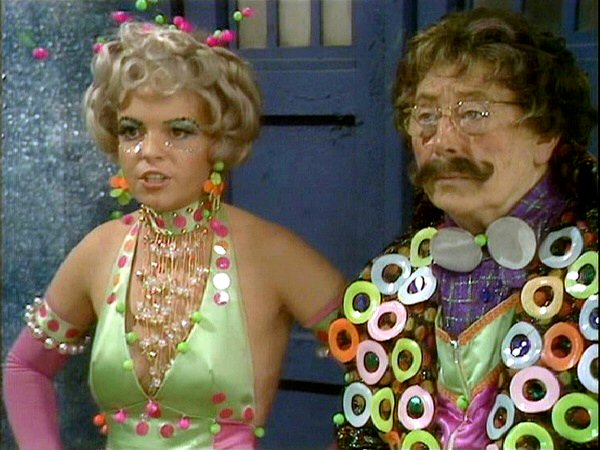
Leslie Dwyer's time as the Doctor is widely held to have been undermined
by the loud, tasteless, multi-coloured coat that he was forced to wear.
by the loud, tasteless, multi-coloured coat that he was forced to wear.
Oh wait! That's Shirna and Vorg. Easy mistake to make.
I'm sure the eeriely mirroring situation is just a freaky coincidence. After all, this is
a Pertwee story, and subtext wasn't invented until 1982 when they aired ‘Kinda’.
Anyway, I don't know how I confused them with the Doctor and Jo Grant, they didn't arrive in the TARDIS. They arrived on an assembly line where they were treated like mass produced objects. Again, no possible hint of irony could possibly have been in Robert Holmes' mind when he wrote that. He's not exactly a writer known for using comedy double acts to promote subversive material, now is he? I'm sure he didn't mean to say that Doctor Who had become rather formulaic in recent years.
Right, so everything I said before, let's just take that as unintentional co-incidence.
You write about two people travelling through space to exotic worlds together, there's bound to be some overlap with a completely different set of characters in the same universe who just happen to travel through space together.
So what about Vorg and Shirna? Well Shirna is the assistant. And Vorg is a somewhat shady seeming, but apparently nice enough, alien with a small, innocuous-looking, machine that can manipulate time and is bigger on the inside than the out. (It's the size of a tall trash can, and can contain entire oceanliners and desert planets.)
Oh and while Vorg tries to calm his assistant when the machine starts to go bonkers, he keeps insisting that everything is alright and he knows how to operate the machine, when he blatantly doesn't.
So yeah, it just gets more and more dissimilar a parallel as I continue. Doesn't it?
Okay, enough with the sarcasm.
Vorg and Shirna are Doctor Who.
They are a statement about Doctor Who WITHIN a serial of Doctor Who.
And what are Vorg and Shirna (aka Doctor Who) trying to do? Well they arrive, reckon their audience is stupid, and then try to con as much cash out of them as possible.
"Step up step up for the monster show! Step up for the monster show! You schmucks!"
Not exactly the BEST thing you can say about Monster Show fan-...oops, I mean Doctor Who fandom, is it?
No nostalgia. Just plain old "Get the mark's money/viewing figures/AI numbers."
Nearby two aliens note that their scientists are puzzled as to why virtually every alien species looks more or less roughly humanoid. Again -- SERIOUS. TAKING. THE. PISS.
Meanwhile the Doctor and Jo are running around in corridors, getting captured, escaping, getting terrified by monsters, running around in corridors, getting captured, escaping, getting terrified by monsters, running around in corridors which Jo insists they've been in before but the Doctor assures her that the corridors all look identical and it's just her imagination, and then they discover that it actually IS the same corridor again and again. And they are surrounded by people who repeat the same actions AGAIN AND AGAIN!
The Doctor's life comes into peril on multiple occasions -- he's almost microwaved to death due to some rather harsh immigration laws, he's almost eaten, etc etc. But for once it's not the Doctor being generally clever, insanely lucky, or his foe's being generally bad at killing people that saves him.
This time around, at every turn the Doctor has saviours who step in on his behalf.
Who are these saviours? A bunch of bickering bureaucrats with unbelievably awful hair. Each of the bureaucrats is driven by a need to outdo the other in a petty game of political backstabbing. Each time the Doctor is threatened, petty bureaucrats advance their own agendas to save Doctor Who... I mean, the Doctor. I mean...well, I don't want to suggest that Robert Holmes was suggesting something about the way decisions were made at the BBC in the 1970s. It's just an eerie coincidence, just like the Vorg/Shirna parallel we debunked earlier.
In brief, the entire history of Doctor Who is deconstructed and taken the piss out of.
And that's not too terribly hard; We've seen horrifically unsubtle stabs at it, say with the LITERAL cliffhanger in ‘Dragonfire’. But what makes Robert Holmes impressive is that he did it under the nose of fans who have seen the episodes multiple times. The difference is that the same fans who are happy to pick apart the socio-political importance of ‘Battlefield’, tend to dismiss Pertwee as a load of old pro-establishment rubbish. Which doesn't pan out if you actually sit down and watch Pertwee stories.
Things like ‘The Green Death’, which was entirely blatant and in-your-face, were far more relevant and necessary than say -- an impassioned speech against nuclear war, which by 1989 wasn't too terribly controversial an idea. You've got the Peladon stories, the ‘Frontier In Space’, the Silurians -- all of which are trying to address relevant points with varying degrees of success. But ‘Carnival of Monsters’ is the Pertwee story that looks inward, and gets away with it.
Now, I should finish on that last line but that would mean I'd have to drop another point entirely, but it's one thing that I mustn't over look -
The Pertwee stories also are a great source to see the fundamental shift of social expectation.
Dystopia, oppression, and state violence were THE EXPECTED NORM of the 1970s. In a modern production all social ills are cured or taking their first steps to being healed within 45 minutes of the opening credits. For instance, even in the first Ood story we see the human characters shift their perceptions radically at the end of the story when they record the Ood deaths. And that sets the stage for the ABSOLUTELY UNAVOIDABLE sequel in which the Ood are freed.
In the ‘Carnival of Monsters’? The powers that be of Inter-Minor push the working class to the brink of insanity and then shoot them dead in cold blood.
Not only is this NOT all fixed with a happy warm bow at the end of the story -- it's NEVER EVEN ADDRESSED.
The Doctor doesn't get involved. He doesn't free the enslaved masses. He doesn't demand retribution for the "forcibly retired" members of the workforce. He just pisses off.
But he doesn't piss off before he laughs, chuckles, and essentially endorses Vorg on his quest to con innocent people out of as much credit bars as possible.
I’ll only say one thing in response to the above. The Ood aren’t “freed”, they free themselves. And in the last episode of ‘Carnival’, Pletrac can’t get the transport to take Vorg and Shirna away because “the functionaries are refusing to work double shifts”. When they protest on their own they can be shot down. When they unite, all the ruling class can do is grumble and look scared. That’s why I like the fact that the Doctor doesn’t free them. They don’t need him to. They can do it themselves. We need a bit of that sort of thing ourselves.
Subscribe to:
Posts (Atom)