"I have in my hand a piece of paper," says Mr Stevens, CEO of Global Chemicals, echoing Chamberlain in unconscious admission that his promises of a profitable truce in the class war will turn out to be worthless, "which will mean a great deal to all of you. Wealth in our time!"
The ex-miners, crowded around the gates of the closed pit, are unimpressed.
"When the National Coal Board were forced to close the pit last year..." Stevens begins.
"It were a shame, that was!" heckles one of the workers, in Ignorant Yokel Speak.
"No, my friends," says Stevens chummily, presenting himself as one of them, "we must not be bitter. We must face the facts."
Note the 'we'; the most abused word in political discourse. As in 'we're all in this together'.
"Coal is a dying industry," asserts Stevens.
The miners shout "Rubbish! Rubbish!"
When it happens in reality, the idea that the mines had to shut because they were unprofitable will be rubbish. Mining was always subsidised.
"Oil is our future now and the government agrees with
me. They have not only given us the go-ahead for our plans,
they have promised us money for future expansion!" So the state is now subsidising a private company instead of nationalised coal and people's jobs. "I have it here in
black and white!"
There is general cheering. This story represents the working class, via the conduit of Welshness, as idiots. The feckless, changeable, easily-swayed mob - a trope that goes back a long way.
"Money for all of us! More jobs, more housing, more cars!" The promise of returned prosperity in the depths of the 70s.
In terms of when it was made, this is an odd scene. Miners were powerful and militant in 1973. They were unionised and they were winning. They weren't sacked, helpless, grumbling no-hopers, stuck on the sidelines.
In terms of the future, however, this scene is actually prescient. By the late-90s, British mining - together with so much manufacturing
industry - had been deliberately destroyed by the Tories, partly from a pure ideological objection to the idea of powerful workers and unions, partly as revenge for the miners bringing down Heath in '74 (the year after this story was broadcast). Huge numbers
of traditional working class jobs were annihilated by the Conservatives. Working class
communities were wrecked in the process. In many ways, the sight of a
crowd of workers, made redundant, closed out of their sold-off and
shut-down workplace, listening to speeches about how coal is dead, being
fraudulently told that their future lies in the trickle-down effect of
private profit, is a sight that predicts the result of Thatcherism.
And when Stevens says "oil is the future" he's only telling part of the truth. The future he really has in mind is one of the corporation as pure post-industrial power structure. Stevens is an administrator, a
manipulator of executive practices, PR, lobbying, influence, delegated
tasks, etc. This is, in its way, strangely prescient of the outward
features of neoliberalism... which was, after all, just getting started
roundabout 1973. The theory of post-industrialism is pretty specious, to be honest, but a lot of people believe in it, interpreting neoliberalism as a reorganisation of capital along lines of services and pure information, production being relegated to a quaint relic. This is largely bullshit, but it expresses something that a lot of people - some of them people like Stevens - believe: that capitalism can dispense with old-style workers, and all the dangers inherent in them, in favour of economies based on the shunting around of pure information. That this is Stevens' dream is expressed by the fact that his company is secretly run by an insane computer that is also his alter ego... or should that be, his 'alter id'. It's aim is to create "total efficiency" in society (which is explicitly stated to be equivalent to the business dominance of Global Chemicals) by sacking all workers, abandoning coal (i.e. production), turning industry into a 'post-industrial' wasteland, brainwashing all corporate executives and linking all computers in the world into itself, thus unifying all information.
Trouble is, Stevens and his 'B.O.S.S.' have reckoned without the gothic, that eternal bad conscience. The gothic brings ghosts out of the disused mine... in the form of giant maggots. They are definitely ghosts. Ghosts - in the sense of the ghost story as we know it - are modern things. Gothic Marxism (perhaps most especially in the insights of Christopher Caudwell) has identified the ghost story as a quintessentially modern phenomenon. It is the worm in the apple of modern rationalism. And it is a very material genre. The 'ghosts' of M.R. James - effective founder of what we call the 'ghost story' - are gothic in that they represent the return of the repressed, but also material in that they emerge from modernity (manufactured things like prints and sheets and train tickets and mass-reproduced patterns) and that the tend to be icky and hairy and chitinous.
Giant maggots which signify the repressed dark secrets of capitalist production, erupting out of a closed mine, are ghosts in this sense. In this story, oddly, they're the ghosts of the future.

ideas are icepickproof
Showing posts with label green death. Show all posts
Showing posts with label green death. Show all posts
Thursday, 21 November 2013


Saturday, 21 July 2012
Skulltopus 12: Come Out onto the Balcony and Wave a Tentacle
Okay, first a quick (well... relatively quick) recap and a few clarifications... because we've come a long way. And then onto some hot Zygon action.
The Story So Far...
According to China Miéville, the tentacular monster was introduced to Western SF/Horror literature in the late 19th and early 20th centuries by the loose style/affect/trend known as 'the Weird'. Lovecraft, Hodgson, Machen, etc. They used various new forms of the monstrous, especially tentacles, as a 'novum', unfreighted with previously accreted meanings and associations, which could express something of the unprecedented, inexplicable, inexpressible catastrophic horror that was engulfing modernity with the onrush of world war, mechanised imperialism and endemic economic crisis. (There were a couple of important pre-eruptions of the tentacular and Weirdish courtesy of SF pioneer H.G. Wells and 'ghost story' writer M.R. James.) Mieville says that the Weird represents a way of trying to express anxieties that is alternate and incompatible with the gothic. The gothic - or hauntological - is an expression of something we already know which has been hidden (or repressed) and which haunts us, threatening to return. The Weird is what we don't - and perhaps cannot - know, erupting without precedent and confronting us with our own incomprehension. Consequently, the gothic and the Weird exist in "non-dialectical superposition", oscillating back and forth... something which shows in the almost total absence in Western monsterology of the skulltopus, a fusion of skull (gothic) and octopus (Weird) which, on the face of it, would seem to be quite an obvious synthesis, especially given that the central hub of an octopus's body is decidedly skull-like in shape.
Much later, long after the process in Western literary and graphic monsterology that Miéville describes, and long after tentacles had been thoroughly assimilated into the mainstream of Western Horror and SF, tentacles begin to make their presence felt in Doctor Who. In the early days, most of the tentacles that appeared in the show did so courtesy of Terry Nation. For instance, he adroitly selected an octopus as a meaningless plot-device monster in 'The Chase'. He may have done this because the octopoidal carried a residual charge of blankness or meaninglessness. Also, Nation seems to have repeatedly associated a tentacular or Weirdesque monster with economic exploitation. The Brains of Morphoton have stubby tentacles and run an entire economy on hypnotism, making scarcity seem like material abundance; the Slyther turns up when the Daleks are forcing people to mine for them and black-marketeers are taking advantage of the situation. This may be a co-optation of the 'blankness' of the tentacular inherited from the Weird. It may also be that, because the modernity that filled the Weird writers with such nebulous horror was capitalist modernity, there is something in their pre-eminent monster-type that naturally lends itself to expressing horror at economic exploitation. (They themselves would probably have rejected this, most of them being reactionaries... though, interestingly, Lovecraft - who was a disgusting racist, living in dread of 'miscegenation' - once identified himself as a supporter of FDR and the New Deal, even calling himself a 'socialist'.) In any case, surprising as it seems - and I find this as unexpected as you probably do - Nation seems to have laid the groundwork for a semiotic connection within Doctor Who between tentacles and capitalism that later appeared, fully-fledged, at the start of the 70s.
Chiming with Miéville's ideas, while also working differently to the process he describes, there is a peculiar dialectic that gets started in the show between the gothic and this half-remembered version of the Weird. 'The Macra Terror' is the harbinger of what is to come. It uses a recalled version of the Weird by using monsters that are crabs (the Weird is very maritime; Hodgson employs giant crabs a lot in his stories) and yet also undefined and/or overdescribed to the point of incoherence (this is also a trait of Weird monsters). At the same time, however, the same monsters are deeply hauntological in that they literally haunt the Colony, representing repressed fears, their very existence denied by even those who have seen them lurking in the shadows. This happens, I think, because 'The Macra Terror' is the first major attempt by Doctor Who - up to that point - to engage with some of the radical ideas of the 60s. Like The Prisoner, which it anticipates in some respects, it frets over an apparent convergence between the underlying political structures of the 'democratic' West and the 'totalitarian' East. The Colony is a political tyranny with capitalist features. There is brainwashing, surveillance, a secret police force... co-existing with a Holiday Camp style atmosphere, leisure time, makeovers, beauty contests and an ideology of cheerful team-spirit. This is a very 60s anxiety and ties in with currents of radical thought of the time. Haunted by this idea, which cannot be openly acknowledged, the text resorts to radically obscuring its hauntological monsters by co-opting aspects of the Weird.
Not long after this, at the start of the 70s, Robert Holmes wrote a story with various elements that seemed to converge upon capitalism as a source of exploitation, alienation and hierarchy... and even to connect capitalism with imperialism, racism and sexism. (I know, you think I've gone mad... well, click the following link to see my reasoning...) 'Spearhead from Space' contains this potential because it concentrates on a capitalist factory, upon the process of production, upon wage labour, upon products and commodities alienated and fetishized to the point of hostile autonomy. Its monsters - the Autons - work as emblems of alienation and commodity fetishism as described by Marx. They are hostile commodities, invested with a life of their own, confronting people as an external and dominating power. They alienate the human image from humans. They are made in the capitalist factory, by workers, several of whom are Asian women working for a white man making white dolls. The Autons themselves are white - whiteness seems to be the Nestene idea of the typical human, the 'vanilla' human if you will. The Autons are expressions of Nestene imperialism; the Nestenes explicitly describe themselves as colonialists. The Nestenes merge their Autons with the human shopping centre and with a pantheon of white Western political oligarchs displayed in Madame Tussauds (with some non-white opponents of white imperialism - Ghandi, MLK - also on display, for counterpoint). The plastic replicas of the ruling class stalk out of Tussauds to take over the country. Meanwhile, the Autons attack in the high street, wearing price tags, gunning people down amidst adverts and logos and shop signs. It's well understood that George A. Romero's Dawn of the Dead (1978) is a 'satire of consumerism' because it features zombies staggering mindlessly around a shopping mall. Indeed, it's pretty much a cliché to mention the fact. It's time people realised that, once again, Doctor Who got there first - only more acutely. However, at the figurative centre of 'Spearhead from Space', at the heart of the factory where the Nestene entity itself is being produced, Holmes seems to evade the convergence of these themes by the sudden introduction of radically incoherent tentacles. The threat was that the themes and signs of the story would converge lucidly upon the capitalist system as a generator of modern nightmares. The tentacles - harking back to their original Weird blankness - are a redaction, a scrambling, an obfuscation. Doctor Who relentlessly concentrates upon the modern nightmares that are generated by capitalism - industrialised warfare and imperialism, biological racism, fascism, etc. - but cannot openly acknowledge capitalism as the hub from which they emanate, owing to its status - the children's own programme that adults adore - within the established culture industry.
The ironic thing is that this semiotic evasion almost instantly became a semiotic association. This may express an inherent instability within any sign that is pressed into the service of the inscrutable or inexpressible. Evasion of meaning is fundamentally not what signs are supposed to do. Evasion of truth, sure, but not of settled significance itself. Such a sign hunts around for a meaning, so to speak. It must find a telos, even if the one it finds is the very telos it was supposed to be evading. (This is not idealism, by the way. When I talk about the sign 'doing' things, I'm actually talking about the people using it... just as one might say that a car 'cruises' when in fact it is the driver doing the cruising.)
In 70s Who, the tentacular sign is employed to evade capitalism, and instantly starts to signify capitalism. It would be easy to see this connection between the tentacular and capitalism as a mere empty recapitulation of continuity when it reappears in Holmes' sequel, 'Terror of the Autons'... if it weren't for almost immediate appearance of 'The Claws of Axos', which is a development and intensification of the connection, written by different writers. Echoing the process described by Miéville - and that's what this is: an echo - the tentacular in Doctor Who is, almost from the first, enmeshed in an antagonistic dialectic with the gothic, the show's better-established mode. For instance, in 'Claws of Axos' the tentacular elbows out the gothic (while taking on a hauntological charge). The story was originally about a space 'vampire' in the shape of a giant skull; it became instead about a huge bag of strange, spectacular, writhing, incoherent flesh.
Later, the tentacular is so integrated into the internal sign system of 70s Who that it just rides in on an association with capitalism, even when there's nothing that needs obscuring because free trade-style capitalism is being presented as implicitly good. But even at this point - roughly speaking, 'The Curse of Peladon' - it still continues dancing with the gothic. In 'The Curse of Peladon', Arcturus is very nearly a skulltopus because he's both capitalist (a representative of the Federation with all its trade and progress, counterposed to Pel feudalism) but also a protectionist reactionary who wants Peladon to stay a feudal backwater. (This, it need hardly be said, reflects the arguments about free trade vs. protectionism which flurried around the UK's entry into the 'Common Market' roundabout the time 'Curse' was made, i.e. the dawn of neoliberalism.)
This skulltopusization can occur because 'Curse of Peladon' is a
distant echo of the process described by Miéville; a televisual atavism
in the 1970s of a process originally found in literature and graphics
in the late 19th and early 20th centuries. The gothic/Weird dance
continues, with tentacles always erupting whenever capitalism appears
in the show as a systemic presence, throughout the rest of the Pertwee
era. In 'The Green Death'
- the last Pertweean gasp of the Weird - there is a tentacle which
appears at the start, almost as an obligatory afterthought, and there
are the Weird-esque maggots. Still, the gothic clings on alongside this
recycled, processed version of the Weird. The gothic keeps trying to
reintegrate. 'Green Death' works like an M.R. James ghost story, with
its material 'hauntings', linked to technological modernity. It will
be recalled that Miéville identified James as one of the precursors of
the Weird. Reading James, one usually encounters not spectral ghosts
but slimey, hairy, icky, chitinous things, or things that seem oddly to
emerge from modernity - haunted prints, designs or train tickets, for
example. This sort of thing is very apt to happen in Doctor Who because its version of the gothic has always been very material
and materialist. 'The Green Death' is a perfect example, with its
Jamesean 'ghosts': slimey, hairy, icky, chitinous monsters that emerge
from a chemical factory. As James prefigured the Weird even as he wrote
in the gothic, so 'Green Death' partially integrates the Weird and the
gothic. It joins the Whoish 'material gothic' to its new habit
of using the Weird as a way of evading/signifying capitalism. Even
its title illustrates this dialectic, with the slimey, gooey 'Green'
grafted onto the gothic 'Death'.
And so, we arrive at the Tom Baker years - always spoken of as quintessentially gothic.
Broton's Zygotic Mynci
The first appearance in the Baker era of anything even faintly Weird or Weird-esque (and it is faint) arrives (as already hinted) in 'Terror of the Zygons'. The Zygons are covered in suckers. They live underwater and control a sea monster. So they're well maritime (as mentioned above, the Weird is frequently maritime in its concerns). The Doctor even refers to them at one point as having tentacles, which is a bit of a stretch on his part, but still... Moreover, they are shape-shifters. This is another of those things which is actually rarer in Doctor Who than one might immediately think. Apologies for the tautology, but the essence of the shape-shifter is
indeterminacy of form. Here, once again, we have incoherence and the
tentacular. I don't want to overstate. The Zygons are hardly
inscrutable. They state their plans very clearly. They are most
obliging with their freely-offered exposition when they capture Harry.
There is little to misunderstand about them. They are a terroristic
advance-guard of a fleet of imperialistic nomads. But they are tentacular (just about) and they are
unstuck from a fixed physical form. Most especially, the inside of
their ship is organic in a way not even hinted-at in the show since
'Axos'. With their great, domed foreheads, their name (which sounds so
much like 'zygotes'), their ability to 'become' adult humans and their
apparent loathing of doing so, their dependence upon the "lactic fluid"
of a much-larger organism and their warm, snug, pulsing, fleshy,
veined base of operations, it's hard not to notice that they are
disquietingly infantile. Monstrous babies were much in vogue in Horror
in the late 60s / early 70s. Rosemary's Baby, It's Alive, Eraserhead, The Omen... the original idea of the writers of Alien
was that the monster should be like a "monstrous, deformed baby".
This is a digression (gee, how unusual here!) but the point is that
their ship recalls Axos, though in a much less wild and spectacular
form.
The semiotic connection between the tentacular and capitalism is being continued, albeit it in a faint, garbled and undeveloped form. 'Terror of the Zygons' features rigs owned and run by an American oil company which is traumatically bringing on the collapse of an old, feudal way of life in favour of new capitalist development. Seven centuries of 'service' seem not to count "these days". All Forgill's servants leave to work for the rigs. Huckle's men trespass upon Forgill's lands, showing no respect for feudal land ownership in their pursuit of capitalist accumulation of a fossil fuel that will power modern technology. As in 'Green Death', the eruption of the Weirdish occurs in something of a gothic manner - the hidden erupts from beneath - as a result of the intrusion of modern, explicitly capitalist technology.
It's tempting to say that the Zygons are associated more with the 'old ways', the feudal aristocracy. Broton disguises himself as the Duke of Forgill and the Zygon ship is linked to the land by a tunnel that leads up into the dusty old library of Forgill Castle. Speaking in his Forgill persona, Broton seems convincingly to voice the resentment of the obsolete aristocrat in the time of the oil corporation. But this is to impose a clear-cut distinction where in fact there are complex interrelationships. The real Duke's ancestors would probably have been among those making 'improvements' to the land, i.e. enclosing it and evicting people from their homes to make way for sheep. This actually happened to land around Loch Ness. These were among the first steps in the rise of modern capitalism in Scotland. Huge tracts of private land used for bourgeois farming and/or rents, leading to the filling-up of industrial towns with displaced new proletarians and/or the expansion of the 'New World' colonies, vital because of their roles in the slave trade and production of commodities like cotton, or coal - the oil of its day.
Similarly, the Zygons plan a massive exercise in invasion and colonialism... chiming with the invasion and annexation of Scotland by England (re-enacted in a miniaturized, comic mode through UNIT's invasion and takeover of Angus's inn... a process he resists by loudly playing the bagpipes at the occupying, armed Sassenachs). But we can't straightforwardly associate Zygon colonialism with English colonialism. The Zygons are also refugees, driven away from their home and seeking a new one. They plan to colonize Earth using the slave labour of the humans. A great many of the Scottish Highlanders driven out of their homes by the Clearances ended up in the Carolinas in America. The Carolinas were, of course, slave states. If the Zygons work as the echoes of English domination of Scotland, they also work as an echo of the forced migrants who ended up dominating the New World. (Meanwhile, we can't straightforwardly assume a connection between Forgill's old-fashioned Scots aristocratic posture and Scottish nationalism. A lot of those dukedoms were created by the English crown.)
Recycling Experiment
Interestingly, some of these same dynamics - the interrelationship of
feudal wealth and modern capitalism, the complex conception of colonial
conquest - reappear in Robert Banks Stewart's other script for
Hinchliffe and Holmes, 'The Seeds of Doom'.
In that story, Harrison Chase is a modern millionaire with a private
lab and salaried employees, including a personal botanist and an
enforcer with a gaggle of naff private thugs. Chase is entirely
immersed in modernity. He is surrounded by modern technology - his
private lab, his private plane, his huge climate-controlled greenhouse,
his peculiar electronic organ (ooo-er missus), etc. He is also
immersed in commodification. He buys officials, information, loyalty,
etc. He owns people "body and soul". He owns and buys things
constantly. He haggles over and buys a painting on screen during the
story. He effectively buys the rights to the pod and everything that
comes from it. That's how he sees it anyway. But he is also a relic
of feudalism. His is evidently an old family, and his money is
evidently old money. His house dates from the time of the Wars of the
Roses ("charmingly named") and is haunted by Sir Bothwell Chase. There
doesn't appear to be a contradiction here. The one form of power
seems to bleed seamlessly into the other. Indeed, it might even go
back farther than that. As the lord and master of cultivated grounds,
as the Abbot of a "green cathedral", as a landowner and employer of a
private army, Chase is almost like an echo of the earliest ruling
classes that arose with the coming of agriculture. He's like one of
the administrators or priests who came into existence when a new way of
making a living - settled growing and reaping - brought surplus and,
with it, social hierarchies... along with organised war, which suddenly
became worthwhile once there were settled civilisations whose crops
and plants you could seize. Chase and Scorby are like the descendants
of these first lords and warriors, still fighting over ownership of the
greenery all these centuries later. Feudalism and capitalism both
seem to have carried this same violent and piratical hierarchy, in
turn, down to the present. Chase is like a palimpsest of all these
rulers. He's the Abbot, the lordly landowner, the modern businessman -
all in one.
Also, there is much talk of 'revolution' in the story, and the inversion of power relationships... caused by an invasion and colonisation. Chase conceives of plants and flowers as being an oppressed group, as though they stand in a colonial relationship to animals. Even from the first, long before he seems to be 'possessed' by the Krynoid (not that he ever really is, if you ask me), he whinges to Dunbar about the "mutilation and torture" of plants in the practice of Bonsai, the favouritism allegedly shown towards animals by the World Ecology Bureau and the unnatural criminality of creating hybrids. Later, he talks of animals like a tyrannical ruling elite, about to be conquered and enslaved by the coming of the Krynoid, which he appears to see as a huge, plant-version of Che Guevara. The invasion and colonialism of the Krynoid is like the ousting of a native ruling class. He almost anticipates the doctrine of 'humanitarian intervention' - invade and conquer to (supposedly) free the oppressed - but for the fact that it isn't the humans he wants to save.
It's open to doubt whether 'Zygons' and 'Seeds' work this way because the show is still trying to evade noticing capitalism as a generator of modern nightmares. It feels more like the recapitulation of a settled sign, almost as a matter of habit. It also feels as though the studiedly gothic atmosphere of the Hinchcliffe / Holmes era is squeezing the Weird tentacles into an increasingly small corner. First there are tentacles that are not really tentacles (arms and legs with decorative suckers), then there are tentacles that are actually vines and creepers and roots. Capitalism still tags alongside these almost-tentacles (or is it the other way round) but in a decidedly muted, faint and compromised form. It appears mixed up with feudalism, in a very tangled way.
There is very little else in the Hinchcliffe years which qualifies as Weird or quasi-Weird or even almost-Weird. The tentacular returns with a vengeance, however, in the more political Williams era... just in time to notice that the world is changing, neoliberalism is flowering, class struggle is waning, Thatcher is rising and capitalism no longer anything to be worried about - at least not officially. Consequently, by the near-end of the Williams years, it no longer feels right to wrap capitalism in tentacles. But, as I say, this only happens after the tentacular/capitalist semiotic connection re-erupts... in ways that range from the furtive to the ambiguous to the angrily and hugely explicit.
CORRECTION, 28/09/12:
In the text above, I say that "A lot of those [Scottish] dukedoms were created by the English crown." That's just plain wrong. Factually inaccurate. Sorry. Thanks to Jennings for pointing this out.
The Story So Far...
 |
| If only 'Pirates of the Caribbean II' had looked this good. |
Much later, long after the process in Western literary and graphic monsterology that Miéville describes, and long after tentacles had been thoroughly assimilated into the mainstream of Western Horror and SF, tentacles begin to make their presence felt in Doctor Who. In the early days, most of the tentacles that appeared in the show did so courtesy of Terry Nation. For instance, he adroitly selected an octopus as a meaningless plot-device monster in 'The Chase'. He may have done this because the octopoidal carried a residual charge of blankness or meaninglessness. Also, Nation seems to have repeatedly associated a tentacular or Weirdesque monster with economic exploitation. The Brains of Morphoton have stubby tentacles and run an entire economy on hypnotism, making scarcity seem like material abundance; the Slyther turns up when the Daleks are forcing people to mine for them and black-marketeers are taking advantage of the situation. This may be a co-optation of the 'blankness' of the tentacular inherited from the Weird. It may also be that, because the modernity that filled the Weird writers with such nebulous horror was capitalist modernity, there is something in their pre-eminent monster-type that naturally lends itself to expressing horror at economic exploitation. (They themselves would probably have rejected this, most of them being reactionaries... though, interestingly, Lovecraft - who was a disgusting racist, living in dread of 'miscegenation' - once identified himself as a supporter of FDR and the New Deal, even calling himself a 'socialist'.) In any case, surprising as it seems - and I find this as unexpected as you probably do - Nation seems to have laid the groundwork for a semiotic connection within Doctor Who between tentacles and capitalism that later appeared, fully-fledged, at the start of the 70s.
Chiming with Miéville's ideas, while also working differently to the process he describes, there is a peculiar dialectic that gets started in the show between the gothic and this half-remembered version of the Weird. 'The Macra Terror' is the harbinger of what is to come. It uses a recalled version of the Weird by using monsters that are crabs (the Weird is very maritime; Hodgson employs giant crabs a lot in his stories) and yet also undefined and/or overdescribed to the point of incoherence (this is also a trait of Weird monsters). At the same time, however, the same monsters are deeply hauntological in that they literally haunt the Colony, representing repressed fears, their very existence denied by even those who have seen them lurking in the shadows. This happens, I think, because 'The Macra Terror' is the first major attempt by Doctor Who - up to that point - to engage with some of the radical ideas of the 60s. Like The Prisoner, which it anticipates in some respects, it frets over an apparent convergence between the underlying political structures of the 'democratic' West and the 'totalitarian' East. The Colony is a political tyranny with capitalist features. There is brainwashing, surveillance, a secret police force... co-existing with a Holiday Camp style atmosphere, leisure time, makeovers, beauty contests and an ideology of cheerful team-spirit. This is a very 60s anxiety and ties in with currents of radical thought of the time. Haunted by this idea, which cannot be openly acknowledged, the text resorts to radically obscuring its hauntological monsters by co-opting aspects of the Weird.
 |
| The most politically loaded image in 'Doctor Who'. |
The ironic thing is that this semiotic evasion almost instantly became a semiotic association. This may express an inherent instability within any sign that is pressed into the service of the inscrutable or inexpressible. Evasion of meaning is fundamentally not what signs are supposed to do. Evasion of truth, sure, but not of settled significance itself. Such a sign hunts around for a meaning, so to speak. It must find a telos, even if the one it finds is the very telos it was supposed to be evading. (This is not idealism, by the way. When I talk about the sign 'doing' things, I'm actually talking about the people using it... just as one might say that a car 'cruises' when in fact it is the driver doing the cruising.)
In 70s Who, the tentacular sign is employed to evade capitalism, and instantly starts to signify capitalism. It would be easy to see this connection between the tentacular and capitalism as a mere empty recapitulation of continuity when it reappears in Holmes' sequel, 'Terror of the Autons'... if it weren't for almost immediate appearance of 'The Claws of Axos', which is a development and intensification of the connection, written by different writers. Echoing the process described by Miéville - and that's what this is: an echo - the tentacular in Doctor Who is, almost from the first, enmeshed in an antagonistic dialectic with the gothic, the show's better-established mode. For instance, in 'Claws of Axos' the tentacular elbows out the gothic (while taking on a hauntological charge). The story was originally about a space 'vampire' in the shape of a giant skull; it became instead about a huge bag of strange, spectacular, writhing, incoherent flesh.
Later, the tentacular is so integrated into the internal sign system of 70s Who that it just rides in on an association with capitalism, even when there's nothing that needs obscuring because free trade-style capitalism is being presented as implicitly good. But even at this point - roughly speaking, 'The Curse of Peladon' - it still continues dancing with the gothic. In 'The Curse of Peladon', Arcturus is very nearly a skulltopus because he's both capitalist (a representative of the Federation with all its trade and progress, counterposed to Pel feudalism) but also a protectionist reactionary who wants Peladon to stay a feudal backwater. (This, it need hardly be said, reflects the arguments about free trade vs. protectionism which flurried around the UK's entry into the 'Common Market' roundabout the time 'Curse' was made, i.e. the dawn of neoliberalism.)
 |
| Astonishingly enough, this character... [SPOILER WARNING!!!] ...turns out to be evil. |
And so, we arrive at the Tom Baker years - always spoken of as quintessentially gothic.
Broton's Zygotic Mynci
 |
| "Go away. You're always hovering. It makes me nervous." "I just want to be near you." "I've told you - not at work!" |
The semiotic connection between the tentacular and capitalism is being continued, albeit it in a faint, garbled and undeveloped form. 'Terror of the Zygons' features rigs owned and run by an American oil company which is traumatically bringing on the collapse of an old, feudal way of life in favour of new capitalist development. Seven centuries of 'service' seem not to count "these days". All Forgill's servants leave to work for the rigs. Huckle's men trespass upon Forgill's lands, showing no respect for feudal land ownership in their pursuit of capitalist accumulation of a fossil fuel that will power modern technology. As in 'Green Death', the eruption of the Weirdish occurs in something of a gothic manner - the hidden erupts from beneath - as a result of the intrusion of modern, explicitly capitalist technology.
It's tempting to say that the Zygons are associated more with the 'old ways', the feudal aristocracy. Broton disguises himself as the Duke of Forgill and the Zygon ship is linked to the land by a tunnel that leads up into the dusty old library of Forgill Castle. Speaking in his Forgill persona, Broton seems convincingly to voice the resentment of the obsolete aristocrat in the time of the oil corporation. But this is to impose a clear-cut distinction where in fact there are complex interrelationships. The real Duke's ancestors would probably have been among those making 'improvements' to the land, i.e. enclosing it and evicting people from their homes to make way for sheep. This actually happened to land around Loch Ness. These were among the first steps in the rise of modern capitalism in Scotland. Huge tracts of private land used for bourgeois farming and/or rents, leading to the filling-up of industrial towns with displaced new proletarians and/or the expansion of the 'New World' colonies, vital because of their roles in the slave trade and production of commodities like cotton, or coal - the oil of its day.
Similarly, the Zygons plan a massive exercise in invasion and colonialism... chiming with the invasion and annexation of Scotland by England (re-enacted in a miniaturized, comic mode through UNIT's invasion and takeover of Angus's inn... a process he resists by loudly playing the bagpipes at the occupying, armed Sassenachs). But we can't straightforwardly associate Zygon colonialism with English colonialism. The Zygons are also refugees, driven away from their home and seeking a new one. They plan to colonize Earth using the slave labour of the humans. A great many of the Scottish Highlanders driven out of their homes by the Clearances ended up in the Carolinas in America. The Carolinas were, of course, slave states. If the Zygons work as the echoes of English domination of Scotland, they also work as an echo of the forced migrants who ended up dominating the New World. (Meanwhile, we can't straightforwardly assume a connection between Forgill's old-fashioned Scots aristocratic posture and Scottish nationalism. A lot of those dukedoms were created by the English crown.)
Recycling Experiment
 |
| The National Trust will have something to say about this. |
Also, there is much talk of 'revolution' in the story, and the inversion of power relationships... caused by an invasion and colonisation. Chase conceives of plants and flowers as being an oppressed group, as though they stand in a colonial relationship to animals. Even from the first, long before he seems to be 'possessed' by the Krynoid (not that he ever really is, if you ask me), he whinges to Dunbar about the "mutilation and torture" of plants in the practice of Bonsai, the favouritism allegedly shown towards animals by the World Ecology Bureau and the unnatural criminality of creating hybrids. Later, he talks of animals like a tyrannical ruling elite, about to be conquered and enslaved by the coming of the Krynoid, which he appears to see as a huge, plant-version of Che Guevara. The invasion and colonialism of the Krynoid is like the ousting of a native ruling class. He almost anticipates the doctrine of 'humanitarian intervention' - invade and conquer to (supposedly) free the oppressed - but for the fact that it isn't the humans he wants to save.
It's open to doubt whether 'Zygons' and 'Seeds' work this way because the show is still trying to evade noticing capitalism as a generator of modern nightmares. It feels more like the recapitulation of a settled sign, almost as a matter of habit. It also feels as though the studiedly gothic atmosphere of the Hinchcliffe / Holmes era is squeezing the Weird tentacles into an increasingly small corner. First there are tentacles that are not really tentacles (arms and legs with decorative suckers), then there are tentacles that are actually vines and creepers and roots. Capitalism still tags alongside these almost-tentacles (or is it the other way round) but in a decidedly muted, faint and compromised form. It appears mixed up with feudalism, in a very tangled way.
There is very little else in the Hinchcliffe years which qualifies as Weird or quasi-Weird or even almost-Weird. The tentacular returns with a vengeance, however, in the more political Williams era... just in time to notice that the world is changing, neoliberalism is flowering, class struggle is waning, Thatcher is rising and capitalism no longer anything to be worried about - at least not officially. Consequently, by the near-end of the Williams years, it no longer feels right to wrap capitalism in tentacles. But, as I say, this only happens after the tentacular/capitalist semiotic connection re-erupts... in ways that range from the furtive to the ambiguous to the angrily and hugely explicit.
CORRECTION, 28/09/12:
In the text above, I say that "A lot of those [Scottish] dukedoms were created by the English crown." That's just plain wrong. Factually inaccurate. Sorry. Thanks to Jennings for pointing this out.
Friday, 2 March 2012
Cottage Industry vs. the Spectacular Tentacular Draculas
According to Miles and Wood, Barry Letts' eco views were very much influnced (as were many people's) by a text called Blueprint for Survival, co-written by Edward Goldsmith (now deceased) and published in the magazine he founded, The Ecologist, in 1972. It was supported by many scientists and was subsequently released in book form to became a best-seller. Miles and Wood identify it as the real-world model for Sir Charles Grover's Last Chance for Man in 'Invasion of the Dinosaurs'. There is indeed something of Goldsmith's politics (small-c conservative; anti-industrial society) in the fictional Grover, who is simultaneously an eco-radical and an establishment elitist who wishes to turn the clock back (literally) to a kind of enlightened feudalism. George Monbiot has described Goldsmith's politics as "a curious mixture of radical and reactionary", saying that he "has advocated the enforced separation of Tutsis and Hutus in Rwanda and Protestants and Catholics in Ulster, on the grounds that they constitute 'distinct ethnic groups' and are thus culturally incapable of co-habitation". According to Monbiot, Goldsmith
Now, I'm not attributing similar views to Barry Letts or Robert Sloman. However, there is something of Goldsmith's hankerings for the regional and the anti-industrial in 'The Green Death'. The very separateness of Wales and the Welsh tells us something. The resolutely English characters - even the Doctor is English really, and this has never been plainer than in 'Green Death' - become strangers in a strange land.
Making the workers Welsh seems like a way of quaintifying them, since quaintness was the deadly stigma that mainstream British (i.e. metropolitan English) media culture foisted upon Wales... at least before substituting constant nasty jokes about shagging sheep and Splott (i.e. standard jokes based on stereotypes about rural people and working class communities). Welshness is a way of 'othering' them, of segregating them, of making them a separate community. The Welsh working class is depicted as a subculture within British society, rather than, say, one of the most significant layers of the majority class in the country... which Welsh mineworkers certainly were at the time.
There's no reason for 'The Green Death' to take place in Wales but that Letts and Sloman want the story to centre on a mine (and going to Wales is cheaper than going further north). But why do they want the story to centre on a mine? They're not interested in miners. It seems as though they feel the need to situate industry and industrial disputes somewhere regional, somewhere definitely apart from the 'middle England' that aliens are always invading in the Letts version of the late 20th century... but why give the story a backdrop of industry and industrial disputes anyway? Because it's all industry's fault, all this "muck" and "devastation" and "death".
 The story certainly notices capitalism as being 'behind' industry - hence the story's Weird inflection - but it also seems to think that the real problem is that certain kinds of capitalism have predominated over other, better kinds. The Nuthutch, crucially, has a sign advertising the sale of healthy, hippy, veggie foods. Enterprise, when stemming from a liberal education, scientific enlightenment, social conscience, etc - can save the world with soya. It's the Linda McCartney theory of progressive capitalism. (Of course, Linda McCartney and Anita Roddick are all big business really, not little rural cottage industries, notwithstanding the anti-industrial fantasies of a particular breed of right-on bourgeois liberal.) 'Industry' on a big scale is BAD... but little islands of bourgeois right-onitude can correct this, especially when they are powered by a nice version of enterprising individualism (i.e. all that self-actualizing that goes on at the Nuthutch) and especially when also assisted by the UN and government grants, etc. I'm glossing and simplifying like crazy, but the model embodied in the Nuthutch is hardy a billion miles away from the small-scale, regional economies proposed to supplant 'industrial society' by the Goldsmithian ecologists.
As I said elsewhere, the 'critique' of capitalism in 'Green Death' is decidely diffident. Most egregiously, by representing the miners as clueless fossils and making them into the dupes of Stevens, Letts and Sloman obfuscate the class struggle and implicate the ex-miners in the crimes of 'Industry'. (This, again, is hardly a billion miles away from the problems in Goldsmithian eco-politics.)
Also, and perhaps most obviously and crudely, the story shows us casual, routine, pro-corporate bias in the Cabinet Room... but also postulates a 'Minister of Ecology' who, in the long run, seems to represent a government that can, when needed and persuaded, put aside loyalty to business and genuinely care more about the environment. Which is Panglossian, to say the least.
It'd be easy to overstate all this, however. Much of the interest of 'The Green Death' is in its manifest failure to offer anything approaching a unified and coherent set of underlying ideas. It is one of those stories that manages to be fascinating because it tries to pull in lots of different directions at once, fails and falls apart.
 Firsly, the world in which Letts and Sloman situate their critique of 'industry' is oddly post-industrial. The miners are all sacked. The mine is closed. There are extended sequences set amidst the abandoned ruins of industry. The chemical plant is oddly empty, except for security guards and a very few executives. The maggots wriggle out across a featureless, entropic, post-industrial landscape of slag.
The pollution that we should really worry about comes not from the mine, not from old-fashioned manufacturing industry, but from the Stevens Process, the magical juggling with chemicals in labs, seemingly accomplished by a skeleton crew of middle-class professionals. Stevens, moreover, is not an old-fashioned capitalist. He's no pit owner of yore, no more than he is a Coal Board official. He's an administrator, a manipulator of executive practices, PR, lobbying, influence, delegated tasks, etc. This is, in its way, strangely prescient of the outward features of neoliberalism... which was, after all, just getting started roundabout 1973.
Secondly, the story may seem to set out to absolve capitalism of its intrinsic sins - by, for instance, representing pollution as an atavistic regression amidst a general march of progress - but it then shifts gears and produces BOSS, who is an expression of alienation. BOSS is not only, like so many Who villains, a material thing that has been produced by human labour and then turned upon his creators, he is also an expression of Stevens' own divided and alienated self.
 (This, by the way, is why BOSS taunts Stevens good-humouredly about being a "superman" and a "good little Nietzschean". Nietzsche's notion of the 'superman' or 'overman' would hardly seem credible to BOSS - who openly expresses his exasperation at human inefficiency and his belief that humans need his leadership... and yet BOSS is himself an extension of that part of Stevens which sets aside qualms and goes about trying to be the 'superman'. The irony is that BOSS, in his/Stevens quest for efficiency and profit (note that they are assumed to be the same thing), must accept his own programming to be inefficient, even eccentric. BOSS and Stevens go round and round in circles, just like a divided self.)
 Thirdly, BOSS - and, by extension, Global Chemicals - is an expression of the drive towards monopoly. Note how, even here, Doctor Who seems to return to the old association of monopoly with the vampiric, an association often noted by commentators upon horror and the gothic. BOSS is vampiric in that he feeds on the mental energy and obedience of his executives (though not, you'll notice, on any working class labourers) and his maggots are vampiric in that they bite, infect and convert. (They even bite the neck.) This is another reason why capital gets associated with the vampire... capital doesn't just exploit (suck blood), it also converts everything into itself (I'll get back to this when I eventually finish my big post about the Borg and the Cybermen).
There's no doubt, by the way, that part of the horror of the Nestenes and Axos - those spectacular, tentacular Draculas - is in their drive towards utter monopoly.
assumes that culture is a rigid, immutable thing: that different communities can live only within the boxes nature has assigned to them. Confusing, for example, Protestantism and unionism, he fails to understand the political forces which cause splits within communities and associations between them. He fails too to see the external manipulation which first defines ethnicity inflexibly, then drives the newly separated peoples to fight.
Now, I'm not attributing similar views to Barry Letts or Robert Sloman. However, there is something of Goldsmith's hankerings for the regional and the anti-industrial in 'The Green Death'. The very separateness of Wales and the Welsh tells us something. The resolutely English characters - even the Doctor is English really, and this has never been plainer than in 'Green Death' - become strangers in a strange land.
Making the workers Welsh seems like a way of quaintifying them, since quaintness was the deadly stigma that mainstream British (i.e. metropolitan English) media culture foisted upon Wales... at least before substituting constant nasty jokes about shagging sheep and Splott (i.e. standard jokes based on stereotypes about rural people and working class communities). Welshness is a way of 'othering' them, of segregating them, of making them a separate community. The Welsh working class is depicted as a subculture within British society, rather than, say, one of the most significant layers of the majority class in the country... which Welsh mineworkers certainly were at the time.
There's no reason for 'The Green Death' to take place in Wales but that Letts and Sloman want the story to centre on a mine (and going to Wales is cheaper than going further north). But why do they want the story to centre on a mine? They're not interested in miners. It seems as though they feel the need to situate industry and industrial disputes somewhere regional, somewhere definitely apart from the 'middle England' that aliens are always invading in the Letts version of the late 20th century... but why give the story a backdrop of industry and industrial disputes anyway? Because it's all industry's fault, all this "muck" and "devastation" and "death".
 The story certainly notices capitalism as being 'behind' industry - hence the story's Weird inflection - but it also seems to think that the real problem is that certain kinds of capitalism have predominated over other, better kinds. The Nuthutch, crucially, has a sign advertising the sale of healthy, hippy, veggie foods. Enterprise, when stemming from a liberal education, scientific enlightenment, social conscience, etc - can save the world with soya. It's the Linda McCartney theory of progressive capitalism. (Of course, Linda McCartney and Anita Roddick are all big business really, not little rural cottage industries, notwithstanding the anti-industrial fantasies of a particular breed of right-on bourgeois liberal.) 'Industry' on a big scale is BAD... but little islands of bourgeois right-onitude can correct this, especially when they are powered by a nice version of enterprising individualism (i.e. all that self-actualizing that goes on at the Nuthutch) and especially when also assisted by the UN and government grants, etc. I'm glossing and simplifying like crazy, but the model embodied in the Nuthutch is hardy a billion miles away from the small-scale, regional economies proposed to supplant 'industrial society' by the Goldsmithian ecologists.
As I said elsewhere, the 'critique' of capitalism in 'Green Death' is decidely diffident. Most egregiously, by representing the miners as clueless fossils and making them into the dupes of Stevens, Letts and Sloman obfuscate the class struggle and implicate the ex-miners in the crimes of 'Industry'. (This, again, is hardly a billion miles away from the problems in Goldsmithian eco-politics.)
Also, and perhaps most obviously and crudely, the story shows us casual, routine, pro-corporate bias in the Cabinet Room... but also postulates a 'Minister of Ecology' who, in the long run, seems to represent a government that can, when needed and persuaded, put aside loyalty to business and genuinely care more about the environment. Which is Panglossian, to say the least.
It'd be easy to overstate all this, however. Much of the interest of 'The Green Death' is in its manifest failure to offer anything approaching a unified and coherent set of underlying ideas. It is one of those stories that manages to be fascinating because it tries to pull in lots of different directions at once, fails and falls apart.
 Firsly, the world in which Letts and Sloman situate their critique of 'industry' is oddly post-industrial. The miners are all sacked. The mine is closed. There are extended sequences set amidst the abandoned ruins of industry. The chemical plant is oddly empty, except for security guards and a very few executives. The maggots wriggle out across a featureless, entropic, post-industrial landscape of slag.
 The pollution that we should really worry about comes not from the mine, not from old-fashioned manufacturing industry, but from the Stevens Process, the magical juggling with chemicals in labs, seemingly accomplished by a skeleton crew of middle-class professionals. Stevens, moreover, is not an old-fashioned capitalist. He's no pit owner of yore, no more than he is a Coal Board official. He's an administrator, a manipulator of executive practices, PR, lobbying, influence, delegated tasks, etc. This is, in its way, strangely prescient of the outward features of neoliberalism... which was, after all, just getting started roundabout 1973.
Secondly, the story may seem to set out to absolve capitalism of its intrinsic sins - by, for instance, representing pollution as an atavistic regression amidst a general march of progress - but it then shifts gears and produces BOSS, who is an expression of alienation. BOSS is not only, like so many Who villains, a material thing that has been produced by human labour and then turned upon his creators, he is also an expression of Stevens' own divided and alienated self.


There's no doubt, by the way, that part of the horror of the Nestenes and Axos - those spectacular, tentacular Draculas - is in their drive towards utter monopoly.
Thursday, 1 March 2012
Skulltopus 10: How Green Was My Death?
'The Green Death' is a ghost story. Doctor Who itself may actually be best described, from one standpoint, as an anthology of ghost stories.
Okay, let's go back a bit.
Firstly, let me defend my notion about 70s Doctor Who sprouting Weird tentacles when it notices (and thus needs to evade and/or signify) capitalism. 'The Green Death' is clearly aware of capitalism and, sure enough, shows signs of Weird inflection. (I'm aware, by the way, that I keep talking about the show as though its alive... a form of commodity fetishism that I'll address some day.)
Apart from anything else, there's a dirty great tentacle in 'The Green Death'. It's only in it for a few seconds, during the Doctor's abortive trip to Metebelis III, but still...

As in 'Curse of Peladon', this is the tentacular riding in on past associations... however, it can't be said to work quite the same way as previous tentacles in the Pertwee era. This tentacle is clearly not obscuring any potential thematic convergence upon the subject of capitalism, as in 'Spearhead from Space' and 'Claws of Axos'. Nor is it standing in for implied capitalism, as in 'Curse of Peladon'. Capitalism is something that 'The Green Death' is aware of openly. It doesn't need to be either obscured or implied... especially since the 'critique' of capitalism the story offers is actually quite diffident, to the extent of dehumanizing the working class. And this tentacle is only a momentarily glimpsed feature of a side-trip, taking place literally light years away from Global Chemicals. However, it's in 'The Green Death' rather than, say, 'The Time Warrior'. It's in a story about an evil corporation rather than one about a feudal warlord. So, the association is still evident and active.
There is also a distinct Weird inflection to the maggots. Their multiplicitous tubular wriggliness is hardly a million miles from being tentacular. They have some of that quintessentially Weird incoherence.

However, like 'Spearhead from Space', 'The Claws of Axos' and 'Curse of Peladon' before it, 'Green Death' retains a hauntological charge.
The maggots themselves are steeped in gothic, in associations to do with death. Real maggots breed in corpses or bad meat. They are of putrefaction. This suggests skulls and bones and graveyards, and it suggests them in the gothic mode: as signalling extremes and transgressions, and the haunting presence of that which has been denied and repressed. Biological corruption is here aesthetically linked with the corruption of the environment by big business. The maggots appear in the mine because they are generated by the toxic waste from the Stevens Process, which is secretly dumped underground. Eventually, they erupt out of the mine into the world above, like zombies out of graves. They make a typical gothic move. They do it almost too literally. They have been repressed and then they return. They have been buried out of sight but wriggle out of their subterranean hiding-place. Moreover, this is gothic very much in the Who mode. It's outward form is non-spectral, material/ist, haunting us with social and political and industrial terrors (i.e. industrial pollution).

Partial mergings or co-existences of the gothic and the Weird are not unfamiliar. China Miéville writes [PDF] of M.R. James, the 'father of the ghost story' (who, it is commonplace to observe, seldom actually wrote about ghosts as such), that the "adversaries" in his stories are
Now, it seems to me that the giant maggots in 'The Green Death' fit in with this description of James's "adversaries". They may not be "startlingly teratologically ahead of their time" (quite the contrary) but they are - clearly - all about "the horror of matter", "capitalist modernity", "cutting-edge techniques", etc. They are aggressively "bizarre", "slimey" and "chitinous" (never mind that Pertwee doesn't know how to pronounce this word).
So, there is an extent to which the gothic and the Weird co-exist in 'The Green Death'. Even the title combines the gothic 'Death' with the slimey, icky, biological 'Green'.
If the maggots are (relatively straightforwardly) the dark, gothic secrets of corporate irresponsibility - the 'externalities', the pollutants of corporate power - breaking up out of their post-industrial tomb to haunt us, then they are also quasi-Weirdified. The maggots may, by their very garbled and arbitrary irrelevance, express the horror of the unforseen and unintended effect, the by-product, the runaway process. In any case, there are precedents for hauntological adversaries of this kind - of the Weird, material, slimey, chitinous, capitalist kind - right at the start of the modern ghost story: the material/ist non-ghosts of James. These are, I think, the very kinds of adversaries that 70s Doctor Who summons up when it notices capitalist relations... and this is itself consistent with the Jamesean ghost story. As noted by Miéville, James's ghosts are often linked to or emergent from capitalism. In very much the same way, Doctor Who's material/ist gothic slips into the quasi-Weird when it slides close to an awareness (of a positive or negative kind) of capitalist relations.
That's why 'The Green Death'... and, indeed, many other Doctor Who stories... could be said to be a ghost story.
But, I hear you scream, how can 'The Green Death' be said to be a 'ghost story' when there are no ghosts in it? How can Doctor Who, with its outer shell of pro-Enlightenment bluster (inherited from an original remit to be 'educational'), be said to be a collection of ghost stories, especially when it keeps telling us that "spooks and ghosts" "don't exist"? The answer is: by being more true to the roots of the modern tradition. Stories of ghosts may date from the emergence of stories themselves, but 'ghost stories', in the sense that we usually talk about them today, date from the 19th century. They're quite different to what we see in, say, the Renaissance, when ghosts simply appeared as and when needed in tragedy or comedy. Hamlet is the classic example. It has a ghost in it, but it is not a 'ghost story' in our terms, no more than it is a 'crime thriller' or a 'whodunnit', despite having murders in it. In many ways, the earliest modern 'ghost stories' are far less spectral than Shakespeare's spirits... and far less easily comprehensible. It is in the very physicality and incoherence of the hauntings in 'The Green Death' that we see this. The maggots haunt, but they do it physically and materially. They even do it Weirdly... as did some of the haunting things of M.R. James.
Now... a distinction must be made. The classic late-19th century / early-20th century 'haute Weird' was prefigured in James, combined with the hauntological. This, however, is clearly not what's going on in 'The Green Death', which was crafted and broadcast long after the Weird proper had burst onto the scene and then declined. Rather, the Weird or quasi-Weird that we see in 'Green Death' is not the true-Weird but an echo of the Weird, a processed and recalled version if it... a spectre of the Weird, if you like. This is broadly true of all the quasi-weird that surfaces in Doctor Who. This 'Who-Weird' is an ancestral trait from the evolutionary history of monsterology, cropping up in outer form only, like a throwback.
This, by the way, illuminates another way in which 'The Green Death' uses a material/ist hauntology: it invokes the concept of atavism. The maggots are said to be "atavistic mutations". Atavism is the reappearance of ancestral traits.
Atavism was associated with the concept of the 'throwback' in the sense of the return of primitivism, hence Lombroso and his idea that criminals were 'primitives' walking in the clothes of modern men. Inherent in this was the notion that the modern (i.e. more evolved) man was less likely to be a criminal... but that Man might slip backwards. Progress marches on but inevitably brings the occasional lapse into regress. Indeed, the regress illumines the progress. This idea seems inherent in 'The Green Death'. The whole raison d'etre of Global Chemicals is a bourgeois notion of progress: efficiency and profit. Yet their progress brings also the atavism that produces throwbacks to an age of monsters (actual science aside).
If the maggots are atavistic, this makes them the genetic gothic. They are a kind of bio-hauntology. Once again, they are ghosts in slimey, hairy, wriggling, chitinous form.
It's interesting, in light of all this, that there is a character in 'The Green Death' called 'Mr James'.
Okay, let's go back a bit.
Firstly, let me defend my notion about 70s Doctor Who sprouting Weird tentacles when it notices (and thus needs to evade and/or signify) capitalism. 'The Green Death' is clearly aware of capitalism and, sure enough, shows signs of Weird inflection. (I'm aware, by the way, that I keep talking about the show as though its alive... a form of commodity fetishism that I'll address some day.)
Apart from anything else, there's a dirty great tentacle in 'The Green Death'. It's only in it for a few seconds, during the Doctor's abortive trip to Metebelis III, but still...

As in 'Curse of Peladon', this is the tentacular riding in on past associations... however, it can't be said to work quite the same way as previous tentacles in the Pertwee era. This tentacle is clearly not obscuring any potential thematic convergence upon the subject of capitalism, as in 'Spearhead from Space' and 'Claws of Axos'. Nor is it standing in for implied capitalism, as in 'Curse of Peladon'. Capitalism is something that 'The Green Death' is aware of openly. It doesn't need to be either obscured or implied... especially since the 'critique' of capitalism the story offers is actually quite diffident, to the extent of dehumanizing the working class. And this tentacle is only a momentarily glimpsed feature of a side-trip, taking place literally light years away from Global Chemicals. However, it's in 'The Green Death' rather than, say, 'The Time Warrior'. It's in a story about an evil corporation rather than one about a feudal warlord. So, the association is still evident and active.
There is also a distinct Weird inflection to the maggots. Their multiplicitous tubular wriggliness is hardly a million miles from being tentacular. They have some of that quintessentially Weird incoherence.

However, like 'Spearhead from Space', 'The Claws of Axos' and 'Curse of Peladon' before it, 'Green Death' retains a hauntological charge.
The maggots themselves are steeped in gothic, in associations to do with death. Real maggots breed in corpses or bad meat. They are of putrefaction. This suggests skulls and bones and graveyards, and it suggests them in the gothic mode: as signalling extremes and transgressions, and the haunting presence of that which has been denied and repressed. Biological corruption is here aesthetically linked with the corruption of the environment by big business. The maggots appear in the mine because they are generated by the toxic waste from the Stevens Process, which is secretly dumped underground. Eventually, they erupt out of the mine into the world above, like zombies out of graves. They make a typical gothic move. They do it almost too literally. They have been repressed and then they return. They have been buried out of sight but wriggle out of their subterranean hiding-place. Moreover, this is gothic very much in the Who mode. It's outward form is non-spectral, material/ist, haunting us with social and political and industrial terrors (i.e. industrial pollution).

Partial mergings or co-existences of the gothic and the Weird are not unfamiliar. China Miéville writes [PDF] of M.R. James, the 'father of the ghost story' (who, it is commonplace to observe, seldom actually wrote about ghosts as such), that the "adversaries" in his stories are
disproportionately and emphatically Weird.
• Touch and touchability is central. James’s is the horror of the physical universe (a trauma that would trace into the obsessive materiality/-ism of Lovecraft’s horror). It is the cloth-ness of the notorious face ‘of crumpled linen’ in ‘Oh Whistle and I’ll Come to You My Lad’ that makes it so terrible. James even names one of his late stories ‘The Malice of Inanimate Objects’. The touchability of his ‘ghosts’ is not a return to that of their 18th-century cousins: this is a new (Weird) haptos, with little to do with human somaticism, and everything to do with the horror of matter. The most grotesque moment in ‘The Ash Tree’ is the ‘soft plump, like a kitten’, with which a just-glimpsed giant spider drops off the bed.
• James’s repeated insistence that he is an ‘antiquary’ is not convincing. He is acutely conscious of capitalist modernity, and a surprising number of his ‘ghosts’ manifest through it. The demon in ‘Casting the Runes’ bizarrely announces its intent by means of an advertisement in a railway carriage. The attack which the
runes occasion is brought down quite amorally on whoever took them last, according to the depersonalised passings-on of bits of paper. The horror is of the universal equivalent in mass commodification: the runes are Bad Money. Most astonishingly, in ‘The Diary of Mr Poynter’, what is haunted is not a scrap of fabric nor the materials with which it is made but the design upon it: it is the copied design, reprinted with explicitly cutting-edge modern techniques, that is the locus for the apparition. This is the work of hauntology in the age of mechanical reproduction.
. . .
• Most important, of his non-ghost ‘ghosts’, a disproportionate number have appurtenances of the Weird, and read now as startlingly teratologically ahead of their time. His apparitions are hairy (‘The Diary of Mr Poynter’, ‘Canon Alberic’s Scrapbook’), chitinous (‘The Ash-Tree’), slimy and/or amphibious (‘The Treasure of Abbot Thomas’), totally bizarre (‘The Uncommon Prayer-Book’), and more than once, tentacled (‘The Treasure of Abbot Thomas’, ‘Count Magnus’).
Now, it seems to me that the giant maggots in 'The Green Death' fit in with this description of James's "adversaries". They may not be "startlingly teratologically ahead of their time" (quite the contrary) but they are - clearly - all about "the horror of matter", "capitalist modernity", "cutting-edge techniques", etc. They are aggressively "bizarre", "slimey" and "chitinous" (never mind that Pertwee doesn't know how to pronounce this word).
So, there is an extent to which the gothic and the Weird co-exist in 'The Green Death'. Even the title combines the gothic 'Death' with the slimey, icky, biological 'Green'.
If the maggots are (relatively straightforwardly) the dark, gothic secrets of corporate irresponsibility - the 'externalities', the pollutants of corporate power - breaking up out of their post-industrial tomb to haunt us, then they are also quasi-Weirdified. The maggots may, by their very garbled and arbitrary irrelevance, express the horror of the unforseen and unintended effect, the by-product, the runaway process. In any case, there are precedents for hauntological adversaries of this kind - of the Weird, material, slimey, chitinous, capitalist kind - right at the start of the modern ghost story: the material/ist non-ghosts of James. These are, I think, the very kinds of adversaries that 70s Doctor Who summons up when it notices capitalist relations... and this is itself consistent with the Jamesean ghost story. As noted by Miéville, James's ghosts are often linked to or emergent from capitalism. In very much the same way, Doctor Who's material/ist gothic slips into the quasi-Weird when it slides close to an awareness (of a positive or negative kind) of capitalist relations.
That's why 'The Green Death'... and, indeed, many other Doctor Who stories... could be said to be a ghost story.
But, I hear you scream, how can 'The Green Death' be said to be a 'ghost story' when there are no ghosts in it? How can Doctor Who, with its outer shell of pro-Enlightenment bluster (inherited from an original remit to be 'educational'), be said to be a collection of ghost stories, especially when it keeps telling us that "spooks and ghosts" "don't exist"? The answer is: by being more true to the roots of the modern tradition. Stories of ghosts may date from the emergence of stories themselves, but 'ghost stories', in the sense that we usually talk about them today, date from the 19th century. They're quite different to what we see in, say, the Renaissance, when ghosts simply appeared as and when needed in tragedy or comedy. Hamlet is the classic example. It has a ghost in it, but it is not a 'ghost story' in our terms, no more than it is a 'crime thriller' or a 'whodunnit', despite having murders in it. In many ways, the earliest modern 'ghost stories' are far less spectral than Shakespeare's spirits... and far less easily comprehensible. It is in the very physicality and incoherence of the hauntings in 'The Green Death' that we see this. The maggots haunt, but they do it physically and materially. They even do it Weirdly... as did some of the haunting things of M.R. James.
Now... a distinction must be made. The classic late-19th century / early-20th century 'haute Weird' was prefigured in James, combined with the hauntological. This, however, is clearly not what's going on in 'The Green Death', which was crafted and broadcast long after the Weird proper had burst onto the scene and then declined. Rather, the Weird or quasi-Weird that we see in 'Green Death' is not the true-Weird but an echo of the Weird, a processed and recalled version if it... a spectre of the Weird, if you like. This is broadly true of all the quasi-weird that surfaces in Doctor Who. This 'Who-Weird' is an ancestral trait from the evolutionary history of monsterology, cropping up in outer form only, like a throwback.
This, by the way, illuminates another way in which 'The Green Death' uses a material/ist hauntology: it invokes the concept of atavism. The maggots are said to be "atavistic mutations". Atavism is the reappearance of ancestral traits.
Atavism was associated with the concept of the 'throwback' in the sense of the return of primitivism, hence Lombroso and his idea that criminals were 'primitives' walking in the clothes of modern men. Inherent in this was the notion that the modern (i.e. more evolved) man was less likely to be a criminal... but that Man might slip backwards. Progress marches on but inevitably brings the occasional lapse into regress. Indeed, the regress illumines the progress. This idea seems inherent in 'The Green Death'. The whole raison d'etre of Global Chemicals is a bourgeois notion of progress: efficiency and profit. Yet their progress brings also the atavism that produces throwbacks to an age of monsters (actual science aside).
If the maggots are atavistic, this makes them the genetic gothic. They are a kind of bio-hauntology. Once again, they are ghosts in slimey, hairy, wriggling, chitinous form.
It's interesting, in light of all this, that there is a character in 'The Green Death' called 'Mr James'.
 |
| Boo! |
Tuesday, 28 February 2012
BBC Wales
The patronizing use of Welsh stereotypes in 'The Green Death' is evidence of the employment of centuries-old imperial condecenscion. However, Welshness alone does not straightforwardly equal idiocy in this story. Rather, it is the conjunction of Welshness with membership of the proletariat which produces characters who don't really have a clue what's going and need everything explained to them.
Clifford Jones and 'Nancy' (note how she doesn't need a surname) are allowed to be efficient and useful only because their Welshness (which entails them using cute provincialisms galore) is offset by their educated, middle-class boffinity and right-onitude. Meanwhile, Jo marvels openly at her own foolishness in caring so much about the death of a "funny little Welshman" (who kept her alive). The difference between these Welsh characters - i.e. between the ones who qualify as people and those who don't - is down to class.
The workers in this story are belittled, peripheral figures. They are profoundly out of touch and their Welshness is but a conduit by which they can be further quaintified. They miss the big picture, even when the hippy scientists try to explain everything to them. They side with Stevens when he tries to bribe them with promises of the trickle-down effect... indeed, the validity of Stevens's claims that profits for Global will also mean prosperity for the workers is never challenged, only qualified by the criticism that pollution will be a side-effect. There is hardly a hint of class struggle here, besides the opening scene... and even here the struggle is portrayed as over. The mine is closed, the miners all but absent. Their status seems unclear... some of them seem to still have access to the mine despite its apparent closure. The mine itself seems not to be owned by the government but by Global Chemicals.
Now, in its haphazard and accidental way, some of this is actually prescient. The UNIT stories were supposed to be 'five minutes into the future' (we're not getting into UNIT dating controversies - I couldn't care less) and, of course, by the late-90s, British mining - together with so much manufacturing industry - had been deliberately destroyed by the Tories. Huge numbers of traditional working class jobs had been annihilated. Working class communities were wrecked in the process. In many ways, the sight of a crowd of workers, made redundant, closed out of their sold-off and shut-down workplace, listening to speeches about how coal is dead, being fraudulently told that their future lies in the trickle-down effect of private profit, is a sight that predicts the result of Thatcherism (which, of course, had already begun under Heath, albeit in a less aggressive form).
Thing is, viewed in the context of the times in which it was made, this is as puzzlingly skewiff as it is prescient. 'Anachronistic' is the only way to properly describe it.
You see... miners were powerful in 1973, having struck in 1972 for the first time since the 20s - and won! Miners all over the country came out over piffling proposed pay rises, proposed by the Tory government in the midst of declining living standards and working conditions. Miners in South Wales made a particularly good showing in the nationwide strike. 135 pits were shut down by industrial action in South Wales alone (the national total was 285), with dockers in Cardiff and Newport refusing to unload imported coal from ships in solidarity. Miners picketed power stations of all kinds and shut down transport of fuel supplies. Welsh miners joined a picket outside the Saltley works in Brimingham, which had been undermining the strike by continuing to send out coke. The miners alone were unable to force the gates of the depot to close, so Arthur Scargill - the trade unionist and activist leading the picketing - appealed for help to the shop stewards of the huge engineering industries in Birmingham. At least thirty thousand workers walked out of factories in the Birmingham area, with at least a third marching to help the miners at Saltley.
 |
| I got this image from the BBC site. You can tell. They chose it because it's taken from such a distance that you can't make out what's happening. |
In one of the greatest working class victories of the post-war period (the 40th anniversary has just been celebrated), thousands of workers forced police to close the gates of the depot. A rattled Tory administration instituted a 'state of emergency' and a three day week in an effort to conserve energy supplies. The miners returned to work, after much negotiation and a ballot, as the highest paid industrial workers in the country - and the strongest and most unified. Their achievements were chipped-away in the context of the Middle East oil crisis and soon their pay began to slip back down the scale, so they struck again in 1974. This time, hapless Heath called a general election and appealed to the country to decide: who runs Britain, the miners or the Tory government? The country made its choice and the Tories were booted from office, to seethe and fester over their resounding defeat at the hands of the unionized and militant miners.
(It's worth noting that the current state of affairs I described earlier - with the British mining industry, like so many other manufacturing industries, lying in wrecked ruins alongside the devastated working class communities that revolved around it - came about as a result of the policies of the Thatcher government. Thatcher - recently portrayed as an inspirational force for change in that movie - came to power in 1979, sworn to inflict ruinous vengeance upon the miners for daring to bring down Heath. Her gang of class-warriors were, as Arthur Scargill rightly asserted, planning to shut down pit after pit, thus punishing and breaking the most militant and class conscious section of the British working class. The Tories made it necessary and unavoidable for the miners to fight to protect their livelihoods and communities. Meanwhile, they (the Tories) plotted and schemed to ensure that they could hold out against the strike they were deliberately provoking. Scargill - a courageous and incorruptible fighter for the working class, whatever his flaws - was not the cause of the miners' defeat in 1984-5. Indeed, he is to be credited with bringing the strike closer to victory than anyone could have expected, given the level of government premeditation, preparation, conspiracy, dishonesty, violence and spite. Crushing defeat though it eventually was, the great miner's strike of 1984-5 is also a heroic page in working class history... and the dire results of government victory would have happened anyway, even if there'd been no Scargill and no strike. The only difference would have been that, had the miners acquiesced without a struggle, the subsequent demoralization would have been even worse and would have left the working class with no inspiring memory of resistance. Just thought I'd mention all this.)
'The Green Death' was broadcast almost right smack inbetween the two massive and inspiring demonstrations of working class power by the miners in 1972 and 1974. It was aired at a time when the miners were by far the most advanced and powerful section of the British working class. And yet, the story depicts miners as sacked, powerless, disunited, grumbling, incompetent, reactionary yokels in the background, to be patronized at best. They play no part in resolving the issues or jeopardy in the story. Indeed, they just get in the way. The only political demo or march in the story is the one organized and attended by the nice, middle-class, hippy boffins.

The workers don't demonstrate, they just stand around outside the gates and grumble before they disperse back to the pub. They are implied to be politically shortsighted and selfish. They don't notice or care much about the environmental destruction, which is implicitly assumed to be a more important problem than their jobs and lives and livings. They are gormless, horny-handed, provincial nincompoops. Some are nice enough but others are openly depicted as rash and violent or nosey and insinuating. The Doctor openly becomes an authority figure when ordering flat-cap-wearing miners around (who need him to tell them how to operate the machinery in their own workplace). Moreover, the Doctor twice assumes disguises in which he plays at being comedy working-class stereotypes.


The working class identity becomes a shell of parody, cliche and ridicule, to be used by the plummy scientist hero before being thrown off.
 |
| It seems only fair to admit that I've altered this image a tad. |
By contrast, all the suited businessmen inside Global - including Stevens, the main human villain - get to have their moments of conscience or indecision or remorse or redemption. No working class character gets anything like that much flesh on their bones. The death of Fell is implicitly meant to be more of a big deal than the deaths of either of the miners. Indeed, even inside Global Chemicals, the workers continue to be depicted as less human than the corporate suits. While Stevens is shown to be conflicted, his driver/henchman is just a glib, brutal thug.
In its terribly liberal-moralistic way, this attempt at an angry, political story misses the chance to engage with what unscrupulous businesses do to ordinary, working people, and also misses a chance to depict those people as a force for change. It completely fails to notice that miners in South Wales are, at the time the story was written, powerful and successful fighters for their own interests and the interests of their class. More, it largely misses the chance to depict working people as fully human.
Saturday, 4 June 2011
Missing Codec
Old Who was not fundamentally about characters or characterisation.
At its best, it used characterisation as a way of expressing its actual concerns, which were narrative or semiotic or conceptual or thematic or mythic or political or satirical... or any combination thereof.
We know everything we need to know about who Kalik, Orum and Pletrac are, how they think, etc. for the pastiche/satire/parable/joke to work.
It simply isn't interested in how Kalik feels about his mother.
It certainly isn't interested in how the Doctor feels. Or hardly ever. Even when the Doctor goes home for the first time, we don't see him soulfully staring at his childhood haunts or standing in the rain over the grave of his deserted Mum. Instead, he gets caught up in a satirical political thriller that turns into a surreal duel and then an apocalyptic techno-melodrama.
Of course, there's plenty of characterisation in 'The Deadly Assassin'. Even minor characters have ways of thinking and speaking. Hildred is a brutal bungler. Borusa is principled in some ways, cynical in others, and has a sneaking admiration for his wayward ex-pupil, etc.
Worldbuilding, in the service of conceptual or historical or political ideas, needs this kind of characterisation. The more charged the concepts or history or ideas being explored, the more charged the emotion. New Who has never done anything as moving (to me) as "Binro was right." Meanwhile, Romana isn't pregnant or anything.
Yes, the Doctor looks sad when Jo decides to marry Jones. At the very end of a story about an evil chemical company befouling an environment full of unemployed people as part of a world domination plot by a mad computer.
When people criticise old Who for not paying enough attention to characterisation, they are often talking about the portrayal of reactive personal emotions, i.e. the kind that make people cry when they lose somebody they love.
This is to forget that drama can be equally compelling when characterisation consists of political or intellectual emotions.
The little sad sting at the end of 'Green Death' is effective, but the meat of the story is a conflict (albeit very broadly sketched) of viewpoints about ecology, technology and the limits of private power.
None of this means, by the way, that old Who didn't sometimes explore reactive personal emotions or neglect political and intellectual emotions. Because it did both, sometimes to egregious degrees.
Nor do I mean to suggest that new Who always neglects the political and intellectual emotions, because it doesn't. Well, it didn't used to anyway... before it came under the control of a man who can suggest visiting Marie Antoinette as an example of a nice day out, akin to a visit to the beach for any decent man, without even realising that he's just said something political.
Fundamentally, however, to criticse old Who for not paying enough attention to characterisation, motivation, emotion etc. is a bit like criticising a lasagne for not playing DIVX files. That isn't what its for.
At its best, it used characterisation as a way of expressing its actual concerns, which were narrative or semiotic or conceptual or thematic or mythic or political or satirical... or any combination thereof.
We know everything we need to know about who Kalik, Orum and Pletrac are, how they think, etc. for the pastiche/satire/parable/joke to work.
It simply isn't interested in how Kalik feels about his mother.
It certainly isn't interested in how the Doctor feels. Or hardly ever. Even when the Doctor goes home for the first time, we don't see him soulfully staring at his childhood haunts or standing in the rain over the grave of his deserted Mum. Instead, he gets caught up in a satirical political thriller that turns into a surreal duel and then an apocalyptic techno-melodrama.
Of course, there's plenty of characterisation in 'The Deadly Assassin'. Even minor characters have ways of thinking and speaking. Hildred is a brutal bungler. Borusa is principled in some ways, cynical in others, and has a sneaking admiration for his wayward ex-pupil, etc.
Worldbuilding, in the service of conceptual or historical or political ideas, needs this kind of characterisation. The more charged the concepts or history or ideas being explored, the more charged the emotion. New Who has never done anything as moving (to me) as "Binro was right." Meanwhile, Romana isn't pregnant or anything.
Yes, the Doctor looks sad when Jo decides to marry Jones. At the very end of a story about an evil chemical company befouling an environment full of unemployed people as part of a world domination plot by a mad computer.
When people criticise old Who for not paying enough attention to characterisation, they are often talking about the portrayal of reactive personal emotions, i.e. the kind that make people cry when they lose somebody they love.
This is to forget that drama can be equally compelling when characterisation consists of political or intellectual emotions.
The little sad sting at the end of 'Green Death' is effective, but the meat of the story is a conflict (albeit very broadly sketched) of viewpoints about ecology, technology and the limits of private power.
None of this means, by the way, that old Who didn't sometimes explore reactive personal emotions or neglect political and intellectual emotions. Because it did both, sometimes to egregious degrees.
Nor do I mean to suggest that new Who always neglects the political and intellectual emotions, because it doesn't. Well, it didn't used to anyway... before it came under the control of a man who can suggest visiting Marie Antoinette as an example of a nice day out, akin to a visit to the beach for any decent man, without even realising that he's just said something political.
Fundamentally, however, to criticse old Who for not paying enough attention to characterisation, motivation, emotion etc. is a bit like criticising a lasagne for not playing DIVX files. That isn't what its for.
Saturday, 23 October 2010
Twee... but Pertinent
Yep, here's the best of my Pertwee stuff from Timelash II. Thrill to my confusion as I struggle to get to grips with an era that itself struggled to get to grips with fuel controversies, miners' strikes, feminism and loads of funny stuff like that. Lots of new material in amongst the stuff I posted at Gallibase.
‘Inferno’
I remember the first time I saw 'Inferno'. I was at university. I popped into town and bought the VHS release with pretty much the last scrapings from the bottom of my overdraught. I took it back to my digs and watched it in one sitting, surrounded by half-read Penguin classics, half-written essays and empty beer cans.
I remember, somewhere towards the middle of the story, practically praying to Someone Or Other (the gods of TV probably) that the writer would have the balls to refuse to reveal what the green slime was and/or what the Primords were.
I remember being well pleased when I got to the end without having had some clumsy sci-fi "explanation" foisted on me.
The Primords are just there. They represent the animal in man, unleashed. The are the externalised form of the snarling beast inside the Brigade Leader that makes him enjoy his fascistic work so much, of the apes inside Sutton and Stahlman that make them tear and snap at each other.
Luckily, the story also has some intelligent things to say about the way people are shaped by the societies in which they live. That fine fellow Mr Benton, when raised in a fascist world (or possibly just employed by one), becomes a brutal sadist... so it's not about our bestial original sin but about our choices within society as we find it and as it shapes us.
UNIT guards make their own lives but not in circumstances of their own choosing.
I know the evil-version-of-regular-character-in-alt-world thing is hardly original... but 'Inferno' does it better and smarter than any other take on the same idea that I’ve seen.
Also, as The Discontinuity Guide says, the "so free will is not an illusion after all!" scene elicits a cheer (or should do) from the viewer.
It's a powerful piece of work because of the ideas, even if they’re not stunningly profound or original, and because of the strength of the direction. The constant background thrumming of machinery, the hazy heat of the outside world, the bleak industrial wasteland in which the project seems to nestle, the use of brilliant 'stock' music by Delia Derbyshire, the incrementally jacked-up claustrophobia, the sweating actors, the performances that ratchet up the tension, the nightmarish apocalypse in Episode Six with blistered zombies catatonic as the air fills with hot ash, the well-integrated stock footage of lava explosions, the stunningly tight and tense cliffhanger to Episode Four with the countdown reaching zero as the Doctor and Stahlmann face each other over a gun... it goes on and on.
Also, the open question of whether the alt-world is a fascist or communist tyranny leads to all sorts of interesting (to me anyway) avenues of thought, including the observation that, either way, it’s more similar than it is different to the democratic world of the Brigadier and UNIT. The basic structure of both societies is essentially the same, i.e. capitalist with varying degrees of state control. The intention of the piece is probably to imply that dictatorships are ‘all the same’, be they right-wing or left-wing in their ideology. But, to me, this is a dead end, and an implication that obscures more than it reveals. But I’ve covered this stuff more fully (far too fully, probably) in another post.
‘Terror of the Autons’
Well, it's bollocks, obviously... but it's also the moment when Doctor Who becomes Doctor Who in the public sense, when it begins to correspond (in a fuzzy, broad, general way) to the mental image of the show that the Gen Pub will adopt, nurse and be disappointed to find the show diverging from in the years ahead.
The Master is a cardboard King Rat in a Nehru collar. He is born fully formed in all his inglory; talking nonsense, having silly plans, twirling his moustache (practically), failing to kill the Doctor time and time again despite his professed hatred, plotting to take over/destroy the world for no adequately explored reason, etc, etc... but Roger Delgado is mesmerisingly good, refusing to send up the daft material.
Jo is utterly irritating... she's the quintessential daft, blonde, screamy, cutesy dollybird that will be perceived as a template for the ur-companion from now on... despite the fact that no companion before or since her has ever really been very much like that.... but Katy is lovable… if you decide not to worry about the depiction of a woman as an infantile accessory to all the grown-ups (i.e. the men). To be honest, if you’re going to let that sort of thing worry you too much, vast swathes of Doctor Who are going to become pretty much unwatchable. I’m not saying you have to accept it uncritically.
Robert Holmes delivers his silliest script so far... but it's also relentlessly and determinedly nasty, filled with imaginative murder, haunted by suffocation and strangulation (with an obsessive harping on such ways of dying that is borderline disturbing and entirely delicious)...
This develops some things that are submerged in the original Auton story: an implied critique of mass produced consumer culture and a representation of alienation through hostile commodities. The death in this story emanates from mass produced commodities, from consumer goods. Grotesque plastic dolls spring to life and lunge at your jugular, ghastly 70s novelty chairs eat you alive, phones strangle you, fake flowers squirt glue at your face, etc. As in ‘Spearhead’, the evil nestles and coils amidst boring business guys in boring offices. As in ‘Spearhead’, the factory manager is enslaved by mind control and colludes with the Nestenes as they mesh with his means of production in order to mass produce the units of themselves that will infiltrate the market and take over our high streets, enslaving us before we know what’s happening. They also find a way in under our noses by disguising themselves within the context of policemen and police cars. Ask these bobbies where they’re taking you and you’ll find blank-faced, eyeless horrors lurking under their latex masks. They’re there to stop you opposing the immanent ascendency of the evil commodities, the products of human labour and industrial production that are now so far out of our control that they confront us as something hostile and alien.
This is Holmes at his silliest, nastiest and most sneaky, undermining the whole of the adult world and implying that everything modern and nice and happy and cute hides razor sharp jaws that will snap closed on you when you least expect it. It could hardly be called satire, still less is it consciously Marxist allegory, but, nevertheless, it taps right into anxieties about consumer culture, authority, the unaccountable goings on in boardrooms, the bland horror of mass produced commercial kipple and the way we’re now so alienated from the things with which human labour and industry is cluttering up the world.
Shame about Roy Stewart being asked back to play essentially the same racist stereotype he played in 'Tomb of the Cybermen'... but it's almost emblematic of the slightly nauseous, off-colour, icky tone of the whole piece.
The whole thing is almost perversely bright and gaudy and multicoloured... it gives it the quality of a surreal nightmare, a bad LSD trip in which the colours of the world get brighter and sunnier and realer even as (to borrow from the great Dr Hunter S Thompson) you watch your dead grandmother climb up your leg with a knife in her teeth.
It's also repetitious, meandering, plotless, characterless... i.e. worthless if you expect it to aspire to anything resembling "drama". It's fun, but of a very queasy kind.
‘The Mind of Evil’
There is a very old idea about ‘human nature’, that we are born with certain characteristics already implanted or programmed in our brains, usually inherited from our parents and ancestors. You will find this idea laced throughout the whole of modern Western culture. Ruffians and villains in Conan Doyle are often said to have "vile antecedents". Oliver Twist is incapable of being a pickpocket because, despite being raised in a pauper's orphanage, he is a middle class child displaced amongst the scum classes. Similarly (because J.K. Rowling is nothing if not studiedly unoriginal) Harry Potter is "unfailingly kind" just like his late mum, despite being systematically emotionally and psychologically abused up to the age of 11. I could go on at great length.
This conception of human nature (please take the quote marks as read whenever I use that phrase) is directly and inextricably linked to class, and to questions of social role, crime, etc. It is still claimed today that people end up in prison because they have inborn tendencies which lead them there. These days we use the language of genetics. Before genes, people used the language of blood. Before that, people used the language of the Bible. The medieval church claimed that drastic and dreadful social divisions were justified because people were born into one category or the other, based on their bloodline. They were the descendents of Cain or Abel, and thus carried the blood of a vile murderer or a goody-two-shoes innocent. Of course, the idea that the peasants were peasants because they had murderer's blood doesn't account for the massive amount of warmongering and killing and torturing and executing done by the supposed descendents of Abel (i.e the Kings and Dukes and whathaveyou). Of course, even today a great deal of chin-scratching cogitation goes into deciding what genetic factors might be causing black urban gun crime... while nobody wonders if the carpet-bombing Prime Minister must have killer genes. And, as John Ball pointed out, if we're all descended from Cain or Abel, that also means we're all descended from (non-murdering) Adam and Eve... so how does that work?
As many thinkers have pointed out, being in prison isn't necessarily a mark of violence or evil (or even, in many cases, actual criminality) so much as a mark of refusing to play your assigned social role. It starts in childhood, with kids medicated for personality disorders for such heinous sins as "disrespecting authority" etc. Also, prisons are a massive system of social control and punitive reinforcement. Vast numbers of people in the American prison system today (which increasingly resembles a kind of privatised system of gulags) are there for non-violent drug crimes. There are many examples of, for instance, disabled people sent away for life because they were caught with a few ounces of weed that they obtained to use personally as a palliative. Meanwhile, the captains of finance who devastate our world and societies, or the politicians who demolish victim populations in the Middle East, somehow mysteriously avoid trial and incarceration.
All of which is a roundabout way of saying that I don't like 'The Mind of Evil'.
Of course, it would be ridiculous to say that we're born without any innate characteristics. We're all born with the grabbing reflex, with "face recognition software", with syntax (if you believe some people), etc... and we're probably capable of being born with the innate set of mental aptitudes that can lead to, say, musical ability, etc. But the tendency - even amongst people who, for instance, edit the journal Science or flog lots of popular science books - is to talk about "genes for homelessness" (which wouldn't be the only silly thing that Matt Ridley believes) or "genes for crime". "Crime" is artificially essentialized into something called, say, "aggression" or "anti-social behaviour" and all sorts of varied and contingent social behaviours are artificially lumped together under this term, while others (the warmongering of leaders, for instance, or the drug dealing of big tobacco firms) are mysteriously ignored, presumably because they are seen as inherently non-criminal.
There's a very interesting (and largely amicable) discussion about this stuff between Richard Dawkins and Steven Rose, here. I particularly like the fact that Rose is wearing a long, multi-coloured scarf.
It’s been pointed out to me that there’s nothing in the story that directly implies that the prisoners are ‘born bad’. They might, it is suggested, just as well contract the evil via their experiences. Well, okay, but that is still hugely reductionist. I’m no fonder of environmental or social or economic determinism than I am of genetic determinism. And the serial depicts prison simplistically as a place where violent, selfish, ruthless, brutal thugs go. No other perspective is even nodded at. We have to confront the text as it stands, and that is where it stands.
Plus, in a story that features an American ambassador during the time of the Vietnam war... well, the show seems completely unaware of any idea that an American ambassador during the Vietnam war (or a Chinese ambassador during the reign of Mao, for that matter) would probably be directly or indirectly complicit in more murder, destruction, violence, rape and torture than all the crims in Stangmore combined. Imperialism is even namechecked at one point... as a bit of rhetorical Stalinist flim-flam for the Brigadier to smirk at.
None of this would be quite so bad if the story didn't also revolve around a dirty big nuclear missile. The cumulative impression is the standard bit of wishy-washy liberal twaddle about "oooh, the darkness of mankind... oooh, there's violence in us and that's why we have nukes and stuff...". Crime isn't possibly seen as about alienation caused by hierarchical and unjust societies, nor is it something that leaders do too... it's something that people with Evil in their heads do, and people like that go to prison. If you're in prison, you're Bad. It's that simple. This is implicit. As is the notion that the weapons of mass destruction with which imperialists threaten the planet are not economic phenomena, or chips in a power play, or actualisations of the conflict inherent in capitalist competition between states, but expressions of our collective guilt, our original sin as a species. My question, as ever, is: who's "we"?
All this is so odd because Don Houghton's other story 'Inferno' seems to take the opposite view. The beast in man (I don't dispute that we bear "the lowly stamp of our origins") is released by environmental factors like green slime (this is still Doctor Who, after all) or is something that is brought out by our social context (i.e. fascism… or perhaps communism) and is still, fundamentally, something that we have the free will to control.
‘The Claws of Axos’
I like this one a lot. It’s trippy. And the organic imagery anticipates an oncoming turn in the aesthetics of sci-fi/horror movies towards an obsession with warped, twisted, weirdified bodies. I'm not sure I'd call it "surrealist", as some do. It's more like the idea of an LSD trip created by someone who's never actually taken LSD but has heard that 'I am The Walrus' was supposedly inspired by it. (Was ‘I am the Walrus’ out when this was made? I know it must’ve been out by the time they made ‘The Three Doctors’…)
As you might expect, I like the depiction of the British government (via Chinn and his boss) as utterly cynical, self-seeking, petty, bureaucratic, xenophobic, etc. As ever in this era, the military get an unduly flattering depiction… but we should also remember that the Brigadier’s ‘establishment’ status is attenuated (at least for Letts and Co.) by his connection to the U.N. rather than the British government. In fact, this story makes a point of showing them in conflict, with Chinn bitching about the U.N., calling the regulars in to arrest the UNIT people, getting little or no cooperation from the Brigadier, etc. The Doctor gets to voice his standard bit of condescending criticism of the “military mind” and what he perceives as the Brigadier’s “shoot first, ask questions later” approach… of course, he has reason to still be sore about the Silurians. But this story implies a difference between Chinn’s automatically hostile attitude to the aliens (which appears to be linked to his comment about “England for the English” of which the Doctor so volubly disapproves) and the Brigadier’s approach. Certainly, as the story progresses, the Brig and the rest of UNIT end up directly opposing Chinn’s plan to get a monopoly on Axonite for the British state. This is liberal moralism, of course (U.K. government = bad… sometimes… when isolationist; U.N. multilateralism = good) but it isn’t without some bite.
It complicates a story that would otherwise be yet another tale of the alien ‘other’ coming to menace us poor, defenceless humans (which is an encoded form of the old ‘savages surround the wagon train’ thing) and turns it into a story about a scrabble for power and exploitation.
It’s interesting that Axos is represented as a scavenger (“the claws of Axos are now deeply embedded in the Earth’s carcass!”), as a vampire (the story’s original title was ‘Vampire from Space’), as hiding its true nature behind golden people, as tempting the humans with offers of immense economic power disguised as appeals to humanitarianism, and as meshing themselves with the Nuton Power Complex, which is a nuclear power station providing energy for a vast area of Britain.
Marx is one of many people who has compared capitalism to vultures and vampires. Gold was the basis of the world capitalist economy for a long time and is an unsurpassable symbol of the madness for accumulation, wealth and economic power, not to mention conspicuous consumption. Humanitarianism and ethical concerns are still regularly trotted out speciously by corporations and imperialists as a cover for their real interests. And fuel is one of the preoccupations of Doctor Who all the way through, but especially in this era. It mirrors a very real obsession of British society. From North Sea gas to striking miners, from nuclear fuel as the bright future to accidents at Sellafield and Chernobyl, from the 1973 oil crisis to BP being chucked out of Iran after the 1979 revolution… during Doctor Who’s original era, fuel was hardly ever out of the news.
The continuing resonance of issues surrounding fuel is testified to by one of the very first stories of the revival in 2005, ‘Aliens of London’ / ‘World War III’, in which the Slitheen want to start a fake war (using fake reports of “massive weapons of destruction” possessed by evil aliens who’ve crashed a ship into a famous, tall, urban structure) that will end up with them cashing in on the profits from selling the entire world as a gigantic ball of radioactive fuel. Do you think RTD was getting at something? (Fair disclosure: I hated that story when it was first broadcast. Thank goodness I grew up.)
But, steering back towards ‘Axos’, I must just say this: people don't starve because there isn't enough food. That's kid logic. They starve because they’re poor and there isn’t any profit in feeding poor people… which makes the kid logic seem significantly more sensible than the kind of logic that leads to butter mountains and grain dumpings while, in other places, famines destroy lives. Of course, the scientists are the only people in the story who seem to take seriously the idea that Axonite could be used for famine relief (though Winser is obviously thinking of his career too)… and there are plenty of very clever scientists (much cleverer than me, for instance) who might believe such a thing.
I must also say this: Pigbin Josh. Yeah, ‘cos homelessness is so funny, isn’t it?
‘Colony in Space’
Drab, protracted and filled with aliens that would look distractingly silly were it not for the even sillier haircuts that surround them. Its integrity as a story in its own right is dented by the unnecessary presence of the Master.
But… this is a story about ordinary people trying to make something better for themselves in a society in which ruthless private interests are ranged against them. Law and order poses as impartial but exists to legitimate the unimpeded self-interest of the corporations. IMC is a gangster operation, but a legal one. They (and the other corporations, it is heavily implied) have turned Earth into a hellhole and now they want to get their claws (they even fit claws to their mining machinery) into any other world they can, plundering them for profit and damn the people who get in the way.
Still relevant enough, I'd argue.
This story has an unusual respect for the token "hothead". Winton (what a wonderfully wet name for the character) is not turned into a psycho by ‘fanaticism’, he doesn't die for his militancy. He is depicted as being as right and/or wrong as the moderate Ash... and Ash has to go to extremes before he can win.
The characterisation is interesting, full of unexpected gestures. Caldwell (the ever-reliable Bernard Kay) is very sympathetic; the employee of the monstrous organisation who tries hard to retain his illusions in the face of ever more obvious illegality and ruthlessness. The Doctor switches off the "entertainment" with disgust. The IMCers celebrate and get tipsy - a great little human detail, which also becomes a satisfying minor plot point. And the quiet way that Dent says "goodbye Ash" when he knows he's sending the man (and an entire population with him) to his death.
This is a Western as well. And there we run into problems because the natives/Indians are depicted according to some of the standard stereotypes: silent, inscrutable, changeable, primitive, etc. Even so, IMC is shown to be employing a racist strategy of lying about native massacres... which Ash's people (who have a modus vivendi with the natives) are shown to be inclined to believe. And, it becomes a little more complex again when the natives become part of a sub-plot/theme about the degeneration of a high-technological culture that created an ultimate weapon which drained their culture of all vitality along with the world where they lived... which chimes with the way Earth is described as ravaged by the high-tech society that the violent corporations have created there. The implication is that the humans on Earth might well find themselves brought to the same pass as the Exarians, their culture decimated by their own technology, carrying spears and worshipping machinery they no longer understand.
I like it for its straightforward anti-corporate and anti-exploitation and anti-nuke sentiments (it clearly isn’t technology as a whole that is being criticised). But it fails to develop many of its themes, such as the inherent conflict between colonists and natives, which could've been an interesting look at the way ordinary people went to America or Israel (or many such settler colonial states) to make better lives free of domination or poverty or discrimination... and found themselves displacing and dominating and impoverishing the people who lived there before them, and justifying this on racist grounds. As it is, the story doesn't really pick up on the irony that Ash and Co. are menaced by very much the same displacement that they themselves have started to inflict upon the natives.
And, if we're honest, as drama, it fails to thrill except in parts.
The problem is that the serial lacks a sense of the mythic or legendary. Doctor Who, I think, is usually at its best when it combines a deep sense of the political with a deep awareness of itself as mythic text. I'd have reworked the story slightly in terms of Shakespeare's The Tempest. Give one of the ordinary natives who deals with the colonists an eloquent and resentful voice. Make Dent into Ash's treacherous brother. That sort of thing.
‘The Dæmons’
The Pertwee era has already been accidentally naff. With this, it becomes actively cheesy for the first time.
The themes about magic vs. science are moronic and facile. The attempt to get the mass/energy stuff right only makes the loony-toon nature of the "science" on display more obvious. Science may *explain* the magic, but scientists (from the village medic to the Professor to the Doctor to Azal) are depicted as arrogant and dogmatic. Azal self-destructs when confronted by an emotional act that he's incapable of understanding. Puh-leeeeeeze. But then Miss Hawthorne is a silly caricature who just dogmatically asserts her POV all over the place.
It's Wheatley/Kneale for dummies. Which is saying something because Kneale is nowhere near as smart as he's supposed to be and as for Wheatley...
I could live with most of the above if the story was fun in its own terms but the script is horrible, constantly overegging the pudding to absurd degrees... so Miss Hawthorne can't just say "the Devil", she says, "Lucifer, the Horned Beast, Beelzebub, the Dark Prince..." etc., etc., etc. The road sign says that, in addition to Devil's End, there's another local village called Satanford or something. And the script is loaded with a constant barrage of what the writers imagine to be cutesy badinage between the regulars that just sounds like the worst sitcom ever written.
And then there's the bloody Morris dancing. There's no excuse for that.
I quite like the way the Master (beautifully played by Delgado, who is so good he carries whole sections of this nonsense singlehandedly) tries to recruit the villagers to his cause using reactionary rhetoric. The script makes a subterranean connection between Satanism and reactionary Little Englandism here... and I know only too well that plenty of people in such places would happily rally to a kind of Daily Mail fascism-lite if it were couched in the right terms.
But the crowning cock-up is that scene where the Third Doctor - who is at his most arrogant and bumptious all the way through this story - patronisingly ticks off Jo in public for not showing her boss enough respect. I tell you, I could puke.
And then there's the crashingly inappropriate description of Hitler as a "bounder". That's a word to describe a Terry Thomas character, not the leader of the Third Reich.
It's full of good ideas... but the road to 'The Ghosts of N-Space' is paved with good ideas... which Barry Letts forces Pertwee et al to dance across wearing very, very dirty boots.
‘The Mutants’
From elsewhere on this blog:
The last bit sounds far too kind to the Brits, who were actually unsparingly brutal in their suppression of independence movements in many of their colonies.
Other stuff I like about 'The Mutants':
The brilliant music and production design; the great monsters; the trippy sequences in the cave; Sondergaard is a hippy drop-out kind of scientist; Pertwee really lets rip with the moral indignation, especially when denouncing Jaeger; Ky is clearly the leader of a national liberation movement that practices violent revolt, yet he is ultimately a sympathetic figure; the sequence when the Skybase's bulkhead is breached is (for the time) extremely well done...
It's sad that the villainy is depicted as the rogue behaviour of one colonialist, rather than official government policy. This blunts the allegory and dampens down the message... but, still, it's clear that the Solonians’ problems are not just caused by the Marshall but by the system of colonial domination that produced him.
All in all, this is pretty great stuff. Only in the turbulent early 70s (and possibly only in the semi-hidden-from-adult-radar context of Doctor Who) could mainstream TV engage quite so clearly against British imperialism and, most pleasingly, for national liberation movements, even violent ones. It goes beyond the usual ‘one man’s terrorist is another man’s freedom fighter’ cliché that Star Trek: The Next Sodding Generation could make whole episodes about, and directly puts Ky in the right. Some people kvetch about the fact that his first act as a floaty glam-rock angel is to kill the Marshall. Is the idea that it is somehow beneath a 'more highly evolved' being to be violent? Or that killing a genocidal racist imperialist is a terrible thing to do? Good on him, I say. The story clearly doesn’t hold it against him, if you’ll allow me to anthropomorphize a television serial for a moment.
The A.N.C. were called “terrorists” by the South African government, and Thatcher agreed – a characterisation that the Tories – via David Cameron (the blue-blooded, royalty-related, Eton and Oxbridge, millionaire, class warrior bastard!) - only got around to repudiating in 2006… and then, I have no doubt, insincerely and for PR purposes only (the slimy, two-faced, Tory reptile…. etc., etc.). Ah, but bringing up the A.N.C. leads to an obvious question: a story about colonial domination and apartheid in which the oppressed natives are as pasty as the oppressors? Doesn’t that miss the point of racism? No, of course not. The test case is Ireland, the first place to feel the jackboot of British colonial imperialism. The Irish were white, just like the people invading and crushing them. Of course, they were quickly repackaged in terms of insulting religious and ethnic stereotypes by their oppressors, as are all oppressed people. Insulting and belittling stereotypes of the Irish are still going strong today. Racism is the retrospective rationalization, not the reason. And you only have to imagine that this is about Ireland rather than Zimbabwe for a moment to see how radically this story can be read.
In fact, let’s imagine it’s about Iraq today.
Oh, and as for Salman Rushdie and his garbled reference to the “Mutilasians” in that tedious, pompous, pretentious book of his… well, maybe I shouldn’t rake all that up again. After all, he got the Who-community's equivalent of a fatwah at the time. Ian Levine called for him to be forced to listen to 'Doctor in Distress' on a perpetual loop, and put him on his Enemies List between Michael Grade and Pamela Nash. A bunch of pudgy blokes in parkers gathered in Trafalgar Square holding placards saying that the book was "cringeworthy" and had a "deus ex machina ending". Ouch.
At Gallibase, someone tried to get their head round how utterly Rushdie misrepresents and misunderstands ‘The Mutants’ by suggesting that he actually got his version of the Mutts from ‘The Brain of Morbius’, in which a lone Mutt makes a cameo appearance. But, as someone else pointed out, it seems unlikely that he’d have easy access to either story in 1988… perhaps he got it from the novelisation. Well, who knows. But I love the idea of Salman Rushdie furtively reading the Target novelisation of 'The Brain of Morbius'. He'd have to hide it inside a copy of Health and Efficiency in case Martin Amis or Ian McKewan (or some other pompous, high-brow, literary wanker) saw him with it.
‘Frontier in Space’
Lots of conventional liberal moralism. Cold war = bad. Racism = bad. Understanding between different peoples = good. Etc.
Analyse it for a split second and it stops being enjoyable space opera and becomes dunderheaded rubbish. Wars start between opposed military/imperial powers because of diplomatic misunderstandings between essentially well-meaning commanders do they? Bleurgh.
Still, we get some meatier stuff when we see the Lunar colony, with its imprisoned dissidents and peace activists (with the professor sounding like Bert Russell and looking like Trotsky). The Doctor makes the peace sign, which is nice.
Plus, we get the Master teamed up with the Daleks. It's brief but its fun, especially when the Master mutters mockingly about the Daleks behind their backs.
This would be more enjoyable if you could watch it knowing it will lead into 6 weeks of the Master and the Daleks fighting a massive, exciting space war with the humans and Draconians as allies. Sadly, you have to watch it with the spectre of the dullest Doctor Who story ever made looming on the immediate horizon.
Good space ships and costumes (the silk evening gowns of the Earth President and her political interrogators being especially satisfying as an example of total, unashamed, psychotic 70s kitsch). And then there’s the greatest example of "hint hint" acting in Who: the scene where the Draconian prince tacitly asks his deputy to arrange the kidnapping of the Doctor and Jo. He goes all slit-eyed and starts talking all slowly and meaningfully and over-enunciating everything. He does everything but actually nudge the deputy in the ribs. It's a joy to watch.
‘Planet of the Dalekzzzzzzzzzzzzzzz……’
Lazy, shoddy, trite and dull, dull, dull. I can never watch this one without falling asleep and dreaming that I'm lost in a beige labyrinth in which the beige walls are lined with beige books, all of which have every word replaced with the word "beige".
‘The Green Death’
They seem to have set out deliberately to make an angry swipe at environmentally destructive companies, business ethics and practices in general and so on. Does it come off? Weeeeell...
I enjoy the use of the boardroom context for evil that takes the form of thuggery, mind control and megalomania... and, theoretically, I like the idea of an eco-story about a nasty old corporation that befouls the land and is opposed by a commune of hippy scientists...
Trouble is, the "Nuthutch" and its denizens are so twee, so tourist bourgeois... and the working class are depicted only as grumbling luddites who distrust both the bosses and the people with the real solutions, i.e. the army (!) and the cutesy, university-educated, trendy, Good Life-esque band of nice middle class kids. Also, the workers, through the conduit of their Welshness, are patronised into being childlike supporting figures. They don't notice or care much about the environmental destruction, which is implicitly assumed to be a more important problem than their jobs and lives and livings. (Though, it has to be admitted, Jones is depicted as managing to be both Welsh and clever simultaneously… and might conceivably be a local, working-class kid made good.)
So, in its terribly liberal moralistic way, this attempt at an angry, political story misses the chance to engage with what unscrupulous businesses do to ordinary, working people, and also misses a chance to depict those people as a force for change.
I like B.O.S.S. though. I expect the writers intended him as an embodiment of ‘everything bad in the system’, the ultimate bad boss. But he can – with a little effort – be read as an embodiment of the system as a whole. He represents unaccountable hierarchy in reified form. He also represents alienation. He’s a product of human creativity that has enslaved its creator. He's capital itself gone rogue. He's a product of the system and he's running things, overtaking his creators. He’s the system automatically taking itself out of human control, as it frequently does. He is taking the system's impulse towards ruthless competition and monopolisation to its logical (mad) extreme. And he hums Wagner while trying to take over the world, which is made of win.
Which brings up B.O.S.S.’s peculiar little speech in which he calls Stevens a “good little Nietzschean”. Well, we all know what Wagner and Nietzsche call to mind, especially when mentioned together. The writers seem to be trying to suggest a link, or a sympathetic resonance, between the monopolistic and rapacious ways of corporations and the ideology of fascism… which is interesting. There are indeed resonances between the methods and structures of corporations and dictatorships. Chomsky, for instance, describes corporations as pure tyrannies, the most totalitarian institutions ever created. They’re ruthlessly and pyramidally hierarchical, highly bureaucratic, often work as internally ‘planned’ or ‘command economies’ (whatever their rhetoric about free trade), have little or no internal democracy, suppress internal dissent, spy on employees, monitor employee orthodoxy, guard their secrecy zealously, fight to keep themselves as near totally unaccountable as they can, are imperialistic in their desire (if not their need) to expand into and take over new markets, employ armed muscle (or rely on the armed muscle of the state), promote their viewpoint through relentless and clever (if often crashingly naff) propaganda, etc.
Furthermore, corporations have a long and inglorious history of doing highly profitable business with fascist dictatorships (including the Nietzsche-and-Wagner-fixated Nazis), or with any tyranny that will open up to them. They don’t even really care if a tyranny describes itself as ‘communist’, as long as it’s open for business (i.e. Murdoch in China).
However, much as individual bosses and capitalists may be highly reactionary or even racist (the foaming anti-Semite and Nazi sympathiser Henry Ford being the classic example), corporations themselves are resolutely non-ideological. Their representatives and adverts and spokesmen may spout specious concerns for freedom and ethics and choice and so on… and on a human level, there may be ideological convictions to neoliberal doctrine, usually held with religious fervour and an imperviousness to evidence by capitalists, corporate managers, mainstream politicians and especially by the pundits and ideologues who write about them all in the mainstream press. But the corporation itself is just a machine for making a profit. They may have the legal status of human beings in the States but they have “neither body to punish nor soul to damn” (as said by either Edward Thurlow or Andrew Jackson, depending on who you believe) and, consequently, corporations themselves do not believe things.
Of course, if a machine for making profit, with neither body nor soul, could somehow start thinking and believing things, it might well talk like B.O.S.S.
The almost unfeasibly brilliant David Harvey has pointed out (opening himself up to wanton misinterpretation by assorted idiots) that neoliberalism is quite happy to embrace (or at least talk about embracing) ‘progressive’ values and movements (i.e. gay liberation, feminism, anti-racism, etc.) as long as these movements are repackaged in commodified and individualised forms as 'identity politics'. By contrast, Nietzsche’s ideas about the “Superman” wouldn’t play well in PR campaigns nowadays, or when ‘Green Death’ was made… precisely because people associate Nietzsche with Nazism and anti-Semitism.
It’s actually a little unfair that Nietzsche should be associated thus, because he loathed anti-Semitism… but I won’t weep for his reputation because he was a vile misogynist (“Thou goest to women? Forget not they whip!”) and his ideas about various competing “wills to power” permeating the natural and social world lends itself to the conclusion - which he himself espoused - that exploitation was an inherent and eternal aspect of human life, impossible to abolish… an ideology that would would appeal to those who claim that capitalism represents the best possible refinement of human social arrangements, and that to strive for anything better is an inherently forlorn hope. That would surely appeal to B.O.S.S., as it appeals to most capitalists, or beneficiaries of capitalism.
‘The Time Warrior’
Bob Holmes does a pseudo-historical, and he does it in the manner of Dennis Spooner, i.e. the vertigo of anachronism (but using little details) and all sly jokes at the whole idea that Who can depict history at all.
The scene where Sarah meets Irongron and then Linx is one of the finest of this era. Sarah is, at this point, genuinely a young, career-minded, independent woman of the early 70s (or at least as close to one as Who can get) meeting a medieval thug and then an intergalactic soldier. It's bursting with character, witty, funny, layered with irony and underpinned with real danger. The cast chuck themselves at it with evident delight, an appreciation of the cheeky self-mockery that the script mandates and a willingness to go serious when needed. So, after all the fun of Sarah's refusal to believe that she's talking to anybody but actors, we're suddenly not laughing when Irongron says "I'll have the manna from your bones you little chicken!" and Sarah starts to look worried.
But we're never called upon to take it too seriously. Or are we? I for one certainly start to take the brotherhood/rivalry between Irongron and Linx (brothers under the skin, as the script points out) pretty seriously. The hi-tech, imperialistic militarism of Linx is counterpointed by the small-scale, vicious ambition of Irongron… thus bringing out the psychological pettiness of even the most sophisticated warmongering, and the imperialistic (i.e. brigandish) motives behind even the most primitive squabbles between propertied people.
The other way that Irongron and Linx chime is in their attitude towards women. To both, women are a peculiarity, an extra, a resource and a disappointment. Linx – who is from a cloned species - even defines human sex as “a primary and secondary reproductive system”. His disdain for women is utilitarian. They’re an inefficient way of creating new people. Similary, to Irongron, they’re just drudges who irritate him by not serving him very well. In light of all this, it’s nice to see Sarah angrily refusing to make the Doctor coffee.
Bob Holmes may poke fun at Sarah’s earnestness, naïveté and touchiness, but he doesn’t ridicule her feminism per se. In fact, he makes a point of showcasing the sexism of feudal society (with Irongron comparing Lady Eleanor to a “narrow-hipped vixen” and defining women as there to “do the lowly work”), and then giving Sarah that great scene where she upbraids Irongron’s female drudges for submitting to male rule. She’s naive, certainly, telling the women that men “don’t own the world”… when, at this point in European history, they really did own pretty much everything… but her refusal to accept the viewpoint that “women will never be free while there are men in the world” is clearly championed. The irony is that the woman who says this is depicted as strong-willed, opinionated and clearly intellectually superior to all the men she serves. And what’s more, she understands (perhaps without realising that she understands) that the more profound division in society is not between men and women but between classes; this is obvious when she tells Sarah not to give the guards at the gate any stew. Sarah’s outraged outburst in response to her resigned servility – “What subservient poppycock! You’re still living in the Middle Ages!” – is a genuinely funny and witty bit of Spoonerian anachro-vertigo, but also makes a point about history. Things change, attitudes change, and the process is driven by people. What we might (with due scepticism) call ‘progress’ comes partly from people refusing to accept that this or that entrenched inequity is inevitable and eternal.
(Of course, another motor of historical change is the development of technology, which Holmes seems to acknowledge with the stuff about humans developing nuclear weapons ‘too early’ if they get rifles in the Middle Ages… which implies that ‘we’ in the 20th/21st centuries are mature enough to handle nukes, which is highly dubious… and the whole underlying notion of successive and ordered ‘stages’ in history is actually far too mechanistic and ahistorical to pass serious muster, but we’ll let it by.)
Holmes might not be particularly well informed about feminism as a set of political ideas, but he at least tries to engage with Sarah’s opinions and convictions. Sadly, most subsequent writers will marginalise this aspect of Sarah’s personality, or turn it into an excuse for wet homilies about “women’s lib”. By the time of ‘The Ark in Space’, Sarah’s political convictions (because that’s what we’re talking about here: political convictions) will be pretty much sidelined. By the time we get to ‘School Reunion’ and her subsequent Adventures, Sarah has become domestic, motherly, romantic and prone to lots of sentimentality. It’s disquieting to notice how many fans use words like “brash” and “shrill” and “irritating” and “extreme” about Sarah’s first appearance. Whatever else she may be, she’s not “extreme”… but then neither is she just the adoring accessory that Jo usually was, so some fans (and fans are still mostly male) will see her as a scary militant, liable to burn her bra at any moment. Which is probably why they keep watching.
‘Invasion of the Dinosaurs’
They only did this because they were assured - assured, I tell you! - that they'd get dinosaurs that didn't look stupid.
Well, the dinosaurs do look stupid. This must be acknowledged and then passed by.
Story? Well... truncated to four episodes, rewritten so that not everyone turns out to be a traitor and restructured so that we are allowed to believe for a while the Sarah really is in space... and you'd have quite a good story.
Actually, it's quite good as it is, but seems to trot when it needs to gallop and wobble when it most needs to keep its balance.
I like the way that the middle-class, liberal/lefty, tutting-at-the-modern-world intelligentsia types are depicted as closet totalitarians and self-righteous elitists. Very true, if you ask me.
Things get a bit weird when it turns out that so many members of the British state and establishment appear to have become radical eco-terrorists. Very unlikely, if you ask me.
I suppose the idea is that ‘back to the good old days’ is a reactionary idea that, in various forms, can have an unfortunate appeal to both establishment types and right-on tree-huggers. Fair enough. And quite perceptive about some of the inherent weaknesses of some of the counter-cultural movements, held over from the 60s, that were winding down at about this time.
First episode is great. Things go downhill when Pertwee is called upon to do a "comedy" cockney accent. Dear god, it hurts.
Loved the novelisation passionately as a kid. My original copy had the pterodactyl attacking a black and white Pertwee. Read it about 712 times. Doctor Who AND dinosaurs in the same story? To me it was very Heaven. The book fell apart in the end and I had to buy another copy, which had a tyrannosaurus in front of St. Paul's. Which just wasn't the same, somehow.
All together now: "KKLAK!".
‘Death to the Daleks’
Funny old stick, Tel-Boy Nation. His scripts are often glib and breezy treatments of oddly thoughtful concepts wrapped up in acres of cliché. A bit of inspired directing can bring stuff out of them. That's what's happened with 'Death to'.
Identikit middle-class space officers (one of whom is called Tarrant, natch), anonymous grunting natives, a standard bit of 70s Von Daniken rubbish, a mineral that sounds like a very private anatomical location, the usual chase/capture/sacrifice/escape nonsense and typically shrill Daleks... and yet, somehow, it becomes a genuinely creepy and sorta fascinating puzzle box of a story.
It's as though the alienating effect of some of the unusual images (a pitch black and silent TARDIS control room, for instance) adds depth to the proceedings. We have the superb idea of the semi-living roots of the city, the humanoid "antibodies", the Exxilon controller in the chair who collapses into dust, the gleaming rooms filled with dusty skeletons, the whole notion of a high civilization ravaged by its own runaway technology and regressing to religion and ‘barbarism’... if this story popped up in Season 18, a) it would look entirely at home and b) some people would gush about how intellectual it is.
The story keeps coming back to confrontations between primitivism and technology. The Daleks have to swap laser beams for old fashioned bullets and are then overpowered by spears and arrows... yet, ironically, their great weapon turns out to be the oldest killer of all: disease. The city itself is like a giant leech. It sucks up all power, technological, intellectual and cultural. It doesn't just feed on the energy of engines and lasers but on the energy of the mind, on sanity and rationality. Its feeding has left the planet and the people barren. Its upper pylon, the one that absorbs all the energy, even looks like a totem pole… which reminds me of Feuerbach, and what he said about Man making a totem pole which reflects his own powers and then bowing down before it, imagining that he bows before some other, greater entity… when all he is really bowing to is his own distorted image. (At least... I think that was Feuerbach...) That’s what the Exxilons are up to, isn’t it?
Briant (the director) is also helped by some occasionally clever production design. Okay, the Dalek ship looks like a hubcap, but the Exxilon city has a creepy and beautiful monumentalism about it (even if, at the end, it’s obviously a polystyrene model being attacked with a kitchen blowtorch)... and the Exxilons themselves seem, at times, to blend with their barren planet. They look like moving rocks.
Somehow, the powerless and increasingly strung-out Daleks are all the more scary for being temporarily innocuous and accompanied everywhere by comedy 'Laurel & Hardy' parp-parp music. Meanwhile, the music goes into a totally different gear elsewhere and hypes up the creepiness very effectively.
Of course, we have the usual libelling of tribal people in which they are depicted as grunting, spear-chucking, girl-sacrificing primitives... though the story then pulls the rug away a bit and turns them into the abused and exploited slaves of the imperialist Daleks (and humans!)...
Also, the co-opting of Von Daniken, and all that stuff about the temple in Peru that must’ve been built by aliens… that relies on the assumption (the underlying assumption of Von Daniken’s ‘work’) made by Westerners that so-called ‘primitive’ people in South America, Africa and other colonised places are incapable of civilization. Any great ruins that white people happen to find are therefore mysterious anomalies. When Cecil Rhodes and his bunch of gangsters moved into Zimbabwe (which Rhodes would eventually, with a fine display of modesty, take it upon himself to rename ‘Rhodesia’) they found ruins that spoke of such sophistication that they were unable to credit them to the ancestors of the ‘savage’ tribesmen. A whole system of implicitly racist and/or culturalist pseudo-science (of which Von Daniken was just a crackpot-populist spinoff) developed in the West to “explain” such impenetrable mysteries.
But, back to Exxilon… this being a Nation script, we also have the obligatory rebels... but they then become oddly moving when shown to be rationalist dissenters from religion, lead by the oddly affecting Bellal.
In a way, this is emblematic of Doctor Who. A kid's adventure story fashioned from Dan Dare, von Daniken, every bit of trash going... but full of ideas, done with such directness, employing linguistic cleverness and raising so many signs and symbols that it somehow becomes more than the sum of its parts. Of course, I might just be biased by the years I spent as a kid watching the VHS again and again and again...
‘The Monster of Peladon’
An amiable enough runaround, if you switch your brain off. But it really is the Who equivalent of listening to Jeremy Vine and Andrew Marr talking about unions: “blah, blah, blah… Winter of Discontent… blah, blah, blah… rubbish on the streets… blah, blah, blah… longest suicide note in British political history… blah, blah, blah” and every other cliché in the book.
‘Monster’ is standard, mainstream, cretinous, bourgeois liberal moralism attempting to comment on a political situation in which a Tory government has just been brought down by a wave of miners strikes more powerful than anything since the 20s.
The underlying assumptions represent the ideology of ‘balance’ and ‘impartiality’ and ‘national interest’ and every other chimera of the mainstream media.
The Pels are all in it together. The Queen and her High Priests, the guards that enforce the law and order, the miners who actually carve the trisilicate out of the rock. Sure, there are classes… and sure the working classes have some legitimate grievances… but, underneath all that, the Pels all have common interests that are only upset by the reactionary troublemaking of Ortron and, even more, by the psychotic fanaticism of Ettis.
In other words, control the xenophobic right-wingers in the government, and make sure the compromisers like Gebek run the unions rather than the looney-left, and the country (sorry, planet) can team up to get everyone the best deal... because that's what everyone wants, right? Because extremism exists at the edges of a spectrum of normalcy in which we all pull together and compromise for the national interest, right?
The state is, in this view, fundamentally functionalist; an honest broker. The smooth running of society is upset by the extremists on both sides. Meanwhile, the flaws of the establishment can be solved by persuading the people at the top to be more democratic and liberal and nice and cuddly and feminist... because they're not ruthlessly determined to hold on to their power, privilege and wealth at any price, and equally determined to keep exploiting the people who have to spend their lives digging in dark pits. Oh-ho-ho no. The idea! You'd have to be a mad militant to believe stuff like that.
Mind you, this story manages to notice that imperial military repression is what greets any attempt at economic self-determination by weak states that provide crucial commodities and resources to empire... though it depicts this as perpetrated by rogue elements that are actually betraying the empire concerned! It's like suggesting that the coup in Guatemala wasn't organised by Eisenhower and the CIA on behalf of the United Fruit Company but was actually the work of freemasons who wanted to sell the bananas to Russia. Bleurgh!!!
This is probably the most politically idiotic Doctor Who story ever made (at least it was until earlier this year) but even so, all it does (for the most part) is mirror the ideological assumptions that still underlie all mainstream discourse today.
‘Planet of the Spiders’
Lupton is believably petty and small as a villain… and understandable; driven to his actions by a society that has worked him dry and then discarded him.
The spiders are ego, rampaging selfishness, greed, the willingness to step on people to feed your desires. The Doctor finds one on his own back and must purge himself. The old man dies so the new man can be born.
Tommy is healed by the crystal and suddenly finds two lines of Blake more beautiful than all the shiny trinkets in his collection.
It’s cheesy but poetic; full of clichés and also possessed of a heartfelt directness. Call me an old softy, but I love it.
‘Inferno’
I remember the first time I saw 'Inferno'. I was at university. I popped into town and bought the VHS release with pretty much the last scrapings from the bottom of my overdraught. I took it back to my digs and watched it in one sitting, surrounded by half-read Penguin classics, half-written essays and empty beer cans.
I remember, somewhere towards the middle of the story, practically praying to Someone Or Other (the gods of TV probably) that the writer would have the balls to refuse to reveal what the green slime was and/or what the Primords were.
I remember being well pleased when I got to the end without having had some clumsy sci-fi "explanation" foisted on me.
The Primords are just there. They represent the animal in man, unleashed. The are the externalised form of the snarling beast inside the Brigade Leader that makes him enjoy his fascistic work so much, of the apes inside Sutton and Stahlman that make them tear and snap at each other.
Luckily, the story also has some intelligent things to say about the way people are shaped by the societies in which they live. That fine fellow Mr Benton, when raised in a fascist world (or possibly just employed by one), becomes a brutal sadist... so it's not about our bestial original sin but about our choices within society as we find it and as it shapes us.
UNIT guards make their own lives but not in circumstances of their own choosing.
I know the evil-version-of-regular-character-in-alt-world thing is hardly original... but 'Inferno' does it better and smarter than any other take on the same idea that I’ve seen.
Also, as The Discontinuity Guide says, the "so free will is not an illusion after all!" scene elicits a cheer (or should do) from the viewer.
It's a powerful piece of work because of the ideas, even if they’re not stunningly profound or original, and because of the strength of the direction. The constant background thrumming of machinery, the hazy heat of the outside world, the bleak industrial wasteland in which the project seems to nestle, the use of brilliant 'stock' music by Delia Derbyshire, the incrementally jacked-up claustrophobia, the sweating actors, the performances that ratchet up the tension, the nightmarish apocalypse in Episode Six with blistered zombies catatonic as the air fills with hot ash, the well-integrated stock footage of lava explosions, the stunningly tight and tense cliffhanger to Episode Four with the countdown reaching zero as the Doctor and Stahlmann face each other over a gun... it goes on and on.
Also, the open question of whether the alt-world is a fascist or communist tyranny leads to all sorts of interesting (to me anyway) avenues of thought, including the observation that, either way, it’s more similar than it is different to the democratic world of the Brigadier and UNIT. The basic structure of both societies is essentially the same, i.e. capitalist with varying degrees of state control. The intention of the piece is probably to imply that dictatorships are ‘all the same’, be they right-wing or left-wing in their ideology. But, to me, this is a dead end, and an implication that obscures more than it reveals. But I’ve covered this stuff more fully (far too fully, probably) in another post.
‘Terror of the Autons’
Well, it's bollocks, obviously... but it's also the moment when Doctor Who becomes Doctor Who in the public sense, when it begins to correspond (in a fuzzy, broad, general way) to the mental image of the show that the Gen Pub will adopt, nurse and be disappointed to find the show diverging from in the years ahead.
The Master is a cardboard King Rat in a Nehru collar. He is born fully formed in all his inglory; talking nonsense, having silly plans, twirling his moustache (practically), failing to kill the Doctor time and time again despite his professed hatred, plotting to take over/destroy the world for no adequately explored reason, etc, etc... but Roger Delgado is mesmerisingly good, refusing to send up the daft material.
Jo is utterly irritating... she's the quintessential daft, blonde, screamy, cutesy dollybird that will be perceived as a template for the ur-companion from now on... despite the fact that no companion before or since her has ever really been very much like that.... but Katy is lovable… if you decide not to worry about the depiction of a woman as an infantile accessory to all the grown-ups (i.e. the men). To be honest, if you’re going to let that sort of thing worry you too much, vast swathes of Doctor Who are going to become pretty much unwatchable. I’m not saying you have to accept it uncritically.
Robert Holmes delivers his silliest script so far... but it's also relentlessly and determinedly nasty, filled with imaginative murder, haunted by suffocation and strangulation (with an obsessive harping on such ways of dying that is borderline disturbing and entirely delicious)...
This develops some things that are submerged in the original Auton story: an implied critique of mass produced consumer culture and a representation of alienation through hostile commodities. The death in this story emanates from mass produced commodities, from consumer goods. Grotesque plastic dolls spring to life and lunge at your jugular, ghastly 70s novelty chairs eat you alive, phones strangle you, fake flowers squirt glue at your face, etc. As in ‘Spearhead’, the evil nestles and coils amidst boring business guys in boring offices. As in ‘Spearhead’, the factory manager is enslaved by mind control and colludes with the Nestenes as they mesh with his means of production in order to mass produce the units of themselves that will infiltrate the market and take over our high streets, enslaving us before we know what’s happening. They also find a way in under our noses by disguising themselves within the context of policemen and police cars. Ask these bobbies where they’re taking you and you’ll find blank-faced, eyeless horrors lurking under their latex masks. They’re there to stop you opposing the immanent ascendency of the evil commodities, the products of human labour and industrial production that are now so far out of our control that they confront us as something hostile and alien.
This is Holmes at his silliest, nastiest and most sneaky, undermining the whole of the adult world and implying that everything modern and nice and happy and cute hides razor sharp jaws that will snap closed on you when you least expect it. It could hardly be called satire, still less is it consciously Marxist allegory, but, nevertheless, it taps right into anxieties about consumer culture, authority, the unaccountable goings on in boardrooms, the bland horror of mass produced commercial kipple and the way we’re now so alienated from the things with which human labour and industry is cluttering up the world.
Shame about Roy Stewart being asked back to play essentially the same racist stereotype he played in 'Tomb of the Cybermen'... but it's almost emblematic of the slightly nauseous, off-colour, icky tone of the whole piece.
The whole thing is almost perversely bright and gaudy and multicoloured... it gives it the quality of a surreal nightmare, a bad LSD trip in which the colours of the world get brighter and sunnier and realer even as (to borrow from the great Dr Hunter S Thompson) you watch your dead grandmother climb up your leg with a knife in her teeth.
It's also repetitious, meandering, plotless, characterless... i.e. worthless if you expect it to aspire to anything resembling "drama". It's fun, but of a very queasy kind.
‘The Mind of Evil’
There is a very old idea about ‘human nature’, that we are born with certain characteristics already implanted or programmed in our brains, usually inherited from our parents and ancestors. You will find this idea laced throughout the whole of modern Western culture. Ruffians and villains in Conan Doyle are often said to have "vile antecedents". Oliver Twist is incapable of being a pickpocket because, despite being raised in a pauper's orphanage, he is a middle class child displaced amongst the scum classes. Similarly (because J.K. Rowling is nothing if not studiedly unoriginal) Harry Potter is "unfailingly kind" just like his late mum, despite being systematically emotionally and psychologically abused up to the age of 11. I could go on at great length.
This conception of human nature (please take the quote marks as read whenever I use that phrase) is directly and inextricably linked to class, and to questions of social role, crime, etc. It is still claimed today that people end up in prison because they have inborn tendencies which lead them there. These days we use the language of genetics. Before genes, people used the language of blood. Before that, people used the language of the Bible. The medieval church claimed that drastic and dreadful social divisions were justified because people were born into one category or the other, based on their bloodline. They were the descendents of Cain or Abel, and thus carried the blood of a vile murderer or a goody-two-shoes innocent. Of course, the idea that the peasants were peasants because they had murderer's blood doesn't account for the massive amount of warmongering and killing and torturing and executing done by the supposed descendents of Abel (i.e the Kings and Dukes and whathaveyou). Of course, even today a great deal of chin-scratching cogitation goes into deciding what genetic factors might be causing black urban gun crime... while nobody wonders if the carpet-bombing Prime Minister must have killer genes. And, as John Ball pointed out, if we're all descended from Cain or Abel, that also means we're all descended from (non-murdering) Adam and Eve... so how does that work?
As many thinkers have pointed out, being in prison isn't necessarily a mark of violence or evil (or even, in many cases, actual criminality) so much as a mark of refusing to play your assigned social role. It starts in childhood, with kids medicated for personality disorders for such heinous sins as "disrespecting authority" etc. Also, prisons are a massive system of social control and punitive reinforcement. Vast numbers of people in the American prison system today (which increasingly resembles a kind of privatised system of gulags) are there for non-violent drug crimes. There are many examples of, for instance, disabled people sent away for life because they were caught with a few ounces of weed that they obtained to use personally as a palliative. Meanwhile, the captains of finance who devastate our world and societies, or the politicians who demolish victim populations in the Middle East, somehow mysteriously avoid trial and incarceration.
All of which is a roundabout way of saying that I don't like 'The Mind of Evil'.
Of course, it would be ridiculous to say that we're born without any innate characteristics. We're all born with the grabbing reflex, with "face recognition software", with syntax (if you believe some people), etc... and we're probably capable of being born with the innate set of mental aptitudes that can lead to, say, musical ability, etc. But the tendency - even amongst people who, for instance, edit the journal Science or flog lots of popular science books - is to talk about "genes for homelessness" (which wouldn't be the only silly thing that Matt Ridley believes) or "genes for crime". "Crime" is artificially essentialized into something called, say, "aggression" or "anti-social behaviour" and all sorts of varied and contingent social behaviours are artificially lumped together under this term, while others (the warmongering of leaders, for instance, or the drug dealing of big tobacco firms) are mysteriously ignored, presumably because they are seen as inherently non-criminal.
There's a very interesting (and largely amicable) discussion about this stuff between Richard Dawkins and Steven Rose, here. I particularly like the fact that Rose is wearing a long, multi-coloured scarf.
It’s been pointed out to me that there’s nothing in the story that directly implies that the prisoners are ‘born bad’. They might, it is suggested, just as well contract the evil via their experiences. Well, okay, but that is still hugely reductionist. I’m no fonder of environmental or social or economic determinism than I am of genetic determinism. And the serial depicts prison simplistically as a place where violent, selfish, ruthless, brutal thugs go. No other perspective is even nodded at. We have to confront the text as it stands, and that is where it stands.
Plus, in a story that features an American ambassador during the time of the Vietnam war... well, the show seems completely unaware of any idea that an American ambassador during the Vietnam war (or a Chinese ambassador during the reign of Mao, for that matter) would probably be directly or indirectly complicit in more murder, destruction, violence, rape and torture than all the crims in Stangmore combined. Imperialism is even namechecked at one point... as a bit of rhetorical Stalinist flim-flam for the Brigadier to smirk at.
None of this would be quite so bad if the story didn't also revolve around a dirty big nuclear missile. The cumulative impression is the standard bit of wishy-washy liberal twaddle about "oooh, the darkness of mankind... oooh, there's violence in us and that's why we have nukes and stuff...". Crime isn't possibly seen as about alienation caused by hierarchical and unjust societies, nor is it something that leaders do too... it's something that people with Evil in their heads do, and people like that go to prison. If you're in prison, you're Bad. It's that simple. This is implicit. As is the notion that the weapons of mass destruction with which imperialists threaten the planet are not economic phenomena, or chips in a power play, or actualisations of the conflict inherent in capitalist competition between states, but expressions of our collective guilt, our original sin as a species. My question, as ever, is: who's "we"?
All this is so odd because Don Houghton's other story 'Inferno' seems to take the opposite view. The beast in man (I don't dispute that we bear "the lowly stamp of our origins") is released by environmental factors like green slime (this is still Doctor Who, after all) or is something that is brought out by our social context (i.e. fascism… or perhaps communism) and is still, fundamentally, something that we have the free will to control.
‘The Claws of Axos’
I like this one a lot. It’s trippy. And the organic imagery anticipates an oncoming turn in the aesthetics of sci-fi/horror movies towards an obsession with warped, twisted, weirdified bodies. I'm not sure I'd call it "surrealist", as some do. It's more like the idea of an LSD trip created by someone who's never actually taken LSD but has heard that 'I am The Walrus' was supposedly inspired by it. (Was ‘I am the Walrus’ out when this was made? I know it must’ve been out by the time they made ‘The Three Doctors’…)
As you might expect, I like the depiction of the British government (via Chinn and his boss) as utterly cynical, self-seeking, petty, bureaucratic, xenophobic, etc. As ever in this era, the military get an unduly flattering depiction… but we should also remember that the Brigadier’s ‘establishment’ status is attenuated (at least for Letts and Co.) by his connection to the U.N. rather than the British government. In fact, this story makes a point of showing them in conflict, with Chinn bitching about the U.N., calling the regulars in to arrest the UNIT people, getting little or no cooperation from the Brigadier, etc. The Doctor gets to voice his standard bit of condescending criticism of the “military mind” and what he perceives as the Brigadier’s “shoot first, ask questions later” approach… of course, he has reason to still be sore about the Silurians. But this story implies a difference between Chinn’s automatically hostile attitude to the aliens (which appears to be linked to his comment about “England for the English” of which the Doctor so volubly disapproves) and the Brigadier’s approach. Certainly, as the story progresses, the Brig and the rest of UNIT end up directly opposing Chinn’s plan to get a monopoly on Axonite for the British state. This is liberal moralism, of course (U.K. government = bad… sometimes… when isolationist; U.N. multilateralism = good) but it isn’t without some bite.
It complicates a story that would otherwise be yet another tale of the alien ‘other’ coming to menace us poor, defenceless humans (which is an encoded form of the old ‘savages surround the wagon train’ thing) and turns it into a story about a scrabble for power and exploitation.
It’s interesting that Axos is represented as a scavenger (“the claws of Axos are now deeply embedded in the Earth’s carcass!”), as a vampire (the story’s original title was ‘Vampire from Space’), as hiding its true nature behind golden people, as tempting the humans with offers of immense economic power disguised as appeals to humanitarianism, and as meshing themselves with the Nuton Power Complex, which is a nuclear power station providing energy for a vast area of Britain.
Marx is one of many people who has compared capitalism to vultures and vampires. Gold was the basis of the world capitalist economy for a long time and is an unsurpassable symbol of the madness for accumulation, wealth and economic power, not to mention conspicuous consumption. Humanitarianism and ethical concerns are still regularly trotted out speciously by corporations and imperialists as a cover for their real interests. And fuel is one of the preoccupations of Doctor Who all the way through, but especially in this era. It mirrors a very real obsession of British society. From North Sea gas to striking miners, from nuclear fuel as the bright future to accidents at Sellafield and Chernobyl, from the 1973 oil crisis to BP being chucked out of Iran after the 1979 revolution… during Doctor Who’s original era, fuel was hardly ever out of the news.
The continuing resonance of issues surrounding fuel is testified to by one of the very first stories of the revival in 2005, ‘Aliens of London’ / ‘World War III’, in which the Slitheen want to start a fake war (using fake reports of “massive weapons of destruction” possessed by evil aliens who’ve crashed a ship into a famous, tall, urban structure) that will end up with them cashing in on the profits from selling the entire world as a gigantic ball of radioactive fuel. Do you think RTD was getting at something? (Fair disclosure: I hated that story when it was first broadcast. Thank goodness I grew up.)
But, steering back towards ‘Axos’, I must just say this: people don't starve because there isn't enough food. That's kid logic. They starve because they’re poor and there isn’t any profit in feeding poor people… which makes the kid logic seem significantly more sensible than the kind of logic that leads to butter mountains and grain dumpings while, in other places, famines destroy lives. Of course, the scientists are the only people in the story who seem to take seriously the idea that Axonite could be used for famine relief (though Winser is obviously thinking of his career too)… and there are plenty of very clever scientists (much cleverer than me, for instance) who might believe such a thing.
I must also say this: Pigbin Josh. Yeah, ‘cos homelessness is so funny, isn’t it?
‘Colony in Space’
Drab, protracted and filled with aliens that would look distractingly silly were it not for the even sillier haircuts that surround them. Its integrity as a story in its own right is dented by the unnecessary presence of the Master.
But… this is a story about ordinary people trying to make something better for themselves in a society in which ruthless private interests are ranged against them. Law and order poses as impartial but exists to legitimate the unimpeded self-interest of the corporations. IMC is a gangster operation, but a legal one. They (and the other corporations, it is heavily implied) have turned Earth into a hellhole and now they want to get their claws (they even fit claws to their mining machinery) into any other world they can, plundering them for profit and damn the people who get in the way.
Still relevant enough, I'd argue.
This story has an unusual respect for the token "hothead". Winton (what a wonderfully wet name for the character) is not turned into a psycho by ‘fanaticism’, he doesn't die for his militancy. He is depicted as being as right and/or wrong as the moderate Ash... and Ash has to go to extremes before he can win.
The characterisation is interesting, full of unexpected gestures. Caldwell (the ever-reliable Bernard Kay) is very sympathetic; the employee of the monstrous organisation who tries hard to retain his illusions in the face of ever more obvious illegality and ruthlessness. The Doctor switches off the "entertainment" with disgust. The IMCers celebrate and get tipsy - a great little human detail, which also becomes a satisfying minor plot point. And the quiet way that Dent says "goodbye Ash" when he knows he's sending the man (and an entire population with him) to his death.
This is a Western as well. And there we run into problems because the natives/Indians are depicted according to some of the standard stereotypes: silent, inscrutable, changeable, primitive, etc. Even so, IMC is shown to be employing a racist strategy of lying about native massacres... which Ash's people (who have a modus vivendi with the natives) are shown to be inclined to believe. And, it becomes a little more complex again when the natives become part of a sub-plot/theme about the degeneration of a high-technological culture that created an ultimate weapon which drained their culture of all vitality along with the world where they lived... which chimes with the way Earth is described as ravaged by the high-tech society that the violent corporations have created there. The implication is that the humans on Earth might well find themselves brought to the same pass as the Exarians, their culture decimated by their own technology, carrying spears and worshipping machinery they no longer understand.
I like it for its straightforward anti-corporate and anti-exploitation and anti-nuke sentiments (it clearly isn’t technology as a whole that is being criticised). But it fails to develop many of its themes, such as the inherent conflict between colonists and natives, which could've been an interesting look at the way ordinary people went to America or Israel (or many such settler colonial states) to make better lives free of domination or poverty or discrimination... and found themselves displacing and dominating and impoverishing the people who lived there before them, and justifying this on racist grounds. As it is, the story doesn't really pick up on the irony that Ash and Co. are menaced by very much the same displacement that they themselves have started to inflict upon the natives.
And, if we're honest, as drama, it fails to thrill except in parts.
The problem is that the serial lacks a sense of the mythic or legendary. Doctor Who, I think, is usually at its best when it combines a deep sense of the political with a deep awareness of itself as mythic text. I'd have reworked the story slightly in terms of Shakespeare's The Tempest. Give one of the ordinary natives who deals with the colonists an eloquent and resentful voice. Make Dent into Ash's treacherous brother. That sort of thing.
‘The Dæmons’
The Pertwee era has already been accidentally naff. With this, it becomes actively cheesy for the first time.
The themes about magic vs. science are moronic and facile. The attempt to get the mass/energy stuff right only makes the loony-toon nature of the "science" on display more obvious. Science may *explain* the magic, but scientists (from the village medic to the Professor to the Doctor to Azal) are depicted as arrogant and dogmatic. Azal self-destructs when confronted by an emotional act that he's incapable of understanding. Puh-leeeeeeze. But then Miss Hawthorne is a silly caricature who just dogmatically asserts her POV all over the place.
It's Wheatley/Kneale for dummies. Which is saying something because Kneale is nowhere near as smart as he's supposed to be and as for Wheatley...
I could live with most of the above if the story was fun in its own terms but the script is horrible, constantly overegging the pudding to absurd degrees... so Miss Hawthorne can't just say "the Devil", she says, "Lucifer, the Horned Beast, Beelzebub, the Dark Prince..." etc., etc., etc. The road sign says that, in addition to Devil's End, there's another local village called Satanford or something. And the script is loaded with a constant barrage of what the writers imagine to be cutesy badinage between the regulars that just sounds like the worst sitcom ever written.
And then there's the bloody Morris dancing. There's no excuse for that.
I quite like the way the Master (beautifully played by Delgado, who is so good he carries whole sections of this nonsense singlehandedly) tries to recruit the villagers to his cause using reactionary rhetoric. The script makes a subterranean connection between Satanism and reactionary Little Englandism here... and I know only too well that plenty of people in such places would happily rally to a kind of Daily Mail fascism-lite if it were couched in the right terms.
But the crowning cock-up is that scene where the Third Doctor - who is at his most arrogant and bumptious all the way through this story - patronisingly ticks off Jo in public for not showing her boss enough respect. I tell you, I could puke.
And then there's the crashingly inappropriate description of Hitler as a "bounder". That's a word to describe a Terry Thomas character, not the leader of the Third Reich.
It's full of good ideas... but the road to 'The Ghosts of N-Space' is paved with good ideas... which Barry Letts forces Pertwee et al to dance across wearing very, very dirty boots.
‘The Mutants’
From elsewhere on this blog:
Two words: Stubbs and Cotton. They’re a cut above yer usual sci-fi guards. Why? Because they behave like real people. Well, they behave a bit like real people (this is still Doctor Who after all). They call their boss “his nibs” when he’s not about. They grumble when the alarm goes off because they’ve got to cut short their tea break. They’re not idealised. Stubbs is prepared (though obviously not eager) to kill “Mutts” before he gets savvy to what’s really going on in the system he serves. For ages they’ve carried on standing their posts, despite casually saying that the Solonians should’ve been given their independence years ago when anybody bothers to ask them.
These are clearly meant to be normal working stiffs. Stubbs has a regional accent (a rarer and therefore more pointed detail back then) and Cotton is a black man with a Caribbean accent (again, a rare and pointed detail). The choice of a Caribbean actor (albeit a very bad one) to play Cotton is indicative (I don’t know if it’s specified in the script that Cotton should be a black man but it hardly matters). The Caribbean was a nexus point of empire – the natives were all but annihilated by Westerners and the islands were subsequently used as a crucial staging post of the slave trade. (Also, in the context of black slavery, the word “cotton” is itself redolent of many pertinent associations.) And it had to be a conscious anti-racist statement, in the early-70s context of racial strife and a resurgent National Front. Stubbs and Cotton are best mates, despite their ethnic difference. The sci-fi context makes them both “Overlords”, i.e. both defined by their common humanity… but they go on to redefine themselves as being against some of their fellow humans, i.e. the Marshal and what he represents. This is the key thing about them: in the course of a struggle against the forces of reaction, they undergo a change. They see and hear things that bring about their political awakening. They shrug off “false consciousness” as they fight alongside Ky and the other Solonians. Just as white and black workers can join forces, so can they join forces with colonial people that their own nation has subjugated.
Everybody knows that ‘The Mutants’ has things to say about apartheid, but mostly we nowadays think of apartheid in connection with the old South Africa. But Rhodesia was an apartheid state too. It had only been a self-declared independent republic since 1965 and, in 1972 was still run by the racist white-minority government of Ian Smith. It would not be until 1979 that pressure from nationalist resistance fighters and revolutionary guerrillas would force Smith to come to terms and hold proper elections, in effect granting “majority rule”. The Marshal is very reminiscent of Smith. He refuses to go along with the official policy of peaceful relinquishment devised by a crumbling system. He dreams of doing what Smith did, declaring independence from the Empire while retaining the minority rule of the “Overlords”.
In 1972, people could still see the turmoil in Britain’s colonies (or former colonies) on the TV news. A generation had lived through a process of imperial divestment, during which the British Empire dismantled itself because the Second World War had left Britain economically bankrupt. The Earth Empire in ‘The Mutants’ is clearly the British Empire (rather than the French or Portugese) because it is taking itself apart. Britain had little choice but to peacefully grant independence to her former colonies once they achieved non-communist “stability” because empire had become too expensive. France, by contrast, squandered lives and treasure trying to hold onto her possessions, only to be defeated at length… but in France in ’68, many students and workers and ordinary people had expressed their solidarity with those brutalised by their own country’s empire, which had once included what the French called Indochina… which had since become the target of another empire, and the focus of more protest.
These are clearly meant to be normal working stiffs. Stubbs has a regional accent (a rarer and therefore more pointed detail back then) and Cotton is a black man with a Caribbean accent (again, a rare and pointed detail). The choice of a Caribbean actor (albeit a very bad one) to play Cotton is indicative (I don’t know if it’s specified in the script that Cotton should be a black man but it hardly matters). The Caribbean was a nexus point of empire – the natives were all but annihilated by Westerners and the islands were subsequently used as a crucial staging post of the slave trade. (Also, in the context of black slavery, the word “cotton” is itself redolent of many pertinent associations.) And it had to be a conscious anti-racist statement, in the early-70s context of racial strife and a resurgent National Front. Stubbs and Cotton are best mates, despite their ethnic difference. The sci-fi context makes them both “Overlords”, i.e. both defined by their common humanity… but they go on to redefine themselves as being against some of their fellow humans, i.e. the Marshal and what he represents. This is the key thing about them: in the course of a struggle against the forces of reaction, they undergo a change. They see and hear things that bring about their political awakening. They shrug off “false consciousness” as they fight alongside Ky and the other Solonians. Just as white and black workers can join forces, so can they join forces with colonial people that their own nation has subjugated.
Everybody knows that ‘The Mutants’ has things to say about apartheid, but mostly we nowadays think of apartheid in connection with the old South Africa. But Rhodesia was an apartheid state too. It had only been a self-declared independent republic since 1965 and, in 1972 was still run by the racist white-minority government of Ian Smith. It would not be until 1979 that pressure from nationalist resistance fighters and revolutionary guerrillas would force Smith to come to terms and hold proper elections, in effect granting “majority rule”. The Marshal is very reminiscent of Smith. He refuses to go along with the official policy of peaceful relinquishment devised by a crumbling system. He dreams of doing what Smith did, declaring independence from the Empire while retaining the minority rule of the “Overlords”.
In 1972, people could still see the turmoil in Britain’s colonies (or former colonies) on the TV news. A generation had lived through a process of imperial divestment, during which the British Empire dismantled itself because the Second World War had left Britain economically bankrupt. The Earth Empire in ‘The Mutants’ is clearly the British Empire (rather than the French or Portugese) because it is taking itself apart. Britain had little choice but to peacefully grant independence to her former colonies once they achieved non-communist “stability” because empire had become too expensive. France, by contrast, squandered lives and treasure trying to hold onto her possessions, only to be defeated at length… but in France in ’68, many students and workers and ordinary people had expressed their solidarity with those brutalised by their own country’s empire, which had once included what the French called Indochina… which had since become the target of another empire, and the focus of more protest.
The last bit sounds far too kind to the Brits, who were actually unsparingly brutal in their suppression of independence movements in many of their colonies.
Other stuff I like about 'The Mutants':
The brilliant music and production design; the great monsters; the trippy sequences in the cave; Sondergaard is a hippy drop-out kind of scientist; Pertwee really lets rip with the moral indignation, especially when denouncing Jaeger; Ky is clearly the leader of a national liberation movement that practices violent revolt, yet he is ultimately a sympathetic figure; the sequence when the Skybase's bulkhead is breached is (for the time) extremely well done...
It's sad that the villainy is depicted as the rogue behaviour of one colonialist, rather than official government policy. This blunts the allegory and dampens down the message... but, still, it's clear that the Solonians’ problems are not just caused by the Marshall but by the system of colonial domination that produced him.
All in all, this is pretty great stuff. Only in the turbulent early 70s (and possibly only in the semi-hidden-from-adult-radar context of Doctor Who) could mainstream TV engage quite so clearly against British imperialism and, most pleasingly, for national liberation movements, even violent ones. It goes beyond the usual ‘one man’s terrorist is another man’s freedom fighter’ cliché that Star Trek: The Next Sodding Generation could make whole episodes about, and directly puts Ky in the right. Some people kvetch about the fact that his first act as a floaty glam-rock angel is to kill the Marshall. Is the idea that it is somehow beneath a 'more highly evolved' being to be violent? Or that killing a genocidal racist imperialist is a terrible thing to do? Good on him, I say. The story clearly doesn’t hold it against him, if you’ll allow me to anthropomorphize a television serial for a moment.
The A.N.C. were called “terrorists” by the South African government, and Thatcher agreed – a characterisation that the Tories – via David Cameron (the blue-blooded, royalty-related, Eton and Oxbridge, millionaire, class warrior bastard!) - only got around to repudiating in 2006… and then, I have no doubt, insincerely and for PR purposes only (the slimy, two-faced, Tory reptile…. etc., etc.). Ah, but bringing up the A.N.C. leads to an obvious question: a story about colonial domination and apartheid in which the oppressed natives are as pasty as the oppressors? Doesn’t that miss the point of racism? No, of course not. The test case is Ireland, the first place to feel the jackboot of British colonial imperialism. The Irish were white, just like the people invading and crushing them. Of course, they were quickly repackaged in terms of insulting religious and ethnic stereotypes by their oppressors, as are all oppressed people. Insulting and belittling stereotypes of the Irish are still going strong today. Racism is the retrospective rationalization, not the reason. And you only have to imagine that this is about Ireland rather than Zimbabwe for a moment to see how radically this story can be read.
In fact, let’s imagine it’s about Iraq today.
Oh, and as for Salman Rushdie and his garbled reference to the “Mutilasians” in that tedious, pompous, pretentious book of his… well, maybe I shouldn’t rake all that up again. After all, he got the Who-community's equivalent of a fatwah at the time. Ian Levine called for him to be forced to listen to 'Doctor in Distress' on a perpetual loop, and put him on his Enemies List between Michael Grade and Pamela Nash. A bunch of pudgy blokes in parkers gathered in Trafalgar Square holding placards saying that the book was "cringeworthy" and had a "deus ex machina ending". Ouch.
At Gallibase, someone tried to get their head round how utterly Rushdie misrepresents and misunderstands ‘The Mutants’ by suggesting that he actually got his version of the Mutts from ‘The Brain of Morbius’, in which a lone Mutt makes a cameo appearance. But, as someone else pointed out, it seems unlikely that he’d have easy access to either story in 1988… perhaps he got it from the novelisation. Well, who knows. But I love the idea of Salman Rushdie furtively reading the Target novelisation of 'The Brain of Morbius'. He'd have to hide it inside a copy of Health and Efficiency in case Martin Amis or Ian McKewan (or some other pompous, high-brow, literary wanker) saw him with it.
‘Frontier in Space’
Lots of conventional liberal moralism. Cold war = bad. Racism = bad. Understanding between different peoples = good. Etc.
Analyse it for a split second and it stops being enjoyable space opera and becomes dunderheaded rubbish. Wars start between opposed military/imperial powers because of diplomatic misunderstandings between essentially well-meaning commanders do they? Bleurgh.
Still, we get some meatier stuff when we see the Lunar colony, with its imprisoned dissidents and peace activists (with the professor sounding like Bert Russell and looking like Trotsky). The Doctor makes the peace sign, which is nice.
Plus, we get the Master teamed up with the Daleks. It's brief but its fun, especially when the Master mutters mockingly about the Daleks behind their backs.
This would be more enjoyable if you could watch it knowing it will lead into 6 weeks of the Master and the Daleks fighting a massive, exciting space war with the humans and Draconians as allies. Sadly, you have to watch it with the spectre of the dullest Doctor Who story ever made looming on the immediate horizon.
Good space ships and costumes (the silk evening gowns of the Earth President and her political interrogators being especially satisfying as an example of total, unashamed, psychotic 70s kitsch). And then there’s the greatest example of "hint hint" acting in Who: the scene where the Draconian prince tacitly asks his deputy to arrange the kidnapping of the Doctor and Jo. He goes all slit-eyed and starts talking all slowly and meaningfully and over-enunciating everything. He does everything but actually nudge the deputy in the ribs. It's a joy to watch.
‘Planet of the Dalekzzzzzzzzzzzzzzz……’
Lazy, shoddy, trite and dull, dull, dull. I can never watch this one without falling asleep and dreaming that I'm lost in a beige labyrinth in which the beige walls are lined with beige books, all of which have every word replaced with the word "beige".
‘The Green Death’
They seem to have set out deliberately to make an angry swipe at environmentally destructive companies, business ethics and practices in general and so on. Does it come off? Weeeeell...
I enjoy the use of the boardroom context for evil that takes the form of thuggery, mind control and megalomania... and, theoretically, I like the idea of an eco-story about a nasty old corporation that befouls the land and is opposed by a commune of hippy scientists...
Trouble is, the "Nuthutch" and its denizens are so twee, so tourist bourgeois... and the working class are depicted only as grumbling luddites who distrust both the bosses and the people with the real solutions, i.e. the army (!) and the cutesy, university-educated, trendy, Good Life-esque band of nice middle class kids. Also, the workers, through the conduit of their Welshness, are patronised into being childlike supporting figures. They don't notice or care much about the environmental destruction, which is implicitly assumed to be a more important problem than their jobs and lives and livings. (Though, it has to be admitted, Jones is depicted as managing to be both Welsh and clever simultaneously… and might conceivably be a local, working-class kid made good.)
So, in its terribly liberal moralistic way, this attempt at an angry, political story misses the chance to engage with what unscrupulous businesses do to ordinary, working people, and also misses a chance to depict those people as a force for change.
I like B.O.S.S. though. I expect the writers intended him as an embodiment of ‘everything bad in the system’, the ultimate bad boss. But he can – with a little effort – be read as an embodiment of the system as a whole. He represents unaccountable hierarchy in reified form. He also represents alienation. He’s a product of human creativity that has enslaved its creator. He's capital itself gone rogue. He's a product of the system and he's running things, overtaking his creators. He’s the system automatically taking itself out of human control, as it frequently does. He is taking the system's impulse towards ruthless competition and monopolisation to its logical (mad) extreme. And he hums Wagner while trying to take over the world, which is made of win.
Which brings up B.O.S.S.’s peculiar little speech in which he calls Stevens a “good little Nietzschean”. Well, we all know what Wagner and Nietzsche call to mind, especially when mentioned together. The writers seem to be trying to suggest a link, or a sympathetic resonance, between the monopolistic and rapacious ways of corporations and the ideology of fascism… which is interesting. There are indeed resonances between the methods and structures of corporations and dictatorships. Chomsky, for instance, describes corporations as pure tyrannies, the most totalitarian institutions ever created. They’re ruthlessly and pyramidally hierarchical, highly bureaucratic, often work as internally ‘planned’ or ‘command economies’ (whatever their rhetoric about free trade), have little or no internal democracy, suppress internal dissent, spy on employees, monitor employee orthodoxy, guard their secrecy zealously, fight to keep themselves as near totally unaccountable as they can, are imperialistic in their desire (if not their need) to expand into and take over new markets, employ armed muscle (or rely on the armed muscle of the state), promote their viewpoint through relentless and clever (if often crashingly naff) propaganda, etc.
Furthermore, corporations have a long and inglorious history of doing highly profitable business with fascist dictatorships (including the Nietzsche-and-Wagner-fixated Nazis), or with any tyranny that will open up to them. They don’t even really care if a tyranny describes itself as ‘communist’, as long as it’s open for business (i.e. Murdoch in China).
However, much as individual bosses and capitalists may be highly reactionary or even racist (the foaming anti-Semite and Nazi sympathiser Henry Ford being the classic example), corporations themselves are resolutely non-ideological. Their representatives and adverts and spokesmen may spout specious concerns for freedom and ethics and choice and so on… and on a human level, there may be ideological convictions to neoliberal doctrine, usually held with religious fervour and an imperviousness to evidence by capitalists, corporate managers, mainstream politicians and especially by the pundits and ideologues who write about them all in the mainstream press. But the corporation itself is just a machine for making a profit. They may have the legal status of human beings in the States but they have “neither body to punish nor soul to damn” (as said by either Edward Thurlow or Andrew Jackson, depending on who you believe) and, consequently, corporations themselves do not believe things.
Of course, if a machine for making profit, with neither body nor soul, could somehow start thinking and believing things, it might well talk like B.O.S.S.
The almost unfeasibly brilliant David Harvey has pointed out (opening himself up to wanton misinterpretation by assorted idiots) that neoliberalism is quite happy to embrace (or at least talk about embracing) ‘progressive’ values and movements (i.e. gay liberation, feminism, anti-racism, etc.) as long as these movements are repackaged in commodified and individualised forms as 'identity politics'. By contrast, Nietzsche’s ideas about the “Superman” wouldn’t play well in PR campaigns nowadays, or when ‘Green Death’ was made… precisely because people associate Nietzsche with Nazism and anti-Semitism.
It’s actually a little unfair that Nietzsche should be associated thus, because he loathed anti-Semitism… but I won’t weep for his reputation because he was a vile misogynist (“Thou goest to women? Forget not they whip!”) and his ideas about various competing “wills to power” permeating the natural and social world lends itself to the conclusion - which he himself espoused - that exploitation was an inherent and eternal aspect of human life, impossible to abolish… an ideology that would would appeal to those who claim that capitalism represents the best possible refinement of human social arrangements, and that to strive for anything better is an inherently forlorn hope. That would surely appeal to B.O.S.S., as it appeals to most capitalists, or beneficiaries of capitalism.
‘The Time Warrior’
Bob Holmes does a pseudo-historical, and he does it in the manner of Dennis Spooner, i.e. the vertigo of anachronism (but using little details) and all sly jokes at the whole idea that Who can depict history at all.
The scene where Sarah meets Irongron and then Linx is one of the finest of this era. Sarah is, at this point, genuinely a young, career-minded, independent woman of the early 70s (or at least as close to one as Who can get) meeting a medieval thug and then an intergalactic soldier. It's bursting with character, witty, funny, layered with irony and underpinned with real danger. The cast chuck themselves at it with evident delight, an appreciation of the cheeky self-mockery that the script mandates and a willingness to go serious when needed. So, after all the fun of Sarah's refusal to believe that she's talking to anybody but actors, we're suddenly not laughing when Irongron says "I'll have the manna from your bones you little chicken!" and Sarah starts to look worried.
But we're never called upon to take it too seriously. Or are we? I for one certainly start to take the brotherhood/rivalry between Irongron and Linx (brothers under the skin, as the script points out) pretty seriously. The hi-tech, imperialistic militarism of Linx is counterpointed by the small-scale, vicious ambition of Irongron… thus bringing out the psychological pettiness of even the most sophisticated warmongering, and the imperialistic (i.e. brigandish) motives behind even the most primitive squabbles between propertied people.
The other way that Irongron and Linx chime is in their attitude towards women. To both, women are a peculiarity, an extra, a resource and a disappointment. Linx – who is from a cloned species - even defines human sex as “a primary and secondary reproductive system”. His disdain for women is utilitarian. They’re an inefficient way of creating new people. Similary, to Irongron, they’re just drudges who irritate him by not serving him very well. In light of all this, it’s nice to see Sarah angrily refusing to make the Doctor coffee.
Bob Holmes may poke fun at Sarah’s earnestness, naïveté and touchiness, but he doesn’t ridicule her feminism per se. In fact, he makes a point of showcasing the sexism of feudal society (with Irongron comparing Lady Eleanor to a “narrow-hipped vixen” and defining women as there to “do the lowly work”), and then giving Sarah that great scene where she upbraids Irongron’s female drudges for submitting to male rule. She’s naive, certainly, telling the women that men “don’t own the world”… when, at this point in European history, they really did own pretty much everything… but her refusal to accept the viewpoint that “women will never be free while there are men in the world” is clearly championed. The irony is that the woman who says this is depicted as strong-willed, opinionated and clearly intellectually superior to all the men she serves. And what’s more, she understands (perhaps without realising that she understands) that the more profound division in society is not between men and women but between classes; this is obvious when she tells Sarah not to give the guards at the gate any stew. Sarah’s outraged outburst in response to her resigned servility – “What subservient poppycock! You’re still living in the Middle Ages!” – is a genuinely funny and witty bit of Spoonerian anachro-vertigo, but also makes a point about history. Things change, attitudes change, and the process is driven by people. What we might (with due scepticism) call ‘progress’ comes partly from people refusing to accept that this or that entrenched inequity is inevitable and eternal.
(Of course, another motor of historical change is the development of technology, which Holmes seems to acknowledge with the stuff about humans developing nuclear weapons ‘too early’ if they get rifles in the Middle Ages… which implies that ‘we’ in the 20th/21st centuries are mature enough to handle nukes, which is highly dubious… and the whole underlying notion of successive and ordered ‘stages’ in history is actually far too mechanistic and ahistorical to pass serious muster, but we’ll let it by.)
Holmes might not be particularly well informed about feminism as a set of political ideas, but he at least tries to engage with Sarah’s opinions and convictions. Sadly, most subsequent writers will marginalise this aspect of Sarah’s personality, or turn it into an excuse for wet homilies about “women’s lib”. By the time of ‘The Ark in Space’, Sarah’s political convictions (because that’s what we’re talking about here: political convictions) will be pretty much sidelined. By the time we get to ‘School Reunion’ and her subsequent Adventures, Sarah has become domestic, motherly, romantic and prone to lots of sentimentality. It’s disquieting to notice how many fans use words like “brash” and “shrill” and “irritating” and “extreme” about Sarah’s first appearance. Whatever else she may be, she’s not “extreme”… but then neither is she just the adoring accessory that Jo usually was, so some fans (and fans are still mostly male) will see her as a scary militant, liable to burn her bra at any moment. Which is probably why they keep watching.
‘Invasion of the Dinosaurs’
They only did this because they were assured - assured, I tell you! - that they'd get dinosaurs that didn't look stupid.
Well, the dinosaurs do look stupid. This must be acknowledged and then passed by.
Story? Well... truncated to four episodes, rewritten so that not everyone turns out to be a traitor and restructured so that we are allowed to believe for a while the Sarah really is in space... and you'd have quite a good story.
Actually, it's quite good as it is, but seems to trot when it needs to gallop and wobble when it most needs to keep its balance.
I like the way that the middle-class, liberal/lefty, tutting-at-the-modern-world intelligentsia types are depicted as closet totalitarians and self-righteous elitists. Very true, if you ask me.
Things get a bit weird when it turns out that so many members of the British state and establishment appear to have become radical eco-terrorists. Very unlikely, if you ask me.
I suppose the idea is that ‘back to the good old days’ is a reactionary idea that, in various forms, can have an unfortunate appeal to both establishment types and right-on tree-huggers. Fair enough. And quite perceptive about some of the inherent weaknesses of some of the counter-cultural movements, held over from the 60s, that were winding down at about this time.
First episode is great. Things go downhill when Pertwee is called upon to do a "comedy" cockney accent. Dear god, it hurts.
Loved the novelisation passionately as a kid. My original copy had the pterodactyl attacking a black and white Pertwee. Read it about 712 times. Doctor Who AND dinosaurs in the same story? To me it was very Heaven. The book fell apart in the end and I had to buy another copy, which had a tyrannosaurus in front of St. Paul's. Which just wasn't the same, somehow.
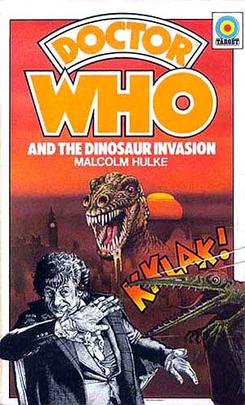

All together now: "KKLAK!".
‘Death to the Daleks’
Funny old stick, Tel-Boy Nation. His scripts are often glib and breezy treatments of oddly thoughtful concepts wrapped up in acres of cliché. A bit of inspired directing can bring stuff out of them. That's what's happened with 'Death to'.
Identikit middle-class space officers (one of whom is called Tarrant, natch), anonymous grunting natives, a standard bit of 70s Von Daniken rubbish, a mineral that sounds like a very private anatomical location, the usual chase/capture/sacrifice/escape nonsense and typically shrill Daleks... and yet, somehow, it becomes a genuinely creepy and sorta fascinating puzzle box of a story.
It's as though the alienating effect of some of the unusual images (a pitch black and silent TARDIS control room, for instance) adds depth to the proceedings. We have the superb idea of the semi-living roots of the city, the humanoid "antibodies", the Exxilon controller in the chair who collapses into dust, the gleaming rooms filled with dusty skeletons, the whole notion of a high civilization ravaged by its own runaway technology and regressing to religion and ‘barbarism’... if this story popped up in Season 18, a) it would look entirely at home and b) some people would gush about how intellectual it is.
The story keeps coming back to confrontations between primitivism and technology. The Daleks have to swap laser beams for old fashioned bullets and are then overpowered by spears and arrows... yet, ironically, their great weapon turns out to be the oldest killer of all: disease. The city itself is like a giant leech. It sucks up all power, technological, intellectual and cultural. It doesn't just feed on the energy of engines and lasers but on the energy of the mind, on sanity and rationality. Its feeding has left the planet and the people barren. Its upper pylon, the one that absorbs all the energy, even looks like a totem pole… which reminds me of Feuerbach, and what he said about Man making a totem pole which reflects his own powers and then bowing down before it, imagining that he bows before some other, greater entity… when all he is really bowing to is his own distorted image. (At least... I think that was Feuerbach...) That’s what the Exxilons are up to, isn’t it?
Briant (the director) is also helped by some occasionally clever production design. Okay, the Dalek ship looks like a hubcap, but the Exxilon city has a creepy and beautiful monumentalism about it (even if, at the end, it’s obviously a polystyrene model being attacked with a kitchen blowtorch)... and the Exxilons themselves seem, at times, to blend with their barren planet. They look like moving rocks.
Somehow, the powerless and increasingly strung-out Daleks are all the more scary for being temporarily innocuous and accompanied everywhere by comedy 'Laurel & Hardy' parp-parp music. Meanwhile, the music goes into a totally different gear elsewhere and hypes up the creepiness very effectively.
Of course, we have the usual libelling of tribal people in which they are depicted as grunting, spear-chucking, girl-sacrificing primitives... though the story then pulls the rug away a bit and turns them into the abused and exploited slaves of the imperialist Daleks (and humans!)...
Also, the co-opting of Von Daniken, and all that stuff about the temple in Peru that must’ve been built by aliens… that relies on the assumption (the underlying assumption of Von Daniken’s ‘work’) made by Westerners that so-called ‘primitive’ people in South America, Africa and other colonised places are incapable of civilization. Any great ruins that white people happen to find are therefore mysterious anomalies. When Cecil Rhodes and his bunch of gangsters moved into Zimbabwe (which Rhodes would eventually, with a fine display of modesty, take it upon himself to rename ‘Rhodesia’) they found ruins that spoke of such sophistication that they were unable to credit them to the ancestors of the ‘savage’ tribesmen. A whole system of implicitly racist and/or culturalist pseudo-science (of which Von Daniken was just a crackpot-populist spinoff) developed in the West to “explain” such impenetrable mysteries.
But, back to Exxilon… this being a Nation script, we also have the obligatory rebels... but they then become oddly moving when shown to be rationalist dissenters from religion, lead by the oddly affecting Bellal.
In a way, this is emblematic of Doctor Who. A kid's adventure story fashioned from Dan Dare, von Daniken, every bit of trash going... but full of ideas, done with such directness, employing linguistic cleverness and raising so many signs and symbols that it somehow becomes more than the sum of its parts. Of course, I might just be biased by the years I spent as a kid watching the VHS again and again and again...
‘The Monster of Peladon’
An amiable enough runaround, if you switch your brain off. But it really is the Who equivalent of listening to Jeremy Vine and Andrew Marr talking about unions: “blah, blah, blah… Winter of Discontent… blah, blah, blah… rubbish on the streets… blah, blah, blah… longest suicide note in British political history… blah, blah, blah” and every other cliché in the book.
‘Monster’ is standard, mainstream, cretinous, bourgeois liberal moralism attempting to comment on a political situation in which a Tory government has just been brought down by a wave of miners strikes more powerful than anything since the 20s.
The underlying assumptions represent the ideology of ‘balance’ and ‘impartiality’ and ‘national interest’ and every other chimera of the mainstream media.
The Pels are all in it together. The Queen and her High Priests, the guards that enforce the law and order, the miners who actually carve the trisilicate out of the rock. Sure, there are classes… and sure the working classes have some legitimate grievances… but, underneath all that, the Pels all have common interests that are only upset by the reactionary troublemaking of Ortron and, even more, by the psychotic fanaticism of Ettis.
In other words, control the xenophobic right-wingers in the government, and make sure the compromisers like Gebek run the unions rather than the looney-left, and the country (sorry, planet) can team up to get everyone the best deal... because that's what everyone wants, right? Because extremism exists at the edges of a spectrum of normalcy in which we all pull together and compromise for the national interest, right?
The state is, in this view, fundamentally functionalist; an honest broker. The smooth running of society is upset by the extremists on both sides. Meanwhile, the flaws of the establishment can be solved by persuading the people at the top to be more democratic and liberal and nice and cuddly and feminist... because they're not ruthlessly determined to hold on to their power, privilege and wealth at any price, and equally determined to keep exploiting the people who have to spend their lives digging in dark pits. Oh-ho-ho no. The idea! You'd have to be a mad militant to believe stuff like that.
Mind you, this story manages to notice that imperial military repression is what greets any attempt at economic self-determination by weak states that provide crucial commodities and resources to empire... though it depicts this as perpetrated by rogue elements that are actually betraying the empire concerned! It's like suggesting that the coup in Guatemala wasn't organised by Eisenhower and the CIA on behalf of the United Fruit Company but was actually the work of freemasons who wanted to sell the bananas to Russia. Bleurgh!!!
This is probably the most politically idiotic Doctor Who story ever made (at least it was until earlier this year) but even so, all it does (for the most part) is mirror the ideological assumptions that still underlie all mainstream discourse today.
‘Planet of the Spiders’
Lupton is believably petty and small as a villain… and understandable; driven to his actions by a society that has worked him dry and then discarded him.
The spiders are ego, rampaging selfishness, greed, the willingness to step on people to feed your desires. The Doctor finds one on his own back and must purge himself. The old man dies so the new man can be born.
Tommy is healed by the crystal and suddenly finds two lines of Blake more beautiful than all the shiny trinkets in his collection.

It’s cheesy but poetic; full of clichés and also possessed of a heartfelt directness. Call me an old softy, but I love it.
Subscribe to:
Posts (Atom)