Showing posts with label hauntology. Show all posts

Saturday, 21 February 2015

Knock Knock

Spoilers.


So, my pre-ordered copy of the much-critically-fawned-upon 'horror' film The Babadook arrived this morning.  And I've just watched it.

What a load of crap.

Look, I get what was being attempted here.  And it was attempted with a lot of sincerity, and some excellent acting.  But, really, what was the point?  Depression is a terrible thing.  Yes, we know.  We all bloody know.  Even those of us lucky enough to have escaped direct experience of depression know that we have escaped something terrible.  Grief is a terrible thing too.  Likewise.  It's better to connect with and love your kids than to not.  Yes.  I don't have kids and I know that.  These are trite morals.

Of course, there's no reason why you couldn't make a film carefully exploring these issues, delineating the experience of suffering from grief and depression so bad that it paralyses even your ability to love your own child.  But if that's what you want to talk about, do so.  Make a film about depression.  Make a film about mental illness.  Make a film about a nervous breakdown.  Make it with sensitivity, and with the space and attention these issues deserve.  The Babadook isn't that film, though it seems to be under the impression that it kind-of might be.

If, on the other hand, you want to make a ghost story, then make a ghost story.  But don't make a film which uses the aesthetics of the ghost story as obvious and simplistic metaphors for depression and mental illness, especially if you're going to spend the entire runtime of the film essentially screaming "THIS IS A METAPHOR FOR DEPRESSION!!!!" at the audience, as if you blatantly don't trust them to twig.

It's possible that someone who has actually suffered from depression may disagree with me here, and I shall respect that disagreement from my lucky positionality, but it seems to me that all we get in The Babadook are trite morals dressed up in dark cloaks.  'DON'T LET HIM IN' says the book about the monster that will creep into your life through looks and words, attack you in bed, and get under your skin.  Well thanks.  I'm sure people suffering from debilitating depression never thought of that.  The story seems to also imply that, once in, depression is almost certain to lead to murder-suicide if left unchecked... which seems a dubious message to be sending out about the plight of millions of perfectly normal, innocent, non-dangerous people who are suffering from a disease.  Also, depression would appear to be a monster that attacks without much in the way of a social origin.  The monster sneaks into your life because of loss and boredom and family difficulties, not because of wider social problems.  Moreover, the monster must be slain by the lone individual deciding to belt up.  Apparently, according to this film, all you have to do to defeat the monster of depression is to pull yourself together.  Even at the point where you are a slavering, knife-wielding homicidal maniac who is breaking the necks of pets (a cheap, obvious and predictable shot that one, by the way) and attempting to strangle your own kid, all you have to do is summon up the will-power to shout down your inner demons.  Presumably, those people who don't manage to summon up the last-minute grit to simply intimidate the Babadook and lock him in a closet are themselves to blame for the catastrophes that follow.  Your own fault.  Should've been stronger.  This is the most simplistic and offensive metaphorical statement on depression since Paul Cornell had a go for Big Finish.

Aside from how dodgy the film's implications are when it comes to serious, real world issues, there is also the question of how the film disrespects the uncanny and the hauntological.  It repeatedly hammers home that we are seeing a mental breakdown rather than an actual haunting.  This is why, despite the hyperbole of reviewers which is larded all over the DVD case, the film isn't remotely scary.  It never takes the monster seriously on his own terms.  It never pays enough respect to the monstrous.  It refuses to be even faintly mysterious.  It puts little ironic clips of classic shockers on the TV that the protagonist stares at in a depressed fug, thus showing us the raw material from which she fashions her dark illusions.  It insists on explaining everything.  Every creepy glimpse or sound is clearly contextualised as a dream or a hallucination, or as a metaphorical depiction of a mental state.  The Babadook attacks a car and causes a car crash... but we are left in no doubt (through heavy implication) that what we have just seen is an accident caused by a woman's depressed and wandering mind.  The little boy in the film believes in the Babadook as an outside force, but the way he talks about it is clearly meant to imply an unconscious perception on his part that his mother is haunted by the demon of depression.  This leads, as the film progresses, to the boy's utterances becoming increasingly gnomic, as it becomes crucial for him to produce dialogue which furthers the metaphor.  This shows a contempt for the thought-world of children, which becomes nothing more than a kind of cargo-cult-style attempt to comprehend the doings of adults.  Speaking of which... even the origin of the spooky book (the best thing in the film, aside from the acting) is explained in a line about the protagonist once having been a children's author.

As with The Innocents - another wildly overrated 'horror' movie that everyone seems to think is a masterpiece except me - the aimed-for ambiguity fails in a way that smells of the film-makers' contempt for anything actually uncanny, resolving downwards into a crashingly literal co-optation of hauntological aesthetics in the service of an ostensibly more serious message.  (At least The Babadook manages to ultimately treat the psychological problems of the protagonist with sympathy, unlike The Innocents, which takes a patronising and misogynistic tone about a character who is, when all is said and done, depicted as nothing more than a prudish, repressed hysteric.)  In both films, the hauntological is disrespected, denied its own integrity and narrative reality, denied its own power to both mean and to defy meaning, denied its own power to be inexplicable or horrifying for the sake of it.  It is denied these things because it is being used for the purposes of inaccurately and simplistically expressing a psychological state.  It is clearly being put in a subordinate position, mined for usable material while its own potential is ignored.

The fundamental problem with using the horrific in such a specific and sceptical way is that it neutralises the power of the horrific to tug at threads deeper than those we know about, and thus to suggest the deep unknowability of ourselves and the world we live in.  Horror often tries to say stuff about the real world, or promote a salutary moral, via a depiction of the return of the repressed.  But it ultimately relies upon the repressed returning in a way that represents a fundamental rupture with what we like to think of as the real world.  The haunting in The Shining has political valences which refer to actual social issues and/or historical horrors, but because it is the story of a literal haunting rather than self-consciously a visualisation of 'just' a mental breakdown, it also insists upon the idea that there is a 'real' faultline in reality that we might fall into.  I don't believe in the literal supernatural, but I find uncanny fiction a far more powerful reflection of my experience of the world than 'realism', especially realism which cannot tolerate symbols and metaphors unless they be clearly announced as such.  The uncanny vision is of a reality riven by cracks, cracks that we all might suddenly tumble into without any understanding of what is happening to us, and with no potential for understanding it.  That's the experience of modernity, for me.  I'm not saying 'realism' has nothing to say to us.  I just generally think it fails to get at the experience of modernity in quite the way managed by the uncanny.  And it should say its own stuff without misusing the uncanny in the capacity of a disrespected servant.

When the boy is being thrown around by the evil force near the end of The Babadook, the way it happens directly in front of his mother's outstretched arms clearly informs us that we are seeing her dissociative perception of her own violence.  She sees what she herself is doing, and inserts gaps of empty space between her hands and the violence they produce.  This is a perfect summation of the film.  In conception and execution, it is very clever... but the ultimate effect is banal, limited and boring.

Thursday, 1 March 2012

Skulltopus 10: How Green Was My Death?

'The Green Death' is a ghost story.  Doctor Who itself may actually be best described, from one standpoint, as an anthology of ghost stories.


Okay, let's go back a bit.

Firstly, let me defend my notion about 70s Doctor Who sprouting Weird tentacles when it notices (and thus needs to evade and/or signify) capitalism.  'The Green Death' is clearly aware of capitalism and, sure enough, shows signs of Weird inflection.  (I'm aware, by the way, that I keep talking about the show as though its alive... a form of commodity fetishism that I'll address some day.)

Apart from anything else, there's a dirty great tentacle in 'The Green Death'.  It's only in it for a few seconds, during the Doctor's abortive trip to Metebelis III, but still...


As in 'Curse of Peladon', this is the tentacular riding in on past associations... however, it can't be said to work quite the same way as previous tentacles in the Pertwee era.  This tentacle is clearly not obscuring any potential thematic convergence upon the subject of capitalism, as in 'Spearhead from Space' and 'Claws of Axos'.  Nor is it standing in for implied capitalism, as in 'Curse of Peladon'.  Capitalism is something that 'The Green Death' is aware of openly.  It doesn't need to be either obscured or implied... especially since the 'critique' of capitalism the story offers is actually quite diffident, to the extent of dehumanizing the working class.  And this tentacle is only a momentarily glimpsed feature of a side-trip, taking place literally light years away from Global Chemicals.  However, it's in 'The Green Death' rather than, say, 'The Time Warrior'.  It's in a story about an evil corporation rather than one about a feudal warlord.  So, the association is still evident and active.

There is also a distinct Weird inflection to the maggots.  Their multiplicitous tubular wriggliness is hardly a million miles from being tentacular.  They have some of that quintessentially Weird incoherence.  


However, like 'Spearhead from Space', 'The Claws of Axos' and 'Curse of Peladon' before it, 'Green Death' retains a hauntological charge.  

The maggots themselves are steeped in gothic, in associations to do with death.  Real maggots breed in corpses or bad meat.  They are of putrefaction.  This suggests skulls and bones and graveyards, and it suggests them in the gothic mode: as signalling extremes and transgressions, and the haunting presence of that which has been denied and repressed.  Biological corruption is here aesthetically linked with the corruption of the environment by big business.  The maggots appear in the mine because they are generated by the toxic waste from the Stevens Process, which is secretly dumped underground.  Eventually, they erupt out of the mine into the world above, like zombies out of graves.  They make a typical gothic move.  They do it almost too literally.  They have been repressed and then they return.  They have been buried out of sight but wriggle out of their subterranean hiding-place.  Moreover, this is gothic very much in the Who mode.  It's outward form is non-spectral, material/ist, haunting us with social and political and industrial terrors (i.e. industrial pollution).


Partial mergings or co-existences of the gothic and the Weird are not unfamiliar.  China Miéville writes [PDF] of M.R. James, the 'father of the ghost story' (who, it is commonplace to observe, seldom actually wrote about ghosts as such), that the "adversaries" in his stories are

disproportionately and emphatically Weird.
• Touch and touchability is central. James’s is the horror of the physical universe (a trauma that would trace into the obsessive materiality/-ism of Lovecraft’s horror). It is the cloth-ness of the notorious face ‘of crumpled linen’ in ‘Oh Whistle and I’ll Come to You My Lad’ that makes it so terrible. James even names one of his late stories ‘The Malice of Inanimate Objects’. The touchability of his ‘ghosts’ is not a return to that of their 18th-century cousins: this is a new (Weird) haptos, with little to do with human somaticism, and everything to do with the horror of matter. The most grotesque moment in ‘The Ash Tree’ is the ‘soft plump, like a kitten’, with which a just-glimpsed giant spider drops off the bed.  
•  James’s repeated insistence that he is an ‘antiquary’ is not convincing. He is acutely conscious of capitalist modernity, and a surprising number of his ‘ghosts’ manifest through it. The demon in ‘Casting the Runes’ bizarrely announces its intent by means of an advertisement in a railway carriage. The attack which the
runes occasion is brought down quite amorally on whoever took them last, according to the depersonalised passings-on of bits of paper. The horror is of the universal equivalent in mass commodification: the runes are Bad Money. Most astonishingly, in ‘The Diary of Mr Poynter’, what is haunted is not a scrap of fabric nor the materials with which it is made but the design upon it: it is the copied design, reprinted with explicitly cutting-edge modern techniques, that is the locus for the apparition. This is the work of hauntology in the age of mechanical reproduction. 
. . . 
• Most important, of his non-ghost ‘ghosts’, a disproportionate number have appurtenances of the Weird, and read now as startlingly teratologically ahead of their time. His apparitions are hairy (‘The Diary of Mr Poynter’, ‘Canon Alberic’s Scrapbook’), chitinous (‘The Ash-Tree’), slimy and/or amphibious (‘The Treasure of Abbot Thomas’), totally bizarre (‘The Uncommon Prayer-Book’), and more than once,  tentacled (‘The Treasure of Abbot Thomas’, ‘Count Magnus’).

Now, it seems to me that the giant maggots in 'The Green Death' fit in with this description of James's "adversaries".  They may not be "startlingly teratologically ahead of their time" (quite the contrary) but they are - clearly - all about "the horror of matter", "capitalist modernity", "cutting-edge techniques", etc.  They are aggressively "bizarre", "slimey" and "chitinous" (never mind that Pertwee doesn't know how to pronounce this word).

So, there is an extent to which the gothic and the Weird co-exist in 'The Green Death'.  Even the title combines the gothic 'Death' with the slimey, icky, biological 'Green'.

If the maggots are (relatively straightforwardly) the dark, gothic secrets of corporate irresponsibility - the 'externalities', the pollutants of corporate power - breaking up out of their post-industrial tomb to haunt us, then they are also quasi-Weirdified.  The maggots may, by their very garbled and arbitrary irrelevance, express the horror of the unforseen and unintended effect, the by-product, the runaway process.  In any case, there are precedents for hauntological adversaries of this kind - of the Weird, material, slimey, chitinous, capitalist kind - right at the start of the modern ghost story: the material/ist non-ghosts of James.  These are, I think, the very kinds of adversaries that 70s Doctor Who summons up when it notices capitalist relations... and this is itself consistent with the Jamesean ghost story.  As noted by Miéville, James's ghosts are often linked to or emergent from capitalism.  In very much the same way, Doctor Who's material/ist gothic slips into the quasi-Weird when it slides close to an awareness (of a positive or negative kind) of capitalist relations.

That's why 'The Green Death'... and, indeed, many other Doctor Who stories... could be said to be a ghost story.

But, I hear you scream, how can 'The Green Death' be said to be a 'ghost story' when there are no ghosts in it?  How can Doctor Who, with its outer shell of pro-Enlightenment bluster (inherited from an original remit to be 'educational'), be said to be a collection of ghost stories, especially when it keeps telling us that "spooks and ghosts" "don't exist"?  The answer is: by being more true to the roots of the modern tradition.  Stories of ghosts may date from the emergence of stories themselves, but 'ghost stories', in the sense that we usually talk about them today, date from the 19th century.  They're quite different to what we see in, say, the Renaissance, when ghosts simply appeared as and when needed in tragedy or comedy.  Hamlet  is the classic example.  It has a ghost in it, but it is not a 'ghost story' in our terms, no more than it is a 'crime thriller' or a 'whodunnit', despite having murders in it.  In many ways, the earliest modern 'ghost stories' are far less spectral than Shakespeare's spirits... and far less easily comprehensible.  It is in the very physicality and incoherence of the hauntings in 'The Green Death' that we see this. The maggots haunt, but they do it physically and materially.  They even do it Weirdly... as did some of the haunting things of M.R. James.

Now... a distinction must be made.  The classic late-19th century / early-20th century 'haute Weird' was prefigured in James, combined with the hauntological.  This, however, is clearly not what's going on in 'The Green Death', which was crafted and broadcast long after the Weird proper had burst onto the scene and then declined.  Rather, the Weird or quasi-Weird that we see in 'Green Death' is not the true-Weird but an echo of the Weird, a processed and recalled version if it... a spectre of the Weird, if you like.  This is broadly true of all the quasi-weird that surfaces in Doctor Who.  This 'Who-Weird' is an ancestral trait from the evolutionary history of monsterology, cropping up in outer form only, like a throwback.

This, by the way, illuminates another way in which 'The Green Death' uses a material/ist hauntology: it invokes the concept of atavism.  The maggots are said to be "atavistic mutations".  Atavism is the reappearance of ancestral traits.

Atavism was associated with the concept of the 'throwback' in the sense of the return of primitivism, hence Lombroso and his idea that criminals were 'primitives' walking in the clothes of modern men.  Inherent in this was the notion that the modern (i.e. more evolved) man was less likely to be a criminal... but that Man might slip backwards.  Progress marches on but inevitably brings the occasional lapse into regress.  Indeed, the regress illumines the progress.  This idea seems inherent in 'The Green Death'.  The whole raison d'etre of Global Chemicals is a bourgeois notion of progress: efficiency and profit.  Yet their progress brings also the atavism that produces throwbacks to an age of monsters (actual science aside).

If the maggots are atavistic, this makes them the genetic gothic.  They are a kind of bio-hauntology.  Once again, they are ghosts in slimey, hairy, wriggling, chitinous form.

It's interesting, in light of all this, that there is a character in 'The Green Death' called 'Mr James'.


Boo!

Tuesday, 24 January 2012

Skulltopus 6: Macra Revisited

According to China Miéville, the classic, early 20th century haute Weird of Lovecraft and Hodgson is the nebulous, meaningless, reactionary scream of incomprehension that greets the onrushing horror of modernity.

I think that, for 70s Doctor Who, a resurrected and processed form of the Weird is what the show draws upon when it finds itself haunted by repressed knowledge that it cannot face: the knowledge that the modern nightmares upon which it dwells are generated by capitalism.  When the themes of a 70s Doctor Who story suggest the possibility that capitalism could be noticed and indicted in systemic terms - particularly in terms of the exploitation of the worker, race and/or imperialism - the show tries to jettison the hauntological (realising that it is itself being haunted... nay, stalked) in favour of the Weird.

I intend to justify these outrageous claims in a forthcoming post.

In my last post - here - I casually asserted that the Weirdish ab-crabs in 'The Macra Terror' are a "prelude" to the connection the show will make in the 70s between the tentacle and capitalism.  It occurs to me that I need to expand a bit on my Skulltopus post about the Macra - here - in order to make myself clear on this point.

I think that the Colony in 'The Macra Terror' is a picture of mainstream Britain in denial during the radical late 60s, of a prosperous capitalist world that runs on repression, oppression, obedience, media conditioning, hierarchy.  The Colony strongly hints at being capitalist in various ways, not least the Butlins vibe that everyone talks about, the Pilot's sitcom businessman manner, Barney's salon and spa, etc.

Most explicitly, the story concentrates on the mining of gas... and Britain in 1967 was right in the middle of switching over to North Sea Gas.  In the story, the gas (a toxic substance that humans don't need and which actively endangers workers) is mined for the benefit of other, hidden, possibly insane reasons/persons - in this case, the Macra.

The Macra, as I noted elsewhere, are extremely hauntological (in that material/pseudo-materialist way that things are hauntological in Who) in that they actively and literally haunt the Colony while clearly representing something that the characters all know must be denied.  In the January 2012 issue of Panic Moon, I hint that this repressed knowledge is the knowledge that they are exploited - specifically and explicitly as workers - by an irrational tyranny, and that this ties into the way that the radical currents in the late 60s were popularizing a critique of Western consumerist capitalism as tyrannical and alienating.

And so, whether it be cause or effect, we get Weirdish monsters.

They are giant crabs, as in some classic Weird fiction... except that, when you listen to the story (especially since you have to listen to it) they are also categorically indeterminate, big/small, crab/non-crab, insect/spider/bacteria things that people have trouble perceiving clearly, even - especially - when they see them.

Moreover, the Macra's own mentalities are extremely contradictory, incoherent, self-denying... to the point of bordering on psychosis. They are so desperate to deny that the Colony's happy and prosperous capitalist world of makeovers and mining (i.e. of productive industry and leisure industry) exists to serve their needs that they end up frantically denying their own existence!

The hysteria of the Macra's screams of "Macra do not exist!  THERE ARE NO MACRA!!!!" (over a TV screen, lets not forget) sounds, to me, very much like the way that mainstream media in capitalist society will go round the houses - sometimes to farcical degrees - to steer conversations, debates, discourse and criticism away from the central economic facts of our society (on the rare occasion that anyone liable to raise them in the first place ever gets on the media).  The Macra deny their own existence, just as capitalist media culture tries to make capitalism vanish into 'democracy' and 'the West' and 'free trade' and 'the economy' and many other euphemisms.  Capitalism tries to make itself invisible, and to make its exploitative core invisible, via its hegemony over culture (back to Gramsci we go) and through the obscuring of class consciousness by various forms of alienation and commodity fetishism (back to Lukacs we go).

Once again, the social wound in which the Macra breed is all to do with hierarchy and exploitation, it operates through productive work for the benefits of people other than the workers, it guards itself using a leisure industry and a hegemonic system of ideas that touts notions of social cohesion, cheerfulness, pulling together, altruism, team spirit, the state as honest broker, enjoy your time off, etc... and all this, not in a totalitarian state (when people say that the Colony is totalitarian they are totally missing the point) but in a society that strongly hints that it is capitalistic even while it uses methods of thought control and repression.

Of course, the production draws heavily upon the semiotics of totalitarianism - most particularly the Cartier/Kneale TV adaptation of Nineteen Eighty-Four - but it also subverts them and... well... de-Sovietizes them to a large extent.  There's a makeover salon and a version of Miss World for Polly to enter.  The holiday camp thing has been noted many times... but the really important thing about that is that holiday camps look like (to use Miles and Wood's phrase) "a little bit of Eastern Europe just outside Cromer".  The regimentation, the smiling authoritarianism, the moral puritanism, and the solidly working class background of most guests, makes the holiday camp an ideal - almost inevitable - way of commenting on the way capitalist Britain and communist dictatorships had certain eerie similarities.  In the late 60s, when people like Herbert Marcuse were suddenly selling lots of books, this was a notion whose time had come.  People were starting to see tyranny on both sides of the iron curtain.  This is why 'The Macra Terror' prefigures The Prisoner.  In that show, Number 6 is never sure which side is holding him.  The unspoken horror of it is that it could be either or both.  It doesn't really matter.  As one of the Number 2s says, both sides will one day regard each other and realise that they are "looking into a mirror".

That's why 'The Macra Terror' (which came before The Prisoner, let's not forget) was near-the-knuckle stuff.  I know this sounds like a strange thing to say about Doctor Who at the best of times... but all the same, this was about as close as mainstream popular TV could get to noticing that capitalism was pretty bloody horrible, not as an exception but as a rule.

The way in which the Macra are radically obscured (Weirdified) is the camouflage, the misdirection.  They - and many of the other Weirdish monsters in Who - arrive when the show itself is being haunted by repressed knowledge that it cannot notice or accept without ceasing to be what Doctor Who is (that is, a staple aspect of the culture industry catering for children in capitalist Britain, existing within that cultural hegemony).  The show, via its materialist or pseudo-materialist gothic dynamic, is constantly drawn to the nightmarish effects of capitalism, often unable and always reluctant to notice that they are capitalist effects, occasionally drawing on the fundamentally non-gothic monster (while still, paradoxically, using the non-gothic in a hauntological way) as a method of escaping from or fudging the conclusions it is edging towards, the conclusion... or perhaps realisation would be a better word... that industrial war, modern imperialism, modern slavery, fascism (all repeatedly addressed by the show) all have their roots in the same system.

Sunday, 22 January 2012

Skulltopus 4: Attack of the Plot-Device Monster

The tentacle was already well established as a staple of monsterology long before Doctor Who was even a glint in Sydney Newman's eye.  When Who selected the tentacle as its semiotic method of evading/signifying capitalism  - as I'm going to argue that it did in the 70s - it selected it from a pre-existing toolbox full of potential signifiers.  But it didn't suddenly stumble upon the octopoidal.  It had encountered tentacles before, albeit only occasionally.

On the whole, the show's early years are pretty thin on tentacles... but there are quasi-tentacular manifestations in 'The Keys of Marinus' (the Brains of Morphoton have stubby little almost-tentacles), 'The Dalek Invasion of Earth' (the Slyther) and 'The Web Planet' (the Animus).  The only proper octopus monster in this era is the Mire Beast from 'The Chase'.  It lives underground and exists solely to provide a way for our heroes to escape from the Aridians without deliberately sentencing them all to Dalek-death.


Oh look... bar the Animus, those were all written by Terry Nation.  Hmmm...

By this point (the early 60s), the 'novum' of the tentacle had passed, but it had entrenched itself in the grammar of Western teratology.  In the process, it had been greatly sheared of its original strategic meaninglessness.  Even so, the Mire Beast doesn't even try to mean anything.  It's almost as though a plot device monster so arbitrary and irrelevant had to be an octopus because the octopus still carries the Weird connotations of meaning meaninglessness.  It means nothing, so what do we make it?  An octopus.  They mean nothing.  Perfect.

I'm simplifying.  And I'm making it sound conscious... which it almost certainly wasn't.  But I'm kind of thinking aloud here.  Give me a break, can't you?  These things become less conscious and more consistent the more deeply the semiotic connections bury themselves into culture.  They become like syntax.  We don't usually use syntax consciously.

Of course, 'meaning nothing' and 'having no meaning' are not necessarily the same thing.  The symbol '0' means nothing... but it doesn't have no meaning.  Indeed, it's meaning is nothing.  (This point is hard to get across in text... it's one of those occasions when, to be absolutely clear, you really need to use vocal inflection.)  This may be the same binary inherent in any sign that is adopted to evade meaning.  It may be inherent in the Weird use of the tentacular.  By trying to use the meaningless to mean meaninglessness, meaning is assigned.  This is as much a dialectic as it is a paradox.  The internal contradiction drives the change from the haute Weird tentacle to the tentacle as a standard monstrous limb-type throughout Western fiction.  The tentacle initially emerges as the perfect way for the Weird to express what it feels to be the incomprehensible and meaningless horror of modernity via its 'novum', its unprecedentedness in Western literature, its semiotic emptiness.  However, the meaninglessness of the tentacle becomes its meaning... or rather, it's most prominent feature.  Its very arbitrariness allows it unfettered entry into almost any context, sometimes even conferring an advantage upon it when someone like Terry Nation is looking for a default monster that will have nothing to do but get the writer out of a plot cul-de-sac, or look cool.

It sounds like I'm having a go at Nation... but, actually, I think his selection of the octopus, his insertion of it into such an inappropriate context (an octopus that lives underground on a desert planet... I mean, what the fuck?), and for such a menial narrative task, actually redounds to his credit.

Pastiche is essential to Nation's method (and to Who's in general).  Nation tends to get a bad rap these days and.... weeeeell, yeah, okay, he's a very inconsistent writer.  But, he could be very canny, especially about how exactly to mix 'n' match the stuff he... *ahem*... utilised. And he's by no means as constantly derivative as some might claim.  He can sometimes work magical feats of selection and synthesis. It shows in his selection of the octopus as a creature of incoherence and meaninglessness, fit to appear in such an inappropriate context and for such an empty reason.  Like the original Weird tentacles - H. G. Wells' giant squid monsters in The Sea Raiders... which just appear, wreak havoc and bugger off again without any explanation - Nation's Mire Beast just eats, shrieks and leaves... as does his Slyther.

'The Chase' features a section which parodies hauntology in the form of robot versions of Dracula and Frankenstein in an amusement park.  In that section of the story, Ian even perfectly expresses the essential nature of the hauntological: "it's uncanny, strange and weird... but it is familiar".  As noted, the tentacle is also pretty "familiar" in Western monsterology by the early 60s, but nowhere near as familiar as Dracula.  The tentacle still looks incoherent and evasive compared to the monsters in the haunted fun house, which are revealed to be nothing but exhibits.  The Doctor seems wedded to an old idea of the hauntological.  He thinks the fun house was a kind of materialised 'collective unconcious'.  Actually, it was a closed repository of dead and obsolete gothic figures.  Next to the craptastically 'old skool' gothic robots in the amusement park, even the Mire Beast looks vital, scary, menacing. I don't think the implicit comparison is insignificant.

The next thing that occurs to me - and I'm as surprised to find myself going this way as you probably are - is that maybe, when he was casting about for a plot-device monster, Terry Nation not only adroitly selected the tentacular (with its blank function inherited from Weird meaninglessness) but also laid the groundwork for the connection that I think Doctor Who (via Robert Holmes) made in the 70s: the tentacular as an evasion of - and, paradoxically/dialectically, a symbol of - capitalism as a system.  He found, in the tentacular, a kind of 'blank sign' which he could press into service... and then something else happened.  His (admittedly injudicious) semiotic literarcy started to lead him places...

Look... even I am not prepared to argue that 'The Chase' contains the basis for a systemic critique of capitalism, except perhaps as an illustration of the idiocy that capitalist culture can produce... however, it is interesting to note that the very first Doctor Who story to feature an actual octopus monster also features depictions of Western rulers (i.e. Elizabeth I and Abe Lincoln, who also appeared in Madame Tussauds in 'Spearhead from Space'), has a section set in New York (the financial hub of Western capitalism) and specifically atop the Empire State Building, and has another section aboard the Mary Celeste (a merchant ship carrying cargo for international trade).

We might also note the section in which we see mini-tentacles in 'The Keys of Marinus' also features a world of luxury and plenty which, seen without brainwashing, is a tatty world of exploitation and lies.  The gorgeous fabrics turn out to be "dirty rags", the amazing scientific instruments are actually chipped old cups, etc.  The very first intrusion of the weird tentacle, in only this very minor way, is conjoined with a story about people being mentally influenced (to live in luxury or to be handmaidens, etc.), about people being controlled by unseen forces, about people being tricked into viewing their austere world as a paradise of freedom, leisure and plenty, about a wealth of commodities (food, clothes, equipment) that is actually illusory.


Nation's noticeable personal lack of aversion to capitalism notwithstanding, it's extremely tempting to connect Morphoton to Western capitalism, given that, when this story was made, the long post-war boom was just starting to decline, the struggles of what would come to be called 'the 60s' were just beginning, etc.

Even the Slyther in 'The Dalek Invasion of Earth' turns up at the point in the story (geographical point and narrative point) where we start to see people's labour being exploited by Daleks who suddenly look like colonial masters of a subdued native population.  The Slyther appears at roughly the same time we encounter the two women in the shack and Ashton... all of whom are engaged in trade, exchange in commodities for profit.

*

The Animus in 'The Web Planet' is a little more complex.  This entity has looked very Lovecraftian to some, to the point that it has been identified as Llogior from the Cthulu Mythos in various New/Missing Adventures novels.  I'll (hopefully) be looking more closely at the Animus - as it relates to the Weird - in another post.

Tuesday, 10 January 2012

Strange Matters


There is something very gothic about Doctor Who, in the hauntological sense.  I mean that the show keeps on doing monsters that represent, in various ways, 'the return of the repressed', monsters that represent buried anxieties, or anxieties that we have attempted to bury.  But the monsters tend to be steadfastly material in quite straightforward ways... and to embody material, social, historical nightmares (fascism is a big one that immediately suggests itself).

It's important to stress that this isn't a contradiction, as such.  Indeed, in many ways, it's 'business as usual' for the gothic.  You can't get more hauntological than vampires, but they tend to be interpreted as representing deeply materialist concerns, from veneral disease to monopoly capitalism (and, these days, teen romance... which is about as materialist as anything gets).  However, while they may represent material, social, historical anxieties, vampires are not straightforwardly material.  They are, like most classic gothic/hauntological monsters, profoundly spectral - or at least ab-physical.  They dissolve in sunlight, cast no reflection, can appear and disappear at will, can physically transform into bats or wolves, can reverse physical time by becoming young again after feasting, can defy gravity by crawling down sheer walls, etc.  And vampires are at the more solid end of the hauntological spectrum.

However, Doctor Who has tended to (rather spuriously) consider itself a champion of an empiricist, scientific approach rather than one which has any truck with the supernatural, making vampires into alien races or mutations created by pollution, for example. (This is, as I say, rather spurious, partly because the writers of the show have usually been less interested in scientific accuracy and more interested in telling stories, often reiterations of myth - and quite right too.)  But the thing to notice here is that, despite the very gothic/hauntological method of many of the show's monsters (haunting us with our repressed anxieties), the show does not usually represent them as spectral or phantasmic or undead in the full supernatural sense.  They may appear and disappear, but its because they've got transmats, not because they're immaterial, undead things that flit in and out of tombs.

In other words, the show wants to have its cake and eat it.  It wants to have hauntological monsters that are alive, that are physical, that are hard and material things, that are organisms or robots.  This is not a denial of the hauntological-as-supernatural, but a recoding of it.  Like much SF, Doctor Who is immensely concerned with myth-reiteration, with retelling legends in the idioms of the age of science and technology and industrialisation.  I'm not here going to go into the various ways that Doctor Who's conception of reality is fundamentally magical.  What I'm trying to tease out is the way that, despite its repression of magical thinking, magical thinking keeps returning to the show and sneaking its way in.  It does this (if I may briefly anthropomorphise a concept) by disguising itself in a materialist form, and by inserting the hauntological method into narratives that are fundamentally about materialist concerns.  The inner logic is magical, the language is materialist.  The thematic preoccupations are drawn more from the language than from the inner logic.  Doctor Who uses the language of materialism to tell magical stories about nightmares of modernity.  This is why the show repeatedly tells stories about monsters that haunt us in a material way with the repressed knowledge or fear of modern nightmares like fascism, industrial genocide, high-tech war, nukes, imperialism, etc.

This is partly why there seems to be something of the trad gothic... something vampiric, zombieish, Frankensteinian, demonic... about so many monsters that, on paper, are straightforward automatons or war machines. Again and again, monstrous flesh lurks within the clanking technological enemy.  A webbed claw emerges from a Dalek casing.  Androids per se are always just the tools or weapons or foes of other races... they are never the main enemy.  The main enemy has to be more gothic.  It has to be Davros, awakening from death and covered in cobwebs.  It has to be Cybermen: walking techno-zombies with cloth faces and empty eye-holes that make them look like bandaged skulls.  When robots are the star threat, a big deal is made of them being like "walking dead".

Monday, 2 January 2012

The Empire of Vanilla

Some things I've noticed about 'Spearhead from Space'

There's a lot of wood in this story.


This suggests a contrast, a conflict even, between older forms of production - the appearance of the hospital, and the Seeleys' cottage, suggest artisanship - and newer industrial technology and mass production, represented by the factory and the evil plastic which creeps out of it.

There are lots of workers in this story.  There's a Nurse.

There's Mullins.
Mullins, one of the many wage labourers in this story...
seen here in the act of labouring for his wage.  

There's a workman in the street, talking to the copper before he investigates the (off-screen) breaking of shop windows (implying the role of the police as protectors of private property and business).  There's the guard at the front gate of UNIT HQ.  There's the guide at Madame Tussauds.

There are the workers in the plastics factory.

I don't know, but I'd guess that these women - together with the male worker
seen earlier in the episode, operating heavy machinery - are actual workers
in the factory where these scenes were filmed.  One of the women is Asian,
which is a pretty big clue that she's a 'real person' rather than an extra.

Some of the workers are 'fake'.  There are Auton Porters who help kidnap the Doctor.  There's an Auton secretary at the factory.  Note how the Nestenes still employ a young woman in a short skirt as a secretary, even if she is made of plastic... but then such women are usually treated like mannequins in practice anyway.

These waxen-faced, blank, zombified workers strongly suggest an extreme form of alienation: line hypnosis, a psychological condition where people are lulled into passive, unresponsive fugue states by constant repetition of the same mechanical tasks - found most famously in people who perform extremely simple tasks at conveyor belts.  More broadly, it suggests the deadened, flattened affect of people who find their Fordist jobs dull beyond belief.

Think this is a stretch?  But the story makes a point of commenting upon automation.  The monsters are called Autons.  We see, as noted above, faceless factory workers at their tedious, repetitive, assembly-line jobs.  And General Scobie, the swaggering old reactionary establishment figure par excellence, upon hearing that the plastics factory has become largely automated (which means a load of people have lost their jobs), makes a crack about automation being a splendid idea because "you don't find machines going on strike!"  In other words, workers should be treated like and behave like machines.... and replacing them with machines is the next best thing.

There is much literal commodification - often of people - in this story.  Ransome is paid off... even his name suggests a payment for a person.  Seeley tries to sell his "thunderball" and nearly gets his wife killed.  Mullins sells the Doctor to the journos.

"I understand you pay for stories?"

But 'Spearhead' really harps on about life being commodified... most particularly by its concentration upon production.  The factory is where human-shaped commodities are produced.  We know why the Autons are so threatening, so uncanny... Ransome helpfully tells us.  It's because they walk and chase and attack, despite having been "made in the factory".  They are the product, the commodity - after us.  As with much SF, including - perhaps especially - Doctor Who, they are evil conceptualised as/through the autonomous product.  They are the unit that shifts itself.


 In the July issue of Panic Moon fanzine, I sketched the outlines of a Marxist reading of 'Spearhead from Space'.  The gist of it was that the Autons are an expression of alienation and commodity fetishism.  Please bear with me while I reiterate some basic principles.  We'll get back to Autons eventually, I promise.


Alienation and Commodity Fetishism

Human beings have always made things.  Productive labour is perhaps the most important aspect of what the young Marx called human 'species being'.  How we make things changes over time.  The rise of capitalism brought the factory system.  The division of labour.  Specialisation without expertise.  Organisation of time.  The creation of new kinds of cities that worked as battery farms for thousands of corralled workers.  Mass production.  Heavy industry.  Conveyor belts.  Fordism.  Mechanisation.  Computer-run facilities.  Humans started to make things faster than ever before, in greater numbers than ever before. And the things started to confront the thingmaker as alien, autonomous, controlling, dominating.  When you have to watch a clock to make sure you clock in and clock out at the right time, it's hard not to feel like you are answerable to the clocks, even if you work in a clock factory making clocks.

The things we made became increasingly wondrous.  The engines became bigger, faster, more powerful.  They allowed man to fly.  And to drop bombs that killed hundreds of thousands in seconds.  Products are double-edged things, to put it mildly.

The things we make... the engines... the artefacts... they behave like this because they are the products of capitalism.  They are commodities.  Made to be sold.  The system demands continued production and circulation of commodities, so products seem to breed and teem and change and mutate and multiply like bacteria.  Increasingly, they seem to have minds of their own.  They move without us, they talk without us, they do things and say things we don't understand, they assail us with cryptic error messages, they catch viruses.  They fly without pilots and destroy villages in Pakistan.  Those last ones we call "drones", naming them after living things (with irony as mordant as it is unconscious, we call them after the mindless worker bees in the rigid insectile hierarchy).  It's amazing, when you stop to think about it, just how CONSTANTLY we think and talk about inanimate stuff, about products, about commodities, as though they are alive... and powerful.  The stock market is a product.  Yet we report upon its twitches and tremours and undulations and ululations and sneezes and farts as though we are reporting the natural bodly processes and moods of some great beast, to who's whims we are subject.  This is an expression of what Marx called commodity fetishism.

Meanwhile, humans are made into commodities.  Capitalism created and depended upon the modern slave trade... and even 'free' labour (which is better than slave labour) is bought and sold on a job market.

The stuff breeds and teems as people die in swathes.  From hunger, from AIDS, from despair, from by-products, from environmental backlash, from sheer grinding poverty.  This happens because the ruling principle is profit rather than need, and because the people who make everything do not do so under conditions of their own choosing.  They are on the job market, so they end up making stuff for the stuff market.  We make what we're told, as many as we're told, for purposes we don't choose.  Indeed, there is no purpose beyond the creation of commodities.  Things are made to be sold.  The iPad is not made in order to express human creativity.  The iPad is made by people whose creative lives have been yoked to the creation of iPads by people who think they can sell iPads in order to make profit that will keep their iPad-making racket going.

Stuff is made in order to be saleable in order to fund the making of saleable stuff.  Marx contrasted this kind of labour - the forced labour of those who must work to eat - to the labour that we undertake because it is part of our humanity.  "Milton" Marx wrote, "produced Paradise Lost in the way that a silkworm produces silk, as the expression of his own nature."  The waged labourer who works in the mass production of copies of Paradise Lost produces only capital - and capital is not hers.  Her human productiveness is redirected into work for the production of something that does not express her nature, that she does not own, that does not enrich her, that she produces only in order to put food on the table.

That is human creativity slaved to a system of general commodity production.  This is alienation.

At least the dolls seem happy.

Not only is human creativity subverted into the production of commodities, human creativity is also subverted into the production of the materiel of the system of commodity production.  We are all glowered-over and dominated by the stuff we and previous generations have made but which confronts us as enemy force. This is old labour, petrified into threatening and ruling facts.  The machines that drive people out of work, or make their work excrutiatingly dull, or make their work dangerous... everything that is owned by the capitalist, or which goes into the capitalist system of production, which enables the system to expropriate the surplus created by the alienated worker... all capital, in other words... was made by workers, by their past labour.  This is 'dead labour', lording it over the living.

The power relationship is omnipresent yet hidden.  Consumerism offers spurious control of and through products.  We in the rich world splurge at the shops, investing in things as though they are charms and icons and totems.  Sexuality is branded, packaged and commodified too.


We expect the sexy things to change how we look, how we are perceived, how we feel, how we think, how we eat, how we have sex.  Our bodies are translated into fake, airbrushed, inhuman objects and then sold back to us as icons of unreachable perfection that we must strive (and pay) to attain.


"They're flexible, that's why we've captured the market"

The Autons look, to me, like the product, the stuff, the commodity, (all of which is capital by means of its expropriation from the worker and its entry into the system of accumulation, circulation and profit)... come alive and attacking.  They are labour that has been expropriated, made alien to the labourer.  They are the automation that is made by workers and then squeezes workers out of the production system.  The dead labour that dominates living labour.  They are the manufactured thing, the thing that is "made in the factory", confronting us (as Marx put it) as something "hostile and alien".  They are perfect emblems of the way that capitalism (and, distinctly, consumerism) turns the human image and human needs into commodities, of humans themselves commodified through the sale and purchase of their labour power.

Note that they attack in the consumerist high street,
surrounded by shops and advertising and brand logos.
Note that they have price tags on them.


House of Cards, House of Wax

There is something uneasy about the modern world as 'Spearhead' presents it to us: it is filled with displays of hierarchy, deference and contempt. 

The military hierarchy is much in evidence, as are the attitudes of ranks to inferiors and superiors.  Munro snaps at the UNIT soldiers who shoot at the Doctor, despite their having orders to keep anyone away from the police box at all costs.  The Brigadier creeps round General Scobie and even Liz - who has been drafted unwillingly into UNIT - makes nice to him.

This is something that we see a great deal in the Pertwee era's representation of life in Britain, though it will soon prove to be found mostly in government projects and naval bases, the contempt usually displayed by a succession of easy hate-figures... bureaucrats, men from the Ministry, etc.  In 'Spearhead' we see (as already noted) a great many ordinary people, often workers in ordinary workplaces, with the hierarchy, deference and contempt ingrained in the everyday functioning of life.

Dr Henderson is contemptuous towards Mullins (gesturing at him impatiently to stop hoovering the corridor), snaps at his Nurse and snarks at lab technicians whom he supposes to have faked an x-ray... but he's creepily ingratiating towards his bluff, posh, arrogant superior.

Everybody's at it.  The journalists curtly address Mullins as "Porter".  Even the Doctor is extraordinarily rude to the guard at the entrance to UNIT HQ.

Seeley is treated as beneath contempt by everybody in a uniform, even lowly grunts.  He is detained - by people who have no stated right to detain him - against his will, patronised, interrogated, threatened, etc.

He is a poacher, of course.  But this raises the issue of private property again, and of the power of the law to punish those who dare to trespass upon the privileges of the propertied.  Whigs & Hunters, and all that.

Seeley, of course, attempts to assert male authority over his wife.  Wonderfully, she tells him to mind his manners.

But hierarchy appears in a more explicitly political way, reflecting something about the wider society... yet it does so in a way that is hardly noticed.  It appears as an almost incidental, background detail.

In 'Spearhead', Madame Tussauds has a room full of leaders and rulers.  Statesmen, presidents, politicians, bishops and pontiffs.  We see Lincoln, Washington, LBJ, Kennedy, Nixon.


The Nestenes have chosen to hide amidst these people.  They have substituted their replicas for all the "top civil servants, government types" and hidden the real oligarchs in a museum.


This may be the most telling detail in the story, yet it masquerades as background colour, as a gimmick, as a setting and nothing more.

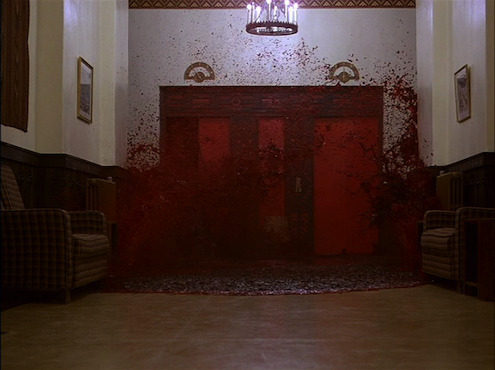
It reminds me of how the Overlook Hotel in Kubrick's The Shining is absolutely draped in Navajo designs, thus turning the film into one of the most disturbing meditations I know of on the conquest of the West and the genocide of the Native Americans - all the more disturbing for being almost entirely silent about it.  Torrance and his family trek out West and camp on the site of an "old Indian burial ground"... and the place is haunted, not by the Indians but by the malignant memory of the decadent highpoint of the society that displaced and slaughtered the Indians, that built its imperialist prosperity on their ransacked graves.

Note the Navajo designs around the elevator doors.

Note the gallons of blood.

Torrance is driven mad by his weak and self-serving sympathy with a temple of luxury and consumption (and, in a related way, of male power and mysoginy), constructed on a lake of blood.

In the same way, though less overtly hauntologically, 'Spearhead' smuggles in - silently, unconsciously - a diagnosis with what's wrong at the top of capitalism, to put alongside its diagnosis of the fetishized commodity which confronts the worker as an alien threat.  It notices that we live in a society that is ruled, that this power is both fake and immensely powerful.  It shows us the rulers of the world, in a line from the great bourgeois revolutionary Washington right up to the political administrators of Britain (mirroring the Atlanticist nature of post-war Britain's alignment with America).  It presents the rulers as a grand spectacle for paying tourists to gawp at, but also shows them as fake things, hollow dummies, tatty replicas and, potentially, as stalking killers waiting to awake.  Power becomes a collection of unreal images, potentially zombified tools (weapons) in the hands of something that is "hostile and alien", that manifests as walking products, as the human form commodified, as work alienated from workers, as evil animated parodies of the human image and human labour, as autonomous manufactoids with hands that - far from performing work - flip open to reveal annihilating weapons.

As if all this weren't unsettling enough, the story goes on to hint - silently, unconsciously, as before - at white power, at the racial hierarchy which exists within Western capitalism, at the link with imperialism and colonialism.

You doubt me?  Watch the scene where we see the dummy bigwigs are waiting in Madame Tussauds to take their places at the apex of capitalist society and rule on behalf of the evil commodities.  You'll notice that, alongside all the generals, politicians and presidents, there are dummies of Martin Luther King and Gandhi.


We've already seen Washington hovering over the other presidents.  Washington was a slave owner.  We've already seen the British generals and politicians.  Capitalist Britain ruled India through military force.

And what are the Nestenes?  Channing tells us.  "We have been colonising other planets for a thousand million years," he says.  They are, self-confessedly, imperialists.  Invaders, enslavers, colonial masters. 

And all the Autons, without exception, are pink.  Pink is their default colour scheme.  Pink is what they think is the colour of human.  The pink Auton is the vanilla model.

They are this way because of the inherent racist hegemony of white faces on British TV (and the Western capitalist culture industries more generally) in the early 70s.... but that doesn't undermine the point.  If anything, it underlines it.  The episode comes quietly, furtively, unconsciously, inadvertantly, dangerously close to a critique of the values embedded in its own implicit aesthetic.


Coming over here, taking our jobs...

In light of this, let's go back and have another look at the Auto Plastics factory.

This may be the single most politically
charged image Doctor Who ever created.


In a story that seems unconsciously preoccupied with capitalist alienation, that depicts the system as profoundly white, that associates the system with conquest and imperialism, these images are 'ground zero'.

This is getting dangerously close (without any conscious intent, I've no doubt) to expressing a joined-up, radical unease about capitalism as alienating, exploitative, racist and imperialistic.

This story situates the 'alien' threat within a very visible depiction of a system in which people are arranged in hierarchies based on their relations of production.

The main monsters are emblems of workers commodified, and of the commodity itself - the product of human labour - as an alienated and hostile force.

It depicts human production - via a capitalist factory - materialised in a form that dominates and attacks people.

It depicts people attacked by walking media images that smash their way out of shop windows and go on the rampage in the consumerist high street, still wearing the (once) fashionable clothes they were supposed to be advertising and covered in price tags.

This all smells strongly of an implicit critique of how people are alienated from their own labour by working for others, and from their very human image via consumerism.

Also, the story hints that, at the apex of all this, there sits a powerful bunch of people who are fundamentally fake and fundamentally white.  By putting Washington, Lincoln, King, Gandhi and a bunch of ruling-class Brits in the same room - not to mention adding LBJ and Nixon, during the era of Vietnam and only a few years after worldwide anti-war protests had peaked - the story gets very, very close to openly and implicitly critiqueing racism, imperialism and colonialism as parts of the same system.

And the presence of the near-invisible non-white working class, busily producing units of white capitalist culture for the profit of a white man who runs a white company, threatens to openly notice how non-whites have been gobbled up as cheap labour by this system.

The potential conclusion is that if you're a non-white worker within this system, you are subject not only the same alienation awaiting the white worker but also to another kind: the kind that sets the basic image of humanity as white and then contrasts you with it.... and sets you to work in the factory, maintaining - via the production of the commodity, i.e. capital - the very system that creates all these layers of oppression.

The presence of the emblems of racism and imperialism (masters and opponents) within the museum, and the imperialist nature of the Nestenes (who tessellate and merge so perfectly with the human system of which they are planning a 'hostile takeover'), nearly takes this story into the realms of outright, but sub-textual, subversion.

One casual mention of the East India Company would be all it would take to bring these threads together openly.

The Nestene entity itself is where all this might have met in some kind of coherent form.  Instead we get something - and this is surprising- almost unprecedented in Doctor Who up to this point: something tentacular, something drawn from the relatively new Western literary style/affect/trend known as 'the Weird'.  We get something radically incoherent.


It's almost as if terror of the themes being played with in this story - themes that so nearly converge to become a joined-up and radical critique of capitalism as systemically exploitative, imperialistic and racist... and, moreover, to do this in the context of modern Britain - has caused Doctor Who itself to flee for comfort and disguise in the realms of the undefined, shapeless and incomprehensible.

When the monster that sits on your Tooting Bec loo is so freighted with things that kids' telly isn't supposed to notice, let alone mention... the realm of the Weird tentacular could be a place to hide.

But that's another essay.


ADDITIONAL

There is also the question of gender. 

In 'Spearhead' the Autons are all male, including all the shop window warrior Autons.  The replicas are all male.  Almost all the powerful people represented in Madame Tussauds are male. 

Explicitly sexist relationships are demonstrated.  There is Seeley.  There is the female nurse in the hospital, patronised by the doctors.  There is Liz Shaw, dragged away from her work at Cambridge against her will and judged for her looks by a male authority figure.  There are the male executives at Auto Plastics, playing with female dolls.  Ransome hoped to profit by further commodifying the female form.  In the novelisation, Ransome's doll wanders around saying "Mama", further showing the way consumer culture markets female roles. 

And, as noted, there are the female workers in the factory.  They work to reproduce capitalist culture's commodification of women, of its characterisation of them as children, of its socialisation of little girls to think of themselves as mothers-in-waiting, etc.  They are shot in such a way as to leave them faceless, as nothing but pairs of hands... which is, of course, a way that working people are described.  "We need more hands," etc., as in Dickens' Hard Times.  There is the waxen-faced female secretary in the short dress who subserviently leads Ransome to her male boss's office.

In addition to the many threads of potential radical comment that I've already listed, 'Spearhead' also contains the worrying potential to notice female commodification and marginalisation in Western capitalist society, and to link this (as it might link racism and imperialism) to the locus of capitalist production and reproduction: the factory, the assembly line, the point of alienated labour.

Thursday, 8 December 2011

Skulltopus 3: Yes, We Have No Macra

If any monster in the history of Who was ever a gothic, hauntological thing embodying the 'return of the repressed', it was the Macra.

All the ostentatious happiness of the Colony is there to cover unease.  They know there’s something wrong, otherwise why deny it so desperately?  Why would the Colony go to such lengths to contain and silence Medok unless he was speaking the unspeakable truth that everybody else wants to deny?  The Macra haunt the Colony, scuttling around at night, hiding in the shadows, unseen then glimpsed and then disappearing.  They haunt the people, who all know about them (even down to having a name for them) but claim to disbelieve in them.  They represent repressed knowledge that is insisting upon being remembered.  This is pure gothic.

But... they’re also a bit Weird, in the sense of the ‘Weird fiction’ of early 20th century horror (something I've discussed in previous Skulltopus posts).  William Hope Hodgson, one of the greatest Weird writers, used giant crabs a lot in his peculiar and deeply unsettling maritime tales.  As previous noted, the author China Miéville has written that the Weird (at least classic, 'haute Weird' of the late 19th-early 20th century) was an attempt to express the meaningless and unrecognisable, and that it thus stands in "non-dialectical superposition" to the gothic (or  the ‘hauntological’), which is about the buried secret, the thing we recognise but refuse, that which we know but wish (need) to deny.  The tentacled thing is the quintessential Weird monster type… a type unprecedented in Western fantastic fiction before the Weird.  But Hodgson's tentacled things co-exist with giant crabs.  I'm not sure how precedented giant crabs were in the Western uncanny.  Certainly, people in the West had seen crabs before... but then, as Miéville acknowledges, they'd seen tentacled things too.  It's not about unfamiliarity so much as literary unprecedentedness, as an absence of semiotic baggage and any tradition of previous meanings.  In any case, whereas the haunting thing is frightening because we recognise it, and recognise that it means something, the Weird thing is frightening because it is something meaningless and incomprehensible, stalking us for no reason that we can ken.

The Macra are TV monsters from 1967... and this is very different to literary monsters in 1917... but that's a minefield I'll try to traverse in another post.  But, shunting that massive problem to one side just for now, the Macra genuinely do seem to me to be Weird, but also to be hauntological.  They haunt because, as noted, they are recognised and not recognised, seen and denied, fled from because of the repressed knowledge that they represent.  On the other hand, they are not spectral or phantasmic, for all their elusiveness.  They're giant crabs for heaven's sake.  Or are they?

Because here’s the really strange thing: the Macra don’t really seem to be giant crabs at all!  The original titles of this story were 'The Spidermen' and 'The Insect-Men'.  The characters in the story are uncertain what the Macra are, even – especially - when they see them.  They don’t call them crabs.  Nobody actually says the word “crab” during the story!  The characters ask: “are they insects?”  They ask: “are they some monstrous form of bacteria?”  The Doctor thinks they’re germs.  It’s unclear how literal he’s being.

Okay, they look like crabs in the few pictures we have left… which is perhaps why this story is, after all, better (or Weirder) heard but not seen: not because the monster props were bad (though, in all honesty…) but because they were too recognisably one type of thing.  Unseen, the Macra retain an indefinability, a categoric indeterminacy.  Mind you, seeing the giant crab while the characters don’t recognise it as crablike but instead suggest other descriptions… this might be even Weirder.  The giant crab may have precedents in classic weird fiction, but the giant quasi-crab or un-crab or ab-crab (it is both crab and not-crab) is even more in the style of the Weird.  The creature of unstable form and type, the creature that is overdescribed using incompatible terms (it’s an insect and a germ, it’s a bacterium and it’s huge, it’s a crab but it also isn’t), the creature that is indeterminate and protean and incomprehensible… that’s genuinely reminiscent of Lovecraft’s radically unrecognisable, incoherently over-described, unknowable ‘Old Ones’ and Shoggoths.

This effect is heightened by the experience of listening to the audio, having the crab image in your head from the CD case and the stills you've seen, but hearing the characters unable (or unwilling) to perceive what the bloody things are.  It's enough to make you hope they never find the footage.  It's certainly enough to make you abjure the recons (though I've never been a recon kind of guy anyway).  'The Macra Terror', by being unseen, becomes a bit more literary... or acquires something of the non-visual, descriptive, imaginational (yes, that is a word - I should know, I just invented it), hallucinogenic quality of literature that demands of us that we should visualise the fantastic and unreal.

Also, the Macra’s mentality and psychology is almost as opaque as their form.  They seem to be both rational and irrational.  They speak, as the voice of Control… but this seems like a ‘normal’ human voice.  It’s an untreated voice.  There’s no audio effect in use, no vocoder, not even after the voice has been revealed as the voice of the Macra.  We have to imagine that voice emanating from one of those Volkswagon-sized un-crabs, sitting behind a mic, skulking out of view around a corner.  The incongruity provokes derision and unease simultaneously.  The voice is plummy and pally, sometimes authoritative, sometimes sneaky… sometimes hilariously over-emphatic, evincing terror and irrational hysteria.  This chimes with their behaviour during the story.  They seem to be utilitarian, machiavellian, ruthless, exploitative, secretive, furtive… but also communicative, dependent, oddly reluctant to order killing, bad planners, bad improvisers, beneficiaries of an unnecessarily fragile set-up, etc.  And they are scared: of being discovered, of being defeated, but also of themselves, of their own existence, of being.  Oddness of oddnesses, the Control voice (the voice of the Macra) is at its most frantic, its most insanely frightened and irrational, its most screechingly emphatic, when it is denying the existence of the Macra.  It denies its own existence, again and again, in an escalatingly loud series of increasingly unhinged, pleonastic reiterations.  It sounds desperate to convince everyone, including itself, that it does not exist.

Of course, with the tapes junked, the Macra have achieved a kind of spectrality.  They don't exist anymore, except as a voice, as the incomprehension in the minds and voices of the characters who encounter them, as depthless CGI reincarnations in another story, and as moment when pulp kid's TV seems to have genuinely approached a belated and partial merging of the Weird and the gothic.


NOTE, 11/04/13:
It's been pointed out to me that the assertion made above that "Nobody actually says the word 'crab' during the story!" is incorrect.  Polly calls them "crabs"... though she does couple the word with "or insects", retaining the air of indeterminacy I was remarking upon.