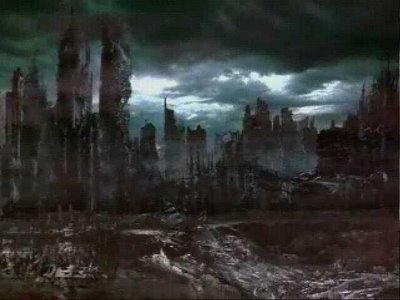
Showing posts with label sci-fi. Show all posts

Thursday, 12 April 2012

Grinding Engines


The mechanical sciences attained to a degree of perfection which, though obscurely foreseen by Lord Bacon, it had been accounted madness to have prophesied in a preceding age. Commerce was pursued with a perpetually increasing vigour, and the same area of the Earth was perpetually compelled to furnish more and more subsistence. The means and sources of knowledge were thus increased together with knowledge itself, and the instruments of knowledge. The benefit of this increase of the powers of man became, in consequence of the inartificial forms into which mankind was distributed, an instrument of his additional evil. The capabilities of happiness were increased, and applied to the augmentation of misery. Modern society is thus an engine assumed to be for useful purposes, whose force is by a system of subtle mechanism augmented to the highest pitch, but which, instead of grinding corn or raising water acts against itself and is perpetually wearing away or breaking to pieces the wheels of which it is composed.
- Percy Bysshe Shelley, A Philosophical View of Reform, 1819-1820 

Silence. It flashed from the woodwork and the walls; it smote him with an awful, total power, as if generated by a vast mill. It rose from the floor, up out of the tattered gray wall-to-wall carpeting. It unleashed itself from the broken and semi-broken appliances in the kitchen, the dead machines which hadn't worked in all the time Isidore had lived here. From the useless pole lamp in the living room it oozed out, meshing with the empty and wordless descent of itself from the fly-specked ceiling. It managed in fact to emerge from every object within his range of vision, as if it — the silence meant to supplant all things tangible. Hence it assailed not only his ears but his eyes; as he stood by the inert TV set he experienced the silence as visible and, in its own way, alive. Alive! He had often felt its austere approach before; when it came it burst in without subtlety, evidently unable to wait. The silence of the world could not rein back its greed. Not any longer. Not when it had virtually won. 
He wondered, then, if the others who had remained on Earth experienced the void this way. Or was it peculiar to his peculiar biological identity, a freak generated by his inept sensory apparatus? Interesting question, Isidore thought. But whom could he compare notes with? He lived alone in this deteriorating, blind building of a thousand uninhabited apartments, which like all its counterparts, fell, day by day, into greater entropic ruin.  Eventually everything within the building would merge, would be faceless and identical, mere pudding-like kipple piled to the ceiling of each apartment. And, after that, the uncared-for building itself would settle into shapelessness, buried under the ubiquity of the dust. By then, naturally, he himself would be dead, another interesting event to anticipate as he stood here in his stricken living room atone with the lungless, all-penetrating, masterful world-silence.
- Philip K. Dick, Do Androids Dream of Electric Sheep?


Entropy is a concern of science-fiction as a whole.
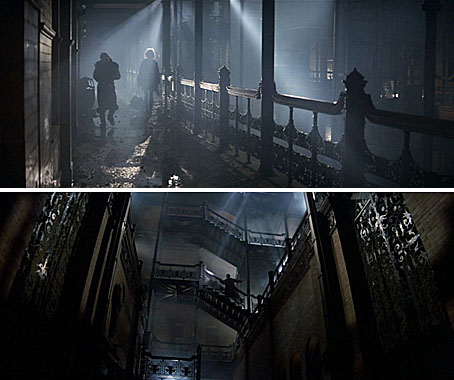


SF - with its concentration upon imagined future history, the elision of past technology with future technology, encounters with alien species further down the road of technological advancement than us and, last but not least, time travel - seems especially concerned with historical transformation, particularly with regards to technology.

Humans seem to have a tendency to imagine future disaster, or at least future decay, as a way of expressing our perception that our own world is winding down and wobbling on the brink.  This may be an inherent human feeling (like the seemingly inevitable perception that younger generations are worse than our own, which Plato was banging on about thousands of years ago).

We’re all time travellers, in a way. We all travel from ‘the old days’ into uncertain futures. This feeling has become especially acute for humans living in the modern era, when the forces of production unleashed by the capitalist mode have achieved things which previous generations would have considered to be impossible except through sorcery. As Marx and Engels put it in The Communist Manifesto, as they attempted to express the way the emerging capitalist system was changing all human experience:

Constant revolutionizing of production, uninterrupted disturbance of all social conditions, everlasting uncertainty and agitation distinguish the bourgeois epoch from all earlier ones. All fixed, fast frozen relations, with their train of ancient and venerable prejudices and opinions, are swept away, all new-formed ones become antiquated before they can ossify. All that is solid melts into air, all that is holy is profaned, and man is at last compelled to face with sober senses his real condition of life and his relations with his kind.

Capitalism began to revolutionise human life to an unprecedented degree, in unprecedented ways and at unprecedented speed, through the arrival of mass production, the factory system, technology, etc. The level and speed at which things changed massively increased.  Technology is a platform from which more sophisticated levels of technology may be attained, just as every scientific advance stems from earlier discoveries… moreover, since the economic basis of the technological revolution was industry, i.e. capitalism, the constant need to revolutionise the system was built into the system. Capitalists must always increase production, invest in new techniques and methods of production, pioneer new products, lower production costs, expand into new markets, etc. Capital breeds capital… and capital must be fed back into the process of expanding the productive forces. Every capitalist does this, for fear of being outstripped and put out of business.

Nevertheless, despite the dynamism of the system and the incredible material progress that it has brought, capitalism is inherently entropic.

Capitalism gave rise to the concept of entropy in the first place.   Thermodynamics (of which entropy is, as we know, the 'second law') - and with it much of modern physics -  was a scientific notion arrived at because of the Industrial Revolution, because the engineers wanted to know how their engines worked, why they didn't work, why they wound down, how they could be stopped from winding down and how they could be made to work better, stronger, faster, harder, longer. The connection continues: the application of entropy to Information Theory came from within the Rand Corporation.

Capitalism generates technological commodities which gradually run down, either in relative terms (i.e. becoming less efficient than new technology) or in absolute terms (i.e. in that they gradually get worn and used and tired) or in both.


This process generates wastage of technology. We’ve all been to the tip and seen those piles of old TVs, cookers, microwaves, freezers, etc. These are phenomena of modernity. I don’t mean that nothing decayed or fell apart in the Middle Ages or the Ancient world (of course it did), but the speed at which we produce more and more technology also increases the speed at which our world fills with technology that has become obsolete, decrepit, malfunctioning and abandoned.  The lives of humans in pre-modern, pre-technological societies are/were fundamentally dominated by endlessly repeating cycles embedded in nature.  The lives of humans in modern, technological society have many of the same cycles, but are increasingly dominated by the onward rush of change that comes with the continual revolutionizing of the productive forces.


Modernity has fundamentally reversed the old relationship humanity used to have with its creations, tools and machines.  For most of human history, the technological creations outlived the creators, both in general and often in particular.  The concept of the waterwheel would outlive the miller; often the particular wheel with which he worked would outlast him.  Now, humans outlive almost all their technological creations, except the most basic and/or monumental, like buildings... and even they have been changed, in both design practices and materials, almost beyond recognition.  The surgeon outlives successive generations of up-to-the-minute surgical tools, the web-designer outlives the most advanced hardware and software every year or so.  They even live to see the fundamental principles revolutionised.


The world that Plato died in was more or less the world he was born in, at least in terms of technology, and at least compared to us. To him, computers would have seemed like magic.  In 1980, Christopher H. Bidmead was able to write a script in which the Doctor expresses surprise that a computer retains information even when switched off. When the people who watched that episode as children (i.e. people like me) die… well, who knows?  Computers themselves may be obsolete by then.  But the undreamt-of advances of the future will leave the increasingly rickety state-of-the-art-circa-2012 standing... or more likely rotting.  Every new mp3 player or mobile phone or digital camera entails older models thrown in the scrap. DVD and Blu-Ray entailed piles of discarded old VHS tapes.  Every newly-purchased gadget means another of those little plastic-coated wire things that tie the brand new cables and leads into a neat bow.  Every DVD or CD bought means adding to the mountains of cellophane in which they come wrapped.


This is just the tip of the shitberg. From the earliest days of the industrial revolution – long before what we know as the green movement - people had been noticing the way that industrial technology generates wastage, pollution and rubbish as by-products. The railways were themselves the result of a staggering development of the productive forces of society, and their effects fed dialectically back into the system, contributing to yet more staggering development. But the combustion engine produced an enormous need to tear energy from the earth in the form of coal, it belched smoke, produced grease and dirt… and all its component parts were subject to all the wear and tear of shoe leather or flint hammers or any other tool. The gears and wheels and tracks wore away, stopped functioning properly, needed replacing, were torn out and discarded when superior innovations came along.


Time has always been, as Ovid put it, “the devourer of all things”, but it is only in the modern era – the era of capitalist industry and mass technology – that we humans have seen such impermeable and ubiquitous evidence of decay, wear and tear, abrasion, clutter and accelerating obsolescence. It surrounds us now. It demonstrates the impermanence of the things we make.  It lurks behind the latest innovations, waiting for their time to come.  And it is our creation.


It was one thing to see the natural world wither every autumn and regenerate itself every spring… these days we watch our own wondrous creations fall apart all around us, all the time, everywhere, no matter what we do. And unlike dead leaves, spent batteries don’t pass back into the soil from which they came. They sit on rubbish heaps. They engorge landfills. They float in canals. If we don’t trouble to do anything about it, they fill our drawers. And every time we open the drawer, they’re still there. Pooled in entropic uselessness. Production and consumption culminating in static malfunction. Recycling is an attempt to fend off industrial entropy as well as environmental devastation… but even the recycling collection vans belch out fumes; even the engines and crushers and pulpers and sievers of the recycling plant eventually run down.


That other great product of the modern age - world-scale, technological, industrial warfare - also creates entropy in massive doses.  All the machinery of modern war is industrially produced and industrially used.  The tanks, the machine guns, the planes, the bombs, the drones, the smart missiles, the body armour, the computer guidance systems, the depleted uranium-coated shells, the armour piercing rounds... they're all subject to the same pressures as all other industrial commodities.  Just like the mp3 players, the war machines are mass produced for profit.  Just like all machines, the military hardware wears down.  The newer model is designed and produced and sold.  A new missile system is bought by a government and all the old warheads are obsolete.  The unused weapons degrade and become useless.  The weapons that are used get bashed and battered, get sprayed with bullets or blown up (like the men who are sent to fire them).  Either that, or their gears grind and shread as the desert sand gets into their innards.  War is often said to lead to technological innovation, what with necessity being the mother of invention.  We might want to wonder how we define "necessity" in this context.


 And we might want to remember, alongside all the innovation, how much destruction war creates.  It leaves not only piles of expended and exhausted weapons, but cities reduced to rubble, the technological commodities that filled them turned to so many smithereens.  The wars that smash the wonders of the modern age to fragments are themselves products of the modern age.


The system that created the drive for hegemony, control of resources and markets which lead to the invasion of Iraq in 2003, also created the materiel which made the invasion possible... much of which was smashed, pulverised and incinerated in the process (to say nothing of the people who were turned to mincemeat or vapour).


But the loss of materiel simply refreshed the market for their products.  The debris piles grow, constantly refreshed by the engines of modernity.  In this sense, warfare is just the fastest, most extreme manifestation of the tendency inherent in capitalism towards the creation, circulation and consumption of commodities.


Modern warfare is industrial, technological... and it is like a frenzied, violent dramatization of the boom and slump cycle - the irresolvable and unreformable contradiction at the heart of capitalism.

This is where we loop back to the start and find the most basic reasons and ways in which capitalism is entropic.

It is the very necessity of accumulation to capitalists that causes crises.  In order to win in the market, the capitalist must invest in productivity.  He must produce his goods or services better, faster, cheaper.  He must drive down prices.  The primary way he can do this while continuing to turn a profit is to make workers more productive by investing in the machinery and techniques they use in the workplace.  But, in doing this, the capitalist changes the ratios.  The worker becomes more and more swamped by, integrated in and subordinate to machinery and systems.


The labour power of the worker is the source of exchange value, which appears in the market as price.  Human labour power is the only commodity that creates new value.  A worker spends only part of each working day creating the amount of value needed to perpetuate their own existence, the rest of the day is spent producing surplus value which goes to the capitalist.  The machinery used in the production process transmits some of the value embedded in it to the products, but cannot produce new value.  By itself, it can do nothing.  It must be set in motion and controlled by human labour power.  And even the value that the machinery does transmit (depreciating all the while) was itself created by the human labour power that created the machine.  When the capitalist pours surplus value back into the system, when he invests in machinery, he invests in that part of the production process that cannot create new value.  This is, ultimately, why prices drop: because the value (i.e. labour time) embedded in the product decreases.  This is all fine and dandy for the first capitalist to make the technical innovation, buy the better machine, automate more of the factory, develop the new and better software, etc... and, in the first instance, it helps him succeed against his competition.  But, over time, more capitalists invest in the same or better innovations, techniques and machines... they must, in order to accumulate in order to compete... and the level of profit across the entire system falls.

This is a tendency that asserts itself over time.  There are, as Marx readily allowed, countervailing tendencies than can retard or offset the falling rate of profit.  But, overall and over time, the tendency shows.  This analysis has been controversial but is readily and convincingly defencible.  Moreover, empirical data bears it out.  The current global recession was caused, at the most fundamental level, by just such a long term decline and stagnation of profitability.

Capitalism drives itself into chaos and crisis even as it accumulates.... because it accumulates.  It’s an inherent aspect of the system, to grind the engines until they burst apart.

Crisis leads to the wastage and destruction of excess capital.  Firms go bust.  Factories and offices close.  People are laid off.  Warehouses stagnate filled with unsold and unsaleable goods.  Town centres empty of going concerns.  Increasingly penurious ex-consumers walk past vacated shops and stare through the dirty windows - the 'Everything Must Go' posters growing faded and tatty; the sellotape holding them up turning yellow and dry - into haunted rooms occupied by nothing but worn carpet and unopened mail.  Empty facilities sit rusting in stasis.  This decay and waste reduces the amount of capital in the system, thus opening up the possibility of a restoration of profit to the average.  It was the accumulation of capital that lead to the fall, remember.

Eventually, the limping casualties that are still viable are gobbled up by the predators big enough to survive the recession.  These leviathans heave the system back out of crisis and the cycle begins again.  But capital becomes ever more concentrated and centralized into the hands of the great predators.  Their power becomes so great that their interests merge with that of the nation state.  Competition and accumulation are played out at the level of global imperialist competition.  Nation states squabble over access to, shares of, control over resources and markets.  They squabble because their existence is ever more bound up with increasingly concentrated and centralized capital.

The system generates entropy at every level.

It even generates entropy of different kinds at different levels of the concept.

Slump generates stasis and dereliction.

Boom generates depreciation and the proliferation of technological clutter and decay.

War generates massive destruction and wastage.

Peace generates the hegemony of huge capitals that standardize and homogenize everything into a vast stream of indistinguishable, banal, bland cultural porridge.  Even without the hyper-consumerism in which we now live, photography and mass production created the stripping away of the aura of the individual work of art, the vertigo of endless reproduction.

If capitalism manages to raise the productive forces as far as some think it will... if it one day creates nanotechnology that will alter matter at the ceullular, or even molecular level... there is a mooted possibility that such technology will result in the reduction of all matter into an undifferentiated mass of shuffled, randomized, unpredictable, informationless, apocalyptic unstuff.

This is the ecophagic apocalypse of the 'grey goo' scenario.  It has fascinated writers of science fiction more than it has genuinely worried scientists.  This is because it ties directly into something that we all know and feel and see about the world of technology, industry and modernity (of capitalism): that it has entropy woven into its fabric.


The world of the machine is - from certain angles - a world of monsters; monsters that champ and chew and digest and excrete human experience.


We live in the shit of Moloch.  And nothing is more entropic than shit.


*


To recap:

Modernity, which is the age of mass industrial technology, is thus also the age of science, whence comes the concept of entropy.  The scientific concept of entropy, besides addressing concerns of industry and science, also expresses - or lends itself to analogies which express - longstanding human anxieties about time, decay, death, etc.  In the modern age, which is the age of capitalism (and hence of mass production and overproduction of commodities), such anxieties are ramped up beyond any level before known in human culture because the modern age is an age of omnipresent wastage, rubbish, obsolescence, clutter, malfunction and destruction.

To expand a bit:

In the past, anxieties about time and decay were not exacerbated by technology and industrial production (for the simple reason that they did not yet exist, or predominate).  Such anxieties were about age and illness and death.  They were treated in myths, legends, fairytales, etc., with their seemingly endless concern with young girls and crones, fertility of land linked to human fertility, death and rebirth, imprisonment, eternal guardianship, etc.  Myths and legends and fairytales endlessly riff on order turned to chaos, chaos turned to order, potential wasted, youth lost, age consuming youth, youth banishing age, fertility banishing barrenness, and so on.

Science fiction is, I think, the reiteration of myth and legend in the age of modernity, hence in the idioms of technology.  There's a definition of sci-fi as being "about the relationship between man and his tools"... yet the "tools" that concern sci-fi are robots, spaceships, computers, etc... all of which are recognisably projections of trends or possibilities within modern industrial technology.  That's why it isn't sci-fi when ancient legends tell of magic swords, but it is sci-fi when writers in the 19th-21st centuries tell of advanced machines that can fly people between the stars.

Therefore, the preoccupation of science fiction - or at least certain strands of science fiction - with entropy is hardly surprising.  SF is the literary/cultural form that is more a product of modernity than any other.  It might be the said to be the adaptation of the most basic forms of storytelling to the landscape (or culturescape) of a world dominated by modern capitalism.  SF is the mythic expression of frenzied technological innovation, general commodity production, overproduction, overaccumulation, obsolescence, re-investment and re-innovation, more production, more obsolescence, more rubbish tips, and so on.

Entropy might just be a key link in this chain.  It is an idea that arose from, and is of great utility to, modernity.  It is an idea expressed in and by the industrial machine, the technologeme.  It expresses something inherent and unavoidable within all technology.  It refers to something that is more visible and intense in all our lives because of mass production.  It also provides a link to older forms of discourse that express ancient human concerns.  After all, anxieties about age, illness, infertility and death have not gone away... they have just been supplemented by anxieties about the aging, malfunctioning, failure and threatening behaviour of technology and industrial products.

Entropy might just be the missing link between myth and science-fiction.

It might just be why the quintessential modern literary/cultural genre of the machine age also became - so often and on so many levels - a reiteration of myth.


Tuesday, 10 January 2012

Strange Matters


There is something very gothic about Doctor Who, in the hauntological sense.  I mean that the show keeps on doing monsters that represent, in various ways, 'the return of the repressed', monsters that represent buried anxieties, or anxieties that we have attempted to bury.  But the monsters tend to be steadfastly material in quite straightforward ways... and to embody material, social, historical nightmares (fascism is a big one that immediately suggests itself).

It's important to stress that this isn't a contradiction, as such.  Indeed, in many ways, it's 'business as usual' for the gothic.  You can't get more hauntological than vampires, but they tend to be interpreted as representing deeply materialist concerns, from veneral disease to monopoly capitalism (and, these days, teen romance... which is about as materialist as anything gets).  However, while they may represent material, social, historical anxieties, vampires are not straightforwardly material.  They are, like most classic gothic/hauntological monsters, profoundly spectral - or at least ab-physical.  They dissolve in sunlight, cast no reflection, can appear and disappear at will, can physically transform into bats or wolves, can reverse physical time by becoming young again after feasting, can defy gravity by crawling down sheer walls, etc.  And vampires are at the more solid end of the hauntological spectrum.

However, Doctor Who has tended to (rather spuriously) consider itself a champion of an empiricist, scientific approach rather than one which has any truck with the supernatural, making vampires into alien races or mutations created by pollution, for example. (This is, as I say, rather spurious, partly because the writers of the show have usually been less interested in scientific accuracy and more interested in telling stories, often reiterations of myth - and quite right too.)  But the thing to notice here is that, despite the very gothic/hauntological method of many of the show's monsters (haunting us with our repressed anxieties), the show does not usually represent them as spectral or phantasmic or undead in the full supernatural sense.  They may appear and disappear, but its because they've got transmats, not because they're immaterial, undead things that flit in and out of tombs.

In other words, the show wants to have its cake and eat it.  It wants to have hauntological monsters that are alive, that are physical, that are hard and material things, that are organisms or robots.  This is not a denial of the hauntological-as-supernatural, but a recoding of it.  Like much SF, Doctor Who is immensely concerned with myth-reiteration, with retelling legends in the idioms of the age of science and technology and industrialisation.  I'm not here going to go into the various ways that Doctor Who's conception of reality is fundamentally magical.  What I'm trying to tease out is the way that, despite its repression of magical thinking, magical thinking keeps returning to the show and sneaking its way in.  It does this (if I may briefly anthropomorphise a concept) by disguising itself in a materialist form, and by inserting the hauntological method into narratives that are fundamentally about materialist concerns.  The inner logic is magical, the language is materialist.  The thematic preoccupations are drawn more from the language than from the inner logic.  Doctor Who uses the language of materialism to tell magical stories about nightmares of modernity.  This is why the show repeatedly tells stories about monsters that haunt us in a material way with the repressed knowledge or fear of modern nightmares like fascism, industrial genocide, high-tech war, nukes, imperialism, etc.

This is partly why there seems to be something of the trad gothic... something vampiric, zombieish, Frankensteinian, demonic... about so many monsters that, on paper, are straightforward automatons or war machines. Again and again, monstrous flesh lurks within the clanking technological enemy.  A webbed claw emerges from a Dalek casing.  Androids per se are always just the tools or weapons or foes of other races... they are never the main enemy.  The main enemy has to be more gothic.  It has to be Davros, awakening from death and covered in cobwebs.  It has to be Cybermen: walking techno-zombies with cloth faces and empty eye-holes that make them look like bandaged skulls.  When robots are the star threat, a big deal is made of them being like "walking dead".

Sunday, 31 October 2010

Gods and Monsters

Happy Hallowe'en.

I was watching The Bride of Frankenstein yesterday; appreciating the fact that James Whale invented the self-analysing comic horror film decades before Wes Craven thought it would be tremendously cute to have characters in a slasher film talk about the narrative rules of slasher films.

At one point, the insane, camp, gin-swigging Dr Pretorius (played by the ridiculously watchable Ernest Thesiger) shows Frankenstein (Colin Clive) his collection of creations: tiny people that Pretorius grew from cultures and... well, it's pretty much indescribable.  Watch it for yourself.  If you've never seen it, you need to.


It isn't explicitly said, but clearly both Pretorius and Frankenstein anticipate (the former with relish and the latter with fear) the breeding of a new race.  Pretorius, for all his campness and his disdain for every human female he meets, seems interested in the breeding potential of these creations of science.

Meanwhile, Frankenstein's monster turns out to have survived the first film and, having learned to talk, expresses his demand for a "friend"... by which he is taken to mean a woman with whom he can mate, though he doesn't express this desire himself. What the children of Boris Karloff and Elsa Lanchester would have looked like is odd enough to contemplate by itself, without imagining babies with cuboid heads and electrified, badger-striped hairdos.

It got me thinking about the origins of the novel Frankenstein.  I don't mean all that stuff that's supposed to have gone down at the Villa Diodati, which is depicted at the opening of Bride of Frankenstein as an arch costume drama, rather than the hazy blur of bullshitting and indolence and copping off that it probably was.  I mean the work and influence of Luigi Galvani, who suggested in 1791 that electricity was an innate property of animal life, and that it might even be the "vital force"... supposedly after noticing the legs of a dead frog kicking when he touched the nerves with his scapel during a lightning storm.  (I'm told he was searching for the testicles, having formed the theory that frogs kept them in their legs.)  Galvani's conclusions about animal electricity were flawed and were superceded by Volta, but 'galvanism' caught on as an idea.  And as morbid, gothic entertainment.  Galvani's nephew Giovanni Aldini became something of a hit, giving demonstrations of how dead bodies could be made to react to electrical charges.


In one famous incident in 1803, Aldini had the corpse of a just-hanged murderer, George Foster, brought from Newgate to the Royal College of Surgeons, where he electocuted the body, causing its jaw to twitch and one of its eyes to open.  When Aldini probed its rectum, the body is said to have arched and kicked and raised its fist as though in fury.  Well, you would, wouldn't you?  This was one of many such experiments carried out by many scientists at the time.  There was another guy who claimed to have briefly reanimated some decapitated kittens.  Awwwww.

According to Mary (writing well afterwards) these experiments were one topic of discussion amongst the bright young things - Byron, Shelley, Mary herself, et al - at the Villa Diodati, alongside the experiments of Dr Erasmus Darwin.  Erasmus Darwin - the grandfather of Charles - was supposed to have bestowed life on pasta, much to the fascination of many people.  Mary claimed that this story, combined with the experiments in galvanism, inspired her to think that a creature might be constructed from parts and then be brought to life.

Erasmus Darwin - who had known Mary's father, the radical philosopher William Godwin - was, interestingly enough, a proto-evolutionary thinker.  In Zoonomia and some of his poems, Erasmus put forward (sometimes obliquely) notions of life developing and changing.  His last poem traces life from primordial soup (presumably minestrone with sentient noodles in it) to modern society.  It was a hit with Romantics like Wordsworth.

The later Darwin would agonise over publishing his findings, knowing that he would be subject to fierce attacks by those who saw natural selection as dethroning God.  Which is what Mary's story is supposed by many to be about: a scientist who challenges God.  The idea that Frankenstein has 'played God' has far more life outside of the novel than inside.  It isn't a central concern of the book.  By contrast, the first theatrical adaptation was called Presumption! or The Fate of Frankenstein, and in James Whale's films people harp on at length about how Frankenstein has meddled in things that man should leave to God.  Of course, in Whale's movies, this is surface patter, lying on top of the deeper concerns.

Whale himself was both irreligious and openly gay.

Many film critics have suggested that the films, especially Bride, can be subject to a gay reading.  They point to the way the camp Pretorius separates Frankenstein from his future wife (his bride, you might say) and propositions him, suggesting that they collaborate in creating new life from seed, as though Pretorius is attempting some kind of gay biological procreation.  Meanwhile, the Monster (who is a despised and hunted outsider) uses one word for all prospective relationships, be they with men or women: "friend".  His friendship with a blind pauper is interpreted as a potential marriage, interrupted by ignorant and intolerant yokels.  Ultimately, he is incompatible with the "bride" that Frankenstein and Pretorius create for him.

The other way that this film is often read is as a Christian allegory.  The Monster is put into Christlike poses several times, especially when captured, tied to a pole and raised in the air, his hands tied above his head.  Crosses abound (though most of these are in the film because several scenes take place in a graveyard).  And so on.

I can't pretend to be sufficiently familiar with the critical literature to evaluate these claims.  Apparently, a lot of people who knew James Whale consider them bullshit - but then they don't need to have been intentional in order to be present in the texts.

There's an interesting (if flowery) article about this stuff here.

Anyway, it's impossible to deny that a story about a creator who makes a man, gives him free will, turns him out into the world and then comes into conflict with him has to be, in some way, a reiteration of 'Genesis'.

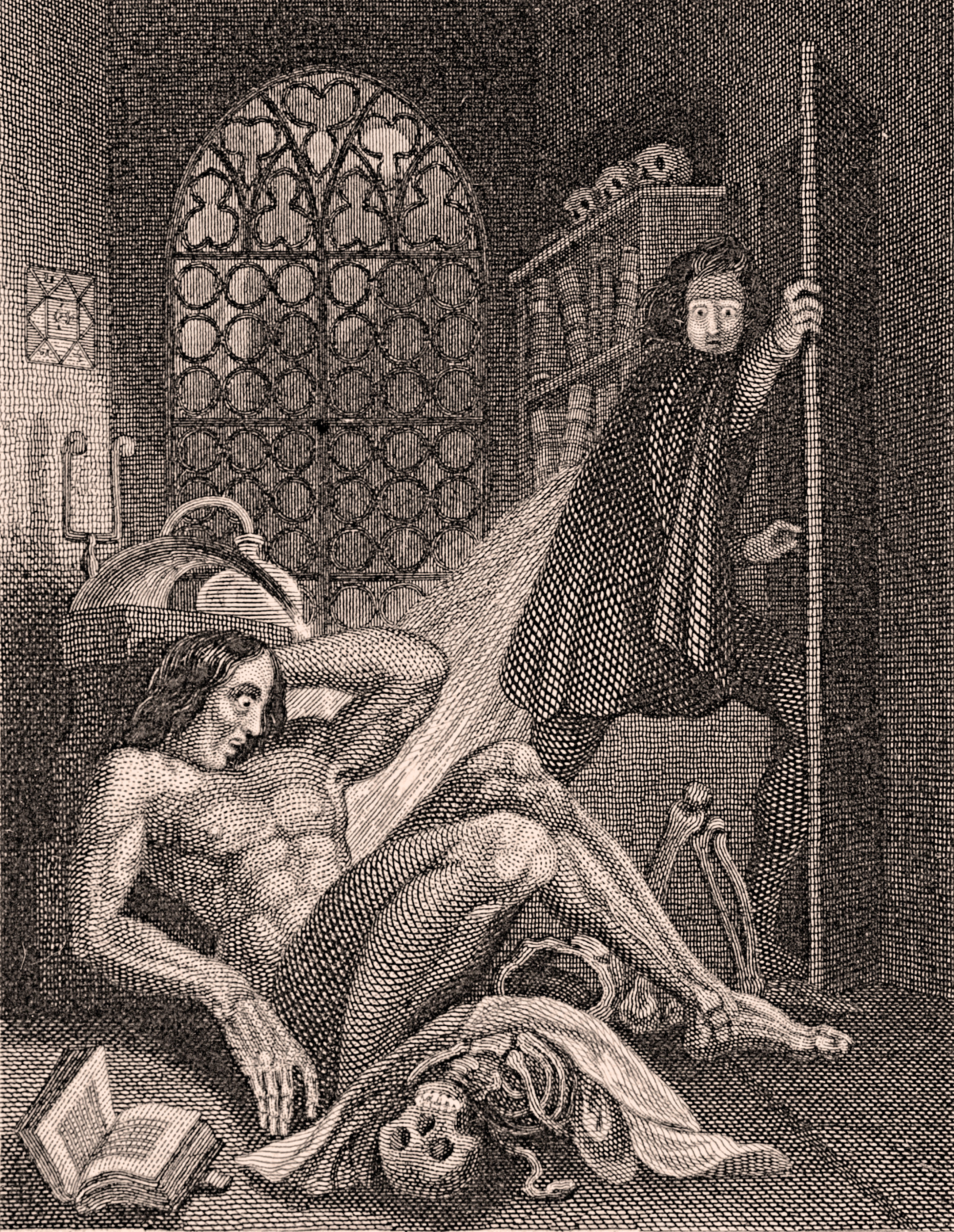
In light of this, it's interesting to look at the first ever depiction of the Monster, an engraving created for the 1831 publication by the truly great and shamefully undervalued artist Theodor von Holst.


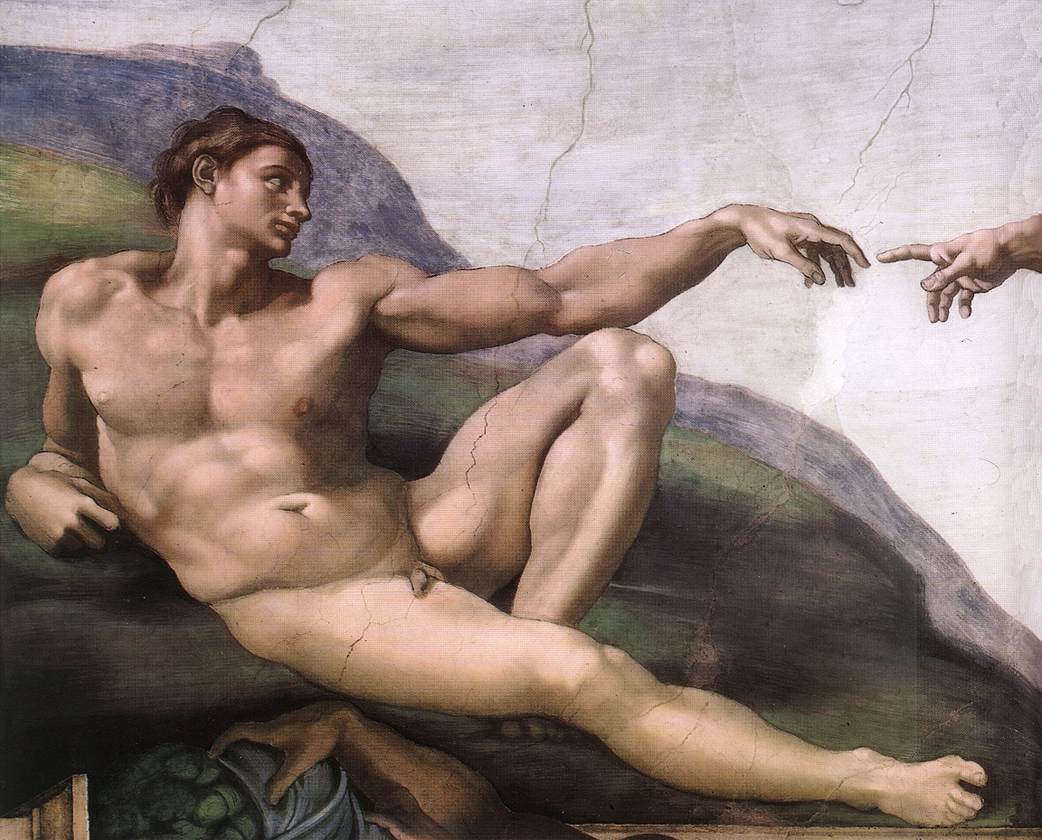
And to compare it to another famous image of a newly created man...


There's more than a slight resemblance.  Adam, of course, doesn't have to take in the sight of his creator's eyes wide with horror as they look upon him... not just yet anyways.

There's no reason to think von Holst didn't take direct inspiration from Michaelangelo.  Holst was a Romantic with a love of the gothic and the supernatural, but it would be a mistake to think of Romanticism and the gothic as a repudiation of the classical, just as it would be wrong to think of Modernism as a repudiation of Expressionism (which horror films like The Bride of Frankenstein illustrate well enough). 

Holst studied under Fuseli, who painted Mary Shelley's mother Mary Wollstonecraft, the great feminist and author of Vindication of the Rights of Woman, who died a little more than a week after giving birth to the future author of Frankenstein.  

Holst was also the great uncle of the composer Gustav Holst, who wrote The Planets suite, which includes a movement entitled 'Mars, the Bringer of War', routinely used directly in sci-fi (Quatermass) or as inspiration for sci-fi music, including Peter Howell's music for 'The Leisure Hive'.  This is perfectly fitting because The War of the Worlds by H. G. Wells is (like Mary Shelley's Frankenstein) one of the foundational texts of science-fiction, thus trading on the percieved connection between Mars and war and translating this into the context of the nascent 'alien invasion' sub-genre.  (As everyone knows, War of the Worlds was dramatised for the radio by Howard Koch and performed by Orson Welles' and John Houseman's Mercury Theatre of the Air, causing widespread panic in America upon the eve of Hallowe'en in 1938.)  It's also fitting because The Planets is a synthesis of astrological notions and musical modernism, which strikes me as pleasingly analagous to my idea that sci-fi is a reiteration of myth and legend in the idioms of the technological age.

The Mercury Theatre broadcast (which featured George Colouris, who would later be cast by Welles as Mr Thatcher in Citizen Kane... and would later go on to even greater achievements, playing Arbitan in 'The Keys of Marinus') is supposed to have had such an amazing effect partly because the American people were skittishly aware that they were on the brink of entering World War II.  Holst's 'Mars, The Bringer of War' takes something of its terrific and stentorian power from the fact that it was written during World War I, during the period when people gradually became aware that the 'Great War' was a horrifying scrabble for muddy and blood-soaked land, with bodies ploughed under barbed wire by great, rolling, implacable, metal monsters called tanks.

Tanks looked like the machines of the future.  They were.  They were the final death knell of the pre-capitalist society.  Bayonets gave way to steel behemoths.  Industry and technology could now make things like that: inhuman, unstoppable, alien, seemingly out of human control.  The trauma of them still echoes through Western culture, with the Daleks themselves partly confected from the memory of these utterly inhuman, bolted, riveted, armour plated, gun-sprouting war monsters. 

Of course, part of the peculiar power of Frankenstein lies in the fact that the Monster is something man made.  He is a product.  An artifact of human creativity and labour.  The Universal version even has dirty great bolts sticking out of his neck, just to emphasize his status as a cyborg (like a Cyberman or a Dalek), as a thing made of bits and pieces, like a car made from parts on a production line.  Frankenstein's monster is the first great monster of Western culture that is made, that is something that humans have fabricated and constructed ourselves.  Instead of encountering it as a hostile part of the landscape, like a predator, we place it in the landscape, and our treatment of it makes it our enemy.  The book expresses a moment in Europe when science was on the rise, when Enlightenment and Reason had become both causes and dogmas.  It was all to do with the slow, lingering death of feudalism and the slow, inexorable rise of capitalism.  It's a big topic, but thinkers from Rousseau to Mary's own father had confronted the old order (Things as They Are, to use the alternative title of Godwin's novel Caleb Williams, a bitter and radical condemnation of the power of aristocracy) with what they conceived of as Reason.  Mary's book is also partly a rebuke to this.  The child of Reason, the product of the new and scientific and sacriligious man, the product of the age of bourgeois production, is a monster that becomes the victim of the flaws in the creator's project and then comes back for revenge.  And breeds.  Tanks breed.  Bombs breed.  Cars breed.  Toys breed.  We have to make them, but they hardly seem like ours at all.  We don't control them.  Or our control becomes more and more remote.  The product of the new age ultimately gives the lie to the ideals of liberty and justice.  Like the tank that is created by capitalism to fight wars for freedom and peace... by bulldozing the bullet-riddled corpses of kids into the mud.

(The solution to this riddle is to be found in the work of Mary's husband Percy, who - in his unsure and unreliable way - was a radical who understood that the people are the ones who have to enforce change, and that that change can be a monster itself rather than a graceful victory for Reason.  In Prometheus Unbound - those Romantics loved Prometheus... Frankenstein's alt title was The Modern Prometheus - Shelley writes of Demogorgon, the monster that can be invoked to destroy tyranny.  Demogorgon.  The Peoplemonster.)

But back to the problem, as identified.  The products that turn.  Marx called capital (the product of human labour appropriated and confronting us as hostile and alien) a vampire.  Mary Shelley had the product of the work of the scientist become a murderous reproach to him.  We still routinely invoke the word "monster" when talking about such products.  We need the language of monsters.

And this just may be a central concern of sci-fi, including Doctor Who.  Voc Robots are created things that turn against us, products that kill.  Xoanon.  The Oracle.  B.O.S.S.  The Peking Homunculus.  WOTAN and his War Machines.  Autons.  Daleks and Cybermen are created things too, half organism and half machine.  Killing machines with people trapped inside somewhere.  Many Doctor Who monsters (more than you'd think) turn out to be created things, or partly created things.  The Ice Warriors have visors and guns integrated in their shells; the Sontarans are clones; the Zygons live on the milk of a cyborg monster.  They're all, partly, the deformed and disowned children of Frankenstein.

Of course, there's a more direct child.  Morbius.  Solon is the mad scientist, living in the castle with the deformed servant, listening to the thunder as he plots to reanimate a criminal (by probing the rectum?), scheming to make a monster from scavanged bits and pieces, ultimately turned upon by his creation, hunted down by torch-weilding locals, etc.  But that's got much more to do with the movies - Universal and Hammer - than it has to do with Mary Shelley.  Even the Sisterhood come from Rider Haggard via Hammer.   

Doctor Who is itself Frankenstein's monster, made of scavanged and second-hand bits and pieces.

That's why its amusing to think of the Character Options toys that so many of us Who fans collect (no doubt made with oil that has to be controlled through invasions of which many of us disapprove).  We're like Dr Pretorius, playing with his little people in jars.  Gods playing with our monsters.  Just make sure you keep the lid on the jar with Cpt. Harkness in it... unless you want your little people to breed.

Anyway, I'm tired of all this brainstorming.  Hallowe'en is over.

Good night.  If you can.

Thursday, 1 July 2010

Mything the Point

What’s the difference between RTD and Moffat?

RTD, for all that he’s an atheist, has a fundamentally religious view. I mean that, while he may not have any belief in an actual god, his basic outlook on life (at least as it finds expression in his writing) is religious in tone and is informed by religious mythology. RTD can’t think about concepts like ‘the end of the world’, or ’saving the world’, or ‘regenerating’, or any of this stuff (all very much the bread and butter of pulp fantasy fiction, which is all Who is really) without connecting it, maybe subconsciously, to religious concepts and stories. (Well, he can, but for the purposes of this theory, I’m going to pretend that he can’t. So there.)

‘Bad Wolf’/'Parting of the Ways’, ‘Gridlock’, ‘Voyage of the Damned’, ‘Sound of Drums’/'Last of the Time Lords’ and the other season finales… they’re all soaked in religious language and imagery, in Christian symbolism. And the theme of fiery judgement is never far away, nor is the idea of someone sacrificing themselves to redeem the world. Isn’t ‘The Ark in Space' supposedly his favourite classic story? No wonder.

I might also mention the fact that his most Whoish work prior to Who (much more Whoish than either of those kids’ fantasy serials he wrote) was about the second coming of Christ. This isn’t unusual. Douglas Adams was another atheist sci-fi writer obsessed with religion. H.G. Wells, Olaf Stapleton, Arthur C. Clarke… in fact, you’d be hard pressed to find a half-decent sci-fi author who doesn’t spend a large amount of his time thinking and writing about religion in one form or another.

Moffat, on the other hand, has no such underlying religious conception. He plays with these concepts on a technical level. He’s much more interested in playing around with plot for its own sake, twisting it around like origami. But there are some problems with this.

Firstly, he doesn’t tune into the mythological/religious basis of science-fiction (which is a reiteration of mythology in the secular age of technology). Secondly, he seems to lack any real interest in evil… which is problematic because Doctor Who, like religion (and, incidentally, like Shakespeare), is absolutely obsessed with evil (and not always in a simplistic way). You might be tempted to bring up Jekyll now… but I’ll remind you that, in Moffat’s conception, even Mr Hyde turns out to be an expression of the fierceness and danger inherent in love.

Consequently, his stories tend to be about malfunctions. They’re about things going wrong, usually technology. Nanogenes, automatic repair systems on spaceships, etc… but also chronology (any supposedly linear, predictable system, really)… and, when dealing with chronology, he can use that as a way of playing around with plot for its own sake.

The problem with playing around with plot for its own sake is that you tend to tie yourself into narrative knots that are very hard to cut through while retaining dramatic values. For all Moffat’s supposed mastery of the time-travel jigsaw plot, the greatest instance of this kind of thing yet found in 2005+ Who is RTD’s deceptively simple trick with the tie in ‘Smith and Jones’. Not because it’s more complicated and twisty than any Moffat bit of “timey wimey” stuff (it clearly isn’t), but because it serves a purpose for both plot and characterization. The real cleverness of it lies in the punning. The Doctor ties the story into a neat little bow with his tie. He goes back to create the confusion that alerted him and Martha to each other in the hospital, simultaneously giving her proof of time travel before she’s even stepped into the TARDIS.

In ‘The Big Bang’, Moffat pulls off something similar when he reveals that the peculiar sequence from ‘Flesh and Stone’ actually fits into another story. The scene has genuine dramatic power, despite being a bit of narrative trickery concealed within a time travel macguffin… though the travelling-back-through-Amy’s-timeline thing is cheating really, a bit of baseless gobbledegook, evidently just made up on the fly and inserted into the story to make it possible for the Doctor to save himself via Amy’s memories.

Most of the time, however, ‘The Big Bang’ relentlessly undercuts itself with its constant mucking about with chronology. Moffat obviously intends us to be going “oooh, that’s clever!” every few minutes. The most egregious example of this is the stuff about Amelia’s drink. It serves no purpose but showing off. It is, essentially, exactly the same thing as the ‘tie trick’ in ‘Smith and Jones’ but stripped of any plot or character significance. However, it’s also probably the least damaging instance, precisely because it has no import for the plot. When, by contrast, you have vital plot points that turn out to be nothing but trickery (i.e. the future Doctor appearing and, apparently, dying), you are looking at a story that isn’t really a story but is just pretending to be. There is absolutely no reason for that sequence to be in there. There’s no reason why the Doctor couldn’t just come up with his plan and clamber into the Pandorica without first getting shot, going back in time by 12 minutes, whispering to himself and appearing to die. It’s not only gratuitous and artificially complex, it also creates a feeling of the drama being undercut. (In fact, if there’s one single factor that repeatedly neuters the dramatic values throughout the entire 2005+ show, it’s the refusal of the dead to stay dead.)

Anyway, the point is that you can do a story in which time (i.e. plot) ties itself into knots and make it interesting as long as the knots are not the whole basis of the story, as long as the story is about something more than that, i.e. ‘Day of the Daleks’, ‘Smith and Jones’, even ‘Blink’ saves itself from being about nothing but sitcom characters caught in plot knots by thinking a bit about what the passage of time really means for people, how it changes them, etc. But when you have a story that, really, is about nothing but plot taken apart and then reconstituted like one of those puzzles with several equally valid solutions…

The other thing that Moffat lacks is, as I said, any real interest in evil or malice. He occasionally tries (i.e. Prisoner Zero is rather nasty) but, really, his baddies are usually malfunctioning, runaway systems or predators. He even writes the Cyberman in ‘The Pandorica Opens’ as an empty, unoccupied machine still running on its old programming (i.e. as a malfunctioning, runaway system) and casts his rogues gallery of Who monsters as uniting to save the Universe!

The ultimate expression of both of these tendencies (plot knots and no evil) came in ‘The Big Bang’, in which the big enemy, the Doctor’s opponent, was *drum roll please* just a malfunctioning, runaway plot!

RTD’s season finales usually left me underwhelmed… but I can’t help thinking that they were all fundamentally more interesting than Moffat’s first effort at an end-of-season blowout, precisely because they all locked into the legendary, mythic aspect of sci-fi and concerned themselves with the Doctor struggling against galaxy-powered malice. It’s hard not to look at ‘The Big Bang’ and see nothing but a well-crafted exercise in manipulating plot, in pushing plot to the limit of its tolerances within the Who milieu. Admittedly, there are some intimations of a theme concerning the relationships between fairytales, childhood imagination, stories, history and... and something or other. But it's all rather garbled and facile. You'd be much better off just rewatching 'The Mind Robber'.

Religious stories rarely make much sense, but they often resonate powerfully. Moffat’s style is more like a labyrinthine whodunit, in which the murder turns out to have just been an accident with a misifiring gun all along.

You’d think that, as an atheist, I’d be unhappy with RTD’s religion-soaked stories… but at least they had some political content. You see, one reason why religious stories are so resonant is because they often have strong political themes. The better (earlier) Gospels, for all their frequent deformities and obscenities, are revolutionary tracts that offer a (for the time) radical political message. They were, after all, popular political expressions of a people subjugated by empire. Of course, the concentrated forces that have appropriated, reinterpreted and controlled these stories for centuries have done a good job of stripping them of this context and content. Whether the people running things are scammers or no, successful religions tend to find their first recruits amongst the poor and downtrodden. Religion, as Marx pointed out, is an expression of and protest against very real suffering and alienation. That’s what ‘Gridlock' is about.

As well as being a reiteration of mythology, sci-fi is (and always has been) drenched in politics (how could it not, religion being a political ideology?) Look at the foundational texts of science-fiction. Frankenstein is about a scientist who plays God (he creates another man in his own image, endows him with free will and then banishes him to wander alone in a cruel and incomprehensible world) but it is also about the Age of Enlightenment, about the radical new ideas sweeping Western society, about the revolution going on in how society relates to the individual, about the role of education in forming personality, about the ideas of Rousseau, etc. H.G. Wells’ The Time Machine is a satire of the class system, with the workers oppressed for so long that they evolve into troglodytes and the idle rich devolving into helpless children, but is also highly redolent of the Garden of Eden and the serpent. The War of the Worlds is both a critique of British imperialism (casting us as the natives being conquered) and a reiteration of the Christian apocalypse.

None of this need surprise us. For centuries, Christianity was the dominant social ideology in Western culture, and was part of the underlying mental grammar of just about everyone in the West. The people who rebelled against the establishment at any time almost always cast their objections in terms of religion. The fiery radical priest John Ball couched his demand for universal equality in terms of the common ancestry of all men from Adam and Eve. The Levellers and the Diggers likewise. The abolitionist movement in both Britain and America did much the same. Protestantism itself began partly as a result of disgust at the corruption and decadence of the Catholic Church, comparing it unfavourably to Christ the pauper. In our own age, it's all too easy to think of dark alliances between political rage and religious ideology... but, lest we get too Sam Harris about this, it's also possible to find alliances between progressive politics and sectors of religion. It's the sigh of the oppressed creature, and sighs can be the expression of murderous rage... or progressive outrage.

Anyway. This inherent political dimension to religious storytelling could be precisely why science-fiction (as myth reiteration) is also so concerned with politics. I dunno. Ask a proper scholar and see what she thinks. (Sorry, how silly of me... any scholar of science-fiction will obviously be male.)

RTD’s mental connection to this religio-mythic element in sci-fi is probably what causes his stories to be so political. For example: The Master in ‘Sound of Drums’ / ‘Last of the Time Lords’ is not just the Anti-Christ, bringing the tribulation and controlling mankind through their own original sins, he is also a Blairesque opportunist who flashes his fake smile at the TV while using the state apparatus to arrest innocent people and scheme for war.

Which I dug.

One last remark. There is another Who story involving a bit of timey-wimeyness and a drink. It’s called ‘Warriors’ Gate’. The Doctor walks into the cobwebby, ruined Tharil dining hall and sets right a goblet that was left on its side centuries ago. Later in the story he is taken back to the moment that the Tharils began to lose control of their empire, when they were attacked at the height of their power by the revolution they thought they could dodge forever. Disgusted by their treatment of their slaves, the Doctor pours wine into the very same goblet (but centuries before he first saw and righted it) until … well, until the Tharil’s cup runneth over… and then knocks it over in a gesture of splendid, ironic contempt for their decadence; decadence built on the suffering, servitude, abuse and unrequited labour of those the Tharils call “only people”. It is an amazing moment. It unites plot, theme, myth and politics. It brings home to you the tangled and circular nature of time at the gateway. It connects the past, present and future… but it does this not only in terms of the temporal shenanigans that form the conceptual heart of the story, but also in terms of the story’s political message about the temporary and fragile and brittle nature of all power built on the cruel usage of others.

Both RTD and Moffat have done excellent work but… well, they don’t write stories like that any more.