Showing posts with label monsters. Show all posts

Wednesday, 30 October 2013

Gothic Marxism

For Hallowe'en, here are some talks to enjoy.

Here's David McNally, talking about the ideas in his book Monsters of the Market: Zombies, Vampires and Global Capitalism, which I mentioned (and cribbed from shamelessly) in this recent post.

Here's Silvia Federici, talking about her book Caliban and the Witch, which links the witchhunt craze to the rise of capitalism.

And here's China Mieville, giving a Marxist view of Hallowe'en (which is more fun than it sounds).


Monsters of the world, unite!

 *

ADDITION 01/11/13:

I didn't know this, but there's a video of the China Mieville talk I linked to above:


Wednesday, 2 May 2012

Green Day

This is a slightly-tweaked version of something originally published in the January 2011 edition of Panic Moon.  Back issues of this excellent fanzine (now, sadly, on hiatus) are still available, here.


Plant monsters. That’s an old one. Where does it come from? Maybe it’s about the Venus Fly Trap, the cactus or the thorns on the stem of a rose. Maybe it’s about the faces that we see in the gnarled bark of trees; the faces that gave us generations of tales about tree folk. We see this in 'The Seeds of Doom', in the initial humanoid shape of the monster, in its booming threats, in its communion with Chase, in the way that the Doctor keeps calling it Keeler ironically, having chided Sarah for referring to the transformed Winlett by name.

Maybe it’s the sheer unnerving silence and mindlessness of things that nonetheless seem to have flesh and veins and skin, that nonetheless grow and move and breed.  We see this in 'The Seeds of Doom', with all the emphasis on skin, blood and pain… and Chase’s obsessional desire to “see what happens when the Krynoid touches human flesh”. We see this in the way the Krynoid moves, unfettered by roots. The way it seethes and crawls. The way it is tentacular, like the octopoda or squid monsters that pervade 20th century literary/cinematic/political monsterology, standing
for the threatened global reach of the powerfully, shapelessly, amorphously unknowable.

Maybe the Krynoid is an echo of the trauma of the first humans to discover that sometimes delicious-looking vegetation gives you agonizing stomach ache… or kills you… or causes terrifying hallucinations. We can see this fear demonstrated in Stevenson, mesmerised by his pod… and Winlett and Keeler so “taken over” that they literally transform into nightmare images of the insane roots that have taken their reason prisoner.

Maybe it’s guilt at tearing up and eating beautiful, living, growing things; we see this in Chase’s later ideological hatred of “animal fiends”. Maybe we can’t help see it - on some level - as exploitation, hence the Doctor’s word: “revolution”. Maybe it’s guilt at the way we wipe out plant species with our industrialised carelessness, guilt that makes us imagine them turning on us. We see this in the existence of the World Ecology Bureau, and Chase’s accusation to Dunbar that the endangered plants are ignored because of a pro-animal bias.

Maybe it’s about ancient history, about wars between peoples over cultivated land covered in crops; organised violence that had been unknown to hunter-gatherer societies for thousands of years until the development of agriculture. Maybe it’s the old and persistent nightmare of the classes of priests and administrators who started to rise once agriculture came, who hoarded the surplus grain and used it to wield power over the people. We see these fears demonstrated in 'The Seeds of Doom', with Scorby the violent capturer of coveted plants, with Harrison Chase (the sole proprietor and abbot of a “green cathedral”) lording it over everyone else because of his wealth, owning people “body and soul”.

Maybe it’s to do with the way vegetation encroaches upon human civilisations, almost like an invading enemy, unless carefully held in check. We can see this in 'The Seeds of Doom', with its beautiful gardens and hothouses suddenly crawling with green enemies, with an outpost of human order in the howling Antarctic wilderness decimated by plant-life within hours of its introduction.

Maybe it’s the sheer terror of inversion, of a system upon which our world depends (in this case, the consumption of the vegetable by the animal) being inverted. Maybe it’s linked to the stunning changes that humans have suddenly had to face throughout history: warm climates turning icy without warning, for instance. We see this in 'The Seeds of Doom', with its very title, with all its apocalyptic talk of a global reversal of the natural order, of man consumed by vegetation. We see this in the way the Krynoid grows, becoming a man-shaped thing, and then a hill-sized thing, and then a house-sized thing. Humans have seen such runaway environmental processes before and we’re seeing them again now, possibly presaging the doom of our species. We’ve seen worlds end. We’ve seen the ruins of once-impregnable citadels swallowed by forest, mighty ziggurats smothered in moss, crumbling empty granaries engulfed by vine and creeper.

Maybe it’s our seemingly innate tendency to imagine monsters, to co-opt anything co-optable for the construction of chimeras made from bits and pieces. Maybe they just hadn’t done a plant monster yet. Maybe they remembered The Thing From Another World or The Day of the Triffids or The Little Shop of Horrors when they were deciding which schlock movie to raid next. Maybe Bob Holmes remembered falling into stinging nettles as a child. Maybe Robert Banks Stewart just hated sprouts.

Wednesday, 16 November 2011

Skulltopus

In his fascinating essay 'M.R. James and the Quantum Vampire' (the link is to a PDF), the author and theorist China Miéville wrote:

The spread of the tentacle – a limb-type with no Gothic or traditional precedents (in ‘Western’ aesthetics) – from a situation of near total absence in Euro-American teratoculture up to the nineteenth century, to one of being the default monstrous appendage of today, signals the epochal shift to a Weird culture.

Miéville charts the way that the cephalopodic suddenly erupts into late 19th-early 20th century "teratology" (monsterology), with conflicted foreshadowings and pre-disavowals (Verne, for example, and Victor Hugo) leading up to a story called 'The Sea Raiders' by H. G. Wells, in which previously unknown squidular monsters suddenly surface and go on an inexplicable rampage off the British coast, and on to the "haute Weird" of William Hope Hodgson and, especially, H. P. Lovecraft.

In this Weird tentacular, Miéville sees much significance.  His argument, as I've gathered from the essay mentioned above (and from listening to various talks he's given), is that the squidular, tentacular and cephalopodic, but especially the octopoidal, arises as a teratological metaphor to supply a need felt by those writers travelling through the crises of modernity at the turn of the 19th-20th century and after.  In their formless and protean nature - many octopuses and squid have developed natural camouflage abilities, making them capable of astonishing feats of transformation - the octopoda seemed to be the shape to use in order to convey shapelessness.  Moreover, the very "novum" or newness of the tentacular (in the West) as a symbol was attractive to those seeking to convey something that had not been conveyed before, that perhaps cannot be coherently conveyed at all.

The octopus - as I've mentioned on this blog and in Panic Moon, following my reading of Miéville - suddenly appears in and conquers the 20th century political propaganda poster (you can see an amazing array of such political octopus propaganda at this blog... to which I have contributed myself).  I've suggested (rather obviously and, I'm sure, unoriginally) that the many arms of the octopus, radiating outwards from the central hub of the body, make it a perfect graphic figure for representing the putative multifarious global reach and manipulative ability of centralised power, whether that power is military, commercial, ideological, whatever.  Exactly the kind of centralised but increasingly global power that was arising in the late 19th and early 20th centuries.  The octopus poster tends to show the creature reaching to many places at once.  Miéville himself has spoken of the octopus as suggesting manipulation.  He has noted how, in these propaganda representations, the octopus is used to signify just about everything from "perfidious Jews" and "perfidious Bolsheviks" to "capitalists", "unrestrained railroad building" and "landlords".  In other words, it means everything... hence it means nothing.  The octopus became immensely "symbolically fecund" in the early decades of the 20th century, but with no set cultural consensus about what it probably meant (unlike vampires and werewolves, say, which had - and still have - very well established, longstanding semiotic baggage).  It was the consequent ability of the tentacular to, so to speak, mean the meaningless, that made it enormously attractive to that wave of writers known as 'the Weird' (i.e. Hodgson and Lovecraft).  According to Miéville, even Weird writers who did not employ the tentacle tried out other such strategies, seeking new symbols to convey impenetrable and morally neutral meaninglessness.  Miéville notes (in the essay to which I linked) that the gap between the various pre-Weird 'try-outs' (i.e. Verne and Hugo) and Wells' stor

saw the Franco-Prussian War and the Commune, the so-called ‘Long Depression’ of 1873-1896, the rise of ‘new unionism’, and the ‘new imperialism’ and murderous ‘scramble for Africa’.  Increasingly visible, especially in the last, the crisis tendencies of capitalism would ultimately lead to World War I (to the representation of which traditional bogeys were quite inadequate). It is the growing proximity of this total crisis – kata-culmination of modernity, ultimate rebuke to nostrums of bourgeois progress – that is expressed in the shift to the morally opaque tentacular and proto-Lovecraftian radical Weird of ‘The Sea Raiders'.

The First World War represents the moment when all the certainties of modernity - rationality, progress, enlightenment - seemed to collapse in upon themselves, to become untenable, to become inadequate as descriptions of a world that had suddenly become indescribable, a world that had become a slaughterhouse... or a revolutionary experiment, in the wave of revolutions and near revolutions that spread out from Bolshevik Russia in the wake of the war.  Miéville has noted the way that, for Lovecraft in At the Mountains of Madness, the indescribably frightening revelation takes the form of... [SPOILER ALERT]... a slave revolt by the Shoggoths.  Lovecraft, an Anglo-Saxon chauvinist who was horrified by 'race-mixing', was quite typical of the early 20th century 'high Weird' wave, in that he was a reactionary (despite, incidentally, being a self-identified "socialist" who supported FDR's New Deal!).  Miéville identifies the Weird (not the 'new Weird', by the way, of which Miéville himself is an exemplar) as a kind of "reactionary ecstasy".  Lovecraft was also a materialist, but an ecstatic one who longed for the numinous.  Miéville once described him, memorably, as "Julian of Norwich plus race hatred and materialism".

It's well worth reading Miéville's essay (linked to above) because it develops these ideas in greater detail, while also looking at the paradoxically relevant figures of various 'ghost story writers' (if you read it, you'll see why I put that phrase into cautionary inverted commas) like Le Fanu and, particularly, M. R. James.  Miéville's concern there is to compare the Weird, in all its tentacular glory (and much of it is glorious stuff) with the spectral... what has come to be broadly called (included in?  analysed as?  obscured by?) the hauntological.  (For a quick intro to the genesis of the interesting, amusing, poetic but ultimately unconvincing wrinkle in the fabric of trendy theory that is hauntology, see here... I especially like the bit about Tintin).  (The best, most persuasive writer I know of on this subject is K-PunkFor instance.)

Miéville identifies M. R. James as a figure who, in some ways, straddles the hauntological and the Weird, going beyond the tired and routine observation that most of James' ghosts are not ghosts, to note that "the adversaries of James’s stories are disproportionately and emphatically Weird" because they tend to be physical and touchable, to be hairy or chitinous or slimey or amphibious or made of cloth... and even, on two occasions, to be tentacular.  Miéville writes that James'

use of more traditional ghosts and/or occasional folk-ish figures is repeated alongside Weird figures that in shortly forthcoming work would be repudiations of them. James’s corpus represents an under-one-roof co-existence – that would be all but unsustainable at any but that unique fulcrum moment – of what will later be seen to be hauntology and the Weird, the oppositional dyad.

In this context, the key James story is without question ‘Count Magnus’. Here, the ‘strange form’ from whose hood projects ‘the tentacle of a devil-fish’ – a Weird, inhuman, Cthulhoid figure who sucks faces from bones – is the servant of ‘a man in a long black cloak and broad hat’, a malevolent human ghost. This is an astounding crossover, its categoric transgression eclipsing any Marvel-DC or Cerebus-meets-Teenage-Mutant-Ninja-Turtle shenanigans. James creates the ultimate tag-team: Hauntology deploys Weird as its sidekick.

This crossover/transgression is the exception to the rule, possible only at the moment just before the Weird-proper emerges.  Miéville suggests that the hauntological and the Weird are two distinct and incompatible ways of thinking about certain aspects/problems of modernity.

The Weird, then, is starkly opposed to the hauntological. Hauntology, a category positing, presuming, implying a ‘time out of joint’, a present stained with traces of the ghostly, the dead-but-unquiet, estranges reality in an almost precisely opposite fashion to the Weird: with a radicalised uncanny – ‘something which is secretly familiar, which has undergone repression and then returned from it’ – rather than a hallucinatory/nihilist novum. The Great Old Ones (Outer Monstrosities, in Hodgson’s formulation) neither haunt nor linger. The Weird is not the return of any repressed: though always described as ancient, and halfrecalled by characters from spurious texts, this recruitment to invented cultural memory does not avail Weird monsters of Gothic’s strategy of revenance, but back-projects their radical unremembered alterity into history, to en-Weird ontology itself.

Weird writers were explicit about their anti-Gothic sensibility: Blackwood’s camper in ‘The Willows’ experiences ‘no ordinary ghostly fear’; Lovecraft stresses that the ‘true weird tale’ is characterised by ‘unexplainable dread of outer, unknown forces’ rather than by ‘bloody bones, or a sheeted form clanking chains according to rule’. The Weird entities have waited in their catacombs, sunken cities and outer circles of space since aeons before humanity. If they remain it is from a pre-ancestral time. In its very unprecedentedness, paradoxically, Cthulhu is less a ghost than the arche-fossil-as-predator. The Weird is if anything ab-, not un-, canny.

The hauntological uses the spectre or phantom or revenant as a signifier for the forgotten, the unspoken, the buried, the hidden, the covered-up, the guilty secret.  The Weird, by contrast, is not about what we don't want to know, it's about what we can't know.  It is, as its literary practitioners constantly insisted, about the unnameable, the indescribable, the both previously unimagined and presently unimaginable, the hitherto unexpected and currently incomprehensible.

Hauntology and Weird are two iterations of the same problematic – that of crisis-blasted modernity showing its contradictory face, utterly new and traced with remnants, chaotic and nihilist and stained with human rebukes.

Miéville suggests that the incompatibility between these two modes is heavily suggested and/or confirmed by the fact (rather startling, on reflection) that, despite our species' apparent obsession with and ingenuity about the creation of monsters, there are hardly any examples to be found, in literature or art, of the skulltopus, the merging of the octopus (Weird) and the skull (Gothic, hauntological).  He announces the creation of a skulltopus as something like a manifesto objective, in order to sublate the unsublateable.  He even draws a skulltopus for us - the picture is to be found near the end of the essay... and strangely compelling it is too.  I understand he now has a skulltopus tattoo.

I find Miéville's ideas both fascinating and highly seductive (which is near enough to 'persuasive' to be going on with for now).  With all this in mind, and remembering this blog's USP, I'm going to be looking at various Doctor Who stories which seem to touch... even if sometimes only very tentatively and tangentially... upon some of these issues.

I can't promise that any of this will happen soon... but you never know.

Sunday, 31 October 2010

Gods and Monsters

Happy Hallowe'en.

I was watching The Bride of Frankenstein yesterday; appreciating the fact that James Whale invented the self-analysing comic horror film decades before Wes Craven thought it would be tremendously cute to have characters in a slasher film talk about the narrative rules of slasher films.

At one point, the insane, camp, gin-swigging Dr Pretorius (played by the ridiculously watchable Ernest Thesiger) shows Frankenstein (Colin Clive) his collection of creations: tiny people that Pretorius grew from cultures and... well, it's pretty much indescribable.  Watch it for yourself.  If you've never seen it, you need to.


It isn't explicitly said, but clearly both Pretorius and Frankenstein anticipate (the former with relish and the latter with fear) the breeding of a new race.  Pretorius, for all his campness and his disdain for every human female he meets, seems interested in the breeding potential of these creations of science.

Meanwhile, Frankenstein's monster turns out to have survived the first film and, having learned to talk, expresses his demand for a "friend"... by which he is taken to mean a woman with whom he can mate, though he doesn't express this desire himself. What the children of Boris Karloff and Elsa Lanchester would have looked like is odd enough to contemplate by itself, without imagining babies with cuboid heads and electrified, badger-striped hairdos.

It got me thinking about the origins of the novel Frankenstein.  I don't mean all that stuff that's supposed to have gone down at the Villa Diodati, which is depicted at the opening of Bride of Frankenstein as an arch costume drama, rather than the hazy blur of bullshitting and indolence and copping off that it probably was.  I mean the work and influence of Luigi Galvani, who suggested in 1791 that electricity was an innate property of animal life, and that it might even be the "vital force"... supposedly after noticing the legs of a dead frog kicking when he touched the nerves with his scapel during a lightning storm.  (I'm told he was searching for the testicles, having formed the theory that frogs kept them in their legs.)  Galvani's conclusions about animal electricity were flawed and were superceded by Volta, but 'galvanism' caught on as an idea.  And as morbid, gothic entertainment.  Galvani's nephew Giovanni Aldini became something of a hit, giving demonstrations of how dead bodies could be made to react to electrical charges.


In one famous incident in 1803, Aldini had the corpse of a just-hanged murderer, George Foster, brought from Newgate to the Royal College of Surgeons, where he electocuted the body, causing its jaw to twitch and one of its eyes to open.  When Aldini probed its rectum, the body is said to have arched and kicked and raised its fist as though in fury.  Well, you would, wouldn't you?  This was one of many such experiments carried out by many scientists at the time.  There was another guy who claimed to have briefly reanimated some decapitated kittens.  Awwwww.

According to Mary (writing well afterwards) these experiments were one topic of discussion amongst the bright young things - Byron, Shelley, Mary herself, et al - at the Villa Diodati, alongside the experiments of Dr Erasmus Darwin.  Erasmus Darwin - the grandfather of Charles - was supposed to have bestowed life on pasta, much to the fascination of many people.  Mary claimed that this story, combined with the experiments in galvanism, inspired her to think that a creature might be constructed from parts and then be brought to life.

Erasmus Darwin - who had known Mary's father, the radical philosopher William Godwin - was, interestingly enough, a proto-evolutionary thinker.  In Zoonomia and some of his poems, Erasmus put forward (sometimes obliquely) notions of life developing and changing.  His last poem traces life from primordial soup (presumably minestrone with sentient noodles in it) to modern society.  It was a hit with Romantics like Wordsworth.

The later Darwin would agonise over publishing his findings, knowing that he would be subject to fierce attacks by those who saw natural selection as dethroning God.  Which is what Mary's story is supposed by many to be about: a scientist who challenges God.  The idea that Frankenstein has 'played God' has far more life outside of the novel than inside.  It isn't a central concern of the book.  By contrast, the first theatrical adaptation was called Presumption! or The Fate of Frankenstein, and in James Whale's films people harp on at length about how Frankenstein has meddled in things that man should leave to God.  Of course, in Whale's movies, this is surface patter, lying on top of the deeper concerns.

Whale himself was both irreligious and openly gay.

Many film critics have suggested that the films, especially Bride, can be subject to a gay reading.  They point to the way the camp Pretorius separates Frankenstein from his future wife (his bride, you might say) and propositions him, suggesting that they collaborate in creating new life from seed, as though Pretorius is attempting some kind of gay biological procreation.  Meanwhile, the Monster (who is a despised and hunted outsider) uses one word for all prospective relationships, be they with men or women: "friend".  His friendship with a blind pauper is interpreted as a potential marriage, interrupted by ignorant and intolerant yokels.  Ultimately, he is incompatible with the "bride" that Frankenstein and Pretorius create for him.

The other way that this film is often read is as a Christian allegory.  The Monster is put into Christlike poses several times, especially when captured, tied to a pole and raised in the air, his hands tied above his head.  Crosses abound (though most of these are in the film because several scenes take place in a graveyard).  And so on.

I can't pretend to be sufficiently familiar with the critical literature to evaluate these claims.  Apparently, a lot of people who knew James Whale consider them bullshit - but then they don't need to have been intentional in order to be present in the texts.

There's an interesting (if flowery) article about this stuff here.

Anyway, it's impossible to deny that a story about a creator who makes a man, gives him free will, turns him out into the world and then comes into conflict with him has to be, in some way, a reiteration of 'Genesis'.

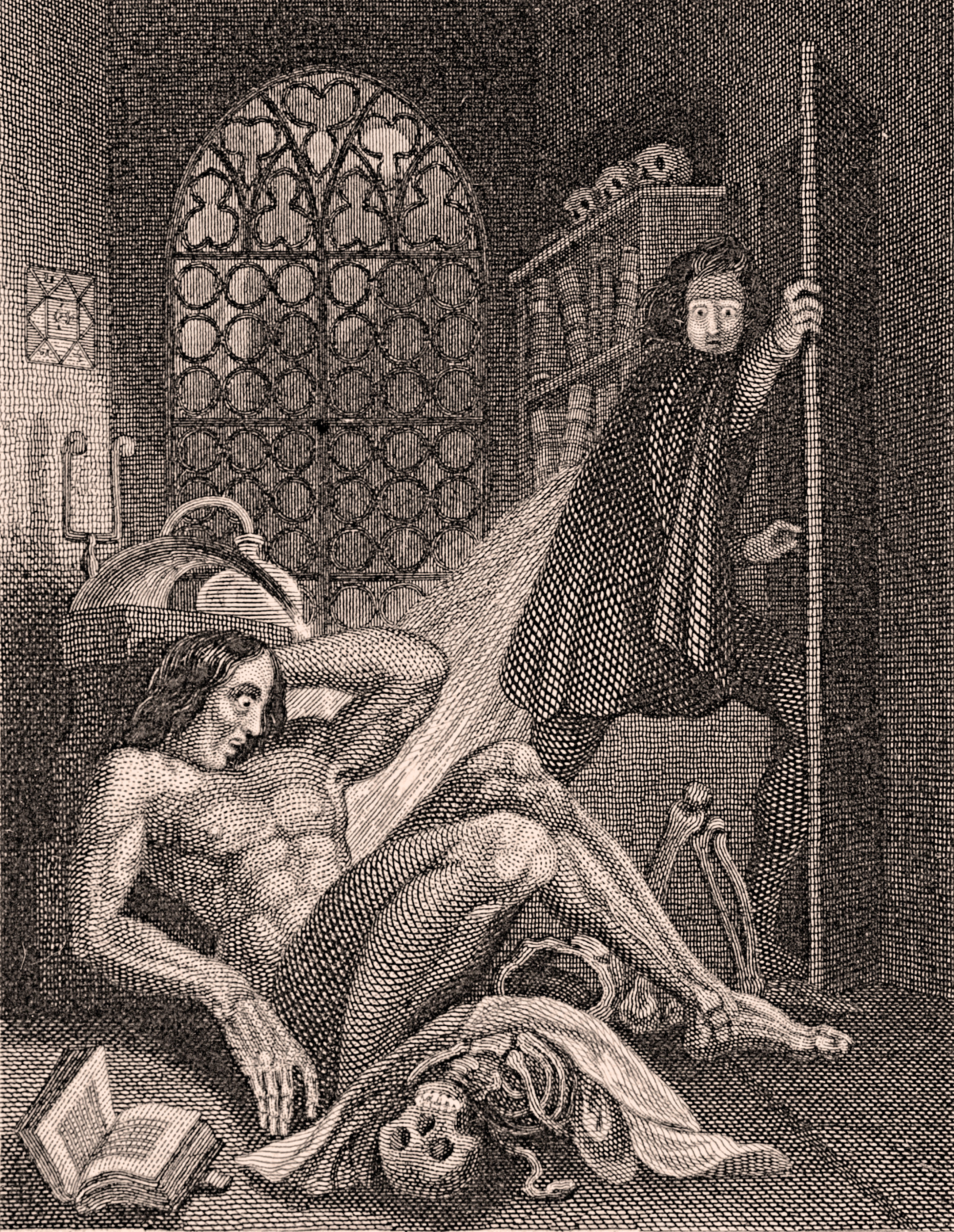
In light of this, it's interesting to look at the first ever depiction of the Monster, an engraving created for the 1831 publication by the truly great and shamefully undervalued artist Theodor von Holst.


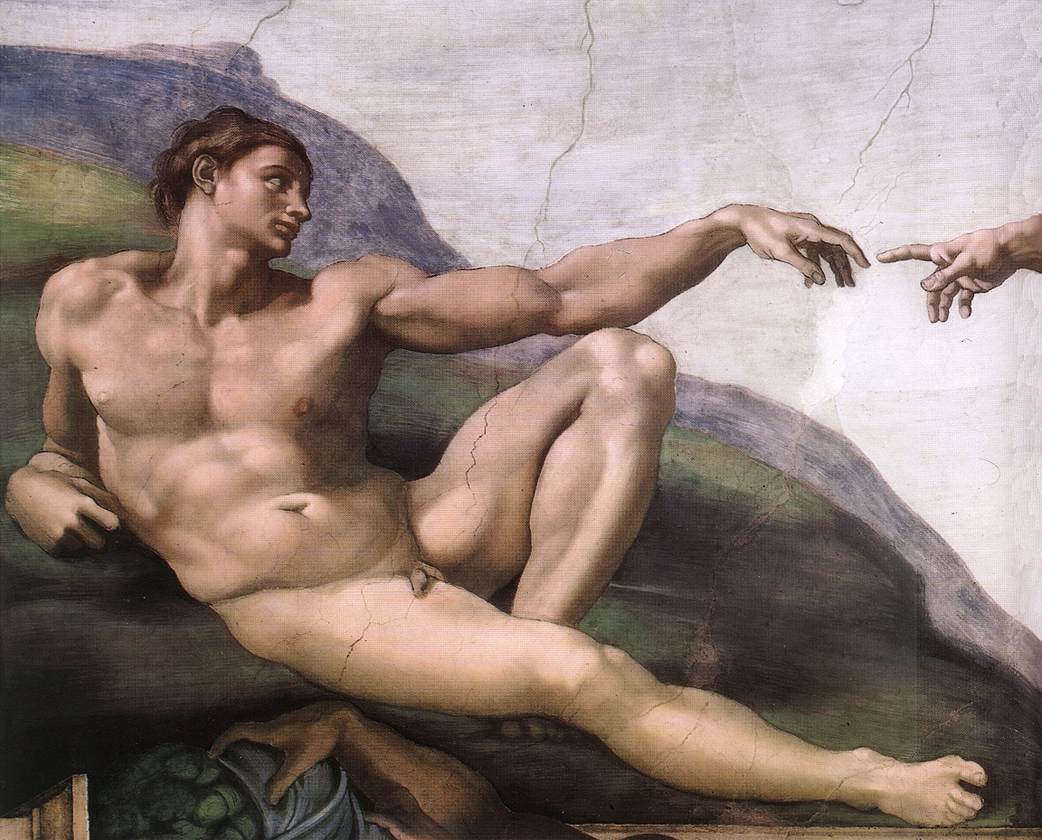
And to compare it to another famous image of a newly created man...


There's more than a slight resemblance.  Adam, of course, doesn't have to take in the sight of his creator's eyes wide with horror as they look upon him... not just yet anyways.

There's no reason to think von Holst didn't take direct inspiration from Michaelangelo.  Holst was a Romantic with a love of the gothic and the supernatural, but it would be a mistake to think of Romanticism and the gothic as a repudiation of the classical, just as it would be wrong to think of Modernism as a repudiation of Expressionism (which horror films like The Bride of Frankenstein illustrate well enough). 

Holst studied under Fuseli, who painted Mary Shelley's mother Mary Wollstonecraft, the great feminist and author of Vindication of the Rights of Woman, who died a little more than a week after giving birth to the future author of Frankenstein.  

Holst was also the great uncle of the composer Gustav Holst, who wrote The Planets suite, which includes a movement entitled 'Mars, the Bringer of War', routinely used directly in sci-fi (Quatermass) or as inspiration for sci-fi music, including Peter Howell's music for 'The Leisure Hive'.  This is perfectly fitting because The War of the Worlds by H. G. Wells is (like Mary Shelley's Frankenstein) one of the foundational texts of science-fiction, thus trading on the percieved connection between Mars and war and translating this into the context of the nascent 'alien invasion' sub-genre.  (As everyone knows, War of the Worlds was dramatised for the radio by Howard Koch and performed by Orson Welles' and John Houseman's Mercury Theatre of the Air, causing widespread panic in America upon the eve of Hallowe'en in 1938.)  It's also fitting because The Planets is a synthesis of astrological notions and musical modernism, which strikes me as pleasingly analagous to my idea that sci-fi is a reiteration of myth and legend in the idioms of the technological age.

The Mercury Theatre broadcast (which featured George Colouris, who would later be cast by Welles as Mr Thatcher in Citizen Kane... and would later go on to even greater achievements, playing Arbitan in 'The Keys of Marinus') is supposed to have had such an amazing effect partly because the American people were skittishly aware that they were on the brink of entering World War II.  Holst's 'Mars, The Bringer of War' takes something of its terrific and stentorian power from the fact that it was written during World War I, during the period when people gradually became aware that the 'Great War' was a horrifying scrabble for muddy and blood-soaked land, with bodies ploughed under barbed wire by great, rolling, implacable, metal monsters called tanks.

Tanks looked like the machines of the future.  They were.  They were the final death knell of the pre-capitalist society.  Bayonets gave way to steel behemoths.  Industry and technology could now make things like that: inhuman, unstoppable, alien, seemingly out of human control.  The trauma of them still echoes through Western culture, with the Daleks themselves partly confected from the memory of these utterly inhuman, bolted, riveted, armour plated, gun-sprouting war monsters. 

Of course, part of the peculiar power of Frankenstein lies in the fact that the Monster is something man made.  He is a product.  An artifact of human creativity and labour.  The Universal version even has dirty great bolts sticking out of his neck, just to emphasize his status as a cyborg (like a Cyberman or a Dalek), as a thing made of bits and pieces, like a car made from parts on a production line.  Frankenstein's monster is the first great monster of Western culture that is made, that is something that humans have fabricated and constructed ourselves.  Instead of encountering it as a hostile part of the landscape, like a predator, we place it in the landscape, and our treatment of it makes it our enemy.  The book expresses a moment in Europe when science was on the rise, when Enlightenment and Reason had become both causes and dogmas.  It was all to do with the slow, lingering death of feudalism and the slow, inexorable rise of capitalism.  It's a big topic, but thinkers from Rousseau to Mary's own father had confronted the old order (Things as They Are, to use the alternative title of Godwin's novel Caleb Williams, a bitter and radical condemnation of the power of aristocracy) with what they conceived of as Reason.  Mary's book is also partly a rebuke to this.  The child of Reason, the product of the new and scientific and sacriligious man, the product of the age of bourgeois production, is a monster that becomes the victim of the flaws in the creator's project and then comes back for revenge.  And breeds.  Tanks breed.  Bombs breed.  Cars breed.  Toys breed.  We have to make them, but they hardly seem like ours at all.  We don't control them.  Or our control becomes more and more remote.  The product of the new age ultimately gives the lie to the ideals of liberty and justice.  Like the tank that is created by capitalism to fight wars for freedom and peace... by bulldozing the bullet-riddled corpses of kids into the mud.

(The solution to this riddle is to be found in the work of Mary's husband Percy, who - in his unsure and unreliable way - was a radical who understood that the people are the ones who have to enforce change, and that that change can be a monster itself rather than a graceful victory for Reason.  In Prometheus Unbound - those Romantics loved Prometheus... Frankenstein's alt title was The Modern Prometheus - Shelley writes of Demogorgon, the monster that can be invoked to destroy tyranny.  Demogorgon.  The Peoplemonster.)

But back to the problem, as identified.  The products that turn.  Marx called capital (the product of human labour appropriated and confronting us as hostile and alien) a vampire.  Mary Shelley had the product of the work of the scientist become a murderous reproach to him.  We still routinely invoke the word "monster" when talking about such products.  We need the language of monsters.

And this just may be a central concern of sci-fi, including Doctor Who.  Voc Robots are created things that turn against us, products that kill.  Xoanon.  The Oracle.  B.O.S.S.  The Peking Homunculus.  WOTAN and his War Machines.  Autons.  Daleks and Cybermen are created things too, half organism and half machine.  Killing machines with people trapped inside somewhere.  Many Doctor Who monsters (more than you'd think) turn out to be created things, or partly created things.  The Ice Warriors have visors and guns integrated in their shells; the Sontarans are clones; the Zygons live on the milk of a cyborg monster.  They're all, partly, the deformed and disowned children of Frankenstein.

Of course, there's a more direct child.  Morbius.  Solon is the mad scientist, living in the castle with the deformed servant, listening to the thunder as he plots to reanimate a criminal (by probing the rectum?), scheming to make a monster from scavanged bits and pieces, ultimately turned upon by his creation, hunted down by torch-weilding locals, etc.  But that's got much more to do with the movies - Universal and Hammer - than it has to do with Mary Shelley.  Even the Sisterhood come from Rider Haggard via Hammer.   

Doctor Who is itself Frankenstein's monster, made of scavanged and second-hand bits and pieces.

That's why its amusing to think of the Character Options toys that so many of us Who fans collect (no doubt made with oil that has to be controlled through invasions of which many of us disapprove).  We're like Dr Pretorius, playing with his little people in jars.  Gods playing with our monsters.  Just make sure you keep the lid on the jar with Cpt. Harkness in it... unless you want your little people to breed.

Anyway, I'm tired of all this brainstorming.  Hallowe'en is over.

Good night.  If you can.