Yes, I'm on Pex Lives again. (I know, it seems like I'm trying to invade the podcast... but you have to remember that, from the point of view of me and Kevin and James, the last one I did was in June.)
This time I'm guesting in a special Christmas bonus episode alongside Gene Mayes, and chatting about the Hammer Frankenstein movies. Download it here.
This is a good, fun episode... and I think I'm better on this than I was on the last one (more relaxed, as James noticed).

ideas are icepickproof
Showing posts with label frankenstein. Show all posts
Showing posts with label frankenstein. Show all posts
Friday, 12 December 2014


Monday, 1 December 2014
Monsterism
In his famous essay 'The Dialectic of Fear' (published in New Left Review #136, Nov-Dec 1982) Franco Moretti used Marxist and Psychoanalytic criticism to provide a coruscating account of the twin monsters of bourgeois culture: Dracula and Frankenstein.
The entire essay is well worth reading and is findable online if you hunt about. Here are some of the best bits about Frankenstein (the book):
and...
I have some issues with Moretti here. He uses the word 'lies' to describe Victor's supposedly inaccurate descriptions of the monster as beautiful. But, firstly, we are confusing perception with reality. Victor perceives his construction as beautiful because he attempts to construct it according to implicitly classical notions of beauty (note the key word "proportion", and remember that original woodcut which depicts the monster as a giganticised and jumbled reiteration of Michaelangelo's newly-created Adam)... but there is no guarantee that things that accord with classical notions of proportion will actually be beautiful. Rather, beauty is concept we have mapped onto certain stereotypical physicalities which stem from a bastardized and historically re-written version of classicism, recast in terms of 18th and 19th century bourgeois prejudices. It is profoundly local - historically, geographically, socially and ideologically. It is implicitly tied in with notions of 'health' which stem from the privileged lives of the rich (smooth skin, for example), and which later get appropriated by reductionist Darwinian ideologies which link beauty with 'fitness'... a set of notions still widely repeated by today's biological determinists. It would be perfectly possible to construct something according to abstract classical (or pseudo-classical) notions of beauty that turned out hideous and terrifying to the beholder. Just imagine actually meeting Michaelangelo's David in the street.
But this leads us to another issue. As stated, we're talking about Victor's perceptions. What seemed beautiful to him in conception, in theory, during construction, in isolated parts, could well seem ghastly in totality. Or perhaps the totality of the final creation simply brings home to Victor the ramifications of what he has done. He has created something which now has seperate existence, seperate power, autonomy and selfhood. When he looks at it as another person as opposed to a plan or a set of pieces to be assembled, he suddenly finds it frightening. This actually fits better with Moretti's conception of the monster as a proletariat in singular, as terrifying because the creator perceives it as his potential gravedigger. Like many creators of actual proletarian populations, Victor the bourgeois looks at what he has created and, in place of the vast reservoir of ready and eager and docile and easily-exploited labour that he planned, he sees something terrifyingly dangerous precisely because of its autonomy.
This in turn leads to another issue. In the preceding quoted paragraph, Moretti is talking about the bourgeois conception of the lower orders as hideously unequal or inferior. He implies a relation between this (which found itself expressed in Darwinian reductionist narratives about degraded 'types' or 'natural lower orders') and between the racial narrative of capitalism. But he seems to be flailing about for a psychological rationale for racism as a response to the horror of the subjected object. But the process of 'race making', in which the bourgeois social order constructs the ideology of biological race (and thus of biological racism) as a justification for racially-ordered systems of labour exploitation, i.e. slavery and the slave trade, is a fair bit more material than that. Furthermore, the psychological aspect (which is definitely present) is based not on horror at the subject but on the need to confront a living subject and make it an object that is horrifying, and thus subjectable. To turn workers who are black into 'negro slaves' for instance, from people who are being exploited into monsters who deserve no better. Moretti misses the extent to which race is ideologically constructed, and the extent to which it thus filters into perceptions. He puts it the wrong way round, or seems to. Having constructed the ideology of racial orders, the system then creates consciousness in people which causes them to perceive racial difference that is not, as we now know, actually existing in nature. There are no 'races', and we construct them out of ideology which acts upon our perceptions of ethnic variations. This, it seems to me, is actually directly mirrored in Victor's sudden perception of his new creation as ugly. He looks at it and called it beautiful, then looks again and perceives it as ugly - which is to say, as Moretti points out, as racially 'other'. And the only change is a material one. The creature is now alive. He made it ugly because it came alive and its disavowal needed an ideological justification. Victor, in effect, 'makes' a race in two senses. He runs the risk of creating a 'race of devils' in the sense of creating a new breed among humans. But this is the diegetic sense that he, the character, perceives and believes. Beneath that, there is Victor as a textual reification of ideological maneuvres. In that sense, what he's actually doing is 'race making'. He is superimposing an ideology of racial difference and hierarchy upon a 'wretch' that he deems inferior because it is both his slave and his potential gravedigger. Its status as a living thing makes this ideologically necessary. That other people perceive the monster in essentially the same way only speaks to the universality of the ideology of race once constructed.
Moretti goes on to recognise something of the instability of some of those aforementioned bourgeois conceptions of beauty, and to bring in the artificiality of race, in the following passage - which is also a neat demonstration of the Marxist insight that progress and barbarism are forever intertwined, to the extent that they are essentially the same thing:
Mary Shelley became something of a reactionary in later life. Despite being a radical critique of the Enlightenment project and the dawning Industrial Revolution, Frankenstein is a book with more than a seed of the reactionary nestling within it. Like many from the early years of capitalism who disapproved of the new system in some measure, she is in many respects essentially a conservative. Shakespeare, writing at the very dawn of the Early Modern Era, at the fulcrum of the transition from fedualism to capitalism, is highly critical of many aspects of the emergent bourgeois culture (along with being irresistibly attracted to them) but his criticism takes the form of an essentially conservative attachment to pre-bourgeois ideas of social obligation. Capitalism detaches pre-capitalist people from old and established ties of obligation which constitute the social structure of fedualism. He sympathises with shepherds leading newly precarious lives in the Forest of Arden after the enclosures, but he also worries about the fickleness of the new urban proles (so like the vicious Roman mob!), and so on. Timon rages at money the universal whore, the utterly faithless golden metaphor which, in the bourgeois system, breaks down all loyalties and moral certainties... and yet Shakespeare's solution is for the classical virtues to be imposed by martial law in the person of Alcibiades. In the same way, Mary Shelley frets at the emergence of the new bourgeois product - so powerful, so autonomous - and the newly forming proletariat - so powerful, so autonomous - even as she rails at the failure of social justice contained within the new system. The book is a critique from a radical position but also from a privileged one. Shelley sees the ruthless failure of tolerance and compassion and social justice which is contained within these new phenomena. The Enlightenment project will fail if it is not cared for and nurtured, and justice is the most essential pre-requisite... and that justice is being denied. But, even as she rails at justice denied, she frets at the revenge of history. This is perfectly in line with the reservations of Mary's father, Godwin, who wants reform through fireside chats with the educated, and her radical boyfriend-later-husband, Percy Shelley, who flip-flops back-and-forth between foaming revolutionism and elitest worrying about the ignorant mob.
But, in some ways, Mary goes further. Frankenstein is almost a declaration that the entire project - not just reform but capitalism itself - is doomed to failure. This is not a categorical judgement. There are countervailing tendencies in this book and others she wrote. She was always profoundly ambivalent about Romanticism and the Enlightenment - something that makes her such a fascinating liminal figure in her milieu. But it seems that, for her, the monstrous nature of the products - be they machines or classes - dooms them to forever be denied justice and responsible use. Without the perspective of class struggle, she doesn't see the possibility that the new class could remake the world. She does, however, see 'the common ruination of the contending classes'. But she lived before capitalism had spread across the globe and taken over. To her, it's not too late for the world to go back to how it was before, once those warring opposites kill each other. Frankenstein and the monster destroy each other. They both die without issue. The 'race of devils' is never spawned. As Moretti points out, Frankenstein has no way of utilising the creature because capital is erased from the picture. There are no factories for it and its kin to work in. It is never cconceived of as productive, or as having utility. Mary Shelley turns the two men - and Capital and Labour - into a doomed fable.
These days, the end of the world is now proverbially known to be easier to imagine than the end of capitalism. To Mary Shelley, it was decidedly the other way round.
(Edited and slightly amended, 18/3/15.)
The entire essay is well worth reading and is findable online if you hunt about. Here are some of the best bits about Frankenstein (the book):
Like the proletariat, the monster is denied a name and an individuality. He is the Frankenstein monster; he belongs wholly to his creator (just as one can speak of 'a Ford worker'). Like the proletariat, he is a collective and artificial creature. He is not found in nature, but built. Frankenstein is a productive inventor-scientist...). Reunited and brought back to life in the monster are the limbs of those - the 'poor' - whom the breakdown of feudal relations has forced into brigandage, poverty and death. Only modern science - this metaphor for the 'dark satanic mills' - can offer them a future. It sews them together again, moulds them according to its will and finally gives them life, But at the moment the monster opens its eyes, its creator
draws back in horror: 'by the glimmer of the half-extinguished light, I saw the dull yellow eye of the creature open; . . . How can I describe my emotions at this catastrophe . . . ?'
Between Frankenstein and the monster there is an ambivalent, dialectical relationship, the same as that which, according to Marx, connects capital with wage-labour. On the one hand, the scientist cannot but create the monster: 'often did my human nature turn with loathing from my occupation, whilst, still urged on by an eagerness which perpetually increased, I brought my work near to a conclusion'. On the other hand, he is immediately afraid of it and wants to kill it, because he realizes he has given life to a creature stronger than himself and of which he cannot henceforth be free. ... The fear aroused by the monster, in other words, is the fear of one who is afraid of having 'produced his own gravediggers'.
and...
'Race of devils': this image of the proletariat encapsulates one of the most reactionary elements in Mary Shelley's ideology. The monster is a historical product, an artificial being: but once transformed into a 'race' he re-enters the immutable realm of Nature. He can become the object of an instinctive, elemental hatred; and 'men' need this hatred to counterbalance the force unleashed by the monster. So true is this that racial discrimination is not superimposed on the development of the narrative but springs directly from it: it is not only Mary Shelley who wants to make the monster a creature of another race, but Frankenstein himself. Frankenstein does not in fact want to create a man (as he claims) but a monster, a race. He narrates at length the 'infinite pains and care' with which he had endeavoured to form the creature; he tells us that 'his limbs were in proportion' and that he had 'selected his features as beautiful'. So many lies -- in the same paragraph, three words later, we read: 'His yellow skin scarcely covered the work of muscles and arteries beneath; his hair was of a lustrous black, and flowing; his teeth of a pearly whiteness; but these luxuriances only formed a more horrid contrast with his watery eyes. . . . his shrivelled complexion and straight black lips.' Even before he begins to live, this new being is already monstrous, already a race apart. He must be so, he is made to be so -- he is created but on these conditions. There is here a clear lament for the feudal sumptuary laws which, by imposing a particular style of dress on each social rank, allowed it to be recognized at a distance and nailed it physically to its social role. Now that clothes have become commodities that anyone can buy, this is no longer possible. Difference in rank must now be inscribed more deeply: in one's skin, one's eyes, one's build. The monster makes us realize how hard it was for the dominant classes to resign themselves to the idea that all human beings are - or ought to be - equal.
I have some issues with Moretti here. He uses the word 'lies' to describe Victor's supposedly inaccurate descriptions of the monster as beautiful. But, firstly, we are confusing perception with reality. Victor perceives his construction as beautiful because he attempts to construct it according to implicitly classical notions of beauty (note the key word "proportion", and remember that original woodcut which depicts the monster as a giganticised and jumbled reiteration of Michaelangelo's newly-created Adam)... but there is no guarantee that things that accord with classical notions of proportion will actually be beautiful. Rather, beauty is concept we have mapped onto certain stereotypical physicalities which stem from a bastardized and historically re-written version of classicism, recast in terms of 18th and 19th century bourgeois prejudices. It is profoundly local - historically, geographically, socially and ideologically. It is implicitly tied in with notions of 'health' which stem from the privileged lives of the rich (smooth skin, for example), and which later get appropriated by reductionist Darwinian ideologies which link beauty with 'fitness'... a set of notions still widely repeated by today's biological determinists. It would be perfectly possible to construct something according to abstract classical (or pseudo-classical) notions of beauty that turned out hideous and terrifying to the beholder. Just imagine actually meeting Michaelangelo's David in the street.
But this leads us to another issue. As stated, we're talking about Victor's perceptions. What seemed beautiful to him in conception, in theory, during construction, in isolated parts, could well seem ghastly in totality. Or perhaps the totality of the final creation simply brings home to Victor the ramifications of what he has done. He has created something which now has seperate existence, seperate power, autonomy and selfhood. When he looks at it as another person as opposed to a plan or a set of pieces to be assembled, he suddenly finds it frightening. This actually fits better with Moretti's conception of the monster as a proletariat in singular, as terrifying because the creator perceives it as his potential gravedigger. Like many creators of actual proletarian populations, Victor the bourgeois looks at what he has created and, in place of the vast reservoir of ready and eager and docile and easily-exploited labour that he planned, he sees something terrifyingly dangerous precisely because of its autonomy.
This in turn leads to another issue. In the preceding quoted paragraph, Moretti is talking about the bourgeois conception of the lower orders as hideously unequal or inferior. He implies a relation between this (which found itself expressed in Darwinian reductionist narratives about degraded 'types' or 'natural lower orders') and between the racial narrative of capitalism. But he seems to be flailing about for a psychological rationale for racism as a response to the horror of the subjected object. But the process of 'race making', in which the bourgeois social order constructs the ideology of biological race (and thus of biological racism) as a justification for racially-ordered systems of labour exploitation, i.e. slavery and the slave trade, is a fair bit more material than that. Furthermore, the psychological aspect (which is definitely present) is based not on horror at the subject but on the need to confront a living subject and make it an object that is horrifying, and thus subjectable. To turn workers who are black into 'negro slaves' for instance, from people who are being exploited into monsters who deserve no better. Moretti misses the extent to which race is ideologically constructed, and the extent to which it thus filters into perceptions. He puts it the wrong way round, or seems to. Having constructed the ideology of racial orders, the system then creates consciousness in people which causes them to perceive racial difference that is not, as we now know, actually existing in nature. There are no 'races', and we construct them out of ideology which acts upon our perceptions of ethnic variations. This, it seems to me, is actually directly mirrored in Victor's sudden perception of his new creation as ugly. He looks at it and called it beautiful, then looks again and perceives it as ugly - which is to say, as Moretti points out, as racially 'other'. And the only change is a material one. The creature is now alive. He made it ugly because it came alive and its disavowal needed an ideological justification. Victor, in effect, 'makes' a race in two senses. He runs the risk of creating a 'race of devils' in the sense of creating a new breed among humans. But this is the diegetic sense that he, the character, perceives and believes. Beneath that, there is Victor as a textual reification of ideological maneuvres. In that sense, what he's actually doing is 'race making'. He is superimposing an ideology of racial difference and hierarchy upon a 'wretch' that he deems inferior because it is both his slave and his potential gravedigger. Its status as a living thing makes this ideologically necessary. That other people perceive the monster in essentially the same way only speaks to the universality of the ideology of race once constructed.
Moretti goes on to recognise something of the instability of some of those aforementioned bourgeois conceptions of beauty, and to bring in the artificiality of race, in the following passage - which is also a neat demonstration of the Marxist insight that progress and barbarism are forever intertwined, to the extent that they are essentially the same thing:
But the monster also makes us realize that in an unequal society they are not equal. Not because they belong to different 'races' but because inequality really does score itself into one's skin, one's eyes and one's body. And more so, evidently, in the case of the first industrial workers: the monster is disfigured not only because Frankenstein wants him to be like that, but also because this was how things actually were in the first decades of the industrial revolution. In him, the metaphors of the critics of civil society become real. The monster incarnates the dialectic of estranged labour described by the young Marx: 'the more his product is shaped, the more misshapen the worker; the more civilized his object, the more barbarous the worker; the more powerful the work, the more powerless the worker; the more intelligent the work, the duller the worker and the more he becomes a slave of nature. . . . It is true that labour produces . . . palaces, but hovels for the worker. . . . It produces intelligence, but it produces idiocy and cretinism for the worker.' Frankenstein's invention is thus a pregnant metaphor of the process of capitalist production, which forms by deforming, civilizes by barbarizing, enriches by impoverishing -- a two-sided process in which each affirmation entails a negation. And indeed the monster - the pedestal on which Frankenstein erects his anguished greatness - is always described by negation: man is well proportioned, the monster is not; man is beautiful, the monster ugly; man is good, the monster evil. The monster is man turned upside-down, negated. He has no autonomous existence; he can never be really free or have a future. He lives only as the other side of that coin which is Frankenstein. When the scientist dies, the monster does not know what to do with his own life and commits suicide.
Mary Shelley became something of a reactionary in later life. Despite being a radical critique of the Enlightenment project and the dawning Industrial Revolution, Frankenstein is a book with more than a seed of the reactionary nestling within it. Like many from the early years of capitalism who disapproved of the new system in some measure, she is in many respects essentially a conservative. Shakespeare, writing at the very dawn of the Early Modern Era, at the fulcrum of the transition from fedualism to capitalism, is highly critical of many aspects of the emergent bourgeois culture (along with being irresistibly attracted to them) but his criticism takes the form of an essentially conservative attachment to pre-bourgeois ideas of social obligation. Capitalism detaches pre-capitalist people from old and established ties of obligation which constitute the social structure of fedualism. He sympathises with shepherds leading newly precarious lives in the Forest of Arden after the enclosures, but he also worries about the fickleness of the new urban proles (so like the vicious Roman mob!), and so on. Timon rages at money the universal whore, the utterly faithless golden metaphor which, in the bourgeois system, breaks down all loyalties and moral certainties... and yet Shakespeare's solution is for the classical virtues to be imposed by martial law in the person of Alcibiades. In the same way, Mary Shelley frets at the emergence of the new bourgeois product - so powerful, so autonomous - and the newly forming proletariat - so powerful, so autonomous - even as she rails at the failure of social justice contained within the new system. The book is a critique from a radical position but also from a privileged one. Shelley sees the ruthless failure of tolerance and compassion and social justice which is contained within these new phenomena. The Enlightenment project will fail if it is not cared for and nurtured, and justice is the most essential pre-requisite... and that justice is being denied. But, even as she rails at justice denied, she frets at the revenge of history. This is perfectly in line with the reservations of Mary's father, Godwin, who wants reform through fireside chats with the educated, and her radical boyfriend-later-husband, Percy Shelley, who flip-flops back-and-forth between foaming revolutionism and elitest worrying about the ignorant mob.
But, in some ways, Mary goes further. Frankenstein is almost a declaration that the entire project - not just reform but capitalism itself - is doomed to failure. This is not a categorical judgement. There are countervailing tendencies in this book and others she wrote. She was always profoundly ambivalent about Romanticism and the Enlightenment - something that makes her such a fascinating liminal figure in her milieu. But it seems that, for her, the monstrous nature of the products - be they machines or classes - dooms them to forever be denied justice and responsible use. Without the perspective of class struggle, she doesn't see the possibility that the new class could remake the world. She does, however, see 'the common ruination of the contending classes'. But she lived before capitalism had spread across the globe and taken over. To her, it's not too late for the world to go back to how it was before, once those warring opposites kill each other. Frankenstein and the monster destroy each other. They both die without issue. The 'race of devils' is never spawned. As Moretti points out, Frankenstein has no way of utilising the creature because capital is erased from the picture. There are no factories for it and its kin to work in. It is never cconceived of as productive, or as having utility. Mary Shelley turns the two men - and Capital and Labour - into a doomed fable.
These days, the end of the world is now proverbially known to be easier to imagine than the end of capitalism. To Mary Shelley, it was decidedly the other way round.
(Edited and slightly amended, 18/3/15.)
Wednesday, 23 October 2013
Maximum Utility
The literature of terror is born precisely out of the terror of a split society and out of the desire to heal it.
- Franco Moretti
People often compare the Borg, the cyborg gestalt from the Star Trek franchise, to Doctor Who's Cybermen. Both races were conceived as humanoids physically augmented with technology, hence a certain superficial visual resemblance, particularly between the Borg and the earliest Cybermen, from 1966's 'The Tenth Planet'... which has just been released on DVD, if you want some way for this post to be halfway relevant to anything.
 |
| Borg |
 |
| Cyberman |
Even so, the similarity of the Cybermen and the Borg is real, and rests upon kindred incoherent anxieties about capitalism.
1.
There's a real incoherence at the heart of the Cybermen. They are definitely communistic monsters, expressing a 'Soviet-version' of the associations between the loss of individuality and collectivism. They seek the total upgrade of the universe, working towards a chilly utopian telos lacking any inequality or freedom. But they are also deeply corporate monsters. They merged or allied themselves with International Electromatics in 'The Invasion'. IE was an expression of capitalist standardisation and mass production. Everything they make is the same, from their disposable radios to their CEO's offices. This is explicitly linked to capitalist production and business practices, and is implicitly linked with the uniformity of the Cybermen.
 |
| Someone's not a very efficienct typist. |
In many ways, the alliance between Tobias Vaughn and the Cybermen is a business partnership, with the invasion a hostile takeover. The partnership is possible because, in Vaughn's ultra-streamlined corporate context, there is a synergy with the Cybermen. In the new series, the alt-world Cybermen actually emerged from a corporation, Cybus Industries. They were a Cybus product, complete with a corporate logo on their chests. (With their divided nature, it's fitting that they take over Battersea Power Station, which began life as a venture of a private company, got nationalised and then closed down, and has since been waiting for a private venture to find a use for it.) The Cybus-Cybermen are linked with the internet, computer software and mobile phone technology, even acquiring the concept of conversion as an "upgrade" which expresses deep ambivalence about the frenetic rush of capitalist technology in the digital age, and the word "delete" (an everyday word now owing to home computing and text messaging) as a euphemism for 'kill'. Moreover, as Simon Kinnear pointed out in Doctor Who Magazine #410 (June 2009), the Cybermen behave like the psychopathic corporation described by the 2003 documentary film The Corporation, and the accompanying book by Joel Bakan. More than this, the Cybermen
conform to the lean mentality of business. Like so many companies, they use aptitude tests to secure the best candidates for Cyber-conversion: what else are the Tombs of Telos but a (somewhat unusual) recruiting station? The Cybermen's standardised functions sound suspiciously like a corporate hierarchy, with job titles (Controller, Leader) to match.
 |
| Yes, I'll go on the record: I quite like this. |
2.
I've written here about how the Cybermen are a Soviet version of the same set of associations that make the (Nazi) Daleks tick: namelessness, robotic/cyborg nature, collectivism, 'totalitarianism'. It's intially tempting to simply characterise the Borg as also an expression of the bourgeois liberal horror of collectivism, or of the widespread mainstream idea of collectivism, i.e. of communism. However, the Borg share much the same ambivalence as that already detected in the Cybermen. Indeed, in many ways, they express the same ambivalence much more clearly and completely.
 |
| You will be assimilated. Your culture will adapt to service ours. |
There is a deep sense of ambivalent confusion embodied within the Borg. While they undoubtedly speak to the horror of collectivism as widely perceived (loss of individual freedom, political tyranny, etc.) they also represent a lurking horror of capitalist rationality, of rationally self interested utility maximisers This is the de facto herd of individual rational actors who are supposed to make up the population in mainstream economics, all of them seeking their own rational self interest and thus giving rise to an unstoppable (and, for the late C20th left/liberal, sometimes destructive) market system. It isn't necessary for us to accept the scandalously absurd descriptions of capitalism offered by mainstream economics to acknowledge that many people do accept them, worry about them, or about what they perceive to be their effects. If our culture doesn't really run on rational self-interest and maximised utility, that doesn't mean that people can't perceive ruthlessly rational self-interest and utility maximisation in the system... and fear them.
Sometimes people fear the effects of capitalism and perceive then as the effects of what they think of as socialism. Such people are a constant source of titilated anxiety for liberals, as the obsession of American liberal publications with the Tea Party shows.
 |
| I didn't know this, but apparently Barack Obama is a Marxist. He's also black, which seems to worry some people. |
The fear of such mentalities usually coincides with an idea that they float freely in a society that is split, but not fundamentally divided on lines of class. Thus, the acceptance of anti-social ideas - or the pushing of rational ideas to anti-social extremes - is something that happens within decentralised pluralities. This liberal fear is of dangerous ideas spreading virally through society. The memetic view of religion pushed by Richard Dawkins is an example, albeit an example of dangerous 'irrationality'... but then, for Dawkins, it is the genes or memes which are the selfish rational actors, not the people who carry them... thus making the people a bit like drones. These kinds of fears are always tied to a fear of the decentralised crowd: the 'mob', in one form or other. Look at the view of consumerism that sees it as a kind of emotional disease which has infected all of 'us'. What is that but a fear of the decentralised crowd, mobilised en masse by a dangerously selfish rationale of consumption? This left/liberal complaint rests upon assumptions based in, or at least supported by, mainstream economics: that the movements of the market are determined on a large scale by the trends created by the small scale rational choices of selfish actors. This very decentralised crowd - an orderly mob - is the personality of the original Borg.
One essential trait of capitalism is the impulse to turn everything into more capitalism. It exists to convert all resources into commodities or productive forces, i.e. to turn everything into capital which then dominates further production, to assimilate everything and convert everything into itself. It is, as Q called the Borg in their debut, "the ultimate user", going after everything it identifies as something it can consume, utilise, transform and make into an image or aspect of itself. You don't have to be a Marxist to notice the ravenousness of the system. Indeed, non-Marxist currents of left/liberal thought in the 90s - often very much the same currents that were working out theories of consumerism - developed this idea further than the moribund, disoriented Marxism that was clinging on (at the extreme margins) at the time. (There is also the left/liberal unease at the Western cultural imperialism, itself piggybacking on neoliberal expansion in new markets... just look at the above image of the McDonalds in Moscow, an emblem of such processes in the 90s. The worry is about the assimilation and homogenization of other cultures. The relevance of this is obvious.)
It isn't necessary to accept as true the notion that the market 'works' because of atomised individuals flocking in formations of rational selfishness, or the details of the attendant left/liberal critique of consumerism, in order to see how these ideas - if accepted - might become a source of anxiety to liberals within a triumphant capitalist world. We can see how such liberal anxities - about an all-conquering capitalism, newly unrestrained, ravenous and consumerist, fueled by a dangerously selfish form of rationality which supposedly permeates society in a decentralised way - might well manifest as something like the Borg... something unstoppable, ruthlessly utilitarian, utterly self-involved, blankly arrogant, destructive, acquisitive and all-consuming, and manifested as a monolithic force composed of an aggregation of atomised individuals.
Liberalism - particulary C20th Liberalism - has always had the divided character that both supports capitalism, and capitalist notions, as liberating or at least optimal, while at the same time fretting over the imbalances, inequalities and injustices which seem - puzzlingly - always to beset the system. Liberalism in the 90s was uniquely placed to have bad dreams about this contradiction, about the horrors lurking within the best of all possible worlds, precisely because of the seeming final triumph of the 'market system'.
Speaking of liberal bad dreams, just look at the 'Descent' two-parter, which becomes a clunky parable about the rise of fascism (complete with red, white and black banners) by showing the disoriented, individualised Borg spellbound by a charismatic warmonger who offers them unity and purpose. Hands up anyone who spots the contours of the classic liberal interpretation of the rise of Hitler. The bewildered people, dizzy after a catastrophe, become mesmerised by the false promises of a demagogue. Here again, the Borg express liberal anxieties about the faultlines in the capitalist millenium.
The Borg are a nightmare that liberal capitalism had about itself.
This is, of course, why the Borg are a dark mirror held up to the Federation. If the Federation is the ultimate flowering of liberal hopes for capitalism (or, at least, Western liberal modernity) as a liberating, utopian force, then the Borg are the atavistic 'dark side' of the same system, repressed but - in the classic gothic move - returning with a vengeance.
3.
Gothic is, of course, very much the word. It can hardly be a coincidence that, as they evolve, the Borg develop features of previous such liberal nightmares about capitalism.... and that these features make them more and more openly gothic. They acquire the decadence of aristocracy, and with it the traits of vampires. The Borg gradually became the nomadic nosferatus of the Trek universe, spreading their plague with a bite and an infection of the blood. From Star Trek: First Contact onwards (i.e. from the moment they are shown to have a Queen), they are shown to shoot tubes into the neck (often leaving two little puncture marks) and assimilate by pumping Borg nanotech into the veins, which are often seen to ripple and turn greyish green beneath the skin as Borgness (i.e evil) flows into them. They become the Undead, the moment they start being lead by Countess Dracula.
This can hardly be an accident, this confluence of vampirism and aristocratic hierarchy. The greatest C19th Gothic vampire story - Dracula - traded on the disdainful, fearful, insecure, resentful, supercilious inferiority-complex felt by a rising professional middle class for aristocracy, something that Stoker took from the iconoclastic Byron's 'Lord Ruthven' and which ended up getting taken up by C20th vampire pop-culture. The vampire is nowadays quite unpicked from his/her previous semiotic entanglement with aristos, when he/she appears in his/her own person (the semiotic entanglement of female vampires with lesbianism is a whole different essay). Your actual fanged, blood-drinking coffin-sleeper can be an emo youth these days. But when vampirism is subtextually invoked in a disguised form - as in the later Borg - it also tends to bring its blue-blooded baggage with it, albeit in submerged ways. Hence, the Borg get a Queen when they get vampiric. (Of course, the Queen also comes from the bee-hive analogy... which is part of the 'surface level' of the semiotics of the Borg, the thematic miniscus that the writers consciously 'get'.)
Also, as has long been understood, the vampire is connected to fears of monopoly capital vs free trade. What can be more monopolistic than the vampire, converting everyone into copies of itself, threatening to infect the race with its bacillus and reconfigure us all in its own image? The vampire is a nightmarish figure of exponential expansion... to the point where one of the great mid-C20th vampire stories - Richard Matheson's I Am Legend - takes them to their logical extreme and puts them in the majority, their monopoly achieved, the last non-vampire brought to the point where he - the rarest of creatures - will become their folklore. It isn't hard to see that these vampiric traits and significations fit the Borg like a glove. The nightmare of capitalism as the great user, the great converter of everything into itself, becomes - in the liberal imagination - the nightmare of monopoly, restriction, control, all configured in terms of a return of the feudal and aristocratic. The Borg eventually slide perfectly into this set of associations.
 |
| "It's 3 for 2 on Dan Brown at Waterstones!" |
4.
The Borg drive to consume, adapt and utilise all technology they come across is also an echo of primitive accumulation, the process by which capitalism assembles the material and materiel it needs in order to function and expand. Capitalism achieved this, most drastically, via enclosures, which gradually brought the land out of feudal forms of ownership and control, and into the new bourgeois forms of property. Attendant on this process was the steady appropriation of the common lands, and the displacement of millions of people, no longer able to make a living from the land and thus forced into cities, into factories. Proletarianization. Essentially the same process was repeated in the great colonial empires of the C19th-20th, with mass deracination a constant product. Primitive accumulation was also built on the ruthless suppression of women, pushing them into new roles that accompanied the atomised bourgeois family, subjugating unpaid female labour to the reproduction of employable workers (both in terms of the creation of new people and the maintenance of already existing workers, ie husbands who needed feeding). Primitive accumulation reached its horrific apogee in the slave trade, with millions of Africans abducted, traded, bought, sold, dragged in chains to plantations in the 'New World, sold again, and forced into the work upon which the 'New World' was 'opened' to the conquest and expansion of Western capital. The genocide of native peoples in these 'New Worlds' - as in the gradual expansion of the United States across the American West - was a similarly crucial aspect of the rise of the modern capitalist world. The shockwaves of these epochal crimes still reverberate today. Modern sexism and racism are creations of this era, to name only the most obvious such legacies. Capitalism came into the world "dripping from head to foot, from every pore, with blood and dirt" as Marx puts it. If we decide (as I think we should) to see Stalin's Russia as a 'state-capitalist' form, in which a bureaucratic class of managers takes the place of private capitalists but, essentially, still runs a capitalist economy (with wage labour and surplus value) albeit a heavily state-controlled one, then we can see just the same process of primitive accumulation and disposession taking place when Stalin industrialises Russia. Ironically, the 'failure' of 'communism' thus helps prove Marx's analysis of the nature of capitalism. And the very 'mirror-image' aspect in the relation between Western 'free market' capitalism and Soviet state capitalism... especially for those liberals who, like Chomsky, see Western capitalism as also statist in a different way... is part of how figures like the Cybermen and the Borg develop with these incoherences and ambivalences within them, especially their dual capitalist/collectivist (Soviet) nature.
There are problems with relating the Borg to capitalism, partly engendered by such incoherences. Capitalists are not a collective intelligence, much as they share underlying class interests and allegiances. They are, as Marx put it in Capital vol.3, "hostile brothers", constantly at each other's throats, compelled to competition. Indeed, capitalists have personal interests that are at war with the capitalist class as a whole, let alone their direct competitors. But remember, the idea is not that the Borg correspond directly to capitalism, but that they express ways in which capitalism is perceived, particularly by sections of liberalism. It certainly looks, much of the time, as though capitalists share a single mind, especially when they flock to the same investment opportunities.
But even this hive-minded collectivity can be seen as expressing liberal anxieties about capitalism. It certainly functions much in the way I described here (as an elision of the nameless, the robotic, the cybernetic and the collectivist... reliant upon the assumption that all alternatives to capitalist freedom lead straight to totalitarianism) but the thing about the collectivism of the Borg is that they collect people as a workforce. To become part of the collective is to become a drone, a worker. In this way, assimilation echoes that proletarianization of humans which took place during primitive accumulation. The Borg appropriate human bodies, acquire an incoherent and heterogenous mass of people, and assemble them into a concentrated mass of drones (i.e. workers), crowded together and co-operating in a factory-like area of technological and industrial production. A hive of activity. This collecting of drones can be read as a retelling of the historical process whereby peasants were forced off the land and into the towns and factories, of how complex social and familial ties were destroyed by the coming of a more atomised (and supposedly more rationalised) society, of how human labour was violently reorganised into massively concentrated and complex sites of industrial or intellectual work (i.e. the factory system, the office). And don't think that the element of compulsion invalidates the analogy. The story of the creation of the proletariat is the story of centuries of ferociously violent and venemous compulsion. Even 'free labour' (ie those other than black people dragged to plantations in chains) found that they had to submit to capitalist wage labour or starve... and if they tried to find 'unlawful' ways to avoid starvation, they found themselves liable to be tortured and murdered by the state. For centuries, anyone considered to be resisting the drive to the assimilation of all workers - ie tramps, bandits, beggers, those who clung to the forest or the land, those who refused in any way the imperatives of working for the new system - were considered objects of terror and evil, whipped and beaten into line, or executed. There was a lot of this, because the transition to wage labour was bitterly resented and resisted. It still is, in every place where it continues today as neoliberalism restructures the world. But there is no alternative. The "archaic culture" (to use Borg phraseology) of the pre-capitalist world was "authority-driven" by God and Church and King, Headman and kin-group, season and harvest and tide... but the new culture smashes all such distinctions, all such old ways. (Of course, capitalism is authority-driven in different ways... but then so do the Borg prove to be.) All that is solid melts into air. The culture of the people must adapt to service the capitalist system. Freedom is irrelevant. The worker, separated from the land and thus from any way of producing the means of life for him/herself, has the freedom to work or starve. Death is irrelevant, since the workers are an amorphous mass of 'hands', each instantly replaceable. And, as we've seen, capital spread across the globe. From 1989-onwards, it really looked as if there was no way left for anyone, anywhere to resist it. Resistance is futile.
Even as some of the anxieties the Borg express rest upon a classless view of society, formed of a decentralised 'mob' (one way of seeing the uniform Borg), so other anxieties they express rest upon a deep awareness of the reality (and potential threat) of the working class. This shouldn't surprise us. The gothic has never been internally consistent; indeed, part of its unique power is its ability to allow dialectical oscillations of meaning within single signs. The 'assembledness' of the Borg, mirroring the same assembledness of the proletariat, is deeply gothic, in that a very similar thing occurs in Frankenstein. The monster is a proletarian monster, assembled just as surely as the proletariat was assembled, a collective whole constructed from heterogenous parts artificially brought together in the process of production, made from the assembled fragments of the poor (the kinds of people who were dug up by grave robbers and sold, on the C18/19th 'corpse economy' to anatomists). Maybe some of the paupers who furnished Victor Frankenstein with parts were hanged for 'crimes' that amounted to violations of private property, or refusal to meekly accept entry into the wage labour system (see above). To quote Moretti:
Like the proletariat, the monster is denied a name and an individuality. He is the Frankenstein monster; he belongs wholly to his creator (just as one can speak of 'a Ford worker'). Like the proletariat, he is a collective and artificial creature.
Denied a name and individuality, the assimilated person is a Borg drone, like 'a Ford worker'. Collective; in the capitalist workplace, quite different to pre-capitalist forms of collectivity from which the proletariat were drawn. Literally collective, in the case of the Borg, but also bodily concentrated, like the proletariat, in a totally 'rationalised' space. Artificial; a new class, surrounded and dominated by machinery (ie capital). Literally artificial in the case of the Borg; a newly synthesised race, surrounded and penetrated by technology (ie capital).
So, once again, the Borg express liberal anxiety over capitalism. Once again, the anxiety is ambivalent. And, once again, the anxiety is both relevant to the 90s context and a reiteration of older liberal anxieties. The faceless, mindless, collective entity: the mob. Engulfed in the horror of labour under capitalism. To be pitied. Also to be feared. This ties directly in with the faultlines in the Godwinian liberalism with which Frankenstein is soaked (Godwin was Mary Shelley's father). Godwin's Political Justice and Caleb Williams demanded democratic reform, and savagely criticised injustice and inequality, but recommended fireside chats with educated people as the only form of agitation. He begged Shelley not to get drawn into organisation among the proletariat themselves, saying "Shelley, you are preparing a scene of blood!". Mary's monster is many things, but among these he is the terrifying threat of the monstrous proletariat, back for revenge for the way he has been abused and mistreated. Also, remember the fear that makes Frankenstein finally and irrevocably reject his creature: the fear that, by making him a mate, he will allow this new race to breed, expand and cover the world. Conversion and monopoly again. As noted, there is ambivalence and incoherence embedded in the Borg, and it's deeply gothic. The liberal terror at capitalist monopoly, expressed by the vampire, has a flipside in the liberal terror at proletarian takeover, expressed by Frankenstein's monster. The Borg reiterate both. In so doing, they express perhaps a submerged fear of the 90s liberal: that he faces either the eternal, capitalist 'end of history' (an unstoppable juggernaut) or, in the absence of Soviet style communism as a domineering force on the left, some new and unknown and uncontrollable way in which the disavowed and repressed underlings of the world will return to express their displeasure. The Borg become the system, and its own internal gravediggers, in one.
5.

 This penetration of the body by the machine is explored far more thoroughly by the Borg in the various Star Trek
franchises. The Borg episodes, and the movie, repeatedly focus on
machinery that infibulates and conjoins with the body. We see cables
plugged directly into head sockets (very 90s, via Cyberpunk) and various
body parts removed and replaced by technological appendages. As noted,
the Borg insert tubials into their victims and inject their essence,
causing the skin to turn zombie-grey. Indeed, the Borg adopt something
that is only obliquely hinted at with regards to the Cybermen: cellular
bio-mechanics, ie nanobots that restructure the body on a cellular
level, and which allow technology to grow and sprout and breed like an
organism. This is all deeply connected with perennial fears generated
by capitalist modernity: the fear of bodily invasion and mutilation.
This penetration of the body by the machine is explored far more thoroughly by the Borg in the various Star Trek
franchises. The Borg episodes, and the movie, repeatedly focus on
machinery that infibulates and conjoins with the body. We see cables
plugged directly into head sockets (very 90s, via Cyberpunk) and various
body parts removed and replaced by technological appendages. As noted,
the Borg insert tubials into their victims and inject their essence,
causing the skin to turn zombie-grey. Indeed, the Borg adopt something
that is only obliquely hinted at with regards to the Cybermen: cellular
bio-mechanics, ie nanobots that restructure the body on a cellular
level, and which allow technology to grow and sprout and breed like an
organism. This is all deeply connected with perennial fears generated
by capitalist modernity: the fear of bodily invasion and mutilation.David McNally's brilliant book - Monsters of the Market - states and explores this topic in greater detail (and if you find what I'm saying here interesting then you should totes go and read McNally because I'm getting tonnes of it from him). Pared right down to the bone, the idea is that capitalism not only disciplines and punishes the body of the worker (see above), it also breaks up her life experience, dividing labour, subjecting her to the rigours of a new kind of measured and organised time, dissecting her life into sections of work (whether at home or 'at work'... because home isn't a workplace, oh ho no). There is, for instance, the working day, and then the various subdivisions of the day. The day is made up of "dead time", when the worker must labour for the capitalist to make her wage. This is the alienation of life activity from the worker, just as the products of her labour are alienated from her control. The result is that the workers experience working life as a kind of living death. The intersection of dissected life and dead time finds literal expression in the "corpse economy", ie the punishment of proletarian bodies even after death in the dissection halls of the ruling class, often via the theft of bodies by 'resurrectionists' and their sale to anatomists. This was fiercely resisted by the London crowd of the C18/19th (that ever-present mob of bourgeois nightmare) at public executions, when riots would break out as people attempted to stop the bodies of the pauper criminals being handed over for further, posthumous, punishment. The cultural expression of all this is in tales of evisceration, dismemberment and anatomisation... and in the various nightmares of capitalist modernity which centre upon terror of (and terror of becoming) the living dead. It stretches right back from that evening in 1816 when Frankenstein and the Vampyre were simultaneously born, right up to today as we swim in a cultural sea of zombies.
Again, it isn't hard to see how the Cybermen and the Borg tie into this. If, as I've tried to show, both (most explicitly and clearly the Borg) are totally products of liberal anxieties about capitalism (as both unstoppable system and generator of the terrifying mob) then the mutilation fantasy implicit in both can be interpreted in light of McNally's ideas. Capital not only surrounds and controls the worker, embedding the worker within technology and the factory and the office, etc., it also penetrates the worker physically, looms over the worker as a force that historically and potentially violates/punishes the working body. The product of this violent interpenetration is the creation of an army of the walking dead.
(By the way, there's a lot more to be said about this issue with relation to other Doctor Who stories and monsters. I'm getting dizzy just contemplating how to apply these insights to 'Revelation of the Daleks' or 'Parting of the Ways'. Let alone most of the Hinchcliffe era... which fumbled its one attempt at Cybermen inexcusably.)
 |
| Look him in the eye and tell him he's not gothic. |
This is all gothic, you see. It's gothic all the way down. Listen to the language we're compelled to use. It's the language of death. Gravediggers, vampires, Frankenstein's monster, zombies. The Cybermen are steeped in it too. Think of their first appearance, wrapped in bandages like mummies, their white faces skull-like with their big round empty eye sockets and their inexpressive straight mouths. Think of their appropriation of the cursed-Egyptian-tomb narrative in 'Tomb of the Cybermen'. As I've noted in the past, whatever its flaws, 'Attack of the Cybermen' is probably the best Cyberman tale of the 80s because it remembers that the Cybermen are bodily imperialists who convert you into a zombie... and also because it seems more in tune with wider society than other later-Cyberman tales. It hooks into the decade of Thatcher, with its smash 'n' grab crooks run by a suave pinstriped businessman (Lytton), and its decidedly more anxious post-Falklands approach to militarism than 'Earthshock' manages (depicting the Cybermen as military conquerors of the Cryons). It's better, if still pretty weak. But at least it reconnects the Cybermen with work, bodily mutilation and economic factors.
6.
The Cybermen never quite attain the clarity and force of the Borg, precisely because of the different circumstances of their production (I mean, their TV production) which means that, once they're out of the 60s, they never again hook directly into the anxieties of their age the way the Borg do. Indeed, the Cybermen have lots more decades to try covering than the Borg did. Born into the post-Cold War world, the Borg had a field of distinct cultural anxieties to connect with... and, in many ways, they manage it. The Cybermen are a product of the 60s. Alongside those left/liberal anxieties about the self-interested rational actor that we mentioned earlier (expressed by the Cybermen as "logic"), they are also born from worries about the "white heat of the technological revolution", about technocratization (not least, of the Labour Party), about computerization, about the ambivalent potentialities of new tech that (50 years on from Wilson's speech) has indeed proved to have deeply ambivalent legacies. This was the post-war boom world, worrying about exactly what kind of utopia was going to be built, given that it was ostensibly going to be built by exactly the same kind of scientific instrumentalism that also built Auschwitz and Hiroshima. You might be tempted to bring up the word Luddite... but, of course, the Luddites were fighting the dispossession and disenfranchisement brought by just such ambivalent new technology. And Luddism is a profound inflection within Frankenstein; not in the crude sense of worry about 'the dangers of science' and 'playing god' (the mainstream philistine view of the book) but in the sense of worry about the failure of the Enlightenment project, of modernity itself, in the face of social injustice. None of which is to say that the Cybermen don't contain some pretty reactionary anxieties about the future of technology... not least their Soviet inflection.
This incoherence and ambivalence - found within the Cybermen and Borg - expresses the liberal anxiety over the splits in society (fundamentally, we're talking about class), and the desire to heal them, to resolve them. The splits are forced together into one (splitless; classless) form, a monolithic threat that must be destroyed... and yet, when destroyed, the monolith becomes a great mass of equally-threatening rubble within which totalitarianism will plot against democracy (cf 'Descent'). So even the liberal fear of 'extremism', unleashed by any challenge to the system, finds expression in the Borg. There is something about the splits that always adapts to any attempt (within Liberalism) to contain or eradicate it. Parenthetically, this may be way the concept of 'adaptation' is so central to the Borg threat, with their seemingly endless ability to adapt to new assaults (while also, of course, hinting at unease about the constant revolutionising of production... something hinted at in the evolution of the Cybermen and their latter-day concept of the "upgrade").
We know that the years since the recession have produced a slew of zombies. Indeed, Time Magazine called zombies "the official monster of the recession", and there's been lots of talk about "zombie banks" and "zombie economies" and "zombie capitalism". The economy continues after its death. As noted, the zombie has, in the past, stood for rather conceptually dodgy ideas about consumerism run amok... which has an obvious relevance to the credit crunch, if a superficial one that tends to blame the victims. But, as also noted, the zombie was also an expression of horror at slavery, at the reduction of the worker to labouring meat. (There is, by the way, a resurgence of zombie tales in those parts of Africa being restructured and socially demolished by neoliberalism... including Nigeria. Ahem. See McNally, again, for details.) In zombie cinema, the zombie runs riot and smashes up the world. And, if the world as it stands is not to your liking (if, for example, you're not a fan of recession, neoliberalism, imperialism, austerity, corporate rule and drastic inequality), there is pleasure to be taken in this spectacle, this violent carnival. The zombie is the faceless, mindless, proletarian mob of bourgeois nightmare, in open urban rebellion. Which we could do with, to be honest. That's why it's a shame that the Borg have disappeared from our age. In the absence of any apparent desire on the part of present-day Doctor Who to make the Cybermen engage with this crisis, the Borg would be uniquely placed to exploit it and express it. In many ways, having been born at the moment when capitalism seemed (to many) to have achieved a triumphant 'end of history', the Borg really ought to come back now, at the moment when capitalism-in-crisis seems to have begun a catastrophic version of the same thing.
*
It's only fair to acknowledge that this post is deeply indebted to the work of Franco Moretti and David McNally... indeed, any genuine insights here are almost certainly theirs; I've just adapted them to my topic. It's also necessary to stress that I diverge from them in my own directions, that I fail to do their ideas justice above, and that any consequent errors are entirely my own.
*
ADDENDUM: I should've made it clear somewhere above that ambivalence and anxiety were built-in to the idea of the 'end of history' from the start, even in the work of Fukuyama. That's important.
CORRECTION 4/12/13: It wasn't Byron who created Lord Ruthven, it was Polidori. Duh.
Wednesday, 4 July 2012
Prometheus Underground
Warning: Triggers and Spoilers. And waffle.
Sex & Monsters
In Prometheus, the Engineers are ancient Titans who created humanity... and, it is implied, seeded the galaxy with their DNA. There is something very noticeable about them: they are all men. Meanwhile, there is a definite vaginal look to a great many of the alien bio-weapons they created and which then subsumed them. However, I don't think its really possible to read the battle between Engineers and their bio-weapons as a battle of the sexes. The weapon creatures are also phallic and penetrative, as in previous iterations of the Alien universe. All the same, it's true that presenting the creators of life (in their own image) as exclusively dudes does imply that generative power resides in the male alone. It is enough for one Engineer to dissolve his DNA into the waters of a planet to kickstart the process that will lead to animal life (if that's how the opening scene is meant to be read). The Engineers are male but apparently sexless, capable of asexual reproduction. The deadly runaway bio-weapons, which seem hermaphroditic, look like the intrusion of sex into a male but sexless world. Sex is thus a terrifying eruption that destabilises a male utopia. The sexual nature of the weapons suggests that the Engineers - we might even be tempted to facetiously re-christen them the 'Mengineers' - find sexual reproduction to be inherently threatening. They set about devising weapons of mass destruction and what do they come up with? Biological goo that sets off a chain reaction of tentacle rape, fanged vaginas and violent monster pregnancy.
Foz Meadows at her blog Shattersnipe (which I heard about from Jon Blum) has made some apt observations about the film's dubious concentration upon highly impractical female underwear, grueling 'ladypain' and forced impregnation. She goes on to say:
And so it is.
One of the interesting things about the original Alien is that it is a man - Kane (John Hurt) - who is the victim of the facehugger rape and the violent birth of the phallic infant Alien. So, although the alien pregnancy also suggests infection, cancer, parasitism and other horrors attendant on life, there is clearly a way in which the original Alien is a personification of sexual violence. This violence is directed at both sexes and emerges through the violation of a man and a subsequent male pregnancy... however, the creature itself is also intensely male. It has that famously phallic head and yet another phallic symbol springs out of its mouth, this one complete with a snapping set of teeth. Even its tail is like a barbed cock which gropes Lambert (Veronica Cartwright) before killing her. Later on, when Ripley (Sigourney Weaver) is menaced by the creature in the escape shuttle, she has stripped to her underwear. This scene is the film at its most sexploitative. In many ways, it's a textbook example of lingering over needlessly-exposed female flesh. But even in this scene it seems that a trap is being set: encouraging those who are so inclined to leer... before showing them their own reflection in the creature when it reappears, languid, slowly playing with its phallic inner jaw, dripping drool/jizz, forcing Ripley to run and hide like someone stalked by a rapist.
As a man, I want to be very careful about declaring that Alien is or is not dodgy in its depiction of sexualised violence against women. If it is, then I also think there is a distinct ambiguity about it. The sexualised, phallic vileness of the Alien itself seems to have been the intention all along. If the film wallows in the sight of a half-naked woman threatened by a monster that is, essentially, an evil penis with teeth, then it also seems aware of the queasiness of what it is doing. The very obscenity of the Alien suggests an awareness of the obscenity of sexual violence... beyond what is arguably the film's more general concern about the horror of physicality itself, with all its attendant violation, infection, pain and predation.
There is something of the same horror of sex in Prometheus. Fertility seems to be the terrible mistake that the Mengineers made, the mistake they wish to erase. They made the infertile fertile (their weapon specifically does this to Shaw) and set in motion the end of their outpost world. But note how the 'fertility nuke' the Mengineers developed actually works. With men, it gets in through the mouth. The Generic Asshole Biologist with Glasses gets done in by a kind of phallic worm with a cobra hood which penetrates his suit and then dives into his mouth. Holloway inadvertently drinks some of the goo and begins to turn into a kind of rampaging mutant (we see the final stage later when Fifield turns up again). Shaw, however, is impregnated in the regular way. She is impregnated via sex - with her husband, no less! That this is a kind of rape-by-proxy committed by David (who spikes Holloway's drink with some of the black goo) doesn't change the point. The creature inside Shaw gestates in what looks like a placental sac, complete with a umbilical cord. I'm not sure if we're meant to think the squid thing was going to exit Shaw violently via the belly... but, the undulations of the entity beneath her skin notwithstanding, there's actually no reason to think it wasn't going to be born via the vagina. So, the Mengineers' weaponized sex gets into the man via an orifice that does not play a specific biological role in sexual reproduction and turns him into a beast. It enters the woman via sex itself, gestates like a baby in the uterus and may even be born vaginally rather than bursting out. I'm almost fearful to think how this system is supposed to work. Once the infected male has become a mad monster, does he go on a rape rampage? If so, I'm glad it's left undepicted and undescribed. In any case, it looks uncomfortably as though the Mengineers specifically decided to use the female as a vector in the progress of their bio-weapons. They chose to use female fertility as a part of their attack. Sex is the weapon; the female is the delivery system.
Race & Monsters
The other thing about the intense un-sexual maleness of the Engineers is that it seems to suggest a monastic warrior brotherhood with fascist overtones.
The Engineers look like the camp, macho, pseudo-expressionistic and/or
neoclassical fascist statues which decorated Hitler's Germany and
Mussolini's Italy. They are utterly white, with blank eyes, as though
made of marble. They represent a kind of aggressively male, body
fascist ideal, with all their bulging muscles and rippling pectorals.
Neoclassicism, as it was co-opted by fascism, reproduced the physiques
of Michaelangelo's David and Adam as an actual physical ideal rather
than as an emblem of human beauty, uniqueness and capability. Humanism
became the worship of the allegedly biologically 'perfect', embodied
in fascist ideology by the white, male, sexless warrior.
The Engineers tie into this in another way. They are like the giants of Norse myth as it was recycled by Wagner and then by later anti-Semites. There is something of Nazi mysticism about the story of the Engineers. They are the perfect giants from before history who supposedly founded all the life and culture of the human age, their chosen people being, of course, the Aryans. Vickers is a blonde ice maiden, which either implies the Aryan credentials of the Weyland family (if she is Weyland's biological daughter) or his fetish for the Aryan type as representing perfection (if she is an android of his design). David (interesting choice of name there) is also an image of superhuman white European 'perfection'. He dyes his hair blonde to seem even more Aryan and models himself on Peter O'Toole's portrayal of T.E. Lawrence in Lawrence of Arabia, a chiseled white European hero who is presented as overcoming pain and taking upon himself leadership of the Arabs. (Incidentally, this paradigm - whitey becomes the leader of the natives - recurs in popular SF. Think Paul Atreides in Dune, or Jake Sully in Avatar.)
There is yet another element of the film that ties in with this. The concentration on language. David studies ancient human languages, explicitly including 'Indo-European'. His fez-wearing, English-accented holographic teacher says "...whilst this manner of articulation is attested in the Indo-European descendants as a purely paralinguistic form, it is phonemic in the ancestral form dating back 5 millenia or more....". I'm not knowledgeable enough to know if this means anything, but it still specifically mentions Indo-European. It is also possible that Sanskrit is explicitly mentioned or alluded to in the film. There is some disagreement (here, for instance) most of which is well above my head. But, in any case, David is studying Indo-European languages in an attempt to find some kind of 'root' language which will enable him to communicate with the Engineers, if they do indeed prove to be the progenitors of humanity. The implication is that the Engineers - our ancient creators or ancestors - will have bestowed language upon us. Our languages will be descended from them, just as we are... therefore, the further back into language David can go, the better his chance of finding some way of comprehending the language of the Engineers. And it works.
This is a reiteration of as aspect of the imperial ideology of Aryanism. To quote Richard Seymour in The Liberal Defence of Murder:
(Seymour's notes refer to a book called Orientalism and Race by Tony Ballantyne, which looks both illuminating and dauntingly scholarly.) Note, by the way, how Seymour refers to the East India Company as "the Company".
The concept of Aryanism later found its way into German Romantic occultism and, from thence, into Nazism. The whole idea of an Aryan 'master race' responsible for the primordial foundation of Western civilization - and just about all subsequent Western cultural achievement - is bound up with the theory that the European languages can be traced back, via commonalities with Sanskrit, etc., to a root language: Proto-Indo-European. The subsequent supposed 'degeneration' of the East as the West thrived was put down to several possible influences. In the 18th and 19th centuries, especially after upsurges of rebellion, the intellectuals of the British imperium (including the liberals, by the way) put it down to the malign influence of Islam, and this notion is a direct ancestor of modern liberal Islamophobia. In the even more delusional line of descent which culminated in Nazism, biological notions of Teutonic superiority came to the fore. The biological and culturalist variants of racism have never been as separate as some claim. And both are aspects of imperialist ideology.
Tropes & Implications
Now, this is really as old as the hills. In many respects, it is a slightly more elaborate version of the von Danikenism that has infected so much SF. There is a kind of Eurocentric paternal condescension built into von Danikenism. Ancient peoples, particularly in the Middle East, Africa and South America, are assumed to have been incapable of creating their own cultures and languages. This trope has been widely used in SF. In Doctor Who alone, it has appeared in 'Death to the Daleks', 'Pyramids of Mars', etc.
But it goes further. In Prometheus, the Engineers created all humanity and all human language from their own selves. This 'strong version' too has been utilised before, though possibly never quite so explicitly. In Quatermass and the Pit, we humans have race wars because we are the genetically engineered creatures of Martian insects who went in for ethnic cleansing.... but we don't speak a language descended from theirs, at least not explicitly.
In Prometheus it is not just ancient cultures that owe their technology, design sense, religion and language to aliens, it is all humanity - possibly all life in the galaxy. Taken literally, this obviates humanity's claim to have made its own history. The various revolutions of history - argicultural, urban, industrial - are simply developments towards greater and greater convergence with the culture of the creators. High technology becomes a telos, preset in our chromosomes. The impetus is the pattern within humanity that matches the Engineers. Human biological origins lead to human historical development from cave dwelling to space ships. Our Engineer DNA leads us to develop their language and their technology. The information in our genes makes us create the corresponding information in our culture. This is a kind of biological determinism (rampant in SF) that, through the issues mentioned above, ties the film to a view of human history which stems from the primal influence of godly progenitors who seem associated with patriarchy, imperialism and Aryanism. (By the way, it also explains the film's obsession with information. The star charts; the DNA sequences; the concentration on language and hieroglyphs; the way the two ships both project massive holographic displays that map out space, geography, cartography and architecture. The film depicts a stream of information flowing from the Engineers' genes all the way up to the humans' maps.)
To an extent then, Prometheus adapts an ideologically imperialist, patriarchal, sexist and racialist view of of human history and presents this as a truth. The truth underlying human biology and also, in a deterministic way, the history of human civilisation, is that all our information stems from a kind of Aryan master race who also speak Proto-Indo-European, represent camply fascistic ideas of physical perfection, seem like a monkish warrior brotherhood and look like an all-male group mortally threatened by any other gender but prepared to use rape as a weapon delivery system.
Yet it's hard to say that this makes the import of the text reactionary in a straightforward way. After all, the character of the Engineers seems to be genocidal, ruthless, cruel, sterile, entropic, capricious.... and they are also defeated by their own creations. Moreover, their ship is brought down by a black man and their last survivor (at least on their weapons planet) is outwitted by a woman. It doesn't look as though the film is asking us to worship them or admire them. And the film definitely expects us to be pleased when their plans are thwarted by those more sexually and racially diverse. (On a basic level, it's just nice to see a genre action movie where the black supporting character doesn't die in the second act.)
The Engineers are like the Eurocentric, patriarchal, white, imperial 'origin story' made flesh. They are the idea of the herrenvolk, literalised so that it may be rejected. Weyland's dying words imply that, as gods, they fall short. They have no answers, no meaning. Indeed, they seem to seek the eradication of meaning. They conceive of information - whether it be sexual reproduction or the mechanics of travel - as ways of erasure. They are an idea that seems inimical to other meanings. This inimical idea is then negated by the return of the meaning it tried to revoke and erase. This happens to them, so to speak, twice. They wish to eradicate the first meanings they created - life/civilisation on Earth and perhaps elsewhere - by creating new, deadly meaning in the form of weaponized sex... but this new meaning again turns upon them. (They are, by the way, quite reminiscent of Light - the white, male, authoritarian scientist/angel that wishes to eradicate meaning when it cannot be controlled and classified - in the Doctor Who story 'Ghost Light'.)
If the Engineers are white, male, imperial gods - and redolent of fascism, which is the ultimate syncresis of all these reactionary power principles - then it must be said that they hardly reflect well upon these principles. They are exterminators, stockpilers of biological weapons, purgers of meaning and information when it fails to meet their inscrutable and vindictive standards, etc.
Gardeners & Engineers
In Prometheus, just as in Christian mythology, we are banished by our creators to wander alone, even as everything that we are comes from them/Him. But Prometheus not only reiterates this mythology, it also does that other quintessential job of SF: it ponders the autonomous (alienated and fetishized) product.
It's no shock that SF continually tells stories which reiterate Genesis while also thinking about the alienation of humanity from the produce of their labour. Genesis is about the alienation of humanity from nature brought by the rise of agriculture, surplus and class. SF reiterates Genesis because it is the modern cultural genre that most directly addresses the unprecedented alienation brought by capitalism, modernity, industry and technology. Genesis is about the relationship between humanity and nature, altered by tools. SF is about the constantly changing and decaying and threatening relationship between humanity and the tools themselves as they careen out of our control.
Genesis is, as noted, hardly the first myth to tread this path. Prometheus brought fire to humanity. Fire is knowledge. Science. Technology. It is the first discovery, the first tool, the first weapon, the first product. In so doing, Prometheus dared to suggest not only that humanity should have knowledge, but also that humanity should have the ability to create. More than it destroys, fire transforms. It is the basis of chemistry. It reveals that matter may change its state, be split in various different states, when altered deliberately by humanity.
Prometheus is far from the first SF story to reiterate these matters. It treads directly in the footsteps of Frankenstein. Victor Frankenstein was the 'modern Prometheus' because he revealed the next stage of what may be done with matter by human hands. Frankenstein fails because he does not take social responsibility for his creation. His 'son' is the first product-monster, the first great monster in the history of European culture that is manufactured. But it is only dangerous because it is abandoned, left without care or justice. Frankenstein's monster is the foundation of SF, which is obsessed with the autonomous product that threatens its creator, the manufactured monster. It is terrifying because it is, ultimately, our responsibility and our punishment.
We humans auto-generate. God is our attempt to infer a 'first cause' in this chain of auto-generation and to spiritually imbue it. Modernity is the rising of the productive forces to an unprecedented level, in which we may produce things of unprecedented power at unprecedented speed and in unprecedented numbers. Frankenstein the book appears at the interface of
i) our awareness of ourselves as biologically generated entities,
ii) our idea of ourselves as the creations of God, and
iii) our dawning realisation that modernity - industry, science, technology - allows us to create things more powerful than us, i.e. things more powerful than our bodies or even our gods (which are themselves our creations, after all).
Personally, we all encounter the book at this interface. This is because the book was written at the moment when European civilisation reached such an interface in history.
Humanity has always been quintessentially productive. The ability of our front two feet to leave the ground and become organs of manipulation is what drove the rise of the human brain. Humans are, above all else, the animal that makes tools. Capitalist modernity thus deeply effects our view of ourselves because it revolutionizes the way we produce. The products of modernity are - simply by virtue of their greater numbers, power and speed, if nothing else - more fetishized, more alive, more able to dominate us and run out of our control. They are more able, at least potentially, to mesh with our biology. Mary Shelley saw this potential meshing in the electrode that made the dead convict twitch and clench his fist. It is also implicit in the machine that steals labour, or which sucks the labourer into its embrace, needing to be set in motion by the workers and expressing this by encircling and towering over them. Today, the intrusion into biology becomes ever more clear. We now have cameras that can relay images directly to the brain, cloned creatures, and other wetware. And there are now more ways than ever in which the worker is towered-over and encircled by the hardware and the software.
Since Frankenstein, SF has harped on these issues. SF is a litany of robots, androids, gynoids, computer sentiences, of thinking weapons, of tools that rebel, or scientific experiments that lash back upon the experimenter. Within the settings of 'space' or 'the future' - which represent the dizzying possibilities of modernity, technology and science - the human as a producer of marvels is also a producer of nightmares than cannot be controlled. The line between the producer and the artifact is always being attacked, if only by some new technical innovation. This is the real reason why the robots attack us. This is why so many of the artifacts claim parity with humanity and demand this parity be accepted... and we're lucky if parity is all they want. Also, in SF humans seem to seek unity and merging with the machine, with its uncontrollable power. The machine seems alive; the living thing tends towards the mechanical. The boundry line between the territories is heavily disputed. Like any such border, there are wars over it.
Beyond its Freudian dimensions, Alien ponders these issues covertly. Its ancient spacefaring aliens (the ones that created the derelict ship) seem inextricably both biology and technology, their pilot looking like an extrusion of beast and engine that has grown within a ship of bones and bulges and arterial corridors and vast hot stomachs in which parasites have laid their eggs. The thing that is born from Kane's chest is a thing of tendons and pulleys, veins and cables, phallic symbols and skin criss-crossed with what look like the outlines of circuits. What people often forget is that the 'Xenomorphs' live up to their assigned name. Their shape morphs to resemble the 'other' in which they grow. The Alien in the first film has taken on the bio-mechanical nature of the pilot on the crashed ship, and it has also taken on the humanoid size and shape of Kane. The machine has penetrated the DNA and is now biologically heritable as a trait. The 'Xenomorph' is the terrifying vehicle/product of this penetration. And don't forget Ash, with his android-madness apparently triggered by resentment and frustrated sexual hatred, his injuries dripping hydraulic fluid that looks like milk or semen, his synthetic innards looking like white and blue plastic intestines.
Prometheus ponders the same issues overtly. Just as Frankenstein displaced God by doing what God does, so the Engineers displace God by being what He is supposed to be. But they also displace Darwinism, at least in the opinion of the biologist. And they displace Frankenstein again because, by having created us artificially, they trivialize the achievement of Weyland in having made David. They even displace Tyrell in Blade Runner and the crisis of simulation that his simulacra have triggered. The simulacrum becomes nothing of the kind when the creator of the simulacra proves to be as engineered a thing as his simulation. Deckard may have had ambiguous dreams about unicorns but Weyland knows, unambiguously, that he is as much a manufactured entity as David. This state of having been manufactured is his new normality. In this state of affairs, who cares that the simulacrum is indistinguishable? The internal distinction that makes this collapse of distinctions significant has been neutralised. Just as Natural Selection is overthrown by the revelation that all life is a product of technological engineering, so is Artificial Creation. You can engineer life at all levels. Creation dissipates. The Engineers have manufactured micro-organisms and macro-organisms. Microbes in the goo, all the way up to giant squids. They have manufactured not only life but life-cycles.
Of course, these biological manufactoids get 'out of control'. Creations always do in these tales. That story goes back to Genesis and before. Long before. As noted, SF has continually retold these ancient stories as a way of grappling with the modern era of technological mass-production. In Frankenstein, the process turns runaway because it is abandoned. In The Island of Dr Moreau, the process turns runaway even though, possibly even because, it has not been abandoned. As China Mieville puts it, Frankenstein says that we are failing the Enlightenment and Moreau says that the Enlightenment has failed.
The project of modernity is unstable, uncontrollable, dangerous because even the best efforts to control it founder on the autonomy of the product. What we might, in political terms, characterise as Mary Shelley's 'reformist' project - drawn from her situation amidst Wollstonecraft (her dead mother, present in her life as stories and texts), Godwin (her father) and Percy Shelley (her husband) - is to nuture and care for the product so that it becomes socially responsible, an agent of justice rather than one of horror. Frankenstein is her prescient caution of what will ensue if this is not done. The product will annihilate us. Mieville says that Frankenstein and Moreau mark opposite ends of the trajectory of Fabianism, mapped out in advance. Moreau is the despairing terminus of Fabianism, written before Wells joined the Fabians. Wells says (without knowing it) that, contra Shelley, the 'reformist' project to nurture and care for modernity is doomed to failure because the product will not be controlled, even with the best efforts. The autonomous product - which is what industry and capital and the fetishized commodity look like in SF - is too much for us to control.
David in Prometheus is, yet again, the autonomous product. At first, he seems tame because of his position. He's been subject to a stringent attempt to integrate him into Weyland's Western, capitalist, patriarchal hierarchy. Like Ash and Bishop, David is a white male. Unlike those untrustworthy agents, he has been fashioned as an heir. Weyland shows him preference over his daughter (if she is a biological daughter). David is "the closest thing" Weyland has "to a son". The daughter doesn't count. It's like Dombey, forgetting Florence and putting "only child" on Paul's tombstone. But still David moves beyond control. On the contrary, he is in control of everyone else, all the way through the film. The story happens because of David's agency and actions. He is evidently not working for Weyland. Little he does directly serves Weyland's interests. When he finally does serve Weyland, he gets the old man killed. How are we - or anyone - to know what David says to the Engineer before the Engineer kills Weyland with David's severed head? David is unsurprised by Weyland's dying declaration. David knew better than to expect answers from a manufacturer-god who has been attacked by his own autonomous product.
Prometheus makes the gods themselves into Engineers. Their name itself appropriates the tool, manufacture, industry, technology. It makes production into our master. We become the object of production not the subject. It expresses alienation. We do not make the engines. We are the engines. The engines we do make (David) are therefore the products of products, made because we were made to make them. Our evolution, our social and agricultural history, become products of alien engineering, made by us because we are machines designed to make them.
When we become the autonomous product (as we do in Prometheus), we become as alienated from our manufacturers as any commodity. But that isn't necessarily bad. Why should we care that something is 'out of control'? Whose control? And, as noted, in Prometheus our alien/ated manufacturers are Eurocentric gods. They are Aryan gods. Fascist myths come alive. Patriarchs and warrior elites. It is as though the problems identified in Frankenstein and Dr Moreau have finally been blamed on somebody. Should they be in control?
Is it conceivable - I ask this tentatively - that, in Prometheus, Hollywood has accidentally created a parable about the need for the alienated to revolt against the alien/ating gods of the era of technology? To reject a power that is conceptualised as the ultimate in white, male, imperialist, theocracy? To reject a power that is, furthermore, a personification of the alienation of humans from their ability to freely produce themselves, their lives, their sexuality, their language and their culture?
These are not profundities that were deliberately crafted into the script of this massively expensive bit of commercial entertainment. They are complexities, intimations and ironies that may be teased out of the text and willfully construed because the text stands as a garbled synthesis of many of the tropes of SF, a genre that has been pondering the issues of modernity for so long.
The best way of looking at it is to say that the film Prometheus itself is an autonomous product that seems to have partially and furtively escaped the control of its reactionary manufacturers.
But then, don't they all?
EDIT: In the original version of this article, I wrongly used the term 'Caucasian' as a synonym for 'white' and/or 'European'. I have amended this. JG, 4/4/14
Sex & Monsters
In Prometheus, the Engineers are ancient Titans who created humanity... and, it is implied, seeded the galaxy with their DNA. There is something very noticeable about them: they are all men. Meanwhile, there is a definite vaginal look to a great many of the alien bio-weapons they created and which then subsumed them. However, I don't think its really possible to read the battle between Engineers and their bio-weapons as a battle of the sexes. The weapon creatures are also phallic and penetrative, as in previous iterations of the Alien universe. All the same, it's true that presenting the creators of life (in their own image) as exclusively dudes does imply that generative power resides in the male alone. It is enough for one Engineer to dissolve his DNA into the waters of a planet to kickstart the process that will lead to animal life (if that's how the opening scene is meant to be read). The Engineers are male but apparently sexless, capable of asexual reproduction. The deadly runaway bio-weapons, which seem hermaphroditic, look like the intrusion of sex into a male but sexless world. Sex is thus a terrifying eruption that destabilises a male utopia. The sexual nature of the weapons suggests that the Engineers - we might even be tempted to facetiously re-christen them the 'Mengineers' - find sexual reproduction to be inherently threatening. They set about devising weapons of mass destruction and what do they come up with? Biological goo that sets off a chain reaction of tentacle rape, fanged vaginas and violent monster pregnancy.
Foz Meadows at her blog Shattersnipe (which I heard about from Jon Blum) has made some apt observations about the film's dubious concentration upon highly impractical female underwear, grueling 'ladypain' and forced impregnation. She goes on to say:
Insofar as the alien attacks go, I’ll give Scott some credit for trope subversion: twice in the course of the film, male characters are violently orally penetrated – and, in the process, killed – by phallic alien tentacles. This is visually disturbing on a number of levels, but given the near universal establishment of tentacle rape as a thing that happens to women, I’m going to give him a big thumbs up for bucking the trend. That being said, what happens to Shaw is awful on just about every level imaginable.
And so it is.
One of the interesting things about the original Alien is that it is a man - Kane (John Hurt) - who is the victim of the facehugger rape and the violent birth of the phallic infant Alien. So, although the alien pregnancy also suggests infection, cancer, parasitism and other horrors attendant on life, there is clearly a way in which the original Alien is a personification of sexual violence. This violence is directed at both sexes and emerges through the violation of a man and a subsequent male pregnancy... however, the creature itself is also intensely male. It has that famously phallic head and yet another phallic symbol springs out of its mouth, this one complete with a snapping set of teeth. Even its tail is like a barbed cock which gropes Lambert (Veronica Cartwright) before killing her. Later on, when Ripley (Sigourney Weaver) is menaced by the creature in the escape shuttle, she has stripped to her underwear. This scene is the film at its most sexploitative. In many ways, it's a textbook example of lingering over needlessly-exposed female flesh. But even in this scene it seems that a trap is being set: encouraging those who are so inclined to leer... before showing them their own reflection in the creature when it reappears, languid, slowly playing with its phallic inner jaw, dripping drool/jizz, forcing Ripley to run and hide like someone stalked by a rapist.
As a man, I want to be very careful about declaring that Alien is or is not dodgy in its depiction of sexualised violence against women. If it is, then I also think there is a distinct ambiguity about it. The sexualised, phallic vileness of the Alien itself seems to have been the intention all along. If the film wallows in the sight of a half-naked woman threatened by a monster that is, essentially, an evil penis with teeth, then it also seems aware of the queasiness of what it is doing. The very obscenity of the Alien suggests an awareness of the obscenity of sexual violence... beyond what is arguably the film's more general concern about the horror of physicality itself, with all its attendant violation, infection, pain and predation.
There is something of the same horror of sex in Prometheus. Fertility seems to be the terrible mistake that the Mengineers made, the mistake they wish to erase. They made the infertile fertile (their weapon specifically does this to Shaw) and set in motion the end of their outpost world. But note how the 'fertility nuke' the Mengineers developed actually works. With men, it gets in through the mouth. The Generic Asshole Biologist with Glasses gets done in by a kind of phallic worm with a cobra hood which penetrates his suit and then dives into his mouth. Holloway inadvertently drinks some of the goo and begins to turn into a kind of rampaging mutant (we see the final stage later when Fifield turns up again). Shaw, however, is impregnated in the regular way. She is impregnated via sex - with her husband, no less! That this is a kind of rape-by-proxy committed by David (who spikes Holloway's drink with some of the black goo) doesn't change the point. The creature inside Shaw gestates in what looks like a placental sac, complete with a umbilical cord. I'm not sure if we're meant to think the squid thing was going to exit Shaw violently via the belly... but, the undulations of the entity beneath her skin notwithstanding, there's actually no reason to think it wasn't going to be born via the vagina. So, the Mengineers' weaponized sex gets into the man via an orifice that does not play a specific biological role in sexual reproduction and turns him into a beast. It enters the woman via sex itself, gestates like a baby in the uterus and may even be born vaginally rather than bursting out. I'm almost fearful to think how this system is supposed to work. Once the infected male has become a mad monster, does he go on a rape rampage? If so, I'm glad it's left undepicted and undescribed. In any case, it looks uncomfortably as though the Mengineers specifically decided to use the female as a vector in the progress of their bio-weapons. They chose to use female fertility as a part of their attack. Sex is the weapon; the female is the delivery system.
Race & Monsters
The other thing about the intense un-sexual maleness of the Engineers is that it seems to suggest a monastic warrior brotherhood with fascist overtones.
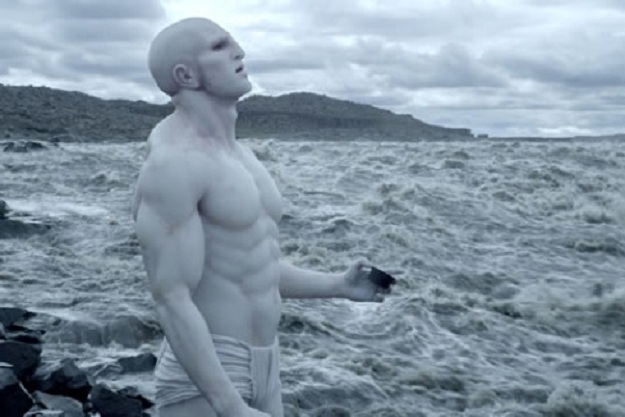
 |
| Image / Reality. |
The Engineers tie into this in another way. They are like the giants of Norse myth as it was recycled by Wagner and then by later anti-Semites. There is something of Nazi mysticism about the story of the Engineers. They are the perfect giants from before history who supposedly founded all the life and culture of the human age, their chosen people being, of course, the Aryans. Vickers is a blonde ice maiden, which either implies the Aryan credentials of the Weyland family (if she is Weyland's biological daughter) or his fetish for the Aryan type as representing perfection (if she is an android of his design). David (interesting choice of name there) is also an image of superhuman white European 'perfection'. He dyes his hair blonde to seem even more Aryan and models himself on Peter O'Toole's portrayal of T.E. Lawrence in Lawrence of Arabia, a chiseled white European hero who is presented as overcoming pain and taking upon himself leadership of the Arabs. (Incidentally, this paradigm - whitey becomes the leader of the natives - recurs in popular SF. Think Paul Atreides in Dune, or Jake Sully in Avatar.)
There is yet another element of the film that ties in with this. The concentration on language. David studies ancient human languages, explicitly including 'Indo-European'. His fez-wearing, English-accented holographic teacher says "...whilst this manner of articulation is attested in the Indo-European descendants as a purely paralinguistic form, it is phonemic in the ancestral form dating back 5 millenia or more....". I'm not knowledgeable enough to know if this means anything, but it still specifically mentions Indo-European. It is also possible that Sanskrit is explicitly mentioned or alluded to in the film. There is some disagreement (here, for instance) most of which is well above my head. But, in any case, David is studying Indo-European languages in an attempt to find some kind of 'root' language which will enable him to communicate with the Engineers, if they do indeed prove to be the progenitors of humanity. The implication is that the Engineers - our ancient creators or ancestors - will have bestowed language upon us. Our languages will be descended from them, just as we are... therefore, the further back into language David can go, the better his chance of finding some way of comprehending the language of the Engineers. And it works.
This is a reiteration of as aspect of the imperial ideology of Aryanism. To quote Richard Seymour in The Liberal Defence of Murder:
The Aryan idea has its origins in the heart of the British Empire. It was a result of the Company's growing control over revenue-collecting and the need to develop an understanding of the texts and languages of the colonized. Not merely a suppuration of imperialism, it became an important fact about the way the empire was organized, and eventually it was offered as the reason why the empire had come about. Essentially, it posited an Indo-European race based upon certain philological affinities between Sanskrit and the Greek and Latin languages. The thesis was that the world's populations could be divided into 'races' descended from Biblical figures - Aryan, Semitic and Tartar. The Aryan race had, it was maintained, invaded and inhabited India during the Vedic 'golden age' and formed a precocious civilization. The post-Vedic age in India had been a sustained period of degeneration: by contrast, the Aryans of Europe were in rude health. These categories not only provided an argument for empire; they also helped to cement British power with the caste system.
(Seymour's notes refer to a book called Orientalism and Race by Tony Ballantyne, which looks both illuminating and dauntingly scholarly.) Note, by the way, how Seymour refers to the East India Company as "the Company".
The concept of Aryanism later found its way into German Romantic occultism and, from thence, into Nazism. The whole idea of an Aryan 'master race' responsible for the primordial foundation of Western civilization - and just about all subsequent Western cultural achievement - is bound up with the theory that the European languages can be traced back, via commonalities with Sanskrit, etc., to a root language: Proto-Indo-European. The subsequent supposed 'degeneration' of the East as the West thrived was put down to several possible influences. In the 18th and 19th centuries, especially after upsurges of rebellion, the intellectuals of the British imperium (including the liberals, by the way) put it down to the malign influence of Islam, and this notion is a direct ancestor of modern liberal Islamophobia. In the even more delusional line of descent which culminated in Nazism, biological notions of Teutonic superiority came to the fore. The biological and culturalist variants of racism have never been as separate as some claim. And both are aspects of imperialist ideology.
Tropes & Implications
Now, this is really as old as the hills. In many respects, it is a slightly more elaborate version of the von Danikenism that has infected so much SF. There is a kind of Eurocentric paternal condescension built into von Danikenism. Ancient peoples, particularly in the Middle East, Africa and South America, are assumed to have been incapable of creating their own cultures and languages. This trope has been widely used in SF. In Doctor Who alone, it has appeared in 'Death to the Daleks', 'Pyramids of Mars', etc.
But it goes further. In Prometheus, the Engineers created all humanity and all human language from their own selves. This 'strong version' too has been utilised before, though possibly never quite so explicitly. In Quatermass and the Pit, we humans have race wars because we are the genetically engineered creatures of Martian insects who went in for ethnic cleansing.... but we don't speak a language descended from theirs, at least not explicitly.
In Prometheus it is not just ancient cultures that owe their technology, design sense, religion and language to aliens, it is all humanity - possibly all life in the galaxy. Taken literally, this obviates humanity's claim to have made its own history. The various revolutions of history - argicultural, urban, industrial - are simply developments towards greater and greater convergence with the culture of the creators. High technology becomes a telos, preset in our chromosomes. The impetus is the pattern within humanity that matches the Engineers. Human biological origins lead to human historical development from cave dwelling to space ships. Our Engineer DNA leads us to develop their language and their technology. The information in our genes makes us create the corresponding information in our culture. This is a kind of biological determinism (rampant in SF) that, through the issues mentioned above, ties the film to a view of human history which stems from the primal influence of godly progenitors who seem associated with patriarchy, imperialism and Aryanism. (By the way, it also explains the film's obsession with information. The star charts; the DNA sequences; the concentration on language and hieroglyphs; the way the two ships both project massive holographic displays that map out space, geography, cartography and architecture. The film depicts a stream of information flowing from the Engineers' genes all the way up to the humans' maps.)
To an extent then, Prometheus adapts an ideologically imperialist, patriarchal, sexist and racialist view of of human history and presents this as a truth. The truth underlying human biology and also, in a deterministic way, the history of human civilisation, is that all our information stems from a kind of Aryan master race who also speak Proto-Indo-European, represent camply fascistic ideas of physical perfection, seem like a monkish warrior brotherhood and look like an all-male group mortally threatened by any other gender but prepared to use rape as a weapon delivery system.
Yet it's hard to say that this makes the import of the text reactionary in a straightforward way. After all, the character of the Engineers seems to be genocidal, ruthless, cruel, sterile, entropic, capricious.... and they are also defeated by their own creations. Moreover, their ship is brought down by a black man and their last survivor (at least on their weapons planet) is outwitted by a woman. It doesn't look as though the film is asking us to worship them or admire them. And the film definitely expects us to be pleased when their plans are thwarted by those more sexually and racially diverse. (On a basic level, it's just nice to see a genre action movie where the black supporting character doesn't die in the second act.)
The Engineers are like the Eurocentric, patriarchal, white, imperial 'origin story' made flesh. They are the idea of the herrenvolk, literalised so that it may be rejected. Weyland's dying words imply that, as gods, they fall short. They have no answers, no meaning. Indeed, they seem to seek the eradication of meaning. They conceive of information - whether it be sexual reproduction or the mechanics of travel - as ways of erasure. They are an idea that seems inimical to other meanings. This inimical idea is then negated by the return of the meaning it tried to revoke and erase. This happens to them, so to speak, twice. They wish to eradicate the first meanings they created - life/civilisation on Earth and perhaps elsewhere - by creating new, deadly meaning in the form of weaponized sex... but this new meaning again turns upon them. (They are, by the way, quite reminiscent of Light - the white, male, authoritarian scientist/angel that wishes to eradicate meaning when it cannot be controlled and classified - in the Doctor Who story 'Ghost Light'.)
If the Engineers are white, male, imperial gods - and redolent of fascism, which is the ultimate syncresis of all these reactionary power principles - then it must be said that they hardly reflect well upon these principles. They are exterminators, stockpilers of biological weapons, purgers of meaning and information when it fails to meet their inscrutable and vindictive standards, etc.
Gardeners & Engineers
In Prometheus, just as in Christian mythology, we are banished by our creators to wander alone, even as everything that we are comes from them/Him. But Prometheus not only reiterates this mythology, it also does that other quintessential job of SF: it ponders the autonomous (alienated and fetishized) product.
It's no shock that SF continually tells stories which reiterate Genesis while also thinking about the alienation of humanity from the produce of their labour. Genesis is about the alienation of humanity from nature brought by the rise of agriculture, surplus and class. SF reiterates Genesis because it is the modern cultural genre that most directly addresses the unprecedented alienation brought by capitalism, modernity, industry and technology. Genesis is about the relationship between humanity and nature, altered by tools. SF is about the constantly changing and decaying and threatening relationship between humanity and the tools themselves as they careen out of our control.
Genesis is, as noted, hardly the first myth to tread this path. Prometheus brought fire to humanity. Fire is knowledge. Science. Technology. It is the first discovery, the first tool, the first weapon, the first product. In so doing, Prometheus dared to suggest not only that humanity should have knowledge, but also that humanity should have the ability to create. More than it destroys, fire transforms. It is the basis of chemistry. It reveals that matter may change its state, be split in various different states, when altered deliberately by humanity.
Prometheus is far from the first SF story to reiterate these matters. It treads directly in the footsteps of Frankenstein. Victor Frankenstein was the 'modern Prometheus' because he revealed the next stage of what may be done with matter by human hands. Frankenstein fails because he does not take social responsibility for his creation. His 'son' is the first product-monster, the first great monster in the history of European culture that is manufactured. But it is only dangerous because it is abandoned, left without care or justice. Frankenstein's monster is the foundation of SF, which is obsessed with the autonomous product that threatens its creator, the manufactured monster. It is terrifying because it is, ultimately, our responsibility and our punishment.
We humans auto-generate. God is our attempt to infer a 'first cause' in this chain of auto-generation and to spiritually imbue it. Modernity is the rising of the productive forces to an unprecedented level, in which we may produce things of unprecedented power at unprecedented speed and in unprecedented numbers. Frankenstein the book appears at the interface of
i) our awareness of ourselves as biologically generated entities,
ii) our idea of ourselves as the creations of God, and
iii) our dawning realisation that modernity - industry, science, technology - allows us to create things more powerful than us, i.e. things more powerful than our bodies or even our gods (which are themselves our creations, after all).
Personally, we all encounter the book at this interface. This is because the book was written at the moment when European civilisation reached such an interface in history.
Humanity has always been quintessentially productive. The ability of our front two feet to leave the ground and become organs of manipulation is what drove the rise of the human brain. Humans are, above all else, the animal that makes tools. Capitalist modernity thus deeply effects our view of ourselves because it revolutionizes the way we produce. The products of modernity are - simply by virtue of their greater numbers, power and speed, if nothing else - more fetishized, more alive, more able to dominate us and run out of our control. They are more able, at least potentially, to mesh with our biology. Mary Shelley saw this potential meshing in the electrode that made the dead convict twitch and clench his fist. It is also implicit in the machine that steals labour, or which sucks the labourer into its embrace, needing to be set in motion by the workers and expressing this by encircling and towering over them. Today, the intrusion into biology becomes ever more clear. We now have cameras that can relay images directly to the brain, cloned creatures, and other wetware. And there are now more ways than ever in which the worker is towered-over and encircled by the hardware and the software.
Since Frankenstein, SF has harped on these issues. SF is a litany of robots, androids, gynoids, computer sentiences, of thinking weapons, of tools that rebel, or scientific experiments that lash back upon the experimenter. Within the settings of 'space' or 'the future' - which represent the dizzying possibilities of modernity, technology and science - the human as a producer of marvels is also a producer of nightmares than cannot be controlled. The line between the producer and the artifact is always being attacked, if only by some new technical innovation. This is the real reason why the robots attack us. This is why so many of the artifacts claim parity with humanity and demand this parity be accepted... and we're lucky if parity is all they want. Also, in SF humans seem to seek unity and merging with the machine, with its uncontrollable power. The machine seems alive; the living thing tends towards the mechanical. The boundry line between the territories is heavily disputed. Like any such border, there are wars over it.
Beyond its Freudian dimensions, Alien ponders these issues covertly. Its ancient spacefaring aliens (the ones that created the derelict ship) seem inextricably both biology and technology, their pilot looking like an extrusion of beast and engine that has grown within a ship of bones and bulges and arterial corridors and vast hot stomachs in which parasites have laid their eggs. The thing that is born from Kane's chest is a thing of tendons and pulleys, veins and cables, phallic symbols and skin criss-crossed with what look like the outlines of circuits. What people often forget is that the 'Xenomorphs' live up to their assigned name. Their shape morphs to resemble the 'other' in which they grow. The Alien in the first film has taken on the bio-mechanical nature of the pilot on the crashed ship, and it has also taken on the humanoid size and shape of Kane. The machine has penetrated the DNA and is now biologically heritable as a trait. The 'Xenomorph' is the terrifying vehicle/product of this penetration. And don't forget Ash, with his android-madness apparently triggered by resentment and frustrated sexual hatred, his injuries dripping hydraulic fluid that looks like milk or semen, his synthetic innards looking like white and blue plastic intestines.
Prometheus ponders the same issues overtly. Just as Frankenstein displaced God by doing what God does, so the Engineers displace God by being what He is supposed to be. But they also displace Darwinism, at least in the opinion of the biologist. And they displace Frankenstein again because, by having created us artificially, they trivialize the achievement of Weyland in having made David. They even displace Tyrell in Blade Runner and the crisis of simulation that his simulacra have triggered. The simulacrum becomes nothing of the kind when the creator of the simulacra proves to be as engineered a thing as his simulation. Deckard may have had ambiguous dreams about unicorns but Weyland knows, unambiguously, that he is as much a manufactured entity as David. This state of having been manufactured is his new normality. In this state of affairs, who cares that the simulacrum is indistinguishable? The internal distinction that makes this collapse of distinctions significant has been neutralised. Just as Natural Selection is overthrown by the revelation that all life is a product of technological engineering, so is Artificial Creation. You can engineer life at all levels. Creation dissipates. The Engineers have manufactured micro-organisms and macro-organisms. Microbes in the goo, all the way up to giant squids. They have manufactured not only life but life-cycles.
Of course, these biological manufactoids get 'out of control'. Creations always do in these tales. That story goes back to Genesis and before. Long before. As noted, SF has continually retold these ancient stories as a way of grappling with the modern era of technological mass-production. In Frankenstein, the process turns runaway because it is abandoned. In The Island of Dr Moreau, the process turns runaway even though, possibly even because, it has not been abandoned. As China Mieville puts it, Frankenstein says that we are failing the Enlightenment and Moreau says that the Enlightenment has failed.
The project of modernity is unstable, uncontrollable, dangerous because even the best efforts to control it founder on the autonomy of the product. What we might, in political terms, characterise as Mary Shelley's 'reformist' project - drawn from her situation amidst Wollstonecraft (her dead mother, present in her life as stories and texts), Godwin (her father) and Percy Shelley (her husband) - is to nuture and care for the product so that it becomes socially responsible, an agent of justice rather than one of horror. Frankenstein is her prescient caution of what will ensue if this is not done. The product will annihilate us. Mieville says that Frankenstein and Moreau mark opposite ends of the trajectory of Fabianism, mapped out in advance. Moreau is the despairing terminus of Fabianism, written before Wells joined the Fabians. Wells says (without knowing it) that, contra Shelley, the 'reformist' project to nurture and care for modernity is doomed to failure because the product will not be controlled, even with the best efforts. The autonomous product - which is what industry and capital and the fetishized commodity look like in SF - is too much for us to control.
David in Prometheus is, yet again, the autonomous product. At first, he seems tame because of his position. He's been subject to a stringent attempt to integrate him into Weyland's Western, capitalist, patriarchal hierarchy. Like Ash and Bishop, David is a white male. Unlike those untrustworthy agents, he has been fashioned as an heir. Weyland shows him preference over his daughter (if she is a biological daughter). David is "the closest thing" Weyland has "to a son". The daughter doesn't count. It's like Dombey, forgetting Florence and putting "only child" on Paul's tombstone. But still David moves beyond control. On the contrary, he is in control of everyone else, all the way through the film. The story happens because of David's agency and actions. He is evidently not working for Weyland. Little he does directly serves Weyland's interests. When he finally does serve Weyland, he gets the old man killed. How are we - or anyone - to know what David says to the Engineer before the Engineer kills Weyland with David's severed head? David is unsurprised by Weyland's dying declaration. David knew better than to expect answers from a manufacturer-god who has been attacked by his own autonomous product.
Prometheus makes the gods themselves into Engineers. Their name itself appropriates the tool, manufacture, industry, technology. It makes production into our master. We become the object of production not the subject. It expresses alienation. We do not make the engines. We are the engines. The engines we do make (David) are therefore the products of products, made because we were made to make them. Our evolution, our social and agricultural history, become products of alien engineering, made by us because we are machines designed to make them.
When we become the autonomous product (as we do in Prometheus), we become as alienated from our manufacturers as any commodity. But that isn't necessarily bad. Why should we care that something is 'out of control'? Whose control? And, as noted, in Prometheus our alien/ated manufacturers are Eurocentric gods. They are Aryan gods. Fascist myths come alive. Patriarchs and warrior elites. It is as though the problems identified in Frankenstein and Dr Moreau have finally been blamed on somebody. Should they be in control?
Is it conceivable - I ask this tentatively - that, in Prometheus, Hollywood has accidentally created a parable about the need for the alienated to revolt against the alien/ating gods of the era of technology? To reject a power that is conceptualised as the ultimate in white, male, imperialist, theocracy? To reject a power that is, furthermore, a personification of the alienation of humans from their ability to freely produce themselves, their lives, their sexuality, their language and their culture?
These are not profundities that were deliberately crafted into the script of this massively expensive bit of commercial entertainment. They are complexities, intimations and ironies that may be teased out of the text and willfully construed because the text stands as a garbled synthesis of many of the tropes of SF, a genre that has been pondering the issues of modernity for so long.
The best way of looking at it is to say that the film Prometheus itself is an autonomous product that seems to have partially and furtively escaped the control of its reactionary manufacturers.
But then, don't they all?
EDIT: In the original version of this article, I wrongly used the term 'Caucasian' as a synonym for 'white' and/or 'European'. I have amended this. JG, 4/4/14
Subscribe to:
Posts (Atom)