Further to some objections I've had to my description of Mad Max: Fury Road as having reasonably good gender politics. Trigger and Spoilers, obviously.
What Mad Max: Fury Road does - with its depiction of Furiosa - is to refuse to
make violence the exclusive province of men, or to make men the only
ones who are any good at it. (Not unprecedented - but quite
good.) Furiosa gets to do all the trad-masculine things that Max does. She's just as good at them as him. This, apparently, is a big
problem for those kinds of insecure, reactionary misogynitwits who
drivel on about how women are weaker than men. According to such
douchenozzles, this is just a scientific fact, and it's not a man's
fault if he just repeats the incontrovertible findings of Science. In
actuality, of course, what such bigoted ninnies are actually doing is
regurgitating some half-digested sociobiologistic bullshit. They then
accuse feminists (who control Hollywood in their ideologically
distorted, bass-ackwards bizzaro world) of playing a dirty, emasculating
trick and oppressing men by spreading the vicious civilisation-eroding
lie that not all women need a man to open jars for them.
The thing is, there is
a rational kernal to some of these complaints (wait). The complaint
comes as a response to a genuine threat (I said wait). The genuine
threat which is correctly perceived by the bawling manbabies is a
threat to their privilege. You see, when Furiosa beats up some man
just as well as Max can (including Max himself), or shoots a gun just as
well as Max can, or drives a car just as well as Max can, what is being
done is that these traditionally masculine behaviours are being
completely detached from masculinity. And what is being detached from
masculinity is violence. So the threat to male privilege is about as
primal as you can get: male privilege is threatened with losing its
monopoly on violence. Given that violence, in one form or another, is
at the root of how all systems of oppression function, this could hardly
be more threatening (at least within the confines of a mainstream
popular movie).
This isn't some submerged theme in the
film that you have to hunt about for. It's front and centre. The
violence Furiosa excels at it specifically and explicitly a violent
response to a patriarchy which itself openly functions through
violence. Most obviously, there is the implied violence of rape (and
kudos to the film for not directly and unnecessarily showing sexual
violence). But there is also the structural violence. The system is literally
patriarchal, in that Imortan Joe's fertility seems to be inextricably
linked to his rulership - either materially or ideologically, or perhaps
both. He rules partly through his family. It is stated that several
members of his ruling elite - and his Imperators (bosses-cum-generals) -
are members of his family. Brothers, etc. Several are sons. They all
seem 'disabled' in some way. One seems unable to breathe without a
mask and oxygen tanks. Another is played by Quentin Kenihan who has the
bone disease osteogenesis imperfecta. Joe's
quest for a 'healthy' or 'normal' son is a big deal, ideologically. It
would appear that the majority of the surviving population are either
old and decaying remnants of the old world, or 'disabled' children of
the new world. (To be clear, I'm not praising or denigrating the film for this... I'm ambivalent about the film's treatment of ability issues.) Joe seems to harvest the healthiest boys from his
subjects and turns them into his War Boys... yet even these young men
seem mutated and medically entropic; anaemic to the point where they
need to ingest the blood of victims in order to survive. Joe may even
suffer from a similar condition himself, given his pallor. Just as Joe
harvests the 'healthiest' boys to be warriors, he harvests the
'healthiest', 'prettiest' girls to become his sex-slaves-cum-breeders.
He is desperate to recapture all his 'Brides', but especially Angharad
(played by supermodel and Matt Smith-lookalike Rosie
Huntington-Whiteley), not just because she's "his favourite" but also
because she's pregnant. When she's injured and her dead baby is
posthumously delivered, Joe and his sons make a big deal of publically
announcing that it was a healthy boy. This is patriarchy turned up to
eleven. It's almost a caricature. A male-dominated hierarchical system
that works through a warrior-ethic and a patrilineal transmission of
power and property. Joe decorates himself in medals, as men often do in
George Miller's dystopias. As in all Mad Max movies, the
masculinity is so aggressively hyperactive that it becomes camp, and
also deeply freighted with anxiety, ambivalence, and repulsion.
(Partly, of course, this is because the films co-opt an exaggerated
version of the performative manners and motifs of biker culture, but I'm
not going there because it's outside my wheelhouse and I don't want to
be writing this essay forever.)
There are problems with the gender politics in the movie. You
could argue that most of the women in the film have a great deal less
agency than Furiosa. But I think the Many Mothers acquit themselves
very well. And I think the Brides have a ton of agency. (Actually, I'm
going to stop calling them 'the Brides'... I'm going to call them 'the
Runaways', since that better describes them and pays them more
respect.) It's just a different kind of agency to the ass-kickers in
the film. It's the agency of brave endurance... fundamentally the
agency Cinderella displays. Cinderella is something I'd have
unthinkingly dismissed as a misogynistic, patriarchal fantasy until
relatively recently when I spotted a tumblr post (I regret to say I
can't find it now so can't give the proper attribution) in which someone
explained that the Cinderella story has huge significance for them as
it is, essentially, the story of someone who survives abuse through
endurance. In many ways, the agency of the Runaways is fairytale
agency, but sans the fairytale idea that brave endurance and patience
are 'enough'. The Runaways are the ones who choose to run away.
They're the ones who ask Furiosa to launch the whole adventure in the
first place. It all happens because they demand their freedom and her
help getting it (in so doing they are, it is implied, appealing for help
on the basis of sorority from a woman who has, up until then, been
living as a comprador with their oppressor - which is not a timid or
unrisky thing to do). The set-up (i.e. Furiosa helps the Runaways at
their request) is an acknowledgement that you shouldn't have to
be a kick-ass hero to escape oppression, that ordinary bravery and
endurance makes people survivors, but also that asses need to be kicked
ultimately if you decide that you shouldn't have to endure any more mistreatment from a violent system.
Furiosa is a bad-ass, but the very fact that she is being bad-ass on
behalf of people who are not natural fighters vitiates any fetishization
of the notion of the bad-ass. In this set-up, the bad-ass woman is at
the service of the non-bad-ass women who nevertheless deserve to be
free. Indeed, her submission to the project of their freedom is her
road to redemption; redemption she needs because, as is implied, she has
previously been a ferocious champion of the very system that has enslaved
them.
It's been pointed out that the Runaways
are presented as supermodels in skimpy clothing. Now there is doubtless
a degree of servicing the male gaze here, and yeah, sure, the script
could've found a way of getting the Runaways some more clothes at some
point. However, you never forget that these women are in the position
they're in because they've been selected - obviously against their will,
or at least after intense structural coercion - as the inmates of
Imortan Joe's vault, of his harem of sex slaves. He's picked the ones that most
closely conform to patriarchally-dictated standards of 'beauty'. He's
clothed them according to his fantasy. If you look and leer, you're
implicated in Joe's behaviour. And it's not like the film allows you to
forget the looming presence of Joe, or the situation of the Runaways as
a direct result of his treatment of them. Now, on the one hand I have
issues with this (as I have with all such inherently hypocritical
attempts at doing themes about 'complicity') but, on the other hand,
it's hard to see how else they could make the point. It's not unlike what Ridley Scott does with Ripley in the last bit of Alien. Yes, she is stripped to her underwear for the delectation of the implicitly male audience member; then we see her diegetic
audience... and it's a profane abomination, panting and touching itself
languidly like a wanking Peeping Tom, drooling cum/slaver from its
lolling jaws.
The
sexualised display of the Runaways in their first
appearance - scantily clad and washing each other - is also a direct
subversion of patriarchal myth and fantasy tropes about the man who
finds beautiful women bathing in private and watches them. The water
they wash with is another connection between precious bodily fluids,
life-giving water, and the commodification to which they themselves are subject.
They are presented in a sexualised way... but it's an entirely
self-involved, inter-woman scene upon which a threatening male presence intrudes.
You then see the complications. The barbaric, bolted chastity belts and the
pregnant belly. It's like what Zack Snyder was obviously trying to do in Sucker Punch.
Implicit in the film is a recognition that
social hierarchy depends upon control of surplus. Stephen Maher in his Jacobin essay is right to point out that the film doesn't portray and decry capitalism. There's no exploitation of surplus value from productive industrial workers or anything like that. But there is a depiction of social hierarchy being based on the sequestration of surplus resources from the mass of the people. This only works in the broadest terms, but it's still there. The priestly and warrior and political castes rise up the hierarchy based on their roles in controlling, tracking, protecting, acquiring and organising the distribution of surplus. If it's like anything, Immortan Joe's oligarchy is like an early form of class society from after the Urban Revolution, or like Neil Faulkner's blunt description of pre-capitalist forms of class society (most especially the Roman Empire) as based on 'robbery with violence' to reinforce systems that stagnate from within because they do not develop the forces of production. The warring brigandage of Joe and his competing 'nations' of scavengers in the wilderness is a post-apocalyptic, salvagepunk-inflected version of the warlordism that evolved in human society as soon as there were pools of urban surplus that could be raided. Joe is actually the ruler of one of those pools of urban surplus, though his surplus appears to be a harnessed natural resources rather than a self-reproducing social system based on agriculture... even if agriculture is part of his system. Furiosa's relatively high position in the hierarchy at the start of the movie is obviously based on her skill as a raider and brigand for Joe. The film doesn't give her much explicit backstory, but it wouldn't be crazy to assume that she herself was used as a sex-slave and breeder for Joe until such time as she proved to be incapable of producing 'healthy' children, whereupon she somehow migrates to a much higher position based on her ability as a warrior.
As
mentioned, the other women are associated with images of fertility all the
way through the movie, from the water in which they bathe to the
collection of seeds in the bag. The milk of lactating women is
harvested by Immortan Joe's patriarchy for drinking (presumably all
drinkable fluids are precious in this poisoned desert). If this were
just to emphasize - for emphasis' sake - the fact that women can get
pregnant and have babies, this would be flabby symbolism and nothing
more. If it were to suggest that the fertility of women is the key to
the renewal of the human race, it would amount to a kind of sexist
fetishizing of the whole idea of the female, as well as suggesting that
female fertility is just a resource to be used. The film escapes these
traps (largely) but embracing both of them and then holding them up as
exactly what they are: traps. Traps, moreover, conceived and laid by
Joe's patriarchy. The continuance of Joe's power relies upon female
fertilty because his familial oligarchy needs to be reproduced. He
presents this as the renewal of the human race when he claims to be the
saviour of the starving, but what he's actually doing is harnessing the
fertile female body (there is, of course, no suggestion that his society
has any idea that there might be people identifiable as, or
self-identifying as, female who are not physiologically capable of
pregnancy) to reproducing an oligarchy. His conception of women thus
entails the idea of them as resources to be used. This is what the
movie does when it associates the women characters with such things as
milk, water, seeds, etc. It identifies them with the resources when
make the reproduction of human life possible, and which are therefore
'owned' and controlled by Joe in Joe's oligarchy. It presents women as
resources among other resources in order to make a point that the women
have been turned into resources by their society. "We are not things"
is written on the walls of their prison by the departing Runaways for
Joe to find. It is the essential nature of the rebellion that they
reject Joe's conception of them as resources. Later, they encounter the
Many Mothers and their bag of seeds. These are resources too, but
resources harnessed by those who have rejected oligarchy and
patriarchy. The seeds represent an acknowledgement that Joe is right to
harness nature, fertility, vegetation, etc as resources for the
production and reproduction of society... but that such resources should
be controlled from below. What better way to put across this idea
than to put these resources into the hands of people who would
themselves be treated as resources by the ruling class? The concept of
fertility is not shied away from. The seeds end up being cared for by
one of the Runaways who is herself pregnant. This is an acknowledgement
that human reproduction is the basis of social reproduction. If the
film seems to accept that women are, in some sense, 'resources', it also
presents this as being an impoverished conception when constructed by
an oligarchical patriarchy, and argues... to be crude about this... that
the resources themselves should stick together and expropriate
themselves from hierarchical control.

ideas are icepickproof
Showing posts with label patriarchy. Show all posts
Showing posts with label patriarchy. Show all posts
Sunday, 14 June 2015


Monday, 8 September 2014
No Name
Triggers
Apparently, they've found out who Jack the Ripper was. Maybe. At least, so says the Daily Mail, and a bloke who's written a book about the case, and who owns a business selling 'Ripper' tours. So, reliable and unbiased sources.
Turns out, Jack the Ripper was... some guy.
Who'd have thunk it?
So, will this put a stop to the lucrative Ripper industry? The books, movies, walks, etc?
No, of course not. Like all previous unmaskings, it'll just fuel the fire, even if this unmasking turns out to rest on marginally better evidence that some hack's ability to create anagrams, or an evidently untrue story told by a publicity hound, or the baseless hunch of a crime writer, or an obviously forged diary, or the manufactured bad reputation of a dead one-time heir to the throne.
Because, contrary to what everyone ever has always said about Jack the Ripper, interest in the case doesn't stem from the fact that the murderer was never caught. It stems from the appeal of the degradation, humiliation, punishment and silencing of women... and from the way revelling in this (with whatever spurious self justification) can distract us from other stuff about the lives those women led, and the world they lived in.
Our misogynistic culture is obsessed with the murder of women. It is possibly the main subject of the present-day Western narrative culture industry, aside from the sexual/romantic conquest of women.
It could be objected that there are so many stories about the murder of women because so many women are murdered... but that doesn't explain, say, the lack of a similar number of stories about the rape of women (as Alan Moore pointed out), or about the political and social subjugation of women, or about any number of other things that are more common.
The prevalence of the actual murder of women is intimately connected with the prevalence of depictions of the murder of women, but in ways that are far more complex than the merely causal (whichever way you want to imagine the causation runs). It's all part and parcel of a cultural misogyny which stems from sexism and patriarchy, generated by class society all the way back to what Engels called "the world historic defeat of the female sex" with the start of social hierarchy. (None of which is to excuse our present cultural practice by appeal to the influence of older structures.)
The women murdered (as is supposed) by the man dubbed Jack the Ripper are objects of morbid fascination because they shared a fate which made them only slightly unusual for women of their class and time. Lots of these women were raped, abused, beaten and/or murdered (by men - let's not efface that vital part of the story). It just so happens that some of these women were murdered in particularly vicious and gruesome ways, with their bodies mutilated and insultingly displayed afterwards. (It's by no means clear how many women were the victim of the one escalating killer who ended up reaching a crescendo of perverse cruelty in the killing of Mary Kelley and then vanished, but it does seem likely that at least four were part of his distinct sequence.)
There is a degree of pity attached to the fascination. Certainly, at the time, many common people in similar walks of life were motivated by fury at the fate of people who they knew, or might have known. But also at the time, part of the fascination was to do with a kind of furtively aroused moralism about 'unfortunates' (as women who were driven to prostitute themselves by poverty were daintily called). Such patronising and contemptuous pity is a mixture of fear and loathing of the poor, and of women. And it puts the focus on sex, safely away from other scarier stuff.
But the fascination with the women is marginal to the wider cultural obsession with Jack the Ripper. The women are props in his story, used as background detail and as titilation (particularly since the women involved worked as prostitutes, with all the sordid arousal this brings to some).
Generally, the obsession is with the man. The killer has been fetishized, celebrated, glamourised and bigged up beyond belief. He has been transformed from a skulking trick into a top-hatted, cloaked, evening-dress-wearing toff with a sinister gladstone bag, riding around in a coach with a royal crest on the side. Gentleman Jack, the genteel and aristocratic killer. There's no doubt that part of this - alongside the various attempts to make him a royal, a freemason or a posh establishment figure covering up for Queen, Country and Lodge - is the submerged horror of a system in which the poor, especially poor women, were the playthings of the rich, material to be used when needed and then allowed to sink back into the slum. But the effect is to transform the killer himself, and his vacuously misogynistic crimes, into a meaningful figure, a powerful figure, a figure of purpose and steely determination, or of glamourous and tortured Jekyll-and-Hydean complexity, an artisan with a philosophy and a moral agenda of his own (however twisted), etc. In this, the Ripper is the prototypical serial killer of the present-day culture industries, of Seven, Messiah, The Tunnel, etc. The killer as intellectual, as the isolated thinker with lessons to teach us in blood, as the sinister harbinger of well-thought out rebukes (which shows simultaneously how much 'we' supposedly all need rebuke for 'our' sins, and how evil the opinionated outcasts bringing the rebukes usually are).
(I used to quite like the Gull/Masons theory... but it's only a story, and only a good one when told by Alan Moore.)
The bullshit and the obsession started at the time, with most of the mythmaking about the case being spun by the contemporary newspapers, eager to mop up the profits along with the blood. The case could be moralised about from every angle except actual, practical sympathy with oppressed women (after all, the only place to go with that was to stop blaming the women and start saying they should be allowed to be safe... which was self-evidently unpublishable radical lunacy). The case was a litmus test on the moral state of society (the killer brings the rebuke that 'we' all need, in his mad way). The case was about swarthy Jews and their sacrificial religion, or about all the foreigners (no wonder the Mail loves this latest story - the guy supposedly identified as the killer was a Polish immigrant). The case was about the degradation of the criminal classes (Punch Magazine, as usual, took the opportunity at the time to define satire as consisting of kicking downwards). The case was a big joke, jolly London lore. Hence the newspapers' invention of the name 'Jack the Ripper' when they hit upon the lucrative idea of sending themselves letters written in red ink, purporting to be from the murderer, invoking 'Springheel Jack' in their fabricated signatures, and sniggering about the whole thing in words that were painstakingly badly spelled (because, of course, 'Jack' couldn't be an educated man).
By the way - notice the contempt for the women integral to the name. He's not murdering people, he's ripping things. In the name, the women become nothing more than sacks or sheets or dresses. Remember, when 'Jack' drones on in his letters about how he hates 'whores', he's actually a journalist speaking with the contempt of the respectable for the 'unfortunate'.
All this is a massive distraction. Was then, is now. Talk about anything, but don't admit that most serial killers - 'Jack' included - are just squalid, pathetic, inadequate little men who hate women because they take the furious feelings of thwarted entitlement inculcated in so many men by patriarchy, and actually act on them. We don't want to have that conversation, or miss out on the latest thriller.
And don't admit that hugely more women died in the East End as a result of preventable disease, despair, drink, hunger, domestic violence... in a word: poverty... than died because of 'Jack'.
And don't admit that, as now, the London of 1888, the hub of an empire, harboured bigger mass murderers in the corridors of power than on the streets where the poor lived, worked their lives away, drank, hit each other, stabbed each other, laughed, joked, prayed, fucked for farthings and huddled together for warmth. And those mass murderers in the corridors of power didn't need to sneak out at night to commit their murders. They oversaw a system of murder every day, from within those very corridors, from behind their eminent Victorian respectability. And they still do.
And don't damage the Ripper industry by admitting that there was never any such person as Jack the Ripper. There was a pathetic and revolting misogynist who probably killed four or five women with escalating hatred and contempt. And then there was a marketing opportunity. And - in a society that still runs on drastic inequality, and on the disciplining, punishing and controlling women and their bodies - the market is still there.

Apparently, they've found out who Jack the Ripper was. Maybe. At least, so says the Daily Mail, and a bloke who's written a book about the case, and who owns a business selling 'Ripper' tours. So, reliable and unbiased sources.
Turns out, Jack the Ripper was... some guy.
Who'd have thunk it?
So, will this put a stop to the lucrative Ripper industry? The books, movies, walks, etc?
No, of course not. Like all previous unmaskings, it'll just fuel the fire, even if this unmasking turns out to rest on marginally better evidence that some hack's ability to create anagrams, or an evidently untrue story told by a publicity hound, or the baseless hunch of a crime writer, or an obviously forged diary, or the manufactured bad reputation of a dead one-time heir to the throne.
Because, contrary to what everyone ever has always said about Jack the Ripper, interest in the case doesn't stem from the fact that the murderer was never caught. It stems from the appeal of the degradation, humiliation, punishment and silencing of women... and from the way revelling in this (with whatever spurious self justification) can distract us from other stuff about the lives those women led, and the world they lived in.
Our misogynistic culture is obsessed with the murder of women. It is possibly the main subject of the present-day Western narrative culture industry, aside from the sexual/romantic conquest of women.
It could be objected that there are so many stories about the murder of women because so many women are murdered... but that doesn't explain, say, the lack of a similar number of stories about the rape of women (as Alan Moore pointed out), or about the political and social subjugation of women, or about any number of other things that are more common.
The prevalence of the actual murder of women is intimately connected with the prevalence of depictions of the murder of women, but in ways that are far more complex than the merely causal (whichever way you want to imagine the causation runs). It's all part and parcel of a cultural misogyny which stems from sexism and patriarchy, generated by class society all the way back to what Engels called "the world historic defeat of the female sex" with the start of social hierarchy. (None of which is to excuse our present cultural practice by appeal to the influence of older structures.)
The women murdered (as is supposed) by the man dubbed Jack the Ripper are objects of morbid fascination because they shared a fate which made them only slightly unusual for women of their class and time. Lots of these women were raped, abused, beaten and/or murdered (by men - let's not efface that vital part of the story). It just so happens that some of these women were murdered in particularly vicious and gruesome ways, with their bodies mutilated and insultingly displayed afterwards. (It's by no means clear how many women were the victim of the one escalating killer who ended up reaching a crescendo of perverse cruelty in the killing of Mary Kelley and then vanished, but it does seem likely that at least four were part of his distinct sequence.)
There is a degree of pity attached to the fascination. Certainly, at the time, many common people in similar walks of life were motivated by fury at the fate of people who they knew, or might have known. But also at the time, part of the fascination was to do with a kind of furtively aroused moralism about 'unfortunates' (as women who were driven to prostitute themselves by poverty were daintily called). Such patronising and contemptuous pity is a mixture of fear and loathing of the poor, and of women. And it puts the focus on sex, safely away from other scarier stuff.
But the fascination with the women is marginal to the wider cultural obsession with Jack the Ripper. The women are props in his story, used as background detail and as titilation (particularly since the women involved worked as prostitutes, with all the sordid arousal this brings to some).
Generally, the obsession is with the man. The killer has been fetishized, celebrated, glamourised and bigged up beyond belief. He has been transformed from a skulking trick into a top-hatted, cloaked, evening-dress-wearing toff with a sinister gladstone bag, riding around in a coach with a royal crest on the side. Gentleman Jack, the genteel and aristocratic killer. There's no doubt that part of this - alongside the various attempts to make him a royal, a freemason or a posh establishment figure covering up for Queen, Country and Lodge - is the submerged horror of a system in which the poor, especially poor women, were the playthings of the rich, material to be used when needed and then allowed to sink back into the slum. But the effect is to transform the killer himself, and his vacuously misogynistic crimes, into a meaningful figure, a powerful figure, a figure of purpose and steely determination, or of glamourous and tortured Jekyll-and-Hydean complexity, an artisan with a philosophy and a moral agenda of his own (however twisted), etc. In this, the Ripper is the prototypical serial killer of the present-day culture industries, of Seven, Messiah, The Tunnel, etc. The killer as intellectual, as the isolated thinker with lessons to teach us in blood, as the sinister harbinger of well-thought out rebukes (which shows simultaneously how much 'we' supposedly all need rebuke for 'our' sins, and how evil the opinionated outcasts bringing the rebukes usually are).
(I used to quite like the Gull/Masons theory... but it's only a story, and only a good one when told by Alan Moore.)
The bullshit and the obsession started at the time, with most of the mythmaking about the case being spun by the contemporary newspapers, eager to mop up the profits along with the blood. The case could be moralised about from every angle except actual, practical sympathy with oppressed women (after all, the only place to go with that was to stop blaming the women and start saying they should be allowed to be safe... which was self-evidently unpublishable radical lunacy). The case was a litmus test on the moral state of society (the killer brings the rebuke that 'we' all need, in his mad way). The case was about swarthy Jews and their sacrificial religion, or about all the foreigners (no wonder the Mail loves this latest story - the guy supposedly identified as the killer was a Polish immigrant). The case was about the degradation of the criminal classes (Punch Magazine, as usual, took the opportunity at the time to define satire as consisting of kicking downwards). The case was a big joke, jolly London lore. Hence the newspapers' invention of the name 'Jack the Ripper' when they hit upon the lucrative idea of sending themselves letters written in red ink, purporting to be from the murderer, invoking 'Springheel Jack' in their fabricated signatures, and sniggering about the whole thing in words that were painstakingly badly spelled (because, of course, 'Jack' couldn't be an educated man).
By the way - notice the contempt for the women integral to the name. He's not murdering people, he's ripping things. In the name, the women become nothing more than sacks or sheets or dresses. Remember, when 'Jack' drones on in his letters about how he hates 'whores', he's actually a journalist speaking with the contempt of the respectable for the 'unfortunate'.
All this is a massive distraction. Was then, is now. Talk about anything, but don't admit that most serial killers - 'Jack' included - are just squalid, pathetic, inadequate little men who hate women because they take the furious feelings of thwarted entitlement inculcated in so many men by patriarchy, and actually act on them. We don't want to have that conversation, or miss out on the latest thriller.
And don't admit that hugely more women died in the East End as a result of preventable disease, despair, drink, hunger, domestic violence... in a word: poverty... than died because of 'Jack'.
And don't admit that, as now, the London of 1888, the hub of an empire, harboured bigger mass murderers in the corridors of power than on the streets where the poor lived, worked their lives away, drank, hit each other, stabbed each other, laughed, joked, prayed, fucked for farthings and huddled together for warmth. And those mass murderers in the corridors of power didn't need to sneak out at night to commit their murders. They oversaw a system of murder every day, from within those very corridors, from behind their eminent Victorian respectability. And they still do.
And don't damage the Ripper industry by admitting that there was never any such person as Jack the Ripper. There was a pathetic and revolting misogynist who probably killed four or five women with escalating hatred and contempt. And then there was a marketing opportunity. And - in a society that still runs on drastic inequality, and on the disciplining, punishing and controlling women and their bodies - the market is still there.
Tuesday, 26 August 2014
The Veil ('Deep Breath' 3)
The veil. A politically loaded symbol. It carries all sorts of old semiotic baggage, of course. Weddings. Widowhood. Ladies in Conan Doyle who want to hide their identities (thus it has a trajectory into the figure of Madame Vastra via Victoriana). In genre TV these days, a woman wearing a veil is likely to be a tragic or vengeful figure, hiding a facial scar of some kind. (See 'Silence in the Library' / 'Forest of the Dead'.)
The veil is thus something that implies a particular set of social situations for women. The connection appears to be the concept of separation. The veil is a boundary between the woman and society. It creates a space in which she can hide her unsightliness, either disfiguring grief or grievous disfigurement, from those who don't want to have to see it. The wedding veil is lifted as the woman is taken possession of in the marriage ceremony; thus it is there to emphasize her acceptability by temporarily putting it in doubt. It is, of course, the symbolic tearing of the hymen. The man takes possession and breaks through the barrier. All very nasty. Not to mention anatomically inaccurate.
Vastra's veil takes on enormous significance in 'Deep Breath'. Indeed, the whole episode is full of talk about faces, with them being stolen, exchanged, worn, hidden, changed... with them contemplated in mirrors.
Vastra is married to Jenny (by Silurian law perhaps?), and yet this marriage hardly seems to have anything to do with Vastra's veil (unsurprising, given that it is black rather than white), since Vastra and Jenny's relationship fails to fit easily into any patriarchal schema. There is no sense in which Jenny owns Vastra. Indeed, the power relationship appears to go the other way (with implied consent).
There is a sense in which Vastra could be said to be mourning. She is an isolated figure in some ways, cut off from her lost people. But this is hardly emphasised at all. She doesn't seem tragic, and her complete lack of vengefulness is so complete as to be worrying (to me anyway).
As mentioned, she reiterates - in some ways - the figure of the veiled lady from Victorian popular fiction, via her place in the regurgitated Victoria trope pyramid. But she inverts this, to some degree, by being the detective. Her veil isn't to hide her secrets from the investigator, rather it is to hide the secrets of the investigator from the client - as long as is necessary.
There is another significance to the veil in our culture at this time: the immensely freighted issue of the hijab... or perhaps I should say, the immensely freighted issue of Western ideas about the hijab. I've likened the Silurians to the Palestinians before now, which would obviously chime... especially when you remember that Vastra has plonked herself down at the hub of the British Empire as a kind of refugee, and the British Empire was mucking around with the area that became Palestine from the 1830s onwards (though Victoriana places Vastra well before the disastrous British interventions of the early 20th century).
Vastra's choice to wear the veil makes her a better representation of this issue than we tend to get from the culture industries. It's a widespread prejudice in Western culture (which imagines itself to be post-sexist) that all or most Muslim women wear the hijab and other such articles of clothing because they're forced to by Muslim men. If Vastra's veil can be tied into our wider 'debate' about this (with 'debate' here meaning the sickening display of Islamophobia dressed up as liberal concern for women's rights) then it looks quite good.
We're onto something with the issue of disfigurement too. The figure of the disfigured woman hiding herself (and thus also her identity and vengeful agenda) is overused and overfamiliar, and laced with some quite nasty assumptions... but Vastra isn't disfigured. Rather, as she herself says, it is Victorian society that considers her disfigured. This is a more-or-less direct connection between race and social exclusion (with race filtered through the SF concept of the alien), and also connects with a critique of attitudes towards women who don't fit the sexist concept of acceptable female appearance. (Slightly undermined by Vastra's fixation on Jenny's prettiness.)
At first sight, this reading also seems undermined somewhat by the way in which Vastra can walk around on the banks of the Thames, surrounded by people, without wearing her veil, attracting no attention. On the other hand, maybe those people do see the veil even if we, the viewers, don't. Because - and this is the really interesting thing - Steven Moffat now seems to be implying that the veil is only visible to people who feel some need to see it because they are unprepared to look the facts about Vastra in the face, as it were... and, by implication, to see past their own prejudices. This, I suppose, is how to read Vastra's comment that she wears the veil as a judgement on others.
Read this way, the veil is a way for the viewer to judge themselves. That's actually quite good, and more pleasant than my initial thought, which was that the "judgement" comment was a rather weasily way of making the need to escape the consequences of social marginalisation into an empowered choice made by the victim.
If the veil is a property of the viewer's perception, that would fit into Moffat's established habit of treating the camera as a diegetic eye (see Phil Sandifer on the Weeping Angels and the Silence for some interesting thoughts on this). It is also, I suppose, the reason why Clara suddenly starts seeing Vastra's veil when she is having problems accepting the new Doctor, and confronting Vastra's support of him. By that logic, it is also why the veil vanishes when she gets her talking to from Vastra. The thing that makes this work is the way Clara's acceptance of the Doctor and Vastra comes via her giving Vastra a severe and confrontational talking-to, which concedes Vastra's basic point while also objecting to her arrogant way of making it.
The veil is thus something that implies a particular set of social situations for women. The connection appears to be the concept of separation. The veil is a boundary between the woman and society. It creates a space in which she can hide her unsightliness, either disfiguring grief or grievous disfigurement, from those who don't want to have to see it. The wedding veil is lifted as the woman is taken possession of in the marriage ceremony; thus it is there to emphasize her acceptability by temporarily putting it in doubt. It is, of course, the symbolic tearing of the hymen. The man takes possession and breaks through the barrier. All very nasty. Not to mention anatomically inaccurate.
Vastra's veil takes on enormous significance in 'Deep Breath'. Indeed, the whole episode is full of talk about faces, with them being stolen, exchanged, worn, hidden, changed... with them contemplated in mirrors.
Vastra is married to Jenny (by Silurian law perhaps?), and yet this marriage hardly seems to have anything to do with Vastra's veil (unsurprising, given that it is black rather than white), since Vastra and Jenny's relationship fails to fit easily into any patriarchal schema. There is no sense in which Jenny owns Vastra. Indeed, the power relationship appears to go the other way (with implied consent).
There is a sense in which Vastra could be said to be mourning. She is an isolated figure in some ways, cut off from her lost people. But this is hardly emphasised at all. She doesn't seem tragic, and her complete lack of vengefulness is so complete as to be worrying (to me anyway).
As mentioned, she reiterates - in some ways - the figure of the veiled lady from Victorian popular fiction, via her place in the regurgitated Victoria trope pyramid. But she inverts this, to some degree, by being the detective. Her veil isn't to hide her secrets from the investigator, rather it is to hide the secrets of the investigator from the client - as long as is necessary.
There is another significance to the veil in our culture at this time: the immensely freighted issue of the hijab... or perhaps I should say, the immensely freighted issue of Western ideas about the hijab. I've likened the Silurians to the Palestinians before now, which would obviously chime... especially when you remember that Vastra has plonked herself down at the hub of the British Empire as a kind of refugee, and the British Empire was mucking around with the area that became Palestine from the 1830s onwards (though Victoriana places Vastra well before the disastrous British interventions of the early 20th century).
Vastra's choice to wear the veil makes her a better representation of this issue than we tend to get from the culture industries. It's a widespread prejudice in Western culture (which imagines itself to be post-sexist) that all or most Muslim women wear the hijab and other such articles of clothing because they're forced to by Muslim men. If Vastra's veil can be tied into our wider 'debate' about this (with 'debate' here meaning the sickening display of Islamophobia dressed up as liberal concern for women's rights) then it looks quite good.
We're onto something with the issue of disfigurement too. The figure of the disfigured woman hiding herself (and thus also her identity and vengeful agenda) is overused and overfamiliar, and laced with some quite nasty assumptions... but Vastra isn't disfigured. Rather, as she herself says, it is Victorian society that considers her disfigured. This is a more-or-less direct connection between race and social exclusion (with race filtered through the SF concept of the alien), and also connects with a critique of attitudes towards women who don't fit the sexist concept of acceptable female appearance. (Slightly undermined by Vastra's fixation on Jenny's prettiness.)
At first sight, this reading also seems undermined somewhat by the way in which Vastra can walk around on the banks of the Thames, surrounded by people, without wearing her veil, attracting no attention. On the other hand, maybe those people do see the veil even if we, the viewers, don't. Because - and this is the really interesting thing - Steven Moffat now seems to be implying that the veil is only visible to people who feel some need to see it because they are unprepared to look the facts about Vastra in the face, as it were... and, by implication, to see past their own prejudices. This, I suppose, is how to read Vastra's comment that she wears the veil as a judgement on others.
Read this way, the veil is a way for the viewer to judge themselves. That's actually quite good, and more pleasant than my initial thought, which was that the "judgement" comment was a rather weasily way of making the need to escape the consequences of social marginalisation into an empowered choice made by the victim.
If the veil is a property of the viewer's perception, that would fit into Moffat's established habit of treating the camera as a diegetic eye (see Phil Sandifer on the Weeping Angels and the Silence for some interesting thoughts on this). It is also, I suppose, the reason why Clara suddenly starts seeing Vastra's veil when she is having problems accepting the new Doctor, and confronting Vastra's support of him. By that logic, it is also why the veil vanishes when she gets her talking to from Vastra. The thing that makes this work is the way Clara's acceptance of the Doctor and Vastra comes via her giving Vastra a severe and confrontational talking-to, which concedes Vastra's basic point while also objecting to her arrogant way of making it.
Saturday, 23 November 2013
3
"Not so much of that oatmeal, girl," says Meg to one of the kitchen drudges, "It's only pikemen we're feeding, not horses."
They're in Irongron's castle, somewhere in the century or so following the Norman Conquest. Sarah is undercover, cooking Irongron's stew.
"Don't the guards on the gate get stew?" she asks, wanting to know in which pots to drop the Doctor's knock-out potion.
"What, meat for those common creatures? I should say not. They'll have oatmeal the same as the rest of us, and lusty enough they are on that. So you watch yourself if ever you take out that skillet."
So class is, perhaps, a more fundamental division than gender, but gender oppression brings its own particular problems.
"I'm not afraid of men. They don't own the world."
Well, they kind-of do... but Sarah isn't discussing actual property relations. She's talking about the way the world should work, with no one group 'owning' it.
"Why should women always have to cook and carry for them?" she demands.
"What else should we do?" asks Meg.
"Stand up for ourselves. Tell the men you're tired of working for them like slaves."
"We are slaves," says Meg.
Wow. No mincing words there.
"Then you should set yourselves free," says Sarah.
None there either.
"Oh? And how should we do that?"
That's a trickier question. It always is. But surely the first hurdle, before the plan, has to be the will.
"Don't you want to be free?" she demands. Essentially, this has become workplace agitation.
"Women will never be free while there are men in the world, girl," says Meg, "We have our place."
You still hear stuff like that today, albeit filtered through layers of code.
"What subservient poppycock! You're still living in the Middle Ages!"
Yeah. We are, in many ways. We're meant to laugh at this outburst, but there's no question in my mind that we're also meant to be on Sarah's side.
There are all sorts of problems with this story. Sarah is - at least in conception - a stereotypical 'wimmin's libber', all touchiness and naivety. The Doctor is deliberately (more) sexist (than usual) in her presence, and we're meant to think this is funny. She's made the butt of much sexist behaviour, apparently for our amusement. For instance, there's the bit quoted above about the "lusty" guards... it's obviously supposed to be cute, even as it acknowledges the particular dangers faced by women in a class hierarchy. And so on. Someone wants to say this story is irredeemably broken by sexism? I'm not going to argue.
But the fact remains, Sarah responds to a woman who is by demonstrably smarter than the men she serves - and aware of the fact that she's a slave - by saying "set yourselves free".
It shines out amidst the crap.
They're in Irongron's castle, somewhere in the century or so following the Norman Conquest. Sarah is undercover, cooking Irongron's stew.
"Don't the guards on the gate get stew?" she asks, wanting to know in which pots to drop the Doctor's knock-out potion.
"What, meat for those common creatures? I should say not. They'll have oatmeal the same as the rest of us, and lusty enough they are on that. So you watch yourself if ever you take out that skillet."
So class is, perhaps, a more fundamental division than gender, but gender oppression brings its own particular problems.
"I'm not afraid of men. They don't own the world."
Well, they kind-of do... but Sarah isn't discussing actual property relations. She's talking about the way the world should work, with no one group 'owning' it.
"Why should women always have to cook and carry for them?" she demands.
"What else should we do?" asks Meg.
"Stand up for ourselves. Tell the men you're tired of working for them like slaves."
"We are slaves," says Meg.
Wow. No mincing words there.
"Then you should set yourselves free," says Sarah.
None there either.
"Oh? And how should we do that?"
That's a trickier question. It always is. But surely the first hurdle, before the plan, has to be the will.
"Don't you want to be free?" she demands. Essentially, this has become workplace agitation.
"Women will never be free while there are men in the world, girl," says Meg, "We have our place."
You still hear stuff like that today, albeit filtered through layers of code.
"What subservient poppycock! You're still living in the Middle Ages!"
Yeah. We are, in many ways. We're meant to laugh at this outburst, but there's no question in my mind that we're also meant to be on Sarah's side.
There are all sorts of problems with this story. Sarah is - at least in conception - a stereotypical 'wimmin's libber', all touchiness and naivety. The Doctor is deliberately (more) sexist (than usual) in her presence, and we're meant to think this is funny. She's made the butt of much sexist behaviour, apparently for our amusement. For instance, there's the bit quoted above about the "lusty" guards... it's obviously supposed to be cute, even as it acknowledges the particular dangers faced by women in a class hierarchy. And so on. Someone wants to say this story is irredeemably broken by sexism? I'm not going to argue.
But the fact remains, Sarah responds to a woman who is by demonstrably smarter than the men she serves - and aware of the fact that she's a slave - by saying "set yourselves free".
It shines out amidst the crap.
Wednesday, 13 November 2013
26
The Doctor, the Brigadier, some scientists and a Ministry bureaucrat have ventured inside Axos, a living ship that has just landed on Earth.
The Axons have greeted them. They are a nuclear family - man in charge, surrounded by wife and boy and girl - modelled on classical statuary, their skin a lustrous gold.
They reflect the prejudices of those they meet. They are part of Axos and have formed themselves from the ship/entity. They easily adapt their image to Westernism, Patriarchy, Classicism, the worship of the commodity and of wealth itself.
In return for shelter (ostensibly), they offer "a gift... a payment". They appear unable to quite understand the concept of 'gift', immediately amending their use of the word. They meant 'payment', which implies a commodity transaction.
Their payment is...
"Axonite!"
It looks like a mineral, something torn from the ground by labour. In reality it is just another aspect of Axos, individuated from the amorphous and tentacular mass of the whole so it will pass as a rock.
"Axonite is the source of all our growth technology," says Daddy Axon, "Axonite can absorb, convert, transmit and programme all forms of energy."
Note the word 'growth'. To Axos, this is a central concept. It's why they're here.
They do a deal. Axonite will be distributed around the globe.
"This is indeed a rich planet you have brought us to," Axos tells their unwilling partner, the Master.
Axos has found a new market into which it can spread, new material to consume.
"Axonite must encircle the world," says Axos.
When it has been distributed globally, Axonite will absorb all energy and return to Axos, glutting it with new power. Remember, Axonite can be anything. It can take any form. It can grow via an occult process. It covers the world. It has a "cycle" which ends with its absorbtion and assimilation of everything around it. It returns to Axos, which is another aspect of itself, bigger and richer, swelling and increasing the whole. It is the commodity form itself - the commodity fetishised and come alive, personifying itself and then treating people as commodities to be consumed. It is scrambled, insane, multifarious, protean, yet singular and unitary. It glitters. It is lusted after as a transformation of production (of food, technology, anything at all) and as power in and of itself... yet the people who want it to serve them end up serving it. It is alien to humanity, yet dresses in the clothes of Western tradition, classical values, oppressive gender relations and wealth. It offers itself as payment, then takes everything as profit. It is ravenous. Vampiric. It circulates and ends its cycle with profit it has sucked from the world. And then it moves on, still hungry.
It is capital.
The Axons have greeted them. They are a nuclear family - man in charge, surrounded by wife and boy and girl - modelled on classical statuary, their skin a lustrous gold.
They reflect the prejudices of those they meet. They are part of Axos and have formed themselves from the ship/entity. They easily adapt their image to Westernism, Patriarchy, Classicism, the worship of the commodity and of wealth itself.
In return for shelter (ostensibly), they offer "a gift... a payment". They appear unable to quite understand the concept of 'gift', immediately amending their use of the word. They meant 'payment', which implies a commodity transaction.
Their payment is...
"Axonite!"
It looks like a mineral, something torn from the ground by labour. In reality it is just another aspect of Axos, individuated from the amorphous and tentacular mass of the whole so it will pass as a rock.
"Axonite is the source of all our growth technology," says Daddy Axon, "Axonite can absorb, convert, transmit and programme all forms of energy."
Note the word 'growth'. To Axos, this is a central concept. It's why they're here.
They do a deal. Axonite will be distributed around the globe.
"This is indeed a rich planet you have brought us to," Axos tells their unwilling partner, the Master.
Axos has found a new market into which it can spread, new material to consume.
"Axonite must encircle the world," says Axos.
When it has been distributed globally, Axonite will absorb all energy and return to Axos, glutting it with new power. Remember, Axonite can be anything. It can take any form. It can grow via an occult process. It covers the world. It has a "cycle" which ends with its absorbtion and assimilation of everything around it. It returns to Axos, which is another aspect of itself, bigger and richer, swelling and increasing the whole. It is the commodity form itself - the commodity fetishised and come alive, personifying itself and then treating people as commodities to be consumed. It is scrambled, insane, multifarious, protean, yet singular and unitary. It glitters. It is lusted after as a transformation of production (of food, technology, anything at all) and as power in and of itself... yet the people who want it to serve them end up serving it. It is alien to humanity, yet dresses in the clothes of Western tradition, classical values, oppressive gender relations and wealth. It offers itself as payment, then takes everything as profit. It is ravenous. Vampiric. It circulates and ends its cycle with profit it has sucked from the world. And then it moves on, still hungry.
It is capital.
27
TW
Adelaide screams at the sight of Palmerdale's dead body.
Leela slaps her across the face, silencing her.
This is horrible. It's one of the relatively few examples of serious, realistic, non-Fantastic, gendered violence in the show. Companions are captured by monsters, etc., but this kind of thing happens rarely. It is better in some places. Worse in others. In 'The Time Meddler', Edith's implied-rape is in there simply to tick a box of genre tropes. Yeurch. In 'Vengeance on Varos', Maldak slaps Peri across the face to assuage his bruised ego. It's utterly gratuitous and revolting.
But this is a woman slapping another woman. (That's not worse... except in the sense that the representation, authored by a man, alibis male involvement in violence against women by ostensibly disappearing its gendered dimension.)
More than that - it's Leela slapping another woman. Wonderful Leela, who has never done anything like this before. Okay, she's a ruthless killer in battle... but slapping a 'hysteric' like she's James Bond or something? Normally, though she dreads weakness in herself because of her self-identification as a warrior, she is gentle and kind to the weak, to the scared. This is part of her warriors' code. She will be back to her real self in later stories. She's even kind to Adelaide later in this story.
What has actually happened here?
Somewhere along the line, Leela - or perhaps I should say, the character of Leela - has internalized the male attitudes of the time in which she is a visitor: the Edwardian era.
None of the male characters from that period physically abuse Adelaide, but Adelaide is secondary to almost all of them. To Palmerdale, she is a secretary and, probably, a mistress. Harker has no doubt about that, dismissing her as "the owner's fancy woman". Skinsale evidently desires her sexually, and also desires her esteem, yet finds her frustrating because she resolutely refuses to like him more than her boss. His delight whenever she becomes dependant upon him is evident. Vince Hawkins is the only person to whom she can feel comfortably superior, treating his bashful attentions as the services of a instrumentum vocale.
This story is all about class in many ways... but it is also about gender. In many ways, it's quite good on the subject. It depicts male attitudes in a non-exculpatory fashion. Leela is a forceful presence, crossing gender boundaries by putting on "men's clothes... working clothes", etc. Leela's actions and personality imply that Adelaide isn't just a dishrag because she's a woman; she's like that because she has been trained in a particular kind of social role owing to her gender and class... a role that involves men looking upon her with varying degrees of objectification and contempt, looks which they train at Leela but which bounce off her. There are other hints at these themes. Women as property. Reuben keeps pornographic pictures under his bed, for example.
But there is still a problem with that slap... which is that it comes from someone outside the Edwardian class system (this is, by the way, a depiction of the dynamics of that system that easily outclasses Downton Abbey or 'Human Nature'). The slap comes from Leela, who transgresses Edwardian sensibilities in so many ways.
Using what is sometimes charmingly called a 'real world point of view', this is probably to do with the fact that some 'Edwardian attitudes' had been internalised by the author of the story. (That this is going on in 1977 tells us a lot.) Employing a strategy I'm usually wary of - the redemptive reading - Leela's slap can be seen as evidence that even she starts to absorb psychological/ideological aspects of a heavily gendered oppressive system simply by being surrounded by it, by being locked in with it in a cramped space.
That's hegemony for you: you don't have to agree with the ideology in order for it to work on you.
Adelaide screams at the sight of Palmerdale's dead body.
Leela slaps her across the face, silencing her.
This is horrible. It's one of the relatively few examples of serious, realistic, non-Fantastic, gendered violence in the show. Companions are captured by monsters, etc., but this kind of thing happens rarely. It is better in some places. Worse in others. In 'The Time Meddler', Edith's implied-rape is in there simply to tick a box of genre tropes. Yeurch. In 'Vengeance on Varos', Maldak slaps Peri across the face to assuage his bruised ego. It's utterly gratuitous and revolting.
But this is a woman slapping another woman. (That's not worse... except in the sense that the representation, authored by a man, alibis male involvement in violence against women by ostensibly disappearing its gendered dimension.)
More than that - it's Leela slapping another woman. Wonderful Leela, who has never done anything like this before. Okay, she's a ruthless killer in battle... but slapping a 'hysteric' like she's James Bond or something? Normally, though she dreads weakness in herself because of her self-identification as a warrior, she is gentle and kind to the weak, to the scared. This is part of her warriors' code. She will be back to her real self in later stories. She's even kind to Adelaide later in this story.
What has actually happened here?
Somewhere along the line, Leela - or perhaps I should say, the character of Leela - has internalized the male attitudes of the time in which she is a visitor: the Edwardian era.
None of the male characters from that period physically abuse Adelaide, but Adelaide is secondary to almost all of them. To Palmerdale, she is a secretary and, probably, a mistress. Harker has no doubt about that, dismissing her as "the owner's fancy woman". Skinsale evidently desires her sexually, and also desires her esteem, yet finds her frustrating because she resolutely refuses to like him more than her boss. His delight whenever she becomes dependant upon him is evident. Vince Hawkins is the only person to whom she can feel comfortably superior, treating his bashful attentions as the services of a instrumentum vocale.
This story is all about class in many ways... but it is also about gender. In many ways, it's quite good on the subject. It depicts male attitudes in a non-exculpatory fashion. Leela is a forceful presence, crossing gender boundaries by putting on "men's clothes... working clothes", etc. Leela's actions and personality imply that Adelaide isn't just a dishrag because she's a woman; she's like that because she has been trained in a particular kind of social role owing to her gender and class... a role that involves men looking upon her with varying degrees of objectification and contempt, looks which they train at Leela but which bounce off her. There are other hints at these themes. Women as property. Reuben keeps pornographic pictures under his bed, for example.
But there is still a problem with that slap... which is that it comes from someone outside the Edwardian class system (this is, by the way, a depiction of the dynamics of that system that easily outclasses Downton Abbey or 'Human Nature'). The slap comes from Leela, who transgresses Edwardian sensibilities in so many ways.
Using what is sometimes charmingly called a 'real world point of view', this is probably to do with the fact that some 'Edwardian attitudes' had been internalised by the author of the story. (That this is going on in 1977 tells us a lot.) Employing a strategy I'm usually wary of - the redemptive reading - Leela's slap can be seen as evidence that even she starts to absorb psychological/ideological aspects of a heavily gendered oppressive system simply by being surrounded by it, by being locked in with it in a cramped space.
That's hegemony for you: you don't have to agree with the ideology in order for it to work on you.
Wednesday, 4 July 2012
Prometheus Underground
Warning: Triggers and Spoilers. And waffle.
Sex & Monsters
In Prometheus, the Engineers are ancient Titans who created humanity... and, it is implied, seeded the galaxy with their DNA. There is something very noticeable about them: they are all men. Meanwhile, there is a definite vaginal look to a great many of the alien bio-weapons they created and which then subsumed them. However, I don't think its really possible to read the battle between Engineers and their bio-weapons as a battle of the sexes. The weapon creatures are also phallic and penetrative, as in previous iterations of the Alien universe. All the same, it's true that presenting the creators of life (in their own image) as exclusively dudes does imply that generative power resides in the male alone. It is enough for one Engineer to dissolve his DNA into the waters of a planet to kickstart the process that will lead to animal life (if that's how the opening scene is meant to be read). The Engineers are male but apparently sexless, capable of asexual reproduction. The deadly runaway bio-weapons, which seem hermaphroditic, look like the intrusion of sex into a male but sexless world. Sex is thus a terrifying eruption that destabilises a male utopia. The sexual nature of the weapons suggests that the Engineers - we might even be tempted to facetiously re-christen them the 'Mengineers' - find sexual reproduction to be inherently threatening. They set about devising weapons of mass destruction and what do they come up with? Biological goo that sets off a chain reaction of tentacle rape, fanged vaginas and violent monster pregnancy.
Foz Meadows at her blog Shattersnipe (which I heard about from Jon Blum) has made some apt observations about the film's dubious concentration upon highly impractical female underwear, grueling 'ladypain' and forced impregnation. She goes on to say:
And so it is.
One of the interesting things about the original Alien is that it is a man - Kane (John Hurt) - who is the victim of the facehugger rape and the violent birth of the phallic infant Alien. So, although the alien pregnancy also suggests infection, cancer, parasitism and other horrors attendant on life, there is clearly a way in which the original Alien is a personification of sexual violence. This violence is directed at both sexes and emerges through the violation of a man and a subsequent male pregnancy... however, the creature itself is also intensely male. It has that famously phallic head and yet another phallic symbol springs out of its mouth, this one complete with a snapping set of teeth. Even its tail is like a barbed cock which gropes Lambert (Veronica Cartwright) before killing her. Later on, when Ripley (Sigourney Weaver) is menaced by the creature in the escape shuttle, she has stripped to her underwear. This scene is the film at its most sexploitative. In many ways, it's a textbook example of lingering over needlessly-exposed female flesh. But even in this scene it seems that a trap is being set: encouraging those who are so inclined to leer... before showing them their own reflection in the creature when it reappears, languid, slowly playing with its phallic inner jaw, dripping drool/jizz, forcing Ripley to run and hide like someone stalked by a rapist.
As a man, I want to be very careful about declaring that Alien is or is not dodgy in its depiction of sexualised violence against women. If it is, then I also think there is a distinct ambiguity about it. The sexualised, phallic vileness of the Alien itself seems to have been the intention all along. If the film wallows in the sight of a half-naked woman threatened by a monster that is, essentially, an evil penis with teeth, then it also seems aware of the queasiness of what it is doing. The very obscenity of the Alien suggests an awareness of the obscenity of sexual violence... beyond what is arguably the film's more general concern about the horror of physicality itself, with all its attendant violation, infection, pain and predation.
There is something of the same horror of sex in Prometheus. Fertility seems to be the terrible mistake that the Mengineers made, the mistake they wish to erase. They made the infertile fertile (their weapon specifically does this to Shaw) and set in motion the end of their outpost world. But note how the 'fertility nuke' the Mengineers developed actually works. With men, it gets in through the mouth. The Generic Asshole Biologist with Glasses gets done in by a kind of phallic worm with a cobra hood which penetrates his suit and then dives into his mouth. Holloway inadvertently drinks some of the goo and begins to turn into a kind of rampaging mutant (we see the final stage later when Fifield turns up again). Shaw, however, is impregnated in the regular way. She is impregnated via sex - with her husband, no less! That this is a kind of rape-by-proxy committed by David (who spikes Holloway's drink with some of the black goo) doesn't change the point. The creature inside Shaw gestates in what looks like a placental sac, complete with a umbilical cord. I'm not sure if we're meant to think the squid thing was going to exit Shaw violently via the belly... but, the undulations of the entity beneath her skin notwithstanding, there's actually no reason to think it wasn't going to be born via the vagina. So, the Mengineers' weaponized sex gets into the man via an orifice that does not play a specific biological role in sexual reproduction and turns him into a beast. It enters the woman via sex itself, gestates like a baby in the uterus and may even be born vaginally rather than bursting out. I'm almost fearful to think how this system is supposed to work. Once the infected male has become a mad monster, does he go on a rape rampage? If so, I'm glad it's left undepicted and undescribed. In any case, it looks uncomfortably as though the Mengineers specifically decided to use the female as a vector in the progress of their bio-weapons. They chose to use female fertility as a part of their attack. Sex is the weapon; the female is the delivery system.
Race & Monsters
The other thing about the intense un-sexual maleness of the Engineers is that it seems to suggest a monastic warrior brotherhood with fascist overtones.
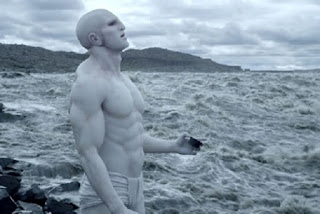
The Engineers look like the camp, macho, pseudo-expressionistic and/or
neoclassical fascist statues which decorated Hitler's Germany and
Mussolini's Italy. They are utterly white, with blank eyes, as though
made of marble. They represent a kind of aggressively male, body
fascist ideal, with all their bulging muscles and rippling pectorals.
Neoclassicism, as it was co-opted by fascism, reproduced the physiques
of Michaelangelo's David and Adam as an actual physical ideal rather
than as an emblem of human beauty, uniqueness and capability. Humanism
became the worship of the allegedly biologically 'perfect', embodied
in fascist ideology by the white, male, sexless warrior.
The Engineers tie into this in another way. They are like the giants of Norse myth as it was recycled by Wagner and then by later anti-Semites. There is something of Nazi mysticism about the story of the Engineers. They are the perfect giants from before history who supposedly founded all the life and culture of the human age, their chosen people being, of course, the Aryans. Vickers is a blonde ice maiden, which either implies the Aryan credentials of the Weyland family (if she is Weyland's biological daughter) or his fetish for the Aryan type as representing perfection (if she is an android of his design). David (interesting choice of name there) is also an image of superhuman white European 'perfection'. He dyes his hair blonde to seem even more Aryan and models himself on Peter O'Toole's portrayal of T.E. Lawrence in Lawrence of Arabia, a chiseled white European hero who is presented as overcoming pain and taking upon himself leadership of the Arabs. (Incidentally, this paradigm - whitey becomes the leader of the natives - recurs in popular SF. Think Paul Atreides in Dune, or Jake Sully in Avatar.)
There is yet another element of the film that ties in with this. The concentration on language. David studies ancient human languages, explicitly including 'Indo-European'. His fez-wearing, English-accented holographic teacher says "...whilst this manner of articulation is attested in the Indo-European descendants as a purely paralinguistic form, it is phonemic in the ancestral form dating back 5 millenia or more....". I'm not knowledgeable enough to know if this means anything, but it still specifically mentions Indo-European. It is also possible that Sanskrit is explicitly mentioned or alluded to in the film. There is some disagreement (here, for instance) most of which is well above my head. But, in any case, David is studying Indo-European languages in an attempt to find some kind of 'root' language which will enable him to communicate with the Engineers, if they do indeed prove to be the progenitors of humanity. The implication is that the Engineers - our ancient creators or ancestors - will have bestowed language upon us. Our languages will be descended from them, just as we are... therefore, the further back into language David can go, the better his chance of finding some way of comprehending the language of the Engineers. And it works.
This is a reiteration of as aspect of the imperial ideology of Aryanism. To quote Richard Seymour in The Liberal Defence of Murder:
(Seymour's notes refer to a book called Orientalism and Race by Tony Ballantyne, which looks both illuminating and dauntingly scholarly.) Note, by the way, how Seymour refers to the East India Company as "the Company".
The concept of Aryanism later found its way into German Romantic occultism and, from thence, into Nazism. The whole idea of an Aryan 'master race' responsible for the primordial foundation of Western civilization - and just about all subsequent Western cultural achievement - is bound up with the theory that the European languages can be traced back, via commonalities with Sanskrit, etc., to a root language: Proto-Indo-European. The subsequent supposed 'degeneration' of the East as the West thrived was put down to several possible influences. In the 18th and 19th centuries, especially after upsurges of rebellion, the intellectuals of the British imperium (including the liberals, by the way) put it down to the malign influence of Islam, and this notion is a direct ancestor of modern liberal Islamophobia. In the even more delusional line of descent which culminated in Nazism, biological notions of Teutonic superiority came to the fore. The biological and culturalist variants of racism have never been as separate as some claim. And both are aspects of imperialist ideology.
Tropes & Implications
Now, this is really as old as the hills. In many respects, it is a slightly more elaborate version of the von Danikenism that has infected so much SF. There is a kind of Eurocentric paternal condescension built into von Danikenism. Ancient peoples, particularly in the Middle East, Africa and South America, are assumed to have been incapable of creating their own cultures and languages. This trope has been widely used in SF. In Doctor Who alone, it has appeared in 'Death to the Daleks', 'Pyramids of Mars', etc.
But it goes further. In Prometheus, the Engineers created all humanity and all human language from their own selves. This 'strong version' too has been utilised before, though possibly never quite so explicitly. In Quatermass and the Pit, we humans have race wars because we are the genetically engineered creatures of Martian insects who went in for ethnic cleansing.... but we don't speak a language descended from theirs, at least not explicitly.
In Prometheus it is not just ancient cultures that owe their technology, design sense, religion and language to aliens, it is all humanity - possibly all life in the galaxy. Taken literally, this obviates humanity's claim to have made its own history. The various revolutions of history - argicultural, urban, industrial - are simply developments towards greater and greater convergence with the culture of the creators. High technology becomes a telos, preset in our chromosomes. The impetus is the pattern within humanity that matches the Engineers. Human biological origins lead to human historical development from cave dwelling to space ships. Our Engineer DNA leads us to develop their language and their technology. The information in our genes makes us create the corresponding information in our culture. This is a kind of biological determinism (rampant in SF) that, through the issues mentioned above, ties the film to a view of human history which stems from the primal influence of godly progenitors who seem associated with patriarchy, imperialism and Aryanism. (By the way, it also explains the film's obsession with information. The star charts; the DNA sequences; the concentration on language and hieroglyphs; the way the two ships both project massive holographic displays that map out space, geography, cartography and architecture. The film depicts a stream of information flowing from the Engineers' genes all the way up to the humans' maps.)
To an extent then, Prometheus adapts an ideologically imperialist, patriarchal, sexist and racialist view of of human history and presents this as a truth. The truth underlying human biology and also, in a deterministic way, the history of human civilisation, is that all our information stems from a kind of Aryan master race who also speak Proto-Indo-European, represent camply fascistic ideas of physical perfection, seem like a monkish warrior brotherhood and look like an all-male group mortally threatened by any other gender but prepared to use rape as a weapon delivery system.
Yet it's hard to say that this makes the import of the text reactionary in a straightforward way. After all, the character of the Engineers seems to be genocidal, ruthless, cruel, sterile, entropic, capricious.... and they are also defeated by their own creations. Moreover, their ship is brought down by a black man and their last survivor (at least on their weapons planet) is outwitted by a woman. It doesn't look as though the film is asking us to worship them or admire them. And the film definitely expects us to be pleased when their plans are thwarted by those more sexually and racially diverse. (On a basic level, it's just nice to see a genre action movie where the black supporting character doesn't die in the second act.)
The Engineers are like the Eurocentric, patriarchal, white, imperial 'origin story' made flesh. They are the idea of the herrenvolk, literalised so that it may be rejected. Weyland's dying words imply that, as gods, they fall short. They have no answers, no meaning. Indeed, they seem to seek the eradication of meaning. They conceive of information - whether it be sexual reproduction or the mechanics of travel - as ways of erasure. They are an idea that seems inimical to other meanings. This inimical idea is then negated by the return of the meaning it tried to revoke and erase. This happens to them, so to speak, twice. They wish to eradicate the first meanings they created - life/civilisation on Earth and perhaps elsewhere - by creating new, deadly meaning in the form of weaponized sex... but this new meaning again turns upon them. (They are, by the way, quite reminiscent of Light - the white, male, authoritarian scientist/angel that wishes to eradicate meaning when it cannot be controlled and classified - in the Doctor Who story 'Ghost Light'.)
If the Engineers are white, male, imperial gods - and redolent of fascism, which is the ultimate syncresis of all these reactionary power principles - then it must be said that they hardly reflect well upon these principles. They are exterminators, stockpilers of biological weapons, purgers of meaning and information when it fails to meet their inscrutable and vindictive standards, etc.
Gardeners & Engineers
In Prometheus, just as in Christian mythology, we are banished by our creators to wander alone, even as everything that we are comes from them/Him. But Prometheus not only reiterates this mythology, it also does that other quintessential job of SF: it ponders the autonomous (alienated and fetishized) product.
It's no shock that SF continually tells stories which reiterate Genesis while also thinking about the alienation of humanity from the produce of their labour. Genesis is about the alienation of humanity from nature brought by the rise of agriculture, surplus and class. SF reiterates Genesis because it is the modern cultural genre that most directly addresses the unprecedented alienation brought by capitalism, modernity, industry and technology. Genesis is about the relationship between humanity and nature, altered by tools. SF is about the constantly changing and decaying and threatening relationship between humanity and the tools themselves as they careen out of our control.
Genesis is, as noted, hardly the first myth to tread this path. Prometheus brought fire to humanity. Fire is knowledge. Science. Technology. It is the first discovery, the first tool, the first weapon, the first product. In so doing, Prometheus dared to suggest not only that humanity should have knowledge, but also that humanity should have the ability to create. More than it destroys, fire transforms. It is the basis of chemistry. It reveals that matter may change its state, be split in various different states, when altered deliberately by humanity.
Prometheus is far from the first SF story to reiterate these matters. It treads directly in the footsteps of Frankenstein. Victor Frankenstein was the 'modern Prometheus' because he revealed the next stage of what may be done with matter by human hands. Frankenstein fails because he does not take social responsibility for his creation. His 'son' is the first product-monster, the first great monster in the history of European culture that is manufactured. But it is only dangerous because it is abandoned, left without care or justice. Frankenstein's monster is the foundation of SF, which is obsessed with the autonomous product that threatens its creator, the manufactured monster. It is terrifying because it is, ultimately, our responsibility and our punishment.
We humans auto-generate. God is our attempt to infer a 'first cause' in this chain of auto-generation and to spiritually imbue it. Modernity is the rising of the productive forces to an unprecedented level, in which we may produce things of unprecedented power at unprecedented speed and in unprecedented numbers. Frankenstein the book appears at the interface of
i) our awareness of ourselves as biologically generated entities,
ii) our idea of ourselves as the creations of God, and
iii) our dawning realisation that modernity - industry, science, technology - allows us to create things more powerful than us, i.e. things more powerful than our bodies or even our gods (which are themselves our creations, after all).
Personally, we all encounter the book at this interface. This is because the book was written at the moment when European civilisation reached such an interface in history.
Humanity has always been quintessentially productive. The ability of our front two feet to leave the ground and become organs of manipulation is what drove the rise of the human brain. Humans are, above all else, the animal that makes tools. Capitalist modernity thus deeply effects our view of ourselves because it revolutionizes the way we produce. The products of modernity are - simply by virtue of their greater numbers, power and speed, if nothing else - more fetishized, more alive, more able to dominate us and run out of our control. They are more able, at least potentially, to mesh with our biology. Mary Shelley saw this potential meshing in the electrode that made the dead convict twitch and clench his fist. It is also implicit in the machine that steals labour, or which sucks the labourer into its embrace, needing to be set in motion by the workers and expressing this by encircling and towering over them. Today, the intrusion into biology becomes ever more clear. We now have cameras that can relay images directly to the brain, cloned creatures, and other wetware. And there are now more ways than ever in which the worker is towered-over and encircled by the hardware and the software.
Since Frankenstein, SF has harped on these issues. SF is a litany of robots, androids, gynoids, computer sentiences, of thinking weapons, of tools that rebel, or scientific experiments that lash back upon the experimenter. Within the settings of 'space' or 'the future' - which represent the dizzying possibilities of modernity, technology and science - the human as a producer of marvels is also a producer of nightmares than cannot be controlled. The line between the producer and the artifact is always being attacked, if only by some new technical innovation. This is the real reason why the robots attack us. This is why so many of the artifacts claim parity with humanity and demand this parity be accepted... and we're lucky if parity is all they want. Also, in SF humans seem to seek unity and merging with the machine, with its uncontrollable power. The machine seems alive; the living thing tends towards the mechanical. The boundry line between the territories is heavily disputed. Like any such border, there are wars over it.
Beyond its Freudian dimensions, Alien ponders these issues covertly. Its ancient spacefaring aliens (the ones that created the derelict ship) seem inextricably both biology and technology, their pilot looking like an extrusion of beast and engine that has grown within a ship of bones and bulges and arterial corridors and vast hot stomachs in which parasites have laid their eggs. The thing that is born from Kane's chest is a thing of tendons and pulleys, veins and cables, phallic symbols and skin criss-crossed with what look like the outlines of circuits. What people often forget is that the 'Xenomorphs' live up to their assigned name. Their shape morphs to resemble the 'other' in which they grow. The Alien in the first film has taken on the bio-mechanical nature of the pilot on the crashed ship, and it has also taken on the humanoid size and shape of Kane. The machine has penetrated the DNA and is now biologically heritable as a trait. The 'Xenomorph' is the terrifying vehicle/product of this penetration. And don't forget Ash, with his android-madness apparently triggered by resentment and frustrated sexual hatred, his injuries dripping hydraulic fluid that looks like milk or semen, his synthetic innards looking like white and blue plastic intestines.
Prometheus ponders the same issues overtly. Just as Frankenstein displaced God by doing what God does, so the Engineers displace God by being what He is supposed to be. But they also displace Darwinism, at least in the opinion of the biologist. And they displace Frankenstein again because, by having created us artificially, they trivialize the achievement of Weyland in having made David. They even displace Tyrell in Blade Runner and the crisis of simulation that his simulacra have triggered. The simulacrum becomes nothing of the kind when the creator of the simulacra proves to be as engineered a thing as his simulation. Deckard may have had ambiguous dreams about unicorns but Weyland knows, unambiguously, that he is as much a manufactured entity as David. This state of having been manufactured is his new normality. In this state of affairs, who cares that the simulacrum is indistinguishable? The internal distinction that makes this collapse of distinctions significant has been neutralised. Just as Natural Selection is overthrown by the revelation that all life is a product of technological engineering, so is Artificial Creation. You can engineer life at all levels. Creation dissipates. The Engineers have manufactured micro-organisms and macro-organisms. Microbes in the goo, all the way up to giant squids. They have manufactured not only life but life-cycles.
Of course, these biological manufactoids get 'out of control'. Creations always do in these tales. That story goes back to Genesis and before. Long before. As noted, SF has continually retold these ancient stories as a way of grappling with the modern era of technological mass-production. In Frankenstein, the process turns runaway because it is abandoned. In The Island of Dr Moreau, the process turns runaway even though, possibly even because, it has not been abandoned. As China Mieville puts it, Frankenstein says that we are failing the Enlightenment and Moreau says that the Enlightenment has failed.
The project of modernity is unstable, uncontrollable, dangerous because even the best efforts to control it founder on the autonomy of the product. What we might, in political terms, characterise as Mary Shelley's 'reformist' project - drawn from her situation amidst Wollstonecraft (her dead mother, present in her life as stories and texts), Godwin (her father) and Percy Shelley (her husband) - is to nuture and care for the product so that it becomes socially responsible, an agent of justice rather than one of horror. Frankenstein is her prescient caution of what will ensue if this is not done. The product will annihilate us. Mieville says that Frankenstein and Moreau mark opposite ends of the trajectory of Fabianism, mapped out in advance. Moreau is the despairing terminus of Fabianism, written before Wells joined the Fabians. Wells says (without knowing it) that, contra Shelley, the 'reformist' project to nurture and care for modernity is doomed to failure because the product will not be controlled, even with the best efforts. The autonomous product - which is what industry and capital and the fetishized commodity look like in SF - is too much for us to control.
David in Prometheus is, yet again, the autonomous product. At first, he seems tame because of his position. He's been subject to a stringent attempt to integrate him into Weyland's Western, capitalist, patriarchal hierarchy. Like Ash and Bishop, David is a white male. Unlike those untrustworthy agents, he has been fashioned as an heir. Weyland shows him preference over his daughter (if she is a biological daughter). David is "the closest thing" Weyland has "to a son". The daughter doesn't count. It's like Dombey, forgetting Florence and putting "only child" on Paul's tombstone. But still David moves beyond control. On the contrary, he is in control of everyone else, all the way through the film. The story happens because of David's agency and actions. He is evidently not working for Weyland. Little he does directly serves Weyland's interests. When he finally does serve Weyland, he gets the old man killed. How are we - or anyone - to know what David says to the Engineer before the Engineer kills Weyland with David's severed head? David is unsurprised by Weyland's dying declaration. David knew better than to expect answers from a manufacturer-god who has been attacked by his own autonomous product.
Prometheus makes the gods themselves into Engineers. Their name itself appropriates the tool, manufacture, industry, technology. It makes production into our master. We become the object of production not the subject. It expresses alienation. We do not make the engines. We are the engines. The engines we do make (David) are therefore the products of products, made because we were made to make them. Our evolution, our social and agricultural history, become products of alien engineering, made by us because we are machines designed to make them.
When we become the autonomous product (as we do in Prometheus), we become as alienated from our manufacturers as any commodity. But that isn't necessarily bad. Why should we care that something is 'out of control'? Whose control? And, as noted, in Prometheus our alien/ated manufacturers are Eurocentric gods. They are Aryan gods. Fascist myths come alive. Patriarchs and warrior elites. It is as though the problems identified in Frankenstein and Dr Moreau have finally been blamed on somebody. Should they be in control?
Is it conceivable - I ask this tentatively - that, in Prometheus, Hollywood has accidentally created a parable about the need for the alienated to revolt against the alien/ating gods of the era of technology? To reject a power that is conceptualised as the ultimate in white, male, imperialist, theocracy? To reject a power that is, furthermore, a personification of the alienation of humans from their ability to freely produce themselves, their lives, their sexuality, their language and their culture?
These are not profundities that were deliberately crafted into the script of this massively expensive bit of commercial entertainment. They are complexities, intimations and ironies that may be teased out of the text and willfully construed because the text stands as a garbled synthesis of many of the tropes of SF, a genre that has been pondering the issues of modernity for so long.
The best way of looking at it is to say that the film Prometheus itself is an autonomous product that seems to have partially and furtively escaped the control of its reactionary manufacturers.
But then, don't they all?
EDIT: In the original version of this article, I wrongly used the term 'Caucasian' as a synonym for 'white' and/or 'European'. I have amended this. JG, 4/4/14
Sex & Monsters
In Prometheus, the Engineers are ancient Titans who created humanity... and, it is implied, seeded the galaxy with their DNA. There is something very noticeable about them: they are all men. Meanwhile, there is a definite vaginal look to a great many of the alien bio-weapons they created and which then subsumed them. However, I don't think its really possible to read the battle between Engineers and their bio-weapons as a battle of the sexes. The weapon creatures are also phallic and penetrative, as in previous iterations of the Alien universe. All the same, it's true that presenting the creators of life (in their own image) as exclusively dudes does imply that generative power resides in the male alone. It is enough for one Engineer to dissolve his DNA into the waters of a planet to kickstart the process that will lead to animal life (if that's how the opening scene is meant to be read). The Engineers are male but apparently sexless, capable of asexual reproduction. The deadly runaway bio-weapons, which seem hermaphroditic, look like the intrusion of sex into a male but sexless world. Sex is thus a terrifying eruption that destabilises a male utopia. The sexual nature of the weapons suggests that the Engineers - we might even be tempted to facetiously re-christen them the 'Mengineers' - find sexual reproduction to be inherently threatening. They set about devising weapons of mass destruction and what do they come up with? Biological goo that sets off a chain reaction of tentacle rape, fanged vaginas and violent monster pregnancy.
Foz Meadows at her blog Shattersnipe (which I heard about from Jon Blum) has made some apt observations about the film's dubious concentration upon highly impractical female underwear, grueling 'ladypain' and forced impregnation. She goes on to say:
Insofar as the alien attacks go, I’ll give Scott some credit for trope subversion: twice in the course of the film, male characters are violently orally penetrated – and, in the process, killed – by phallic alien tentacles. This is visually disturbing on a number of levels, but given the near universal establishment of tentacle rape as a thing that happens to women, I’m going to give him a big thumbs up for bucking the trend. That being said, what happens to Shaw is awful on just about every level imaginable.
And so it is.
One of the interesting things about the original Alien is that it is a man - Kane (John Hurt) - who is the victim of the facehugger rape and the violent birth of the phallic infant Alien. So, although the alien pregnancy also suggests infection, cancer, parasitism and other horrors attendant on life, there is clearly a way in which the original Alien is a personification of sexual violence. This violence is directed at both sexes and emerges through the violation of a man and a subsequent male pregnancy... however, the creature itself is also intensely male. It has that famously phallic head and yet another phallic symbol springs out of its mouth, this one complete with a snapping set of teeth. Even its tail is like a barbed cock which gropes Lambert (Veronica Cartwright) before killing her. Later on, when Ripley (Sigourney Weaver) is menaced by the creature in the escape shuttle, she has stripped to her underwear. This scene is the film at its most sexploitative. In many ways, it's a textbook example of lingering over needlessly-exposed female flesh. But even in this scene it seems that a trap is being set: encouraging those who are so inclined to leer... before showing them their own reflection in the creature when it reappears, languid, slowly playing with its phallic inner jaw, dripping drool/jizz, forcing Ripley to run and hide like someone stalked by a rapist.
As a man, I want to be very careful about declaring that Alien is or is not dodgy in its depiction of sexualised violence against women. If it is, then I also think there is a distinct ambiguity about it. The sexualised, phallic vileness of the Alien itself seems to have been the intention all along. If the film wallows in the sight of a half-naked woman threatened by a monster that is, essentially, an evil penis with teeth, then it also seems aware of the queasiness of what it is doing. The very obscenity of the Alien suggests an awareness of the obscenity of sexual violence... beyond what is arguably the film's more general concern about the horror of physicality itself, with all its attendant violation, infection, pain and predation.
There is something of the same horror of sex in Prometheus. Fertility seems to be the terrible mistake that the Mengineers made, the mistake they wish to erase. They made the infertile fertile (their weapon specifically does this to Shaw) and set in motion the end of their outpost world. But note how the 'fertility nuke' the Mengineers developed actually works. With men, it gets in through the mouth. The Generic Asshole Biologist with Glasses gets done in by a kind of phallic worm with a cobra hood which penetrates his suit and then dives into his mouth. Holloway inadvertently drinks some of the goo and begins to turn into a kind of rampaging mutant (we see the final stage later when Fifield turns up again). Shaw, however, is impregnated in the regular way. She is impregnated via sex - with her husband, no less! That this is a kind of rape-by-proxy committed by David (who spikes Holloway's drink with some of the black goo) doesn't change the point. The creature inside Shaw gestates in what looks like a placental sac, complete with a umbilical cord. I'm not sure if we're meant to think the squid thing was going to exit Shaw violently via the belly... but, the undulations of the entity beneath her skin notwithstanding, there's actually no reason to think it wasn't going to be born via the vagina. So, the Mengineers' weaponized sex gets into the man via an orifice that does not play a specific biological role in sexual reproduction and turns him into a beast. It enters the woman via sex itself, gestates like a baby in the uterus and may even be born vaginally rather than bursting out. I'm almost fearful to think how this system is supposed to work. Once the infected male has become a mad monster, does he go on a rape rampage? If so, I'm glad it's left undepicted and undescribed. In any case, it looks uncomfortably as though the Mengineers specifically decided to use the female as a vector in the progress of their bio-weapons. They chose to use female fertility as a part of their attack. Sex is the weapon; the female is the delivery system.
Race & Monsters
The other thing about the intense un-sexual maleness of the Engineers is that it seems to suggest a monastic warrior brotherhood with fascist overtones.
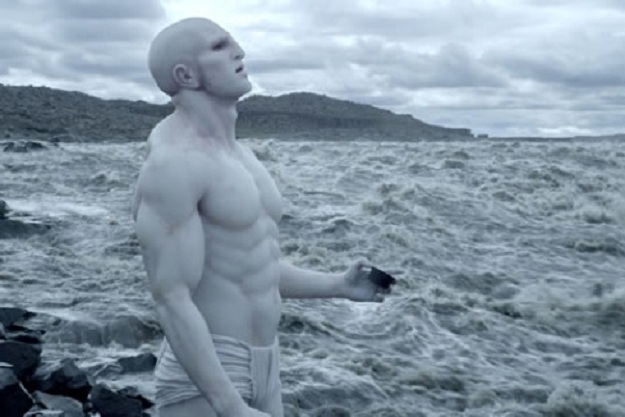
 |
| Image / Reality. |
The Engineers tie into this in another way. They are like the giants of Norse myth as it was recycled by Wagner and then by later anti-Semites. There is something of Nazi mysticism about the story of the Engineers. They are the perfect giants from before history who supposedly founded all the life and culture of the human age, their chosen people being, of course, the Aryans. Vickers is a blonde ice maiden, which either implies the Aryan credentials of the Weyland family (if she is Weyland's biological daughter) or his fetish for the Aryan type as representing perfection (if she is an android of his design). David (interesting choice of name there) is also an image of superhuman white European 'perfection'. He dyes his hair blonde to seem even more Aryan and models himself on Peter O'Toole's portrayal of T.E. Lawrence in Lawrence of Arabia, a chiseled white European hero who is presented as overcoming pain and taking upon himself leadership of the Arabs. (Incidentally, this paradigm - whitey becomes the leader of the natives - recurs in popular SF. Think Paul Atreides in Dune, or Jake Sully in Avatar.)
There is yet another element of the film that ties in with this. The concentration on language. David studies ancient human languages, explicitly including 'Indo-European'. His fez-wearing, English-accented holographic teacher says "...whilst this manner of articulation is attested in the Indo-European descendants as a purely paralinguistic form, it is phonemic in the ancestral form dating back 5 millenia or more....". I'm not knowledgeable enough to know if this means anything, but it still specifically mentions Indo-European. It is also possible that Sanskrit is explicitly mentioned or alluded to in the film. There is some disagreement (here, for instance) most of which is well above my head. But, in any case, David is studying Indo-European languages in an attempt to find some kind of 'root' language which will enable him to communicate with the Engineers, if they do indeed prove to be the progenitors of humanity. The implication is that the Engineers - our ancient creators or ancestors - will have bestowed language upon us. Our languages will be descended from them, just as we are... therefore, the further back into language David can go, the better his chance of finding some way of comprehending the language of the Engineers. And it works.
This is a reiteration of as aspect of the imperial ideology of Aryanism. To quote Richard Seymour in The Liberal Defence of Murder:
The Aryan idea has its origins in the heart of the British Empire. It was a result of the Company's growing control over revenue-collecting and the need to develop an understanding of the texts and languages of the colonized. Not merely a suppuration of imperialism, it became an important fact about the way the empire was organized, and eventually it was offered as the reason why the empire had come about. Essentially, it posited an Indo-European race based upon certain philological affinities between Sanskrit and the Greek and Latin languages. The thesis was that the world's populations could be divided into 'races' descended from Biblical figures - Aryan, Semitic and Tartar. The Aryan race had, it was maintained, invaded and inhabited India during the Vedic 'golden age' and formed a precocious civilization. The post-Vedic age in India had been a sustained period of degeneration: by contrast, the Aryans of Europe were in rude health. These categories not only provided an argument for empire; they also helped to cement British power with the caste system.
(Seymour's notes refer to a book called Orientalism and Race by Tony Ballantyne, which looks both illuminating and dauntingly scholarly.) Note, by the way, how Seymour refers to the East India Company as "the Company".
The concept of Aryanism later found its way into German Romantic occultism and, from thence, into Nazism. The whole idea of an Aryan 'master race' responsible for the primordial foundation of Western civilization - and just about all subsequent Western cultural achievement - is bound up with the theory that the European languages can be traced back, via commonalities with Sanskrit, etc., to a root language: Proto-Indo-European. The subsequent supposed 'degeneration' of the East as the West thrived was put down to several possible influences. In the 18th and 19th centuries, especially after upsurges of rebellion, the intellectuals of the British imperium (including the liberals, by the way) put it down to the malign influence of Islam, and this notion is a direct ancestor of modern liberal Islamophobia. In the even more delusional line of descent which culminated in Nazism, biological notions of Teutonic superiority came to the fore. The biological and culturalist variants of racism have never been as separate as some claim. And both are aspects of imperialist ideology.
Tropes & Implications
Now, this is really as old as the hills. In many respects, it is a slightly more elaborate version of the von Danikenism that has infected so much SF. There is a kind of Eurocentric paternal condescension built into von Danikenism. Ancient peoples, particularly in the Middle East, Africa and South America, are assumed to have been incapable of creating their own cultures and languages. This trope has been widely used in SF. In Doctor Who alone, it has appeared in 'Death to the Daleks', 'Pyramids of Mars', etc.
But it goes further. In Prometheus, the Engineers created all humanity and all human language from their own selves. This 'strong version' too has been utilised before, though possibly never quite so explicitly. In Quatermass and the Pit, we humans have race wars because we are the genetically engineered creatures of Martian insects who went in for ethnic cleansing.... but we don't speak a language descended from theirs, at least not explicitly.
In Prometheus it is not just ancient cultures that owe their technology, design sense, religion and language to aliens, it is all humanity - possibly all life in the galaxy. Taken literally, this obviates humanity's claim to have made its own history. The various revolutions of history - argicultural, urban, industrial - are simply developments towards greater and greater convergence with the culture of the creators. High technology becomes a telos, preset in our chromosomes. The impetus is the pattern within humanity that matches the Engineers. Human biological origins lead to human historical development from cave dwelling to space ships. Our Engineer DNA leads us to develop their language and their technology. The information in our genes makes us create the corresponding information in our culture. This is a kind of biological determinism (rampant in SF) that, through the issues mentioned above, ties the film to a view of human history which stems from the primal influence of godly progenitors who seem associated with patriarchy, imperialism and Aryanism. (By the way, it also explains the film's obsession with information. The star charts; the DNA sequences; the concentration on language and hieroglyphs; the way the two ships both project massive holographic displays that map out space, geography, cartography and architecture. The film depicts a stream of information flowing from the Engineers' genes all the way up to the humans' maps.)
To an extent then, Prometheus adapts an ideologically imperialist, patriarchal, sexist and racialist view of of human history and presents this as a truth. The truth underlying human biology and also, in a deterministic way, the history of human civilisation, is that all our information stems from a kind of Aryan master race who also speak Proto-Indo-European, represent camply fascistic ideas of physical perfection, seem like a monkish warrior brotherhood and look like an all-male group mortally threatened by any other gender but prepared to use rape as a weapon delivery system.
Yet it's hard to say that this makes the import of the text reactionary in a straightforward way. After all, the character of the Engineers seems to be genocidal, ruthless, cruel, sterile, entropic, capricious.... and they are also defeated by their own creations. Moreover, their ship is brought down by a black man and their last survivor (at least on their weapons planet) is outwitted by a woman. It doesn't look as though the film is asking us to worship them or admire them. And the film definitely expects us to be pleased when their plans are thwarted by those more sexually and racially diverse. (On a basic level, it's just nice to see a genre action movie where the black supporting character doesn't die in the second act.)
The Engineers are like the Eurocentric, patriarchal, white, imperial 'origin story' made flesh. They are the idea of the herrenvolk, literalised so that it may be rejected. Weyland's dying words imply that, as gods, they fall short. They have no answers, no meaning. Indeed, they seem to seek the eradication of meaning. They conceive of information - whether it be sexual reproduction or the mechanics of travel - as ways of erasure. They are an idea that seems inimical to other meanings. This inimical idea is then negated by the return of the meaning it tried to revoke and erase. This happens to them, so to speak, twice. They wish to eradicate the first meanings they created - life/civilisation on Earth and perhaps elsewhere - by creating new, deadly meaning in the form of weaponized sex... but this new meaning again turns upon them. (They are, by the way, quite reminiscent of Light - the white, male, authoritarian scientist/angel that wishes to eradicate meaning when it cannot be controlled and classified - in the Doctor Who story 'Ghost Light'.)
If the Engineers are white, male, imperial gods - and redolent of fascism, which is the ultimate syncresis of all these reactionary power principles - then it must be said that they hardly reflect well upon these principles. They are exterminators, stockpilers of biological weapons, purgers of meaning and information when it fails to meet their inscrutable and vindictive standards, etc.
Gardeners & Engineers
In Prometheus, just as in Christian mythology, we are banished by our creators to wander alone, even as everything that we are comes from them/Him. But Prometheus not only reiterates this mythology, it also does that other quintessential job of SF: it ponders the autonomous (alienated and fetishized) product.
It's no shock that SF continually tells stories which reiterate Genesis while also thinking about the alienation of humanity from the produce of their labour. Genesis is about the alienation of humanity from nature brought by the rise of agriculture, surplus and class. SF reiterates Genesis because it is the modern cultural genre that most directly addresses the unprecedented alienation brought by capitalism, modernity, industry and technology. Genesis is about the relationship between humanity and nature, altered by tools. SF is about the constantly changing and decaying and threatening relationship between humanity and the tools themselves as they careen out of our control.
Genesis is, as noted, hardly the first myth to tread this path. Prometheus brought fire to humanity. Fire is knowledge. Science. Technology. It is the first discovery, the first tool, the first weapon, the first product. In so doing, Prometheus dared to suggest not only that humanity should have knowledge, but also that humanity should have the ability to create. More than it destroys, fire transforms. It is the basis of chemistry. It reveals that matter may change its state, be split in various different states, when altered deliberately by humanity.
Prometheus is far from the first SF story to reiterate these matters. It treads directly in the footsteps of Frankenstein. Victor Frankenstein was the 'modern Prometheus' because he revealed the next stage of what may be done with matter by human hands. Frankenstein fails because he does not take social responsibility for his creation. His 'son' is the first product-monster, the first great monster in the history of European culture that is manufactured. But it is only dangerous because it is abandoned, left without care or justice. Frankenstein's monster is the foundation of SF, which is obsessed with the autonomous product that threatens its creator, the manufactured monster. It is terrifying because it is, ultimately, our responsibility and our punishment.
We humans auto-generate. God is our attempt to infer a 'first cause' in this chain of auto-generation and to spiritually imbue it. Modernity is the rising of the productive forces to an unprecedented level, in which we may produce things of unprecedented power at unprecedented speed and in unprecedented numbers. Frankenstein the book appears at the interface of
i) our awareness of ourselves as biologically generated entities,
ii) our idea of ourselves as the creations of God, and
iii) our dawning realisation that modernity - industry, science, technology - allows us to create things more powerful than us, i.e. things more powerful than our bodies or even our gods (which are themselves our creations, after all).
Personally, we all encounter the book at this interface. This is because the book was written at the moment when European civilisation reached such an interface in history.
Humanity has always been quintessentially productive. The ability of our front two feet to leave the ground and become organs of manipulation is what drove the rise of the human brain. Humans are, above all else, the animal that makes tools. Capitalist modernity thus deeply effects our view of ourselves because it revolutionizes the way we produce. The products of modernity are - simply by virtue of their greater numbers, power and speed, if nothing else - more fetishized, more alive, more able to dominate us and run out of our control. They are more able, at least potentially, to mesh with our biology. Mary Shelley saw this potential meshing in the electrode that made the dead convict twitch and clench his fist. It is also implicit in the machine that steals labour, or which sucks the labourer into its embrace, needing to be set in motion by the workers and expressing this by encircling and towering over them. Today, the intrusion into biology becomes ever more clear. We now have cameras that can relay images directly to the brain, cloned creatures, and other wetware. And there are now more ways than ever in which the worker is towered-over and encircled by the hardware and the software.
Since Frankenstein, SF has harped on these issues. SF is a litany of robots, androids, gynoids, computer sentiences, of thinking weapons, of tools that rebel, or scientific experiments that lash back upon the experimenter. Within the settings of 'space' or 'the future' - which represent the dizzying possibilities of modernity, technology and science - the human as a producer of marvels is also a producer of nightmares than cannot be controlled. The line between the producer and the artifact is always being attacked, if only by some new technical innovation. This is the real reason why the robots attack us. This is why so many of the artifacts claim parity with humanity and demand this parity be accepted... and we're lucky if parity is all they want. Also, in SF humans seem to seek unity and merging with the machine, with its uncontrollable power. The machine seems alive; the living thing tends towards the mechanical. The boundry line between the territories is heavily disputed. Like any such border, there are wars over it.
Beyond its Freudian dimensions, Alien ponders these issues covertly. Its ancient spacefaring aliens (the ones that created the derelict ship) seem inextricably both biology and technology, their pilot looking like an extrusion of beast and engine that has grown within a ship of bones and bulges and arterial corridors and vast hot stomachs in which parasites have laid their eggs. The thing that is born from Kane's chest is a thing of tendons and pulleys, veins and cables, phallic symbols and skin criss-crossed with what look like the outlines of circuits. What people often forget is that the 'Xenomorphs' live up to their assigned name. Their shape morphs to resemble the 'other' in which they grow. The Alien in the first film has taken on the bio-mechanical nature of the pilot on the crashed ship, and it has also taken on the humanoid size and shape of Kane. The machine has penetrated the DNA and is now biologically heritable as a trait. The 'Xenomorph' is the terrifying vehicle/product of this penetration. And don't forget Ash, with his android-madness apparently triggered by resentment and frustrated sexual hatred, his injuries dripping hydraulic fluid that looks like milk or semen, his synthetic innards looking like white and blue plastic intestines.
Prometheus ponders the same issues overtly. Just as Frankenstein displaced God by doing what God does, so the Engineers displace God by being what He is supposed to be. But they also displace Darwinism, at least in the opinion of the biologist. And they displace Frankenstein again because, by having created us artificially, they trivialize the achievement of Weyland in having made David. They even displace Tyrell in Blade Runner and the crisis of simulation that his simulacra have triggered. The simulacrum becomes nothing of the kind when the creator of the simulacra proves to be as engineered a thing as his simulation. Deckard may have had ambiguous dreams about unicorns but Weyland knows, unambiguously, that he is as much a manufactured entity as David. This state of having been manufactured is his new normality. In this state of affairs, who cares that the simulacrum is indistinguishable? The internal distinction that makes this collapse of distinctions significant has been neutralised. Just as Natural Selection is overthrown by the revelation that all life is a product of technological engineering, so is Artificial Creation. You can engineer life at all levels. Creation dissipates. The Engineers have manufactured micro-organisms and macro-organisms. Microbes in the goo, all the way up to giant squids. They have manufactured not only life but life-cycles.
Of course, these biological manufactoids get 'out of control'. Creations always do in these tales. That story goes back to Genesis and before. Long before. As noted, SF has continually retold these ancient stories as a way of grappling with the modern era of technological mass-production. In Frankenstein, the process turns runaway because it is abandoned. In The Island of Dr Moreau, the process turns runaway even though, possibly even because, it has not been abandoned. As China Mieville puts it, Frankenstein says that we are failing the Enlightenment and Moreau says that the Enlightenment has failed.
The project of modernity is unstable, uncontrollable, dangerous because even the best efforts to control it founder on the autonomy of the product. What we might, in political terms, characterise as Mary Shelley's 'reformist' project - drawn from her situation amidst Wollstonecraft (her dead mother, present in her life as stories and texts), Godwin (her father) and Percy Shelley (her husband) - is to nuture and care for the product so that it becomes socially responsible, an agent of justice rather than one of horror. Frankenstein is her prescient caution of what will ensue if this is not done. The product will annihilate us. Mieville says that Frankenstein and Moreau mark opposite ends of the trajectory of Fabianism, mapped out in advance. Moreau is the despairing terminus of Fabianism, written before Wells joined the Fabians. Wells says (without knowing it) that, contra Shelley, the 'reformist' project to nurture and care for modernity is doomed to failure because the product will not be controlled, even with the best efforts. The autonomous product - which is what industry and capital and the fetishized commodity look like in SF - is too much for us to control.
David in Prometheus is, yet again, the autonomous product. At first, he seems tame because of his position. He's been subject to a stringent attempt to integrate him into Weyland's Western, capitalist, patriarchal hierarchy. Like Ash and Bishop, David is a white male. Unlike those untrustworthy agents, he has been fashioned as an heir. Weyland shows him preference over his daughter (if she is a biological daughter). David is "the closest thing" Weyland has "to a son". The daughter doesn't count. It's like Dombey, forgetting Florence and putting "only child" on Paul's tombstone. But still David moves beyond control. On the contrary, he is in control of everyone else, all the way through the film. The story happens because of David's agency and actions. He is evidently not working for Weyland. Little he does directly serves Weyland's interests. When he finally does serve Weyland, he gets the old man killed. How are we - or anyone - to know what David says to the Engineer before the Engineer kills Weyland with David's severed head? David is unsurprised by Weyland's dying declaration. David knew better than to expect answers from a manufacturer-god who has been attacked by his own autonomous product.
Prometheus makes the gods themselves into Engineers. Their name itself appropriates the tool, manufacture, industry, technology. It makes production into our master. We become the object of production not the subject. It expresses alienation. We do not make the engines. We are the engines. The engines we do make (David) are therefore the products of products, made because we were made to make them. Our evolution, our social and agricultural history, become products of alien engineering, made by us because we are machines designed to make them.
When we become the autonomous product (as we do in Prometheus), we become as alienated from our manufacturers as any commodity. But that isn't necessarily bad. Why should we care that something is 'out of control'? Whose control? And, as noted, in Prometheus our alien/ated manufacturers are Eurocentric gods. They are Aryan gods. Fascist myths come alive. Patriarchs and warrior elites. It is as though the problems identified in Frankenstein and Dr Moreau have finally been blamed on somebody. Should they be in control?
Is it conceivable - I ask this tentatively - that, in Prometheus, Hollywood has accidentally created a parable about the need for the alienated to revolt against the alien/ating gods of the era of technology? To reject a power that is conceptualised as the ultimate in white, male, imperialist, theocracy? To reject a power that is, furthermore, a personification of the alienation of humans from their ability to freely produce themselves, their lives, their sexuality, their language and their culture?
These are not profundities that were deliberately crafted into the script of this massively expensive bit of commercial entertainment. They are complexities, intimations and ironies that may be teased out of the text and willfully construed because the text stands as a garbled synthesis of many of the tropes of SF, a genre that has been pondering the issues of modernity for so long.
The best way of looking at it is to say that the film Prometheus itself is an autonomous product that seems to have partially and furtively escaped the control of its reactionary manufacturers.
But then, don't they all?
EDIT: In the original version of this article, I wrongly used the term 'Caucasian' as a synonym for 'white' and/or 'European'. I have amended this. JG, 4/4/14
Saturday, 14 April 2012
How Curses Work 3.5: Mythoimperialismo
Imperialism lies not just in the physical violence of invasion, domination, exploitation and subjugation, but also in the cultural violence of the appropriation and representation of the subjugated.
This is how exploitation and domination always works. Patriarchy's domination of women is expressed in the marginalization, infantilization and suffocating sexualization of the female image in culture, the relentless portrayal of the woman as secondary, as an adjunct, as a commodity, as a servant or helpmate, as a source of male pleasure and satisfaction. So the violence of imperialism is also expressed in the representation of the subjugated peoples as inferior and/or dangerous, by the plundering of their stories, histories, images, ideas, practices, customs, languages, discourses, art, architecture, etc., and their transformation into aspects of the dominant culture of the imperialist.
The subject culture is usually thus shown to be inherently deserving of domination, inherently savage, childlike, irrational and sinister. If the subject culture is not demonized, it is usually infantilized, fanaticized (even their bravery is not real bravery but rather fanatical zeal from savages who do not feel pain or fear death the way we civilized people do), or shown as shambolic, idiotic and comic. Needless to say, any resistance to imperial domination, or violent reaction against it, is generalised and used as evidence of the fanaticism and savagery of the dominated.
The imperialism of the modern age - beyond the brutal reality of bullets and plunder, and beyond the underlying system of states competing globally when their geopolitical priorities converge with those of their national concentrations of capital - is a system of myths. It is as important to promulgate myths among the people of the imperial nation as it is to foist them on the victims. One of the most enduring myths of imperialism is that the victims are to blame for their own plight. This, together with a whole raft of inferiority complexes, is internalized by colonized people. But it is also internalized by the colonizing nation. This manifests itself in various versions. There is, for instance, the 'it's for their own good' version, which says that the colonized benefit from colonialism, because colonialism brings them the benefits of 'civilization' (i.e. white Anglo-Saxon Christianity or modern secular liberal democracy, depending on which era the ideology comes from) to people who desperately need it. This is closely related to the demonizing of the colonized. The dual nature of the 'native' in all colonialist ideology is that they are "half-devil and half-child".
Our imperialism needs its ideological myths, just as much as the imperialism of the past... the really scary thing is that we keep coming up with the same myths about the same people... probably because we keep needing those myths as a cultural blindfold to stop ourselves seeing imperialism for what it is.
These are the merest banalities.
This is how exploitation and domination always works. Patriarchy's domination of women is expressed in the marginalization, infantilization and suffocating sexualization of the female image in culture, the relentless portrayal of the woman as secondary, as an adjunct, as a commodity, as a servant or helpmate, as a source of male pleasure and satisfaction. So the violence of imperialism is also expressed in the representation of the subjugated peoples as inferior and/or dangerous, by the plundering of their stories, histories, images, ideas, practices, customs, languages, discourses, art, architecture, etc., and their transformation into aspects of the dominant culture of the imperialist.
The subject culture is usually thus shown to be inherently deserving of domination, inherently savage, childlike, irrational and sinister. If the subject culture is not demonized, it is usually infantilized, fanaticized (even their bravery is not real bravery but rather fanatical zeal from savages who do not feel pain or fear death the way we civilized people do), or shown as shambolic, idiotic and comic. Needless to say, any resistance to imperial domination, or violent reaction against it, is generalised and used as evidence of the fanaticism and savagery of the dominated.
The imperialism of the modern age - beyond the brutal reality of bullets and plunder, and beyond the underlying system of states competing globally when their geopolitical priorities converge with those of their national concentrations of capital - is a system of myths. It is as important to promulgate myths among the people of the imperial nation as it is to foist them on the victims. One of the most enduring myths of imperialism is that the victims are to blame for their own plight. This, together with a whole raft of inferiority complexes, is internalized by colonized people. But it is also internalized by the colonizing nation. This manifests itself in various versions. There is, for instance, the 'it's for their own good' version, which says that the colonized benefit from colonialism, because colonialism brings them the benefits of 'civilization' (i.e. white Anglo-Saxon Christianity or modern secular liberal democracy, depending on which era the ideology comes from) to people who desperately need it. This is closely related to the demonizing of the colonized. The dual nature of the 'native' in all colonialist ideology is that they are "half-devil and half-child".
Our imperialism needs its ideological myths, just as much as the imperialism of the past... the really scary thing is that we keep coming up with the same myths about the same people... probably because we keep needing those myths as a cultural blindfold to stop ourselves seeing imperialism for what it is.
These are the merest banalities.
Subscribe to:
Posts (Atom)