Showing posts with label alien. Show all posts

Wednesday, 4 July 2012

Prometheus Underground

Warning: Triggers and Spoilers.  And waffle.


Sex & Monsters

In Prometheus, the Engineers are ancient Titans who created humanity... and, it is implied, seeded the galaxy with their DNA. There is something very noticeable about them: they are all men. Meanwhile, there is a definite vaginal look to a great many of the alien bio-weapons they created and which then subsumed them. However, I don't think its really possible to read the battle between Engineers and their bio-weapons as a battle of the sexes. The weapon creatures are also phallic and penetrative, as in previous iterations of the Alien universe. All the same, it's true that presenting the creators of life (in their own image) as exclusively dudes does imply that generative power resides in the male alone. It is enough for one Engineer to dissolve his DNA into the waters of a planet to kickstart the process that will lead to animal life (if that's how the opening scene is meant to be read). The Engineers are male but apparently sexless, capable of asexual reproduction. The deadly runaway bio-weapons, which seem hermaphroditic, look like the intrusion of sex into a male but sexless world. Sex is thus a terrifying eruption that destabilises a male utopia. The sexual nature of the weapons suggests that the Engineers - we might even be tempted to facetiously re-christen them the 'Mengineers' - find sexual reproduction to be inherently threatening. They set about devising weapons of mass destruction and what do they come up with? Biological goo that sets off a chain reaction of tentacle rape, fanged vaginas and violent monster pregnancy.

Foz Meadows at her blog Shattersnipe (which I heard about from Jon Blum) has made some apt observations about the film's dubious concentration upon highly impractical female underwear, grueling 'ladypain' and forced impregnation. She goes on to say:

Insofar as the alien attacks go, I’ll give Scott some credit for trope subversion: twice in the course of the film, male characters are violently orally penetrated – and, in the process, killed – by phallic alien tentacles. This is visually disturbing on a number of levels, but given the near universal establishment of tentacle rape as a thing that happens to women, I’m going to give him a big thumbs up for bucking the trend. That being said, what happens to Shaw is awful on just about every level imaginable.

And so it is.

One of the interesting things about the original Alien is that it is a man - Kane (John Hurt) - who is the victim of the facehugger rape and the violent birth of the phallic infant Alien. So, although the alien pregnancy also suggests infection, cancer, parasitism and other horrors attendant on life, there is clearly a way in which the original Alien is a personification of sexual violence. This violence is directed at both sexes and emerges through the violation of a man and a subsequent male pregnancy... however, the creature itself is also intensely male. It has that famously phallic head and yet another phallic symbol springs out of its mouth, this one complete with a snapping set of teeth. Even its tail is like a barbed cock which gropes Lambert (Veronica Cartwright) before killing her. Later on, when Ripley (Sigourney Weaver) is menaced by the creature in the escape shuttle, she has stripped to her underwear. This scene is the film at its most sexploitative. In many ways, it's a textbook example of lingering over needlessly-exposed female flesh. But even in this scene it seems that a trap is being set: encouraging those who are so inclined to leer... before showing them their own reflection in the creature when it reappears, languid, slowly playing with its phallic inner jaw, dripping drool/jizz, forcing Ripley to run and hide like someone stalked by a rapist.

As a man, I want to be very careful about declaring that Alien is or is not dodgy in its depiction of sexualised violence against women. If it is, then I also think there is a distinct ambiguity about it. The sexualised, phallic vileness of the Alien itself seems to have been the intention all along. If the film wallows in the sight of a half-naked woman threatened by a monster that is, essentially, an evil penis with teeth, then it also seems aware of the queasiness of what it is doing. The very obscenity of the Alien suggests an awareness of the obscenity of sexual violence... beyond what is arguably the film's more general concern about the horror of physicality itself, with all its attendant violation, infection, pain and predation.

There is something of the same horror of sex in Prometheus. Fertility seems to be the terrible mistake that the Mengineers made, the mistake they wish to erase. They made the infertile fertile (their weapon specifically does this to Shaw) and set in motion the end of their outpost world. But note how the 'fertility nuke' the Mengineers developed actually works. With men, it gets in through the mouth. The Generic Asshole Biologist with Glasses gets done in by a kind of phallic worm with a cobra hood which penetrates his suit and then dives into his mouth. Holloway inadvertently drinks some of the goo and begins to turn into a kind of rampaging mutant (we see the final stage later when Fifield turns up again). Shaw, however, is impregnated in the regular way. She is impregnated via sex - with her husband, no less! That this is a kind of rape-by-proxy committed by David (who spikes Holloway's drink with some of the black goo) doesn't change the point. The creature inside Shaw gestates in what looks like a placental sac, complete with a umbilical cord. I'm not sure if we're meant to think the squid thing was going to exit Shaw violently via the belly... but, the undulations of the entity beneath her skin notwithstanding, there's actually no reason to think it wasn't going to be born via the vagina. So, the Mengineers' weaponized sex gets into the man via an orifice that does not play a specific biological role in sexual reproduction and turns him into a beast. It enters the woman via sex itself, gestates like a baby in the uterus and may even be born vaginally rather than bursting out. I'm almost fearful to think how this system is supposed to work. Once the infected male has become a mad monster, does he go on a rape rampage? If so, I'm glad it's left undepicted and undescribed. In any case, it looks uncomfortably as though the Mengineers specifically decided to use the female as a vector in the progress of their bio-weapons. They chose to use female fertility as a part of their attack. Sex is the weapon; the female is the delivery system.


Race & Monsters

The other thing about the intense un-sexual maleness of the Engineers is that it seems to suggest a monastic warrior brotherhood with fascist overtones.
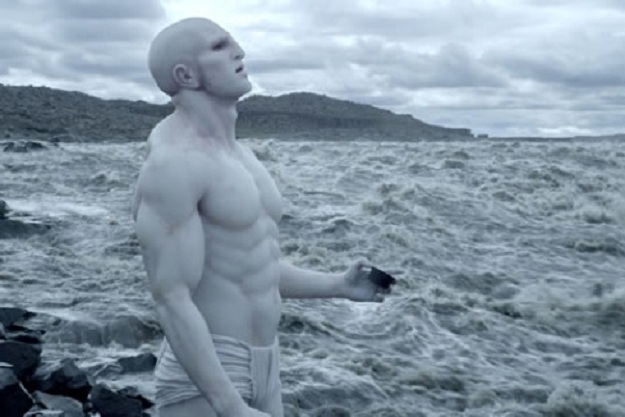
Image / Reality.
The Engineers look like the camp, macho, pseudo-expressionistic and/or neoclassical fascist statues which decorated Hitler's Germany and Mussolini's Italy. They are utterly white, with blank eyes, as though made of marble. They represent a kind of aggressively male, body fascist ideal, with all their bulging muscles and rippling pectorals. Neoclassicism, as it was co-opted by fascism, reproduced the physiques of Michaelangelo's David and Adam as an actual physical ideal rather than as an emblem of human beauty, uniqueness and capability. Humanism became the worship of the allegedly biologically 'perfect', embodied in fascist ideology by the white, male, sexless warrior.

The Engineers tie into this in another way. They are like the giants of Norse myth as it was recycled by Wagner and then by later anti-Semites. There is something of Nazi mysticism about the story of the Engineers. They are the perfect giants from before history who supposedly founded all the life and culture of the human age, their chosen people being, of course, the Aryans. Vickers is a blonde ice maiden, which either implies the Aryan credentials of the Weyland family (if she is Weyland's biological daughter) or his fetish for the Aryan type as representing perfection (if she is an android of his design). David (interesting choice of name there) is also an image of superhuman white European 'perfection'. He dyes his hair blonde to seem even more Aryan and models himself on Peter O'Toole's portrayal of T.E. Lawrence in Lawrence of Arabia, a chiseled white European hero who is presented as overcoming pain and taking upon himself leadership of the Arabs. (Incidentally, this paradigm - whitey becomes the leader of the natives - recurs in popular SF. Think Paul Atreides in Dune, or Jake Sully in Avatar.)

There is yet another element of the film that ties in with this.  The concentration on language.  David studies ancient human languages, explicitly including 'Indo-European'.  His fez-wearing, English-accented holographic teacher says "...whilst this manner of articulation is attested in the Indo-European descendants as a purely paralinguistic form, it is phonemic in the ancestral form dating back 5 millenia or more....".  I'm not knowledgeable enough to know if this means anything, but it still specifically mentions Indo-European.  It is also possible that Sanskrit is explicitly mentioned or alluded to in the film.  There is some disagreement (here, for instance) most of which is well above my head.  But, in any case, David is studying Indo-European languages in an attempt to find some kind of 'root' language which will enable him to communicate with the Engineers, if they do indeed prove to be the progenitors of humanity. The implication is that the Engineers - our ancient creators or ancestors - will have bestowed language upon us. Our languages will be descended from them, just as we are... therefore, the further back into language David can go, the better his chance of finding some way of comprehending the language of the Engineers. And it works.

This is a reiteration of as aspect of the imperial ideology of Aryanism. To quote Richard Seymour in The Liberal Defence of Murder:


The Aryan idea has its origins in the heart of the British Empire. It was a result of the Company's growing control over revenue-collecting and the need to develop an understanding of the texts and languages of the colonized. Not merely a suppuration of imperialism, it became an important fact about the way the empire was organized, and eventually it was offered as the reason why the empire had come about. Essentially, it posited an Indo-European race based upon certain philological affinities between Sanskrit and the Greek and Latin languages. The thesis was that the world's populations could be divided into 'races' descended from Biblical figures - Aryan, Semitic and Tartar. The Aryan race had, it was maintained, invaded and inhabited India during the Vedic 'golden age' and formed a precocious civilization. The post-Vedic age in India had been a sustained period of degeneration: by contrast, the Aryans of Europe were in rude health. These categories not only provided an argument for empire; they also helped to cement British power with the caste system.

(Seymour's notes refer to a book called Orientalism and Race by Tony Ballantyne, which looks both illuminating and dauntingly scholarly.) Note, by the way, how Seymour refers to the East India Company as "the Company".

The concept of Aryanism later found its way into German Romantic occultism and, from thence, into Nazism. The whole idea of an Aryan 'master race' responsible for the primordial foundation of Western civilization - and just about all subsequent Western cultural achievement - is bound up with the theory that the European languages can be traced back, via commonalities with Sanskrit, etc., to a root language: Proto-Indo-European. The subsequent supposed 'degeneration' of the East as the West thrived was put down to several possible influences. In the 18th and 19th centuries, especially after upsurges of rebellion, the intellectuals of the British imperium (including the liberals, by the way) put it down to the malign influence of Islam, and this notion is a direct ancestor of modern liberal Islamophobia. In the even more delusional line of descent which culminated in Nazism, biological notions of Teutonic superiority came to the fore. The biological and culturalist variants of racism have never been as separate as some claim. And both are aspects of imperialist ideology.


Tropes & Implications

Now, this is really as old as the hills. In many respects, it is a slightly more elaborate version of the von Danikenism that has infected so much SF. There is a kind of Eurocentric paternal condescension built into von Danikenism. Ancient peoples, particularly in the Middle East, Africa and South America, are assumed to have been incapable of creating their own cultures and languages. This trope has been widely used in SF. In Doctor Who alone, it has appeared in 'Death to the Daleks', 'Pyramids of Mars', etc.

But it goes further. In Prometheus, the Engineers created all humanity and all human language from their own selves. This 'strong version' too has been utilised before, though possibly never quite so explicitly. In Quatermass and the Pit, we humans have race wars because we are the genetically engineered creatures of Martian insects who went in for ethnic cleansing.... but we don't speak a language descended from theirs, at least not explicitly.

In Prometheus it is not just ancient cultures that owe their technology, design sense, religion and language to aliens, it is all humanity - possibly all life in the galaxy. Taken literally, this obviates humanity's claim to have made its own history. The various revolutions of history - argicultural, urban, industrial - are simply developments towards greater and greater convergence with the culture of the creators. High technology becomes a telos, preset in our chromosomes. The impetus is the pattern within humanity that matches the Engineers. Human biological origins lead to human historical development from cave dwelling to space ships. Our Engineer DNA leads us to develop their language and their technology. The information in our genes makes us create the corresponding information in our culture. This is a kind of biological determinism (rampant in SF) that, through the issues mentioned above, ties the film to a view of human history which stems from the primal influence of godly progenitors who seem associated with patriarchy, imperialism and Aryanism. (By the way, it also explains the film's obsession with information. The star charts; the DNA sequences; the concentration on language and hieroglyphs; the way the two ships both project massive holographic displays that map out space, geography, cartography and architecture. The film depicts a stream of information flowing from the Engineers' genes all the way up to the humans' maps.)

To an extent then, Prometheus adapts an ideologically imperialist, patriarchal, sexist and racialist view of of human history and presents this as a truth. The truth underlying human biology and also, in a deterministic way, the history of human civilisation, is that all our information stems from a kind of Aryan master race who also speak Proto-Indo-European, represent camply fascistic ideas of physical perfection, seem like a monkish warrior brotherhood and look like an all-male group mortally threatened by any other gender but prepared to use rape as a weapon delivery system.

Yet it's hard to say that this makes the import of the text reactionary in a straightforward way. After all, the character of the Engineers seems to be genocidal, ruthless, cruel, sterile, entropic, capricious.... and they are also defeated by their own creations. Moreover, their ship is brought down by a black man and their last survivor (at least on their weapons planet) is outwitted by a woman. It doesn't look as though the film is asking us to worship them or admire them. And the film definitely expects us to be pleased when their plans are thwarted by those more sexually and racially diverse. (On a basic level, it's just nice to see a genre action movie where the black supporting character doesn't die in the second act.)

The Engineers are like the Eurocentric, patriarchal, white, imperial 'origin story' made flesh. They are the idea of the herrenvolk, literalised so that it may be rejected. Weyland's dying words imply that, as gods, they fall short. They have no answers, no meaning. Indeed, they seem to seek the eradication of meaning. They conceive of information - whether it be sexual reproduction or the mechanics of travel - as ways of erasure. They are an idea that seems inimical to other meanings. This inimical idea is then negated by the return of the meaning it tried to revoke and erase. This happens to them, so to speak, twice. They wish to eradicate the first meanings they created - life/civilisation on Earth and perhaps elsewhere - by creating new, deadly meaning in the form of weaponized sex... but this new meaning again turns upon them. (They are, by the way, quite reminiscent of Light - the white, male, authoritarian scientist/angel that wishes to eradicate meaning when it cannot be controlled and classified - in the Doctor Who story 'Ghost Light'.)

If the Engineers are white, male, imperial gods - and redolent of fascism, which is the ultimate syncresis of all these reactionary power principles - then it must be said that they hardly reflect well upon these principles. They are exterminators, stockpilers of biological weapons, purgers of meaning and information when it fails to meet their inscrutable and vindictive standards, etc.


Gardeners & Engineers

In Prometheus, just as in Christian mythology, we are banished by our creators to wander alone, even as everything that we are comes from them/Him. But Prometheus not only reiterates this mythology, it also does that other quintessential job of SF: it ponders the autonomous (alienated and fetishized) product.

It's no shock that SF continually tells stories which reiterate Genesis while also thinking about the alienation of humanity from the produce of their labour. Genesis is about the alienation of humanity from nature brought by the rise of agriculture, surplus and class. SF reiterates Genesis because it is the modern cultural genre that most directly addresses the unprecedented alienation brought by capitalism, modernity, industry and technology. Genesis is about the relationship between humanity and nature, altered by tools. SF is about the constantly changing and decaying and threatening relationship between humanity and the tools themselves as they careen out of our control.

Genesis is, as noted, hardly the first myth to tread this path. Prometheus brought fire to humanity. Fire is knowledge. Science. Technology. It is the first discovery, the first tool, the first weapon, the first product. In so doing, Prometheus dared to suggest not only that humanity should have knowledge, but also that humanity should have the ability to create. More than it destroys, fire transforms. It is the basis of chemistry. It reveals that matter may change its state, be split in various different states, when altered deliberately by humanity.

Prometheus is far from the first SF story to reiterate these matters. It treads directly in the footsteps of Frankenstein. Victor Frankenstein was the 'modern Prometheus' because he revealed the next stage of what may be done with matter by human hands. Frankenstein fails because he does not take social responsibility for his creation. His 'son' is the first product-monster, the first great monster in the history of European culture that is manufactured. But it is only dangerous because it is abandoned, left without care or justice. Frankenstein's monster is the foundation of SF, which is obsessed with the autonomous product that threatens its creator, the manufactured monster. It is terrifying because it is, ultimately, our responsibility and our punishment.

We humans auto-generate. God is our attempt to infer a 'first cause' in this chain of auto-generation and to spiritually imbue it. Modernity is the rising of the productive forces to an unprecedented level, in which we may produce things of unprecedented power at unprecedented speed and in unprecedented numbers. Frankenstein the book appears at the interface of

i) our awareness of ourselves as biologically generated entities,

ii) our idea of ourselves as the creations of God, and

iii) our dawning realisation that modernity - industry, science, technology - allows us to create things more powerful than us, i.e. things more powerful than our bodies or even our gods (which are themselves our creations, after all).

Personally, we all encounter the book at this interface. This is because the book was written at the moment when European civilisation reached such an interface in history.

Humanity has always been quintessentially productive. The ability of our front two feet to leave the ground and become organs of manipulation is what drove the rise of the human brain. Humans are, above all else, the animal that makes tools. Capitalist modernity thus deeply effects our view of ourselves because it revolutionizes the way we produce. The products of modernity are - simply by virtue of their greater numbers, power and speed, if nothing else - more fetishized, more alive, more able to dominate us and run out of our control. They are more able, at least potentially, to mesh with our biology. Mary Shelley saw this potential meshing in the electrode that made the dead convict twitch and clench his fist. It is also implicit in the machine that steals labour, or which sucks the labourer into its embrace, needing to be set in motion by the workers and expressing this by encircling and towering over them. Today, the intrusion into biology becomes ever more clear. We now have cameras that can relay images directly to the brain, cloned creatures, and other wetware. And there are now more ways than ever in which the worker is towered-over and encircled by the hardware and the software.

Since Frankenstein, SF has harped on these issues. SF is a litany of robots, androids, gynoids, computer sentiences, of thinking weapons, of tools that rebel, or scientific experiments that lash back upon the experimenter. Within the settings of 'space' or 'the future' - which represent the dizzying possibilities of modernity, technology and science - the human as a producer of marvels is also a producer of nightmares than cannot be controlled. The line between the producer and the artifact is always being attacked, if only by some new technical innovation. This is the real reason why the robots attack us. This is why so many of the artifacts claim parity with humanity and demand this parity be accepted... and we're lucky if parity is all they want. Also, in SF humans seem to seek unity and merging with the machine, with its uncontrollable power. The machine seems alive; the living thing tends towards the mechanical. The boundry line between the territories is heavily disputed. Like any such border, there are wars over it.

Beyond its Freudian dimensions, Alien ponders these issues covertly.  Its ancient spacefaring aliens (the ones that created the derelict ship) seem inextricably both biology and technology, their pilot looking like an extrusion of beast and engine that has grown within a ship of bones and bulges and arterial corridors and vast hot stomachs in which parasites have laid their eggs.  The thing that is born from Kane's chest is a thing of tendons and pulleys, veins and cables, phallic symbols and skin criss-crossed with what look like the outlines of circuits.  What people often forget is that the 'Xenomorphs' live up to their assigned name.  Their shape morphs to resemble the 'other' in which they grow.  The Alien in the first film has taken on the bio-mechanical nature of the pilot on the crashed ship, and it has also taken on the humanoid size and shape of Kane.  The machine has penetrated the DNA and is now biologically heritable as a trait.  The 'Xenomorph' is the terrifying vehicle/product of this penetration.  And don't forget Ash, with his android-madness apparently triggered by resentment and frustrated sexual hatred, his injuries dripping hydraulic fluid that looks like milk or semen, his synthetic innards looking like white and blue plastic intestines.

Prometheus ponders the same issues overtly.  Just as Frankenstein displaced God by doing what God does, so the Engineers displace God by being what He is supposed to be.  But they also displace Darwinism, at least in the opinion of the biologist.  And they displace Frankenstein again because, by having created us artificially, they trivialize the achievement of Weyland in having made David.  They even displace Tyrell in Blade Runner and the crisis of simulation that his simulacra have triggered.  The simulacrum becomes nothing of the kind when the creator of the simulacra proves to be as engineered a thing as his simulation.  Deckard may have had ambiguous dreams about unicorns but Weyland knows, unambiguously, that he is as much a manufactured entity as David.  This state of having been manufactured is his new normality.  In this state of affairs, who cares that the simulacrum is indistinguishable?  The internal distinction that makes this collapse of distinctions significant has been neutralised.  Just as Natural Selection is overthrown by the revelation that all life is a product of technological engineering, so is Artificial Creation.  You can engineer life at all levels.  Creation dissipates.  The Engineers have manufactured micro-organisms and macro-organisms.  Microbes in the goo, all the way up to giant squids.  They have manufactured not only life but life-cycles.

Of course, these biological manufactoids get 'out of control'.  Creations always do in these tales.  That story goes back to Genesis and before.  Long before.  As noted, SF has continually retold these ancient stories as a way of grappling with the modern era of technological mass-production.  In Frankenstein, the process turns runaway because it is abandoned.  In The Island of Dr Moreau, the process turns runaway even though, possibly even because, it has not been abandoned.  As China Mieville puts it, Frankenstein says that we are failing the Enlightenment and Moreau says that the Enlightenment has failed.

The project of modernity is unstable, uncontrollable, dangerous because even the best efforts to control it founder on the autonomy of the product.  What we might, in political terms, characterise as Mary Shelley's 'reformist' project - drawn from her situation amidst Wollstonecraft (her dead mother, present in her life as stories and texts), Godwin (her father) and Percy Shelley (her husband) - is to nuture and care for the product so that it becomes socially responsible, an agent of justice rather than one of horror.  Frankenstein is her prescient caution of what will ensue if this is not done.  The product will annihilate us.  Mieville says that Frankenstein and Moreau mark opposite ends of the trajectory of Fabianism, mapped out in advance.  Moreau is the despairing terminus of Fabianism, written before Wells joined the Fabians.  Wells says (without knowing it) that, contra Shelley, the 'reformist' project to nurture and care for modernity is doomed to failure because the product will not be controlled, even with the best efforts.  The autonomous product - which is what industry and capital and the fetishized commodity look like in SF - is too much for us to control.

David in Prometheus is, yet again, the autonomous product.  At first, he seems tame because of his position.  He's been subject to a stringent attempt to integrate him into Weyland's Western, capitalist, patriarchal hierarchy.  Like Ash and Bishop, David is a white male.  Unlike those untrustworthy agents, he has been fashioned as an heir.  Weyland shows him preference over his daughter (if she is a biological daughter).  David is "the closest thing" Weyland has "to a son".  The daughter doesn't count.  It's like Dombey, forgetting Florence and putting "only child" on Paul's tombstone.  But still David moves beyond control.  On the contrary, he is in control of everyone else, all the way through the film.  The story happens because of David's agency and actions.  He is evidently not working for Weyland.  Little he does directly serves Weyland's interests.  When he finally does serve Weyland, he gets the old man killed.  How are we - or anyone - to know what David says to the Engineer before the Engineer kills Weyland with David's severed head?  David is unsurprised by Weyland's dying declaration.  David knew better than to expect answers from a manufacturer-god who has been attacked by his own autonomous product.

Prometheus makes the gods themselves into Engineers. Their name itself appropriates the tool, manufacture, industry, technology. It makes production into our master. We become the object of production not the subject. It expresses alienation. We do not make the engines. We are the engines. The engines we do make (David) are therefore the products of products, made because we were made to make them. Our evolution, our social and agricultural history, become products of alien engineering, made by us because we are machines designed to make them.

When we become the autonomous product (as we do in Prometheus), we become as alienated from our manufacturers as any commodity. But that isn't necessarily bad. Why should we care that something is 'out of control'? Whose control? And, as noted, in Prometheus our alien/ated manufacturers are Eurocentric gods. They are Aryan gods. Fascist myths come alive. Patriarchs and warrior elites. It is as though the problems identified in Frankenstein and Dr Moreau have finally been blamed on somebody. Should they be in control?

Is it conceivable - I ask this tentatively - that, in Prometheus, Hollywood has accidentally created a parable about the need for the alienated to revolt against the alien/ating gods of the era of technology? To reject a power that is conceptualised as the ultimate in white, male, imperialist, theocracy? To reject a power that is, furthermore, a personification of the alienation of humans from their ability to freely produce themselves, their lives, their sexuality, their language and their culture?

These are not profundities that were deliberately crafted into the script of this massively expensive bit of commercial entertainment. They are complexities, intimations and ironies that may be teased out of the text and willfully construed because the text stands as a garbled synthesis of many of the tropes of SF, a genre that has been pondering the issues of modernity for so long.

The best way of looking at it is to say that the film Prometheus itself is an autonomous product that seems to have partially and furtively escaped the control of its reactionary manufacturers.

But then, don't they all?


EDIT:  In the original version of this article, I wrongly used the term 'Caucasian' as a synonym for 'white' and/or 'European'.  I have amended this.  JG, 4/4/14

Tuesday, 19 June 2012

When Titans Clash

Spoiler Warning


Prometheus tries to evoke the aesthetics of Alien in a way that is borderline obsessive. Even down to making sure there are cream-coloured leathery/cushiony pads on the spaceship corridor walls. Still greater attention is paid to replicating H.R. Giger's design concepts for the derelict alien ship, cockpit and pilot from the original film. The really weird thing is that, even as Prometheus deliberately and slavishly tries to evoke and/or copy the aesthetics of Alien, it completely overlays them with an entirely different, clashing aesthetic sense.

Look, why is this image so powerful?


There are, I think, a number of reasons.

Most importantly, it's because it is just explicable enough to make sense while also being inexplicable enough to unnerve.  We are plainly looking at a navigator or pilot in a cockpit.  We understand this.  We are also looking at something inhuman and estranged, something that evades any attempt on our part to relate to it directly.  The 'Space Jockey' (as it is sometimes called) is a pilot, evidently, but it is also a giant, a fossil, a mammoth, a skeleton, a statue, a cyborg, a petrified outgrowth of flesh embedded within a colossal machine.  We cannot separate the entity from the artifact.  The ribs of the creature flow outward into the cables of the chair.  The trunk of the face flows down into the workings of the mechanism.  We cannot disentangle organism from system, animal from engine.  They are fundamentally akin, interchangeable, interpenetrating, symbiotic.  This was always the intention: to suggest something that was inextricably both biological and technological.  The cockpit and the pilot are not discrete things but are conjoined to the point of identity.  They were one flesh, until the flesh peeled away.  It's entropic in both an organic and mechanical way simultaneously.  It's the ossified cadaver of a wrecked bio-machine.

It's also beautiful, but not in a straightforward way.  It's not pretty.  It's hideously, ominously, unnaturally, grotesquely beautiful.  It's beautiful in the same way as a scorpion, or the bleached skull of an ox lying in a parched gulch, or a pile of rusted flywheels that was once a graceful machine.  It has the troubling, terrible beauty of wreckage, of the predator, of the insectile, the dead, the decayed, the destroyed, the deadly.

And it's fucking scary.  It's a great big skull-faced monster in a huge black room made out of what looks like loads of bones.

Now, look at this:


This is pretty.  It's the cockpit from Alien... decorated with shimmering CGI lights and swirls and spirals and graphics and glowing planets. It's like someone stuck gold stars all over one of Goya's 'black paintings' or inserted some watercolour daffodils into a Max Ernst canvas. Well, why am I dancing around this? It's like putting pretty, computer-generated patterns all over a picture by H.R. Giger. The design and CGI rendering is perfectly nice in and of itself, but in this context it looks like a tawdry, clashing embellishment. It neutralises the uncanny effect of the setting. For all the familiarity that popular culture now has with Giger (thanks largely to Alien) his imagery remains fundamentally inscrutable. The image above plasters extremely familiar, almost routine imagery - CGI computery prettiness - over this fundamentally inscrutable image. It wouldn't be so bad if this were meant, in narrative terms, to be human technology inserted into the context of the alien ship, as with the floaty red probe things... but the display above is actually supposed to represent the technology and culture and design sense of the pilot-type aliens themselves.

This is more than just an aesthetic problem.  The technology of the beings that Shaw calls 'the Engineers' is recognisably similar to the technology of the humans as we see it in the film.  Suddenly, the mysterious and unknowable culture of the gigantic skeletal bio-mechanical thing from Alien is explained, demonstrated and shown to be easily understood in conventional futuristicky/SF terms.  The aliens have computers just like the humans.  They have holographic displays just like the humans.  They have navigation charts just like the humans.  They have cryo-beds just like the humans.  They have chairs around button-covered consoles... on which they leave their flutes!  They suddenly have doors that open and close (think about it - there's nothing like that in the derelict from the original film).  They have cargo bays.  The cockpit chair turns out to be just that - a chair in which a humanoid sits.  He didn't grow out of it.  He sat in it.  Wearing a spacesuit and a helmet.

This helmet thing is a big deal.  The skeletal face of the alien pilot, with its ossified veins, its cavernous eyes and its trunk-like snout... turns out to be a helmet, just like the head-like helmet of the aliens in Independence Day.  Like many crappy sci-fi films post-Alien, Independence Day tried to ape Giger's influential design concepts.  So ID4 had bio-mechanical stuff in it, but in a processed and banal form.  Now the Alien series reclaims its appropriated design concepts... and recycles the lazy, banal variants already used by inferior films.

And what is inside the helmet?  We get to see.  Not only is the pilot's eerie, inscrutable, alien face revealed to be a piece of perfectly explicable human-like technology, with its trunk a kind of hinged flap, but we see it removed, and beneath there is...  a guy.  An odd-looking guy, for sure, but a guy, nonetheless.

Moreover, these guys have comprehensible motives.  We may not be told why they created life on Earth and then decided to destroy it, but these aims are comprehensible in and of themselves.  The 'Engineers' can be communicated with, spoken to.  Their thought processes are apparently akin to those of humans.  It is no longer that The Company wishes to utilise the Xenomorphs (if we must call them that) as weapons... apparently they always were weapons, or outgrowths of weapons.  The Engineers created them as such, wittingly or unwittingly.  The Engineers are capable of military strategy then, along with fear, rage, the desire for revenge, and other such all-too familiar states of mind.

Again, there's nothing wrong with this in and of itself, but it is appended onto the imagery of the derelict craft and its silent, inscrutable, lonely occupant in Alien... and it represents a fundamental misprision of why those things are so interesting.  Put crudely, to explain the Space Jockey is to make it less mysterious (of course) and therefore less powerful.  It was always a Titan.  It's just that Alien allowed us to believe in the Titan by making it unknowable.  Prometheus makes the Titans less titanic by making them simply larger versions of us.

Wednesday, 16 November 2011

Skulltopus 2: Bad Night at Fang Rock

Further to this post, in which I sketched out the ideas of the author China MiƩville concerning the relationship between the tentacular and the Weird, and the superpositioning of the Weird and the hauntological in monsterology (please read that before you read anything below), here's my first attempt to look at Doctor Who through that lens.

'Horror of Fang Rock' (1977) seems like an obvious first port of call.  Set just before the First World War (in other words, in the years of the rise of the semiotic octopus, just before the explosion of the Weird), the Rutan is a tentacular monster, though the tentacles are rarely seen and, on the whole, the creature seems more like a jellyfish (even down to its "affinity with electricity").


It seems to be a manifestation of the nebulous electrified military modernity that the character Reuben so resents and fears.  It seems permeated with technology through its affinity with electricity.  It uses the generator, speaks of its ability to shape-shift as a "technique" and leaves bits of its own alien tech all over the place, including a "signal modulator" that chimes thematically with all the concentration on the lighthouse's wireless telegraph.  It also espouses an ideology of empire and militarism, and uses an arrogant tone of snobbery with regards to the Sontarans, which is entirely fitting with the story's intense focus on class.

(So, there's an obvious connection here which I've made before.  'Fang Rock' is set in the early 20th century and features a tentacular monster which seems to carry metaphorical weight to do with imperialism, technology, militarism, global conquest... just the kinds of things that tentacles were being used to signify in the early 20th century political propaganda posters mentioned by MiĆ©ville and in my first Skulltopus post.  Obviously, this connection is complicated by the fact that the story I'm talking about was written, made and broadcast in 1977, not 1907 or 1917... but the connection is tempting all the same, as a possible example of semiotic drift, of the cultural bric-a-brac of one age hitching a ride into another via that previous age's representation as a period.)

The story, as a whole, seems more sympathetic to the working class characters than the 'upper class' ones. However, the various strands of the drama which explicitly deal with class only arrive at an open and easily comprehensible liberal critique of snobbery, privilege and inequality, albeit a barbed one.  The nature of the Rutan threatens to sharpen the critique, though it is ultimately far too contradictory a figure to function as a straightforward metaphor, of either a reactionary or radical nature.  The Rutan personifies the oncoming dangers of the twentieth century in a form that associates itself with militarism, military technology, class and imperialism.  However, beyond this core of metaphorical specificity, there is a difficulty in pinning down the Rutan.

It cannot be said to metaphorically embody British imperialism, specifically.  True, it appears in a story in which British imperialism is referenced... but then so is the imperialism of other nations, albeit via the xenophobia of Reuben, who mentions various nationalities engaged in imperialism at this point, saying that none of them can be trusted.  Moreover, the Rutan attacks an island populated entirely by British people.  This is not a difficult semiotic point to parse.  Nor can the Rutan be easily and clearly identified as representing ruling class imperialism.  The story as a whole is intensely concerned with the dynamics of social position, yet the Rutan fails - or refuses - to resolve itself into a part of any clear polemical strategy.

The destruction the Rutan wreaks is general.  It kills all ages, sexes and classes.  It kills the self-consciously 'honourable' officer-and-gentleman who made his name enforcing empire in India.  It kills the titled nouveau riche and his secretary/mistress.  It kills the lighthouse keepers, old and young, and the sailor.  If it stands for the lethal destructiveness of the oncoming era of technology and imperialism... i.e. the 'Great War' that is, to the people in the lighthouse, only a few years away... then it depicts the dangers as generally applicable, regardless of social position.  This is a very deliberate tactic of the text.  There is no other real reason for all the guest characters to die...

...unless it's to imply that Fang Rock will become the setting of a Marie Celeste-style legend.  The last episode ends with the Doctor quoting Wilfrid Wilson Gibson's The Ballad of Flannen Isle, a poem about an actual mystery concerning the unexplained disappearance of three lighthouse keepers in 1900... which suggests that the story was structured in such a way as to make such a quote appropriate.  This is interesting because it suggests the incomprehensibility of a puzzle, of an attempt to reconstruct a 'crime scene' that will defy accurate reconstruction, of subsequent mythic retellings of the weird goings-on at Fang Rock.

Whatever the rationale, this kind of general slaughter is quite usual in Doctor Who.  The best examples of something similar (i.e. the monster kills all but one or a very few survivors) are to be found in horror films, or horror-inflected films.  In SF, the examples that immediately suggest themselves are Alien and John Carpenter's The Thing... which is interesting.  In both films, as in 'Fang Rock', the alien menace is nearly/almost/kind-of/not-quite tentacular in the full octopoidal sense.  In both films, as in 'Fang Rock' (which antedates them both), there are small groups with complex patterns of social status and hierarchy within them (think of Ripley's initial amused contempt for Parker and Brett; of the way Bennings rudely barracks Nauls the black cook).  Also, both films are heavily "Weird-inflected" (to use a term MiĆ©ville has used to describe Alien), in that both feature monsters of unstable physical shape and unknowable mentality (incidentally, that's why I don't like the Director's Cut of Alien - because by reinserting the 'cocoon sequence' Ridley Scott makes the complete disappearance of Brett and Dallas more comprehensible, more purposeful, thus less frightening).

For now let's simply note that 'Fang Rock' depicts a miniature 'British community' - various ages, sexes and classes represented - attacked indiscriminately from outside without regard for the differences within.  You could argue that the reason for the general slaughter is to be found in the failure of the humans to 'pull together'.  In other words, the barbed liberal critique of class collapses into a somewhat moralistic sermon about how, divisions and inequities aside, the British must unite across such barriers to defend themselves against attack from outside.  Looked at this way, the story's liberalism slips into conservatism.  It becomes not merely moralistic but nationalistic.  The imperialism that the Rutan seems to represent becomes forthrightly foreign and aggressive, an alien imperialism of which the British are the victims, to which they must respond, and to which they will collectively fall - if they don't pull together, realise that they're all in it together, keep calm and carry on, etc.  The 'upper classes' come in for some stick, as they sometimes do from various strands of reactionary conservatism, for no longer being sufficiently responsible and effective to 'do their part', unlike the idealised 'rough diamonds' that are the dutiful and comparatively morally elevated working men.  In this mode of reactionary thought, the nation demands that each man do his duty... the responsible working man is to be admired for doing so, whereas the decadent aristocracy is to be scorned for failing.  It's worth noting that the position of lighthouse keeper is freighted with associations to do with duty, lonely sacrifice, guarding the nation's coast, protecting trade, keeping all sea traffic safe, etc.  However, it's also possible to read the text as demonstrating the various ways in which class privilege makes it impossible for the people who enjoy it to co-operate effectively with those below them.  There are constant misunderstandings in the story across the lines of class, with the toffs missing as many cues as the workers and the workers displaying as much savvy as the toffs (think of Vince's naivety about the telegraph message, immediately followed by his understanding that he must burn Palmerdale's bribe or risk being hanged).

When the Rutan steals or copies a human form, it chooses the form of Reuben, the most entrenchedly and doggedly 'old-fashioned' of the working class characters.  His form becomes its chosen vehicle.  Even when it discards his "ridiculous shape", it retains his voice, albeit altered (a point to which I'll return).


But again, it is impossible to fully resolve how this aspect of the text effects the meaning of the Rutan as a depiction of imperialism.   The Rutan remains indeterminate.  Reuben is idiotically xenophobic (much to the Doctor's weary irritation), an aspect of his personality which itself might be seen as undermining the possibility of reading this as a story about the foreign imperialism that he mentions, or as implying that imperialism occurs because of (or functions through) the ignorance, hostility and suspicious nationalism of common people.  In this view, the Rutan's racial chauvinism becomes associated with the xenophobia of the proletarian within an empire; it becomes relocated from the imperial system to the imperial subject.

On the other hand, if we choose to interpret the Rutan as 'using' Reuben (it does, after all, kill him and dump his body in a dark and dirty hole in the course of copying him) then we might see the story as imputing a view of imperialism as the callously lethal forced employment of the working class and the subsequent post-mortem treatment of them as refuse; as a process whereby even the bodies of the workers are stolen from them.  Moreover, when the Rutan appears as itself but continues to use Reuben's voice, that voice is altered... not only by a vocoder, to suggest mechanical reproduction (referring back to the Rutan's strangely and invisibly mechanical interior nature) but also by losing all traces of Reuben's accent and working class modes of speech.  Indeed, the Rutan's voice - though recognisably still voiced by the same actor who played Reuben - has a posh edge to it, an arrogance and swagger which chimes with the militaristic, propagandistic, snobbish, elitist, officer-class tone it strikes in its comments.

So, is there any kind of case for calling 'Horror of Fang Rock' an example of the Weird, albeit only a kind of temporarily resurrected and anachronistic example of it, hauntologically repeating on us via semiotic drift?  Well, we have the early 20th century setting, a tentacular monster which is explicitly formless (even in its 'true' shape it looks more like a dollop of jelly) and protean, with an ability to 'shape shift'.  There is an intimation that the desired effect was to leave the aftermath of the events on the lighthouse as an impenetrable puzzle in the manner of the Flannen Isle mystery.  Furthermore, the monster appears to represent - in a politically irresolvable manner that suggests, from some angles, a reactionary reading - the oncoming nightmares of 20th century modernity: military technology, ruthless imperialism, conquest, general and ignoble slaughter, etc.  The monster has a core of unplaceableness, of unpindownability.  It seems to represent both British imperialism and foreign imperialism attacking Britain, to be both a rebuke to Britain and an alibi for Britain.  Perhaps most particularly, there is the hauntological feel of the piece, which gives way to a non-hauntological monster.  Reuben's talk of the legendary "beast of Fang Rock" and of Ben's soul being likely to walk since those who die unnatural deaths "never rest easy", along with a certain BBC ghost story aesthetic, combine to suggest the hauntological as a feint, only to push such possibilities away once the monster makes its pseudo-fleshy pseudopodia fully visible.

Well... for the reasons above, it might be fair enough to go ahead and call 'Fang Rock' "Weird-inflected", but only to a slight degree.  Many Weird tales are maritime (Hodgson's Sargasso Sea stories, for example), but so are many non-Weird stories.  The mystery of what happened at the lighthouse will be a mystery only to those who find the bodies.  We know exactly what happened.  We saw it all.  The Rutan killed everyone.  We know how and we know why.  Its lethality is clearly and (pseudo)-scientifically explained in terms of electricity.  Its motivation is clearly explained in political, ideological and pragmatic military terms, even if the precise inflection of its imperialism is impossible to fully parse.  If we accept MiĆ©ville's definitions, then the Rutan fails to be Weird at the most fundamental hurdle: it is intelligible.  At the crudest level, the problem is that it speaks.  It converses, rationally and intelligently.  It has a point of view, stated aims, even an ideology.  It has a being, an ontology rather than a hauntology or a Weirdity.  (Though it does retain enough of the spectral or phantasmic to make itself insubstantial when Leela throws a knife at it.)


Moreover, it means... and, however irresolvable (confused might be a less charitable word) that meaning may be, it doesn't mean meaninglessness.  It evades a single, unitary, clear-cut political meaning, but it doesn't evade meaning itself.  It might reflect the bemused and suspicious fear of modernity seen in the character of Reuben, it might reflect a kind of oncoming 'general imperialism' in which imperialism of an international and thus non-localisable kind is 'the problem', but however fuzzy and deferred that meaning becomes, it still is a meaning intended to mean.  The problem embodied in the Rutan is blurred, nebulous, non-local, indeterminate, irresolvable in linear terms... but it isn't fundamentally unknowable.  And it seems to convey things that we (like Reuben) recognise and already fear, hauntology style.  Moreover, we're clearly being asked (as we so often are in this show) to draw moral conclusions.  'Fang Rock' rejects the idea that the horror of modernity makes modernity incomprehensible in principle, and rejects the idea that it is morally neutral.  For all that it flirts with reactionary import, it doesn't come anywhere near that radically scared fugue state in which the 'reactionary ecstatics' of the Weird despaired of meaning entirely.  Doing something like that - i.e. a monster with no apparent motivation, no mentality, no ideology, no discernible purpose, no comprehensible methods even - would likely have been percieved (probably wrongly) as too extreme or unsatisfying for the kid viewers.  It would also approach something that the Weird often does but which Who can never do, simply because of its function within the culture industry: abandon or neglect narrative.

All the same, there is something interesting in the way 'Horror of Fang Rock' comes close to the Weird in some ways, suggests it, skirts it, toys with it, distantly reflects it, attempts (unsuccessfully) to meld it with the hauntological.  This - I'm probably going to argue - is a recurring inflection in Doctor Who.  It's to be expected, given that Doctor Who is a kind of shaggily indiscriminate collage, rudely assembled by too many cooks from the cultural debris of a century and more of genre, pulp and semiotics.

Last word (here anyway):  It's interesting how Doctor Who's constantly repeating foreclosure upon the idea of the supernatural, which is part of its (generally spurious) inner identification of itself as supporting empiricism and materialism (which itself stems from the original idea of it as 'educational') seems to also foreclose upon hauntological readings... something that 'Fang Rock' demonstrates, with its refusal of the hauntological logic despite the employment of the hauntological affect, its use and subsequent disavowal of "fisherman's tales" of "mythical sea creatures", its rumination on the superstitions of the different classes, the moment it gives Leela to express her (paradoxical) 'belief' in science over shamanism.  And yet, the more I look at the show as a whole, the more I seem to see attempts on its part to 'get around' this foreclosure and to represent the haunting, implicating, being/non-being monster that returns the repressed. Hence the peculiar materialist gothic, a strain that runs through it.  Think of the Cybermen, who are simultaneously the embodied nightmares of the technological and bandage-wrapped crypto-Mummies... but with cloth-faces like the linen thing from the Weird/hauntological buffer zone of M. R. James.

I shall probably be looking at Zygons in this series.  And Krynoids (which, in passing, become much less scary when they speak and explain themselves).  And Axons.  And, I suspect most especially, the Fendahl.  And I'll probably have to look at that Tennant two-parter... you know, the one which attempted to grapple with metaphysical themes, the gothic, the satanic... by invoking the resolutely non-gothic, non-ghostly visual tropes of the Weird, ie Lovecraftian Cthulhu-esque slave monsters in revolt.

More later.

Thursday, 30 September 2010

Sex, Death & Rock 'n' Roll

The Curious Orange, before he got the Lee & Herring gig.


In the mid-1980s, Doctor Who (perhaps influenced by a cultural context in which a strict matriarchal figure was punishing the British people for their own submerged desires) developed a habit of delving into surprisingly murky and morbid corners... and no story has corners quite as murky and morbid as 'Revelation of the Daleks'. The undercurrents in this strange tale include unrequited love, lust, suicide, alcoholism, putrefaction, mutilation, cannibalism and even – obliquely – necrophilia. This is a story that has a perverse, sexless, destructive, sado-masochistic anti-romance at its core, relegating all the stuff about galactic conquest to the sidelines.

Naturally, displaying obtuseness that is almost customary, most commentators have missed this and worried volubly about the least of the story’s delectable sins: the onscreen violence, which is only startling when judged against the largely implicit jeopardy of the Davison era and hardly compares to the extremes of, say, ‘The Brain of Morbius’. But ‘Revelation’ looked tame even then, even by the standards of material made for kids. Have you seen Indiana Jones and the Temple of Doom? It’s torture porn for finger-painters.


THE DORIAN MODE

The literary novel that we're *supposed* to talk about in connection with 'Revelation' is, of course, Waugh's The Loved One... but, while I don't dispute the Waugh connection, the book that I always find myself thinking of when I watch 'Revelation' is Wilde’s The Picture of Dorian Gray. This is a novel that seriously worried some people at the time of its publication, not just because of its determinedly ambiguous morality and gay undercurrents, but because of its sheer, unbridled (and supposedly un-British) sensuality; its focus upon physical details, upon heady emotions and upon lavish descriptions of colours, fabrics, flowers and, most especially, aromas. The eponymous Dorian even spends some of his long life dedicated to the study and enjoyment of perfumes.

We encounter smells in many Saward scripts. In ‘The Visitation’, the TARDIS crew encounters the smell of sulpher and then of the alien gas soliton. In ‘Resurrection of the Daleks’, the bacteriological weapon used against the staff of the prison ship causes the infected to stink even as their skin bubbles and drips off. In ‘Attack of the Cybermen’, the defrosting Telosian tombs give off the smell of bad meat. In ‘The Two Doctors’, which Saward script-edited, the Doctor launches into a little soliloquy about the evocativeness of smell as he and Peri stand in the kitchen of the deserted space station, sniffing the rotting food and – it is implied – the corpses that the Sontarans left in their wake. In ‘Revelation’ we have Bostock who stinks “like rotting flesh” because his personal philosophy forbids him to wash. The smell of the butcher’s shop window is heavily implied by Stengos’ appearance.

Also, as in Dorian Gray, there is a noticeable emphasis on flowers. The Doctor and Peri walk through banks of them on their way to Tranquil Repose; Jobel and his staff are first seen amidst floral decorations; Tasambeker is offered a flower in a cruel parody of a compliment.

The echoes of Dorian continue. ‘Revelation’ is a story unusually interested in surfaces, even if only to highlight the tacky tastelessness of the funeral business. ‘Revelation’, like Dorian, is a story in which inner corruption is hidden by superficial beauty. What does the cosmetic undertaker do but hide the corruption of a cadaver under make-up, creating the illusion of an unblemished loved one sleeping the sleep of the just? The desire for unearned immortality is shared by Dorian Gray and the unscrupulous, frozen, ruling class that seem destined to get their wish horribly fulfilled inside Dalek casings.

'Revelation' might, in very broad terms, inherit a setting and a character from The Loved One, but in just about every other respect, Waugh is jettisoned. Waugh's novel (easily his worst) is about British ex-pats amidst the cultural peculiarities of mid-20th century California. Wilde's novel (in my view, one of the very greatest English novels of the 19th century) donates far more of its concerns to 'Revelation', even if they are the more superficial ones: surfaces, appearances, corruption, immortality, art and odour... and the body.


WRITTEN ON THE BODY

I think that ‘Revelation’ is - perhaps more than any other tale in the canon - about the body. This is quite a large statement, since the list of Who stories that have tried to creep kids out by showing them bodily possessions, bodily infections, bodily mutations, bodily transformations and bodily mutilations is very long. Funny thing is, relatively few of the stories that have featured these things have also really been about the body. ‘Black Orchid’ features disfigurement (both voluntary and involuntary) but that isn’t really what it’s about… if, in fact, it could be said to be about anything. ‘The Seeds of Doom’ dwells lovingly on gradual and grueling physical consumption/transformation of animal by vegetation, but the point is the frightening idea of a natural world that rebels against us, of an inverted food chain as in ‘The Day of the Triffids’. ‘The Caves of Androzani’ features infection by a toxin that mercilessly destroys the body from within, yet only the fever brought on by the closing stages of the poisoning seems to relate to anything beyond pure plot, as Peri’s burning temperature meshes with Jek’s febrile temperament. Jek himself is, in his Richard IIIish way, consumed by his own disfigurement, but this is only a symptom of his morbid narcissism. ‘Inferno’ features werewolvish transformations, but these are more like manifestations of man’s partly brutish nature than meditations on the animal body itself. Cybermen stories have consistently failed to harp on the one potentially scary thing about the Cybermen: the way they physically invade and transform us, revealing a compatibility between organism and artifact. ‘The Ark in Space’ is probably the nearest the series ever came to true and pure “body horror” before ‘Revelation’, but even here, where the horror of compatibility is forcefully expressed, the compatibility with the insectile is stressed as psychological and cultural and social even more than physical. Apart from ‘The Empty Child’ (which is a whole can of worms by itself), the nearest the new series has come to doing a story about the body is probably ‘New Earth’, which has mutants, medicines, cat people and a grotesquely fat man who is turning to stone... the physical concerns continue into the main subplot, which is a ‘body-swap’ comedy of the type that Hollywood produced by the hundredweight in the late 80s (all of them, as far as I can recall, starring either Tom Hanks or people who built their entire careers on looking and sounding vaguely like Tom Hanks). Mind you, it should be noted just how much 'New Earth' owes to 'Revelation'. In the secret, gothic depths below a professional institution seemingly devoted to healing, ghastly experiments are afoot which treat humans as raw material, blah, blah, blah.

I mentioned, above, the failed potential of almost all Cyberman stories to confront the body as a theme or as an opportunity for provoking horror... well, as Tat Wood points out in About Time vol. 6, 'Revelation' is really a Cyberman story but with Daleks instead of Cybermen! Saward was, as everyone knows, obsessed with Cybermen... however, the Cybermen in his stories tend to act and talk more like macho mercenaries than emotionless creatures of pure logic. Of course, there's always been a problem with the Cybermen. Arguably, the only ones that ever really seemed plausibly emotionless and even faintly logical were the ones in 'The Tenth Planet'... but even they are acting irrationally when you really analyse them. It was a bad mistake to ask TV hacks to write monsters who were totally logical; they usually find it hard enough to write human characters who behave according to the ad hoc logic of normal, everyday sanity... but, I'm supposed to be writing about Daleks not Cybermen... which is the same mistake Saward made in 'Revelation'. Everything in 'Revelation' makes it the perfect context in which Cybermen can be properly reimagined as the predatory robozombies that they always coulda/woulda/shoulda been. 'Revelation' is about death and resurrection via technology, about the merging of technology with biology, about the horror of compatibility, about the infiltration of the emotional mind by programmed dogma (Stengos), about the contrast between the eccentricity of human passions coming into conflict with bland and sinister uniformity (there is even a scene in which someone kills Daleks with rock 'n' roll), about humans as meat, about humans as product, etc., etc., etc. The story seems tailor made for the Cybermen. Even the Jobel and Tasambeker subplot fits in beautifully. The rather tragic Tasambeker could actually find relief in losing her emotions whereas Jobel could be semi-redeemed by his ferocious attachment to physical lusts and pleasures. This is a story that could have allowed the show to, for once, actually explore the concepts and implications of the Cybermen rather than just using them as stomping heavies. And so... they put Davros and the Daleks into it. Moreover, Saward actually uses the story to turn the Daleks into Cybermen, i.e. by having the Daleks (for the first time) harvesting humans and transforming them into new Daleks.

The really strange thing is that this happens again in 'The Parting of the Ways'. The 2005 finale episodes would make much more thematic sense as a Cyberman story, though Russell T. Davies stamps his own imprimatur upon matters by making these remade, half-human Daleks into crazed religious fundies. Irony drenches matters when you consider that 'Revelation of the Daleks', a title so arbitrary and irrelevant when applied to the closer of Season 22, would have been a very apt title (on several levels) for 'Bad Wolf', whereas 'Bad Wolf' is what 'Parting of the Ways' should've been called. 'Revelation' of the Daleks' should, of course, have been called 'Resurrection of the Daleks'... which opens the question of what 'Resurrection of the Daleks' should've been called. How about 'The Parting of the Ways'?

Anyway, that's enough title shuffling. Back to the point.

Interestingly enough, the actual Cyberman story which does do more than any other to confront the sheer horror of physical invasion posed by the Cybermen is the Season 22 opener 'Attack of the Cybermen' (which wasn't written by Eric Saward... honest guv). Whatever the overall weaknesses of the story (and they are considerable) it does manage to (sort of) remember that the Cybermen are predatory zombies rather than just robots. As mentioned, the defrosted Telosian tombs emanate a nasty smell; the torture of Lytton for information demonstrates that the Cybermen think of pain as an exploitable weakness of the fleshlings (a point somewhat undermined by their habit in the 80s of yelling and giving every appearance of agony when shot); the half-converted Lytton begs to be put out of his misery and uses his last ounce of self-will to stab the Cyberleader, who then gushes gouts of green hydraulic fluid over him.

It should be no surprise that this happens in Season 22, a run of episodes absolutely obsessed with wallowing in bodily fluids. Now, one can sneer at Saward's desire to make Doctor Who all gory and gungey, but he's tuned into his cultural moment, at least in terms of the genre in which he had found himself working. Saward's tenure (roughly, 1982-1985) coincides with a remarkable period of shift in the aesthetics of mainstream fantasy and sci-fi movies, away from the heroic style epitomised by the ultra-influential Star Wars films (the original ones, I mean... the proper ones) and towards a grottier, grimier, ickier set of visual and thematic concerns. The original Star Wars itself had been a step in this direction, for its time. Unlike the pristine environments of 2001: A Space Odyssey, the "galaxy far, far away" in which Luke, Han and Leia strut their seventies stuff has dirty space canteens full of exotic aliens and waste disposal chambers full of smelly garbage.

But Ridley Scott's Alien (a film that Saward attempted to remake in a Who context at least twice) self-consciously goes a quantum leap further. By co-opting the Swiss surrealist artist H.R. Giger to do the alien spaceship/creature designs, the producers opened a whole can of very wriggly worms. Giger tapped directly into the unspoken, submerged (possibly unconscious) concerns of the shlocky script and produced some of the most remarkable and influential production design concepts in cinema history. The derelict alien ship discovered by the blue collar astrogrunts is a twisted dreamscape of ribcage corridors, pregnant bulges, labial slits, vaginal openings and penile extrusions. The aliens themselves are separated units of this Freudian nightmareland, created as they are from spidery mobile hands that grab your face and cover your screaming mouth, fleshy probes that thrust themselves down your throat and lay their eggs inside you, aggressive penises with gnashing metal teeth that give birth to themselves through your chest, giant phallic tubed heads and barbed tails that grope you before their grinning faces split open and erupt into yet more fanged cocks, dripping thick goo. Alien may be about space people on a space ship getting killed by a space alien... but its also about lust, rape, sexual sadism, pregnancy as parasitism, childbirth as painful violence... all the horrors that we sometimes detect in the sexual and the physical. Sometimes people look at me funny when I talk like this. But, really, this film has Ian Holm (with white, milky fluid dripping down his face) trying to kill Sigourney Weaver by shoving a rolled-up porn mag into her mouth. This is hardly a subtext at all.

The other interesting thing about the aliens in the Alien movies is that they are "bio-mechanoids", examples of a kind of being that Giger had been imagining and painting and sculpting for years. They are not just made of rude bits and pieces, they're also made of tubing and pistons and pumps. Their skin is patterned like fleshy circuitboards. Look at the way the alien is hidden in plain sight in the final sequence of the original film. As Sigourney strips to her smalls, she wanders round the escape shuttle, oblivious to the fact that the alien is sitting curled up amidst the wires and control panels and pipes that line the walls of the ship. It isn't obscured, or crouching in the dark. It is just sat there. But she doesn't see it, and nor do we... because its head looks like part of the machinery. The same trick is pulled (far less successfully) in the later films.

There are probably all sorts of arthouse and/or cult movies that got there first, but Alien is the one that really got everyone's attention. Ridley Scott didn't invent the idea of "body horror" but he did do it very well and make it phenomenally successful. David Cronenberg had been plugging away making films about the relationships between injury, infection, mutation, deformity, consciousness and sex (sorry, I mean SEX!!!!) since the 60s. Cronenberg, routinely called a genius nowadays, toiled in the wilderness for years making startling, eccentric, deeply unnerving and sexually charged horror films.

Interestingly enough, the Saward tenure on Doctor Who more or less coincides with a shift towards science-fiction in Cronenberg's films. Scanners (1981), Videodrome (1983) and The Fly (1986) all come from this period. Cronenberg's films had harped on about scientists and experiments before, but these films are the ones that start worrying about the future of technology and how it will effect human physical existence and experience. These films break new ground in their depiction of tortured human bodies penetrated and meshed with the machines of the future, machines like computers, televisions, video players and telepods.

You'll have noticed that these sci-fi/horror movies I've been talking about have a common theme: the meshing of technology and biology. They also tend to be highly politically charged. Videodrome is about a right-wing conspiracy to infiltrate the minds of TV viewers, turning them into slaves who will commit political assassinations to order. John Carpenter's semi-masterpiece They Live, also from around this time and part of this shift, is about... well, it's about an ordinary American working class man who has been laid off, has to take casual and non-unionised work, lives in a kind of shanty town for the poor, witnesses a violent police attack upon said shanty town and then acquires a pair of magic sunglasses, through which an ordinary American cityscape looks like this:

...and politicians, businessmen, cops and rich people look like this:

Through the glasses, dollar bills are just white oblongs with 'THIS IS YOUR GOD' written on them. The ruling class and their lackeys all turn out to be aliens... an idea also broached in a truly extraordinary film, also from the late 80s, called Society.

I don't want to overstate this. Carpenter's The Thing - a rare example of a remake that comprehensively wipes the floor with its lacklustre original - is a film from around this period that does just about everything imaginable with and to the human body short of meshing it with technology... and it's also noticeably, even remarkably, apolitical for Carpenter. But, on the whole, there is a mini-trend in genre movies around this time for sci-fi and horror to merge, for these mixed genres to feature mergings of human biology with technology, and for these stories to have strong political subtexts.

Much of Saward's oeuvre fits this general pattern... and he was only amplifying and marrying-up tendencies that had already been in Who for some time. The show's second ever story was a political allegory featuring cyborgs! And since 'Inferno', arguably since 'The Tomb of the Cybermen', it had been on the radar of Who creative teams that their show worked as 'horror films for kids' (I forget who coined that phrase but it's perfect). Saward seems to have drawn on the trends in sci-fi/horror filmmaking to synthesize these trends, though he was less interested in the politics than in the cool biomechanoids splattered with gore.

And that's part of how we ended up with Lytton's crushed hands, and Stengos' mutated head - complete with pulsating veins - sitting inside a transparent Dalek casing.

But ‘Revelation of the Daleks’ does more than just present us with cool images. Like Alien (which is clearly an influence on Saward) it really is, in a very essential way, about the human body… and, in a submerged way, about sex (we’ll get to this a bit later). In fact, the story’s preoccupation with physicality is almost obsessional, certainly when compared with most other Who stories. It is quite prepared (ready, happy, eager) to get nasty about the body. There’s a kind of constant background squelch of physical ickiness. ‘Revelation of the Daleks’ gives a booze-swigging coward lines about how he’ll “know the name and function of each organ as it plops out” when he is tortured to death, harps on about bodies decomposing to the point where they “froth” or need to be “ladled” into suitable containers, has crooked accountants make queeny double entendres about “double entries”, smirkingly brings up the subject of nose-picking, shows us a room full of pickled yet living brains and introduces a character who stinks like bad meat because personal hygiene is against his principles. But ‘Revelation’ goes further than that. It doesn’t just mention smells and snot and hint at sodomy. It mentions all sorts of ways in which the body is, or becomes, disgusting and ruined.

Leaving aside the various ways that the story references decomposition, let’s think about disfigurement. Natasha is only threatened with disfigurement before the distinctly unenthusiastic Takis puts the brakes on Lilt’s naked sadism. But just consider, for a moment, the number of people in the story who are disfigured or mangled in some way. First, of course, we have Davros. For much of the story he appears to be nothing but a head in a jar; later, when the real Davros appears, we learn that there’s a bit more of him than that… but he’s still crippled, wheelchair bound, eyeless and one-armed. This is an inheritance from previous continuity, but it still chimes with Orcini’s faulty artificial leg, the leprous mutant who attacks the Doctor and Peri, and even Tasambeker’s crippling awkwardness. The deformity seems to radiate outwards from Davros, making him look like a warping influence upon the world around him. Stengos, in particular, mirrors Davros. By the time Natasha finds him, he’s also a disfigured, mutated, disembodied head meshed with technology, half enclosed inside a Dalek casing. It’s almost as if Davros, who titters like a flasher as Natasha comes closer to finding her father in this state, is trying to recreate himself. Well, he’s always had “a fanatical desire to perpetuate himself in his machine” and, according to the Doctor, Davros has “finally done it… he’s finally managed to create Daleks that can reproduce anywhere.”

Reproduction. Children. Davros and his creatures. Stengos and his daughter. Meanwhile, Tasambeker longs to make her disdainful and contemptuous boss into a sugar daddy, even as Jobel lusts after girls (including Peri) young enough to be his daughter. When stroking his own vanity by cruelly taunting Tasambeker, Jobel’s worst insult is to compare her (and unfavourably at that) to his mother. Anybody who recognises in Jobel the shade of his pseudo-template - the slavish mummy’s boy Joyboy - will know what this suggests. The half-glimpsed hints that gather around these conjunctions are creepy in the extreme.


FREUDIAN TRIPS

Yes, we’re finally onto the sex. The intonations are incoherent and quiet, but they are undeniably sexual and they are the darkest sexual intonations to be found anywhere in Doctor Who. Even those married cousins ‘The Curse of Fenric’ and ‘The Empty Child’ have nothing to match ‘Revelation’ when it comes to furtively murmured sexual undercurrents. ‘The Empty Child’ is saturated in sex (from the girl/woman child/mother Nancy to the omnivorous lothario Captain Jack; from the butcher and his other way of trading meat to that whole conversation about “dancing”; from Algy’s cute bum to the “man” that sent an evacuated boy running back to the safer option of nightly bombing raids) but, while it acknowledges that sex is scary and dangerous, it doesn’t seem to despair of the possibility that most options – including promiscuity and teen-parenthood – can bring fulfillment… indeed, if it has a ‘message’, it is that sex is linked to the fulfillment of real humanity, counterpoised against the emptiness of repression and denial. Even ‘Fenric’ - with its monsters that emerge from the teenage female psyche, mother-hatred, emotional rape and strong intimations of repressed public school gay crushes ending in violence and paralysis - cannot end without suggesting that “dangerous undercurrents” can be banished by having a bit of a swim in your suspenders. Shall we therapeutically regress ourselves back into the show’s black and white superego (skipping tastefully over the Australian woman with a huge, evil, pink snake in her subconscious), all the way back to the early days? Ahh, but things were simpler and more innocent back then when the galaxy was monochome and in 405 lines. ‘The Rescue’ can only (just) be interpreted as being about a teenage girl menaced by a pervert in a fetish costume if you squint at it very hard with ironic determination; ‘The Romans’ refuses to even notice the fact that it makes farcical comedy out of the way a fat murderer attempts to molest a slavegirl; Edith in ‘The Time Meddler’ is assaulted by rampaging Norsemen, but only because Dennis Spooner is raising his authorial eyebrows knowingly at Viking stereotypes.

By contrast, in ‘Revelation of the Daleks’ we are presented with a tubby, toupĆ©ed, lecherous embalmer of corpses (first seen showing off amidst a display of peacock feathers: the symbol par excellence of male sexual strutting) who extends his love of playing with bodies to his living female staff members, sexually harasses Peri (taking her every cringe as encouragement) and enjoys himself by viciously insulting and demeaning a young woman who fawns on him like an over-excited puppy. When asked why she dotes on the man who constantly humiliates her, she is unable to answer… but why does anybody keep voluntarily going back for more punishment? Their Master/slave relationship is truly discomforting to watch; her every groveling submission only making him into more of a bully. Her inner hatred of Jobel is toyed with by Davros until she seems ready to murder the object of her hopeless affection, expecting no reward but to be freed from her body and made into a Dalek. It is left ambiguous whether this idea genuinely appeals to her, or whether it is just her sycophancy to Davros and fear for Jobel that makes her seem to accept it… but one can almost understand how the idea might appeal to her: the idea of shedding her body. When Takis playfully, mockingly, gives her a flower, she throws it away like contact with something beautiful is a reproach to her. It seems to be this action that entices Davros to start playing with her… perhaps he sees himself in her gesture, empathizing with the trapped rage that makes her want to destroy and reject beauty. In any case, by the time she reaches Jobel she has decided to warn him. But Jobel is clear: he’d rather “run away” with his mother than “own” her. Despite the pre-watershed code-words, it’s obvious what Jobel is getting at. In his supreme arrogance, Jobel takes her warning as an attempt at ingratiation with a transparent ulterior motive (he may even be partly right) and rather than let anyone imagine that she might be anywhere near his league (ha!), he spurns and needles her until she snaps. How does Jobel manage to upset her so much that she plunges a syringe full of embalming fluid into his heart? Well, there’s the mother comment… but he also says something that, on the face of it, seems almost kind. “You’ve spent too many hours alone in this preparation room,” he says quietly. “Someone as impressionable as you should lavish a little more time on the living rather than fantasizing with the dead.” The italics are mine, but Clive Swift does give those words suggestive emphasis. Remember that pleased little smile on her face when she gets permission to tart up the corpse of the murdered guard? Davros refers to how Jobel likes to “play with the bodies of the dead”. Maybe Tasambeker does too. What kind of “fantasizing with the dead” does this awkward, downtrodden, disliked, vilified, lonely, masochistic woman get up to when she’s all by herself in the preparation room with unresisting, silent playmates? I’m not saying that the intimation was necessarily deliberate, or even conscious, but it’s there all the same. Killing for Company was published the same year that ‘Revelation’ was broadcast. We have waded, perhaps by accident, into very deep and dark waters indeed.

Mind you, even at this point, as Jobel pierces Tasambeker so effectively with his needling that she is driven to pierce him with a needle in return, the story cannot resist undercutting itself ironically with a reminder of the absurdity and fragility of the body and bodily dignity. As Jobel, the preening narcissist, drops to the floor, gasping his incredulity at the idea of anybody thinking they could manage without him, and dies… his ridiculous wig falls off, revealing the pathetic bald pate of a vain old man.

***

This seems like an appropriate moment to end this session, as someone once said. I have more to say about this bottomless pit of a story, but it'll have to wait for another time. Expect politics. Lots of it.