Yep, here's the best of my Pertwee stuff from Timelash II. Thrill to my confusion as I struggle to get to grips with an era that itself struggled to get to grips with fuel controversies, miners' strikes, feminism and loads of funny stuff like that. Lots of new material in amongst the stuff I posted at Gallibase.
‘Inferno’
I remember the first time I saw 'Inferno'. I was at university. I popped into town and bought the VHS release with pretty much the last scrapings from the bottom of my overdraught. I took it back to my digs and watched it in one sitting, surrounded by half-read Penguin classics, half-written essays and empty beer cans.
I remember, somewhere towards the middle of the story, practically praying to Someone Or Other (the gods of TV probably) that the writer would have the balls to refuse to reveal what the green slime was and/or what the Primords were.
I remember being well pleased when I got to the end without having had some clumsy sci-fi "explanation" foisted on me.
The Primords are just there. They represent the animal in man, unleashed. The are the externalised form of the snarling beast inside the Brigade Leader that makes him enjoy his fascistic work so much, of the apes inside Sutton and Stahlman that make them tear and snap at each other.
Luckily, the story also has some intelligent things to say about the way people are shaped by the societies in which they live. That fine fellow Mr Benton, when raised in a fascist world (or possibly just employed by one), becomes a brutal sadist... so it's not about our bestial original sin but about our choices within society as we find it and as it shapes us.
UNIT guards make their own lives but not in circumstances of their own choosing.
I know the evil-version-of-regular-character-in-alt-world thing is hardly original... but 'Inferno' does it better and smarter than any other take on the same idea that I’ve seen.
Also, as
The Discontinuity Guide says, the "so free will is not an illusion after all!" scene elicits a cheer (or should do) from the viewer.
It's a powerful piece of work because of the ideas, even if they’re not stunningly profound or original, and because of the strength of the direction. The constant background thrumming of machinery, the hazy heat of the outside world, the bleak industrial wasteland in which the project seems to nestle, the use of brilliant 'stock' music by Delia Derbyshire, the incrementally jacked-up claustrophobia, the sweating actors, the performances that ratchet up the tension, the nightmarish apocalypse in Episode Six with blistered zombies catatonic as the air fills with hot ash, the well-integrated stock footage of lava explosions, the stunningly tight and tense cliffhanger to Episode Four with the countdown reaching zero as the Doctor and Stahlmann face each other over a gun... it goes on and on.
Also, the open question of whether the alt-world is a fascist or communist tyranny leads to all sorts of interesting (to me anyway) avenues of thought, including the observation that, either way, it’s more similar than it is different to the democratic world of the Brigadier and UNIT. The basic structure of both societies is essentially the same, i.e. capitalist with varying degrees of state control. The intention of the piece is probably to imply that dictatorships are ‘all the same’, be they right-wing or left-wing in their ideology. But, to me, this is a dead end, and an implication that obscures more than it reveals. But I’ve covered this stuff more fully (far too fully, probably) in
another post.
‘Terror of the Autons’
Well, it's bollocks, obviously... but it's also the moment when
Doctor Who becomes
Doctor Who in the public sense, when it begins to correspond (in a fuzzy, broad, general way) to the mental image of the show that the Gen Pub will adopt, nurse and be disappointed to find the show diverging from in the years ahead.
The Master is a cardboard King Rat in a Nehru collar. He is born fully formed in all his inglory; talking nonsense, having silly plans, twirling his moustache (practically), failing to kill the Doctor time and time again despite his professed hatred, plotting to take over/destroy the world for no adequately explored reason, etc, etc... but Roger Delgado is mesmerisingly good, refusing to send up the daft material.
Jo is utterly irritating... she's the quintessential daft, blonde, screamy, cutesy dollybird that will be perceived as a template for the
ur-companion from now on... despite the fact that no companion before or since her has ever really been very much like that.... but Katy is lovable… if you decide not to worry about the depiction of a woman as an infantile accessory to all the grown-ups (i.e. the men). To be honest, if you’re going to let that sort of thing worry you too much, vast swathes of
Doctor Who are going to become pretty much unwatchable. I’m not saying you have to accept it uncritically.
Robert Holmes delivers his silliest script so far... but it's also relentlessly and determinedly nasty, filled with imaginative murder, haunted by suffocation and strangulation (with an obsessive harping on such ways of dying that is borderline disturbing and entirely delicious)...
This develops some things that are submerged in the original Auton story: an implied critique of mass produced consumer culture and a representation of alienation through hostile commodities. The death in this story emanates from mass produced commodities, from consumer goods. Grotesque plastic dolls spring to life and lunge at your jugular, ghastly 70s novelty chairs eat you alive, phones strangle you, fake flowers squirt glue at your face, etc. As in ‘Spearhead’, the evil nestles and coils amidst boring business guys in boring offices. As in ‘Spearhead’, the factory manager is enslaved by mind control and colludes with the Nestenes as they mesh with his means of production in order to mass produce the units of themselves that will infiltrate the market and take over our high streets, enslaving us before we know what’s happening. They also find a way in under our noses by disguising themselves within the context of policemen and police cars. Ask these bobbies where they’re taking you and you’ll find blank-faced, eyeless horrors lurking under their latex masks. They’re there to stop you opposing the immanent ascendency of the evil commodities, the products of human labour and industrial production that are now so far out of our control that they confront us as something hostile and alien.
This is Holmes at his silliest, nastiest and most sneaky, undermining the whole of the adult world and implying that everything modern and nice and happy and cute hides razor sharp jaws that will snap closed on you when you least expect it. It could hardly be called satire, still less is it consciously Marxist allegory, but, nevertheless, it taps right into anxieties about consumer culture, authority, the unaccountable goings on in boardrooms, the bland horror of mass produced commercial kipple and the way we’re now so alienated from the things with which human labour and industry is cluttering up the world.
Shame about Roy Stewart being asked back to play essentially the same racist stereotype he played in 'Tomb of the Cybermen'... but it's almost emblematic of the slightly nauseous, off-colour, icky tone of the whole piece.
The whole thing is almost perversely bright and gaudy and multicoloured... it gives it the quality of a surreal nightmare, a bad LSD trip in which the colours of the world get brighter and sunnier and realer even as (to borrow from the great
Dr Hunter S Thompson) you watch your dead grandmother climb up your leg with a knife in her teeth.
It's also repetitious, meandering, plotless, characterless... i.e. worthless if you expect it to aspire to anything resembling "drama". It's fun, but of a very queasy kind.
‘The Mind of Evil’
There is a very old idea about ‘human nature’, that we are born with certain characteristics already implanted or programmed in our brains, usually inherited from our parents and ancestors. You will find this idea laced throughout the whole of modern Western culture. Ruffians and villains in Conan Doyle are often said to have "vile antecedents". Oliver Twist is incapable of being a pickpocket because, despite being raised in a pauper's orphanage, he is a middle class child displaced amongst the scum classes. Similarly (because J.K. Rowling is nothing if not studiedly unoriginal) Harry Potter is "unfailingly kind" just like his late mum, despite being systematically emotionally and psychologically abused up to the age of 11. I could go on at great length.
This conception of human nature (please take the quote marks as read whenever I use that phrase) is directly and inextricably linked to class, and to questions of social role, crime, etc. It is still claimed today that people end up in prison because they have inborn tendencies which lead them there. These days we use the language of genetics. Before genes, people used the language of blood. Before that, people used the language of the Bible. The medieval church claimed that drastic and dreadful social divisions were justified because people were born into one category or the other, based on their bloodline. They were the descendents of Cain or Abel, and thus carried the blood of a vile murderer or a goody-two-shoes innocent. Of course, the idea that the peasants were peasants because they had murderer's blood doesn't account for the massive amount of warmongering and killing and torturing and executing done by the supposed descendents of Abel (i.e the Kings and Dukes and whathaveyou). Of course, even today a great deal of chin-scratching cogitation goes into deciding what genetic factors might be causing black urban gun crime... while nobody wonders if the carpet-bombing Prime Minister must have killer genes. And, as John Ball pointed out, if we're all descended from Cain or Abel, that also means we're all descended from (non-murdering) Adam and Eve... so how does that work?
As many thinkers have pointed out, being in prison isn't necessarily a mark of violence or evil (or even, in many cases, actual criminality) so much as a mark of refusing to play your assigned social role. It starts in childhood, with kids medicated for personality disorders for such heinous sins as "disrespecting authority" etc. Also, prisons are a massive system of social control and punitive reinforcement. Vast numbers of people in the American prison system today (which increasingly resembles a kind of privatised system of gulags) are there for non-violent drug crimes. There are many examples of, for instance, disabled people sent away for life because they were caught with a few ounces of weed that they obtained to use personally as a palliative. Meanwhile, the captains of finance who devastate our world and societies, or the politicians who demolish victim populations in the Middle East, somehow mysteriously avoid trial and incarceration.
All of which is a roundabout way of saying that I don't like 'The Mind of Evil'.
Of course, it would be ridiculous to say that we're born without any innate characteristics. We're all born with the grabbing reflex, with "face recognition software", with syntax (if you believe some people), etc... and we're probably capable of being born with the innate set of mental aptitudes that can lead to, say, musical ability, etc. But the tendency - even amongst people who, for instance, edit the journal
Science or flog lots of popular science books - is to talk about "
genes for homelessness" (which wouldn't be the only silly thing that
Matt Ridley believes) or "genes for crime". "Crime" is artificially essentialized into something called, say, "aggression" or "anti-social behaviour" and all sorts of varied and contingent social behaviours are artificially lumped together under this term, while others (the warmongering of leaders, for instance, or the drug dealing of big tobacco firms) are mysteriously ignored, presumably because they are seen as inherently non-criminal.
There's a very interesting (and largely amicable) discussion about this stuff between Richard Dawkins and Steven Rose,
here. I particularly like the fact that Rose is wearing a long, multi-coloured scarf.
It’s been pointed out to me that there’s nothing in the story that directly implies that the prisoners are ‘born bad’. They might, it is suggested, just as well contract the evil via their experiences. Well, okay, but that is still hugely reductionist. I’m no fonder of environmental or social or economic determinism than I am of genetic determinism. And the serial depicts prison simplistically as a place where violent, selfish, ruthless, brutal thugs go. No other perspective is even nodded at. We have to confront the text as it stands, and that is where it stands.
Plus, in a story that features an American ambassador during the time of the Vietnam war... well, the show seems completely unaware of any idea that an American ambassador during the Vietnam war (or a Chinese ambassador during the reign of Mao, for that matter) would probably be directly or indirectly complicit in more murder, destruction, violence, rape and torture than all the crims in Stangmore combined. Imperialism is even namechecked at one point... as a bit of rhetorical Stalinist flim-flam for the Brigadier to smirk at.
None of this would be quite so bad if the story didn't also revolve around a dirty big nuclear missile. The cumulative impression is the standard bit of wishy-washy liberal twaddle about "oooh, the darkness of mankind... oooh, there's violence in us and that's why we have nukes and stuff...". Crime isn't possibly seen as about alienation caused by hierarchical and unjust societies, nor is it something that leaders do too... it's something that people with Evil in their heads do, and people like that go to prison. If you're in prison, you're Bad. It's that simple. This is implicit. As is the notion that the weapons of mass destruction with which imperialists threaten the planet are not economic phenomena, or chips in a power play, or actualisations of the conflict inherent in capitalist competition between states, but expressions of our collective guilt, our original sin as a species. My question, as ever, is: who's "we"?
All this is so odd because Don Houghton's other story 'Inferno' seems to take the opposite view. The beast in man (I don't dispute that we bear "the lowly stamp of our origins") is released by environmental factors like green slime (this is still
Doctor Who, after all) or is something that is brought out by our social context (i.e. fascism… or perhaps communism) and is still, fundamentally, something that we have the free will to control.
‘The Claws of Axos’
I like this one a lot. It’s trippy. And the organic imagery anticipates an oncoming turn in the aesthetics of sci-fi/horror movies towards an obsession with warped, twisted, weirdified bodies. I'm not sure I'd call it "surrealist", as some do. It's more like the idea of an LSD trip created by someone who's never actually taken LSD but has heard that 'I am The Walrus' was supposedly inspired by it. (Was ‘I am the Walrus’ out when this was made? I know it must’ve been out by the time they made ‘The Three Doctors’…)
As you might expect, I like the depiction of the British government (via Chinn and his boss) as utterly cynical, self-seeking, petty, bureaucratic, xenophobic, etc. As ever in this era, the military get an unduly flattering depiction… but we should also remember that the Brigadier’s ‘establishment’ status is attenuated (at least for Letts and Co.) by his connection to the U.N. rather than the British government. In fact, this story makes a point of showing them in conflict, with Chinn bitching about the U.N., calling the regulars in to arrest the UNIT people, getting little or no cooperation from the Brigadier, etc. The Doctor gets to voice his standard bit of condescending criticism of the “military mind” and what he perceives as the Brigadier’s “shoot first, ask questions later” approach… of course, he has reason to still be sore about the Silurians. But this story implies a difference between Chinn’s automatically hostile attitude to the aliens (which appears to be linked to his comment about “England for the English” of which the Doctor so volubly disapproves) and the Brigadier’s approach. Certainly, as the story progresses, the Brig and the rest of UNIT end up directly opposing Chinn’s plan to get a monopoly on Axonite for the British state. This is liberal moralism, of course (U.K. government = bad… sometimes… when isolationist; U.N. multilateralism = good) but it isn’t without some bite.
It complicates a story that would otherwise be yet another tale of the alien ‘other’ coming to menace us poor, defenceless humans (which is an encoded form of the old ‘savages surround the wagon train’ thing) and turns it into a story about a scrabble for power and exploitation.
It’s interesting that Axos is represented as a scavenger (“the claws of Axos are now deeply embedded in the Earth’s carcass!”), as a vampire (the story’s original title was ‘Vampire from Space’), as hiding its true nature behind
golden people, as tempting the humans with offers of immense economic power disguised as appeals to humanitarianism, and as meshing themselves with the Nuton Power Complex, which is a nuclear power station providing energy for a vast area of Britain.
Marx is one of many people who has compared capitalism to vultures and
vampires. Gold was the basis of the world capitalist economy for a long time and is an unsurpassable symbol of the madness for accumulation, wealth and economic power, not to mention conspicuous consumption. Humanitarianism and ethical concerns are still regularly trotted out speciously by corporations and imperialists as a cover for their real interests. And fuel is one of the preoccupations of
Doctor Who all the way through, but especially in this era. It mirrors a very real obsession of British society. From North Sea gas to striking miners, from nuclear fuel as the bright future to accidents at Sellafield and Chernobyl, from the 1973 oil crisis to BP being chucked out of Iran after the 1979 revolution… during
Doctor Who’s original era, fuel was hardly ever out of the news.
The continuing resonance of issues surrounding fuel is testified to by one of the very first stories of the revival in 2005, ‘Aliens of London’ / ‘World War III’, in which the Slitheen want to start a fake war (using fake reports of “massive weapons of destruction” possessed by evil aliens who’ve crashed a ship into a famous, tall, urban structure) that will end up with them cashing in on the profits from selling the entire world as a gigantic ball of radioactive fuel. Do you think RTD was getting at something? (Fair disclosure: I hated that story when it was first broadcast. Thank goodness I grew up.)
But, steering back towards ‘Axos’, I must just say this: people don't starve because there isn't enough food. That's kid logic. They starve because they’re poor and there isn’t any profit in feeding poor people… which makes the kid logic seem significantly more sensible than the kind of logic that leads to butter mountains and grain dumpings while, in other places, famines destroy lives. Of course, the scientists are the only people in the story who seem to take seriously the idea that Axonite could be used for famine relief (though Winser is obviously thinking of his career too)… and there are plenty of very clever scientists (much cleverer than me, for instance) who might believe such a thing.
I must also say this: Pigbin Josh. Yeah, ‘cos homelessness is so funny, isn’t it?
‘Colony in Space’
Drab, protracted and filled with aliens that would look distractingly silly were it not for the even sillier haircuts that surround them. Its integrity as a story in its own right is dented by the unnecessary presence of the Master.
But… this is a story about ordinary people trying to make something better for themselves in a society in which ruthless private interests are ranged against them. Law and order poses as impartial but exists to legitimate the unimpeded self-interest of the corporations. IMC is a gangster operation, but a legal one. They (and the other corporations, it is heavily implied) have turned Earth into a hellhole and now they want to get their claws (they even fit claws to their mining machinery) into any other world they can, plundering them for profit and damn the people who get in the way.
Still relevant enough, I'd argue.
This story has an unusual respect for the token "hothead". Winton (what a wonderfully wet name for the character) is not turned into a psycho by ‘fanaticism’, he doesn't die for his militancy. He is depicted as being as right and/or wrong as the moderate Ash... and Ash has to go to extremes before he can win.
The characterisation is interesting, full of unexpected gestures. Caldwell (the ever-reliable Bernard Kay) is very sympathetic; the employee of the monstrous organisation who tries hard to retain his illusions in the face of ever more obvious illegality and ruthlessness. The Doctor switches off the "entertainment" with disgust. The IMCers celebrate and get tipsy - a great little human detail, which also becomes a satisfying minor plot point. And the quiet way that Dent says "goodbye Ash" when he knows he's sending the man (and an entire population with him) to his death.
This is a Western as well. And there we run into problems because the natives/Indians are depicted according to some of the standard stereotypes: silent, inscrutable, changeable, primitive, etc. Even so, IMC is shown to be employing a racist strategy of lying about native massacres... which Ash's people (who have a
modus vivendi with the natives) are shown to be inclined to believe. And, it becomes a little more complex again when the natives become part of a sub-plot/theme about the degeneration of a high-technological culture that created an ultimate weapon which drained their culture of all vitality along with the world where they lived... which chimes with the way Earth is described as ravaged by the high-tech society that the violent corporations have created there. The implication is that the humans on Earth might well find themselves brought to the same pass as the Exarians, their culture decimated by their own technology, carrying spears and worshipping machinery they no longer understand.
I like it for its straightforward anti-corporate and anti-exploitation and anti-nuke sentiments (it clearly isn’t technology as a whole that is being criticised). But it fails to develop many of its themes, such as the inherent conflict between colonists and natives, which could've been an interesting look at the way ordinary people went to America or Israel (or many such settler colonial states) to make better lives free of domination or poverty or discrimination... and found themselves displacing and dominating and impoverishing the people who lived there before them, and justifying this on racist grounds. As it is, the story doesn't really pick up on the irony that Ash and Co. are menaced by very much the same displacement that they themselves have started to inflict upon the natives.
And, if we're honest, as drama, it fails to thrill except in parts.
The problem is that the serial lacks a sense of the mythic or legendary.
Doctor Who, I think, is usually at its best when it combines a deep sense of the political with a deep awareness of itself as mythic text. I'd have reworked the story slightly in terms of Shakespeare's
The Tempest. Give one of the ordinary natives who deals with the colonists an eloquent and resentful voice. Make Dent into Ash's treacherous brother. That sort of thing.
‘The Dæmons’
The Pertwee era has already been accidentally naff. With this, it becomes actively cheesy for the first time.
The themes about magic vs. science are moronic and facile. The attempt to get the mass/energy stuff right only makes the loony-toon nature of the "science" on display more obvious. Science may *explain* the magic, but scientists (from the village medic to the Professor to the Doctor to Azal) are depicted as arrogant and dogmatic. Azal self-destructs when confronted by an emotional act that he's incapable of understanding. Puh-leeeeeeze. But then Miss Hawthorne is a silly caricature who just dogmatically asserts her POV all over the place.
It's Wheatley/Kneale for dummies. Which is saying something because Kneale is nowhere near as smart as he's supposed to be and as for Wheatley...
I could live with most of the above if the story was fun in its own terms but the script is horrible, constantly overegging the pudding to absurd degrees... so Miss Hawthorne can't just say "the Devil", she says, "Lucifer, the Horned Beast, Beelzebub, the Dark Prince..." etc., etc., etc. The road sign says that, in addition to Devil's End, there's another local village called Satanford or something. And the script is loaded with a constant barrage of what the writers imagine to be cutesy badinage between the regulars that just sounds like the worst sitcom ever written.
And then there's the bloody Morris dancing. There's no excuse for that.
I quite like the way the Master (beautifully played by Delgado, who is so good he carries whole sections of this nonsense singlehandedly) tries to recruit the villagers to his cause using reactionary rhetoric. The script makes a subterranean connection between Satanism and reactionary Little Englandism here... and I know only too well that plenty of people in such places would happily rally to a kind of
Daily Mail fascism-lite if it were couched in the right terms.
But the crowning cock-up is that scene where the Third Doctor - who is at his most arrogant and bumptious all the way through this story - patronisingly ticks off Jo in public for not showing her boss enough respect. I tell you, I could puke.
And then there's the crashingly inappropriate description of Hitler as a "bounder". That's a word to describe a Terry Thomas character, not the leader of the Third Reich.
It's full of good ideas... but the road to 'The Ghosts of N-Space' is paved with good ideas... which Barry Letts forces Pertwee
et al to dance across wearing very, very dirty boots.
‘The Mutants’
From
elsewhere on this blog:
Two words: Stubbs and Cotton. They’re a cut above yer usual sci-fi guards. Why? Because they behave like real people. Well, they behave a bit like real people (this is still Doctor Who after all). They call their boss “his nibs” when he’s not about. They grumble when the alarm goes off because they’ve got to cut short their tea break. They’re not idealised. Stubbs is prepared (though obviously not eager) to kill “Mutts” before he gets savvy to what’s really going on in the system he serves. For ages they’ve carried on standing their posts, despite casually saying that the Solonians should’ve been given their independence years ago when anybody bothers to ask them.
These are clearly meant to be normal working stiffs. Stubbs has a regional accent (a rarer and therefore more pointed detail back then) and Cotton is a black man with a Caribbean accent (again, a rare and pointed detail). The choice of a Caribbean actor (albeit a very bad one) to play Cotton is indicative (I don’t know if it’s specified in the script that Cotton should be a black man but it hardly matters). The Caribbean was a nexus point of empire – the natives were all but annihilated by Westerners and the islands were subsequently used as a crucial staging post of the slave trade. (Also, in the context of black slavery, the word “cotton” is itself redolent of many pertinent associations.) And it had to be a conscious anti-racist statement, in the early-70s context of racial strife and a resurgent National Front. Stubbs and Cotton are best mates, despite their ethnic difference. The sci-fi context makes them both “Overlords”, i.e. both defined by their common humanity… but they go on to redefine themselves as being against some of their fellow humans, i.e. the Marshal and what he represents. This is the key thing about them: in the course of a struggle against the forces of reaction, they undergo a change. They see and hear things that bring about their political awakening. They shrug off “false consciousness” as they fight alongside Ky and the other Solonians. Just as white and black workers can join forces, so can they join forces with colonial people that their own nation has subjugated.
Everybody knows that ‘The Mutants’ has things to say about apartheid, but mostly we nowadays think of apartheid in connection with the old South Africa. But Rhodesia was an apartheid state too. It had only been a self-declared independent republic since 1965 and, in 1972 was still run by the racist white-minority government of Ian Smith. It would not be until 1979 that pressure from nationalist resistance fighters and revolutionary guerrillas would force Smith to come to terms and hold proper elections, in effect granting “majority rule”. The Marshal is very reminiscent of Smith. He refuses to go along with the official policy of peaceful relinquishment devised by a crumbling system. He dreams of doing what Smith did, declaring independence from the Empire while retaining the minority rule of the “Overlords”.
In 1972, people could still see the turmoil in Britain’s colonies (or former colonies) on the TV news. A generation had lived through a process of imperial divestment, during which the British Empire dismantled itself because the Second World War had left Britain economically bankrupt. The Earth Empire in ‘The Mutants’ is clearly the British Empire (rather than the French or Portugese) because it is taking itself apart. Britain had little choice but to peacefully grant independence to her former colonies once they achieved non-communist “stability” because empire had become too expensive. France, by contrast, squandered lives and treasure trying to hold onto her possessions, only to be defeated at length… but in France in ’68, many students and workers and ordinary people had expressed their solidarity with those brutalised by their own country’s empire, which had once included what the French called Indochina… which had since become the target of another empire, and the focus of more protest.
The last bit sounds far too kind to the Brits, who were actually unsparingly brutal in their suppression of independence movements in many of their colonies.
Other stuff I like about 'The Mutants':
The brilliant music and production design; the great monsters; the trippy sequences in the cave; Sondergaard is a hippy drop-out kind of scientist; Pertwee really lets rip with the moral indignation, especially when denouncing Jaeger; Ky is clearly the leader of a national liberation movement that practices violent revolt, yet he is ultimately a sympathetic figure; the sequence when the Skybase's bulkhead is breached is (for the time) extremely well done...
It's sad that the villainy is depicted as the rogue behaviour of one colonialist, rather than official government policy. This blunts the allegory and dampens down the message... but, still, it's clear that the Solonians’ problems are not just caused by the Marshall but by the system of colonial domination that produced him.
All in all, this is pretty great stuff. Only in the turbulent early 70s (and possibly only in the semi-hidden-from-adult-radar context of
Doctor Who) could mainstream TV engage quite so clearly against British imperialism and, most pleasingly,
for national liberation movements, even violent ones. It goes beyond the usual ‘one man’s terrorist is another man’s freedom fighter’ cliché that
Star Trek: The Next Sodding Generation could make whole episodes about, and directly puts Ky in the right. Some people kvetch about the fact that his first act as a floaty glam-rock angel is to kill the Marshall. Is the idea that it is somehow beneath a 'more highly evolved' being to be violent? Or that killing a genocidal racist imperialist is a terrible thing to do? Good on him, I say. The story clearly doesn’t hold it against him, if you’ll allow me to anthropomorphize a television serial for a moment.
The A.N.C. were called “terrorists” by the South African government, and Thatcher agreed – a characterisation that the Tories – via David Cameron (
the blue-blooded, royalty-related, Eton and Oxbridge, millionaire, class warrior bastard!) - only got around to repudiating in 2006… and then, I have no doubt, insincerely and for PR purposes only (the slimy, two-faced, Tory reptile…. etc., etc.). Ah, but bringing up the A.N.C. leads to an obvious question: a story about colonial domination and apartheid in which the oppressed natives are as pasty as the oppressors? Doesn’t that miss the point of racism? No, of course not. The test case is Ireland, the first place to feel the jackboot of British colonial imperialism. The Irish were white, just like the people invading and crushing them. Of course, they were quickly repackaged in terms of insulting religious and ethnic stereotypes by their oppressors, as are all oppressed people. Insulting and belittling stereotypes of the Irish are still going strong today. Racism is the retrospective rationalization, not the reason. And you only have to imagine that this is about Ireland rather than Zimbabwe for a moment to see how radically this story can be read.
In fact, let’s imagine it’s about Iraq today.
Oh, and as for Salman Rushdie and his garbled reference to the “Mutilasians” in that tedious, pompous, pretentious book of his… well, maybe I shouldn’t rake all that up again. After all, he got the
Who-community's equivalent of a fatwah at the time. Ian Levine called for him to be forced to listen to 'Doctor in Distress' on a perpetual loop, and put him on his Enemies List between Michael Grade and Pamela Nash. A bunch of pudgy blokes in parkers gathered in Trafalgar Square holding placards saying that the book was "cringeworthy" and had a "deus ex machina ending". Ouch.
At Gallibase, someone tried to get their head round how utterly Rushdie misrepresents and misunderstands ‘The Mutants’ by suggesting that he actually got his version of the Mutts from ‘The Brain of Morbius’, in which a lone Mutt makes a cameo appearance. But, as someone else pointed out, it seems unlikely that he’d have easy access to either story in 1988… perhaps he got it from the novelisation. Well, who knows. But I love the idea of Salman Rushdie furtively reading the Target novelisation of 'The Brain of Morbius'. He'd have to hide it inside a copy of
Health and Efficiency in case
Martin Amis or Ian McKewan (or some other pompous, high-brow, literary wanker) saw him with it.
‘Frontier in Space’
Lots of conventional liberal moralism. Cold war = bad. Racism = bad. Understanding between different peoples = good. Etc.
Analyse it for a split second and it stops being enjoyable space opera and becomes dunderheaded rubbish. Wars start between opposed military/imperial powers because of diplomatic misunderstandings between essentially well-meaning commanders do they? Bleurgh.
Still, we get some meatier stuff when we see the Lunar colony, with its imprisoned dissidents and peace activists (with the professor sounding like Bert Russell and looking like Trotsky). The Doctor makes the peace sign, which is nice.
Plus, we get the Master teamed up with the Daleks. It's brief but its fun, especially when the Master mutters mockingly about the Daleks behind their backs.
This would be more enjoyable if you could watch it knowing it will lead into 6 weeks of the Master and the Daleks fighting a massive, exciting space war with the humans and Draconians as allies. Sadly, you have to watch it with the spectre of the dullest
Doctor Who story ever made looming on the immediate horizon.
Good space ships and costumes (the silk evening gowns of the Earth President and her political interrogators being especially satisfying as an example of total, unashamed, psychotic 70s kitsch). And then there’s the greatest example of "hint hint" acting in
Who: the scene where the Draconian prince tacitly asks his deputy to arrange the kidnapping of the Doctor and Jo. He goes all slit-eyed and starts talking all slowly and meaningfully and over-enunciating everything. He does everything but actually nudge the deputy in the ribs. It's a joy to watch.
‘Planet of the Dalekzzzzzzzzzzzzzzz……’
Lazy, shoddy, trite and dull, dull, dull. I can never watch this one without falling asleep and dreaming that I'm lost in a beige labyrinth in which the beige walls are lined with beige books, all of which have every word replaced with the word "beige".
‘The Green Death’
They seem to have set out deliberately to make an angry swipe at environmentally destructive companies, business ethics and practices in general and so on. Does it come off? Weeeeell...
I enjoy the use of the boardroom context for evil that takes the form of thuggery, mind control and megalomania... and, theoretically, I like the idea of an eco-story about a nasty old corporation that befouls the land and is opposed by a commune of hippy scientists...
Trouble is, the "Nuthutch" and its denizens are so twee, so
tourist bourgeois... and the working class are depicted only as grumbling luddites who distrust both the bosses and the people with the real solutions, i.e. the army (!) and the cutesy, university-educated, trendy,
Good Life-esque band of nice middle class kids. Also, the workers, through the conduit of their Welshness, are patronised into being childlike supporting figures. They don't notice or care much about the environmental destruction, which is implicitly assumed to be a more important problem than their jobs and lives and livings. (Though, it has to be admitted, Jones is depicted as managing to be both Welsh
and clever simultaneously… and might conceivably be a local, working-class kid made good.)
So, in its terribly liberal moralistic way, this attempt at an angry, political story misses the chance to engage with what unscrupulous businesses do to ordinary, working people, and also misses a chance to depict those people as a force for change.
I like B.O.S.S. though. I expect the writers intended him as an embodiment of ‘everything bad in the system’, the ultimate bad boss. But he can – with a little effort – be read as an embodiment of the system as a whole. He represents unaccountable hierarchy in reified form. He also represents alienation. He’s a product of human creativity that has enslaved its creator. He's capital itself gone rogue. He's a product of the system
and he's running things, overtaking his creators. He’s the system automatically taking itself out of human control, as it frequently does. He is taking the system's impulse towards ruthless competition and monopolisation to its logical (mad) extreme. And he hums Wagner while trying to take over the world, which is made of win.
Which brings up B.O.S.S.’s peculiar little speech in which he calls Stevens a “good little Nietzschean”. Well, we all know what Wagner and Nietzsche call to mind, especially when mentioned together. The writers seem to be trying to suggest a link, or a sympathetic resonance, between the monopolistic and rapacious ways of corporations and the ideology of fascism… which is interesting. There are indeed resonances between the methods and structures of corporations and dictatorships.
Chomsky, for instance, describes corporations as pure
tyrannies, the most totalitarian institutions ever created. They’re ruthlessly and pyramidally hierarchical, highly bureaucratic, often work as internally ‘planned’ or ‘command economies’ (whatever their rhetoric about free trade), have little or no internal democracy, suppress internal dissent, spy on employees, monitor employee orthodoxy, guard their secrecy zealously, fight to keep themselves as near totally unaccountable as they can, are imperialistic in their desire (if not their need) to expand into and take over new markets, employ armed muscle (or rely on the armed muscle of the state), promote their viewpoint through relentless and clever (if often crashingly naff) propaganda, etc.
Furthermore, corporations have a long and inglorious history of doing highly profitable business with fascist dictatorships (including the Nietzsche-and-Wagner-fixated Nazis), or with any tyranny that will open up to them. They don’t even really care if a tyranny describes itself as ‘communist’, as long as it’s open for business (i.e.
Murdoch in
China).
However, much as individual bosses and capitalists may be highly reactionary or even racist (the foaming anti-Semite and Nazi sympathiser
Henry Ford being the classic example), corporations themselves are resolutely non-ideological. Their representatives and adverts and spokesmen may spout specious concerns for freedom and ethics and choice and so on… and on a human level, there may be ideological convictions to neoliberal doctrine, usually held with religious fervour and an imperviousness to evidence by capitalists, corporate managers, mainstream politicians and especially by the pundits and ideologues who write about them all in the mainstream press. But the corporation itself is just a machine for making a profit. They may have the legal status of human beings in the States but they have “neither body to punish nor soul to damn” (as said by either Edward Thurlow or Andrew Jackson, depending on who you believe) and, consequently, corporations themselves do not believe things.
Of course, if a machine for making profit, with neither body nor soul,
could somehow start thinking and believing things, it might well talk like B.O.S.S.
The almost unfeasibly brilliant
David Harvey has pointed out (opening himself up to wanton misinterpretation by assorted idiots) that neoliberalism is quite happy to embrace (or at least talk about embracing) ‘progressive’ values and movements (i.e. gay liberation, feminism, anti-racism, etc.) as long as these movements are repackaged in commodified and individualised forms as 'identity politics'. By contrast, Nietzsche’s ideas about the “Superman” wouldn’t play well in PR campaigns nowadays, or when ‘Green Death’ was made… precisely because people associate Nietzsche with Nazism and anti-Semitism.
It’s actually a little unfair that Nietzsche should be associated thus, because he loathed anti-Semitism… but I won’t weep for his reputation because he was a vile misogynist (“Thou goest to women? Forget not they whip!”) and his ideas about various competing “wills to power” permeating the natural and social world lends itself to the conclusion - which he himself espoused - that exploitation was an inherent and eternal aspect of human life, impossible to abolish… an ideology that would would appeal to those who claim that capitalism represents the best possible refinement of human social arrangements, and that to strive for anything better is an inherently forlorn hope. That would surely appeal to B.O.S.S., as it appeals to most capitalists, or beneficiaries of capitalism.
‘The Time Warrior’
Bob Holmes does a pseudo-historical, and he does it in the manner of Dennis Spooner, i.e. the vertigo of anachronism (but using little details) and all sly jokes at the whole idea that
Who can depict history at all.
The scene where Sarah meets Irongron and then Linx is one of the finest of this era. Sarah is, at this point, genuinely a young, career-minded, independent woman of the early 70s (or at least as close to one as
Who can get) meeting a medieval thug and then an intergalactic soldier. It's bursting with character, witty, funny, layered with irony and underpinned with real danger. The cast chuck themselves at it with evident delight, an appreciation of the cheeky self-mockery that the script mandates and a willingness to go serious when needed. So, after all the fun of Sarah's refusal to believe that she's talking to anybody but actors, we're suddenly not laughing when Irongron says "I'll have the manna from your bones you little chicken!" and Sarah starts to look worried.
But we're never called upon to take it too seriously. Or are we? I for one certainly start to take the brotherhood/rivalry between Irongron and Linx (brothers under the skin, as the script points out) pretty seriously. The hi-tech, imperialistic militarism of Linx is counterpointed by the small-scale, vicious ambition of Irongron… thus bringing out the psychological pettiness of even the most sophisticated warmongering, and the imperialistic (i.e. brigandish) motives behind even the most primitive squabbles between propertied people.
The other way that Irongron and Linx chime is in their attitude towards women. To both, women are a peculiarity, an extra, a resource and a disappointment. Linx – who is from a cloned species - even defines human sex as “a primary and secondary reproductive system”. His disdain for women is utilitarian. They’re an inefficient way of creating new people. Similary, to Irongron, they’re just drudges who irritate him by not serving him very well. In light of all this, it’s nice to see Sarah angrily refusing to make the Doctor coffee.
Bob Holmes may poke fun at Sarah’s earnestness, naïveté and touchiness, but he doesn’t ridicule her feminism
per se. In fact, he makes a point of showcasing the sexism of feudal society (with Irongron comparing Lady Eleanor to a “narrow-hipped vixen” and defining women as there to “do the lowly work”), and then giving Sarah that great scene where she upbraids Irongron’s female drudges for submitting to male rule. She’s naive, certainly, telling the women that men “don’t own the world”… when, at this point in European history, they really did own pretty much everything… but her refusal to accept the viewpoint that “women will never be free while there are men in the world” is clearly championed. The irony is that the woman who says this is depicted as strong-willed, opinionated and clearly intellectually superior to all the men she serves. And what’s more, she understands (perhaps without realising that she understands) that the more profound division in society is not between men and women but between classes; this is obvious when she tells Sarah not to give the guards at the gate any stew. Sarah’s outraged outburst in response to her resigned servility – “What subservient poppycock! You’re still living in the Middle Ages!” – is a genuinely funny and witty bit of Spoonerian anachro-vertigo, but also makes a point about history. Things change, attitudes change, and the process is driven by people. What we might (with due scepticism) call ‘progress’ comes partly from people refusing to accept that this or that entrenched inequity is inevitable and eternal.
(Of course, another motor of historical change is the development of technology, which Holmes seems to acknowledge with the stuff about humans developing nuclear weapons ‘too early’ if they get rifles in the Middle Ages… which implies that ‘we’ in the 20th/21st centuries are mature enough to handle nukes, which is highly dubious… and the whole underlying notion of successive and ordered ‘stages’ in history is actually far too mechanistic and ahistorical to pass serious muster, but we’ll let it by.)
Holmes might not be particularly well informed about feminism as a set of political ideas, but he at least
tries to engage with Sarah’s opinions and convictions. Sadly, most subsequent writers will marginalise this aspect of Sarah’s personality, or turn it into an excuse for wet homilies about “women’s lib”. By the time of ‘The Ark in Space’, Sarah’s political convictions (because that’s what we’re talking about here:
political convictions) will be pretty much sidelined. By the time we get to ‘School Reunion’ and her subsequent
Adventures, Sarah has become domestic, motherly, romantic and prone to lots of sentimentality. It’s disquieting to notice how many fans use words like “brash” and “shrill” and “irritating” and “extreme” about Sarah’s first appearance. Whatever else she may be, she’s not “extreme”… but then neither is she just the adoring accessory that Jo usually was, so some fans (and fans are still mostly male) will see her as a scary militant, liable to burn her bra at any moment. Which is probably why they keep watching.
‘Invasion of the Dinosaurs’
They only did this because they were assured - assured, I tell you! - that they'd get dinosaurs that didn't look stupid.
Well, the dinosaurs do look stupid. This must be acknowledged and then passed by.
Story? Well... truncated to four episodes, rewritten so that not everyone turns out to be a traitor and restructured so that we are allowed to believe for a while the Sarah really
is in space... and you'd have quite a good story.
Actually, it's quite good as it is, but seems to trot when it needs to gallop and wobble when it most needs to keep its balance.
I like the way that the middle-class, liberal/lefty, tutting-at-the-modern-world intelligentsia types are depicted as closet totalitarians and self-righteous elitists. Very true, if you ask me.
Things get a bit weird when it turns out that so many members of the British state and establishment appear to have become radical eco-terrorists. Very unlikely, if you ask me.
I suppose the idea is that ‘back to the good old days’ is a reactionary idea that, in various forms, can have an unfortunate appeal to both establishment types and right-on tree-huggers. Fair enough. And quite perceptive about some of the inherent weaknesses of some of the counter-cultural movements, held over from the 60s, that were winding down at about this time.
First episode is great. Things go downhill when Pertwee is called upon to do a "comedy" cockney accent. Dear god, it hurts.
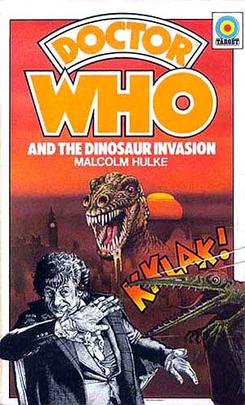
Loved the novelisation passionately as a kid. My original copy had the
pterodactyl attacking a black and white Pertwee. Read it about 712 times.
Doctor Who AND dinosaurs in the same story? To me it was very Heaven. The book fell apart in the end and I had to buy another copy, which had
a tyrannosaurus in front of St. Paul's. Which just wasn't the same, somehow.
All together now: "KKLAK!".
‘Death to the Daleks’
Funny old stick, Tel-Boy Nation. His scripts are often glib and breezy treatments of oddly thoughtful concepts wrapped up in acres of cliché. A bit of inspired directing can bring stuff out of them. That's what's happened with 'Death to'.
Identikit middle-class space officers (one of whom is called Tarrant, natch), anonymous grunting natives, a standard bit of 70s Von Daniken rubbish, a mineral that sounds like a very private anatomical location, the usual chase/capture/sacrifice/escape nonsense and typically shrill Daleks... and yet, somehow, it becomes a genuinely creepy and sorta fascinating puzzle box of a story.
It's as though the alienating effect of some of the unusual images (a pitch black and silent TARDIS control room, for instance) adds depth to the proceedings. We have the superb idea of the semi-living roots of the city, the humanoid "antibodies", the Exxilon controller in the chair who collapses into dust, the gleaming rooms filled with dusty skeletons, the whole notion of a high civilization ravaged by its own runaway technology and regressing to religion and ‘barbarism’... if this story popped up in Season 18, a) it would look entirely at home and b) some people would gush about how intellectual it is.
The story keeps coming back to confrontations between primitivism and technology. The Daleks have to swap laser beams for old fashioned bullets and are then overpowered by spears and arrows... yet, ironically, their great weapon turns out to be the oldest killer of all: disease. The city itself is like a giant leech. It sucks up all power, technological, intellectual and cultural. It doesn't just feed on the energy of engines and lasers but on the energy of the mind, on sanity and rationality. Its feeding has left the planet and the people barren. Its upper pylon, the one that absorbs all the energy, even
looks like a totem pole… which reminds me of
Feuerbach, and what he said about Man making a totem pole which reflects his own powers and then bowing down before it, imagining that he bows before some other, greater entity… when all he is really bowing to is his own distorted image. (At least... I
think that was Feuerbach...) That’s what the Exxilons are up to, isn’t it?
Briant (the director) is also helped by some occasionally clever production design. Okay, the Dalek ship looks like a hubcap, but the Exxilon city has a creepy and beautiful monumentalism about it (even if, at the end, it’s obviously a polystyrene model being attacked with a kitchen blowtorch)... and the Exxilons themselves seem, at times, to blend with their barren planet. They look like moving rocks.
Somehow, the powerless and increasingly strung-out Daleks are all the more scary for being temporarily innocuous and accompanied everywhere by comedy 'Laurel & Hardy' parp-parp music. Meanwhile, the music goes into a totally different gear elsewhere and hypes up the creepiness very effectively.
Of course, we have the usual libelling of tribal people in which they are depicted as grunting, spear-chucking, girl-sacrificing primitives... though the story then pulls the rug away a bit and turns them into the abused and exploited slaves of the imperialist Daleks (and humans!)...
Also, the co-opting of Von Daniken, and all that stuff about the temple in Peru that must’ve been built by aliens… that relies on the assumption (the underlying assumption of Von Daniken’s ‘work’) made by Westerners that so-called ‘primitive’ people in South America, Africa and other colonised places are incapable of civilization. Any great ruins that white people happen to find are therefore mysterious anomalies. When Cecil Rhodes and his bunch of gangsters moved into Zimbabwe (which Rhodes would eventually, with a fine display of modesty, take it upon himself to rename ‘Rhodesia’) they found ruins that spoke of such sophistication that they were unable to credit them to the ancestors of the ‘savage’ tribesmen. A whole system of implicitly racist and/or culturalist pseudo-science (of which Von Daniken was just a crackpot-populist spinoff) developed in the West to “explain” such impenetrable mysteries.
But, back to Exxilon… this being a Nation script, we also have the obligatory rebels... but they then become oddly moving when shown to be rationalist dissenters from religion, lead by the oddly affecting Bellal.
In a way, this is emblematic of
Doctor Who. A kid's adventure story fashioned from Dan Dare, von Daniken, every bit of trash going... but full of ideas, done with such directness, employing linguistic cleverness and raising so many signs and symbols that it somehow becomes more than the sum of its parts. Of course, I might just be biased by the years I spent as a kid watching the VHS again and again and again...
‘The Monster of Peladon’
An amiable enough runaround, if you switch your brain off. But it really is the
Who equivalent of listening to Jeremy Vine and Andrew Marr talking about unions: “blah, blah, blah… Winter of Discontent… blah, blah, blah… rubbish on the streets… blah, blah, blah… longest suicide note in British political history… blah, blah, blah” and every other cliché in the book.
‘Monster’ is standard, mainstream, cretinous, bourgeois liberal moralism attempting to comment on a political situation in which
a Tory government has just been brought down by a wave of miners strikes more powerful than anything since the 20s.
The underlying assumptions represent the ideology of ‘balance’ and ‘impartiality’ and ‘national interest’ and every other chimera of the mainstream media.
The Pels are all in it together. The Queen and her High Priests, the guards that enforce the law and order, the miners who actually carve the trisilicate out of the rock. Sure, there are classes… and sure the working classes have some legitimate grievances… but, underneath all that, the Pels all have common interests that are only upset by the reactionary troublemaking of Ortron and, even more, by the psychotic fanaticism of Ettis.
In other words, control the xenophobic right-wingers in the government, and make sure the compromisers like Gebek run the unions rather than the looney-left, and the country (sorry, planet) can team up to get everyone the best deal... because that's what everyone wants, right? Because extremism exists at the edges of a spectrum of normalcy in which we all pull together and compromise for the national interest, right?
The state is, in this view, fundamentally functionalist; an honest broker. The smooth running of society is upset by the extremists on both sides. Meanwhile, the flaws of the establishment can be solved by persuading the people at the top to be more democratic and liberal and nice and cuddly and feminist... because they're not ruthlessly determined to hold on to their power, privilege and wealth at any price, and equally determined to keep exploiting the people who have to spend their lives digging in dark pits. Oh-ho-ho no. The idea! You'd have to be a mad militant to believe stuff like that.
Mind you, this story manages to notice that imperial military repression is what greets any attempt at economic self-determination by weak states that provide crucial commodities and resources to empire... though it depicts this as perpetrated by rogue elements that are actually betraying the empire concerned! It's like suggesting that the
coup in Guatemala wasn't organised by Eisenhower and the CIA on behalf of the United Fruit Company but was actually the work of freemasons who wanted to sell the bananas to Russia. Bleurgh!!!
This is probably the most politically idiotic
Doctor Who story ever made (at least it was until earlier this year) but even so, all it does (for the most part) is mirror the ideological assumptions that still underlie all mainstream discourse today.
‘Planet of the Spiders’
Lupton is believably petty and small as a villain… and understandable; driven to his actions by a society that has worked him dry and then discarded him.
The spiders are ego, rampaging selfishness, greed, the willingness to step on people to feed your desires. The Doctor finds one on his own back and must purge himself. The old man dies so the new man can be born.
Tommy is healed by the crystal and suddenly finds two lines of
Blake more beautiful than all the shiny trinkets in his collection.
It’s cheesy but poetic; full of clichés and also possessed of a heartfelt directness. Call me an old softy, but I love it.