Showing posts with label gallifrey. Show all posts

Thursday, 10 July 2014

Othering Thursday

Someone called 'Bright Coat and Bravado' (you can guess their favourite Doctor), posted this on tumblr.  Here's a snippet:

I have a serious problem with  the “Cartmel Masterplan”. It’s not really about Looms, if you’ll believe that. It’s about The Other.

I can’t fucking stand the idea that the Doctor - or anyone - is “destined for greatness”. 

I posted the following off-the-cuff response (which I reproduce here, opportunistically, because I quite liked it when I read it back):


On the whole, I love the Cartmel era, and have a lot of affection for the Virgin New Adventures… but I don’t like the idea of the Doctor as the recycled ‘Other’.

I don’t like the idea of him being ‘exceptional’ for his society.  Much as he is bound to be exceptional from a human standpoint, I think that should always be because of what he does rather than what he is.  I like the idea of him as someone who failed in his home context - “…scraping through with 51% at the second attempt” - and being a bit rubbish, a bit of a dilettante, a bit of a second-rater, a bit of a fartaround.  Probably because I feel like one of those myself.  But that’s okay.  I hate the winners vs losers view of life.  I hate the idea that one’s worth is determined by one’s ‘success’ in the competition of life, in carving a niche for oneself in a hierarchy.  I still more hate the idea of those kinds of judgements being made without taking into account the fact that some people start off at higher rungs and with greater advantages.  The Doctor should be someone who started off at such a high rung but who proved unsuited for it because of his infinite distractability, his vagueness and his inability to ‘play the game’… and also because of the moral sense - and the imperative to be a social actor - that he acquires from his involvement, from his breaching of the walls of the enclosed and reactionary envelope of Gallifrey, from his adventures and researches and friendships ‘out there’ in the muck and strife and pain of the universe.

The transformation of him into the reincarnation of a godlike founder figure from mythological pre-history injects a 80s/90s ‘epic’ sensibility into a 60s/70s ‘rebel’ storyline.  It is a post-defeat rationalisation overwriting an artefact that originated at a time of struggle.  The Doctor-as-drop-out-from-the-ruling-class is an (admittedly imperfect) artefact of 1969.  It gets renewed - even intensified - in 1976.  And then it gets downplayed and downplayed until - interestingly enough - Holmes gets his hands on it again at the end of the Trial in 1986.  But in the run up to the ‘long-90s’, Cartmel et al lay the groundwork for a potential vitiation of it.  Even as that crew take the show to angrier and bolshier territory than its has visited for quite some time, they’re also utiling an affect from various cultural strands that bigs the Doctor up and fetishizes him, and his ‘power’.  I criticise Moffat (and RTD) for this… but the truth is that Cartmel & Co. started it, or almost started it.  Thankfully it only partially and intermittently materialises on TV.  They took out the “more than just a Time Lord” line, and the “brief glimpse of his birth” line makes its way into the novelisation of ‘Curse of Fenric’ but not the broadcast show.  The NAs, being purely made of words, can allow these tendencies to come out to play in a way that the TV show itself seemed to reject.

Fair disclosure: I loved the Cartmel masterplan at the time (and all the stuff that goes with that term… i.e. the manipulative, amoral, chessmaster Doctor, and his grimdark adventures, and his mythological origins, and his power, and his way of saying things that Merlin said in Excalibur, etc, etc, etc)

Friday, 29 October 2010

The Lords Temporal

This is an edited and tweaked version of something I wrote for the old site.


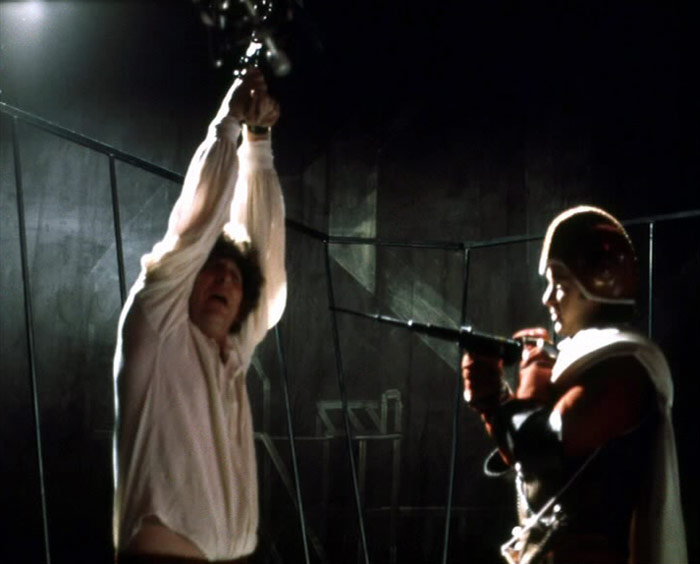
If 'The Deadly Assassin' has a central thesis, it might be this: power is no guaranteur of responsibility. Or even sensibleness. This tale shows us beings like us. Godlike in their technology, they are also childlike in their small-mindedness.

In 'The Deadly Assassin', the Time Lords are senile gerontocrats living on ossified priviledge. They natter, bumble and scheme. The less shot-away amongst them spend their time snapping at each other with haughty contempt or scheming over appearances and expediency. Robert Holmes deliberately strips Power of its outward signs of dignity and virtue and superiority.

They are locked in a rigid class system. They fail to understand their own technology, their own power, their own myths. They "adjust the truth" to suit their agendas. Their outwardly civilised society begins to crumble into anarchy when two of their renegades return and start fighting out their neuroses. The sit on a massive computer lake of information in which nestles a surreal and nightmarish dreamscape filled with elemental terrors. Their Panopticon (literally: place where all can be seen) hides secrets. The biggest secret is a singularity, a piece of cosmic anarchy that they've slaved to their technology and then forgotten about. This is a picture of denial. Like the lies that are "good for public morale" overlaying the sordid truth, their society pretends to be controlled and calm but rests on hidden and deadly knowledge.

As a satire, it isn't subtle. Robert Holmes chucks in random signifiers from various power elites of Western culture: British public schools, Washington DC, the Vatican, Oxbridge, etc. Gallifrey seems to be his scathing picture of an oligarchial and decadent world, run by liars or killers or the senile, reported by snobbish and fautous twitterers content to reel off the official-view of the upper echelons. Trials are manipulated for convenience. Elections are devoid of real democracy. Behind the specious words about "our traditions of fairness and justice", the system's Swiss Guard-style private police use torture and assumption. Hildred is a brutal bungler; Spandrell's intelligence and independence only highlights how unusual he is in his world.

 "Aren't you worried Wikileaks might find out about this?"

Most outragously, the story seems to riff on the Kennedy assassination. 'The Deadly Assassin' isn't an allegory of Dealey Plaza, but it does play with our collective (often confabulated) consciousness of that political slaying. The Doctor is a "patsy", his alleged weapon has misaligned scopes, the real killer is from within the top circle of power, the truth is changed by Borusa's cover-up.

We even have the cheekily named Celestial Intervention Agency, of which the Doctor is assumed to be a member... and, indeed, the Doctor has been involved in Time Lord-sanctioned interventions. Is he a C.I.A. agent? This one throwaway reference muddies the waters (or rather stirs waters that are already muddy). The Time Lords speak of their policy of neutral observation of the universe (Gallifrey is the place where all can be seen) and of their strict non-interventionism... but, like the Western 'democracies' that speak of international law and then organise coups d'etat in places where they feel their interests are threatened, they can always ask their "C.I.A." to intervene on the quiet.

As ever with Holmes, the language is amazing. This story gave the Who-myth so many words and phrases: "High Council", "Matrix", "Rassilon", "Eye of Harmony", "Castellan", "APC net", "Celestial Intervention Agency", "artron energy", "shabogan", etc. etc. And we have Borusa's aloof and suave variety of verbal dexterity. I needn't quote, you know what I'm talking about.

It's heady stuff. It's so mythic that it has firmly buried itself into the subconscious of the whole show, providing Who with its own personal origin-legend. It's also politically complex, witty, cynical, surreal. For all its flaws, you can't help but marvel at it. Apart from everything else, there are those astonishing costumes! Of course, subsequent return trips to Gallifery sullied its reputation... but that isn't Bob Holmes' fault. After this, Gallifrey started looking like every other high-tech alien world, lit and furnished like a Habitat showroom.

RTD's attempts turned Gallifrey into Hogwarts with a bog-standard Bespin-style citadel, and then into Coruscant. The fact that the costumes are all wrong in the new series - the ceremonial circle-based shoulder-display thingies worn by guards! - is a sign of a wider failure to grasp what the Time Lords are supposed to be. Gallifrey, should it ever be seen again, needs to be like the place in 'The Deadly Assassin': a dark, gothic labyrinth of high politics, murky motives, unaccountable power, shadows and oligarchy and cover stories... and, crucially, decadent idiocy. Not a backdrop for an ex-Bond doing a Voldemort.

Admittedly, the plot of 'The Deadly Assassin' makes no sense at all. And the music is naff. As is the make-up. And the title is rubbish. 'The Deadly Assassin' indeed! As opposed to what? 'The Harmless Assassin'?

Nine out of ten, as Borusa would say.