"Don't get any ambitious ideas," says Castellan Spandrell to his prisoner.
"I just wanted to check it was the same staser," says the Doctor, examing the weapon used to assassinate the President of the High Council of Time Lords. "You see that symbol at the end of the corridor?"
The Doctor indicates a huge Seal of Rassilon.
"What about it?" asks Spandrell.
"You try and hit it," says the Doctor, handing Spandrell the staser.
"That's the kind of vandalism we're always running the Shabogans in for," grumbles Spandrell.
Spandrell is, basically, the Chief of Police in the Time Lord Capitol. As such, the Doctor is his prisoner, having been caught holding a rifle in a gallery near the spot where the President was gunned down.
We never see any Shabogans. The reference is never explained. It just seems to be part of a Gallifreyan policeman's job to arrest people called 'Shabogans' for vandalism. But let's not pass over this too quickly. There is regular crime here? There are hooligans running around the corridors of the Capitol of the Time Lords of Gallifrey?
Well, yes, of course.
The Time Lords are not just 'aliens'. They're explicitly potrayed as the ruling class. They have sycophantic TV presenters who interview them creepily (about process and personalities... just like Andrew Marr outside Number 10) when they congregate at elaborate government ceremonies. They wear traditional robes and ornate, arcane bling at these state events. They have the poshest of posh accents, like a great club of old Etonians and Oxbridge alumni... or like Oxbridge dons. They have Academies and Colleges in the Capitol, populated by fussy, blithering, crusty old farts who reminisce about how many of these ceremones they've attended over the centuries. They have Chancellors. They have Cardinals and Chapters too. One of them creates a nightmarescape for the Doctor which references Western colonialism (there is a khaki-wearing hunter who goes on safari and tracks the Doctor like big game) and the First World War. They have a 'Panopticon', named after the surveillance-heavy prison designed by Jeremy Bentham, one of the founders of Liberalism. They have a kind of police force, run by the Castellan, whose uniforms make them vaguely reminiscent of Swiss Guards. They also have a President. Their Presidents have names like kings or popes (Pandak III, for instance) and are chosen by a tiny electorate (just the other Time Lords, presumably) from a tiny pool of thoroughly respectable establishment types. They also have a shadowy government organisation, complete with secret agents, called the CIA (Celestial Intervention Agency - yuk yuk).
Police. Media commentators, edcuated at the same Academy as the other Time Lords, taught by the people they end up talking about on TV. Great White Hunters. Popes. Kings. Presidents. Colleges. Chapters. Cardinals. Chancellors. The Time Lords are a concentrated synthesis of various Western power structures. Oxbridge. The Vatican. Prisons. Liberalism. Conservatism. The House of Lords. The CIA. Washington.
So, of course there are 'Shabogans'. There must be 'Proles' so that the rulers have someone to rule, so that the dirty jobs get done, so that the Time Toilets get cleaned.
By the way... the origin of the word 'shabogan' is obscure to me. The nearest thing I can find is a reference in V. Gordon Childe to 'Shub-lugals', cadres of labourers who were not slaves but who were paid with subsistence rations by the kings of early urban Mesopotamia. Proto-proletarians from the dawn of civilisation. Gallifrey is elsewhere (but by the same writer) said to be "the oldest civilisation". Which is partly why I choose to believe that the Shabogans of Gallifrey are not the posh drop-outs we see in a later story, or drunken students, but rather an invisible group of workers who do everything for the Time Lords... but who sometimes get pissed off and riot, and then get arrested by Spandrell's Time Police. I'd hate to think there were no rowdy Time Proles to give the Time Lords a bloody nose from time to time. If the Time Lords are a trans-historical ruling class, an accretion of Western power principles - oligarchy, gerontocracy, white power (they're all white), patriarchy (they are all men), established religion, police, media, public school, Oxbridge, British government, US government - then I like the idea that their unseen drudges are related to one of the earliest forms of urban worker in the history of civilisation.
Spandrell takes his shot.
"Miles away," he says ruefully.
"The sights," says the Doctor, nodding at the weapon, "So you see, I couldn't have shot the President
if I tried. And equally, I couldn't hit the assassin. That's why
they were fixed."
"The assassin, according to you, being one of the High Council," observes Spandrell sceptically.
"Yes, he was in the party surrounding the President. I
saw him draw a staser and step forward. I aimed a bolt at him, but
at that time I didn't know the sights had been fixed."
"One of the High Council. It's getting better and better."
"What is?"
"Your story. But still a story. Where's the evidence, Doctor?"
"I'll tell you where the evidence is... in the Public Register camera. I was standing right beside it."
This is all so 70s it hurts. The era of paranoia about government conspiracies in pop-culture (well, one of the eras of that... there was another one in the 90s). This story is riffing on familiar motifs from the conspiratorial account of the Kennedy assassination. The supposed lone assassin is actually a patsy. He was a CIA agent. His supposed weapon couldn't have performed the feat attributed to it. The assassination was captured on film, and analysis of this recording will reveal the truth. The real assassin comes from the highest circle of power and is engaged in a cover-up.
It doesn't really matter if Robert Holmes, the writer of this story, believed that the CIA (the American CIA, that is) killed Kennedy. In the real world, there doesn't seem to be much reason to think so, though it's the kind of thing one gets from people like Holmes, who might be best described, at least as far as we can judge him from his work, as a 'romantic anti-establishment libertarian'. He's often called 'cynical', but he's cynical about power.
(Parenthetically... I don't find it implausible that governments conspire to kill people. On the contrary, that's almost a definition of government. Nor do I find it implausible that the US government would conspire to assassinate a world leader. We know, for instance, that Kennedy himself was deeply involved in several covert conspiracies to assassinate world leaders. That's pretty much business as usual for American presidents... except that Kennedy had to keep quiet about his 'kill list' whereas Obama boasts about his. I don't even find it all that implausible (in basic principle) that the US government might conspire to kill the US president... but he'd have to be a whole lot more threatening to them than Kennedy was (which was not at all). It's actually difficult to see how anyone potentially dangerous enough to need rubbing out could possibly make it through the immense number of filters and baffles which stand between the Oval Office and anyone who wants to get into it. The really interesting thing about the endless 'debate' about the Kennedy assassination is that it almost totally obscures - at least in mainstream culture - any discussion of what the man was actually like as a politcian. It obscures his reckless belligerence that helped bring on the Cuban Missile Crisis about a year before 'An Unearthly Child' aired, a confrontation that nearly destroyed the entire world. It obscures his vital role in kicking off the Vietnam war, an imperialist attack upon a practically defenceless country that ultimately claimed the lives of something like two million people. There's a case to be made that Kennedy helped conspire to bring about the assassination of an entire society. Compared to that, the question of who, if anyone, was on the Grassy Knoll somewhat recedes, at least as far as I'm concerned.)
Relatedly, it doesn't really matter who killed the President of the Time Lords. What matters is that Holmes puts that kind of paranoid unease - about arcane, decadent, self-involved, self-perpetuating structures that seethe with an undertow of secrecy and violence - into a fictional space synthesised from just about every signifier he could come up with for the established centres of Western power... and which he also signified as being a representation of ruling classes throughout history.
It's a sign of the times (those conspiratorial 70s) that the obsession is with occult government structures rather than with business or capital.
*
NOTE 4/12/13:
Dunno why I said the Cuban Missile Crisis was "a few weeks" prior to 'An Unearthly Child'. I've amended that above.

ideas are icepickproof
Showing posts with label kennedy assassination. Show all posts
Showing posts with label kennedy assassination. Show all posts
Friday, 22 November 2013


Friday, 29 October 2010
The Lords Temporal
This is an edited and tweaked version of something I wrote for the old site.
If 'The Deadly Assassin' has a central thesis, it might be this: power is no guaranteur of responsibility. Or even sensibleness. This tale shows us beings like us. Godlike in their technology, they are also childlike in their small-mindedness.
In 'The Deadly Assassin', the Time Lords are senile gerontocrats living on ossified priviledge. They natter, bumble and scheme. The less shot-away amongst them spend their time snapping at each other with haughty contempt or scheming over appearances and expediency. Robert Holmes deliberately strips Power of its outward signs of dignity and virtue and superiority.
They are locked in a rigid class system. They fail to understand their own technology, their own power, their own myths. They "adjust the truth" to suit their agendas. Their outwardly civilised society begins to crumble into anarchy when two of their renegades return and start fighting out their neuroses. The sit on a massive computer lake of information in which nestles a surreal and nightmarish dreamscape filled with elemental terrors. Their Panopticon (literally: place where all can be seen) hides secrets. The biggest secret is a singularity, a piece of cosmic anarchy that they've slaved to their technology and then forgotten about. This is a picture of denial. Like the lies that are "good for public morale" overlaying the sordid truth, their society pretends to be controlled and calm but rests on hidden and deadly knowledge.
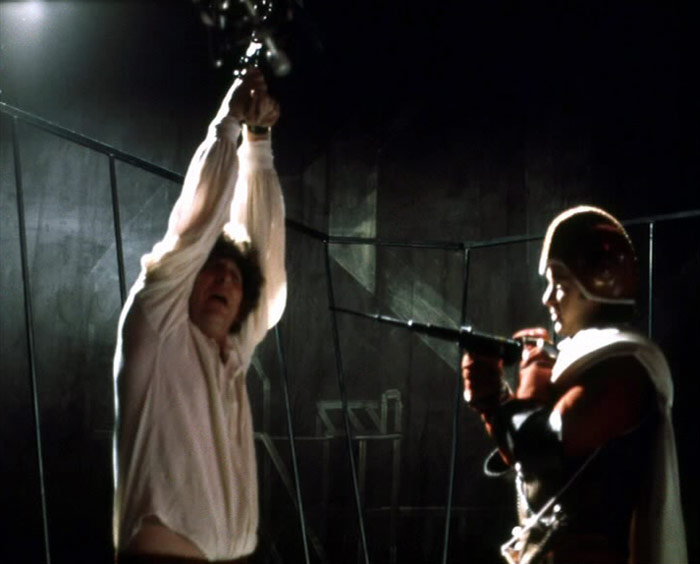
As a satire, it isn't subtle. Robert Holmes chucks in random signifiers from various power elites of Western culture: British public schools, Washington DC, the Vatican, Oxbridge, etc. Gallifrey seems to be his scathing picture of an oligarchial and decadent world, run by liars or killers or the senile, reported by snobbish and fautous twitterers content to reel off the official-view of the upper echelons. Trials are manipulated for convenience. Elections are devoid of real democracy. Behind the specious words about "our traditions of fairness and justice", the system's Swiss Guard-style private police use torture and assumption. Hildred is a brutal bungler; Spandrell's intelligence and independence only highlights how unusual he is in his world.

Most outragously, the story seems to riff on the Kennedy assassination. 'The Deadly Assassin' isn't an allegory of Dealey Plaza, but it does play with our collective (often confabulated) consciousness of that political slaying. The Doctor is a "patsy", his alleged weapon has misaligned scopes, the real killer is from within the top circle of power, the truth is changed by Borusa's cover-up.
We even have the cheekily named Celestial Intervention Agency, of which the Doctor is assumed to be a member... and, indeed, the Doctor has been involved in Time Lord-sanctioned interventions. Is he a C.I.A. agent? This one throwaway reference muddies the waters (or rather stirs waters that are already muddy). The Time Lords speak of their policy of neutral observation of the universe (Gallifrey is the place where all can be seen) and of their strict non-interventionism... but, like the Western 'democracies' that speak of international law and then organise coups d'etat in places where they feel their interests are threatened, they can always ask their "C.I.A." to intervene on the quiet.
As ever with Holmes, the language is amazing. This story gave the Who-myth so many words and phrases: "High Council", "Matrix", "Rassilon", "Eye of Harmony", "Castellan", "APC net", "Celestial Intervention Agency", "artron energy", "shabogan", etc. etc. And we have Borusa's aloof and suave variety of verbal dexterity. I needn't quote, you know what I'm talking about.
It's heady stuff. It's so mythic that it has firmly buried itself into the subconscious of the whole show, providing Who with its own personal origin-legend. It's also politically complex, witty, cynical, surreal. For all its flaws, you can't help but marvel at it. Apart from everything else, there are those astonishing costumes! Of course, subsequent return trips to Gallifery sullied its reputation... but that isn't Bob Holmes' fault. After this, Gallifrey started looking like every other high-tech alien world, lit and furnished like a Habitat showroom.
RTD's attempts turned Gallifrey into Hogwarts with a bog-standard Bespin-style citadel, and then into Coruscant. The fact that the costumes are all wrong in the new series - the ceremonial circle-based shoulder-display thingies worn by guards! - is a sign of a wider failure to grasp what the Time Lords are supposed to be. Gallifrey, should it ever be seen again, needs to be like the place in 'The Deadly Assassin': a dark, gothic labyrinth of high politics, murky motives, unaccountable power, shadows and oligarchy and cover stories... and, crucially, decadent idiocy. Not a backdrop for an ex-Bond doing a Voldemort.
Admittedly, the plot of 'The Deadly Assassin' makes no sense at all. And the music is naff. As is the make-up. And the title is rubbish. 'The Deadly Assassin' indeed! As opposed to what? 'The Harmless Assassin'?
Nine out of ten, as Borusa would say.
If 'The Deadly Assassin' has a central thesis, it might be this: power is no guaranteur of responsibility. Or even sensibleness. This tale shows us beings like us. Godlike in their technology, they are also childlike in their small-mindedness.
In 'The Deadly Assassin', the Time Lords are senile gerontocrats living on ossified priviledge. They natter, bumble and scheme. The less shot-away amongst them spend their time snapping at each other with haughty contempt or scheming over appearances and expediency. Robert Holmes deliberately strips Power of its outward signs of dignity and virtue and superiority.
They are locked in a rigid class system. They fail to understand their own technology, their own power, their own myths. They "adjust the truth" to suit their agendas. Their outwardly civilised society begins to crumble into anarchy when two of their renegades return and start fighting out their neuroses. The sit on a massive computer lake of information in which nestles a surreal and nightmarish dreamscape filled with elemental terrors. Their Panopticon (literally: place where all can be seen) hides secrets. The biggest secret is a singularity, a piece of cosmic anarchy that they've slaved to their technology and then forgotten about. This is a picture of denial. Like the lies that are "good for public morale" overlaying the sordid truth, their society pretends to be controlled and calm but rests on hidden and deadly knowledge.
As a satire, it isn't subtle. Robert Holmes chucks in random signifiers from various power elites of Western culture: British public schools, Washington DC, the Vatican, Oxbridge, etc. Gallifrey seems to be his scathing picture of an oligarchial and decadent world, run by liars or killers or the senile, reported by snobbish and fautous twitterers content to reel off the official-view of the upper echelons. Trials are manipulated for convenience. Elections are devoid of real democracy. Behind the specious words about "our traditions of fairness and justice", the system's Swiss Guard-style private police use torture and assumption. Hildred is a brutal bungler; Spandrell's intelligence and independence only highlights how unusual he is in his world.
"Aren't you worried Wikileaks might find out about this?"
Most outragously, the story seems to riff on the Kennedy assassination. 'The Deadly Assassin' isn't an allegory of Dealey Plaza, but it does play with our collective (often confabulated) consciousness of that political slaying. The Doctor is a "patsy", his alleged weapon has misaligned scopes, the real killer is from within the top circle of power, the truth is changed by Borusa's cover-up.
We even have the cheekily named Celestial Intervention Agency, of which the Doctor is assumed to be a member... and, indeed, the Doctor has been involved in Time Lord-sanctioned interventions. Is he a C.I.A. agent? This one throwaway reference muddies the waters (or rather stirs waters that are already muddy). The Time Lords speak of their policy of neutral observation of the universe (Gallifrey is the place where all can be seen) and of their strict non-interventionism... but, like the Western 'democracies' that speak of international law and then organise coups d'etat in places where they feel their interests are threatened, they can always ask their "C.I.A." to intervene on the quiet.
As ever with Holmes, the language is amazing. This story gave the Who-myth so many words and phrases: "High Council", "Matrix", "Rassilon", "Eye of Harmony", "Castellan", "APC net", "Celestial Intervention Agency", "artron energy", "shabogan", etc. etc. And we have Borusa's aloof and suave variety of verbal dexterity. I needn't quote, you know what I'm talking about.
It's heady stuff. It's so mythic that it has firmly buried itself into the subconscious of the whole show, providing Who with its own personal origin-legend. It's also politically complex, witty, cynical, surreal. For all its flaws, you can't help but marvel at it. Apart from everything else, there are those astonishing costumes! Of course, subsequent return trips to Gallifery sullied its reputation... but that isn't Bob Holmes' fault. After this, Gallifrey started looking like every other high-tech alien world, lit and furnished like a Habitat showroom.
RTD's attempts turned Gallifrey into Hogwarts with a bog-standard Bespin-style citadel, and then into Coruscant. The fact that the costumes are all wrong in the new series - the ceremonial circle-based shoulder-display thingies worn by guards! - is a sign of a wider failure to grasp what the Time Lords are supposed to be. Gallifrey, should it ever be seen again, needs to be like the place in 'The Deadly Assassin': a dark, gothic labyrinth of high politics, murky motives, unaccountable power, shadows and oligarchy and cover stories... and, crucially, decadent idiocy. Not a backdrop for an ex-Bond doing a Voldemort.
Admittedly, the plot of 'The Deadly Assassin' makes no sense at all. And the music is naff. As is the make-up. And the title is rubbish. 'The Deadly Assassin' indeed! As opposed to what? 'The Harmless Assassin'?
Nine out of ten, as Borusa would say.
Subscribe to:
Posts (Atom)