The greatness and uniqueness of 'Image of the Fendahl' is shown in the scene where the Doctor "explains" what's going on to Adam Colby. Of course, he doesn't actually do any such thing. He suggests two possible explanations. He favours the first but his listener is sceptical so the Doctor offers an alternative which his listener finds more plausible. The Doctor also says that it might all be a coincidence. His tone is flippant but there is no real reason to suppose that he isn't being serious. It is clear that the Doctor is theorising and that he doesn't have the final answer.
This is fascinating and, as far as I can recall, unique in classic Doctor Who.
The Doctor has often been seen to behave superficially like a scientist (mucking about with test tubes, talking about oscillators, etc.) but this is the first and only real occasion when he really acts like one (like an idealised, Baconian one, that is). The Doctor is admitting that he doesn’t know and doing his best to come up with workable explanations which fit the facts. Moreover, the person the Doctor is speaking to is a scientist who has demanded answers and is coming to his own conclusions about how plausible the Doctor's ideas are. No final decision is reached or stated as to which solution (if any) is correct. Fendleman's rant to Stael before his death tends to support the Doctor's idea about genetic manipulation (Colby's preferred option, possibly because he heard Fendleman speak) but the Doctor seems to prefer his first idea about a "biological transmutation field" which Colby might doubt simply because he doesn't know what one is.
This is all highly appropriate in a story that is preoccupied with the tensions between science, evidence, theory, supposition, superstition and belief.
The story opens with Colby fretting over a dissonance between established scientific facts (the age of the skull) and the apparent impossibility of their implications. (Someone once asked J.B.S. Haldane if any scientific finding could disprove evolution; "Fossil rabbits in the pre-Cambrian" was his gruff response.) Meanwhile, Fendleman spends much of the story trying to convince Adam of the validity of his theories. Wonderfully, Fendleman gets it partly right and partly wrong (something else that doesn’t usually happen in tales like this). His theory about the pentagram being a neural relay seems to be borne out, but his idea of the nature of the power it contains is woefully mistaken. Nobody is really entirely Right or Wrong about anything in this story, which is very refreshing.
Stael is an interesting character. His employment of the occult ritual is self-consciously ironic and cynical. He rejects Colby's taunts about being a Satanist and claims to be unimpressed by "the grimoires". Nevertheless, he employs occult language and ceremonies... this might be meant as showing unconscious drives. Scott Fredericks (an actor with a lot of interiority) even seems to be working to endow Stael with a repressed sexual interest in Colby. Stael's ideas exist on that deeply-70s line of thinking along which the occult, paranormal phenomena and science intersect. This might be dated but it is perfectly appropriate with this story.
The story does a lot of that Nigel Kneale stuff. Apparently supernatural effects are revealed as side-effects of natural phenomena. Quatermass is usually mentioned but the story’s real debt is to Kneale’s masterpiece The Stone Tape, in which a team of practical scientists (!) who dig down in an old priory (!) discover that a haunting in the house is a kind of natural recording. The central female character in The Stone Tape has an unusual sympathy with the haunting/entity and ends up being absorbed by it… just like Thea Ransome. I don’t mean to accuse Boucher of plagiarism; there are as many differences as similarities and Boucher’s script, arguably, has more to say about the nature of belief that Kneale’s.
The Fendahl manifests itself in the manner of an all-out occult horror. Skulls, pentagrams, rituals, sacrifices. But the entity is clearly described as a horrible, one-off evolutionary snafu. It is suggested (the Doctor continues to offer suggestions rather than statements) that our human concepts of evil are influenced by the appearance and methods of the Fendahl... so human superstitions about evil come from our attempts to understand things like death and predation. The Fendahl is not stored inside a pentagram-embossed skull because it is diabolical, rather we have drawn our iconography of evil from a collective memory of the Fendahl, a creature so inimical to life that is it, effectively, a personification of death... but then, evolution is itself a kind of personification of death. It depends upon death as much as upon anything else.
Interestingly, the Fendahl never displays actual, conscious malice. I used to think that the core should have spoken up with sinister words. Watching the story now I am very glad that it stays silent and enigmatic. The closest it gets to expressing a malevolent personality is the little smile as it consumes human life force... but any creature might express satisfaction as it feeds. It is not really evil. It is just a supremely evolved predator. It is Death, in the sense that it feeds on living things in the most fundamental way possible: it assimilates them into itself... but in biological terms, that's quite right. To feed on something is to absorb those parts of it that can become part of you, excreting those bits that are unassimilable.
The key to understanding this story lies in the exchange between Ma Tyler and Jack about the nature of belief. “When most believe, that do make it true,” she asserts. “People used to think the world was flat,” Jack tells his grandma, “but it were still round.” “Ah,” she replies immediately, “but they behaved as though t’were flat!” This apparent gibberish is actually right to the point.
The story is full of people who behave as though their assumptions are correct and, in so doing, contribute to the situation in which the Fendahl reawakens. Fendleman and Stael, for their different reasons, have decided that the power within the skull should be released and so they set about it. Ted Moss clings to “the old ways” and thus takes part in Stael’s ceremony. Even Colby refuses to accept scientific facts when they contradict his assumptions and so brings Thea into contact with the skull. The Fendahl feeds on the life force, according to the Doctor, so it can be seen as a personification of death, more particularly as the dark side of evolution. But another subtext is also clear: it feeds on belief. Belief without reason. Belief against evidence.
How apt that it should have evolved as a result of natural selection turning back on itself.
The thing unfolds like a nightmare. I mean that in the broad sense. The story is dreamlike. Its narrative logic is fairly strong (even the matter of who releases the Doctor is fathomable, given some deduction) but the nuts and bolts of the story are jumpy, dream-logical, figurative and alliterative. The Doctor and Leela disappear into time for a brief period but return after what looks like a full day has passed for the other characters. We are asked to interpret quite important parts of the action from the standpoint of thematic rhymes and resonances. The fourth wall is broken. Spoken numbers fail to match the number of fingers being held up. We keep getting references to dreams. And dream scenarios crop up: sudden, inexplicable imobility for example. People have names that seem oddly appropriate. "Thea Ransome" suggests sacrifice: she is the ransom paid to a theistic entity. Even Ted Moss clings like a slow growth. The idiosyncratic editing emphasizes the peculiarity of the proceedings. We cut sharply away from scenes after highly pregnant remarks have been snapped out... and then the camera will linger longer than seems obviously necessary, in order to catch the expressions of a speaker or hearer.
The only cloud on the horizon (other than a certain painful tweeness in certain scenes) is the mooted notion that people might behave in certain specific ways because they've been genetically programmed to. But then, the Doctor only talks about "desires and instincts", which probably do have a genetic factor. Fendleman's interpretation is more extreme, and sounds like genetic destiny... but the Fendahl might've employed a scattershot effect, feeding in the right "desires and instincts" and hoping that eventually someone would be in a position to act upon them in the right way. Does it "explain the dark side of man's nature"? Well, if the Fendahl personifies evolution (through death and predation) then... maybe... but I don't think anything in the story reduces the picture to genetic-determinism.
Of course, either way, the meaning of the oblique title becomes clear. As does the significance of the name Adam. Whether it personifies brutal evolution or a demonic puppetmaster that depends upon unreason, the Fendahl, it is implied, created us in its own image.

ideas are icepickproof
Wednesday, 8 December 2010


Fang Rock, Class and the Tentacular Revolution
If you ask me, 'Horror of Fang Rock' is one of the best ever; a thriller that focuses on characters who really interact while they're trapped together, featuring Tom and Louise at their acme.
It investigates the nature of belief in an age of rising science and technology: Adelaide's astrology fetish compares to the superstition of Vince and Reuben, with Vince's terror as real as hers, and Reuben's fear of monsters more a manifestation of melancholy stubbornness at the rise of unsympathetic forces he doesn't understand (like electricity... which is also the weapon of the monster that kills and impersonates him). Meanwhile, Leela lectures Adelaide that consulting her "shaman" (despite Adelaide's denial, that is the right word for people like Miss Nethercote) is a "waste of time"... but, with relishable irony, the semi-educated Leela simply believes in science because her mentor has told her to.
'Fang Rock' has a quiet undercurrent about sex too. Adelaide is understood by Harker to be Palmerdale's "fancy woman" and Skinsale obviously envies this (though god knows why)... but he's also clearly very taken with Leela. Paddy Russell gives us a whole shot simply to establish how much Skinsale digs Leela on sight. Vince is very flustered by Leela's impromptu striptease (which she completely fails to understand) and pays attentions to Adelaide, which she simply treats with a patronising indulgence (to her he's an instrumentum vocale, not a young man). And then we have the porn under Reuben's bed. Mind you, I'm not a Freudian so I'm not saying anything about phallic symbolism. Sometimes, a lighthouse is just a lighthouse.
'Fang Rock' is also very interested in class and the way it was changing in the early 20th century. Palmerdale is loaded and is therefore a scumbag, obviously. Crude but very Whoish... and true enough in general terms. He seems dead posh to the keepers... but to Skinsale (a wonderfully apt name, considering the manner of his death) Palmerdale is a nouveu riche, arriviste, vulgar little money-grubber... and such things obviously matter to Palmerdale since he has evidently purchased his lordly title. He tries to buy everything. He even seems to be paying his mistress (albeit for being a secretary rather than a concubine). Skinsale, meanwhile, considers himself Palmerdale's social superior, despite obviously being skint (old money, obviously... and with a reputation built on enforcing empire in India). Palmerdale gets loads of his sailors killed but makes sure that he escapes (there are lifeboats enough for the gentry, as with the Titanic disaster, but not for the commoners) after causing the crash because he's anxious to use insider info to fleece the markets... and then views Harker's recriminations as irrelevant impertinence, and the keepers as more servants.
It's worth noticing that the Doctor treats the workers (other than the cloddish and xenophobic Reuben) with respect. He starts off calling Vince "Mr Hawkins" while the poshos automatically talk to him like he's a footman.
Vince, upon realising that Palmerdale is dead, burns the cash that His Lordship gave him, instinctively understanding that if he's found in possession of it, the society he lives in will simply assume that he murdered the venal, titled git for the money.
Perhaps you think I'm imagining that this story is obsessed with class, status and snobbery? I ask you to remember that seemingly throwaway detail that the Rutan refers to the Sontarans as "rabble". See what I mean?
Okay, it ain't revolutionary. Very little Who is. 'Fang Rock' offers a lefty/liberal critique rather than a radical challenge. But the critique is quite strong and sophisticated.
It does occur to me that the Rutan embodies electricity and technology and militarism... and the oncoming 'Great War' was pretty indiscriminate in the way it killed, precisely because of the startling new military technology that it produced.
It's interesting to ponder what China Miéville calls "the tentacular revolution", that strange occurrence within sci-fi/horror fiction, roughly starting round about the turn of the century, in which the West suddenly discovered the uncanny potential of the giant squid and the octopus. The tentacled beast also saturates political posters and propaganda round about this period (reaching a crescendo in the twenty years or so around WWI). Have a look at this amazing blog.
Miéville doesn't give a straightforward or reductionist reading of this tentacular trend. He suggests it represents a failure of meaning (the octopus is amorphous and terrifyingly unlike anything else specific, hence it's like everything) in an age of uncertainty. But it seems to me that it can also be connected to the rise of modern communication and travel (railways, telegraphs, etc) and to the rise of global companies, global military aims and political movements. Which is precisely the sort of thing the Rutan embodies - an imperialist philosophy, communication (his signal modulator), new weaponry, new tech, etc - and which the other characters talk about too (i.e. Palmerdale with the wireless telegraph, etc).
The most salient physical feature of the octopus/squid is its many arms - which is graphically perfect for representing 'global reach' of the kind attributed to countries, companies, ideas, technology, imperialist armies, etc... especially in an age of expansion (or, to use our terms, globalization). In political posters, the octopus is constantly represented hugging a map or globe, with its arms in many places.
Of course, 'Fang Rock' was made in the 70s not the 1910s, so it doesn't have quite the same meaning as octopus horror stories by H.G. Wells or Tsarist anti-semitic octopus posters... so this is a case of semiotic drift. The signs and symbols of one age get a piggyback ride on its representation in a period drama. But there were similar things in the air in the 70s too, thanks to Vietnam, etc. And now also, which might be why the tentacle is making something of a comeback in political posters (often with either 'al-Qaeda' or 'Neo-liberalism' written on it, depending on who produced it) and also in modern fantasy writing.
It investigates the nature of belief in an age of rising science and technology: Adelaide's astrology fetish compares to the superstition of Vince and Reuben, with Vince's terror as real as hers, and Reuben's fear of monsters more a manifestation of melancholy stubbornness at the rise of unsympathetic forces he doesn't understand (like electricity... which is also the weapon of the monster that kills and impersonates him). Meanwhile, Leela lectures Adelaide that consulting her "shaman" (despite Adelaide's denial, that is the right word for people like Miss Nethercote) is a "waste of time"... but, with relishable irony, the semi-educated Leela simply believes in science because her mentor has told her to.
'Fang Rock' has a quiet undercurrent about sex too. Adelaide is understood by Harker to be Palmerdale's "fancy woman" and Skinsale obviously envies this (though god knows why)... but he's also clearly very taken with Leela. Paddy Russell gives us a whole shot simply to establish how much Skinsale digs Leela on sight. Vince is very flustered by Leela's impromptu striptease (which she completely fails to understand) and pays attentions to Adelaide, which she simply treats with a patronising indulgence (to her he's an instrumentum vocale, not a young man). And then we have the porn under Reuben's bed. Mind you, I'm not a Freudian so I'm not saying anything about phallic symbolism. Sometimes, a lighthouse is just a lighthouse.
'Fang Rock' is also very interested in class and the way it was changing in the early 20th century. Palmerdale is loaded and is therefore a scumbag, obviously. Crude but very Whoish... and true enough in general terms. He seems dead posh to the keepers... but to Skinsale (a wonderfully apt name, considering the manner of his death) Palmerdale is a nouveu riche, arriviste, vulgar little money-grubber... and such things obviously matter to Palmerdale since he has evidently purchased his lordly title. He tries to buy everything. He even seems to be paying his mistress (albeit for being a secretary rather than a concubine). Skinsale, meanwhile, considers himself Palmerdale's social superior, despite obviously being skint (old money, obviously... and with a reputation built on enforcing empire in India). Palmerdale gets loads of his sailors killed but makes sure that he escapes (there are lifeboats enough for the gentry, as with the Titanic disaster, but not for the commoners) after causing the crash because he's anxious to use insider info to fleece the markets... and then views Harker's recriminations as irrelevant impertinence, and the keepers as more servants.
It's worth noticing that the Doctor treats the workers (other than the cloddish and xenophobic Reuben) with respect. He starts off calling Vince "Mr Hawkins" while the poshos automatically talk to him like he's a footman.
Vince, upon realising that Palmerdale is dead, burns the cash that His Lordship gave him, instinctively understanding that if he's found in possession of it, the society he lives in will simply assume that he murdered the venal, titled git for the money.
Perhaps you think I'm imagining that this story is obsessed with class, status and snobbery? I ask you to remember that seemingly throwaway detail that the Rutan refers to the Sontarans as "rabble". See what I mean?
Okay, it ain't revolutionary. Very little Who is. 'Fang Rock' offers a lefty/liberal critique rather than a radical challenge. But the critique is quite strong and sophisticated.
It does occur to me that the Rutan embodies electricity and technology and militarism... and the oncoming 'Great War' was pretty indiscriminate in the way it killed, precisely because of the startling new military technology that it produced.
It's interesting to ponder what China Miéville calls "the tentacular revolution", that strange occurrence within sci-fi/horror fiction, roughly starting round about the turn of the century, in which the West suddenly discovered the uncanny potential of the giant squid and the octopus. The tentacled beast also saturates political posters and propaganda round about this period (reaching a crescendo in the twenty years or so around WWI). Have a look at this amazing blog.
Miéville doesn't give a straightforward or reductionist reading of this tentacular trend. He suggests it represents a failure of meaning (the octopus is amorphous and terrifyingly unlike anything else specific, hence it's like everything) in an age of uncertainty. But it seems to me that it can also be connected to the rise of modern communication and travel (railways, telegraphs, etc) and to the rise of global companies, global military aims and political movements. Which is precisely the sort of thing the Rutan embodies - an imperialist philosophy, communication (his signal modulator), new weaponry, new tech, etc - and which the other characters talk about too (i.e. Palmerdale with the wireless telegraph, etc).
The most salient physical feature of the octopus/squid is its many arms - which is graphically perfect for representing 'global reach' of the kind attributed to countries, companies, ideas, technology, imperialist armies, etc... especially in an age of expansion (or, to use our terms, globalization). In political posters, the octopus is constantly represented hugging a map or globe, with its arms in many places.
Of course, 'Fang Rock' was made in the 70s not the 1910s, so it doesn't have quite the same meaning as octopus horror stories by H.G. Wells or Tsarist anti-semitic octopus posters... so this is a case of semiotic drift. The signs and symbols of one age get a piggyback ride on its representation in a period drama. But there were similar things in the air in the 70s too, thanks to Vietnam, etc. And now also, which might be why the tentacle is making something of a comeback in political posters (often with either 'al-Qaeda' or 'Neo-liberalism' written on it, depending on who produced it) and also in modern fantasy writing.
Wednesday, 24 November 2010
Rise Like Lions
Even as I type this, protestors are clambering over the stone lions at the base of Nelson's Column, waving anti-cuts placards while sat astride the petrified leonine relics of an imperial age that is still decaying... and trying to take us all with it.

'Warrior's Gate' came up for discussion at Gallifrey Base today. It seems almost ridiculously appropriate. Well, it does to me anyway.

Biroc makes me think of Walter Benjamin’s ‘Angel of History’:
Benjamin's exegesis was inspired by a figure in a painting by Klee... but, sometimes, when I read that passage, I see Biroc. To me, Biroc is the angel, haunted by the cruelties of the past and propelled forwards by the inexorable progress of brutality, yearning to pull the emergency cord and stop the train of history, to burst apart the continuum of repetitive exploitation. The media of his travel are the mirrors, the shimmering reproaches that reflect his and his people’s ruin back at him, and allow him through into the past where he can see – and even participate in - the horror of the lost empire that has doomed his people to their turn in servitude, the lions now kings no more, the king’s beasts in chains.
The Doctor walks into the cobwebby, ruined Tharil dining hall and sets right a goblet that was left on its side centuries ago. Later in the story he is taken back to the moment when the Tharils began to lose control of their empire, when they were attacked at the height of their power by the revolution they thought they could dodge forever. Disgusted by their treatment of their slaves, the Doctor pours wine into the very same goblet (but centuries before he first saw and righted it) until … well, until the Tharil’s cup runneth over… and then knocks it over in a gesture of splendid, ironic contempt for their decadence; decadence built on the suffering, servitude, abuse and unrequited labour of those the Tharils call “only people”.
The grand feudalism of the Tharils has crumbled, demolished by the revenge of history, by the revolt of the serfs and their faceless machines of violent liberation… and the industrious serfs have built their own civilisation, which has become mercantile and imperialistic, technological and temporal, perhaps with their time engines based on the looted skills of the time sensitives who used to loot their skills long ago. It’s never stated that Rorvik and his gang are the descendants of the slaves who built the Gundans… but even if they’re not, it hardly matters. They represent the high-technological interplanetary trading society that replaces the empires of castles and banqueting halls and leonine heraldry. In the history of our world, the international slave traders were essential to the rise of capitalism, helping to supersede the world of feudalism and aristocracy.
Biroc is the noble warrior who knows his world is gone - and that it deserves to be gone - forced to represent his people who are now the wracked and stacked and bought and sold merchandise of a philistine capitalist culture, a culture that gives opportunities to cretinous, narcissistic but enterprising bigots who can pay enough bonus-hunters to help them ship the slaves through the gateway, the eye of the needle.
(Rorvik, by the way, is every inch the swaggering Thatcherite of the early-80s... and of today. He's self-righteous about his own supposed leadership qualities and initiative. He's all hubristic bibble about "lily-livered deadweights". He doesn't even understand the Doctor's reference to the Tharil slaves as "poor creatures", interpreting it as impugning their monetary value. The sublime merely irritates him. Everything that doesn't serve him, he tries to break. "Everything breaks eventually" could be the motto of Tory socio-economic policy.)
But Biroc, with a little unnecessary help from the Doctor & Co… who don’t realise that all they have to do is sit back and watch the gears and cogs of history tick by as Biroc and his friends wind them… manages to blast open the trap. And Romana goes with him because she doesn’t want to go back to a static and petty and reactionary world that would never understand a temporal, striving, regretful, angry thing like Biroc in a million years. The words the Doctor uses to say goodbye to her are a cheeky appropriation of Shakespeare, from a story about men who tried to swim against the ruthless tide of history.
The weak enslave themselves. The slaves who do not revolt consent to their condition. The imperialists, lords and slavers all create the conditions for their own dethronement and indenture… in fact, just being a slaver is a kind of indenture, an enslavement to boredom and decadence and banality and routine cruelty. But, if you are sensitive to time, if you understand history, if you can see the pattern of the whole in the behaviour of the tiny random chances, then you can visualise a different possible future and jump for it… and break out of the loop even as it shrinks around you. In other words: if you are sincere, blood vanishes and fear gives way.
Go, protestors! You'll be superb. You're the Tharils now. Rise like lions.


'Warrior's Gate' came up for discussion at Gallifrey Base today. It seems almost ridiculously appropriate. Well, it does to me anyway.
Biroc makes me think of Walter Benjamin’s ‘Angel of History’:
The Angel of History must look just so. His face is turned towards the past. Where we see the appearance of a chain of events, he sees one single catastrophe, which unceasingly piles rubble on top of rubble and hurls it before his feet. He would like to pause for a moment so fair, to awaken the dead and to piece together what has been smashed. But a storm is blowing from Paradise, it has caught itself up in his wings and is so strong that the Angel can no longer close them. The storm drives him irresistibly into the future, to which his back is turned, while the rubble-heap before him grows sky-high. That which we call progress, is this storm.
Benjamin's exegesis was inspired by a figure in a painting by Klee... but, sometimes, when I read that passage, I see Biroc. To me, Biroc is the angel, haunted by the cruelties of the past and propelled forwards by the inexorable progress of brutality, yearning to pull the emergency cord and stop the train of history, to burst apart the continuum of repetitive exploitation. The media of his travel are the mirrors, the shimmering reproaches that reflect his and his people’s ruin back at him, and allow him through into the past where he can see – and even participate in - the horror of the lost empire that has doomed his people to their turn in servitude, the lions now kings no more, the king’s beasts in chains.
The Doctor walks into the cobwebby, ruined Tharil dining hall and sets right a goblet that was left on its side centuries ago. Later in the story he is taken back to the moment when the Tharils began to lose control of their empire, when they were attacked at the height of their power by the revolution they thought they could dodge forever. Disgusted by their treatment of their slaves, the Doctor pours wine into the very same goblet (but centuries before he first saw and righted it) until … well, until the Tharil’s cup runneth over… and then knocks it over in a gesture of splendid, ironic contempt for their decadence; decadence built on the suffering, servitude, abuse and unrequited labour of those the Tharils call “only people”.
The grand feudalism of the Tharils has crumbled, demolished by the revenge of history, by the revolt of the serfs and their faceless machines of violent liberation… and the industrious serfs have built their own civilisation, which has become mercantile and imperialistic, technological and temporal, perhaps with their time engines based on the looted skills of the time sensitives who used to loot their skills long ago. It’s never stated that Rorvik and his gang are the descendants of the slaves who built the Gundans… but even if they’re not, it hardly matters. They represent the high-technological interplanetary trading society that replaces the empires of castles and banqueting halls and leonine heraldry. In the history of our world, the international slave traders were essential to the rise of capitalism, helping to supersede the world of feudalism and aristocracy.
Biroc is the noble warrior who knows his world is gone - and that it deserves to be gone - forced to represent his people who are now the wracked and stacked and bought and sold merchandise of a philistine capitalist culture, a culture that gives opportunities to cretinous, narcissistic but enterprising bigots who can pay enough bonus-hunters to help them ship the slaves through the gateway, the eye of the needle.
(Rorvik, by the way, is every inch the swaggering Thatcherite of the early-80s... and of today. He's self-righteous about his own supposed leadership qualities and initiative. He's all hubristic bibble about "lily-livered deadweights". He doesn't even understand the Doctor's reference to the Tharil slaves as "poor creatures", interpreting it as impugning their monetary value. The sublime merely irritates him. Everything that doesn't serve him, he tries to break. "Everything breaks eventually" could be the motto of Tory socio-economic policy.)
But Biroc, with a little unnecessary help from the Doctor & Co… who don’t realise that all they have to do is sit back and watch the gears and cogs of history tick by as Biroc and his friends wind them… manages to blast open the trap. And Romana goes with him because she doesn’t want to go back to a static and petty and reactionary world that would never understand a temporal, striving, regretful, angry thing like Biroc in a million years. The words the Doctor uses to say goodbye to her are a cheeky appropriation of Shakespeare, from a story about men who tried to swim against the ruthless tide of history.
The weak enslave themselves. The slaves who do not revolt consent to their condition. The imperialists, lords and slavers all create the conditions for their own dethronement and indenture… in fact, just being a slaver is a kind of indenture, an enslavement to boredom and decadence and banality and routine cruelty. But, if you are sensitive to time, if you understand history, if you can see the pattern of the whole in the behaviour of the tiny random chances, then you can visualise a different possible future and jump for it… and break out of the loop even as it shrinks around you. In other words: if you are sincere, blood vanishes and fear gives way.
Go, protestors! You'll be superb. You're the Tharils now. Rise like lions.
Tharil Graffiti
Tuesday, 16 November 2010
Royal Wedding
It's been announced that King Peladon is to marry some blonde or other. They'll be married in a marriage ceremony after which they'll be married. They'll then be husband and wife. And King and Queen. And be married. After their glittering wedding, which will glitter. She'll look wonderful. He'll look less wonderful but still wonderful. They'll glitter. It'll be a marvellous occasion. They'll be married in a royal wedding by the High Priest and there'll be lots of wedding stuff and clothes and music and dancing and food and wine and weddings and married and royal wedding and king and queen crown tiara dress ball gala dress crown look lovely wedding married king palace glitter coach dress trumpets guests wedding cake oooh doesn't she look beautiful marriage royal crown queen king wedding wedding wedding wedding wedding wedding wedding wedding wedding wedding wedding wedding wedding wedding wedding wedding wedding wedding wedding wedding wedding wedding wedding wedding wedding wedding wedding wedding wedding wedding wedding wedding wedding wedding wedding wedding wedding wedding wedding wedding wedding wedding wedding wedding wedding wedding wedding wedding wedding wedding wedding wedding wedding wedding wedding wedding wedding wedding wedding wedding wedding wedding wedding wedding wedding wedding wedding wedding wedding wedding wedding wedding wedding wedding wedding wedding wedding wedding wedding wedding wedding wedding wedding wedding wedding wedding wedding wedding wedding wedding wedding wedding wedding wedding wedding wedding wedding wedding wedding wedding wedding wedding wedding wedding wedding wedding wedding wedding wedding wedding wedding wedding wedding wedding wedding wedding wedding wedding wedding wedding wedding wedding wedding wedding wedding wedding wedding wedding wedding wedding wedding wedding wedding wedding wedding wedding wedding wedding wedding wedding wedding wedding wedding wedding wedding wedding wedding wedding wedding wedding wedding wedding wedding wedding wedding wedding wedding wedding wedding wedding wedding wedding wedding wedding wedding wedding wedding wedding wedding wedding wedding wedding wedding wedding wedding wedding wedding wedding wedding wedding wedding wedding wedding wedding wedding wedding wedding wedding wedding wedding wedding wedding wedding wedding wedding wedding wedding wedding wedding wedding wedding wedding wedding wedding wedding wedding wedding wedding wedding wedding wedding wedding wedding wedding wedding wedding wedding wedding wedding wedding wedding wedding wedding wedding wedding wedding wedding wedding wedding wedding wedding wedding wedding wedding wedding wedding wedding wedding wedding wedding wedding wedding wedding wedding wedding wedding wedding wedding wedding wedding wedding wedding wedding wedding wedding wedding...
For more on the forthcoming royal wedding, see almost every other page of this newspaper and all other newspapers for months and months and months and months and fucking months.
In other news:
Society in full collapse and working classes starving.
See our special comment section for an article from the High Priest of Aggedor on the evil of window breaking.
For more on the forthcoming royal wedding, see almost every other page of this newspaper and all other newspapers for months and months and months and months and fucking months.
In other news:
Society in full collapse and working classes starving.
See our special comment section for an article from the High Priest of Aggedor on the evil of window breaking.
Sunday, 31 October 2010
Gods and Monsters
Happy Hallowe'en.
I was watching The Bride of Frankenstein yesterday; appreciating the fact that James Whale invented the self-analysing comic horror film decades before Wes Craven thought it would be tremendously cute to have characters in a slasher film talk about the narrative rules of slasher films.
At one point, the insane, camp, gin-swigging Dr Pretorius (played by the ridiculously watchable Ernest Thesiger) shows Frankenstein (Colin Clive) his collection of creations: tiny people that Pretorius grew from cultures and... well, it's pretty much indescribable. Watch it for yourself. If you've never seen it, you need to.
It isn't explicitly said, but clearly both Pretorius and Frankenstein anticipate (the former with relish and the latter with fear) the breeding of a new race. Pretorius, for all his campness and his disdain for every human female he meets, seems interested in the breeding potential of these creations of science.
Meanwhile, Frankenstein's monster turns out to have survived the first film and, having learned to talk, expresses his demand for a "friend"... by which he is taken to mean a woman with whom he can mate, though he doesn't express this desire himself. What the children of Boris Karloff and Elsa Lanchester would have looked like is odd enough to contemplate by itself, without imagining babies with cuboid heads and electrified, badger-striped hairdos.
It got me thinking about the origins of the novel Frankenstein. I don't mean all that stuff that's supposed to have gone down at the Villa Diodati, which is depicted at the opening of Bride of Frankenstein as an arch costume drama, rather than the hazy blur of bullshitting and indolence and copping off that it probably was. I mean the work and influence of Luigi Galvani, who suggested in 1791 that electricity was an innate property of animal life, and that it might even be the "vital force"... supposedly after noticing the legs of a dead frog kicking when he touched the nerves with his scapel during a lightning storm. (I'm told he was searching for the testicles, having formed the theory that frogs kept them in their legs.) Galvani's conclusions about animal electricity were flawed and were superceded by Volta, but 'galvanism' caught on as an idea. And as morbid, gothic entertainment. Galvani's nephew Giovanni Aldini became something of a hit, giving demonstrations of how dead bodies could be made to react to electrical charges.

In one famous incident in 1803, Aldini had the corpse of a just-hanged murderer, George Foster, brought from Newgate to the Royal College of Surgeons, where he electocuted the body, causing its jaw to twitch and one of its eyes to open. When Aldini probed its rectum, the body is said to have arched and kicked and raised its fist as though in fury. Well, you would, wouldn't you? This was one of many such experiments carried out by many scientists at the time. There was another guy who claimed to have briefly reanimated some decapitated kittens. Awwwww.
According to Mary (writing well afterwards) these experiments were one topic of discussion amongst the bright young things - Byron, Shelley, Mary herself, et al - at the Villa Diodati, alongside the experiments of Dr Erasmus Darwin. Erasmus Darwin - the grandfather of Charles - was supposed to have bestowed life on pasta, much to the fascination of many people. Mary claimed that this story, combined with the experiments in galvanism, inspired her to think that a creature might be constructed from parts and then be brought to life.
Erasmus Darwin - who had known Mary's father, the radical philosopher William Godwin - was, interestingly enough, a proto-evolutionary thinker. In Zoonomia and some of his poems, Erasmus put forward (sometimes obliquely) notions of life developing and changing. His last poem traces life from primordial soup (presumably minestrone with sentient noodles in it) to modern society. It was a hit with Romantics like Wordsworth.
The later Darwin would agonise over publishing his findings, knowing that he would be subject to fierce attacks by those who saw natural selection as dethroning God. Which is what Mary's story is supposed by many to be about: a scientist who challenges God. The idea that Frankenstein has 'played God' has far more life outside of the novel than inside. It isn't a central concern of the book. By contrast, the first theatrical adaptation was called Presumption! or The Fate of Frankenstein, and in James Whale's films people harp on at length about how Frankenstein has meddled in things that man should leave to God. Of course, in Whale's movies, this is surface patter, lying on top of the deeper concerns.
Whale himself was both irreligious and openly gay.
Many film critics have suggested that the films, especially Bride, can be subject to a gay reading. They point to the way the camp Pretorius separates Frankenstein from his future wife (his bride, you might say) and propositions him, suggesting that they collaborate in creating new life from seed, as though Pretorius is attempting some kind of gay biological procreation. Meanwhile, the Monster (who is a despised and hunted outsider) uses one word for all prospective relationships, be they with men or women: "friend". His friendship with a blind pauper is interpreted as a potential marriage, interrupted by ignorant and intolerant yokels. Ultimately, he is incompatible with the "bride" that Frankenstein and Pretorius create for him.
The other way that this film is often read is as a Christian allegory. The Monster is put into Christlike poses several times, especially when captured, tied to a pole and raised in the air, his hands tied above his head. Crosses abound (though most of these are in the film because several scenes take place in a graveyard). And so on.
I can't pretend to be sufficiently familiar with the critical literature to evaluate these claims. Apparently, a lot of people who knew James Whale consider them bullshit - but then they don't need to have been intentional in order to be present in the texts.
There's an interesting (if flowery) article about this stuff here.
Anyway, it's impossible to deny that a story about a creator who makes a man, gives him free will, turns him out into the world and then comes into conflict with him has to be, in some way, a reiteration of 'Genesis'.
In light of this, it's interesting to look at the first ever depiction of the Monster, an engraving created for the 1831 publication by the truly great and shamefully undervalued artist Theodor von Holst.


There's more than a slight resemblance. Adam, of course, doesn't have to take in the sight of his creator's eyes wide with horror as they look upon him... not just yet anyways.
That's why its amusing to think of the Character Options toys that so many of us Who fans collect (no doubt made with oil that has to be controlled through invasions of which many of us disapprove). We're like Dr Pretorius, playing with his little people in jars. Gods playing with our monsters. Just make sure you keep the lid on the jar with Cpt. Harkness in it... unless you want your little people to breed.
Anyway, I'm tired of all this brainstorming. Hallowe'en is over.
Good night. If you can.
I was watching The Bride of Frankenstein yesterday; appreciating the fact that James Whale invented the self-analysing comic horror film decades before Wes Craven thought it would be tremendously cute to have characters in a slasher film talk about the narrative rules of slasher films.
At one point, the insane, camp, gin-swigging Dr Pretorius (played by the ridiculously watchable Ernest Thesiger) shows Frankenstein (Colin Clive) his collection of creations: tiny people that Pretorius grew from cultures and... well, it's pretty much indescribable. Watch it for yourself. If you've never seen it, you need to.
It isn't explicitly said, but clearly both Pretorius and Frankenstein anticipate (the former with relish and the latter with fear) the breeding of a new race. Pretorius, for all his campness and his disdain for every human female he meets, seems interested in the breeding potential of these creations of science.
Meanwhile, Frankenstein's monster turns out to have survived the first film and, having learned to talk, expresses his demand for a "friend"... by which he is taken to mean a woman with whom he can mate, though he doesn't express this desire himself. What the children of Boris Karloff and Elsa Lanchester would have looked like is odd enough to contemplate by itself, without imagining babies with cuboid heads and electrified, badger-striped hairdos.
It got me thinking about the origins of the novel Frankenstein. I don't mean all that stuff that's supposed to have gone down at the Villa Diodati, which is depicted at the opening of Bride of Frankenstein as an arch costume drama, rather than the hazy blur of bullshitting and indolence and copping off that it probably was. I mean the work and influence of Luigi Galvani, who suggested in 1791 that electricity was an innate property of animal life, and that it might even be the "vital force"... supposedly after noticing the legs of a dead frog kicking when he touched the nerves with his scapel during a lightning storm. (I'm told he was searching for the testicles, having formed the theory that frogs kept them in their legs.) Galvani's conclusions about animal electricity were flawed and were superceded by Volta, but 'galvanism' caught on as an idea. And as morbid, gothic entertainment. Galvani's nephew Giovanni Aldini became something of a hit, giving demonstrations of how dead bodies could be made to react to electrical charges.

In one famous incident in 1803, Aldini had the corpse of a just-hanged murderer, George Foster, brought from Newgate to the Royal College of Surgeons, where he electocuted the body, causing its jaw to twitch and one of its eyes to open. When Aldini probed its rectum, the body is said to have arched and kicked and raised its fist as though in fury. Well, you would, wouldn't you? This was one of many such experiments carried out by many scientists at the time. There was another guy who claimed to have briefly reanimated some decapitated kittens. Awwwww.
According to Mary (writing well afterwards) these experiments were one topic of discussion amongst the bright young things - Byron, Shelley, Mary herself, et al - at the Villa Diodati, alongside the experiments of Dr Erasmus Darwin. Erasmus Darwin - the grandfather of Charles - was supposed to have bestowed life on pasta, much to the fascination of many people. Mary claimed that this story, combined with the experiments in galvanism, inspired her to think that a creature might be constructed from parts and then be brought to life.
Erasmus Darwin - who had known Mary's father, the radical philosopher William Godwin - was, interestingly enough, a proto-evolutionary thinker. In Zoonomia and some of his poems, Erasmus put forward (sometimes obliquely) notions of life developing and changing. His last poem traces life from primordial soup (presumably minestrone with sentient noodles in it) to modern society. It was a hit with Romantics like Wordsworth.
The later Darwin would agonise over publishing his findings, knowing that he would be subject to fierce attacks by those who saw natural selection as dethroning God. Which is what Mary's story is supposed by many to be about: a scientist who challenges God. The idea that Frankenstein has 'played God' has far more life outside of the novel than inside. It isn't a central concern of the book. By contrast, the first theatrical adaptation was called Presumption! or The Fate of Frankenstein, and in James Whale's films people harp on at length about how Frankenstein has meddled in things that man should leave to God. Of course, in Whale's movies, this is surface patter, lying on top of the deeper concerns.
Whale himself was both irreligious and openly gay.
Many film critics have suggested that the films, especially Bride, can be subject to a gay reading. They point to the way the camp Pretorius separates Frankenstein from his future wife (his bride, you might say) and propositions him, suggesting that they collaborate in creating new life from seed, as though Pretorius is attempting some kind of gay biological procreation. Meanwhile, the Monster (who is a despised and hunted outsider) uses one word for all prospective relationships, be they with men or women: "friend". His friendship with a blind pauper is interpreted as a potential marriage, interrupted by ignorant and intolerant yokels. Ultimately, he is incompatible with the "bride" that Frankenstein and Pretorius create for him.
The other way that this film is often read is as a Christian allegory. The Monster is put into Christlike poses several times, especially when captured, tied to a pole and raised in the air, his hands tied above his head. Crosses abound (though most of these are in the film because several scenes take place in a graveyard). And so on.
I can't pretend to be sufficiently familiar with the critical literature to evaluate these claims. Apparently, a lot of people who knew James Whale consider them bullshit - but then they don't need to have been intentional in order to be present in the texts.
There's an interesting (if flowery) article about this stuff here.
Anyway, it's impossible to deny that a story about a creator who makes a man, gives him free will, turns him out into the world and then comes into conflict with him has to be, in some way, a reiteration of 'Genesis'.
In light of this, it's interesting to look at the first ever depiction of the Monster, an engraving created for the 1831 publication by the truly great and shamefully undervalued artist Theodor von Holst.
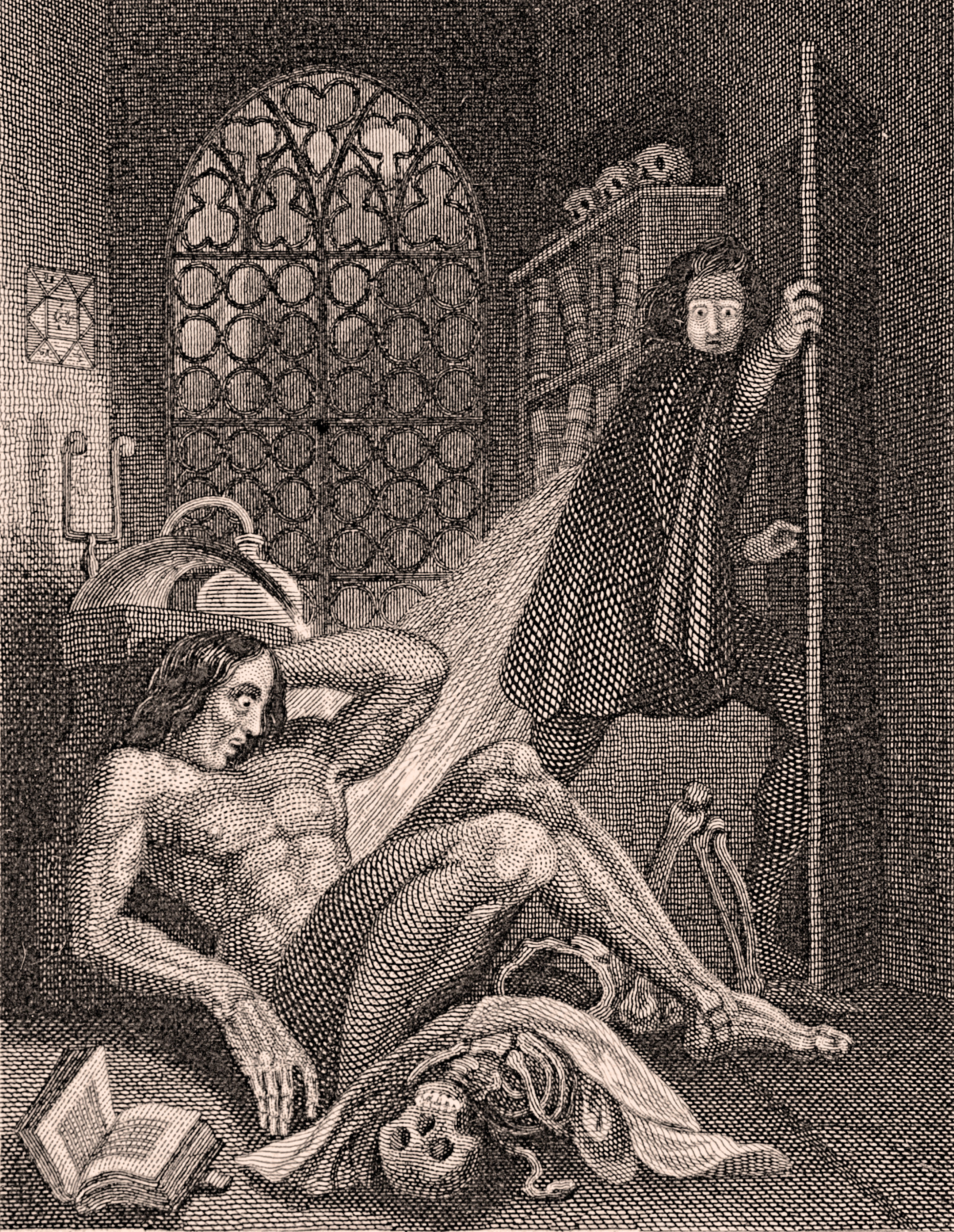
And to compare it to another famous image of a newly created man...
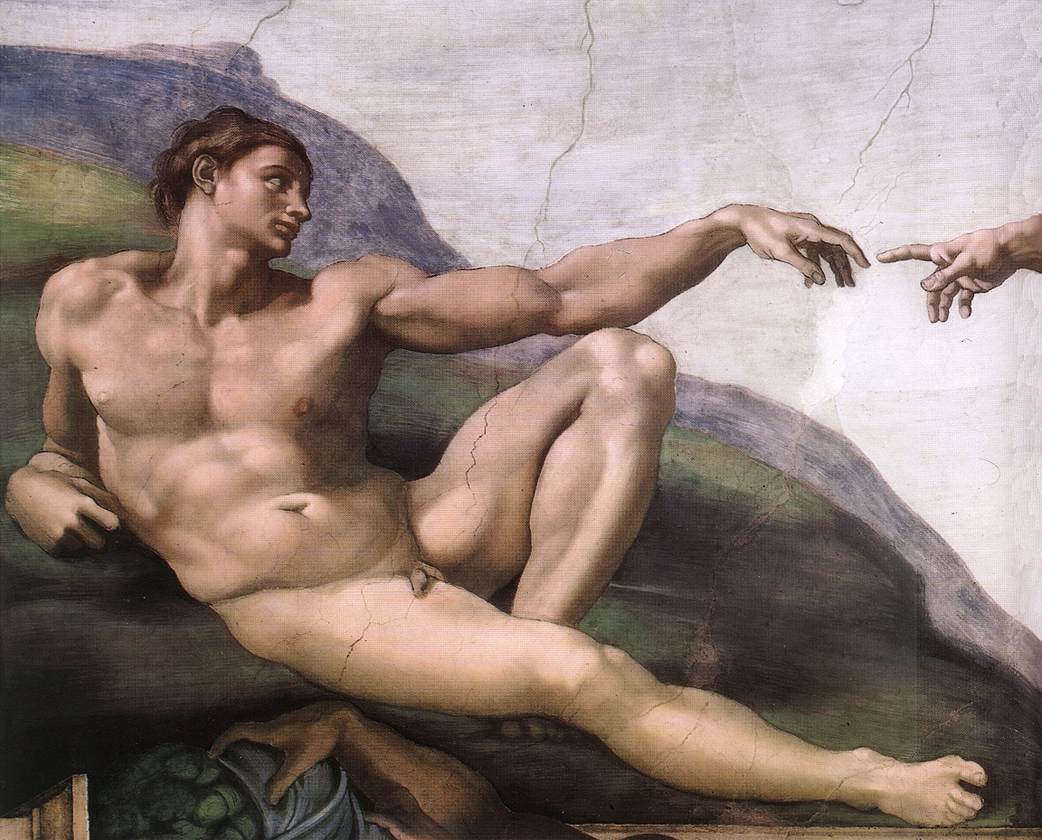
There's no reason to think von Holst didn't take direct inspiration from Michaelangelo. Holst was a Romantic with a love of the gothic and the supernatural, but it would be a mistake to think of Romanticism and the gothic as a repudiation of the classical, just as it would be wrong to think of Modernism as a repudiation of Expressionism (which horror films like The Bride of Frankenstein illustrate well enough).
Holst studied under Fuseli, who painted Mary Shelley's mother Mary Wollstonecraft, the great feminist and author of Vindication of the Rights of Woman, who died a little more than a week after giving birth to the future author of Frankenstein.
Holst was also the great uncle of the composer Gustav Holst, who wrote The Planets suite, which includes a movement entitled 'Mars, the Bringer of War', routinely used directly in sci-fi (Quatermass) or as inspiration for sci-fi music, including Peter Howell's music for 'The Leisure Hive'. This is perfectly fitting because The War of the Worlds by H. G. Wells is (like Mary Shelley's Frankenstein) one of the foundational texts of science-fiction, thus trading on the percieved connection between Mars and war and translating this into the context of the nascent 'alien invasion' sub-genre. (As everyone knows, War of the Worlds was dramatised for the radio by Howard Koch and performed by Orson Welles' and John Houseman's Mercury Theatre of the Air, causing widespread panic in America upon the eve of Hallowe'en in 1938.) It's also fitting because The Planets is a synthesis of astrological notions and musical modernism, which strikes me as pleasingly analagous to my idea that sci-fi is a reiteration of myth and legend in the idioms of the technological age.
The Mercury Theatre broadcast (which featured George Colouris, who would later be cast by Welles as Mr Thatcher in Citizen Kane... and would later go on to even greater achievements, playing Arbitan in 'The Keys of Marinus') is supposed to have had such an amazing effect partly because the American people were skittishly aware that they were on the brink of entering World War II. Holst's 'Mars, The Bringer of War' takes something of its terrific and stentorian power from the fact that it was written during World War I, during the period when people gradually became aware that the 'Great War' was a horrifying scrabble for muddy and blood-soaked land, with bodies ploughed under barbed wire by great, rolling, implacable, metal monsters called tanks.
Tanks looked like the machines of the future. They were. They were the final death knell of the pre-capitalist society. Bayonets gave way to steel behemoths. Industry and technology could now make things like that: inhuman, unstoppable, alien, seemingly out of human control. The trauma of them still echoes through Western culture, with the Daleks themselves partly confected from the memory of these utterly inhuman, bolted, riveted, armour plated, gun-sprouting war monsters.
Of course, part of the peculiar power of Frankenstein lies in the fact that the Monster is something man made. He is a product. An artifact of human creativity and labour. The Universal version even has dirty great bolts sticking out of his neck, just to emphasize his status as a cyborg (like a Cyberman or a Dalek), as a thing made of bits and pieces, like a car made from parts on a production line. Frankenstein's monster is the first great monster of Western culture that is made, that is something that humans have fabricated and constructed ourselves. Instead of encountering it as a hostile part of the landscape, like a predator, we place it in the landscape, and our treatment of it makes it our enemy. The book expresses a moment in Europe when science was on the rise, when Enlightenment and Reason had become both causes and dogmas. It was all to do with the slow, lingering death of feudalism and the slow, inexorable rise of capitalism. It's a big topic, but thinkers from Rousseau to Mary's own father had confronted the old order (Things as They Are, to use the alternative title of Godwin's novel Caleb Williams, a bitter and radical condemnation of the power of aristocracy) with what they conceived of as Reason. Mary's book is also partly a rebuke to this. The child of Reason, the product of the new and scientific and sacriligious man, the product of the age of bourgeois production, is a monster that becomes the victim of the flaws in the creator's project and then comes back for revenge. And breeds. Tanks breed. Bombs breed. Cars breed. Toys breed. We have to make them, but they hardly seem like ours at all. We don't control them. Or our control becomes more and more remote. The product of the new age ultimately gives the lie to the ideals of liberty and justice. Like the tank that is created by capitalism to fight wars for freedom and peace... by bulldozing the bullet-riddled corpses of kids into the mud.
(The solution to this riddle is to be found in the work of Mary's husband Percy, who - in his unsure and unreliable way - was a radical who understood that the people are the ones who have to enforce change, and that that change can be a monster itself rather than a graceful victory for Reason. In Prometheus Unbound - those Romantics loved Prometheus... Frankenstein's alt title was The Modern Prometheus - Shelley writes of Demogorgon, the monster that can be invoked to destroy tyranny. Demogorgon. The Peoplemonster.)
But back to the problem, as identified. The products that turn. Marx called capital (the product of human labour appropriated and confronting us as hostile and alien) a vampire. Mary Shelley had the product of the work of the scientist become a murderous reproach to him. We still routinely invoke the word "monster" when talking about such products. We need the language of monsters.
And this just may be a central concern of sci-fi, including Doctor Who. Voc Robots are created things that turn against us, products that kill. Xoanon. The Oracle. B.O.S.S. The Peking Homunculus. WOTAN and his War Machines. Autons. Daleks and Cybermen are created things too, half organism and half machine. Killing machines with people trapped inside somewhere. Many Doctor Who monsters (more than you'd think) turn out to be created things, or partly created things. The Ice Warriors have visors and guns integrated in their shells; the Sontarans are clones; the Zygons live on the milk of a cyborg monster. They're all, partly, the deformed and disowned children of Frankenstein.
Of course, there's a more direct child. Morbius. Solon is the mad scientist, living in the castle with the deformed servant, listening to the thunder as he plots to reanimate a criminal (by probing the rectum?), scheming to make a monster from scavanged bits and pieces, ultimately turned upon by his creation, hunted down by torch-weilding locals, etc. But that's got much more to do with the movies - Universal and Hammer - than it has to do with Mary Shelley. Even the Sisterhood come from Rider Haggard via Hammer.
Doctor Who is itself Frankenstein's monster, made of scavanged and second-hand bits and pieces.
That's why its amusing to think of the Character Options toys that so many of us Who fans collect (no doubt made with oil that has to be controlled through invasions of which many of us disapprove). We're like Dr Pretorius, playing with his little people in jars. Gods playing with our monsters. Just make sure you keep the lid on the jar with Cpt. Harkness in it... unless you want your little people to breed.
Anyway, I'm tired of all this brainstorming. Hallowe'en is over.
Good night. If you can.
Saturday, 30 October 2010
Auntie in Distress. And Dat Dress.
A belated embedation for Mitch Benn's brilliant song 'Proud of the BBC'. Flawed as it is, the Beeb is ours. It must be defended. And not just because it makes Doctor Who either. Though that's a big one, obviously.
See also Mitch Benn's site for details.
See also Mitch Benn's site for details.
Friday, 29 October 2010
The Lords Temporal
This is an edited and tweaked version of something I wrote for the old site.
If 'The Deadly Assassin' has a central thesis, it might be this: power is no guaranteur of responsibility. Or even sensibleness. This tale shows us beings like us. Godlike in their technology, they are also childlike in their small-mindedness.
In 'The Deadly Assassin', the Time Lords are senile gerontocrats living on ossified priviledge. They natter, bumble and scheme. The less shot-away amongst them spend their time snapping at each other with haughty contempt or scheming over appearances and expediency. Robert Holmes deliberately strips Power of its outward signs of dignity and virtue and superiority.
They are locked in a rigid class system. They fail to understand their own technology, their own power, their own myths. They "adjust the truth" to suit their agendas. Their outwardly civilised society begins to crumble into anarchy when two of their renegades return and start fighting out their neuroses. The sit on a massive computer lake of information in which nestles a surreal and nightmarish dreamscape filled with elemental terrors. Their Panopticon (literally: place where all can be seen) hides secrets. The biggest secret is a singularity, a piece of cosmic anarchy that they've slaved to their technology and then forgotten about. This is a picture of denial. Like the lies that are "good for public morale" overlaying the sordid truth, their society pretends to be controlled and calm but rests on hidden and deadly knowledge.
As a satire, it isn't subtle. Robert Holmes chucks in random signifiers from various power elites of Western culture: British public schools, Washington DC, the Vatican, Oxbridge, etc. Gallifrey seems to be his scathing picture of an oligarchial and decadent world, run by liars or killers or the senile, reported by snobbish and fautous twitterers content to reel off the official-view of the upper echelons. Trials are manipulated for convenience. Elections are devoid of real democracy. Behind the specious words about "our traditions of fairness and justice", the system's Swiss Guard-style private police use torture and assumption. Hildred is a brutal bungler; Spandrell's intelligence and independence only highlights how unusual he is in his world.

Most outragously, the story seems to riff on the Kennedy assassination. 'The Deadly Assassin' isn't an allegory of Dealey Plaza, but it does play with our collective (often confabulated) consciousness of that political slaying. The Doctor is a "patsy", his alleged weapon has misaligned scopes, the real killer is from within the top circle of power, the truth is changed by Borusa's cover-up.
We even have the cheekily named Celestial Intervention Agency, of which the Doctor is assumed to be a member... and, indeed, the Doctor has been involved in Time Lord-sanctioned interventions. Is he a C.I.A. agent? This one throwaway reference muddies the waters (or rather stirs waters that are already muddy). The Time Lords speak of their policy of neutral observation of the universe (Gallifrey is the place where all can be seen) and of their strict non-interventionism... but, like the Western 'democracies' that speak of international law and then organise coups d'etat in places where they feel their interests are threatened, they can always ask their "C.I.A." to intervene on the quiet.
As ever with Holmes, the language is amazing. This story gave the Who-myth so many words and phrases: "High Council", "Matrix", "Rassilon", "Eye of Harmony", "Castellan", "APC net", "Celestial Intervention Agency", "artron energy", "shabogan", etc. etc. And we have Borusa's aloof and suave variety of verbal dexterity. I needn't quote, you know what I'm talking about.
It's heady stuff. It's so mythic that it has firmly buried itself into the subconscious of the whole show, providing Who with its own personal origin-legend. It's also politically complex, witty, cynical, surreal. For all its flaws, you can't help but marvel at it. Apart from everything else, there are those astonishing costumes! Of course, subsequent return trips to Gallifery sullied its reputation... but that isn't Bob Holmes' fault. After this, Gallifrey started looking like every other high-tech alien world, lit and furnished like a Habitat showroom.
RTD's attempts turned Gallifrey into Hogwarts with a bog-standard Bespin-style citadel, and then into Coruscant. The fact that the costumes are all wrong in the new series - the ceremonial circle-based shoulder-display thingies worn by guards! - is a sign of a wider failure to grasp what the Time Lords are supposed to be. Gallifrey, should it ever be seen again, needs to be like the place in 'The Deadly Assassin': a dark, gothic labyrinth of high politics, murky motives, unaccountable power, shadows and oligarchy and cover stories... and, crucially, decadent idiocy. Not a backdrop for an ex-Bond doing a Voldemort.
Admittedly, the plot of 'The Deadly Assassin' makes no sense at all. And the music is naff. As is the make-up. And the title is rubbish. 'The Deadly Assassin' indeed! As opposed to what? 'The Harmless Assassin'?
Nine out of ten, as Borusa would say.
If 'The Deadly Assassin' has a central thesis, it might be this: power is no guaranteur of responsibility. Or even sensibleness. This tale shows us beings like us. Godlike in their technology, they are also childlike in their small-mindedness.
In 'The Deadly Assassin', the Time Lords are senile gerontocrats living on ossified priviledge. They natter, bumble and scheme. The less shot-away amongst them spend their time snapping at each other with haughty contempt or scheming over appearances and expediency. Robert Holmes deliberately strips Power of its outward signs of dignity and virtue and superiority.
They are locked in a rigid class system. They fail to understand their own technology, their own power, their own myths. They "adjust the truth" to suit their agendas. Their outwardly civilised society begins to crumble into anarchy when two of their renegades return and start fighting out their neuroses. The sit on a massive computer lake of information in which nestles a surreal and nightmarish dreamscape filled with elemental terrors. Their Panopticon (literally: place where all can be seen) hides secrets. The biggest secret is a singularity, a piece of cosmic anarchy that they've slaved to their technology and then forgotten about. This is a picture of denial. Like the lies that are "good for public morale" overlaying the sordid truth, their society pretends to be controlled and calm but rests on hidden and deadly knowledge.
As a satire, it isn't subtle. Robert Holmes chucks in random signifiers from various power elites of Western culture: British public schools, Washington DC, the Vatican, Oxbridge, etc. Gallifrey seems to be his scathing picture of an oligarchial and decadent world, run by liars or killers or the senile, reported by snobbish and fautous twitterers content to reel off the official-view of the upper echelons. Trials are manipulated for convenience. Elections are devoid of real democracy. Behind the specious words about "our traditions of fairness and justice", the system's Swiss Guard-style private police use torture and assumption. Hildred is a brutal bungler; Spandrell's intelligence and independence only highlights how unusual he is in his world.
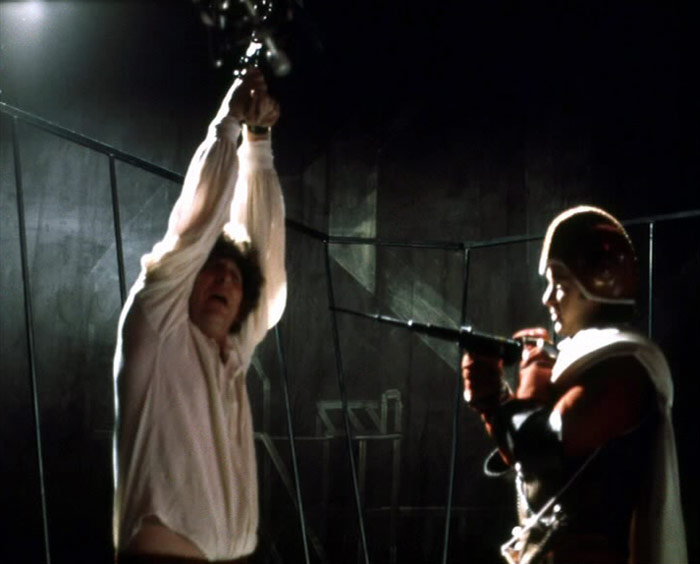
"Aren't you worried Wikileaks might find out about this?"
Most outragously, the story seems to riff on the Kennedy assassination. 'The Deadly Assassin' isn't an allegory of Dealey Plaza, but it does play with our collective (often confabulated) consciousness of that political slaying. The Doctor is a "patsy", his alleged weapon has misaligned scopes, the real killer is from within the top circle of power, the truth is changed by Borusa's cover-up.
We even have the cheekily named Celestial Intervention Agency, of which the Doctor is assumed to be a member... and, indeed, the Doctor has been involved in Time Lord-sanctioned interventions. Is he a C.I.A. agent? This one throwaway reference muddies the waters (or rather stirs waters that are already muddy). The Time Lords speak of their policy of neutral observation of the universe (Gallifrey is the place where all can be seen) and of their strict non-interventionism... but, like the Western 'democracies' that speak of international law and then organise coups d'etat in places where they feel their interests are threatened, they can always ask their "C.I.A." to intervene on the quiet.
As ever with Holmes, the language is amazing. This story gave the Who-myth so many words and phrases: "High Council", "Matrix", "Rassilon", "Eye of Harmony", "Castellan", "APC net", "Celestial Intervention Agency", "artron energy", "shabogan", etc. etc. And we have Borusa's aloof and suave variety of verbal dexterity. I needn't quote, you know what I'm talking about.
It's heady stuff. It's so mythic that it has firmly buried itself into the subconscious of the whole show, providing Who with its own personal origin-legend. It's also politically complex, witty, cynical, surreal. For all its flaws, you can't help but marvel at it. Apart from everything else, there are those astonishing costumes! Of course, subsequent return trips to Gallifery sullied its reputation... but that isn't Bob Holmes' fault. After this, Gallifrey started looking like every other high-tech alien world, lit and furnished like a Habitat showroom.
RTD's attempts turned Gallifrey into Hogwarts with a bog-standard Bespin-style citadel, and then into Coruscant. The fact that the costumes are all wrong in the new series - the ceremonial circle-based shoulder-display thingies worn by guards! - is a sign of a wider failure to grasp what the Time Lords are supposed to be. Gallifrey, should it ever be seen again, needs to be like the place in 'The Deadly Assassin': a dark, gothic labyrinth of high politics, murky motives, unaccountable power, shadows and oligarchy and cover stories... and, crucially, decadent idiocy. Not a backdrop for an ex-Bond doing a Voldemort.
Admittedly, the plot of 'The Deadly Assassin' makes no sense at all. And the music is naff. As is the make-up. And the title is rubbish. 'The Deadly Assassin' indeed! As opposed to what? 'The Harmless Assassin'?
Nine out of ten, as Borusa would say.
Subscribe to:
Posts (Atom)